



How to Start an Online Clothing Business

Jump to
You're stylish, you're passionate, and you're tired of watching other people wear clothes you could've designed better. So you've decided: you're going to start your own online clothing line.
It's a real opportunity. Online clothing sales in the U.S. hit an estimated $61.8 billion in 2025 and keep climbing, and overall U.S. retail ecommerce grew nearly 10% year-over-year in early 2026, according to the Census Bureau. People are buying clothes online, more of them every year, and there's room for a brand with a real point of view.
But "there's room" isn't the same as "it's easy." This is the checklist for starting an online clothing line for real — what it costs, what regulators actually require, and what trips up first-time founders before they ship their first order.
Is an Online Clothing Business Right for You?
The honest answer depends on four things: whether you can actually make (or direct the making of) clothes, whether you have a genuine point of view, whether you can stomach an industry with brutal return rates, and how you plan to sell. Walk through each before you sink money into it.
Do you have the skills, or a plan to get them?
Having a great eye for clothes is a start. But somewhere between "helpful" and "necessary," you need real knowledge of design, textiles, and garment construction — because even if a factory does the sewing, you need to produce concepts, specs, and fit notes they can actually build from.
You don't need a fashion degree. Self-taught designers build real brands constantly. But you do need enough technical fluency to communicate what you want, and enough humility to test it before you bet the business on it. That's what a minimum viable product (MVP) is for: a small first run — 30 pieces, not 3,000 — so if nobody buys, you've lost a manageable amount instead of your entire budget.
Do you have a real point of view?
There's one thing you can't outsource: passion for what you're making. Plenty of businesses succeed on decent execution and no strong feelings about the product. Clothing generally isn't one of them — the market is too crowded and too visual for a brand with no real identity to break through.
That doesn't mean copying what's already working. It means knowing exactly what you're adding to a market that already has plenty of options: better fit for an underserved size range, higher quality at a fair price, a specific aesthetic nobody else is doing well. Your brand's reputation is the whole game. Consumers can tell the difference between a brand with a real story and one that's just chasing a trend.
Can you handle an industry built on returns?
This is the part most first-timers don't see coming. Apparel has the highest return rate of any ecommerce category — 20-40% of what you sell comes back, driven mostly by fit and sizing issues, against a roughly 19% average across all of ecommerce, according to the National Retail Federation and Happy Returns. Every one of those returns costs you return shipping, inspection, and often a markdown if the item can't be resold at full price.
That's not a reason to skip online clothing. It's a reason to invest early in accurate sizing information, honest product photos, and a fit guide — because reducing your return rate by even a few points has a bigger impact on your margin than almost anything else you'll do this year.
How will you sell?
Ecommerce is still the cheapest way in. It keeps startup costs down, and having some sales history and brand recognition makes retailers and wholesale buyers more likely to take your call later.
Beyond your own site, marketplaces like Amazon and Etsy can add exposure early on — customers already trust those platforms, which can build your brand faster than a cold-traffic ecommerce site alone. Selling wholesale to retailers is the other option: higher volume, lower margin per piece, and none of the customer-facing marketing and fulfillment work.
How Much Does It Cost to Start an Online Clothing Business?
There's no single number, because your production model changes everything. Realistically, you're looking at a few hundred dollars to launch lean with print-on-demand, or $15,000-$30,000+ if you're committing to a manufactured run, inventory, and professional photography before you've made a sale.
Here's where the money actually goes:
- Ecommerce platform: Shopify's entry-level Basic plan runs $39/month, or $29/month billed annually — enough for a real storefront, not just a checkout link.
- Production, no-inventory route: Print-on-demand services like Printful are free to use, with fulfillment costs coming out of each sale — there's no upfront inventory spend, which is the fastest way to test a concept.
- Production, small-batch manufacturing: U.S. cut-and-sew shops commonly start at 50-100 units per style, at roughly $18-60 per piece depending on complexity — driven mostly by fixed setup costs that get divided across a small run. A basic style's setup alone can run around $800 regardless of how many units you order, so batching a few styles together helps.
- Sampling, before you ever sell anything: Expect $80-250 per style per round for a manufacturer to turn your concept into a physical sample — money spent before a single customer sees the product.
- Trademark registration: The USPTO's base filing fee is $350 per class of goods — one class covers most single-category clothing lines, but add services like custom printing and you may need a second class.
- Business insurance: General and product liability coverage for a small apparel business commonly runs around $40-45 a month to start, scaling with revenue and inventory value.
Use the SBA's startup cost worksheet to build your own real number instead of guessing — the categories above are the inputs, but your mix of print-on-demand versus manufactured inventory changes the total by tens of thousands of dollars.

What Startup Costs Catch People Off Guard?
Beyond the obvious line items, a few costs and rule changes surprise almost every new clothing founder.
Returns are a line item, not a footnote. Given apparel's 20-40% return rate, budget for return shipping and inventory that can't be resold at full price as an ongoing cost of doing business — not an occasional annoyance.
Import duties changed in 2025, and it matters if you source overseas. The de minimis exemption that let shipments valued at $800 or less enter the U.S. duty-free was suspended for all countries effective August 29, 2025, under Executive Order 14324, and that suspension has continued into 2026. If your plan involves importing inventory or working with an overseas dropshipping supplier, build duties into your unit economics now rather than discovering them at customs.
Sampling is a real budget line before you've made a cent. At $80-250 per style per round, and most brands going through at least one revision, testing a five-style first collection can easily run $1,000-2,000 before you know if any of it sells.
A trademark isn't a one-time cost. Beyond the initial filing fee, the USPTO requires a renewal filing every 10 years — a small but easy-to-forget recurring cost.
What Licenses and Permits Do You Need?
Every state has different rules, but two requirements apply almost everywhere you sell clothing online.
You need a seller's permit wherever you have sales tax nexus. Clothing is taxable tangible property in most states, and selling online doesn't exempt you — you generally need a permit in your home state at minimum, and potentially in any state where your sales exceed that state's economic nexus threshold. California, for example, requires a seller's permit through the CDTFA before you make your first taxable sale, and most other states run a similar process through their own tax agency.
Every garment needs a fiber-content and care label — this one's federal, not optional. The FTC's Textile and Wool Acts require labels disclosing fiber content by weight, country of origin, and the manufacturer or marketer's identity, and a separate Care Labeling Rule requires permanent washing or dry-cleaning instructions. This applies whether you're printing shirts yourself or having a factory produce a full collection — violations are treated as unfair or deceptive practices under the FTC Act. It's an easy rule to not know exists until someone flags it.
If you're importing product, you'll also want to understand Customs and Border Protection's current entry requirements given the de minimis change above — low-value shipments that used to clear automatically now need to be formally entered.
How Do You Actually Start an Online Clothing Business?
Here's the real sequence, once you've decided the idea is worth pursuing.
- Define your brand before you design a single piece. What's the gap you're filling — better fit, a specific aesthetic, more sustainable materials, a price point nobody's hitting well? Your answer should draw on your own experience and taste, because customers can tell when a brand is generic. A business plan built around your idea forces you to answer this concretely instead of vaguely — LivePlan's Idea Canvas is built for exactly this stage, and their Clothing E-Commerce Site sample plan is a useful reference for how another apparel founder structured theirs.
- Choose your production model. Print-on-demand keeps upfront costs near zero and is the fastest way to test whether a design sells at all. Small-batch manufacturing costs more upfront but gives you more control over quality and margin once you've proven demand. Most founders start with one and graduate to the other as volume justifies it.
- Register your business and lock down your brand name. Set up your LLC or sole proprietorship, get your seller's permit in your home state, and run a trademark search before you fall in love with a name — a $350 filing fee is a lot cheaper than rebranding six months in.
- Build a store that actually reflects your brand. A Shopify Basic plan gets you a real storefront for under $40 a month. Whatever platform you use, invest in real product photography — professional, well-lit images are the single biggest lever for converting a visitor who likes your product into someone who trusts your site enough to buy from it.
- Handle labeling and, if relevant, import compliance before your first shipment goes out. Get your fiber-content and care labels sorted with your manufacturer or printer now, not after a customer complaint. If you're sourcing overseas, factor the post-2025 duty requirements into your landed cost per unit.
- Get insured before you have real inventory value at risk. At roughly $40-45 a month to start, product liability coverage is cheap relative to what a single claim — a defective product, an allergic reaction to dye, a fire in your home studio — could cost you without it.
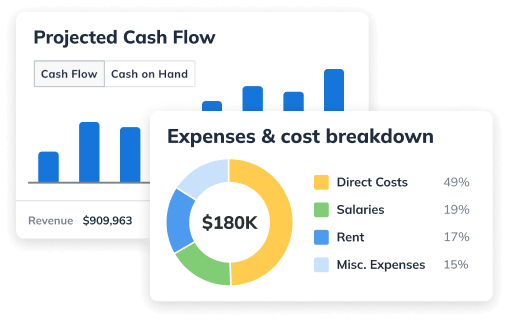
- Build a real financial forecast, not a guess. Map out your cost per unit, your break-even volume, and how a 20-30% return rate affects your actual margin — not your gross margin. This is where LivePlan's financial forecasting tools earn their keep: connect your real cost assumptions and watch how a change in return rate or unit cost flows through your entire plan, instead of rebuilding a spreadsheet every time something shifts.
- Launch small, market like you mean it, and listen. Test your MVP run with real customers — friends and family can be a starting point, but seek out people outside your circle for honest feedback on fit and quality. Build your presence where your actual customers spend time (not every platform, just the right ones), invest a real budget in paid social once you have a product worth promoting, and consider creator partnerships as a modern, lower-cost version of the old celebrity-endorsement playbook. Then watch your target market closely and adjust based on what they actually do, not just what they say.
Ready to put real numbers behind step 7? Start your financial forecast and see what your margins look like before you commit to a manufacturing run.
Frequently asked questions
No — you can legally sell clothes online as a sole proprietor, and many small clothing brands start that way. But a sole proprietorship doesn't separate your personal assets from the business, so if a product liability claim or a bigger debt ever hits, your personal savings and property are exposed. An LLC costs more to set up and adds some paperwork, but it's the more common choice once you're carrying real inventory or shipping product to customers, since that's exactly the kind of risk it's designed to protect against.
Realistically, a few hundred dollars. Print-on-demand services like Printful charge nothing upfront — you only pay when an order comes in — and Shopify's Basic plan runs $29-39/month. That combination gets you a live store and a sellable product with no inventory risk. It won't get you a manufactured collection or professional photography, but it's enough to test whether people will actually buy what you're making before you spend more.
Not before you launch, but the earlier you file, the better. A federal trademark application typically takes 12 to 18 months from filing to registration, so if you wait until your brand is already getting attention, someone else could file first. Most founders run a trademark search before settling on a name, then file the application around the same time they're building their store — that way the clock is running while you're getting ready to sell, not after.
Apparel companies average a 56.9% gross margin but only a 3.9% net margin, according to NYU Stern's industry margin data — a wide gap that's mostly explained by returns, markdowns, and customer acquisition costs eating into what looks like a healthy markup on paper. Budget conservatively: a garment that costs you $20 to make and sells for $60 looks like a 67% margin until returns, payment processing, and ad spend take their cut.
Both. Because Printful and similar services charge no upfront fee and take their cut per order, your margin per piece is lower than manufacturing your own run at scale — but you're not carrying inventory risk or tying up cash in stock that might not sell. Most founders use print-on-demand to validate a design before committing to the higher-margin, higher-risk path of a manufactured batch, rather than staying on it indefinitely once a style proves it sells.
Sources
- Census Bureau: Quarterly Retail E-Commerce Sales, Q1 2026
- IBISWorld: Online Women's Clothing Sales in the US Market Size
- National Retail Federation & Happy Returns: 2025 Retail Returns Landscape
- SBA: Calculate Your Startup Costs
- Shopify: Pricing
- Printful: Pricing
- Tris Apparel: Apparel Sampling Costs Explained
- USPTO: How Much Does It Cost to Trademark?
- USPTO: How Long Does It Take to Register a Trademark?
- SBA: Choose a Business Structure
- NYU Stern: Operating and Net Margins by Sector
- Insureon: Product Liability Insurance Cost
- California CDTFA: Obtaining a Seller's Permit
- FTC: Threading Your Way Through the Labeling Requirements Under the Textile and Wool Acts
- Federal Register: Notice of Implementation of Executive Order 14324, Suspending Duty-Free De Minimis Treatment for All Countries
- CBP: E-Commerce Frequently Asked Questions

Richard Meadow
Richard Meadow is a writer that works on topics related to freelancing, ecommerce, and small business advice. He uses Caunce O'Hara as a reference in his work. He is always interested in new subjects and articles to read and enjoys writing about them. He has previously worked closely with ecommerce companies and has found a lot of insight with his experience.