




Dog Kennel Business Plan


Business Plan Summary
This dog kennel business plan example features The Creature Nannie, a family-run dog boarding facility on owner Sara Sloth's five-acre property in Ocala, Florida, where a renovated barn houses 20 individual, climate-controlled kennel suites. It covers The Creature Nannie's deliberately low dog-to-handler ratio, its $5,000 self-funded launch, and its positioning against both traditional kennels and app-based sitter marketplaces like Rover and Wag. Use it as inspiration for your own plan, and read our guide on how to start a kennel and pet boarding business for step-by-step advice. See also our dog and cat kennel business plan example for another perspective. Download a free business plan template to get started, or browse more business plan examples.
The Creature Nannie
Executive Summary
The Creature Nannie is a small, family-run dog boarding facility on Sara Sloth's five-acre property in Ocala, Florida. What began as a home-based foster arrangement has grown into a purpose-built operation: a renovated barn houses 20 climate-controlled kennel suites arranged around several fenced turnout yards, and Sara now works alongside two part-time dog-care handlers to keep the same personal, low-stress approach at a larger scale. Guest dogs get multiple walks and play sessions a day, real one-on-one time with a familiar handler, and none of the sterile-cage stress of a big commercial kennel.
Florida's year-round travel season — snowbirds heading north in summer, families flying out of Orlando for holidays, retirees on extended trips — means local dog owners need boarding they can trust more than once or twice a year. The Creature Nannie competes directly with traditional kennels and app-based sitter marketplaces by offering something neither can at this scale: a small, deliberately low dog-to-handler ratio, a consistent facility and team the dog gets to know over repeat visits, and daily photo and video updates through a simple booking app.
The Creature Nannie's key to success is protecting the quality of care as it scales — keeping the dog-to-handler ratio low even at 20-dog capacity — while building a loyal, vocal customer base through consistently excellent care.
The Creature Nannie's mission is to give Marion County pet owners genuine peace of mind while they travel, by providing the finest boarding care available for their dog, at a scale that lets the business support a small team without losing the personal touch that built it.
Objectives for the first three years of operation:
- Build a facility-based service business that consistently exceeds customer expectations, even as guest capacity grows well beyond what one person could manage alone.
- Grow the client base through superior care, a well-trained handler team, and word-of-mouth referrals rather than heavy marketing spend.
- Establish a sustainable, cash-flow-positive small business capable of supporting Sara and her handler team long-term.
Opportunity

Problem Worth Solving
Dog owners who travel face a difficult choice: leave their pet at a kennel, book an independent sitter through an app, or find a facility they truly trust. Kennels cover the basics — food, water, a supervised yard break — but the dogs are never truly happy. Anyone who has picked up a dog from a week in a cage-lined facility knows the look: dirty coat, hoarse bark from a week of barking at strangers, and a dog that's clearly relieved to be going home.
App-based sitter marketplaces solve the "stranger in a cage" problem but introduce a different one: the sitter is often a stranger too, working out of an unfamiliar house, with inconsistent reviews and no ongoing relationship with the pet or its owner. For Marion County's many dog-owning households, especially those who travel frequently for work, family, or Florida's long snowbird season, neither option feels like real peace of mind — and neither scales to serve more than a handful of dogs at a time without losing that personal touch.
The Creature Nannie is built for the segment of dog owners who believe there should be a better alternative — a facility with a small, consistent handler team and a deliberately low dog-to-handler ratio, where growing to serve more dogs doesn't mean the dog gets less attention.
Our Solution
The Creature Nannie offers boarding care at Sara Sloth's Ocala, Florida property, where a renovated barn provides 20 individual, climate-controlled kennel suites — each with its own bed, not a bare cage — arranged around several fenced turnout yards. Dogs get multiple walks a day (tracked and shared with owners through a GPS-enabled walk app), regular supervised play sessions in the yards, and one-on-one handling time from a small, consistent team rather than a rotating cast of strangers.
Capacity is set at 20 dogs at a time, supported by Sara and two part-time dog-care handlers — a ratio of roughly one handler for every seven dogs, deliberately kept low so every guest still gets real attention rather than just supervision. Staying disciplined about that ratio, not just the headcount, is the core of the business model as it scales past what Sara could do alone.
Boarding is priced at $80 per night or $490 per week per dog — a premium rate reflecting the individual suites, low handler ratio, and full-service care that a standard kennel or app-based sitter can't match — with pet parents receiving daily photo and video updates through a private booking and messaging app so they can check in from anywhere.
Market Overview
The Creature Nannie will build its customer base through a mix of digital-first outreach and trusted local relationships. A Google Business Profile optimized for searches like "dog boarding Ocala FL" gives the business visibility with pet owners actively planning travel, while an active presence in local Facebook groups and Nextdoor — where Marion County residents already ask neighbors for pet-care recommendations — drives early referrals at no cost.
Strategic alliances with Ocala-area veterinary clinics remain central to the strategy: participating vets receive a supply of free trial-day coupons to pass along to clients, giving The Creature Nannie a warm introduction from a source pet owners already trust. Online reviews (Google, Facebook, and the booking app) will be actively requested after each stay, since for a home-based service with no storefront, reviews function as the primary trust signal for new customers researching alternatives to a kennel.
Given the current landscape of pet care options — impersonal commercial kennels on one end and inconsistent app-based sitter marketplaces on the other — The Creature Nannie's home-based, capacity-capped model is a genuinely distinct offering in the Ocala market, and is well positioned to build a loyal customer base quickly once initial reviews are in place.
Market Segmentation
The Creature Nannie's target market is dog owners in and around Ocala, Florida who see their dog as family and can afford a premium alternative to standard kennel boarding. Marion County — Florida's horse country, known for its large-lot residential and agricultural properties — has an unusually high concentration of dog owners relative to its size, and a growing population of both year-round residents and seasonal snowbirds who travel frequently and need reliable care while away.
The other defining trait of this segment is ability to pay: at $80/night, The Creature Nannie sits well above a standard kennel or a budget app-based sitter, closer to a boutique/concierge tier of pet care. The typical customer has a household income above $110,000, values a known, low-turnover team over the lowest price, and has been burned before by a dog coming home from a kennel dirty, hoarse, and clearly stressed.
Market Analysis | |||||||
|---|---|---|---|---|---|---|---|
Year 1 (2026) | Year 2 (2027) | Year 3 (2028) | Year 4 (2029) | Year 5 (2030) | |||
Potential Customers | Growth | CAGR | |||||
Marion County dog-owning households | 5% | 75,000 | 78,750 | 82,690 | 86,820 | 91,160 | 5.00% |
Other | 0% | 0 | 0 | 0 | 0 | 0 | 0.00% |
Total | 5.00% | 75,000 | 78,750 | 82,690 | 86,820 | 91,160 | 5.00% |
Even a small fraction of this pool is enough to fill a 20-dog facility at this premium price point — the constraint on The Creature Nannie's growth is capacity and staffing, not demand.
Target Market Segment Strategy
The Creature Nannie's service is distinct enough — and Ocala-area demand deep enough — that customer acquisition can stay lean even at 20-dog capacity. Two channels do most of the work: partnerships with respected local veterinarians who distribute free trial-day coupons to clients they already trust, and a strong Google Business Profile and Facebook/Nextdoor presence that surfaces the business when pet owners search for boarding alternatives.
The Creature Nannie isn't the only option in the Ocala pet-care market — kennels and app-based sitter platforms like Rover and Wag are both active locally — but neither offers a small, low-turnover handler team paired with individual kennel suites and real acreage to run on. That gap is the whole strategy: prove the model works with early customers, collect reviews, and let referrals and repeat bookings fill the calendar as capacity comes online.
Competitors
The Creature Nannie competes with two very different types of alternatives in the Ocala market: traditional dog kennels/boarding facilities, and app-based sitter marketplaces such as Rover and Wag that connect owners with independent in-home sitters.
Factor | Traditional Kennels | App-Based Sitter Marketplaces | The Creature Nannie |
|---|---|---|---|
Environment | Cages, shared facility | Varies by sitter, often unfamiliar to owner | Individual kennel suites, family-run facility |
Attention | Limited staff-to-dog ratio | Depends entirely on individual sitter | Low ~1:7 handler-to-dog ratio, deliberately capped |
Exercise | Minimal | Varies by sitter | Multiple walks daily, fenced turnout yards |
Consistency | Same facility, rotating staff | New sitter possible each booking | Same small handler team every stay |
Capacity | Often high volume, impersonal | Single sitter, variable | Maximum 20 dogs at a time |
Pricing | Lower nightly rate | Mid-range, commission-based | $80/night or $490/week — premium tier |
The Creature Nannie is deliberately positioned at the top of the local market. No competitor in the Ocala/Marion County market combines a capped, low dog-to-handler ratio with individual suites and real acreage the way The Creature Nannie does, and its pricing reflects that: customers who choose it are explicitly paying more for a level of consistency and attention that neither a high-volume kennel nor a rotating-sitter app can offer.
Execution
Market Plan Overview
The Creature Nannie will build a loyal customer base quickly by consistently exceeding expectations on every stay. The core lever is the model itself — a small, consistent handler team keeping a deliberately low dog-to-handler ratio even at full 20-dog capacity — paired with a steady stream of five-star reviews and word-of-mouth referrals from Ocala-area veterinarians and past customers to create strong, low-cost demand.
The Discerning Snowbird
Margaret Henderson
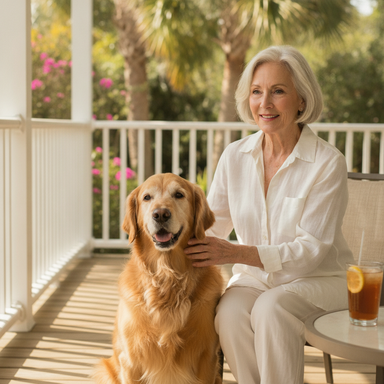
Margaret is a retired educator who spends her winters in an Ocala 55+ community and her summers in Michigan. She views her Golden Retriever, Bailey, as a family member and is extremely hesitant to leave her in high-volume, loud commercial facilities that cause the dog anxiety.
Age
69
Location
On Top of the World, Ocala, FL
Family Status
Married, adult children living out of state
Education
Master's in Education
Profession
Retired School Principal
Opportunities
- Offer tiered pricing for snowbirds who need 2-3 week boarding windows during their transition months between Florida and the North.
- Market the quiet, low-stress renovated barn environment as an ideal 'retirement retreat' for older dogs who can't handle the chaos of large kennels.
Pain Points
- High-volume kennels are too loud and stressful for her aging dog
- Fear of 'anonymous' care where she doesn't know the specific person watching her pet
- Difficulty finding reliable care during the peak 'heading north' season in late spring
Needs
- A calm, climate-controlled environment that mimics a home setting
- Regular, personal updates that prove Bailey is receiving one-on-one affection
- A consistent relationship with a small team she can trust year-after-year
“Bailey is my constant companion; I can't enjoy my trip to see the grandkids if I'm worried she's sitting in a cold metal cage feeling abandoned.”

The Tech-Savvy Suburban Parent
Sarah Jenkins
Sarah is a busy working mother who represents the growing demographic of young professionals moving to Marion County. She balances a corporate career with family life and relies heavily on technology to manage her household, including her family's energetic Labradoodle.
Age
36
Location
Silver Springs Shores, Ocala, FL
Family Status
Married, 2 children (ages 6 & 9)
Education
Bachelor's in Marketing
Profession
Regional Sales Manager
Opportunities
- Create attractive pricing for suburban households that often own two or more dogs to capture the 'family vacation' market.
- Focus on highly shareable photo and video content that Sarah can show her children while they are away on vacation.
Pain Points
- The 'kennel cough' and hygiene risks associated with large-scale commercial pet resorts
- Guilt from the children when the dog looks sad or dirty in pickup photos from traditional kennels
- The lack of transparency in traditional boarding facilities
Needs
- Easy, friction-less booking and payment through a mobile app
- Visual evidence (photos/videos) that her dog is happy and playing
- A low dog-to-handler ratio to ensure her pet doesn't get lost in the crowd
“When we go to Disney, the kids ask about the dog more than the rides. I need to be able to show them a video of him playing so we can all relax.”

The Equestrian Professional
Javier Rodriguez
Javier is a professional horse trainer and frequent competitor at the World Equestrian Center. His demanding schedule involves frequent travel to shows across the Southeast, requiring a boarding solution that is as professional and high-standard as the equine care he provides to his own clients.
Age
42
Location
NW Ocala (Horse Country), FL
Family Status
Single, lives on a farmstead
Education
Bachelor's in Animal Science
Profession
High-Performance Horse Trainer
Opportunities
- Provide specialized pickup and drop-off services for clients working at or visiting the World Equestrian Center.
- Leverage the booking app to provide high-quality video updates that appeal to owners who value meticulous, professional animal husbandry.
Pain Points
- Amateur sitters from apps lack the professional facility standards he expects
- Standard kennels don't offer enough physical exercise for his high-energy Jack Russell Terrier
- His unpredictable schedule makes it hard to find consistent boarding availability
Needs
- Multiple daily exercise sessions and high-engagement outdoor time
- A facility with professional-grade sanitation and safety protocols
- Reliable, app-based booking that fits into a fast-paced professional life
“I spend my life ensuring world-class care for horses; I expect that same level of professional attention and facility quality for my own dog.”
Sales Strategy
The sales strategy centers on converting every satisfied customer into a source of future business. After each stay, owners are asked for a Google or Facebook review and added to a referral list that's shared with prospective clients who want proof this isn't just a nicely worded website.
Because the advantages of a low-ratio, family-run facility over a big commercial kennel or an unfamiliar app-based sitter are easy to see once explained, converting an inquiry into a booking is rarely the hard part. The real constraint is capacity and staffing: the handler team only grows in step with bookings, so the dog-to-handler ratio stays low even as the facility fills toward its 20-dog capacity. Sales effort is aimed at filling the calendar with the right customers at a sustainable pace — not overbooking beyond what the current team can properly handle.
Marketing Strategy
The Creature Nannie's marketing is deliberately low-cost and locally focused, scaled to fill 20 boarding suites without losing its word-of-mouth roots:
- Google Business Profile, optimized and actively maintained so the business surfaces for searches like "dog boarding Ocala FL" and "dog boarding facility Marion County."
- Local Facebook groups and Nextdoor, where Ocala-area pet owners already ask neighbors for boarding recommendations — a direct, low-cost line to the exact target customer.
- Veterinarian partnerships. Sara provides several well-respected local vet clinics with free trial-day coupons for their clients. Vets are a natural referral source: pet owners ask them for service recommendations, and vets recognize a low-ratio, attentive facility as a genuinely better option than a high-volume kennel.
- A website with online booking, built to load fast on mobile, show real photos of the suites, yards, and handler team, and let prospective customers request a stay in a few taps rather than a phone call.
- Review generation. Every stay ends with a request for a Google/Facebook review; the growing library of reviews becomes the main driver of new bookings as capacity scales up.
As the business grows toward full capacity, modest paid social promotion during peak travel windows (spring break, summer, winter holidays) supplements the organic channels above — but referrals and reviews remain the primary driver even at 20-dog scale.
Competitive Edge
The Creature Nannie's competitive edge is simple: a dog staying with The Creature Nannie gets multiple real walks and play sessions a day from a small, familiar handler team, tracked and shared through a booking app, plus run of fenced turnout yards across a five-acre property. No commercial kennel and no app-based sitter marketplace can match that combination of consistency, attention, and space — especially at a scale most home-based alternatives can't reach. Dogs leave content, not stressed — and that difference is what owners notice, remember, and tell other dog owners about.
To develop good business strategies, perform a SWOT analysis of your business. It's easy with our free guide and template. Learn how to perform a SWOT analysis
Milestones
The Creature Nannie has several milestones early on:
- Business plan completion — a roadmap for the organization and an ongoing tool for tracking performance and improvement.
- Complete the barn-to-kennel-facility renovation on the Ocala property.
- Hire and train the initial two-person dog-care handler team.
- Complete initial strategic development, including the launch of the website/booking app and first veterinarian partnerships.
- Reach full capacity (20 dogs regularly scheduled).
Milestones | |||||
|---|---|---|---|---|---|
Milestone | Start Date | End Date | Budget | Manager | Department |
Business plan completion | 4/1/2026 | 5/15/2026 | $0 | Sara Sloth | Planning |
Facility renovation complete | 5/1/2026 | 6/30/2026 | $45,000 | Sara Sloth | Operations |
Handler team hired and trained | 6/1/2026 | 7/15/2026 | $0 | Sara Sloth | Operations |
Initial strategic development complete | 6/15/2026 | 7/15/2026 | $0 | Sara Sloth | Marketing |
Full capacity reached | 7/15/2026 | 9/30/2027 | $0 | Sara Sloth | Operations |
Totals | $45,000 |
Sales Plan
The business launches in June 2026, after completing the barn-to-kennel renovation and hiring the initial two-person handler team. The first month is used to publish the Google Business Profile and website with online booking, and to form initial alliances with a handful of Ocala-area veterinarians. Bookings begin at low volume and build steadily as reviews and referrals accumulate; filling all 20 suites takes longer than a small home setup would, with the schedule expected to approach full capacity by roughly month 15 of operation as the handler team, reputation, and referral base all grow together.
Year | Revenue |
|---|
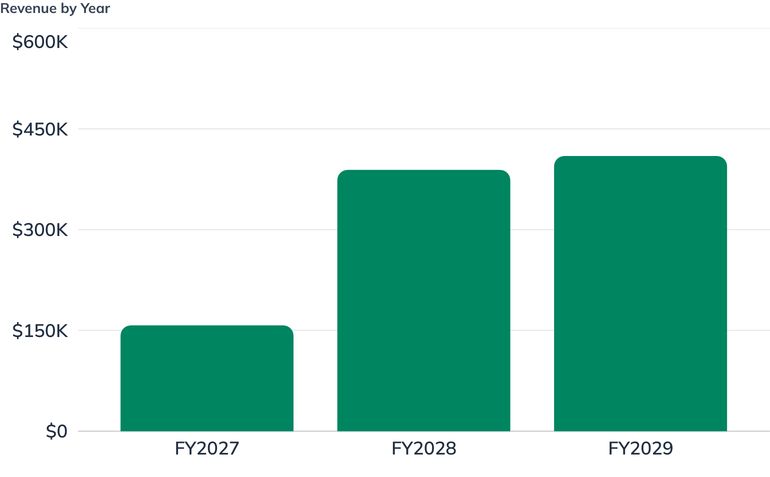
Boarding is priced at $80 per night or $490 per week per dog, capped at 20 dogs at a time. This is a premium rate relative to standard kennels, reflecting individual climate-controlled suites, a low dog-to-handler ratio, and daily photo/video updates. Because bookings are a mix of single nights and full-week stays, the financial model uses a blended effective rate of about $74 per occupied dog-night rather than the flat nightly rate. Revenue ramps through the first year and a half as capacity and staffing scale together, reaching near-full capacity by late 2027 and then growing modestly year over year within the constraints of the 20-dog facility.
Locations and Facilities
The Creature Nannie operates from a five-acre property in Ocala, Florida, in Marion County's horse-country landscape where large properties with agricultural outbuildings are common. The facility includes:
- A renovated barn converted into 20 individual, climate-controlled kennel suites, each with its own bed — not bare cages
- Several fenced turnout yards across the property for off-leash exercise, play, and supervised group time
- A dedicated intake/check-in area for drop-off and pickup
- Sara's family home on the same property, keeping an owner-operator presence on site rather than an offsite commercial facility
- A home/facility monitoring camera system and GPS-tracked walk app so pet parents can see their dog is settled in, even from out of state or out of the country
This on-property model keeps overhead lower than a standalone commercial kennel while giving The Creature Nannie the acreage and infrastructure to serve far more dogs than a single-family home ever could — without losing the family-run feel that differentiates it from big kennels and rotating app-based sitters. Every dog gets multiple walks and play sessions daily from a small, consistent handler team.
Technology
Technology at The Creature Nannie is kept simple and functional, scaled to a 20-suite facility rather than custom-built software:
- A website that serves as the business's primary brochure — photos of the kennel suites, turnout yards, and handler team, licensing and insurance information, service details, and an embedded online booking form.
- A booking and messaging app used to schedule stays, manage the 20-suite calendar, collect payment, and send pet parents daily photo and video updates so they can check in on their dog from anywhere.
- A GPS-enabled walk-tracking app that logs each walk and shares the route and duration with the owner.
- A facility monitoring camera system covering the kennel suites and turnout yards, giving an extra layer of visibility and reassurance for both the handler team and pet parents.
None of this requires custom software — off-the-shelf pet-boarding booking platforms and consumer smart-home/camera tools cover the full stack at a manageable monthly cost, which keeps ongoing technology spend modest even at full capacity.
Development Requirements
The website will be built using an off-the-shelf, AI-assisted website builder rather than custom development, keeping both cost and setup time low. Sara will handle initial setup herself, with a local freelance designer engaged for a few hours if help is needed with photography and layout polish. No ongoing developer relationship is required — the booking, payments, and messaging functionality run through the third-party pet-sitting app rather than custom code.
Website Marketing Strategy
The website is optimized for local search — targeting terms like "dog boarding Ocala FL" and "in-home dog sitter Marion County" — but is not actively promoted through paid ads. It functions primarily as a trust-building resource: a place Sara can point prospective customers to for photos, reviews, licensing details, and the online booking form, rather than a channel that needs to independently generate traffic.
Equipment and Tools
The Creature Nannie will need the following equipment and supplies, scaled for 20-dog capacity:
- Laptop/tablet with cloud-based booking software subscription and QuickBooks Online
- Facility monitoring camera system covering suites and turnout yards
- GPS tracking collars/tags for walks
- 20 dog beds (one per kennel suite)
- Kennel suite fixtures: partition gates, flooring, and feeding stations for 20 suites
- ~40 water/food bowls and assorted dog toys
- Several dog leashes for handler use
- Doggie treats and enrichment items
- Cleaning equipment and pooper scoopers for daily yard and suite maintenance
Ongoing supplies include dog food (as needed per guest), grooming supplies, shampoo, software subscription fees, and replacement toys, bedding, and cleaning supplies as wear and volume increase.
Milestones
Business plan completion Complete the business plan as a roadmap for the organization. Budget: $0. | Sara Sloth May 15, 2026 |
Facility renovation complete Convert the barn on the Ocala property into 20 climate-controlled kennel suites with fenced turnout yards. Budget: $45,000. | Sara Sloth June 30, 2026 |
Handler team hired and trained Hire and train the initial two-person part-time dog-care handler team. Budget: $0. | Sara Sloth July 15, 2026 |
Initial strategic development complete Complete initial strategic development including the website/booking app launch and first veterinarian alliances. Budget: $0. | Sara Sloth July 15, 2026 |
Full capacity reached Reach full capacity with 20 dogs regularly scheduled. Budget: $0. | Sara Sloth Sept 30, 2027 |
Key Metrics for Success
The Creature Nannie will track the following key metrics as it ramps toward full 20-dog capacity:
Metric | Year 1 | Year 2 | Year 3 |
|---|---|---|---|
Net Profit Margin | Building toward break-even as bookings and staffing ramp | Approaching sustained profitability | Stable, healthy margin |
Gross Margin | Healthy — direct cost per guest dog is modest relative to price | Healthy | Healthy |
Revenue Growth | Steep, driven by capacity and handler-team ramp-up | Continued growth toward full capacity | Modest, capacity-constrained |
Break-even | Reached as bookings approach full 20-dog capacity | — | — |
- Reach near-full capacity (20 dogs) within about 15 months of launch
- Maintain a dog-to-handler ratio no higher than roughly 1:7 at every stage of growth
- Achieve positive net profit within the first two to three years
- Build a referral list and review base strong enough to sustain demand without heavy paid marketing spend
Company
Ownership and Structure
The Creature Nannie is a boarding facility for dogs, based on the Sloth family's five-acre property. When a customer travels, they drop their dog off at The Creature Nannie, where it stays in one of 20 individual kennel suites and is fed, walked, and played with by Sara Sloth and her handler team throughout its stay.
The Creature Nannie is located in Ocala, Florida.
Company Ownership
The Creature Nannie operates as a single-member LLC, wholly owned by Sara Sloth. Structuring the business as an LLC provides personal liability protection appropriate for a home-based animal care business — a sensible safeguard given dogs are in Sara's home and family spaces daily.
Start-up Summary
Scaling to 20-dog capacity requires real capital, not just a home-office setup. Major one-time costs include:
- Barn-to-kennel facility renovation — converting the property's barn into 20 climate-controlled kennel suites with fenced turnout yards (~$45,000)
- LLC formation and Marion County business license/permit fees
- Commercial pet-boarding liability insurance and bonding (first-year premium)
- Website design and booking-platform setup
- Kennel equipment: 20 dog beds, suite partitions/gates, feeding stations, a facility camera system, and GPS tracking collars
- A working-capital cushion to cover expenses during the first year, while bookings and the handler team scale up toward full capacity
Total start-up funding required is approximately $70,000, financed through a mix of Sara Sloth's personal investment ($20,000) and a small-business loan ($50,000, 9% interest, 7-year term). See the Financial Plan chapter for the detailed funding and use-of-funds breakdown.
Management Team
Sara Sloth holds a degree in marketing from the University of Florida. Throughout her four years in Gainesville, she worked part time (full time in the summers) at a veterinary clinic — a job she chose out of a lifelong love of animals, particularly dogs.
After graduating, Sara joined a Central Florida marketing and PR firm, where she spent several years full time before she and her husband Tom decided to start a family. She negotiated a part-time, work-from-home arrangement with the firm to raise her children, and the family eventually settled in Ocala. Her children are now five and six years old.
The idea for The Creature Nannie clicked at a dinner party, when a guest mentioned their dog had just come home from a kennel stay clearly stressed and unhappy. What started as a small, home-based foster arrangement for a handful of dogs grew quickly enough that Sara converted a barn on the family's five-acre property into a proper boarding facility and brought on a small handler team, rather than turning customers away or compromising the personal attention that built the business's reputation.
Sara now serves as owner and facility manager, overseeing daily operations, customer relationships, and the handler team. She is supported by two part-time Dog Care Handlers, responsible for feeding, walking, play sessions, and suite upkeep, hired and trained specifically to maintain the low dog-to-handler ratio that remains The Creature Nannie's core differentiator even at 20-dog capacity.
Advisors
The Creature Nannie relies on two informal advisors as the business gets off the ground:
- A local Ocala-area veterinarian, who provides guidance on canine health and safety protocols, emergency procedures, and serves as a key referral partner.
- A small-business mentor/bookkeeper (connected through SCORE Ocala), who advises Sara on licensing, insurance, and basic bookkeeping so the administrative side of the business stays simple and compliant as it grows.
Financial Plan
Revenue
Need actual charts? We recommend using LivePlan as the easiest way to create graphs for your own business plan.Create your own business plan
Expenses & Costs
Need real milestones? We recommend using LivePlan as the easiest way to create milestones for your own business plan.Create your own business plan
Profitability
Need real financials? We recommend using LivePlan as the easiest way to create financials for your own business plan.Create your own business plan
Use of Funds
Sara Sloth will invest $5,000 of personal funds to launch The Creature Nannie. No outside investors or loans are planned.
Use of Funds | Amount |
|---|---|
Start-up expenses (legal, website) | $800 |
Working capital (cash on hand) | $4,200 |
Total | $5,000 |
Start-up expenses cover legal fees ($500) and website development ($300). The remaining $4,200 provides operating cash to cover expenses during the ramp-up period before the schedule reaches capacity.
Sources of Funds
The Creature Nannie is funded entirely by owner investment — no loans or outside financing.
Source | Amount | Terms |
|---|---|---|
Sara Sloth (owner investment) | $5,000 | One-time equity contribution at start-up |
Loans | $0 | None |
Total Funding | $5,000 |
With no debt financing, there are no principal or interest payments. All start-up costs ($800 in expenses plus $4,200 working capital) are covered by Sara's personal investment of $5,000.
Projected Statements
Key Assumptions
Assumption | Value |
|---|---|
Income tax treatment | Pass-through (single-member LLC); no entity-level income tax modeled |
Small business loan | $50,000 at 9% interest, 7-year term (84 payments), originated at launch |
Direct cost of sales | 10% of revenue (dog food, treats, and care supplies) |
Dog Care Handlers (direct labor) | 2 part-time handlers, scaling from ~$1,300/month combined at launch to ~$4,400/month combined at full capacity |
Sara Sloth compensation | $50,000 (Year 1) → $100,000 (Year 2) → $130,000 (Year 3), rising as the facility reaches capacity and profitability |
Facility renovation | $45,000 one-time build-out, depreciated over 15 years |
Owner investment | $20,000 (one-time) |
Maximum dog capacity | 20 dogs |
Nightly/weekly rate | $80/night or $490/week per dog — a premium tier reflecting individual suites and a low handler ratio; a blended effective rate of about $74/night is used in the financial model to reflect the mix of nightly and weekly bookings |
Tax assumptions: The Creature Nannie operates as a single-member LLC, a pass-through entity. Business income flows to Sara Sloth's personal tax return rather than being taxed at the entity level, so no corporate income tax is modeled in the forecast.
Financing assumptions: Start-up capital combines Sara's $20,000 personal investment with a $50,000 small-business loan at 9% interest over a 7-year term, reflecting current small-business lending terms for a facility build-out of this scale.
Frequently Asked Questions
A dog kennel business plan should cover your facility and capacity plan, positioning against competing boarding options, staffing model, and funding structure. The Creature Nannie's plan, for example, details its 20-suite renovated barn facility on a five-acre Ocala, Florida property, a deliberately low ~1:7 handler-to-dog ratio, and a lean $5,000 start-up funded entirely by owner Sara Sloth.
The Creature Nannie launched on just $5,000 — $800 in start-up expenses plus $4,200 in working capital, all from owner Sara Sloth's personal investment with no loans. That figure is unusually lean because the business converted an existing barn on Sara's own property rather than building or leasing a commercial facility from scratch, so costs for other dog kennels will vary significantly based on whether land and structures are already in hand.
Yes — boarding facilities typically need an animal boarding or kennel license, zoning approval for a commercial animal operation, and liability insurance or bonding, which is why The Creature Nannie budgets a dedicated line item for insurance, licensing, and bonding in its operating expenses. Requirements vary by county, so it's worth confirming specifics with local authorities, especially for a property-based facility like this one.
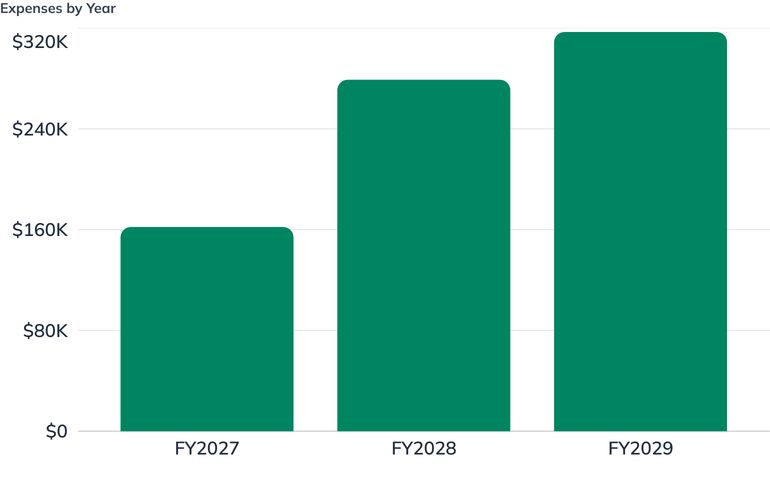
The Creature Nannie earns boarding revenue at $80 per night or $490 per week per dog, capped at 20 dogs at a time to protect its low handler ratio rather than maximizing volume. Across its multi-year forecast, the plan projects roughly $956,000 in total revenue against about $758,000 in expenses, reflecting a premium-priced, capacity-capped model rather than a high-volume kennel.
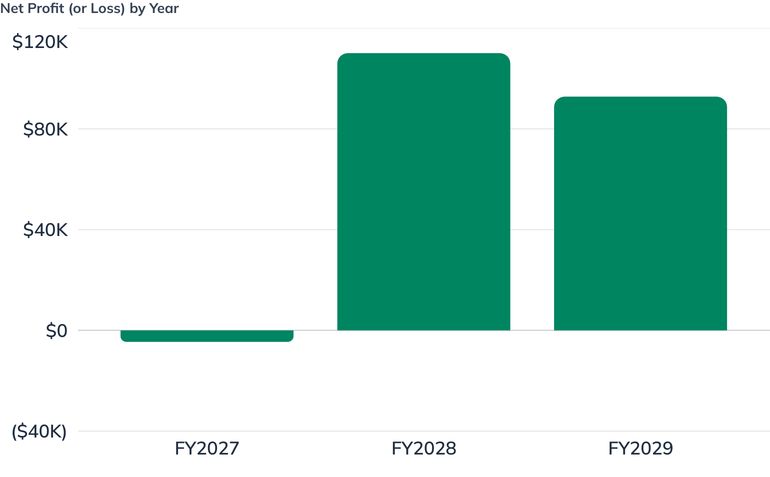
The Creature Nannie's plan doesn't commit to a specific profitable month, but its multi-year forecast projects roughly $198,000 in cumulative net profit against about $956,000 in total revenue, and the business is built to stay cash-flow-positive by keeping start-up costs and overhead low from day one. Timelines for other kennels will depend heavily on facility costs and how quickly capacity fills.
Unlike traditional kennels, which typically house dogs in cages with a high staff-to-dog ratio, The Creature Nannie offers individual climate-controlled suites and keeps a deliberately low ~1:7 handler-to-dog ratio even at full 20-dog capacity. And unlike app-based marketplaces such as Rover and Wag, where a dog may get a different, unfamiliar sitter each booking, The Creature Nannie's guests see the same small handler team every stay, with GPS-tracked walks and daily photo and video updates through a booking app.
The Creature Nannie serves Marion County, Florida dog owners who travel often — Florida's year-round travel patterns, including snowbirds heading north each summer, families flying out of Orlando for holidays, and retirees on extended trips, mean local dog owners need boarding they trust more than once or twice a year. These are owners who've been burned by the 'stranger in a cage' feeling of a traditional kennel or the inconsistency of a rotating app-based sitter, and are willing to pay a premium for consistency.
The Creature Nannie leans on partnerships with local Ocala-area veterinary clinics, which distribute free trial-day coupons to clients they already trust, alongside a Google Business Profile optimized for searches like 'dog boarding Ocala FL' and an active presence in local Facebook groups and Nextdoor. Online reviews are actively requested after every stay, since as a home-based facility with no storefront, reviews are the primary way new customers build trust before booking.

Business Plan Outline
Start your plan