





Precision Power Wash


Business Plan Summary
This pressure washing business plan example features Precision Power Wash, a soft-wash-first exterior cleaning company launching in Eugene, Springfield, and the surrounding Lane County communities in October 2026 — a Willamette Valley market where roughly 46 inches of annual rain and frost-free winters grow moss, algae, and lichen faster than almost anywhere in the country. It covers the three-stream model that sets the plan apart — one-time residential jobs, the Valley Green Guard annual maintenance membership billed monthly, and recurring commercial contracts that keep crews billable through the wet season — alongside the wash-water containment practice Eugene Code 6.446 requires, a two-rig equipment buildout, and a $185,000 launch capitalization pairing owner equity with an SBA 7(a) term loan, with three-year projections taking revenue from $200,917 to $688,092. Use it as inspiration for your own plan. Download a free business plan template to get started, or browse more business plan examples.
Precision Power Wash
Executive Summary
Precision Power Wash is a soft-wash-first exterior cleaning company serving Eugene, Springfield, and the surrounding Lane County communities, launching in October 2026.
The opportunity
The southern Willamette Valley grows moss, algae, and lichen on roofs, siding, driveways, and fences faster than almost anywhere in the country. Roughly 46 inches of annual rain and mild, frost-free winters mean that every property in our market has a recurring exterior cleaning need — not a cosmetic preference, but a genuine problem involving roof granule loss, slick walkways, and premature siding failure.
The market is served, but poorly. Nationally, 65% to 67% of the 68,000 to 75,000 active pressure washing contractors are solo or part-time operators, and between 35% and 42% of new entrants close within their first year. Eugene property owners experience that churn as unanswered phones, quotes that never arrive, and operators who put 3,000 PSI on a composition roof and let wash water run to the storm drain. There is no shortage of options in this market. There is a shortage of an operator who answers, uses the right method, handles the water legally, and will still exist next year.
What we do differently
We soft wash by default. Roofs, siding, cedar, and stucco are cleaned with a 12V low-pressure chemical system at under 100 PSI, which kills biological growth at the root instead of blasting it loose to return in four months. High pressure is reserved for concrete and masonry, where it belongs.
We sell a maintenance relationship, not a one-time job. Our Valley Green Guard annual membership bundles a scheduled house soft wash, driveway cleaning, gutter service, and preventative roof treatment, billed monthly and auto-scheduled year over year. It converts the industry's defining failure mode — clean a house once, never see the owner again — into a renewing customer base.
We hold recurring commercial contracts. Property management firms, HOAs, restaurant groups, and retail centers on monthly and quarterly schedules keep our crews billable through the Eugene wet season, when residential demand collapses.
We handle wash water the way Eugene Code 6.446 requires — containment, inlet protection, and vacuum recovery to an approved sanitary discharge point, documented on every applicable job. Most low-bid competitors cannot do this, which quietly removes them from the commercial bid lists we most want to be on.
The team
Founder Ryan Halvorsen brings eleven years in the Eugene trades, most recently supervising four crews across roughly 180 residential and commercial accounts for a Lane County property maintenance company — the buying side of exactly this service. He is PWNA certified in soft washing and environmental compliance. The company launches with a crew lead and a technician, adds a second fully equipped rig and crew in early 2028, and adds part-time office and dispatch support in Year 3. All field staff are W-2 employees paid above prevailing Eugene market rates, because turnover is the most expensive cost in this trade that never shows up on a P&L.
The financials
Year 1 (FY2027) | Year 2 (FY2028) | Year 3 (FY2029) | |
|---|---|---|---|
Revenue | $200,917 | $415,531 | $688,092 |
Gross margin | 45.6% | 50.7% | 56.9% |
Net profit | ($65,320) | ($6,638) | $56,210 |
Ending cash | $53,165 | $49,617 | $106,455 |
Operating cash flow turns positive in May 2027. Year 1 is a planned and fully funded loss — the cost of launching in October and carrying a crew through five months of Willamette Valley rain before the first real season. Year 2 finishes near breakeven because we deliberately absorb the cost of a second rig and two new hires mid-year; that decision adds roughly $272,000 to Year 3 revenue. By Year 3 the business is durably profitable at an 8.2% net margin, with memberships and commercial contracts accounting for 46% of revenue.
Cash on hand never goes negative in any month of the forecast, with a low point of $27,851 in April 2028 during the expansion.
The ask
We are raising $185,000 in initial capitalization: a $40,000 owner equity contribution and a $145,000 SBA 7(a) term loan at 9.25% over ten years with a three-month interest-only period. A further $59,000 equipment loan funds the second rig in February 2028. Funds go to two fully equipped commercial rigs, a West Eugene shop, launch marketing, licensing and insurance, and a working capital reserve sized specifically to carry the business through its first winter. Projected Year 3 debt service coverage is approximately 3.1×.
Opportunity

Problem Worth Solving
The southern Willamette Valley has a moss problem, and almost every property owner in Eugene and Springfield lives with it.
Eugene averages roughly 46 inches of rain a year, concentrated in a long, gray October-through-May stretch, and pairs it with mild winters that never freeze hard enough to kill anything off. The result is a climate that grows moss, algae, lichen, and mildew on north-facing siding, composition roofs, concrete driveways, paver patios, cedar fences, and gutter faces faster than almost anywhere else in the country. A homeowner in Phoenix pressure washes for dust. A homeowner in Eugene washes because their roof is losing granules to moss root systems, their walkway is genuinely slick, and their house looks a decade older than it is.
That creates three distinct pain points our customers describe to us in almost the same words every time.
It is a safety and liability problem, not a cosmetic one. Algae-slicked concrete is the single most common slip hazard on Eugene residential and commercial properties during the wet season. Property managers and restaurant operators know a fall on a green sidewalk is a claim, and most have no scheduled plan to prevent it — they react after a complaint.
Doing it wrong causes expensive damage. The DIY route, and the low-bid operator route, both default to high-pressure water on everything. On a composition roof that strips granules and voids manufacturer warranties. On cedar siding it furs the grain. On mortar joints and older paint it drives water into the envelope. Homeowners have heard these stories from neighbors and are genuinely nervous about who they let near their roof, which is why so many of them simply do nothing for years.
The regulatory side is invisible until it isn't. Eugene Code 6.446 requires wash water from commercial cleaning activity to be collected and discharged to a vegetated area or the sanitary sewer — not the storm drain — whenever soaps, detergents, hot water, or other cleaners are involved, because the storm system runs untreated to the Willamette. A large share of the operators bidding these jobs let everything run to the curb. The property owner, not the contractor, is the one exposed when a stormwater inspector follows the suds.
Underneath all three is a service-quality problem that anyone who has hired a contractor in this market recognizes. Exterior cleaning has one of the lowest barriers to entry of any trade: a consumer-grade machine from a big-box store and a magnetic truck sign is a functioning business by Saturday. Between 35% and 42% of new pressure washing businesses nationally close within their first year, and the churn shows up locally as unanswered phones, quotes that never arrive, no-show appointments, no proof of insurance, and no way to book the same crew again next year. Property owners are not short of options. They are short of an operator who answers, shows up, knows which surfaces need low pressure, handles the water responsibly, and will still be in business in three years.
Our Solution
Precision Power Wash is a soft-wash-first exterior cleaning company serving Eugene, Springfield, and the surrounding Lane County communities. We are built for the Willamette Valley specifically: our default method is low-pressure chemical cleaning that kills the moss and algae at the root, and we reserve high pressure for the surfaces that can actually take it.
Soft washing is our default, not an upsell. Roofs, painted and vinyl siding, cedar, stucco, and screens are cleaned with a 12V soft wash system applying a sodium hypochlorite and surfactant blend at garden-hose pressure — under 100 PSI. The chemistry does the work, the biological growth dies rather than being blasted loose to regrow in four months, and nothing gets driven under the siding. High-pressure equipment and rotary surface cleaners come out for concrete, pavers, and masonry, where they belong. Every technician is trained to state which method a surface is getting and why before starting.
We sell a maintenance cycle, not a one-time blast. Our core residential offer is the Valley Green Guard annual membership: a scheduled house soft wash, driveway and walkway cleaning, gutter clean-out with face brightening, and a preventative roof treatment, timed to the local season and repeating every year without the customer having to remember. Members get priority scheduling, a locked-in rate, and a mid-year touch-up window. This turns the single most common failure mode in this trade — a customer you clean once and never hear from again — into a renewing relationship, and it turns our slowest months into booked months.
Commercial route work carries us through the rainy season. Alongside residential, we hold recurring contracts with Eugene-area property managers, HOAs, restaurant groups, retail centers, and self-storage and multifamily owners: monthly or quarterly sidewalk and entryway cleaning, dumpster corral and grease-pad washing, awning and storefront cleaning, and parking structure work. These are scheduled, often performed after hours, and priced as ongoing agreements rather than one-off bids. They are the reason our crews stay billable in January.
We handle wash water the way the code requires. Every job that involves detergents, degreasers, or heated water is run with storm drain inlet protection, berms and containment mats where the surface allows, and a vacuum recovery unit for reclaiming and hauling water to an approved sanitary discharge point, consistent with Eugene Code 6.446 and Oregon DEQ guidance. We document it. For commercial clients — restaurants and property managers in particular — this is not a nice-to-have; it is the reason they can hire us instead of managing a compliance risk. It is also a service most of our low-bid competitors are not equipped to deliver, which quietly removes them from the bid list on the accounts we most want.
We answer the phone. Every inquiry gets a response the same business day. Quotes for standard residential work are delivered within 24 hours, most of them built from satellite measurement without needing an on-site visit. Customers get an automated appointment confirmation, a text when the crew is en route, and before-and-after photos attached to the invoice. None of this is novel in other trades. In Eugene exterior cleaning, it is still enough to stand out.
Target Market
Our service area is Eugene, Springfield, and the surrounding Lane County communities within roughly a 30-minute drive of our shop: Coburg, Junction City, Creswell, Veneta, Pleasant Hill, and the Thurston and Gateway areas of Springfield. Eugene alone had an estimated population of 178,618 as of mid-2025, with an owner-occupied housing rate of 47.9% and a median owner-occupied home value of $460,400. Add Springfield and the unincorporated fringe and the drivable market is roughly 100,000 to 110,000 housing units, of which we estimate 45,000 to 55,000 are detached owner-occupied homes — the properties that actually buy exterior cleaning.
We are not chasing all of them. We serve three defined segments.
Segment 1 — The equity-protective homeowner (primary residential)
Homeowners aged 40 to 70 in owner-occupied detached houses valued from roughly $400,000 up, in South Eugene, Southeast Eugene, Crest Drive, Friendly, College Hill, Cal Young, Gilham, Santa Clara, and the newer Thurston and Jasper Meadows subdivisions in Springfield. Household income typically $85,000 and up against a Eugene median household income of $66,562.
They are not buying clean concrete. They are buying protection of the largest asset they own and the removal of a chore they do not want to do on a ladder in the rain. They research before they hire, read reviews carefully, ask about insurance, and are the segment most receptive to a scheduled annual plan because their real preference is to stop thinking about it. They are also the segment most damaged by a bad operator, which makes our surface-appropriate method a purchase reason rather than a technical footnote. This group is our Valley Green Guard membership base.
Segment 2 — Property managers, HOAs, and multifamily owners (primary commercial)
Eugene has a deep rental market — the University of Oregon anchors a student population that keeps roughly half the city's housing stock in rental use — and a correspondingly large population of professional property management firms managing scattered single-family rentals, small apartment complexes, and HOA-governed subdivisions. Their buying logic is entirely different from a homeowner's: they need scheduled, documented, insured work at a predictable annual cost, performed without them being present, with photo proof they can forward to an owner or a board.
They also carry real slip-and-fall exposure on shared walkways every wet season, and most of them are managing it reactively. A single relationship here yields dozens of addresses, and turnover cleanings between tenants create steady incremental work. This is the segment where recurring contracts are won, and where being genuinely compliant on wash-water handling wins bids against cheaper operators.
Segment 3 — Restaurants, retail centers, and small commercial (secondary)
Restaurant groups, breweries, food carts and cart pods, grocery and retail strip centers, self-storage facilities, medical and dental offices, and auto dealerships in the Willamette Street, West 11th, Coburg Road, Gateway, and downtown Eugene corridors. Needs are dumpster corrals, grease-stained entry pads, drive-thru lanes, patio and sidewalk seating areas, awnings, and storefront glass surrounds — most on a monthly or quarterly cycle, most performed before opening or after close. Health-inspection pressure and franchise brand standards make this work non-discretionary in a way residential work is not, which is exactly why it holds up when the residential phone goes quiet in December.
Why the market supports us
Nationally, pressure washing services generated an estimated $2.1 to $2.3 billion in 2025 and are projected to grow 3.2% to 4.1% in 2026, with residential work representing 62% to 67% of industry revenue. Applying national per-household spending patterns to Lane County's housing base, we estimate the drivable Eugene-Springfield exterior cleaning market at $6 million to $9 million annually. We do not need a large share of it. Our three-year plan requires capturing a fraction of one percent of the residential segment plus a modest book of commercial accounts — a target that is achievable through execution rather than through market disruption.
Competition
Eugene's exterior cleaning market is crowded but not consolidated. Nationally the industry runs 68,000 to 75,000 active contractors, of whom 65% to 67% are solo or part-time operators and fewer than 7% employ six or more people. Eugene mirrors that shape closely. We compete against four groups, and we compete differently against each.
Established local exterior cleaning companies
Alpine Wash Pros, ClearView PNW, Cascade Wash Pros, Revive Washing Pros, and Refreshing Pro Wash are the operators a Eugene homeowner is most likely to find on the first page of a search. Several are genuinely good: real websites, review volume, roof and gutter capability, and multi-year track records. This is the tier we take most seriously and the tier we benchmark our own quality against.
Our differentiation is structural rather than technical. Nearly all of them sell transactional jobs — a customer calls, gets a quote, gets a wash, and disappears until they notice the moss again two or three years later. Almost none sell a scheduled annual maintenance membership, and almost none have built a commercial recurring-contract book deep enough to fill the wet season. That leaves them competing hardest for the same summer residential leads at the same rising acquisition cost, which nationally has climbed from $45–$95 in 2023–2024 to $85–$180 in competitive markets today. Our membership model and our commercial route work reduce how many of those leads we have to buy each year.
Handyman and multi-service generalists
Local operators bundling pressure washing with gutter cleaning, window washing, moss removal, yard cleanup, and general handyman work. They win on convenience and on being already known to the customer. They lose on equipment and method: a generalist typically owns one cold-water machine, defaults to high pressure on every surface, and cannot soft wash a roof safely or reclaim wash water on a commercial site.
We do not try to out-convenience them. We compete by owning the technically demanding work — roofs, multi-story soft washing, restaurant grease pads, containment-required commercial sites — that a generalist cannot bid. We are also happy to be the specialist a handyman refers roof work to, and we actively cultivate those referral relationships rather than treating them as competitors.
Low-bid and part-time operators
The largest group by headcount and the smallest by revenue: a consumer machine, a pickup, a Facebook Marketplace listing, and a price 30% to 50% below ours. They are a real constraint on the bottom of the market and we will lose price-only shoppers to them consistently.
We do not chase that customer. Our answer is to make the difference legible before the price is discussed: proof of general liability and workers' compensation coverage, written surface-specific method statements, documented wash-water handling, before-and-after photos on every invoice, and a workmanship guarantee. When a homeowner understands that the cheap bid is going to put 3,000 PSI on a composition roof, price stops being the only variable. Their high failure rate also works in our favor over time — a meaningful share of the customers who tried the cheap option last year are our leads this year.
National franchises and DIY
Franchised window and exterior cleaning brands have a light footprint in Eugene relative to Portland, and where present they carry royalty-driven pricing without a local operator's judgment about Willamette Valley moss cycles. DIY — a rented machine for $45 to $250 a day — remains the true default for a large share of homeowners. We treat DIY less as a competitor than as the condition we convert: our content and quotes are built to make the ladder-and-rental-machine weekend look like what it is, which is a full Saturday, a real fall risk, and frequently a damaged surface.
Our defensible position
Summarized simply, we intend to be the Eugene operator who is (1) soft-wash-first and honest about method, (2) selling a recurring maintenance relationship instead of a one-time transaction, (3) genuinely compliant on wash-water handling in a way that makes us bid-eligible on commercial accounts others cannot serve, and (4) reliably responsive in a trade where responsiveness is rare. None of those four is individually impossible to copy. Holding all four at once, with the systems and the insurance to back them, is what the low-bid tier cannot do and the established tier has not chosen to do.
Execution
Marketing Plan
Our marketing has one job in Year 1: make Precision Power Wash the obvious choice for a Eugene homeowner who has just decided to do something about their moss. It has a second job from Year 2 forward: make sure we never have to buy that customer twice.
Local search is the foundation
The overwhelming majority of exterior cleaning demand starts as an intent-driven local search — "pressure washing Eugene," "roof moss removal Springfield OR," "gutter cleaning near me." We treat our Google Business Profile as the primary storefront, not the website: fully completed service list, service-area definition, weekly photo posts of actual local jobs, and a review-request text sent automatically the day after every completed job through our field service software. Review velocity and recency drive map-pack ranking more than review count alone, which is why we request continuously rather than in campaigns. Our target is a 4.8-plus rating with steady monthly review flow by the end of Year 1.
The website is a straightforward conversion tool built on a service-business template: one page per service (house soft washing, roof cleaning, concrete and driveway, gutters, fence and deck, commercial), one page per neighborhood we serve, visible licensing and insurance, real before-and-after galleries, and an instant-quote request form above the fold on every page. Neighborhood pages matter more than they sound — "pressure washing South Eugene" is a low-competition, high-intent phrase, and there are a dozen of them worth owning here.
Paid search runs as a controlled supplement, not the engine. Google Local Services Ads carry the Google Guaranteed badge and charge per lead rather than per click, which suits a trade where trust is the barrier; we run these year-round with a capped budget. Standard search ads run seasonally, concentrated in the April-through-September window when residential intent peaks, targeted to high-value service terms and paused when the schedule is full. With acquisition costs in competitive markets now running $85 to $180 per customer, disciplined budget caps and honest per-channel tracking are not optional.
Proof, not promises
Every completed job produces before-and-after photography from a fixed vantage point. That photo library feeds the website galleries, the Google Business Profile, monthly Instagram and Facebook posts, and — most importantly — the quote itself, where we attach recent work from the customer's own neighborhood. Short vertical video of soft washing a moss-covered roof performs unusually well on local social and costs us nothing but the phone in a technician's pocket.
We publish a small amount of genuinely useful local content rather than generic industry filler: when to treat a roof in the Willamette Valley, why high pressure ruins composition shingles, what Eugene's wash-water rules mean for a property manager. This is the content that earns the calls from people who were about to rent a machine.
Neighborhood and referral density
Route density is profit in this business. When we book a job, we drop branded door hangers on the surrounding properties offering a same-week neighbor rate, and we post the completed job to the relevant Nextdoor neighborhood. Clustering work reduces drive time, which is the largest hidden cost in a mobile service, and Eugene's distinct, tight-knit neighborhoods make this unusually effective.
Our customer referral program pays a credit toward the referrer's next service and gives the new customer a first-service discount. We also build a deliberate partner referral network: roofing contractors who need moss handled before an inspection, gutter installers, painters who need a clean substrate, real estate agents preparing listings, and home inspectors. These partners send pre-qualified work at near-zero acquisition cost, and we reciprocate.
Commercial outreach is direct, not advertised
Commercial contracts are not won through search. They are won by identifying the fifteen to twenty property management firms, restaurant groups, and HOA boards in Eugene worth having, and working them directly: a walk-through with photographs of their actual property, a written proposal covering scheduled frequency, insurance certificates, and our documented wash-water containment procedure. Our commercial pipeline is tracked in the CRM with named decision-makers and renewal dates, and the owner personally owns this channel — it is relationship work, not campaign work.
Retention is the highest-return channel we have
The Valley Green Guard membership is marketed to every residential customer at the point of invoice, when satisfaction is highest and the before-and-after photo is on the screen. Members are auto-scheduled for the following year and confirmed by text. Every non-member customer enters an annual reactivation sequence — an email and text at the seasonal moment their property is due, with photos of their own prior service attached. A reactivated customer costs a fraction of a new one, and in a business where the national norm is to clean a house once and lose it, our retention rate is the number that will most determine whether we are still growing in Year 3.

The Asset Guardian
David Miller
A long-time resident of the South Eugene hills, David views his home as his most significant financial asset and a legacy for his children. He is highly detail-oriented and frustrated by the 'fly-by-night' nature of local contractors who fail to show up or lack proper insurance.
Age
58
Location
South Eugene, OR
Family Status
Married, 2 adult children
Education
Master’s Degree in Architecture
Profession
Senior Project Manager at a regional firm
Opportunities
- Enroll David in a recurring annual maintenance plan to prevent moss buildup before it damages his composition roof granules.
- Market the technical benefits of low-pressure cleaning to appeal to his desire for surface-appropriate care that won't void his roof warranty.
Pain Points
- Contractors who use high pressure on delicate cedar siding or shingles
- The constant battle against slick, dangerous moss on his north-facing driveway
- Unreliable service providers who don't answer the phone or provide proof of insurance
Needs
- A documented, scheduled maintenance plan that requires zero mental effort
- Proof of liability insurance and workers' comp before work begins
- An operator who understands the unique climate of the southern Willamette Valley
“I don't want a 'guy with a truck.' I want a professional who knows how to protect my roof without blasting the granules off.”

The Brand Perfectionist
Marcus Thorne
Marcus owns a popular brewery and taproom on the Willamette Street corridor. He understands that first impressions are everything and that a mossy, grease-stained entryway can drive customers away and attract health inspector scrutiny.
Age
36
Location
Downtown Eugene, OR
Family Status
Married, no children
Education
Associate Degree in Culinary Arts
Profession
Owner/Operator of a local craft brewery
Opportunities
- Perform monthly dumpster pad and patio cleaning between 2:00 AM and 8:00 AM to avoid disrupting customer service.
- Target high-traffic areas like grease-stained entry pads and drive-thru lanes with specialized degreasing agents.
Pain Points
- Grease and grime buildup in the dumpster corral that attracts pests
- Mildew on outdoor patio seating that makes the venue look unhygienic
- Pressure washing noise or water spray interfering with customers during business hours
Needs
- Reliable, monthly recurring service that happens automatically
- Specialized equipment for hot water degreasing and storefront glass surrounds
- A service provider that understands and meets franchise or health department standards
“If my patio looks dirty, people assume my kitchen is dirty. I need this done right, and I need it done before we open at 11.”
The Compliance Coordinator
Sarah Jenkins
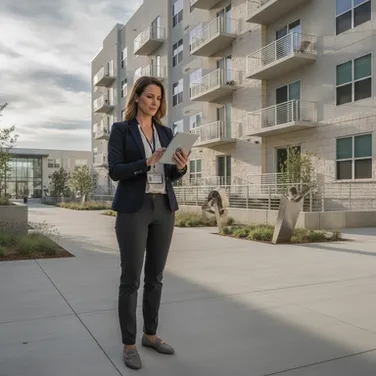
Sarah manages a portfolio of 40+ residential rentals and small apartment complexes near the University of Oregon. Her primary goal is risk mitigation and keeping owners satisfied through documented property maintenance.
Age
42
Location
Springfield, OR
Family Status
Single, 1 child (age 10)
Education
Bachelor's in Business Administration
Profession
Senior Property Manager at a top-rated Eugene firm
Opportunities
- Provide a single point of contact for exterior cleaning across multiple addresses with predictable annual costs.
- Offer 'Before and After' photo documentation and slip-resistance verification for shared walkways to protect against injury claims.
Pain Points
- Slip-and-fall hazards on common area walkways during the long rainy season
- Difficulty finding vendors who can handle wash-water runoff according to city regulations
- The administrative burden of chasing down no-show vendors for tenant move-out cleans
Needs
- Standardized invoicing and digital photo proof of completed work for property owners
- Strict adherence to Eugene/Springfield environmental regulations for water handling
- Responsiveness to urgent 'move-out' cleaning requests between student leases
“I need a vendor who makes my job easier. If they don't show up or send me photos, I can't bill the owner or protect the tenants.”
Sales Plan
Our sales process is deliberately fast and low-friction on the residential side, and deliberately consultative on the commercial side. They are different sales and we run them differently.
Residential: speed wins
Speed of response is the single strongest predictor of who wins a residential exterior cleaning job. Most Eugene homeowners contact two or three companies; the one who responds first and most clearly usually books the work regardless of a modest price difference. Our standard is a same-business-day response to every inquiry and a written quote within 24 hours.
Most residential quotes are built remotely. We measure roof and driveway square footage from satellite imagery, confirm siding type and story count from street-level imagery and a few photos the customer texts us, and send a formal quote from our field service software without a site visit. This removes the scheduling delay that costs competitors the job and keeps our billable hours in the field rather than in a truck driving to estimates. We visit in person only for multi-story, complex, or high-value properties where the walk-through itself builds confidence.
Quotes are presented as three clear options rather than a single number — a targeted service, a recommended package, and a full-property package — because a customer choosing among options converts better than a customer deciding yes or no, and the middle option is where most land. Every quote includes the surface-specific method we will use and why, proof of insurance, and photos of comparable work nearby. Quotes carry a 30-day validity and are followed up by text at day two and day seven.
Typical residential pricing in this market runs roughly $0.35 to $0.77 per square foot depending on surface and condition, with a house soft wash generally falling between $170 and $360, a driveway between $100 and $260, a deck or patio around $200 to $240, gutters between $55 and $160, and a roof soft wash between $250 and $600. We price at or slightly above the local median, never at the bottom, and we hold a minimum job charge so that a single small service never leaves a crew unprofitable after drive time and setup.
The membership conversion
Every residential job ends with the same conversation, at the moment the customer is looking at the before-and-after photos: an offer to move onto the Valley Green Guard annual membership at a rate below what they just paid, with priority scheduling and automatic annual booking. Members pay monthly, which smooths our cash and lowers the perceived cost for them. Our target is to convert a meaningful share of first-time residential customers to membership at the point of invoice, and this conversion — more than any lead source — is what compounds.
Commercial: consultative and contract-based
Commercial sales begin with a site walk-through. We photograph the actual problem areas — the greased dumpster pad, the algae-slicked entry, the stained drive-thru lane — and return a written proposal within five business days that specifies scope, service frequency, after-hours scheduling windows, insurance limits and certificate holders, and our wash-water containment and disposal procedure under Eugene Code 6.446. That last element regularly decides the bid, because a property manager who understands their own exposure would rather pay slightly more than inherit a stormwater violation.
We propose annual agreements with monthly or quarterly service, invoiced on net-30 terms, with an annual price escalator built in. Where a prospect is hesitant, we offer a single paid pilot service on their worst property — this closes reliably, because the result is visible and the risk is trivial. The owner personally handles all commercial relationships through Year 2; a dedicated estimator role is added when the account book outgrows one person.
Managing the season
Eugene residential demand concentrates hard between April and September. We manage the shoulder and off-season deliberately: commercial contracts are scheduled year-round and weighted toward winter months, gutter cleaning is sold in October and November when the need is obvious, roof treatments are promoted in early spring, and we run a pre-season booking incentive in February and March that fills April before it arrives. We also hold a standing winter offer for interior-adjacent and covered work — parking structures, covered walkways, loading docks — that can be performed in the rain. The seasonality is real and we plan around it rather than pretending it away.
Locations & Facilities
Precision Power Wash is a mobile service business. Our value is produced entirely at the customer's property, so we deliberately keep fixed facility costs low and put capital into equipment and vehicles instead.
Shop and yard
We lease a small industrial flex unit of roughly 1,000 to 1,200 square feet in the West Eugene industrial corridor near Highway 99 and Roosevelt Boulevard, an area with the lowest per-square-foot industrial rents in the metro and direct arterial access to both Eugene and Springfield. The space provides secure indoor overnight storage for the trailer, skid units, and soft wash systems; a locked, bermed, and ventilated chemical storage area for sodium hypochlorite, surfactants, and degreasers with secondary containment and posted safety data sheets; a fenced parking area for the truck and trailer; a wash and fill station with a metered water connection; and a small office corner for the owner's administrative work.
The unit is chosen specifically for a floor drain plumbed to the sanitary sewer, which lets us discharge reclaimed wash water legally and inexpensively at the end of each day rather than paying for outside disposal. We confirm this connection and its permitted use with Eugene Public Works before signing, since it is the operational detail that makes our compliance commitment practical rather than aspirational.
We do not need or want a retail storefront. No customer visits us, and every dollar spent on visible frontage is a dollar not spent on a second truck.
Service radius
Our primary service area is everything within roughly 30 minutes of the shop: Eugene, Springfield, Coburg, Junction City, Creswell, Veneta, and Pleasant Hill. We accept work in outlying Lane County — Cottage Grove, Oakridge, Florence — at a travel surcharge, and only when it can be batched with other jobs in the same direction.
Route density inside that radius is a core operating discipline. Drive time is unbillable and it is the largest hidden cost in a mobile trade, so we schedule by geographic cluster rather than in the order jobs were booked, grouping each day's work into one or two neighborhoods wherever the customer's timing allows.
Water and utilities
Most residential jobs draw water from the customer's own spigot, which is standard practice and disclosed in advance. Our trailer carries a buffer tank so that low-flow spigots and commercial sites without accessible water do not stop a job, and we fill at the shop before each route. Commercial sites are surveyed for water access during the initial walk-through.
Growth path
The initial unit is sized to hold one full rig comfortably and two with reorganization. When the second crew launches in Year 2 we expect to remain in the same space; the third-year decision point is either a modestly larger unit in the same corridor or a satellite parking arrangement in Springfield to cut deadhead miles on the east side. Neither requires a move out of the West Eugene industrial market, where supply is adequate and rents are stable.
Technology
Exterior cleaning is not a technology business, but the gap between a systematized operator and a truck-and-a-phone operator is almost entirely a software gap. We run the business on a small, deliberately unglamorous stack that we implement before our first paying job rather than bolting on later.
Field service management — Jobber
Jobber is our operational core and the single system every job passes through: quoting, scheduling, dispatch, route optimization, job costing, invoicing, payment collection, and the customer database. Technicians work from the mobile app — job details, property notes, surface warnings, before-and-after photo capture, time tracking, and job completion all happen on the phone in the field, and nothing depends on paperwork returning to the shop.
The automations matter more than the features. Customers receive automatic booking confirmations, an en-route text with crew arrival time, an invoice with photos attached on completion, and a review request the following day. Recurring Valley Green Guard members and commercial contract clients are set up as repeating job schedules, so next year's work is already on the calendar the day this year's is finished. Unpaid invoices trigger automated reminders without the owner chasing anyone.
Estimating and measurement
Residential quotes are measured remotely using satellite and aerial imagery for roof and hardscape square footage, cross-checked against street-level imagery for siding type and story count. This is what lets us return a written quote within 24 hours without spending a technician's billable hour driving to an estimate. Measurements and the resulting price are stored against the property record, so a repeat or membership visit requires no re-estimating.
Payments and accounting
Payments are accepted by card and ACH at the point of invoice through Jobber's integrated processing, with saved payment methods for membership customers billed monthly. Jobber syncs to QuickBooks Online, which holds our books; payroll runs through Gusto, which handles Oregon-specific requirements including Paid Leave Oregon and the state transit tax. Our bookkeeping is reconciled monthly by an outside bookkeeper rather than by the owner at midnight.
Marketing and reputation
Google Business Profile is managed actively, with review requests flowing automatically from Jobber. The website runs on a standard service-business platform with the quote form wired directly into Jobber so no lead is manually re-keyed. Call tracking numbers on each paid channel tell us what a lead actually costs by source, which is what makes our advertising budget a decision rather than a guess.
AI in daily operations
We use AI tooling the way any small business does in 2026 — as ordinary infrastructure, not as a differentiator we advertise. It drafts commercial proposals and follow-up sequences from our templates, writes neighborhood service page copy and social captions from job photos, summarizes the week's job costing into the metrics we actually review, and handles first-pass response to after-hours inquiries so that a lead arriving at 9pm gets an acknowledgment rather than silence. A person reviews anything a customer sees. It saves the owner several hours a week of administrative work, which in a two-crew business is the difference between selling commercial accounts and not.
Documentation and compliance
Wash-water containment procedures, safety data sheets for every chemical we carry, surface-specific method statements, and technician training checklists live in a shared cloud workspace accessible from any phone in the field. Job photos and containment documentation are retained against the customer record, which is what allows us to demonstrate compliance to a commercial client or an inspector on request rather than from memory.
Equipment & Tools
Our equipment strategy is to buy professional-grade at launch rather than upgrading through failure. Consumer machines are the reason most new operators in this trade quit — they cannot hold production rates, they break in the middle of a booked week, and they cannot perform the commercial work that carries the winter. We capitalize one complete commercial rig at launch and a second, near-identical rig when the second crew comes online in Year 2.
Rig 1 — launch configuration
Vehicle. A used three-quarter-ton pickup with a tow package, purchased rather than leased, wrapped with our branding. The wrap is both marketing and credibility; an unmarked truck reads as a side hustle to a property manager.
Trailer. A tandem-axle enclosed trailer, 7 by 14 feet, which secures the equipment overnight, keeps chemicals out of the weather, and serves as a rolling billboard. Enclosed rather than open is a deliberate choice: theft of exposed equipment is a real and recurring loss in this trade.
Primary pressure washer. A belt-drive commercial cold-water unit in the 4 to 5.5 GPM range with a professional pump. Flow rate, not pressure rating, determines how fast a surface actually cleans, and a 4-plus GPM unit roughly halves the time on a driveway compared with a consumer 2.5 GPM machine.
Hot water capability. A hot-water skid or add-on burner. This is what makes restaurant grease pads, dumpster corrals, drive-thru lanes, and oil-stained commercial concrete possible at all, and it is the single piece of equipment that separates our commercial bid from a generalist's. It is not optional for the account base we intend to build.
Soft wash system. A dedicated 12V soft wash setup with proportioning, applying our sodium hypochlorite and surfactant blend at well under 100 PSI. This is our default method on roofs, siding, cedar, and stucco, and it is used on the majority of our residential jobs.
Surface cleaner. A commercial rotary surface cleaner, 20 to 24 inches, for driveways, patios, sidewalks, and parking areas. It produces an even, stripe-free finish in a fraction of the time a wand takes, and it is why our concrete pricing works.
Water handling. A 225 to 325 gallon buffer tank so that low-flow residential spigots and commercial sites without accessible water never stop a job, plus hose reels with 300 feet of pressure hose, 200 feet of soft wash line, and extension wands and telescoping poles for two-story and gutter-face work.
Wash-water recovery. Storm drain inlet protection mats and berms, a portable containment mat for equipment and staging, absorbent socks and filtration media, and a vacuum recovery unit for reclaiming wash water on jobs involving detergents, degreasers, or heat. Reclaimed water is hauled to the shop and discharged to the sanitary sewer. This package is what makes us compliant under Eugene Code 6.446 and bid-eligible on commercial work that most of our competitors cannot legally perform.
Safety and access. Ladders and a stabilizer, fall protection harness for any roof-edge work, chemical-resistant gloves and suits, eye and respiratory protection, and a first aid and spill kit on every truck.
Chemicals. Sodium hypochlorite, surfactants and thickening agents, degreasers, rust and oxidation removers, and wood-appropriate cleaners and brighteners. Chemical cost typically runs under 10% of job price, and we buy in bulk and mix at the shop rather than buying pre-diluted.
Rig 2 — Year 2 expansion
The second crew receives a near-identical configuration: a second used truck, a second enclosed trailer, a commercial cold-water unit, a second soft wash system and surface cleaner, tank and reels, and its own containment and safety package. Standardizing the two rigs is intentional — any technician can work either truck, any part fits either machine, and training is written once.
Maintenance and replacement
Every machine follows a documented maintenance schedule — pump oil, unloader and hose inspection, winterization ahead of the first freeze — logged in Jobber against the equipment record. We carry a spare pump, spare hoses, and common fittings, because a failed pump on a Tuesday in July costs far more in lost bookings than the spare costs to hold. Pressure washers and soft wash systems are depreciated on a five-year schedule, vehicles and trailers over seven; we plan replacement rather than reacting to failure.
Milestones
LLC formed, licensed, insured, and shop leased Oregon LLC registration and EIN complete; Eugene and Springfield business registrations filed; general liability, commercial auto, workers' compensation, and inland marine coverage bound; West Eugene flex unit leased with confirmed sanitary sewer floor drain. | Ryan Halvorsen Oct 31, 2026 |
Rig 1 built out and first revenue job completed Truck, enclosed trailer, commercial cold-water unit, hot-water skid, soft wash system, surface cleaner, tank, and full containment package purchased, installed, and wrapped. First paying customer served. | Ryan Halvorsen Nov 30, 2026 |
Website, Google Business Profile, and Jobber live Service and neighborhood pages published, Google Business Profile verified with photos and full service list, Local Services Ads active, Jobber configured with quoting, automated reminders, review requests, and QuickBooks sync. | Ryan Halvorsen Dec 15, 2026 |
First three recurring commercial contracts signed Three signed annual agreements with Eugene-area property management firms, HOAs, or restaurant groups on monthly or quarterly service, establishing the wet-season revenue floor. | Ryan Halvorsen Mar 31, 2027 |
Valley Green Guard membership launched with 40 members Annual residential maintenance membership offered at every invoice, billed monthly at $59 through Jobber, with 40 active members enrolled and auto-scheduled for the following year. | Ryan Halvorsen June 30, 2027 |
100 Google reviews at a 4.8+ rating Automated post-job review requests sustain continuous monthly review flow, securing consistent Google map-pack placement for core Eugene and Springfield search terms. | Ryan Halvorsen Sept 30, 2027 |
Rig 2 and second crew operational Second truck, trailer, and equipment package in service; second crew lead promoted internally and second technician hired and certified, ahead of the Year 2 spring peak. | Ryan Halvorsen Mar 31, 2028 |
Owner transitions from field production to general manager Both rigs run by certified crew leads, freeing the owner for commercial sales, hiring, and financial management with field work only as backup. | Ryan Halvorsen June 30, 2028 |
Recurring revenue reaches 40% of monthly revenue Combined Valley Green Guard memberships and commercial contracts cover 40% of monthly revenue, eliminating the wet-season cash trough as a going-concern risk. | Ryan Halvorsen Sept 30, 2028 |
Office and dispatch coordinator hired Part-time coordinator takes over inbound calls, scheduling, routing, quote follow-up, invoicing, and membership renewals, returning the owner's time to commercial sales. | Ryan Halvorsen Nov 30, 2028 |
S corporation election reviewed with CPA Formal review of whether net income supports an S corporation election for self-employment tax savings, alongside equipment depreciation and estimated tax planning. | Ryan Halvorsen Dec 31, 2028 |
290 active memberships and expansion decision point Membership base at roughly 290 active members with monthly churn held under 1%; evaluate a third crew, a Springfield satellite parking arrangement, and the repayment schedule on both loans. | Ryan Halvorsen Sept 30, 2029 |
Key Metrics
We review a small set of numbers every week and a slightly larger set every month. The discipline is keeping the list short enough that it is actually looked at.
Weekly operating metrics
Jobs completed per crew per day. Our production target is four to six residential jobs per crew per day in season. This is the clearest single signal of whether routing, equipment, and crew skill are working together.
Billable hours as a share of paid hours. Drive time, setup, teardown, and shop time are all paid and none of them are billable. We target 65% or better. When this slips, the cause is almost always route density, not effort.
Schedule fill rate for the coming two weeks. Our early warning system. A soft two weeks out is a marketing problem we can still fix; a soft next week is a revenue loss already booked.
Average job value. Tracked separately for residential and commercial. Rising average job value from package selection and add-on services is a far cheaper path to growth than more leads.
Callbacks and rework. Any job requiring a return visit at our expense. Target is under 2% of completed jobs. This is our quality canary and it is reviewed by name, not just in aggregate.
Monthly business metrics
Leads by source, and cost per acquired customer by source. With acquisition costs in competitive markets running $85 to $180, we need to know which channel produced each customer. Any paid channel that cannot demonstrate its cost per customer is paused.
Quote-to-close rate. Tracked separately for residential and commercial, and against response time. If our close rate falls, the first thing we check is how fast we responded.
Valley Green Guard membership count and conversion rate. The percentage of first-time residential customers who convert to an annual membership at invoice, and the total active member count. This is the metric that determines whether Year 3 is built on new leads or on a base we already own.
Recurring revenue share. The share of monthly revenue coming from memberships and commercial contracts rather than one-off jobs. Raising this is the whole strategy for surviving the Eugene wet season, and we watch it climb quarter over quarter.
Customer retention and reactivation rate. The share of last year's customers who booked again this year. In a trade where the norm is to clean a house once and never see the owner again, this number is our real competitive position.
Gross margin by service line. Roof soft washing, house washing, concrete, gutters, and commercial contracts each cost differently to deliver. We review margin by line quarterly and reprice or drop what does not clear our threshold.
Revenue per crew and labor cost as a percentage of revenue. The two numbers that tell us whether adding the second crew was the right call and when a third would be.
Cash on hand and weeks of runway. Reviewed monthly without exception, and with particular attention entering October, because the seasonal trough is predictable and being surprised by it is inexcusable.
Review volume and average rating. Target is a 4.8-plus Google rating with continuous monthly review flow, since recency drives local search ranking as much as total count.
Safety and compliance
Incidents, near-misses, and property damage claims. Target is zero, reviewed monthly, with every near-miss written up so the next technician learns from it. Ladder and roof-edge work is where this business gets hurt.
Containment compliance rate. The share of applicable jobs with documented wash-water containment and disposal. Target is 100%. Our commercial positioning depends on this being a fact rather than a claim.
Company
Ownership & Structure
Precision Power Wash is organized as Precision Power Wash LLC, an Oregon limited liability company registered with the Oregon Secretary of State Corporation Division, with its principal place of business in Eugene, Lane County, Oregon.
Ownership
The company is wholly owned by its founder, Ryan Halvorsen, who holds 100% of the membership interest and serves as Managing Member. There are no outside equity holders, and the operating agreement reserves the right to admit additional members only by unanimous consent of existing members — a provision that keeps the door open to a future partner or key-employee equity grant without complicating the current structure.
Why an LLC
The LLC form gives us three things that matter in this trade. It creates a genuine liability shield between the business and the owner's personal assets, which is not academic in a business that puts ladders on roofs and chemicals near storm drains. It passes income through to the owner's personal return, avoiding entity-level tax while the business is small. And it is the structure commercial clients and property management firms expect to see on a certificate of insurance and a W-9 — a sole proprietorship reads as a hobby to a procurement contact.
We will revisit an S corporation election with our CPA once net income makes the self-employment tax savings meaningful, which we anticipate reviewing at the end of our second fiscal year.
Registrations, licenses, and insurance
- Oregon Secretary of State business registration and annual renewal, with a registered agent of record
- Federal EIN and Oregon Department of Revenue business identification number for payroll withholding
- City of Eugene and City of Springfield business registration as applicable to work performed in each jurisdiction
- Oregon Construction Contractors Board (CCB) license where the scope of work requires it — we confirm applicability with the CCB before performing any work that touches building repair or improvement, and carry the license rather than risk an unlicensed-contractor finding
- General liability insurance at $1,000,000 per occurrence and $2,000,000 aggregate, the threshold most Eugene property management firms require before adding a vendor
- Commercial auto coverage on all company vehicles and trailers
- Oregon workers' compensation coverage, mandatory for all employees under state law, placed through SAIF or a comparable carrier
- Inland marine / equipment coverage on the rigs, trailers, and machines, which are the bulk of our capitalized assets
- Oregon DEQ and City of Eugene stormwater compliance, following Eugene Code 6.446 for wash-water collection and discharge, with a WPCF 1700-B permit obtained if and when the scope of our commercial work requires one
Governance and administration
As a single-member LLC we keep governance light but real. The company maintains a separate operating bank account and credit card with no commingling of personal funds, a written operating agreement, and books kept in QuickBooks Online reconciled monthly by an outside bookkeeper. Payroll runs through Gusto so that Oregon-specific obligations — state withholding, Paid Leave Oregon, the statewide transit tax, and workers' compensation reporting — are handled correctly from the first paycheck rather than corrected later. An annual review with our CPA covers entity election, equipment depreciation, and estimated tax planning.
All employees are classified as W-2 employees. We do not use independent contractor classification for crew labor. Oregon applies a strict test, misclassification exposure in the cleaning trades is high, and our commercial clients specifically ask about it during vendor onboarding.
Management Team
Ryan Halvorsen — Founder and Managing Member
Ryan founded Precision Power Wash after eleven years in the Eugene trades, most recently as a field operations supervisor for a Lane County property maintenance company where he managed four crews across roughly 180 residential and commercial accounts. That role is the origin of this business: he spent years watching exterior cleaning get subcontracted out to whoever answered the phone, watching those subs damage roofs with high pressure and let wash water run to the curb, and watching property managers absorb the complaints because there was no better option on the list.
He brings three things directly relevant to what this company needs to do. He knows how to run a route — scheduling by geographic cluster, holding crews to production rates, and costing jobs after the fact rather than guessing at them. He has the local relationships, having worked with a significant share of the property management firms, HOA boards, and general contractors in the Eugene-Springfield market on the buying side of exactly this service. And he has hired, trained, and retained field labor in a tight Lane County labor market, which is the constraint most operators in this trade hit at their second truck and never get past.
Ryan is a graduate of the University of Oregon's Lundquist College of Business, is certified through the Power Washers of North America (PWNA) in both soft washing and environmental compliance, and holds current OSHA 10 and fall protection certification. He runs field work personally through Year 1 and transitions to a general manager role — sales, commercial accounts, hiring, and financial management — as the second crew comes online.
Crew Lead — hired at launch
Our first hire is an experienced crew lead who runs field production alongside Ryan from day one and takes over Rig 1 when Ryan steps back from daily field work. We are recruiting from the local landscaping, roofing, and property maintenance labor pool, prioritizing candidates with ladder and roof-edge experience, a clean driving record for trailer towing, and demonstrable customer-facing judgment — this person is alone at a customer's home and their conduct is the brand.
The role owns daily production: surface assessment and method selection, chemical mixing and dilution, wash-water containment setup and documentation, before-and-after photography, equipment maintenance logging, and training the technician working with them. Compensation is set above the local median for comparable technician work, with a performance bonus tied to jobs completed, callback rate, and review generation.
Exterior Cleaning Technicians
Technicians are hired as W-2 employees at a starting wage benchmarked above prevailing Eugene rates for comparable cleaning and grounds work, with a scheduled increase at ninety days on completion of our internal certification. We hire the first technician at launch, add a second crew lead and technician in Year 2 when Rig 2 comes online, and staff seasonally around the April-through-September peak.
Retention is a deliberate strategy, not a hope. Turnover in this trade is brutal and every departure costs us training time, quality, and customer relationships. We pay above market, provide paid training rather than trial-by-fire, supply all equipment and branded uniforms, offer genuine year-round hours through our commercial and membership base rather than seasonal layoffs, and promote from within — the Rig 2 crew lead position is offered internally first.
Office and Dispatch Coordinator — Year 3
As the account book grows past what one owner can schedule, quote, and invoice, we add a part-time office and dispatch coordinator handling inbound calls, scheduling and routing, quote follow-up, invoicing and collections, and membership renewals. This role exists to give Ryan his selling time back; in a two-crew business, the owner's hours spent on administration are the binding constraint on commercial growth.
Training and certification
Every field employee completes an internal certification before working unsupervised: surface identification and method selection, pressure and chemical dilution standards by surface, soft wash system operation, ladder safety and fall protection, wash-water containment and disposal procedure under Eugene Code 6.446, chemical handling and safety data sheet familiarity, and customer interaction standards. Training is documented and refreshed annually. We treat the certification as a real gate — a technician who has not passed it does not go on a roof.
The honest gaps
Ryan's background is operations and field management, not finance or marketing. We address that directly rather than pretending otherwise: bookkeeping is outsourced to a local firm with monthly reconciliation, tax and entity planning sit with a CPA, and website build and paid search setup are contracted to a specialist rather than self-taught. The advisory relationships described in the next section exist for the same reason.
Advisors
A single-member LLC with two trucks does not need a board of directors. It does need people who will tell the owner he is wrong before the market does. We have assembled a small set of professional and peer advisors, each engaged for a specific gap.
Professional advisors
CPA — Eugene-based small business accounting firm. Engaged for annual tax preparation, quarterly estimated tax planning, equipment depreciation strategy, and the S corporation election review scheduled at the end of Year 2. We meet quarterly rather than annually; the point of a CPA in a growing business is the decisions made before the year closes, not the return filed after.
Bookkeeper — outside monthly reconciliation. QuickBooks Online is reconciled monthly by an outside bookkeeper who also produces our monthly profit and loss and job costing summary. This is deliberately not the owner's job. Owner-kept books in a service business are the single most common reason an operator discovers a margin problem a year late.
Attorney — Oregon small business and contracts. Retained on an as-needed basis for the operating agreement, our residential and commercial service agreement templates, employment documentation and handbook, and liability waiver language for high-risk surfaces such as aged roofing and painted wood. The commercial service agreement in particular gets a professional review before we sign our first property management contract, not our tenth.
Insurance broker — commercial lines specialist. An independent broker who understands contractor and cleaning-trade exposures places our general liability, commercial auto, workers' compensation, and inland marine coverage, and reviews limits annually as our crew count and asset base grow. The broker also handles certificate of insurance requests, which arrive constantly from commercial clients and are a real administrative burden if handled ad hoc.
Environmental compliance consultant — engaged as needed. For wash-water containment procedure review and confirmation of whether our commercial scope triggers a WPCF 1700-B permit under Oregon DEQ. We consult before expanding into a new category of commercial work rather than discovering the requirement during an inspection.
Industry and peer advisors
Power Washers of North America (PWNA). Membership provides technical standards, soft washing and environmental certification, chemical safety guidance, and — most usefully — access to a national operator community where the answer to a pricing, equipment, or chemistry question is a day away rather than a season of trial and error.
A non-competing operator relationship outside our market. We maintain a peer relationship with an established exterior cleaning company owner in a comparable, non-overlapping Pacific Northwest market. Because we are not competing for the same customers, the conversation is candid in a way local competitor conversations never are: real production rates, real close rates, what actually happens at the third truck, and what they would do differently.
Local mentorship. Ryan works with a mentor through the Lane County SCORE chapter, with additional support available from the Oregon Small Business Development Center Network hosted at Lane Community College — a resource that provides no-cost advising on financial management, hiring, and growth planning specifically for Oregon small businesses.
How we use them
Advisors are only useful if consulted on a schedule. We hold a quarterly financial review with the bookkeeper and CPA covering job costing, margin by service line, and cash position heading into the seasonal trough; an annual insurance and compliance review before each peak season; and an annual strategic review with our peer operator and SCORE mentor covering the coming year's hiring, equipment, and expansion decisions. Between those, the standing rule is that any decision involving more than a modest capital commitment or a new category of legal or environmental exposure gets a call before it gets a signature.
Financial Plan
Revenue
Need real financials? We recommend using LivePlan as the easiest way to create financials for your own business plan.Create your own business plan
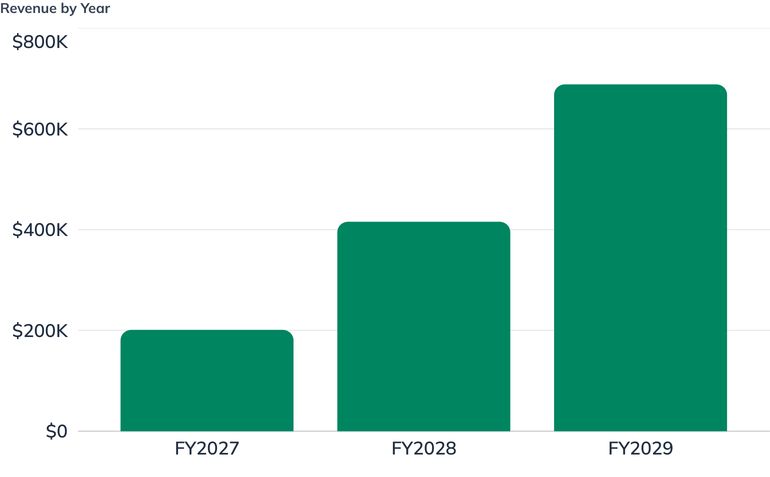
We forecast revenue from three streams, each with a different growth driver and a different role in the business. Total revenue reaches $200,917 in Year 1, $415,531 in Year 2, and $688,092 in Year 3.
Residential exterior cleaning — one-time jobs
Our largest stream and our customer acquisition engine. We model an average residential job value of $425 in Year 1, rising to $445 and then $478 as our service mix shifts toward higher-value roof soft washing and full-property packages. This sits at or slightly above the local market, consistent with typical 2026 pricing of $170–$360 for a house wash, $100–$260 for a driveway, and $250–$600 for a roof soft wash.
Volume ramps from a standing start. We complete our first jobs in November 2026 and build to 320 jobs in Year 1, 540 in Year 2, and 780 in Year 3. The monthly pattern is deliberately seasonal: our peak runs April through August, and December through February run at roughly a quarter of peak volume. Pretending otherwise would produce a forecast that fails the moment the Willamette Valley rain sets in.
Valley Green Guard memberships — recurring
Our annual residential maintenance membership, billed monthly at $59 in Year 1, $62 in Year 2, and $65 in Year 3. Members are converted at the point of invoice from completed one-time jobs, so this stream grows as a function of residential volume rather than as a separate acquisition effort.
We model 74 new members in Year 1, 145 in Year 2, and 120 in Year 3, against a monthly churn rate of 1% — a defensible assumption for an annual home maintenance service where the alternative is remembering to rebook. The compounding is the point: an active base of roughly 250 members by the end of Year 3 produces revenue that arrives in January as reliably as it arrives in July.
Commercial contracts and scheduled services
Property management, HOA, restaurant, and retail work billed per scheduled service at an average of $850 in Year 1, $875 in Year 2, and $925 in Year 3 — consistent with commercial job values that nationally range from $850 to $3,500 and up.
We model 55 services in Year 1, 90 in Year 2, and 128 in Year 3, spread far more evenly across the calendar than residential work. Commercial volume barely dips in winter, which is precisely why we pursue it.
What the mix tells us
In Year 1, 68% of revenue comes from one-time residential jobs and only 32% from recurring or scheduled sources. By Year 3 that has inverted meaningfully: memberships and commercial contracts together account for 46% of revenue. That shift is the single most important thing happening in this forecast. It is what converts a seasonal, lead-dependent trade business into one with a predictable floor, and it is what allows us to keep four field employees on payroll through a Eugene January rather than laying them off and rehiring strangers every spring.
Expenses & Costs
Need real financials? Explore a spreadsheet-free path to generating financial data for your business.Create your own business plan
Direct costs
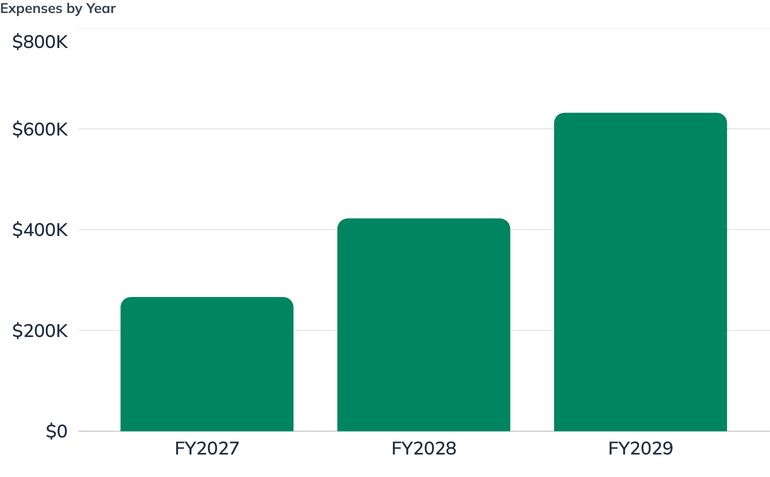
Direct costs are the cost of actually performing the work: field labor, chemicals, fuel, and payment processing. They total $109,398 in Year 1, $204,788 in Year 2, and $296,303 in Year 3.
Field labor is the dominant component and is treated as cost of goods sold rather than overhead, because it scales directly with jobs performed. Crew wages run $80,265 in Year 1, $144,536 in Year 2, and $196,530 in Year 3 before employer burden.
Cleaning chemicals and consumables are modeled at 7% of revenue, consistent with the industry norm that chemical cost stays under 10% of job price. We buy sodium hypochlorite, surfactants, and degreasers in bulk and mix at the shop rather than paying for pre-diluted product.
Fuel and job vehicle operating cost is modeled at 5% of revenue — realistic for a mobile service running two rigs across a 30-minute radius, and a direct argument for the route density discipline described in our Key Metrics.
Card and ACH processing at 2.5% of revenue, since essentially all residential and membership payments are collected electronically at the point of invoice.
Personnel and wages
All wages are set at or above prevailing Eugene-Springfield market rates. Oregon's standard-county minimum wage, which applies in Lane County, is $15.55 per hour as of July 1, 2026. Local market pay for pressure washing and comparable cleaning technician work in Eugene averages roughly $18.82 per hour, with a typical range of $16.15 to $20.53. We deliberately pay above that band, because turnover is the most expensive line item in this trade that never appears on a P&L.
Role | Wage | Timing |
|---|---|---|
Owner / General Manager | $48,000 → $66,000 → $96,000 annually | From launch |
Crew Lead, Rig 1 | $25.00/hr, rising to $27.56/hr by Year 3 | Hired November 2026 |
Exterior Cleaning Technician, Rig 1 | $20.00/hr, with reduced winter hours | Hired November 2026 |
Crew Lead, Rig 2 | $25.50/hr, rising to $26.78/hr | Hired March 2028 |
Exterior Cleaning Technician, Rig 2 | $20.00/hr | Hired April 2028 |
Office & Dispatch Coordinator (0.6 FTE) | $23.00/hr | Hired November 2028 |
All roles are W-2 employees. Employer burden — payroll taxes, Oregon workers' compensation, Paid Leave Oregon, and the statewide transit tax — is modeled on top of gross wages and runs approximately 20% of payroll, totaling $25,653 in Year 1, $42,107 in Year 2, and $67,276 in Year 3.
Owner compensation grows deliberately as the business stabilizes: a modest $48,000 in the launch year while cash is tight, $66,000 in Year 2, and $96,000 in Year 3 once two crews are producing. A founder salary held flat for three years while the business grows would not be a realistic plan.
Operating expenses
Operating expenses total $132,313 in Year 1, $182,937 in Year 2, and $297,366 in Year 3 including owner and administrative salaries and employer burden. The largest non-payroll items:
- Shop and yard lease — $1,300 per month at launch, rising to $1,400 by Year 3, for a 1,000–1,200 square foot West Eugene flex unit with a sanitary sewer floor drain
- Marketing — $14,500 in Year 1, $20,600 in Year 2, $27,600 in Year 3, weighted heavily toward the spring and summer peak and toward Local Services Ads and Google Ads. At roughly 4% of Year 3 revenue this is disciplined for a trade where acquisition costs now run $85 to $180 per customer
- Insurance — $450 per month at launch for general liability, commercial auto, and inland marine, rising to $780 per month once the second rig and second crew are in service. Workers' compensation is carried within payroll burden
- Software and subscriptions — $350 to $520 per month for Jobber, QuickBooks Online, Gusto, call tracking, and website hosting
- Professional fees — $450 to $650 per month for outside bookkeeping, CPA, and as-needed legal work
- Vehicle and equipment maintenance — $250 per month at launch rising to $600, plus spare pumps and hoses held in stock
- Wash water hauling and waste disposal, licenses, permits, and DEQ compliance — approximately $240 to $350 per month combined, the direct cost of the containment commitment that makes us bid-eligible on commercial work
Interest and depreciation
Interest expense on the SBA term loan and the Rig 2 equipment loan runs $12,126 in Year 1, $15,625 in Year 2, and $16,184 in Year 3. Depreciation on vehicles, trailers, and equipment runs $12,400, $18,819, and $22,029 respectively — non-cash, but a real signal that this equipment will need replacing on a schedule rather than at failure.
Profitability
Need real financials? We recommend using LivePlan as the easiest way to create financials for your own business plan.Create your own business plan
The shape of the three years
Year 1 (FY2027) | Year 2 (FY2028) | Year 3 (FY2029) | |
|---|---|---|---|
Revenue | $200,917 | $415,531 | $688,092 |
Gross margin | $91,519 (45.6%) | $210,743 (50.7%) | $391,788 (56.9%) |
Operating income | ($40,794) | $27,806 | $94,422 |
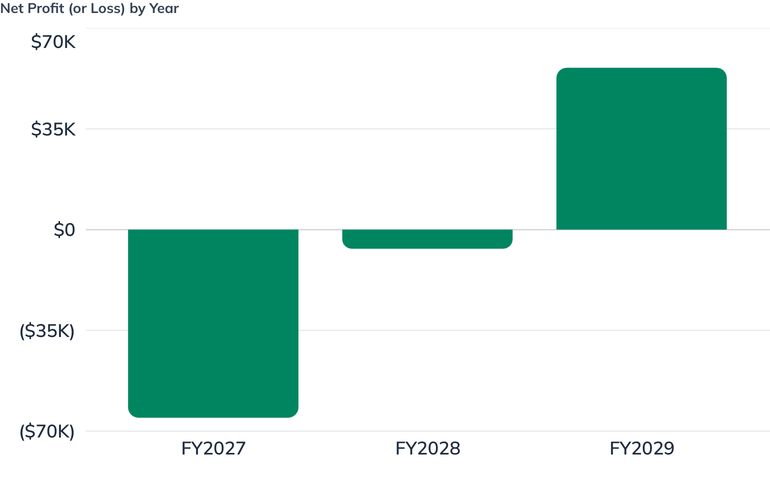
Net profit | ($65,320) | ($6,638) | $56,210 |
Ending cash | $53,165 | $49,617 | $106,455 |
Gross margin improves for structural reasons, not optimistic ones
Gross margin climbs from 45.6% to 56.9% across the plan. This is not a pricing assumption doing the work. It comes from three specific things: crew utilization improves as route density and membership scheduling reduce unbillable drive time; the higher-margin membership stream grows from 9% of revenue to 29%; and average job value rises as our mix shifts toward roof soft washing and full-property packages. The final figure sits comfortably inside the 45% to 65% range typical for well-run operators in this trade.
Year 1 is a planned loss
We forecast a net loss of $65,320 in the first year. This is what launching in October in the Willamette Valley costs: we carry a crew lead and a technician, a leased shop, insurance, and a marketing budget through five months of rain before the season that pays for them arrives. Attempting to show a profitable first year would require either understating the seasonality or pretending we can operate without employees, and neither would survive contact with reality.
The loss is fully funded. Our capitalization is sized so that cash never approaches zero at any point in the plan.
Cash flow turns before profit does
Monthly operating cash flow turns positive in May 2027, roughly seven months after launch, as the spring peak arrives and the membership base begins contributing. Cash on hand bottoms at $41,018 in May 2027 during the first year, recovers through the summer, and closes Year 1 at $53,165.
The plan's true low point is $27,851 in April 2028, driven by the Rig 2 purchase in February 2028 and the payroll of two new crew members hired ahead of the season they will serve. This is the deliberate risk in the plan and it is deliberately funded — the $59,000 equipment loan lands in the same month as the purchase, and cash begins climbing again from May 2028 forward. Cash on hand never goes negative in any month of the forecast.
Cash turning positive before net profit is the normal and expected pattern here: depreciation of $12,400 to $22,029 per year is a real charge against profit but not against the bank account.
Net profitability arrives in Year 3
We reach a small monthly net profit during the summer of 2027, fall back into loss through the following winter and the Rig 2 expansion, and turn durably net profitable in Year 3, closing at $56,210 — an 8.2% net margin.
Year 2 finishes at a near-breakeven loss of $6,638, which is the honest cost of expanding to a second crew mid-year. We could show a profitable Year 2 by deferring the second rig, but doing so would cap Year 3 at roughly the Year 2 revenue line. Taking a $6,638 loss to add $272,000 of Year 3 revenue is the correct trade, and it is a decision the plan makes explicitly rather than by accident.
What the owner actually earns
Net profit understates the owner's economics. Ryan draws a W-2 salary of $48,000, $66,000, and $96,000 across the three years, all of it already deducted above the net profit line. By Year 3 the business is producing $96,000 in owner compensation plus $56,210 in net profit — roughly $152,000 in combined owner economics — while carrying two fully equipped rigs and servicing both loans on schedule.
What would have to go wrong
The forecast is most sensitive to three things, in order. Membership conversion: if we convert members at half the modeled rate, Year 3 revenue falls by roughly $98,000 and net profit goes to zero. Crew retention: losing a crew lead in April costs a full peak season of that rig's production. Commercial contract wins: our first three contracts must land by March 2027 for the wet-season floor to exist at all.
Each of these is an execution risk within our control rather than a market risk outside it, which is why our Key Metrics track all three weekly.
Use of Funds
We are raising $185,000 in initial capitalization at launch, plus a $59,000 equipment loan in February 2028 to fund the second rig. Every dollar is allocated below.
Initial capitalization — October 2026 ($185,000)
Rig 1 capital equipment — $69,000
Item | Amount | Useful life |
|---|---|---|
Used 3/4-ton pickup truck with tow package | $29,000 | 7 years |
Enclosed 7' × 14' tandem-axle trailer | $9,500 | 7 years |
Pressure washing & soft wash equipment package — 5.5 GPM belt-drive commercial unit, hot-water skid, 12V soft wash system, rotary surface cleaner, 225-gallon buffer tank, hose reels and hoses | $19,000 | 5 years |
Wash water containment & vacuum recovery system — inlet protection, berms, containment mats, filtration media, vacuum recovery unit | $5,500 | 5 years |
Vehicle wrap, branding, ladders, fall protection and safety gear | $6,000 | 3 years |
The hot-water capability and the containment package together account for roughly $14,000 of this total. They are the two line items a cost-cutting founder would defer, and they are the two that make our entire commercial strategy possible. We are not deferring them.
Working capital and launch costs — $116,000
Item | Amount |
|---|---|
Shop lease security deposit | $3,600 |
Operating cash reserve to fund the Year 1 loss and seasonal trough | $92,400 |
Initial marketing launch — website build, Google Business Profile setup, Local Services Ads, vehicle signage, door hangers | $9,000 |
Business formation, CCB licensing, permits, first insurance premiums, legal and accounting setup | $6,000 |
Initial chemical and consumable inventory, spare pumps, hoses and fittings | $5,000 |
The operating cash reserve is the largest single use of funds, and intentionally so. A business that launches in October in the Willamette Valley must survive five months of rain before its first real season. Underfunding that gap is the most common way a well-run exterior cleaning company fails, and it is the reason we have sized capitalization above what the equipment alone requires.
Year 2 expansion — February 2028 ($59,000)
Item | Amount | Useful life |
|---|---|---|
Rig 2 — used pickup truck and enclosed trailer | $38,000 | 7 years |
Rig 2 — pressure washing and soft wash equipment, containment package, wrap and tools | $21,000 | 5 years |
Rig 2 is deliberately configured to match Rig 1 so that any technician can work either truck, any spare part fits either machine, and training is written once. The purchase is timed for February so the rig, the crew lead, and the technician are all in place and certified before the April peak — buying capacity in June means paying for it without earning from it.
Total sources and uses
Total funds raised across the plan | $244,000 |
Capital equipment and vehicles (both rigs) | $128,000 |
Security deposit | $3,600 |
Launch marketing, formation, licensing and inventory | $20,000 |
Working capital reserve | $92,400 |
Sources of Funds
Precision Power Wash is capitalized with a blend of owner equity and conventional small business debt. We are not seeking outside investors, and the ownership structure described in our Company chapter reflects that.
Owner equity contribution — $40,000
Ryan Halvorsen contributes $40,000 in personal capital at launch in October 2026, recorded as paid-in capital with no repayment obligation. This represents 22% of initial capitalization.
The size of this contribution matters for two reasons beyond the cash itself. SBA lenders expect meaningful owner injection on a startup — typically 10% to 20% of total project cost — and coming in above that band materially improves both approval odds and terms. And it puts the founder's own money at risk alongside the lender's, which is the correct alignment for a business whose success depends almost entirely on the founder's execution.
SBA 7(a) term loan — $145,000
A $145,000 SBA 7(a) term loan at 9.25% annual interest over 120 months, drawn in October 2026, with an initial three-month interest-only period before principal amortization begins.
The rate reflects current SBA 7(a) variable pricing for a loan of this size, which is set as a spread over the prime rate. The ten-year term is standard for an SBA loan financing a mix of equipment and working capital, and it deliberately keeps the monthly payment low enough to survive a Willamette Valley January. The three-month interest-only period covers our launch quarter, when the trucks are being outfitted and the first jobs are still ramping.
We expect to secure this loan through a Eugene-area SBA preferred lender or a local credit union with SBA lending authority. The loan will be secured by the vehicles and equipment it finances and backed by a personal guarantee from the owner. Interest expense totals $12,126 in Year 1, and the loan amortizes on schedule throughout the plan with no balloon.
Equipment loan — $59,000 (February 2028)
A $59,000 equipment loan at 9.75% over 60 months, drawn in February 2028 to finance Rig 2. Equipment financing is the right instrument here: the term matches the asset life, the collateral is the equipment itself, and the five-year amortization means the rig is paid off well before it needs replacing.
Drawing this in Year 2 rather than borrowing it up front is deliberate. There is no reason to pay interest for sixteen months on a truck we will not put into service until February 2028, and by that point we will have a real operating history to present to the lender rather than a projection.
Summary of sources
Source | Type | Amount | Terms | Timing |
|---|---|---|---|---|
Owner equity contribution | Equity | $40,000 | No repayment | Oct 2026 |
SBA 7(a) term loan | Debt | $145,000 | 9.25%, 120 months, 3-month interest-only | Oct 2026 |
Equipment loan — Rig 2 | Debt | $59,000 | 9.75%, 60 months | Feb 2028 |
Total | $244,000 |
Debt service and coverage
Total debt service across both loans runs approximately $22,300 in Year 1, $29,600 in Year 2, and $37,900 in Year 3. Against Year 3 operating income of $94,423 plus $22,029 of non-cash depreciation, that produces a debt service coverage ratio of roughly 3.1× — comfortably above the 1.25× minimum most SBA lenders require, and enough headroom that a soft season does not put us in technical default.
No dividends or owner distributions beyond salary are modeled during the three-year plan. Cash generated above operating needs stays in the business to fund the reserve, the Rig 2 down payment cushion, and eventually the third-crew decision at the end of Year 3.
Projected Statements
Frequently Asked Questions
A pressure washing business plan should define your service area and the surfaces you'll clean, which cleaning method each one gets, how you'll price and schedule work across a seasonal calendar, your licensing and wash-water compliance approach, and financials covering equipment, working capital, and a realistic path to profitability. Precision Power Wash's plan, for example, pairs a 30-minute service radius around Eugene and Springfield with three revenue streams and a two-rig equipment buildout, and models the first year honestly as a planned $65,320 loss because launching in October means carrying a crew through five months of rain before the paying season arrives. It also sizes the operating cash reserve — $92,400, the single largest use of funds — specifically so that gap is funded rather than survived.
Precision Power Wash is capitalized at $185,000 at launch. Roughly $69,000 goes to the first rig — a used 3/4-ton pickup at $29,000, an enclosed tandem-axle trailer at $9,500, a $19,000 equipment package with a 5.5 GPM belt-drive unit, hot-water skid and 12V soft wash system, a $5,500 wash-water containment and vacuum recovery system, and $6,000 in wrap, ladders, and fall protection. The remaining $116,000 is working capital and launch costs, dominated by a $92,400 operating cash reserve. A second rig follows in February 2028 for $59,000, financed separately rather than borrowed up front.
In Eugene the wash water is the regulated part, and Precision Power Wash treats it as a competitive advantage rather than a burden. Eugene Code 6.446 requires water from commercial cleaning involving soaps, detergents, or heated water to be collected and discharged to a vegetated area or the sanitary sewer rather than the storm drain, so every applicable job runs with inlet protection, berms, and vacuum recovery to an approved discharge point — documented. The company also carries Oregon LLC registration, Eugene and Springfield business registrations, an Oregon CCB license where scope requires it, workers' compensation, and general liability at $1,000,000 per occurrence — the threshold most local property management firms require before adding a vendor.
Precision Power Wash forecasts three streams with deliberately different rhythms. One-time residential jobs are the largest and the customer acquisition engine, at an average job value of $425 rising to $478 and volume growing from 320 to 780 jobs a year. Valley Green Guard memberships bill monthly at $59 to $65 and are converted at the point of invoice, reaching an active base of roughly 250 by Year 3. Commercial contracts with property managers, HOAs, and restaurant groups average $850 to $925 per scheduled service, and together with memberships they grow from 32% of revenue in Year 1 to 46% by Year 3.
Precision Power Wash plans for a $65,320 net loss in Year 1, narrowing to $6,638 in Year 2 before reaching $56,210 of net profit in Year 3 on $688,092 of revenue. Cash turns well before profit does: monthly operating cash flow goes positive in May 2027, about seven months after launch, as the spring peak arrives and the membership base begins contributing. The plan's true low point is $27,851 in April 2028, driven by the second rig purchase and two new crew members hired ahead of the season they serve — deliberately timed to land in the same month as the $59,000 equipment loan, so cash never goes negative in any month of the forecast.
Soft washing applies a sodium hypochlorite and surfactant blend through a 12V system at under 100 PSI — roughly garden-hose pressure — so the chemistry kills moss and algae at the root instead of blasting it loose to regrow in four months. High pressure is the right tool for concrete, pavers, and masonry, and the wrong one for composition roofs, cedar, stucco, and painted siding, where it strips granules, furs the grain, and drives water into the building envelope. Precision Power Wash makes soft washing the default rather than an upsell, and trains every technician to say which method a surface is getting and why before starting — a direct response to a market where low-bid operators put 3,000 PSI on everything.
Precision Power Wash targets two buyers with entirely different logic. Its primary residential customer is an equity-protective homeowner aged 40 to 70 in an owner-occupied Eugene or Springfield house valued from about $400,000 up, with household income of $85,000 and above against a local median of $66,562 — someone buying protection of their largest asset and the removal of a chore involving a ladder in the rain, which is why they convert well to an annual membership. On the commercial side, property managers, HOAs, multifamily owners, restaurant groups, and retail centers buy scheduled, documented, insured work with photo proof they can forward to an owner or board, and a single relationship yields dozens of addresses.
This is the central design problem in the plan, because Eugene's December through February residential volume runs at roughly a quarter of the April-through-August peak. Precision Power Wash attacks it from three directions: commercial route work that barely dips in winter, the Valley Green Guard membership base that bills in January as reliably as in July, and a launch capitalization sized to fund the gap outright rather than hope through it. The target is recurring revenue reaching 40% of monthly revenue by September 2028, at which point the wet-season cash trough stops being a going-concern risk — which is a different strategy from the local competitors who mostly sell transactional jobs and compete for the same summer leads at an acquisition cost that has climbed to $85 to $180.

Business Plan Outline
Start your plan