





Evergreen Power & Light



Business Plan Summary
This electrical contractor business plan example features Evergreen Power & Light, a residential electrical company opening in January 2027 from a shop and yard in the Deer Valley corridor of North Phoenix — a market where more than half of Maricopa County's single-family homes were built before 2000 on 100- and 125-amp services that were never sized for two heat pumps, an EV charger, and an induction range. It covers the capacity-and-resilience specialty that defines the company — 200-amp service and panel upgrades, EV charging, dedicated heat-pump circuits, and battery backup — delivered on published flat-rate pricing and two-hour arrival windows, plus the Evergreen Home Circuit membership that turns one-time service calls into recurring relationships. It also details the Arizona ROC R-11 licensing structure with a master electrician as qualifying party, a two-van launch growing to a six-van fleet and twelve people by 2031, and a $525,000 capitalization pairing $125,000 of owner equity with a $400,000 SBA 7(a) term loan, with five-year projections taking revenue from $895,753 to $2,702,319. Use it as inspiration for your own plan. Download a free business plan template to get started, or browse more business plan examples.
Evergreen Power & Light
Executive Summary
Evergreen Power & Light is a residential electrical contracting company serving the Phoenix metropolitan area from a shop and yard in North Phoenix. We specialize in one thing the Valley needs more of every year: bringing older homes up to the electrical capacity modern life demands. Service and panel upgrades, dedicated circuits, EV charging, whole-home surge protection, and battery backup are our core work, delivered on flat-rate pricing that the customer sees before we start.
We open in January 2027 under the ownership of Carlos Rojas, a master electrician with fourteen years in the Valley trade, and Nadia Rojas, who runs operations and finance. The company holds an Arizona Registrar of Contractors R-11 residential electrical license with Carlos as qualifying party, and will add the C-11 commercial classification in 2029 so we can serve small commercial and property-management accounts alongside our residential work.
The opportunity. More than half of Maricopa County's single-family housing stock was built before 2000, much of it with 100- and 125-amp services that were never designed for two heat pumps, an EV in the garage, an induction range, and a home office. Phoenix summers are getting longer and hotter, APS and SRP rates are climbing, and the federal residential solar tax credit expired at the end of 2025 — which has shifted homeowner spending away from speculative rooftop arrays and toward the durable, non-negotiable work of making the house itself capable and resilient. That is precisely where we operate.
What makes us different. Three things. First, published flat-rate pricing: every common job has a price on our website, and the technician quotes from the same book in the driveway. Second, scheduling that respects the customer's day — online booking, two-hour arrival windows, live technician tracking, and same-day availability held open every weekday. Third, a heat-resilience specialty: we are the company that understands what 115-degree afternoons do to a service panel, an attic-run circuit, and a homeowner's tolerance for an outage, and we design and sell around that reality.
How we grow. We launch with two service vans and a five-person team, and add one van and the crew to staff it in each of the following four years, reaching a six-van fleet and twelve people by 2031. A battery-storage and EV-charging installation capability layers on top of the service business as it matures. Recurring revenue comes from the Evergreen Home Circuit membership — an annual safety inspection, priority scheduling, and a standing discount — which we begin selling on the first service call and which anchors our repeat business.
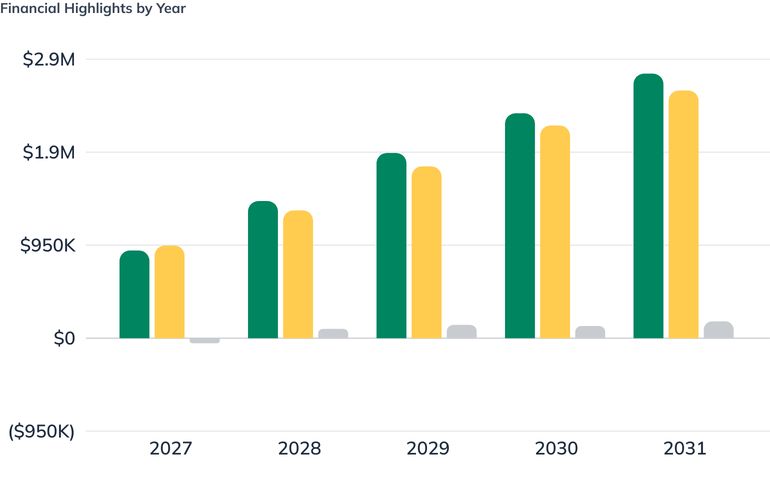
Where this ends up. Revenue reaches $895,753 in 2027 and $2,702,319 by 2031. The first year runs a planned loss of $51,402 as we build review volume and market position; the business turns its first profitable month in June 2027 and is profitable in every full year from 2028 on, earning $171,982 in 2031. Cash never drops below $102,330 — the low point comes in April 2028, just after we buy the third van — and finishes the horizon at $432,426.
What we need. Evergreen Power & Light is launching with $525,000 in startup capital: $125,000 of owner equity from the founders and a $400,000 SBA 7(a) term loan at 9.75 percent over ten years, covering $257,000 of vehicles, tooling, and startup assets plus $268,000 of working capital through the ramp. The full use and sources of funds are detailed in the Financial Plan.
Need real milestones? We recommend using LivePlan as the easiest way to create milestones for your own business plan.Create your own business plan

Opportunity
Problem Worth Solving
Phoenix homes are being asked to carry electrical loads their wiring was never designed for, and the gap is widening every year.
The houses are old and the loads are new. Maricopa County's residential building boom ran hardest from the 1970s through the early 2000s. Homes from that era were typically built with 100- or 125-amp services, aluminum branch wiring in some vintages, and load centers from manufacturers that no longer make replacement breakers. Those services were sized for one air conditioner, a gas range, and a television. They are now being asked to carry a variable-speed heat pump, a second mini-split in a converted garage, a Level 2 EV charger, an induction cooktop, a pool pump on a longer schedule, and a home office running all day. When a homeowner calls an installer for any one of those upgrades, the answer that comes back is frequently "your panel can't take it" — and that is where the project stalls.
Heat has turned an inconvenience into a safety issue. Phoenix now routinely runs long stretches of 110-degree-plus afternoons. Heat accelerates the degradation of connections, breakers, and insulation, and it means an electrical failure during a summer peak is not a comfort problem but a health one. Homeowners understand this intuitively; what they lack is a contractor who will inspect, explain, and prioritize the work rather than sell them the biggest available ticket.
Utility economics are pushing people to act. APS and SRP have both moved rates upward and restructured export compensation, with APS exporting at roughly $0.0617/kWh and SRP near $0.0345/kWh on 2026 schedules. At the same time, the federal residential clean energy credit that covered 30% of a homeowner-owned solar system expired December 31, 2025. The result is a market where the old "just put solar on it" answer no longer pencils the way it did, and homeowners are redirecting that budget toward things with a clearer payback and a clearer necessity: capacity, backup, efficiency, and resilience. The industry expects roughly an 18% contraction in owner-purchased residential solar installations in 2026 even as residential battery storage continues to grow sharply.
The trade cannot keep up, and customers feel it. The United States needs roughly 81,000 new electricians a year through 2034 against a workforce of about 818,700, and close to 30% of union electricians are between 50 and 70 years old. In a fast-growing market like Phoenix, the practical consequence for a homeowner is a two-week wait for a callback, a four-hour arrival window that gets missed, a verbal price that changes on the invoice, and no clear explanation of what was actually wrong. The complaint we hear most is not about price. It is about not being able to get anyone to show up, tell the truth, and finish the job.
And the trust gap is real. Electrical work is the definition of an information asymmetry: the customer cannot evaluate the diagnosis, cannot price the parts, and cannot tell a necessary upgrade from an upsell. Arizona ROC complaint volumes and consumer-review patterns in the Valley both reflect it. A residential electrical company that removes the pricing ambiguity and the scheduling uncertainty is solving the part of the problem customers actually experience.
Our Solution
Evergreen Power & Light is a residential electrical service company built around capacity, resilience, and transparency. We do the work that makes a Phoenix house capable of carrying a modern load and staying safe through a Valley summer — and we do it on published prices and scheduling the customer can count on.
Our service lines
Service and repair. Diagnostics, troubleshooting, outlet and switch repair, GFCI/AFCI corrections, aluminum wiring remediation with COPALUM/AlumiConn connectors, recessed and outdoor lighting, ceiling fans, and code corrections for home sales. This is the front door of the business and the source of most of our customer relationships.
Service and panel upgrades. Replacing 100- and 125-amp services with 200-amp equipment, including meter combos, mast and grounding work, whole-home surge protection, and coordination with APS or SRP for the disconnect and reconnect. We handle the permit with the City of Phoenix, Scottsdale, Mesa, Glendale, Chandler, or Peoria as the address requires, and we manage the utility scheduling so the homeowner does not have to.
EV charging. Level 2 charger installation with proper load calculation, dedicated circuits, and — where the panel is tight — load-management devices such as the DCC-12 or a smart splitter that let us add charging without a full service upgrade. We install customer-supplied units and stock Emporia, Wallbox, and Tesla Universal chargers.
Heat-resilience work. Dedicated circuits for heat pumps, mini-splits, and second-stage cooling; attic and garage circuit remediation where heat has degraded connections; whole-house fan and ventilation circuits; and pre-summer inspections that catch failing breakers and loose lugs before a July afternoon does.
Battery backup and storage. Whole-home and partial-home battery installation — Enphase IQ, Tesla Powerwall 3, and FranklinWH — including retrofits onto the very large installed base of Valley homes that already have solar but no storage. We enroll qualifying customers in the APS battery rebate program, which currently offers up to $3,750, and in utility virtual power plant programs where they are available.
Solar, on the right terms. We do not chase owner-purchased rooftop solar in a market where the federal credit has expired. We install solar as an add-on to storage work, and we partner with a third-party ownership provider for customers who want a lease or PPA — a structure that still carries a federal credit through 2027 — rather than pressuring homeowners into a cash purchase whose economics have changed.
How the offer is built
Flat-rate, published pricing. Our common jobs are priced on our website. The technician quotes from that same book on a tablet in the driveway, presents good/better/best options in writing, and the customer approves with a signature before any work begins. There is no hourly meter running and no invoice surprise.
Scheduling that holds. Customers book online or by phone, receive a two-hour arrival window, and get a text with the technician's name, photo, and live location. We hold two same-day slots open every weekday for emergencies, and we run a Saturday crew from May through September.
Diagnose, document, prioritize. Every service call includes a documented panel and safety check with photos, and the customer receives a written summary marking findings as urgent, recommended, or monitor. We quote all three tiers and let the customer decide. This is how we build a repair-to-upgrade pipeline without pressure selling.
Evergreen Home Circuit membership. An annual plan that includes a full electrical safety inspection, a pre-summer heat readiness check, priority scheduling, no diagnostic fee, and a standing discount on repairs. It converts one-time service customers into a recurring relationship and gives us a book of business to schedule against in slower months.
Warranty. Two years on labor for repairs, five years on service upgrades, and full manufacturer warranty registration handled by our office on every piece of equipment we install.
Target Market
We serve homeowners in the Phoenix metropolitan area, working a service radius of roughly 35 minutes from our North Phoenix shop. That covers North Phoenix and Deer Valley, Scottsdale and Paradise Valley, Glendale and Peoria, Tempe, Mesa, Chandler, and the closer parts of Gilbert and Surprise.
Market context
Maricopa County remains one of the fastest-growing large counties in the United States, and Greater Phoenix has been ranked among the top ten U.S. markets to watch for 2026 on the strength of manufacturing, semiconductor, and data-center investment. Growth matters to us less for the new-construction work — which is largely locked up by production-builder contracts we do not want — than for what it does to the existing housing stock: rising home values, high renovation activity, an active resale market that generates inspection-driven repair work, and a steady stream of new arrivals buying 25-year-old houses and immediately upgrading them.
The Valley's housing stock is the core asset of our market. A large majority of owner-occupied single-family homes in the metro predate 2005, and the 1970s–1990s tranche in Phoenix, Glendale, Tempe, Mesa, and central Scottsdale is exactly the vintage that arrives at our door: original panel, marginal service size, and a homeowner who wants an EV charger, a casita circuit, or a heat-pump conversion.
Primary segments
Segments here describe who is buying and why. They cut across our revenue streams rather than mapping one-to-one onto them — a capacity upgrader typically arrives as a service call and leaves as a panel upgrade — so the shares below are directional, not a restatement of the revenue forecast.
The capacity upgrader (roughly 40% of revenue). Homeowner, 35–60, household income $110,000+, owns a home built between 1975 and 2005, and has hit a wall: the panel won't take the EV charger, the mini-split, or the pool equipment. This customer is not shopping on price alone — they are shopping on whether the contractor can actually get it done, handle the utility, and pass inspection. Panel upgrades and EV installations together run about 39% of forecast revenue over five years, which is where this segment principally lands.
The service-and-repair homeowner (roughly 35% of revenue). Any age, any vintage of home, calling because something stopped working — a dead circuit, a tripping breaker, a scorched outlet, a failed pool timer. Their decision criteria are speed and trust, in that order. This is our highest-volume segment and the top of our funnel: a well-run repair call is what earns the panel upgrade six months later. Service and repair is 39% of forecast revenue; a portion of that is the first visit from customers who ultimately belong to the segments above and below.
The resilience and backup buyer (roughly 17% of revenue). Higher-income households, often in Scottsdale, Paradise Valley, Arcadia, and North Phoenix, who already have solar or are adding it, and who want battery backup because a summer outage is a genuine hazard. They are motivated by reliability first and economics second, and they respond to utility rebate and VPP enrollment as a reason to move now. Battery storage is 17% of forecast revenue.
Real estate agents, property managers, and home inspectors. Not the end customer, but a referral segment that produces steady, schedulable work: pre-listing corrections, inspection-item repairs, and post-close upgrades on a closing deadline. Their volume is forecast inside the service and upgrade streams rather than separately. Margins are slightly thinner, but the work is predictable and the referral relationships compound.
Who we do not serve
We do not bid new-construction tract housing, and we do not pursue large commercial or industrial projects. Both require crew scale and bonding capacity that compete directly with the service business for people, and both pay on terms that would strain a young company's cash. We will take on small commercial service work — restaurants, offices, retail, and property-management portfolios — from 2029, once the residential service operation is stable and we hold the C-11 classification. That work is forecast inside our existing service and panel upgrade streams rather than as a separate revenue line, because it is the same work performed for a different kind of customer, and because we would rather under-promise it in the model than build a growth plan on a market we have not yet served.
Why this market rewards our model
The segments above overlap in one important way: they all buy on availability and trust rather than on the lowest bid. In a market where the binding constraint is licensed labor rather than customer demand, a company that shows up when it says it will, prices in writing, and keeps its technicians long enough to get good at the work can grow steadily without ever winning a race to the bottom on price.
Competition
The Phoenix residential electrical market is crowded but not consolidated. The Arizona Registrar of Contractors lists thousands of active residential electrical licenses statewide, the overwhelming majority of them one- and two-truck operations. Competition falls into four groups, each with a predictable weakness.
National and regional home-service platforms. Companies such as Parker & Sons, George Brazil, and Penguin Air run combined HVAC, plumbing, and electrical operations across the Valley, most under private-equity or strategic ownership. They have real advantages: heavy brand spending, 24/7 dispatch, financing at the door, and enough trucks to guarantee same-day service. Their weakness is the model itself — commissioned sales, aggressive replacement recommendations, and technician turnover that makes consistency hard. They have trained a large share of Valley homeowners to be suspicious of electrical quotes, which is a market condition we can convert.
Established independent electrical contractors. Firms in the five-to-fifteen-truck range with fifteen or more years in the Valley, strong reputations, and loyal repeat customers. These are our most direct competitors and the standard we are aiming at. Their common gaps are operational rather than technical: dated scheduling and communication, quoting that still happens by phone the next day, thin online presence, and owner-dependence that caps how fast they can grow. Several are also approaching succession, which will move work in the market over the next five years.
Solar-first installers. Companies built during the 30% federal-credit era, now facing an owner-purchased residential solar market expected to contract roughly 18% in 2026 following the expiration of the 25D credit. Many are pivoting toward battery storage and third-party-ownership models, and some are adding electrical service work they are not well set up to perform. They compete with us for storage projects, but they generally lack a service and repair operation to fall back on — which makes their revenue lumpy and their crews hard to retain.
Handymen and unlicensed operators. Cheapest on the invoice, and a persistent presence on neighborhood Facebook groups and Nextdoor. They cannot pull permits, cannot legally do work above the ROC's handyman exemption threshold, and cannot get a service upgrade inspected or a utility reconnect scheduled. They take low-end work from us and occasionally create work for us when a homeowner needs a failed job corrected before a sale closes.
Our competitive position
We compete on three things and deliberately not on price.
Transparency. Published flat-rate pricing and written good/better/best options remove the single biggest source of friction in this trade. Very few Valley competitors publish prices at all.
Reliability. Two-hour arrival windows, live technician tracking, and held-open same-day slots address the complaint homeowners actually voice. Operations, not marketing, is the moat here.
Specialization. We are the Valley company that understands heat, capacity, and backup as one connected problem. A generalist home-service platform sells a panel upgrade as a product; we sell it as the answer to a load calculation the customer can see.
Barriers to entry and how we hold position
The binding constraint in this business is licensed labor, not customers. With roughly 81,000 new electricians needed nationally each year through 2034 and close to 30% of the union workforce within retirement range, the companies that grow are the ones that can hire and hold journeymen. Our answer is to pay at or above the Phoenix market rate rather than at the bottom of it, run a real apprenticeship track with paid exam preparation and license fees, and build a schedule and a truck standard that experienced technicians actually want to work in. Wage competitiveness is a retention strategy in this market, and we have modeled it as one.
We are also aware of our own vulnerabilities. We start with no brand and no review history in a market where reviews drive lead flow; we depend heavily on our founder's license as the ROC qualifying party; and our storage line is exposed to changes in utility rebate and export policy. The Financial Plan builds a working-capital cushion for the ramp, and our service-first mix keeps us from depending on any single incentive program.
Execution
Marketing Plan
Our marketing is built on a simple premise: in residential electrical, the customer is not browsing. They have a problem right now, they are searching for someone who can come today, and they will choose based on proximity, reviews, and whether the price is knowable before the truck arrives. Nearly all of our spend goes to being findable at that moment and to making the second call cheaper than the first.
Local search is the foundation. Google Business Profile is our single most important marketing asset. We build out complete profiles for the primary service areas — Phoenix, Scottsdale, Glendale, Peoria, Tempe, Mesa, Chandler — with weekly photo posts from real jobs, full service and attribute listings, and an active Q&A. Our website is built on service-area landing pages targeting the searches that actually convert ("200 amp panel upgrade Phoenix," "EV charger installation Scottsdale," "electrician near me open now"), each with the flat-rate price range published on the page. Local SEO, schema markup, and page speed get ongoing attention because organic and map-pack leads carry no per-lead cost and compound over time.
Reviews are the campaign. Every completed job triggers an automated review request by text within an hour of the technician leaving, sent while the customer is still standing in a room where the lights work. The technician is trained to ask in person first; the automation only follows. We respond to every review, positive or negative, within 24 hours. Our target is a 4.8-plus rating and a steady cadence of new reviews rather than a burst, because recency is what the map pack rewards. Reviews also feed everything else — they are the proof in our ads, on our landing pages, and in our estimates.
Paid search and Local Services Ads. Google Local Services Ads (Google Guaranteed) run from day one, since they charge per lead and sit above the map pack for exactly the high-intent searches we want. Paid search supplements with tightly scoped campaigns on emergency and high-value job terms, with call tracking on every number and negative-keyword lists that keep us out of commercial, industrial, and DIY traffic. Budgets shift seasonally: heavier in May through September when heat drives failures, lighter in the shoulder months where we lean on membership and referral work instead.
Neighborhood and community presence. Nextdoor and neighborhood Facebook groups drive real volume in Valley communities, and they reward participation over advertising. We sponsor a small number of HOA newsletters and community events in the 1980s–1990s neighborhoods that match our target vintage, and our vans are wrapped as mobile signage — a van parked in a driveway for four hours in a target neighborhood is one of the highest-return marketing assets we own.
Partner referral network. We build standing relationships with real estate agents, home inspectors, property managers, HVAC contractors, EV dealerships, and solar companies that need a licensed electrician for capacity work. HVAC and solar partners are especially valuable, because their job frequently stalls on a panel that cannot carry the new equipment — which is our highest-value work arriving pre-qualified. We reciprocate referrals, respond to partner requests within one business day, and treat that response time as the product.
Content that answers the question the customer is actually asking. Short, specific pieces on our site and YouTube channel: what a 200-amp upgrade costs in Phoenix and why, how to tell whether your panel can take an EV charger, what the APS battery rebate covers, why breakers trip more in July. We use AI tools to draft and repurpose this content efficiently, but every piece is reviewed by Carlos before it publishes — accuracy in this trade is a safety matter, not a style preference.
Retention marketing. Our customer list is the cheapest lead source we will ever have. Quarterly email and text campaigns go to past customers: pre-summer heat readiness checks in April, membership renewal reminders, and follow-ups on the "recommended" and "monitor" items documented on their last visit. Deferred work from a documented inspection is the highest-converting lead we generate, and it costs us nothing to reach.
Budget. Marketing runs at 7.5% of revenue in the launch year while we build review volume and search position, then steps down to 6.0% in 2028 and 5.0% by 2031 as organic, membership, and referral sources carry more of the load — inside the 5–8% band that benchmark data identifies as healthy for residential electrical contractors. Every channel is measured on cost per booked job and cost per acquired customer, not on impressions.

The Sustainable Estate Owner
Robert Sterling
Robert lives in an expansive Paradise Valley home built in the late 1990s that is beginning to show its age electrically. As a high-earning executive, he is less concerned with the lowest bid and more focused on integrating premium, high-tech solutions like smart panels and EV charging for his luxury fleet.
Age
58
Location
Paradise Valley, AZ
Family Status
Married, empty nesters
Education
MBA from Arizona State University
Profession
Executive at a Semiconductor Manufacturing Firm
Opportunities
- Upsell premium SPAN smart panels (priced $7,000-$9,500) to provide high-end energy management and visibility for his large estate.
- Install multi-port Level 2 charging stations with custom wiring to support a growing collection of high-performance electric vehicles.
- Design a comprehensive solar and battery backup system to ensure zero downtime for his home office and security systems.
Pain Points
- Frustrated by contractors who do not show up on time or provide professional written quotes
- Existing 200-amp panel is maxed out, preventing the addition of a new guest house (casita) circuit
- High utility bills from cooling a large, older home during Phoenix summers
Needs
- A contractor with a C-11 classification that can handle complex residential service work
- Reliable energy storage to protect against grid instability during peak heat
- Transparent, high-touch communication and project management
“I'm not looking for the cheapest guy in the Valley; I'm looking for the one who will do it right the first time so I don't have to think about it again.”
The Tech-Forward Renovator
David Nguyen
David recently purchased a 1984-built home in Scottsdale, capitalizing on the active resale market. He is a remote worker who is immediately upgrading the 'core assets' of the house, including a full electrical overhaul to support his new EV and solar aspirations before tax credits expire.
Age
38
Location
Central Scottsdale, AZ
Family Status
Married, 2 children (ages 4 & 6)
Education
B.S. in Computer Science
Profession
Remote Software Engineer
Opportunities
- Market Level 2 charger installations ($1,645 average) to be completed before the 30C tax credit expires in June 2026.
- Offer a seamless bundle that includes a 200-amp service upgrade and solar installation to maximize the $20,000 average project value.
- Create 'New Move-In' packages that address common 1980s home issues like marginal service size and outdated outlets.
Pain Points
- Pressure to complete upgrades before the June 2026 EV tax credit deadline
- The 82-day median 'days on market' for his previous home has made him very sensitive to project timelines
- Original 1984 wiring cannot handle his home office equipment and a Level 2 charger simultaneously
Needs
- Fast response times for quotes (similar to the 10-minute response standard set by competitors)
- Contractors who can navigate the SRP interconnection process efficiently
- Digital-first communication, including written quotes and online scheduling
“I bought this house knowing it needed work, but I didn't realize the electrical panel was a ticking time bomb for my tech gear.”

The Legacy Homeowner
Martha Jenkins
Martha has lived in her Moon Valley home since 1978 and is part of the 28% of the neighborhood's senior population. She is focused on safety and home longevity, needing to upgrade her original Federal Pacific panel to accommodate a modern heat-pump conversion.
Age
72
Location
Moon Valley, Phoenix, AZ
Family Status
Widowed, 3 adult children
Education
Master of Education
Profession
Retired Public School Administrator
Opportunities
- Offer comprehensive electrical safety inspections to identify fire hazards in 40+ year old wiring systems common in Moon Valley.
- Provide specialized panel upgrades ($2,500-$5,500) specifically designed to support new energy-efficient HVAC systems.
- Position electrical upgrades as essential maintenance to maintain her home's value in a market where 44% of listings are seeing price cuts.
Pain Points
- Fear of electrical fires due to outdated 'Zinsco' or 'Federal Pacific' panels common in her vintage of home
- Confused by the technical jargon used by national solar 'salesmen' who knock on her door
- Difficulty finding trustworthy local labor that respects her home and time
Needs
- Patient, clear explanations of what work is being done and why it is necessary for safety
- Assistance navigating the new 2026 instant solar permitting process in Maricopa County
- A reliable local company that won't disappear after the installation is complete
“This house has been my home for forty years. I want to make sure it's safe and efficient for whoever inherits it next.”
Sales Plan
Selling residential electrical work happens in the driveway, not in a conference room. Our sales process is designed so that the technician standing in the customer's garage has everything needed to diagnose, price, present, and close — and so that the customer never has to wonder what a job will cost.
The call. Every inbound call is answered by a live person during business hours and by our after-hours service outside them, with a target of answering within three rings and never sending a customer to voicemail during the day. The booking script captures the address, the symptom, the age of the home, panel brand and size if the customer can see it, and whether there is any burning smell or visible damage — which routes the call to same-day emergency dispatch. Online booking runs in parallel for customers who would rather not call, and both paths land in the same dispatch board.
The visit. The technician arrives inside a two-hour window after a text with their name and photo. Every service call begins the same way: diagnose the stated problem, then walk the panel and the home's major circuits and document the condition with photos. The customer gets a written summary organized as urgent, recommended, and monitor — with a photo attached to each finding. Nothing on that list is presented as mandatory unless it is genuinely a safety issue, and we say plainly which is which.
The quote. Pricing comes from our published flat-rate book on the technician's tablet. Every job is presented as three written options — a repair-only good option, a repair-plus-related-work better option, and a best option that addresses the underlying capacity or condition issue — with the price of each visible side by side. The customer signs on the tablet to approve. Because the price is the same price on our website, there is nothing to negotiate and no reason for a technician to shade a number to close a sale.
Financing. For projects above roughly $2,500 — service upgrades, whole-home rewires, battery installations — we offer third-party consumer financing through Wisetack or a comparable provider, presented as a monthly figure alongside the cash price. Financing availability is the difference between a panel upgrade happening now and happening next year, particularly for the capacity-upgrader segment.
Compensation that does not corrupt the recommendation. Technicians are paid a competitive hourly wage at or above the Phoenix market rate, plus a performance bonus tied to a blended set of measures — membership sign-ups, review count and rating, callback rate, and revenue — rather than straight commission on ticket size. We are explicit about this with customers, because the single fastest way to differentiate from the large home-service platforms in this market is to be able to say honestly that our technician does not earn more by recommending more.
The membership close. Every service call includes an offer of the Evergreen Home Circuit membership, presented as the way to make the diagnostic fee disappear and get priority scheduling next summer. It is a low-friction ask at the end of a job the customer is happy with, and our target is to convert a meaningful share of first-time service customers into members.
Larger projects. Service upgrades, storage installations, and whole-home rewires are quoted on-site the same day whenever possible, with the permit application and utility coordination started by our office within one business day of approval. For battery and solar-adjacent work, Carlos performs a load calculation and a site assessment before quoting, and we run the APS rebate or VPP enrollment paperwork on the customer's behalf.
Follow-up. Unsold "recommended" items go into a follow-up queue in ServiceTitan with a scheduled touch — 30 days, 6 months, and the following spring. Quoted-not-sold projects get one call and one text, not a pursuit campaign. Deferred work converts at a far better rate than cold marketing, and it costs us a reminder.
Locations & Facilities
Evergreen Power & Light operates from a leased shop-and-office suite in the Deer Valley industrial corridor of North Phoenix, near the I-17 and Loop 101 interchange. The location was chosen for drive time rather than visibility: from Deer Valley our vans can reach North Phoenix, Glendale, Peoria, Scottsdale, and central Phoenix inside 30 minutes, and Tempe, Mesa, and Chandler inside 45 in typical traffic. We are a dispatch business, not a retail one — no customer ever needs to visit us, so we pay for freeway access and yard space instead of a storefront.
The facility. Roughly 2,500 square feet of flex industrial space: a grade-level roll-up bay for loading and van maintenance, warehouse space for material inventory and staged equipment, a small parts room, and about 600 square feet of finished office for dispatch, administration, and a training and toolbox-talk area. A fenced, gated yard holds vans overnight, along with the trailer, ladders, and conduit racks.
Why we lease rather than buy. A young service company's capital belongs in vans, tools, inventory, and payroll, not in real estate. Flex industrial space in the Deer Valley and North Black Canyon corridors is readily available on three-to-five-year terms, which gives us room to relocate to a larger building in 2031, once the fleet reaches six vans and the yard and warehouse are genuinely full. We negotiate a lease with a renewal option and enough electrical service in the building to support van charging if we add an electric service vehicle.
Security and inventory control. Copper, tooling, and battery equipment are theft targets. The building has monitored alarm and camera coverage, the yard is fenced and gated with camera coverage of the van parking, and vans are equipped with GPS and lockable interior cabinets. Higher-value inventory — batteries, inverters, EVSE units, and switchgear — is stored inside the warehouse rather than on the trucks, and issued against a specific job.
Warehouse and material flow. We stock a working inventory of common material: breakers for the panel brands most prevalent in Valley homes, 200-amp load centers and meter combos, wire, conduit and fittings, devices, surge protectors, and a small number of EVSE units. Vans are restocked each morning from a par-level list managed in ServiceTitan, so technicians start the day loaded rather than starting the day at a supply house. Special-order and project material — batteries, inverters, custom switchgear — is drop-shipped or picked up from our primary suppliers (Rexel, CED, and Platt branches along the I-17 corridor) and staged in the warehouse against a scheduled job.
Service territory. Our committed service area covers roughly a 35-minute radius: Phoenix, Deer Valley, Anthem, Glendale, Peoria, Scottsdale, Paradise Valley, Tempe, Mesa, Chandler, and the nearer parts of Gilbert, Surprise, and Goodyear. We do not travel to Casa Grande, Prescott, or Tucson. Dispatch is zoned so that each van works a geographic cluster during a given day, which is what keeps drive time — the largest hidden cost in a service business — under control.
Working conditions. Attics in a Phoenix summer regularly exceed 150 degrees, and heat safety is a real operational constraint, not a formality. Attic and roof work is scheduled for early morning from May through September, vans carry water and electrolyte supplies, and our heat-illness protocol includes mandatory rest cycles and a hard stop rule that any technician can invoke without discussion. This is both a safety obligation and a retention advantage in a market where crews leave companies that ignore it.
Regulatory footprint. We are licensed by the Arizona Registrar of Contractors under the R-11 residential electrical classification, with the C-11 commercial classification planned for 2029. We carry the ROC-required license bond, general liability, commercial auto, and workers' compensation coverage. We hold a City of Phoenix transaction privilege tax license and register in the other municipalities where we regularly pull permits; TPT on prime contracting receipts is built into our published prices and accounted for within direct costs. Permits are pulled through each jurisdiction's online portal, and utility coordination runs through APS and SRP builder-services channels.
Technology
Our technology stack is chosen to do two things: make the customer's experience feel effortless, and let a small office team run a growing fleet without adding administrative headcount. None of it is exotic. What matters is that it is in place from day one rather than bolted on after the company has already built bad habits.
Field service management — ServiceTitan. ServiceTitan is the operational spine of the business: call booking and dispatch, the flat-rate price book, on-site estimates with good/better/best presentation and signature capture, invoicing and payment, membership management, inventory par levels, technician performance reporting, and the follow-up queue for unsold recommendations. It is a significant monthly cost for a company our size, and we have chosen to carry it anyway. The alternative — Housecall Pro or Jobber at a fraction of the price — would save real money in year one and cost us the price book discipline, membership infrastructure, and reporting that our entire model depends on.
Customer-facing communication. Online booking on our website feeds directly into the dispatch board. Automated texts confirm the appointment, announce the two-hour window, and send a technician bio with a live tracking link when the van is en route. Estimates, invoices, and the photo-documented inspection summary all arrive by email and text. Payment is taken in the field by card or ACH, with financing options presented through Wisetack for larger projects.
Phone and lead handling. A cloud phone system with call recording and call tracking numbers per marketing channel, so we know which spend produces booked jobs rather than which produces ringing. After-hours calls route to a trade-trained answering service that can book, escalate a genuine emergency to the on-call technician, or schedule for morning. Every recorded call is a training asset; we review a sample weekly.
Accounting and payroll. QuickBooks Online, integrated with ServiceTitan so that invoices, payments, and payroll flow without re-keying. Gusto handles payroll, onboarding, and benefits administration. A fractional bookkeeper reconciles monthly and closes the books by the tenth; Nadia reviews job costing on every completed project over $2,500 so that our flat-rate pricing stays anchored to actual cost rather than to last year's assumptions.
Estimating and design tools. Load calculations are performed in a dedicated NEC calculation tool rather than on paper, and the calculation is included in the customer's quote packet for capacity work — showing the math is a sales advantage as much as a compliance one. For storage projects we use manufacturer design tools (Enphase, Tesla, and FranklinWH) for sizing and backup-panel layout, and we maintain a shared photo library of Valley panel types so that a technician can identify an obsolete load center on sight.
AI and automation, used where they earn their keep. We use AI to draft marketing content and service-area page copy for Carlos to review, to summarize recorded calls into coaching notes, to produce first-pass responses to reviews, and to convert technicians' field photos and voice notes into readable customer summaries. We do not use it to make a diagnostic or code judgment, and we do not let it write anything technical that goes to a customer without a licensed review. The efficiency is real; the accountability stays with a human holding a license.
Data and reporting. A weekly dashboard tracks the operating metrics listed in Key Metrics — booked call rate, average ticket, revenue per van, membership count, callback rate, review velocity, and gross margin by job type. The numbers come out of ServiceTitan and QuickBooks automatically and are reviewed every Monday morning by Carlos and Nadia. A monthly review compares actuals to this plan's forecast in LivePlan, and the forecast is updated rather than admired.
Security and continuity. Customer data lives in vendor-hosted systems with multi-factor authentication enforced on every account. Company devices are managed with remote-wipe capability, and we carry a cyber liability rider on our business policy. Backups of accounting data are exported monthly and stored independently of the vendor.
Equipment & Tools
A residential service electrician's productivity is decided by what is on the van. A technician who has to leave a job for a supply house has lost an hour and, frequently, the sale. We equip fully and we standardize, so that any technician can work out of any van.
Fleet. We launch with two service vans and add one each year as volume justifies it — a third in early 2028, a fourth in mid-2029, a fifth in 2030, and a sixth in 2031, reaching a six-van fleet by the end of the plan. Our standard is a high-roof Ford Transit 250 or Ram ProMaster, purchased new or as a low-mileage late-model unit, upfitted with Adrian Steel or Ranger Design shelving, a partition, interior LED lighting, a lockable secure cabinet for high-value material, a ladder rack carrying a fiberglass extension ladder and a step ladder, an inverter and shore-power charging for tool batteries, GPS telematics, and a full vehicle wrap. Fully outfitted, each van runs about $62,000 at launch, which is why we specify once and buy the same configuration every time. A utility trailer handles conduit, larger material, and equipment for storage installations.
Test and diagnostic equipment. Each van carries a Fluke 87V true-RMS multimeter, a clamp meter, a non-contact voltage tester, a GFCI/AFCI circuit analyzer, a wire tracer and circuit identifier, a megohmmeter for insulation testing, and an infrared thermal camera. The thermal camera is not optional equipment for us: in a market where heat degrades connections, a thermal scan of a panel is both the diagnostic that finds the real problem and the photo that explains it to the customer.
Hand and power tools. A standardized Milwaukee M12/M18 battery platform across the fleet so batteries and chargers interchange: hammer drills, impact drivers, band saw, SDS rotary hammer, cable cutters, and a knockout punch set. Plus the full complement of insulated hand tools, fish tape and rods, conduit benders in the common trades sizes, a threader for larger rigid work, and torque screwdrivers — torque specification on terminations is a code requirement and a callback prevention measure.
Safety equipment. Arc-rated PPE appropriate to residential service work, insulated gloves with a documented inspection and retest schedule, arc-rated face shields, hard hats, safety glasses, and lockout/tagout kits on every van. Heat-specific equipment is standard given our climate: each van carries a cooler, water and electrolyte supply, cooling towels, and a shaded rest setup for attic and rooftop work.
Specialty equipment for our service lines. For service and panel upgrades: hydraulic crimpers, cable benders, temporary power equipment, and a generator so we can keep a customer's refrigerator and one AC circuit alive during a longer changeout. For EV charging: load-management devices and EVSE commissioning tools. For storage: battery lift equipment, torque tools to manufacturer specification, and the commissioning laptops and manufacturer software required for Enphase, Tesla, and FranklinWH systems. Manufacturer certification for each battery platform is required before a technician commissions one, and we budget the training time.
Technology in the field. Every technician carries a company tablet running ServiceTitan for dispatch, price book, estimating, photo documentation, and payment capture, plus a company phone. Tablets are the point of sale, so we spec them with rugged cases and cellular data rather than depending on a customer's Wi-Fi.
Tool policy. The company provides all power tools, test equipment, ladders, and safety gear. Technicians are expected to bring their own basic hand tools, and we provide an annual tool allowance to help maintain them. In a labor market this tight, being the company that equips its people properly is a recruiting argument, and we treat it as one.
Maintenance and replacement. Vans run a scheduled preventive maintenance interval tracked in our telematics platform. Test equipment is calibrated annually and insulated gloves are retested on the required cycle, with certificates kept on file. Tools and equipment are inventoried quarterly against the van par list, and we plan on a replacement cycle rather than waiting for failures — a van down or a meter out of calibration costs more than the maintenance ever does.
Milestones
Form LLC and secure ROC R-11 license File Arizona LLC with the Corporation Commission, complete the operating agreement, obtain EIN, and secure the ROC R-11 residential electrical license with Carlos as qualifying party. Post the license bond and bind general liability, commercial auto, and workers' compensation coverage. | Carlos Rojas Nov 15, 2026 |
Close SBA 7(a) financing Close the $400,000 SBA 7(a) term loan (10 years at 9.75%, prime plus 3.0%) with the community bank partner and fund the $125,000 owner equity injection, for $525,000 of total launch capital. Establish business banking, credit card, and supplier accounts with Rexel and CED. | Nadia Rojas Dec 15, 2026 |
Shop leased, fleet outfitted, systems live Sign the Deer Valley shop lease, take delivery of and upfit two service vans, stock opening inventory, and stand up ServiceTitan, QuickBooks Online, Gusto, the cloud phone system, and the website with published flat-rate pricing. | Nadia Rojas Dec 31, 2026 |
Open for business — first service calls Launch with two vans and a five-person team. Google Business Profile verified, Local Services Ads live, and the flat-rate price book in production. | Carlos Rojas Jan 4, 2027 |
Launch Evergreen Home Circuit membership Membership program built in ServiceTitan, technicians trained on the offer, and the pre-summer heat readiness inspection running as the first member benefit ahead of the 2027 cooling season. | Nadia Rojas Mar 31, 2027 |
Battery storage line certified and selling Complete Enphase, Tesla Powerwall, and FranklinWH installer certifications, establish the APS battery rebate and VPP enrollment process, and sign a third-party-ownership partner for customers who want a lease or PPA on solar. Certification must be finished in September so the first battery project can be booked in October 2027, where the forecast places it. | Carlos Rojas Sept 30, 2027 |
Reach 100 Google reviews at a 4.8+ average Review velocity is the engine of map-pack position and the cheapest lead source we have. Automated post-job review requests plus in-person asks, with every review answered within 24 hours. | Nadia Rojas Sept 30, 2027 |
Add third van and dispatch coordinator Triggered by sustained revenue per van at target with the schedule running two or more days out. Put van #3 on the road and hire a third service electrician plus a dedicated dispatch and customer service coordinator, so Nadia moves from dispatching to managing. | Carlos Rojas Mar 31, 2028 |
Second ROC-qualified party on staff Lead journeyman passes the ROC trade and business management examinations, removing the single-qualifying-party dependency that is the company's largest structural risk, and clearing the way for the C-11 commercial classification in 2029. Company pays exam fees and preparation time. | Carlos Rojas Dec 31, 2028 |
Add C-11 commercial classification and fourth crew Add the ROC C-11 commercial electrical classification to serve small commercial and property-management accounts, hire a service manager so Carlos steps fully out of the daily rotation, and put a fourth van on the road. Both the van purchase and the service manager's first month land in July 2029 in the forecast. | Carlos Rojas July 31, 2029 |
Apprenticeship track produces first journeyman Our founding apprentice completes required hours and licensure, and moves onto the journeyman pay band — a step budgeted in the forecast (a blended $59,500 in 2030, $80,000 in 2031) rather than negotiated after the fact. Growing our own journeymen is the only durable answer to a labor market short roughly 81,000 electricians a year nationally. | Carlos Rojas June 30, 2030 |
Six-van fleet and $2.7M run rate Operate a six-van fleet across residential service and the storage and EV line, reaching $2,702,319 in annual revenue. The SBA term loan is five years into its ten-year term with roughly $250,800 of principal outstanding. Evaluate relocation to a larger facility and consider early principal paydown from accumulated cash. | Nadia Rojas Dec 31, 2031 |
Key Metrics
We review a small set of numbers every Monday morning. If these move in the right direction, the financial statements follow; if we only watch the financial statements, we find out about problems a quarter too late.
Demand and lead flow
- Booked call rate — the share of inbound calls that become a scheduled appointment. Target above 85%. A drop here is almost always a phone-handling problem, not a demand problem, and it is the cheapest thing in the business to fix.
- Cost per booked job by channel — Local Services Ads, paid search, organic and map pack, referral, and repeat. This is how the marketing budget gets allocated, not by impressions or clicks.
- Review velocity and rating — new reviews per month and running average across Google. Target a 4.8-plus average and a steady monthly cadence. Recency drives map-pack position, which drives the cheapest leads we have.
Field productivity
- Calls completed per technician per day — target 2.5 to 3.5 for service work. Below that, the problem is usually dispatch zoning or drive time, both of which we control.
- Revenue per van per month — our single best measure of whether the fleet is sized correctly, and the assumption the whole forecast rests on. The plan runs on roughly $37,000 to $39,000 per van per month; the upper-quartile benchmark for a residential service truck is closer to $32,000. If we track below plan for two consecutive quarters, the next van waits. When a van sustains its target and the schedule is running two or more days out, it is time to hire, not before.
- Average ticket, split by job type — service and repair, panel and service upgrade, EV charging, and storage tracked separately. A blended average hides the mix shifts that actually matter.
- Callback rate — return visits for work we already performed, as a percentage of completed jobs. Target under 2%. Every callback is unpaid labor, a damaged review, and a training signal.
Sales quality
- Option presentation rate — the share of calls where all three written options were presented. This is a process metric we can coach directly, and it moves average ticket without any pressure selling.
- Estimate close rate on projects over $2,500 — tracked separately from service work, and reviewed with financing attach rate, since the two move together.
- Membership conversion and count — first-time service customers converted to Evergreen Home Circuit, plus active member count and annual renewal rate. Membership count is our best leading indicator of next year's schedulable work.
Financial health
- Gross margin by job type — service and repair should run well above project work, and storage installations should be watched most closely because equipment cost is the largest component. Anything drifting below plan triggers a price book review rather than a note in the file.
- Labor efficiency — billable field hours as a share of paid field hours. Drive time, supply house runs, and unbilled callbacks all show up here first.
- Days sales outstanding — our operating goal is near zero, since residential service is collected at the door by card or ACH before the technician leaves. The forecast is built more conservatively than that: it carries a collection lag that puts modeled receivables at roughly 29 days in 2027 easing to 15 days by 2031, which pushes about $70,000 of first-year cash collection into the following period. If we hold to collection at the door, cash runs ahead of this plan. We track DSO monthly and watch it hardest on agent, property-manager, and small-commercial work, where terms are real.
- Cash on hand in weeks of operating expense — our floor is eight weeks. The forecast clears that floor in every month of 2027, 2028, and 2029, including the fleet-purchase troughs of April 2028 and July 2029, and at every year end thereafter. This is the number that determines whether we hire, buy a van, or wait.
People
- Technician retention — measured as average tenure and annual voluntary turnover. In a market short roughly 81,000 electricians a year nationally, retention is a growth constraint, and we treat a resignation as a serious operational event.
- Wage position versus Phoenix market — reviewed annually against current market data for journeyman, mid-level, and apprentice rates. Our policy is to sit at or above the local market, and we verify it rather than assume it.
- Apprentice progression — hours logged toward licensure and exam pass rate. Growing our own journeymen is the only durable answer to the labor shortage, and the pay step that follows licensure is budgeted in the forecast rather than negotiated after the fact.
Company
Ownership & Structure
Evergreen Power & Light LLC is an Arizona limited liability company formed in Maricopa County, taxed as an S corporation from its first full year of operation. Carlos Rojas and Nadia Rojas own the company jointly, 60% and 40% respectively, and both are managing members. There are no outside equity holders, and the operating agreement gives each member a right of first refusal on any transfer of membership interest.
Why this structure. An LLC gives us liability separation and operational simplicity, and the S-corporation election lets the owners take a reasonable W-2 salary with remaining profit distributed without self-employment tax — a meaningful difference for a business whose owners are also its two most productive workers. Carlos's salary as a working master electrician and Nadia's as operations manager are set at the reasonable-compensation levels our CPA supports: deliberately below market during the ramp years and rising to a genuine market rate by the end of the plan. Both appear in the personnel forecast rather than being buried in distributions.
Licensing and the qualifying party. The company holds an Arizona Registrar of Contractors R-11 residential electrical license, with Carlos Rojas serving as the statutory qualifying party. This is the single largest structural dependency in the business: under ROC rules the license is tied to a qualified individual, and the company cannot legally contract without one. We manage that concentration deliberately. Our lead journeyman is on a defined track to take the ROC business management and trade examinations by the end of 2028, which gives us a second qualified party on staff and removes a genuine single point of failure. We plan to add the C-11 commercial electrical classification in 2029 to serve small commercial and property-management work; that revenue is forecast inside our existing service and upgrade streams rather than as a separate line, because it is the same work performed for a different kind of customer. The company carries the ROC-required license bond and files annual reports with the Arizona Corporation Commission.
Governance. With two owner-managers, formal governance is light but not absent. Carlos and Nadia hold a documented weekly operations meeting and a monthly financial review, and the operating agreement requires both members to approve any capital expenditure above $25,000, any new debt, any change in ownership, and any hire above the technician level. Decisions of that class are recorded in writing. An advisory group described in the Advisors section meets quarterly and provides outside perspective without holding equity or voting rights.
Taxes. As a pass-through entity the company owes no entity-level income tax; profit flows to the owners' personal returns, and the forecast therefore carries no corporate income tax line. Arizona transaction privilege tax under the prime contracting classification applies to our contracting receipts; it is embedded in our published flat-rate prices and accounted for within direct costs rather than shown separately. We hold a City of Phoenix TPT license and register in the other municipalities where we regularly pull permits.
Insurance and risk. We carry commercial general liability, commercial auto covering the full fleet, workers' compensation for all field employees, an umbrella policy, tools and equipment coverage, and a cyber liability rider. Workers' compensation for electricians (class code 5190) is one of our larger insurance costs — Arizona rates run well above the national average — which is another reason our safety program is treated as a financial control and not just a compliance file.
Succession and continuity. Both owners carry key-person life insurance sufficient to retire the company's debt, with the company as beneficiary, and the operating agreement contains a buy-sell provision funded by that coverage. Building a second ROC-qualified party on staff and documenting our processes in ServiceTitan rather than in the founders' heads are the practical steps toward a business that could survive, and eventually be sold without, either owner.
Management Team
Carlos Rojas — Co-owner, Master Electrician, ROC Qualifying Party
Carlos has fourteen years in the Valley electrical trade. He completed a four-year apprenticeship in Phoenix, worked six years as a journeyman on residential service and remodel work, and spent the last four as a service manager at an established Valley electrical contractor, where he ran a six-truck residential service department and built the flat-rate price book that department still uses. He holds Arizona journeyman and master credentials, serves as the company's ROC qualifying party, and carries manufacturer certifications for Enphase and Tesla storage systems. Carlos runs the field: hiring, technical standards, training, quality, safety, and the pricing book. He works service calls himself through the launch year and remains partly in the rotation until we hire a service manager in July 2029, at which point he steps fully out of daily production.
Nadia Rojas — Co-owner, Operations and Finance
Nadia spent nine years in operations management for a regional distribution business, the last four running a team that handled scheduling, dispatch, purchasing, and customer service for a fleet of delivery vehicles. She manages everything that is not on a ladder: dispatch and scheduling, permits and utility coordination, purchasing and inventory, marketing, bookkeeping oversight, payroll, and the customer experience standards. She is the owner of the weekly metrics review and of the monthly comparison of actual results against this plan.
Founding team and hiring plan
We open with five people: both owners, one journeyman lead technician, one mid-level service electrician, and one apprentice. Nadia handles dispatch and office work herself in the launch months, and we add a dedicated dispatch and customer service coordinator in March 2028 alongside the third van and a second service electrician. March 2029 brings a storage and EV installation lead and a second apprentice; July 2029 adds the fourth van and the service manager. A third service electrician joins in 2030 and a second journeyman in 2031, taking us to twelve people. Every hiring decision is triggered by a metric — sustained revenue per van at target with the schedule running two or more days out — rather than by optimism.
Compensation: paying at the market, on purpose
Our wage policy is to sit at or above the Phoenix-metro market rate for every field role, and we have built the financial forecast on that basis rather than on the lowest wage we could plausibly pay.
The current Phoenix market, checked against several independent 2026 sources, runs roughly as follows: journeyman electricians at $32–$38 per hour with an average near $35; mid-level service electricians at $25–$32, with the experienced end of that band at $30–$32; and entry-level apprentices and helpers at $18–$22. Phoenix electrician pay overall averages about $29.31 per hour, or roughly $61,000 a year, with the 75th percentile near $68,000 and the 90th above $84,000. Nationally, the median sits at $29.98 per hour and top earners exceed $106,000. Our lead journeyman is hired at the upper end of the local journeyman band, our service electrician at the experienced end of the mid-level band, and our apprentice above the bottom of the entry range — because in a labor market this tight, hiring at the bottom of the band is how a company buys itself constant turnover.
This is a deliberate financial choice with a defensible return. The United States needs roughly 81,000 new electricians per year through 2034 against a workforce near 818,700; close to 30% of union electricians are 50 to 70 years old and about 20,000 retire annually; and the data-center buildout is pulling licensed electricians toward large commercial projects that pay extraordinarily well. In that market, an underpaid technician is not a saving — they are a vacancy with a notice period. Replacing a service electrician costs us recruiting time, four to eight weeks of reduced productivity, and the customer relationships that walked out with them.
We also grow our own. Our founding apprentice is on a funded track to journeyman licensure in mid-2030, and the pay step that follows — from apprentice scale to the journeyman band — is budgeted in the forecast rather than left to be negotiated afterward. A second apprentice starts the same track in 2029.
Beyond base wages, field employees receive a performance bonus tied to a blended set of measures — membership sign-ups, review count and rating, callback rate, and revenue — rather than straight commission on ticket size, which keeps the recommendation honest. Benefits include a health insurance contribution, paid time off, an annual tool allowance, company-paid license renewals and continuing education, paid exam preparation for apprentices testing for journeyman status, and a company-matched retirement plan added in year three. Wages are reviewed annually against current Phoenix market data, and the review is documented rather than assumed.
The gaps we know we have
Neither owner has scaled a company past roughly a dozen employees, and neither has run a construction business through a downturn. We address this through the advisory relationships described in the next section, through a fractional CFO engagement beginning in year two, and by making the metrics in this plan the basis of a real monthly review rather than a document that gets written once and filed.
Advisors
We have assembled a small advisory group rather than a formal board. None of these advisors hold equity or voting rights; they are compensated with modest annual honoraria or standard professional fees, and the group meets quarterly with Carlos and Nadia to review results against this plan.
Ray Whitfield — Industry advisor. A retired owner of a fifteen-truck Valley electrical contracting company that he sold in 2023 after twenty-eight years. Ray advises on the transitions we have not made yet: moving from working owner to manager, adding a second layer of supervision, and knowing when a service business is ready for another van. He is also our reality check on pricing and on the Valley's competitive landscape.
Dana Okafor, CPA — Accounting and tax. A Phoenix CPA whose practice concentrates on construction and trade contractors. She handles our tax filings and S-corporation compliance, advises on reasonable-compensation levels for the owners, and reviews job costing methodology so that our flat-rate book stays tied to real cost. She works alongside our fractional bookkeeper, who closes the books monthly.
Marcus Lin — Fractional CFO (from year two). An outsourced CFO engagement, engaged part-time beginning in year two, to build the cash-flow discipline that a growing service company needs before it needs it: rolling thirteen-week cash forecasting, gross margin analysis by job type, hiring and fleet capital decisions, and preparation for future financing.
Renata Ortiz, Esq. — Construction attorney. Reviewed our operating agreement, customer contract terms, warranty language, and employment documents at formation, and advises on lien rights, ROC complaint response, and subcontractor agreements as needed.
Wendell Park — Insurance and risk broker. A commercial broker specializing in trade contractors, who manages our general liability, commercial auto, workers' compensation, umbrella, and cyber coverage. Because workers' compensation for electrical work carries one of the higher rates in the trades — Arizona rates for class code 5190 run meaningfully above the national average — Wendell also advises on our safety program and experience modification rating, where the return on prevention is direct and measurable.
Banking and lending. Our SBA 7(a) financing is arranged through an Arizona community bank with an active SBA lending practice and experience with trade contractors. The relationship banker participates in an annual review of results against this plan and is our first call when we are ready to finance additional vehicles or a larger facility.
Trade and community relationships. We hold membership in the Independent Electrical Contractors Arizona chapter for training, apprenticeship resources, and code updates, and in local chambers in the communities where we do the most work. Carlos participates in an ROC continuing-education cohort and maintains manufacturer training relationships with Enphase, Tesla, and FranklinWH — which are as much a source of technical support and lead referrals as of certification.
Financial Plan
Revenue
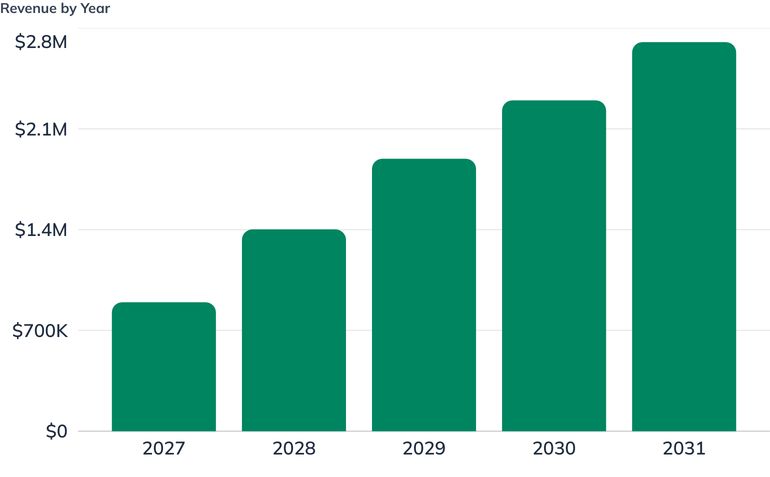
Need real financials? Explore a spreadsheet-free path to generating financial data for your business.Create your own business plan
Our revenue comes from five streams, all sold to the same residential customer base and all reinforcing one another. Service and repair work is the top of the funnel; panel upgrades, EV charging, and battery storage are where the value is; and the membership program is what makes the relationship recur.
Service & Repair Calls. Flat-rate diagnostic and repair work at an average ticket of $585 in 2027, rising to $675 by 2031 as our mix shifts toward more complex work. We forecast 610 completed calls in 2027 building to roughly 1,540 by 2031. Volume follows a pronounced Valley seasonal curve — May through August run 40 to 60 percent above the winter months, because heat is what makes electrical systems fail.
Service & Panel Upgrades. Our highest-value recurring project type, averaging $5,200 per job in 2027 and $6,000 by 2031 — squarely inside the $3,500–$7,500 range Phoenix contractors quote for a 200-amp service upgrade. We forecast 62 upgrades in the first year, growing to 126 by 2031. Roughly a third originate as a service call where the technician's documented panel inspection surfaced the real problem.
EV Charger Installations. Level 2 installations at an average of $1,750 in 2027, growing to $1,950. Fifty-eight in 2027, 124 by 2031. This stream carries a visible December and January peak driven by new-vehicle purchases and gift installations.
Battery Storage & Backup Systems. Our largest per-project stream at an average of $17,500 in 2027, rising to $19,500. This line does not begin until October 2027, once manufacturer certifications are complete, and ramps deliberately: six projects in the launch year, 12 in 2028, and 25 by 2031. We are intentionally conservative here. The expiration of the federal 25D residential credit at the end of 2025 is expected to contract owner-purchased solar installations by roughly 18 percent nationally in 2026, and we would rather build this line on retrofit storage for the Valley's existing solar base — supported by APS rebates of up to $3,750 and virtual power plant enrollment — than on an incentive we do not control.
Evergreen Home Circuit Memberships. Recurring revenue at $18 per month, sold on service calls beginning in April 2027. Modest in dollar terms — about $10,000 in year one and $178,000 by 2031 — but disproportionately important. Members book more work, book it earlier, and give us a schedulable book of business in the shoulder months.
Total revenue by year
2027 | 2028 | 2029 | 2030 | 2031 | |
|---|---|---|---|---|---|
Revenue | $895,753 | $1,401,305 | $1,892,046 | $2,297,526 | $2,702,319 |
Growth | Launch year | 56.4% | 35.0% | 21.4% | 17.6% |
Fleet at year end | 2 vans | 3 vans | 4 vans | 5 vans | 6 vans |
Small commercial and property-management service work, which we take on from 2029 once the C-11 classification is in place, is forecast inside the Service & Repair and Panel Upgrade streams rather than as a separate line. The work is the same work; only the customer is different.
Growth is fleet-driven, and that is the assumption to test. We run two vans in 2027, add a third in March 2028, a fourth in July 2029, a fifth in early 2030, and a sixth in early 2031. Measured against the year-end fleet, revenue per van runs between roughly $448,000 and $473,000 across the whole horizon — $447,877 in the launch year and $450,387 in 2031. That is well above the $310,000 median and around the top decile for residential service trucks, and it is high from day one rather than climbing with maturity, for two specific reasons: our average project is a $5,200 panel upgrade rather than a $400 repair call, and the launch-year fleet is staffed thicker than one person per van — Carlos works in the field alongside a lead journeyman, a service electrician, and an apprentice, so two vans carry roughly three and a half productive people through 2027.
Two notes on how to read that figure. It uses year-end van counts, so 2028 and 2029 — the years a van arrives mid-year — understate what each truck actually produced: 2029 runs three vans for six months and four for six, which on a true van-year basis is closer to $540,000 per van rather than the $473,000 the year-end count implies. And the ratio is a planning yardstick, not a target we manage to; the operating metric is revenue per van per month, reviewed against the schedule.
This is the single most important assumption in the forecast and we treat it as such. If per-van revenue lands closer to the $380,000 upper-quartile benchmark than to $450,000, revenue falls roughly 15 percent below plan at every fleet size. That is why every van addition here is gated on the operating trigger described in Key Metrics — sustained revenue per van at target with the schedule running two or more days out — rather than on the calendar. We add the truck after the volume proves itself, not before.
Expenses & Costs
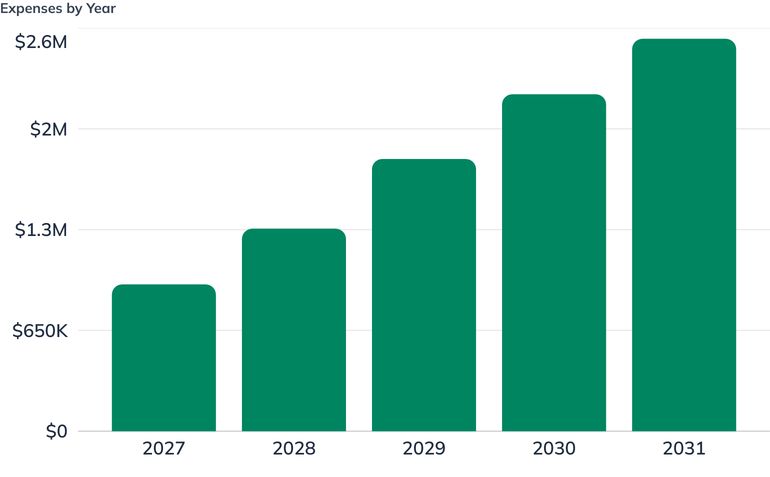
Need actual charts? We recommend using LivePlan as the easiest way to create graphs for your own business plan.Create your own business plan
Direct costs
Our cost of goods sold has two components: materials and field labor.
Materials are modeled as a percentage of each revenue stream, reflecting how different the mix is across our service lines: 11% on service and repair, 20% on panel and service upgrades (panel, meter combo, wire, and permit fees), 25% on EV charger installations, and 52% on battery storage — where the battery, inverter, and backup gateway dominate the job cost. Card processing and consumer financing fees add 2.2% of total revenue. Arizona transaction privilege tax on prime contracting is embedded in our published flat-rate prices and carried inside these material costs rather than shown as a separate tax line.
Field labor — every journeyman, service electrician, apprentice, and the storage installation lead — is carried in direct costs rather than overhead, because that is what it actually is. Only the owners, the dispatch coordinator, and the service manager sit above the gross margin line.
That produces gross margins of 56.4% in 2027, 58.7% in 2028, 55.9% in 2029, 54.3% in 2030, and 52.9% in 2031. The gradual decline is the mix shifting toward equipment-heavy battery work. All five years land inside the 52–65% band that benchmark data identifies as healthy for residential electrical contractors, and they are achieved while paying at the upper end of the Phoenix wage market rather than the bottom.
Personnel
Payroll is our largest cost and our most deliberate one. We start with five people and reach twelve by 2031.
Role | Start | 2027 | 2031 |
|---|---|---|---|
Carlos Rojas — Owner & Master Electrician | Jan 2027 | $88,000 | $150,000 |
Nadia Rojas — Operations & Finance | Jan 2027 | $62,000 | $98,000 |
Lead Journeyman Electrician | Jan 2027 | $79,000 | $95,000 |
Service Electrician | Jan 2027 | $64,500 | $76,500 |
Founding apprentice → journeyman (licensed mid-2030) | Jan 2027 | $43,700 | $80,000 |
Service Electrician II | Mar 2028 | — | $75,000 |
Dispatch & Customer Service Coordinator | Mar 2028 | — | $53,000 |
Storage & EV Installation Lead | Mar 2029 | — | $90,000 |
Apprentice Electrician II | Mar 2029 | — | $51,000 |
Service Manager | Jul 2029 | — | $103,000 |
Service Electrician III | 2030 | — | $75,000 |
Journeyman Electrician II | 2031 | — | $92,000 |
These wages are benchmarked, not estimated. The Phoenix market in 2026 runs roughly as follows: journeyman electricians at $32–$38 per hour with an average near $35; mid-level service electricians at $25–$32, with the experienced end of that band at $30–$32; and entry-level apprentices and helpers at $18–$22. Our lead journeyman starts at $38 per hour equivalent, our service electrician at $31, and our apprentice at $21 — each at or near the top of its band. Phoenix electricians overall average about $29.31 per hour or $61,000 a year, with the 75th percentile near $68,000; both of our founding field electricians clear that mark on day one.
The founding apprentice's step from $48,500 in 2029 to a blended $59,500 in 2030 and $80,000 in 2031 is their promotion to journeyman on licensure, which the milestone plan targets for mid-2030. Growing our own journeyman is cheaper than recruiting one and is the only durable answer to this labor market.
Employer burden of 20% is applied on top of every wage, covering payroll taxes, unemployment, and workers' compensation — which for electrical contractors in Arizona (class code 5190) runs meaningfully above the national average, between roughly $2.95 and $6.32 per $100 of payroll. Health insurance contributions and the retirement match added in year three are budgeted separately.
Raises are built in at roughly 4 to 5 percent annually for field and office staff. Owner compensation grows faster — from $88,000 to $150,000 for Carlos and $62,000 to $98,000 for Nadia — because it is deliberately set below market during the ramp, at the reasonable-compensation level our CPA supports for the S-corporation election, and rises to a genuine market rate for an owner-operator and an operations manager as the business can support it.
Operating expenses
Expense | 2027 | 2031 |
|---|---|---|
Shop & yard lease (Deer Valley) | $40,800 | $45,960 |
Marketing & advertising | $67,200 | $135,000 |
Vehicle fuel, maintenance & registration | $27,600 | $81,600 |
Insurance — GL, auto, umbrella, cyber | $31,200 | $58,800 |
Health contribution & retirement match | $24,000 | $66,000 |
Professional fees — CPA, bookkeeping, legal, fractional CFO | $19,200 | $50,400 |
Software — ServiceTitan, QuickBooks, Gusto, phone | $17,400 | $29,400 |
Small tools, consumables & uniforms | $10,800 | $23,400 |
Utilities & internet | $10,200 | $12,600 |
Licenses, permits, bonds & continuing education | $7,800 | $12,600 |
After-hours answering service | $7,200 | $11,400 |
Office, bank fees & miscellaneous | $6,600 | $10,800 |
Marketing runs at 7.5% of revenue in the launch year while we build review volume and map-pack position, then 6.0% in 2028, 5.4% in 2029, 5.3% in 2030, and 5.0% in 2031 — inside the 5–8% band benchmark data identifies as healthy, and trending toward the efficient end as organic search, membership, and referral carry more of the load. Vehicle costs scale directly with the fleet. Professional fees step up in 2028 when the fractional CFO engagement begins.
Depreciation runs from $34,257 in 2027 to $80,829 in 2031, reflecting seven-year schedules on vans and leasehold improvements, five years on tools and specialty equipment, and three years on computers and tablets. Interest on the SBA loan starts at $34,843 and declines to $26,402 as the principal amortizes.
Profitability
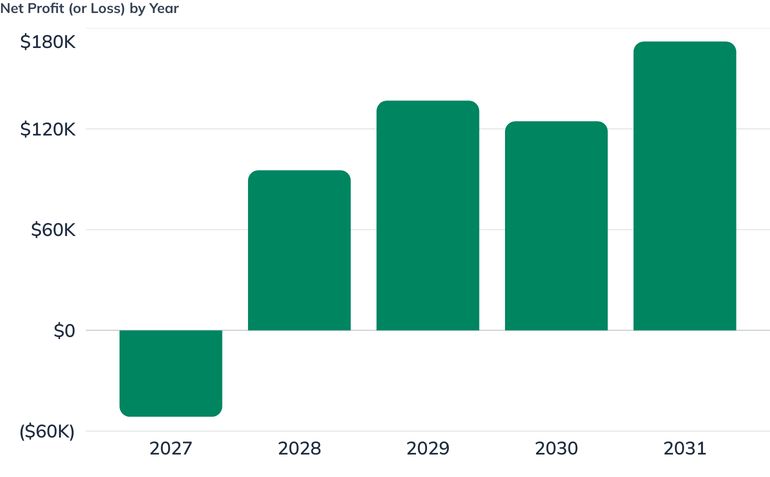
Need real milestones? Establish a clear path for your business with real-world examples.Create your own business plan
2027 | 2028 | 2029 | 2030 | 2031 | |
|---|---|---|---|---|---|
Revenue | $895,753 | $1,401,305 | $1,892,046 | $2,297,526 | $2,702,319 |
Gross margin | $505,138 | $823,194 | $1,058,462 | $1,246,760 | $1,428,873 |
Gross margin % | 56.4% | 58.7% | 55.9% | 54.3% | 52.9% |
Operating expenses | $487,440 | $648,499 | $837,123 | $1,024,940 | $1,149,660 |
Operating income | $17,698 | $174,695 | $221,338 | $221,820 | $279,213 |
Net profit | ($51,402) | $95,320 | $136,759 | $124,510 | $171,982 |
Net margin | (5.7%) | 6.8% | 7.2% | 5.4% | 6.4% |
Ending cash | $170,557 | $210,184 | $271,343 | $321,407 | $432,426 |
Year one is a planned loss, and a small one. We finish 2027 at a net loss of $51,402 on $895,753 of revenue. Monthly results tell the more useful story: we lose roughly $43,200 in January against a nearly empty schedule, cut that loss every month as the ramp builds, and turn our first profitable month in June 2027. September dips $137 below the line in the ordinary shoulder-season lull that follows the summer peak, and October through December are all comfortably profitable, with December earning $32,056.
Profitable from year two. 2028 delivers $95,320 of net profit on $1.4 million of revenue, and the business is profitable in every full year thereafter. Individual months still dip negative in the winter and shoulder seasons — January, March, and April 2028, and October and December 2029 — with March 2028 the deepest at a $4,192 loss, when the third van and two new hires land in the slowest quarter of the year. That pattern is normal for a seasonal service business in a market where heat drives demand, and it is why we manage to cash rather than to any single month's profit.
Profit does not rise in a straight line, and the reason is deliberate. 2029 earns $136,759, 2030 drops to $124,510, and 2031 recovers to $171,982. The 2030 step-down is not a deterioration: it is a full year of the service manager's salary, a fifth van's depreciation, and the founding apprentice's promotion to journeyman pay all landing in the same year. We would rather absorb those costs a year early than run the crew short through a Phoenix summer.
Net margin in the 5 to 7.5 percent range is a deliberate trade, not a shortfall. Benchmark data puts a solid residential electrical contractor at 12 to 20 percent net. We run below that band for two reasons we would make again. First, we pay at the upper end of the Phoenix wage market in a trade short roughly 81,000 electricians a year nationally — the alternative is a cheaper payroll and a revolving door, which costs more than the wage differential ever does. Second, we hire ahead of revenue: the storage lead, the service manager, and every van arrive before the volume that justifies them, which is what makes the growth curve achievable in the first place. A company willing to run at maturity headcount without maturity growth would show a better margin and a worse business.
Gross margin is where we hold the line. At 53 to 59 percent across the horizon — with all field labor charged above the line — we sit inside the healthy band for our category, and we protect it with published flat-rate pricing tied to real job costing rather than to last year's assumptions. The gradual decline from 58.7 percent in 2028 to 52.9 percent in 2031 is the mix shifting toward battery storage, our most equipment-heavy work.
Cash is the number we manage to. Ending cash grows every year, from $170,557 to $432,426, with the SBA loan amortizing on schedule across its ten-year term. The path is not a straight climb: cash falls from its January 2027 peak to $107,650 in June 2027 as the ramp burns working capital, and dips again at each fleet purchase — to $102,330 in April 2028 after the third van and to $213,434 in July 2029 after the fourth. Those are the low points, and cash never goes negative in any month of the forecast.
Our internal floor is eight weeks of operating expense on hand. Across 2027, 2028, and 2029 — the years the forecast carries in monthly detail — the balance clears that floor in every single month, including the two fleet-purchase troughs, and clears it at every year end thereafter. That cushion is what lets us hire the next technician on the metric rather than on the hope.
Use of Funds
Evergreen Power & Light requires $525,000 to launch. Just under half of that is equipment and startup assets; the rest is working capital to carry us through the ramp without ever managing the business from a cash-poor position.
Startup assets — $257,000
Item | Amount |
|---|---|
Service vans #1 and #2 — purchase, upfit and wrap | $124,000 |
Tools, test equipment and ladders — launch fleet | $38,000 |
Opening material inventory and supplier deposits | $38,000 |
Shop fit-out and leasehold improvements | $22,000 |
Trailer, generator and specialty equipment | $14,000 |
Lease security and utility deposits | $12,000 |
Office equipment, computers and field tablets | $9,000 |
Total | $257,000 |
Two fully outfitted vans at $62,000 each is the single largest line, and it is not where we look for savings. A van without a complete tool and material load produces a technician who leaves the job for a supply house, and that lost hour costs more over a year than the shelving did. The same logic applies to the $38,000 tool and test equipment package, which includes a thermal camera on every van — the diagnostic that finds heat-degraded connections and the photograph that explains them to the customer.
Working capital — $268,000
The remaining $268,000 funds operations through the ramp. It covers payroll for a five-person team from day one, the launch marketing push that builds our review volume and map-pack position, insurance and licensing, and the operating losses of the first five months. The forecast shows those losses precisely: about $43,200 in January narrowing to break-even in June 2027, with cash falling from its opening peak to $107,650 in June 2027 before the summer season turns it around.
We sized this deliberately rather than to the minimum. A thinner raise would technically clear the ramp, but it would leave the company managing week to week through its first summer — exactly when a growing electrical service business needs to be able to say yes to work, buy material ahead of a job, and hire the third technician when the metric says to. It also has to absorb the third van in March 2028, which lands in the slowest quarter of the year and takes cash to its overall low point of $102,330 that April. Holding eight weeks of operating expense through that month is the whole reason the raise is this size. The cushion is part of the plan, not padding on it.
Capital investment after launch
Additional vehicles are funded from operations rather than new debt: van #3 with its tool package in March 2028 ($80,000), van #4 in July 2029 ($85,000), van #5 in early 2030 ($89,000), and van #6 in early 2031 ($93,000). Each purchase is gated on the same operating trigger as the hire that goes with it.
Sources of Funds
The $525,000 launch requirement is funded with a conventional blend of owner equity and SBA-guaranteed debt.
Source | Amount | Share |
|---|---|---|
Owner investment — Carlos & Nadia Rojas | $125,000 | 23.8% |
SBA 7(a) term loan | $400,000 | 76.2% |
Total | $525,000 | 100% |
Owner investment — $125,000. Contributed by the founders at close from personal savings and the proceeds of a prior property sale. This is equity, not a loan to the company: there is no repayment obligation and no interest. It represents roughly 24 percent of total capitalization, which is comfortably above the equity injection most SBA lenders look for on a startup and is what makes the debt side of the structure financeable.
SBA 7(a) term loan — $400,000. A ten-year term loan at 9.75 percent, arranged through an Arizona community bank with an active SBA lending practice and experience with trade contractors. The rate reflects the market as of mid-2026: with prime at 6.75 percent, the SBA variable-rate maximum for a 7(a) loan above $350,000 is prime plus 3.0 percent, which is exactly the 9.75 percent we have modeled. We have assumed the lender prices at that ceiling rather than below it, so the interest line in this forecast is conservative rather than optimistic. Interest expense runs $34,843 in the first year and declines to $26,402 by 2031 as the principal amortizes, with the loan fully retired within its ten-year term.
Why this structure and not another. An equipment-financing-plus-line-of-credit approach would reduce the up-front raise, but it would leave the working capital that carries us through the first summer sitting on a revolving facility priced above the SBA rate and callable at the worst possible moment. Outside equity is not appropriate for a business of this scale and would dilute two owners who are also the company's two most productive workers. A single amortizing term loan against a meaningful owner injection is the structure this business is built for.
Collateral and guarantees. The loan is secured by the company's vehicles, equipment, and general business assets, with the personal guarantees of both owners as SBA requires. Both founders carry key-person life insurance sufficient to retire the debt, with the company named as beneficiary.
No additional financing is contemplated. Vans three through six and their tool packages are funded from operating cash flow, not new debt. If the business outgrows the Deer Valley facility once the fleet reaches six vans in 2031, a larger lease — not a purchase — is the expected path, and would be evaluated with our relationship banker against results at that time.
Projected Statements
Frequently Asked Questions
An electrical contracting business plan should define the service territory and the specific work you take on, your licensing and qualifying-party structure, how jobs are priced and scheduled, a hiring plan tied to real operating triggers, and financials covering vans, tooling, working capital, and a credible path to profit. Evergreen Power & Light's plan, for example, pairs a 35-minute service radius around North Phoenix with five revenue streams and a two-van launch, and models 2027 honestly as a planned $51,402 loss because a new electrical company spends its first months building review volume and map-pack position before the work compounds. It also sizes the working capital — $268,000, more than half the total raise — specifically so that ramp is funded rather than survived.
Startup cost depends almost entirely on how many trucks you put on the road and how much working capital you carry behind them. Evergreen Power & Light budgets $525,000 to launch: $257,000 in startup assets — two fully outfitted service vans at $62,000 each and a $38,000 tool and test equipment package that puts a thermal camera on every van — plus $268,000 of working capital covering a five-person payroll, the launch marketing push, insurance and licensing, and the operating losses of the first five months. The plan deliberately raises above the minimum, because a thinner cushion would leave the company managing week to week through its first Phoenix summer, exactly when it needs to say yes to work.
Yes — electrical work is licensed at the state level almost everywhere, and the license typically attaches to a qualified individual rather than to the company. Evergreen Power & Light holds an Arizona Registrar of Contractors R-11 residential electrical license with co-owner Carlos Rojas, a master electrician with fourteen years in the Valley trade, serving as qualifying party, and the plan schedules the C-11 commercial classification for 2029 so the company can add small commercial and property-management accounts. The plan also treats permitting as an operational function rather than paperwork, pulling permits with Phoenix, Scottsdale, Mesa, Glendale, Chandler, or Peoria as the address requires and managing APS or SRP disconnect and reconnect scheduling so the homeowner never has to.
Evergreen Power & Light earns across five reinforcing streams rather than one. Flat-rate service and repair calls are the top of the funnel at a $585 average ticket in 2027, growing from 610 calls to roughly 1,540 by 2031; service and panel upgrades are the highest-value recurring project at $5,200 per job rising to $6,000, with about a third originating as a service call where the technician's documented panel inspection surfaced the real problem; EV charger installations average $1,750; and battery storage is the largest per-project line at $17,500, beginning in October 2027 once manufacturer certifications are complete. The Evergreen Home Circuit membership sits underneath all of it, converting one-time customers into a book of business the company can schedule against in slower months.
Evergreen Power & Light turns its first profitable month in June 2027, five months after opening, as the Valley heat season drives service volume — but closes the launch year at a planned $51,402 loss because January through May run at a deficit while the company builds review volume and market position. It is profitable in every full year from 2028 onward, earning $171,982 in 2031 on $2,702,319 of revenue. Cash never drops below $102,330, and that low point comes in April 2028 rather than during the launch, because the third van lands in the slowest quarter of the year.
Because in Phoenix residential electrical, the friction customers actually complain about is not the price — it is not knowing the price. Evergreen Power & Light publishes a price for every common job on its website, and the technician quotes from that same book on a tablet in the driveway, presenting written good/better/best options the customer signs before any work begins, with no hourly meter running and no invoice surprise. The plan treats this as a direct counter to the commissioned-sales home-service platforms operating across the Valley, which have trained a large share of homeowners to be suspicious of electrical quotes — a market condition the company converts rather than fights.
Evergreen Power & Light serves three overlapping homeowner segments within about 35 minutes of its North Phoenix shop. Capacity upgraders — roughly 40% of revenue — own homes built between 1975 and 2005 and have hit a wall where the panel will not take an EV charger or a mini-split; service-and-repair homeowners are the highest-volume segment at about 35%, calling because something stopped working and deciding on speed and trust; and resilience buyers in Scottsdale, Paradise Valley, and Arcadia want battery backup because a summer outage in Phoenix is a genuine hazard. A fourth group — real estate agents, property managers, and home inspectors — is not the end customer but a referral channel producing steady, schedulable work on closing deadlines.
Because the economics changed. The federal residential clean energy credit that covered 30% of a homeowner-owned solar system expired December 31, 2025, and the industry expects roughly an 18% contraction in owner-purchased residential solar installations in 2026 even as battery storage keeps growing. Evergreen Power & Light's plan redirects toward what homeowners are actually buying instead — capacity, backup, and heat resilience — installing solar only as an add-on to storage work and partnering with a third-party ownership provider for customers who want a lease or PPA, rather than pressuring anyone into a cash purchase whose payback no longer pencils. It also enrolls qualifying customers in the APS battery rebate, currently up to $3,750.

Business Plan Outline
Start your plan