




Wildcraft Cultivation


Business Plan Summary
This cannabis farm business plan example features Wildcraft Cultivation, a 22-acre craft cannabis farm in Oregon's Applegate Valley growing sun-powered, living-soil flower under 30,000 square feet of light-deprivation greenhouse and selling wholesale into the state's licensed adult-use market. It covers OLCC Tier II licensing and farm-zoning requirements, a four-line wholesale revenue model spanning bulk craft flower, packaged eighths, pre-roll smalls, and fresh-frozen material for solventless hash processors, a $3.1 million funding plan weighted toward equity, and five-year financial projections — showing a first-year loss, near break-even in year two, and steady profitability from 2029 onward. Use it as inspiration for your own plan, and read our guide on how to start a farm with step-by-step advice. Download a free business plan template to get started, or browse more business plan examples.
Wildcraft Cultivation
Executive Summary
Wildcraft Cultivation is a craft cannabis farm on 22 acres in Oregon's Applegate Valley, growing sun-powered, living-soil flower under 30,000 square feet of light-deprivation greenhouse. We hold an OLCC Tier II mixed producer license and sell exclusively into Oregon's licensed adult-use market as a wholesale supplier — we do not operate a retail storefront, and we do not intend to.
Oregon does not need another cannabis farm. It needs better ones. The state has been structurally oversupplied since 2018, and the flood of undifferentiated outdoor biomass has pushed average wholesale flower to record lows. That collapse is real, but it is not evenly distributed. It has hollowed out the middle of the market while leaving a durable, underserved premium tier: buyers at Oregon's better dispensaries consistently report they cannot source enough genuinely top-shelf, small-batch, sun-grown flower — particularly outside the September-to-January window when everyone's outdoor harvest hits at once. Wildcraft is built for that gap, not for the commodity market that created it.
Our approach rests on three decisions. First, living soil in permanent no-till beds rather than pots and bottled nutrients: the beds get better every season instead of worse, input costs fall year over year, and the terpene expression that comes out of a mature soil biology is something a hydroponic room cannot easily fake. Second, light deprivation instead of full-term outdoor: automated blackout curtains let us force flowering on our schedule, which yields three harvest windows a year instead of one, spreads labor and cash flow across the calendar, and — critically — puts fresh, current-season flower on shelves in March and April when the competition is selling nine-month-old inventory. Third, a dedicated fresh-frozen program for Oregon's solventless hash makers, a fast-growing premium category where living-soil sun-grown material genuinely outperforms indoor and commands pricing that bulk flower no longer does.
We sell four things: A-grade craft flower in bulk to retailers and wholesalers; packaged retail-ready eighths under the Wildcraft label; pre-roll-grade smalls and B-grade flower; and fresh-frozen whole-plant material for solventless extraction. That mix means no single price collapse can take the farm down, and it means every gram of what we grow has a home at an appropriate price rather than being dumped into the biomass market.
The farm is led by two founders with complementary and directly relevant backgrounds: a head of cultivation with eleven years growing in the Rogue Valley, and a chief executive who spent nine years in agricultural operations and wholesale sales. We are siting in Jackson County deliberately — the Applegate's dry summers, cool nights, and long light season are the reason this region has produced Oregon's most awarded sun-grown flower, and the local labor pool has more experienced cannabis cultivation workers per capita than anywhere else in the state.
Wildcraft's plan is not to out-grow anyone. It is to be the farm that a discerning buyer calls first — a consistent, compliant, well-branded supplier of the product Oregon is short of, at a scale small enough to stay genuinely craft and large enough to support real wages and a real business.
Need real milestones? We recommend using LivePlan as the easiest way to create milestones for your own business plan.Create your own business plan

Opportunity
Problem Worth Solving
Oregon's cannabis market has an oversupply problem and a quality shortage at the same time. Both statements are true, and the tension between them is the opportunity Wildcraft is built around.
The oversupply is real and it is structural. OLCC's own supply and demand analysis shows Oregon consumers buying roughly 57 cents' worth of cannabis for every dollar's worth the state's producers grow. Statewide retail sales have slid from a 2021 peak of about $1.2 billion to roughly $925 million in 2025, while harvest volumes keep setting records. Median retail flower prices have fallen every year since 2023 and hit a record low in spring 2026. Bulk outdoor flower now changes hands at prices at or below what it costs most farms to produce it. Roughly a quarter of U.S. cannabis operators are profitable, and Oregon growers are among the worst paid in the country. Any plan that ignores this is not a plan.
But the collapse is concentrated in undifferentiated product. What has actually happened is that the floor fell out of the commodity market while the ceiling held. Oregon consumers are buying nearly 10% more units year over year at meaningfully lower average prices — the demand is there, it has simply migrated to value. Underneath that migration, a smaller but stable set of buyers continues to pay real money for flower that is demonstrably better: hand-tended, slow-cured, soil-grown, with terpene profiles and bag appeal that mass-produced material does not have. Budtenders and purchasing managers at Oregon's better dispensaries will tell you plainly that this product is hard to source consistently.
Three specific problems create that gap.
Seasonality. Oregon's outdoor crop is harvested almost entirely in October. It floods the market in November, gets sold through the winter, and by the following spring the only "fresh" product on shelves is indoor — which is expensive to produce and increasingly hard to justify at current prices. From February through July, genuinely current-season sun-grown flower is scarce. Farms that can supply that window are supplying it into a shortage.
Quality inconsistency. The economics of the last five years have pushed most growers toward volume: bigger plants, tighter budgets, faster dries, machine trim. That is a rational response to price compression, and it has made consistent top-shelf flower harder to find, not easier. Buyers describe sourcing craft flower as a relationship business conducted farm by farm, batch by batch, because they cannot rely on any single supplier to deliver the same thing twice.
The solventless input bottleneck. Solventless hash — rosin, live rosin, cold-cure — is one of the few cannabis categories with pricing power left. It requires fresh-frozen whole-plant material harvested and frozen within hours, from plants grown clean enough that the resin heads survive washing. Very few Oregon farms are set up to supply it properly: it demands cold-chain infrastructure at the farm, a cultivar library selected for resin production rather than yield, and a cultivation approach that keeps the trichomes intact. Hash makers routinely turn material away.
Wildcraft exists because a farm designed around light deprivation, living soil, and on-site freezing solves all three of these at once — not as a marketing angle, but as a consequence of how the farm is physically built.
Our Solution
Wildcraft Cultivation is a 22-acre licensed cannabis farm in the Applegate Valley running 30,000 square feet of light-deprivation greenhouse canopy over permanent living-soil beds, supported by 2,500 square feet of indoor propagation and mother-stock space. We are an OLCC Tier II mixed producer selling wholesale into Oregon's licensed market.
Living soil, no-till, permanent beds. Our greenhouses are built over in-ground raised beds filled with a locally amended living soil — compost, worm castings, biochar, basalt, crab and kelp meal, and a cover crop rotation — that we build once and then feed rather than replace. Plants go directly into the same beds season after season. The soil biology matures, water-holding capacity improves, and per-cycle input cost declines as the beds establish. There is no runoff, no reservoir chemistry to manage, and no plastic pots to buy or landfill. It is slower to dial in than hydroponics and considerably cheaper to run once it is.
Automated light deprivation. Each greenhouse bay carries a motorized blackout curtain system that lets us control photoperiod independently of the calendar. That gives us three flowering windows per year instead of the single October harvest a full-term outdoor farm gets: an early cycle finishing in late June and July, a mid-summer cycle finishing in September, and a fall cycle finishing in October. The strategic consequence matters more than the agronomic one — it lets us hold current-season inventory into the spring scarcity window and gives us fresh product to sell in months when most Oregon sun-grown farms have nothing but last year's crop.
Sun as the primary light source. We use no supplemental flowering lights. The Applegate gets long, intense summer light, low humidity, and a 30-degree day-night temperature swing that pushes anthocyanin and terpene expression. Compared with an indoor operation, our electricity consumption per pound is roughly an order of magnitude lower — the greenhouse runs fans, controls, irrigation pumps, and dehumidification in the drying barn, not thousand-watt fixtures. That single structural difference is what allows a craft-quality product to be produced at a cost that works at Oregon's prices.
Four product lines from one crop.
- Wildcraft craft flower (bulk): hand-trimmed, slow-dried at low temperature for 10–14 days, cured in Grove Bags to a stable water activity, sold in bulk to Oregon retailers and wholesalers with full terpene panels.
- Wildcraft packaged eighths: the same A-grade flower, packaged retail-ready in 3.5g glass under our own label with harvest date, cultivar, and batch COA on every jar. Retailers get a shelf-ready SKU; we capture the packaging margin instead of handing it to a wholesaler.
- Smalls and pre-roll grade: dense, fully mature lower-canopy flower sold to pre-roll producers and value-tier retailers. This is not waste — it is a deliberate product with its own buyers.
- Fresh-frozen for solventless: designated plants harvested whole, hand-bucked, and into a blast freezer within two hours, sold frozen to Oregon's solventless hash makers. Cultivars for this line are selected for resin head size and stalk integrity rather than yield.
Genetics as an asset. We maintain a mother library of cultivars selected and back-crossed specifically for Applegate conditions — mold resistance in the fall shoulder, finish times that fit a dep schedule, and resin production that holds up in a wash. Over time this library is one of the harder things for a competitor to replicate, and it is the foundation of a farm brand rather than a commodity SKU.
Certification and transparency. We are pursuing Sun+Earth certification and publishing full test panels — potency, terpenes, pesticides, microbials, heavy metals — for every batch. Oregon's better buyers increasingly ask for regenerative and sun-grown credentials, and having them documented converts a story into a purchasing criterion.
Target Market
Wildcraft sells business-to-business only. Our customers are OLCC-licensed entities; the consumer who eventually smokes our flower is the end user we design for but never transact with. That distinction shapes everything about how we go to market.
Segment 1 — Independent craft-forward dispensaries (primary). Oregon has roughly 800 licensed retailers. Our target is the 120–180 of them that compete on curation rather than price: shops in Portland, Bend, Eugene, Ashland, Hood River, and Corvallis whose budtenders can name the farm behind the flower on the top shelf and whose customers pay $35–50 for an eighth without flinching. These buyers purchase in small, frequent lots — often one to five pounds at a time, reordering every two to four weeks — and they care intensely about consistency, freshness, harvest date, and terpene percentage. They are relationship buyers, slow to add a new farm and slow to drop one. We intend to reach 40–60 active accounts and to be a standing top-shelf line at most of them. Because they order in small lots, they are also the segment most willing to pay for packaged product rather than doing their own jarring.
Segment 2 — Solventless hash processors. A concentrated group of roughly 20–30 Oregon processors buy fresh-frozen material seriously, and perhaps a dozen of those are producing premium live rosin. They buy in large single transactions — several hundred pounds of frozen material at a time, timed to their wash schedule — and they are exacting about how the material was handled: time from cut to freeze, whether it was handled warm, whether the cultivar washes. Winning two or three of these as standing annual partners underwrites a meaningful share of a harvest before it is even planted, which is unusually valuable in a market this volatile. This is also the segment where our living-soil, sun-grown approach is a technical advantage rather than a marketing one.
Segment 3 — Wholesalers and pre-roll producers. Licensed wholesalers and pre-roll manufacturers absorb volume — our smalls, our B-grade, and any A-grade we have not placed directly. They pay less per pound and demand nothing in the way of brand, but they clear inventory quickly and in size. We treat this segment as a release valve and a cash-timing tool rather than a growth channel, and we deliberately cap how much of the crop goes here.
Segment 4 — Multi-location retail chains (selective). Oregon's larger retail groups can move real volume and pay reliably, but they negotiate hard, demand deep pricing, and can drop a supplier without warning. We will work with chains that treat craft flower as a distinct category with its own margin expectations, and decline the ones that want top-shelf product at value pricing.
The consumer behind the buyer. Oregon's premium flower consumer skews 28–45, is meaningfully more likely to be a regular rather than occasional user, buys by cultivar and farm rather than by THC percentage alone, and increasingly asks about growing practice — sun-grown, living soil, pesticide-free, regenerative. This consumer is a shrinking share of a growing unit-volume market, which is precisely why serving them well is defensible: the value tier is a race to the bottom that we would lose, and this tier is a race to the top that we can win.
Geographic focus. Year one concentrates on southern Oregon and the Portland metro, the two markets where a new Applegate farm can be introduced through existing relationships. Bend, Eugene, and the coast follow in year two. Oregon has authorized interstate cannabis commerce contingent on federal law changing, but no agreement exists and none is expected soon — we plan for an Oregon-only market and treat any future export channel as upside we have not counted on.
Competition
Oregon has roughly 1,370 active OLCC producer licenses — about 544 outdoor, 566 indoor, and 263 mixed. That number is the single most important fact about our competitive environment, and it is worth being blunt: we are entering a market with more growers than it needs. Our competitive position depends entirely on not competing with most of them.
Competitor group 1 — Large-scale outdoor biomass farms. These are the operations that produce the bulk of Oregon's tonnage: multi-acre full-term outdoor grows harvesting once each October, machine-trimmed, sold in large lots at whatever the market will bear. They compete purely on cost per pound and they are extremely good at it. Where they beat us: price, absolutely and without contest. Where we beat them: they have one harvest window, no cold chain, no brand a consumer would recognize, and product quality that varies with the weather. We will never take a price-driven account from them and will not try.
Competitor group 2 — Indoor cultivators. Companies like Grown Rogue, a publicly traded Medford operator running roughly 15,000 square feet of indoor canopy, compete for the same premium shelf space we want. Indoor product commands Oregon's highest wholesale prices, in the $480–600 per pound range for quality bulk. Where they beat us: year-round production on a predictable schedule, tight environmental control, and consumers who still equate "indoor" with "best." Where we beat them: structural cost. Indoor cultivation in the Pacific Northwest consumes on the order of 128 kWh per square foot of canopy annually against roughly 12 for a greenhouse — an energy burden they carry into every pound and we do not. As Oregon prices continue to compress, that gap widens in our favor.
Competitor group 3 — Established craft sun-grown farms. This is our real competitive set: southern Oregon farms with recognized names, existing shelf relationships, and their own regenerative and terroir stories. East Fork Cultivars in Takilma and a cohort of Applegate and Williams-area farms have spent years building exactly the reputation we are seeking. Where they beat us: they are already there. Buyer relationships, Cultivation Classic and Oregon Leaf recognition, and a track record we do not yet have. Where we compete: most full-term craft farms harvest once a year and are functionally absent from the market for six months. Our light-dep schedule and fresh-frozen program give us two distinct advantages they largely do not contest — spring availability and a serious solventless input business.
Competitor group 4 — Out-of-state pressure. None today. Oregon's interstate commerce statute is inert pending federal action, and federal rescheduling in April 2026 reached only FDA-approved products and state-licensed medical marijuana, leaving adult-use in Schedule I. If interstate trade ever opens, Oregon's low-cost sun-grown production becomes an export advantage rather than a threat — but we do not model it and do not depend on it.
Our defensible position. Three things are genuinely hard to copy quickly. First, mature living soil: our beds are a four-year investment that a competitor cannot buy off a shelf. Second, an Applegate-adapted genetics library selected for dep timing, mold resistance, and wash performance. Third, the cold-chain infrastructure and processor relationships behind the fresh-frozen line — an established full-term outdoor farm would need to rebuild its harvest workflow to enter that business.
The honest risks. Wholesale prices could fall further; a bad fall shoulder season could compromise a harvest; a single large craft-focused competitor could saturate the spring window we are counting on. We manage these with a four-line product mix so no single price movement is fatal, staggered harvests so no single weather event takes the whole crop, and a deliberate decision to stay small enough to sell out rather than large enough to have to dump.
Execution
Marketing Plan
Cannabis marketing in Oregon operates under real constraints. OLCC rules restrict advertising channels and content, and the major ad platforms — Google, Meta, and the app stores — will not run paid cannabis advertising regardless of state legality. That rules out the default digital playbook and pushes us toward the channels that actually move wholesale product: the trade, the budtender, and the package on the shelf.
Positioning. Wildcraft is the Applegate light-dep farm — sun-grown, living soil, three harvests a year, fresh flower when nobody else has it. Every piece of communication we produce reinforces one of those four claims. We are not the cheapest, we are not the highest-THC, and we do not pretend to be either.
Budtender education is our largest marketing investment. In a market where consumers ask "what's good?" more often than they ask for a brand by name, the person behind the counter makes the sale. We run in-store education sessions at every active account — 30 minutes, before open, with the crew, walking through the current cultivars, the terpene panels, the harvest dates, and why a March-fresh dep flower smokes differently than October flower sold in March. Staff get samples where OLCC rules permit and a one-page cultivar card for the shelf. We budget for this as a recurring monthly commitment across our account base, not a launch campaign.
Packaging as media. Our 3.5g jars carry the harvest date on the front, not buried in a lot code. Cultivar name, terpene profile, farm location, and a QR code to the full batch COA. In a category where most packaging is legally-required text on a mylar bag, a jar that tells the consumer when the flower was cut is genuinely differentiating and costs us nothing beyond good design.
Trade channels. We list on Leafly and Weedmaps as a producer so consumers can find which shops carry us. We maintain an active Confident Cannabis presence for bulk buyers and publish every COA there. We use LeafLink for wholesale ordering and its marketplace visibility. We submit to the Cultivation Classic and Oregon Leaf's competitions — for a craft farm, an award is worth more than any advertising spend we could make.
Owned digital. A simple, well-photographed website with a cultivar library, current availability, harvest calendar, and a wholesale inquiry form. An Instagram account documenting the farm — soil, canopy, harvest, the drying barn — which is the one social channel where cannabis brands still reliably reach both consumers and industry buyers. A monthly email to buyers announcing what is coming down and when. All of it is farm-first content: the product photography is the marketing, and we shoot it ourselves in natural light rather than paying for a campaign.
Earned media and community. Southern Oregon cannabis has an active regional press and a tight grower community. We host two open-farm days a year for licensees and press, participate in Sun+Earth and regenerative-agriculture programming, and make our head of cultivation available for interviews and panels. Certification bodies and industry associations are, in practice, our most cost-effective distribution for credibility.
What we deliberately do not do. No paid programmatic advertising, no influencer deals, no billboards, no discount-driven promotion. Discounting a craft product to move it teaches buyers to wait for the discount, and in a price-compressed market that is a spiral we cannot get out of. If a batch is not selling, we address the batch, not the price.

The Strategic Retail Owner
CEO and Founder
Responsible for the financial health and brand positioning of a retail chain in a declining market. They are focused on securing high-margin, premium inventory that justifies a higher price point to offset the 23% market price drop in Oregon.
Priorities
- Maximizing gross margins above the 50% industry standard
- Differentiating retail locations from 1,300+ competitors
- Increasing inventory turnover for high-tier flower
Evaluation Criteria
- Wholesale price vs. projected retail MSRP
- Reliability and consistency of harvest schedules
- Brand alignment with 'Craft' and 'Living Soil' marketing trends
Pain Points
- Market price compression making low-tier flower unprofitable
- Stagnant inventory from oversupplied, low-quality producers
- Difficulty maintaining a 'premium' brand image with inconsistent supply
Common Objections
- The price per pound is significantly higher than the $1,096 market average
- Concerned about consumer price sensitivity in the $0-$50 monthly spend bracket
“I cannot compete on price against the big outdoor farms; I have to compete on quality and exclusivity to keep my doors open.”

The Curation Expert
Inventory Manager
Manages day-to-day product selection and vendor relationships. They are the internal advocate who sees the 'quality shortage' firsthand and wants products that 'sell themselves' through shelf appeal and a compelling cultivation story.
Priorities
- Maintaining a diverse and 'fresh' menu for regular customers
- Sourcing flower with exceptional 'bag appeal' and aroma
- Educating budtenders on the benefits of light-deprivation and living soil
Evaluation Criteria
- Visual 'frostiness' and bud structure
- Unique strain lineage not found in every other shop
- Quality of the 'Wildcraft' brand story and educational assets
Pain Points
- Boring 'mids' that sit on shelves for months and lose potency
- Customers complaining about dry, machine-trimmed flower
- Lack of unique selling points to explain higher price tiers to Millennials
Common Objections
- We already have three 'craft' brands on the shelf right now
- Is the packaging compliant and ready for immediate retail display?
“I need flower that makes people stop and smell the jar the moment they walk in. If it doesn't have that 'wow' factor, it's just more noise.”

The Extraction Specialist
Director of Processing
A technical expert who evaluates raw biomass for concentrate production. They care deeply about the 'on-site freezing' and 'living soil' aspects because it directly impacts the terpene yield and clarity of their live rosin products.
Priorities
- Securing high-terpene 'Fresh Frozen' biomass
- Ensuring zero pesticide contamination for clean extracts
- Optimizing the harvest-to-freezer timeline for maximum resin preservation
Evaluation Criteria
- Certificate of Analysis (COA) terpene percentages
- Specifics of the on-site freezing protocol and equipment
- Trichome maturity and density under magnification
Pain Points
- Poorly frozen biomass resulting in 'black' or low-quality oil
- Inconsistent terpene profiles from synthetic-nutrient grown plants
- High waste ratios from low-quality starting material
Common Objections
- Is the 'on-site freezing' truly immediate or is there a transport delay?
- How consistent are the batches across different light-deprivation cycles?
“If the starting material isn't perfect, my extracts won't be either. I need that living soil terpene profile to win the Leaf Bowl.”
Sales Plan
Wholesale cannabis in Oregon is sold farm-to-buyer, largely by phone, text, and in-person drops. There is no mandatory distributor tier — an OLCC producer may transfer directly to processors, wholesalers, and retailers — so we own the customer relationship end to end and we intend to keep it that way.
The sales motion. Our CEO carries the book personally through the first two years. The cycle looks like this: sample first, sell second. A prospective account receives a sample jar with the full COA before any pricing conversation, because in craft flower the product either speaks or it does not. If the buyer is interested, the first order is small — one to three pounds, or a case of packaged eighths — and priced without negotiation. We follow the first order with a budtender session within two weeks and a sell-through check at 30 days. Accounts that reorder twice go on our availability email and get first call on limited drops.
Pricing discipline. We publish a price list and hold it. Craft flower is sold on quality and availability, not on volume discounts; the only structural discount we offer is a modest one for standing monthly commitments, because predictable offtake is worth real money to a farm. Indicative wholesale pricing at launch:
Product | Unit | Wholesale price |
|---|---|---|
A-grade craft flower, bulk | pound | $525–650 |
Wildcraft packaged eighth (3.5g jar) | unit | $10–12 |
Smalls / pre-roll grade | pound | $180–240 |
Fresh-frozen whole plant | pound (frozen) | $150–200 |
These reflect current Oregon market conditions, where bulk outdoor flower trades in the $150–250 range and quality indoor realizes $480–600. We price above outdoor and below indoor, which is exactly where a craft light-dep product belongs, and we expect to defend it with quality rather than argue it with a spreadsheet.
Selling the harvest before it is cut. The fresh-frozen line is sold on annual contracts negotiated in winter for the following season: a processor commits to a volume and a price window, we commit specific greenhouse bays and cultivars to their wash schedule, and the material moves within hours of harvest. This is the most valuable sales structure available to us — it converts a speculative crop into contracted revenue and removes the single largest cause of distressed selling in Oregon, which is having product and no buyer at harvest time.
Inventory and release strategy. We do not sell the whole crop at harvest. Properly cured and stored in a cold, dark, humidity-controlled room, our flower holds quality for months, and Oregon's price cycle bottoms every November through February when everyone's outdoor hits. We sell roughly half of each harvest within 60 days for cash flow and hold the balance into the spring window, where both price and demand for fresh sun-grown flower are structurally better. This is the single highest-leverage commercial decision the farm makes each year.
Terms and collection. Oregon wholesale runs on 14- and 30-day terms, and slow payment is endemic in the industry. We start every new account on payment-on-delivery, extend net 14 only after three clean transactions, and cap exposure per account. Any account more than 45 days past due goes back to prepay. This costs us some volume and it is worth it — a farm that ships to a shop that later fails has effectively given away a harvest.
Sales targets. Year one is about proving the product and landing 15–25 active accounts plus one anchor solventless partner. Year two builds to 40–50 accounts with two or three standing fresh-frozen contracts and adds a dedicated wholesale account manager. Year three reaches roughly 60 accounts and shifts the emphasis from breadth to depth — more SKUs and more volume per account, and a reorder rate above 70%.
Locations & Facilities
The site. Wildcraft operates from a 22-acre parcel in the Applegate Valley, Jackson County, Oregon, zoned Exclusive Farm Use. Oregon statute (ORS 475C.489) classifies marijuana as a crop for farm-use purposes, which means licensed production is permitted on EFU and farm-zoned land under the same procedures as any other agricultural crop — with three statutory exclusions we design around: no new dwellings tied to marijuana production, no farm stand sales, and no commercial activities conducted in conjunction with the crop. Jackson County maintains its own marijuana production ordinance layered on top of state rules, and parcel-level compliance was confirmed before purchase.
Why the Applegate. This valley produces some of the most awarded sun-grown cannabis in the United States for reasons that are climatic rather than sentimental: long, intense summer light; very low August humidity; a 25–30°F day-to-night temperature swing that drives terpene and anthocyanin expression; and a fall shoulder season dry enough that late-finishing plants are not automatically lost to botrytis. It also sits inside a labor market with more experienced cannabis cultivation workers per capita than anywhere else in Oregon, and within 30 minutes of Medford, where the region's testing labs, suppliers, and several major processors are based.
Built structures.
- Six light-deprivation greenhouses, 5,000 sq ft each, totaling 30,000 sq ft of mature plant canopy. Gothic-arch steel frame, double poly with inflation, roll-up sidewalls, horizontal airflow fans, and motorized blackout curtain systems on each house. Beds are in-ground and permanent. Houses are run on staggered flowering schedules so no two finish in the same week.
- 2,500 sq ft propagation and mother building — insulated, LED-lit, environmentally controlled, housing mother stock, a cloning area, and early vegetative growth. This is the only space on the farm using significant artificial light.
- 4,800 sq ft drying and curing barn — four independent dry rooms held at 60°F and 60% relative humidity, plus a cure and storage room and a separate trim room. Independent rooms let us dry four harvests without cross-contamination or scheduling conflicts.
- Post-harvest and cold-chain building — bucking and trim stations, vacuum sealing, a walk-in cold storage room for cured inventory, and a blast freezer with staged frozen storage for the fresh-frozen program. Cut-to-freeze time under two hours is the operating standard.
- Secure vault and compliance office — OLCC-compliant limited-access area, camera server, and Metrc workstation.
Water. Water is the binding constraint on any southern Oregon farm and we treated it as a siting criterion rather than an afterthought. The parcel carries certificated irrigation water rights, backed by 40,000 gallons of on-site storage and a rainwater catchment system off the greenhouse roofs. Oregon irrigation rights typically carry a limited season of use, and the Water Resources Department makes no assurance of sufficiency — so we hold both storage and a standing water-hauling relationship as contingency. Living soil beds and drip fertigation cut our consumption materially against pot-and-drain-to-waste growing.
Power. Service is from Pacific Power. Because we use no supplemental flowering lights, connected load is modest — fans, controls, irrigation pumps, dehumidification in the dry rooms, and freezer capacity. We expect to sit on a general service commercial schedule around 8.65 cents per kWh plus demand charges rather than the higher small-nonresidential rate, and a rooftop solar array on the post-harvest building is planned for 2030, funded from operating cash flow once the farm is consistently profitable.
Security and access. OLCC-compliant camera coverage of every limited-access area, all points of ingress and egress, and the perimeter, with 90-day retention. Badge-controlled access to the vault and drying rooms, alarm monitoring, and perimeter fencing with a gated entrance. All staff hold OLCC marijuana worker permits.
Expansion capacity. The parcel has room and grading for two additional greenhouse bays and a second drying barn without requiring new water rights. We hold that capacity in reserve rather than building it — the plan is to fill the market position we have before adding canopy we would have to sell into a soft market.
Technology
Wildcraft is a farm, not a technology company, and our stack reflects that: a small number of systems that are non-negotiable for compliance, a small number that make a two-founder operation possible, and nothing else.
Compliance and seed-to-sale. Metrc is Oregon's mandated cannabis tracking system, and every plant, harvest lot, package, and transfer we handle lives in it. Oregon is unusually favorable here — OLCC pays the Metrc program fee on licensees' behalf, so our only cost is consumables at roughly $0.45 per plant tag and $0.25 per package tag. We run Distru as our operational layer on top of Metrc, which handles inventory, order management, invoicing, manifests, and the Metrc sync in one place. Doing this by hand in Metrc alone is how small farms accumulate compliance violations; the software is cheaper than a single one.
Wholesale and marketplace. LeafLink for wholesale ordering and buyer discovery, and Confident Cannabis for publishing certificates of analysis and listing bulk lots. Both are effectively table stakes for a producer selling to more than a handful of accounts.
Greenhouse environment and irrigation. Each house runs on an environmental controller managing blackout curtain deployment, roll-up sidewalls, exhaust and horizontal airflow fans, and heating on a per-house schedule. Blackout timing is automated and logged — running dep by hand is where light leaks and hermaphroditism come from. Irrigation is Netafim pressure-compensating drip on a zoned fertigation system, with METER TEROS soil moisture, temperature, and EC sensors in each bed feeding a dashboard the cultivation team reviews daily. In living soil, the sensors are doing something different than in hydro: they tell us when the biology is stressed, not when to feed a recipe.
Drying and curing. Each of the four dry rooms is independently controlled for temperature, humidity, and airflow with Quest dehumidification and continuous data logging. Cure happens in Grove Bags with water-activity verification before packaging. The drying barn is where good flower becomes mediocre flower faster than anywhere else on the farm, so it is the most instrumented building we own.
Cultivation records. A cultivar and cycle log — germination and clone dates, bed assignment, feeding and amendment history, IPM applications, environmental data, harvest weights by bed, and final test results — maintained per bay per cycle. Over five years this is how the genetics library becomes a real asset rather than a collection of names, and it is what lets us reproduce a good batch instead of hoping for one.
Integrated pest management. Beneficial insect programs (predatory mites, aphidius, lacewings) sourced from regional insectaries, weekly scouting with photo logs, and only OLCC-permitted inputs. Oregon's pesticide testing panel is strict and a failed batch is a total loss, so IPM is run as a documented protocol rather than a reaction.
Back office. QuickBooks Online for accounting, configured with the account structure our CPA needs to compute two separate taxable incomes — Oregon allows normal business expense deductions for cannabis operators, while federal law under IRC §280E does not, so cost-of-goods-sold allocation has to be precise and defensible from day one. Gusto for payroll and Oregon tax filings. Slack and Notion for internal coordination, including the standard operating procedures every role works from.
Security. A cloud-managed camera system with 90-day retention meeting OLCC specification, badge access control on limited-access areas, and monitored intrusion alarms.
On AI. We use it the way any small business does in 2026 — drafting buyer communications, summarizing cultivation logs, forecasting demand against harvest timing — and we do not consider it a differentiator. What grows the flower is soil, sun, and attention.
Equipment & Tools
Capital equipment is where a cultivation plan succeeds or fails, because the temptation is always to under-build the parts the customer never sees — drying, curing, and cold storage — in favor of more canopy. We do the opposite. Canopy is capped by our license; post-harvest capacity is what determines whether that canopy produces top-shelf flower or B-grade.
Greenhouse structures and light deprivation. Six 5,000 sq ft gothic-arch steel greenhouses with double-poly inflated covering, roll-up sidewalls, ridge venting, and horizontal airflow fans. Each carries a motorized blackout curtain system with light-tight end walls — the single most important piece of equipment on the farm, since a light leak during dep costs an entire cycle in that house. Propane unit heaters extend the shoulder seasons on both ends.
Beds and irrigation. Permanent in-ground raised beds framed and filled with living soil, established once and amended thereafter. Netafim pressure-compensating drip lines on zoned solenoid control, a 1,500-gallon fertigation mixing station with compost tea brewers, in-line filtration, and booster pumps. Beds are top-dressed and cover-cropped between cycles rather than turned.
Water infrastructure. Two 20,000-gallon storage tanks, a rainwater catchment system plumbed off the greenhouse roofs, and pump and filtration equipment.
Propagation. LED fixtures, propagation benches, humidity domes, a cloning station, and environmental control for the 2,500 sq ft mother and prop building. This is our only significant lighting load.
Harvest and post-harvest. Two commercial bucking machines for de-stemming, hang-drying infrastructure across four independent dry rooms with Quest dehumidifiers and data logging, stainless trim tables, a GreenBroz dry trimmer for smalls and pre-roll grade (A-grade flower is hand-trimmed and always will be), vacuum sealers, and a precision scale package for Metrc-compliant weights.
Cold chain for fresh-frozen. A walk-in blast freezer sized to take a full bay's harvest down to temperature quickly, staged frozen storage, food-grade totes and liners, and a refrigerated transport capability. Cut-to-freeze under two hours is not achievable with chest freezers, and this is the equipment that makes the solventless line a real business rather than a side hustle.
Storage. A walk-in cold, dark, humidity-controlled cure and inventory room — the equipment that underwrites our strategy of holding half of each harvest into the spring price window.
Farm equipment. A compact utility tractor with loader, forks, and implements; a utility vehicle for moving material between buildings; a flatbed truck for deliveries and pickups; and a soil and compost handling area.
Facility systems. A standby generator sized to carry the freezer, dry rooms, and security system through a rural outage; the OLCC-compliant camera and access-control system; perimeter fencing and gated entry; and the compliance workstation and vault build-out.
Packaging. Glass 3.5g jars, child-resistant closures, label printing equipment, Grove Bags for cure, and turkey bags and totes for bulk.
Deferred to 2030 — rooftop solar. A $150,000 array on the post-harvest building, sized against the dry rooms and freezer, which are our largest remaining electrical loads. It is deliberately not in the initial buildout: it improves margin but does not produce a crop, so we fund it from operating cash flow once the farm is consistently profitable rather than from investor capital.
What we deliberately do not buy. No supplemental flowering lights — they would convert our canopy classification, blow up our power bill, and undercut the entire economic argument for a greenhouse. No automated trimming for A-grade flower. No extraction equipment; we sell fresh-frozen to processors who are better at that than we would be, and we would rather be the best input supplier in the valley than a mediocre processor.
Milestones
Submit OLCC producer license application and close on the Applegate parcel Tier II mixed producer application filed with land use, water use, and premises documentation. Real-estate LLC closes on the 22-acre parcel and executes the lease to the operating company. | Dev Okonkwo Jan 29, 2027 |
Six light-dep greenhouses erected and blackout systems commissioned 30,000 sq ft of canopy under structure, blackout curtains tested for light leaks, irrigation and fertigation plumbed, water storage online. | Marisol Vance Apr 30, 2027 |
Living soil beds established and first plants in ground Permanent beds built and inoculated across three houses; spring light-dep cycle transplanted from the propagation building. | Marisol Vance May 15, 2027 |
OLCC license issued and Metrc onboarding complete Final inspection passed, license in hand, all staff holding worker permits, plant tags applied and Distru synced to Metrc. | Dev Okonkwo May 29, 2027 |
Drying barn and blast freezer operational Four independent dry rooms holding 60/60, cure room online, blast freezer validated at cut-to-freeze under two hours. | Marisol Vance June 30, 2027 |
First fresh-frozen delivery to a solventless partner First contracted frozen whole-plant lot harvested, frozen, and transferred. Validates the cold chain and the solventless channel. | Dev Okonkwo July 24, 2027 |
First light-dep harvest completed Spring dep cycle cut, hung, and into the dry rooms. Yield per square foot and A-grade share measured against plan for the first time. | Marisol Vance July 31, 2027 |
First wholesale flower sale and 10 active retail accounts Cured, tested, and sold. Ten dispensaries carrying Wildcraft bulk flower with budtender education completed at each. | Dev Okonkwo Sept 30, 2027 |
Wildcraft packaged eighths launch Branded 3.5g glass jars with harvest date, cultivar, terpene profile, and batch COA on shelf at launch accounts. | Dev Okonkwo Nov 13, 2027 |
25 active retail accounts and full 30,000 sq ft canopy in production All six houses planted for the first time in the same season, with the account base to absorb the volume. | Marisol Vance Mar 31, 2028 |
Sun+Earth regenerative certification achieved Third-party verification of the regenerative, sun-grown, fair-labor claims that underpin the brand. | Marisol Vance June 30, 2028 |
Two standing fresh-frozen supply contracts signed for 2029 Annual volume and price commitments negotiated ahead of planting, converting a speculative crop into contracted revenue. | Dev Okonkwo Dec 15, 2028 |
First profitable year closed The first full year of production across all six houses closes above break-even. Profit is thin by design — the plan is built on conservative yields — and the milestone that matters is that the farm no longer consumes capital. | Dev Okonkwo Dec 31, 2028 |
60 active retail accounts Distribution target reached across southern Oregon, Portland metro, Bend, Eugene, and the coast, with a reorder rate above 70%. | Dev Okonkwo July 31, 2029 |
Rooftop solar array commissioned $150,000 array on the post-harvest building, funded from operating cash flow, cutting the farm's largest remaining utility cost. | Marisol Vance July 31, 2030 |
Production cost per pound below $300 Mature living-soil beds, falling input costs, and improved labor efficiency put Wildcraft firmly on the low side of the greenhouse cost curve. | Marisol Vance Dec 31, 2030 |
Evaluate canopy expansion and additional licensing With the farm consistently sold out and cash reserves built, assess adding the two reserved greenhouse bays against market conditions. | Dev Okonkwo June 30, 2031 |
Key Metrics
We review a short list of numbers weekly, and a longer list at the close of every harvest cycle. In a market where wholesale price is largely outside our control, the metrics that matter most are the ones measuring what we can control: yield, grade, cost, and sell-through.
Production metrics
| Grams per square foot per cycle | Whether the beds and the cultivar mix are performing | 40–50 g/sq ft (≈30 modeled) | | Grams per square foot per year | The number that actually drives revenue | 100+ g/sq ft (≈75 modeled) | | A-grade share of harvest | The single biggest driver of revenue per square foot | ≥ 50% by year 3 | | Cost per pound produced | Our position on the industry cost curve | At or under $300/lb at maturity | | Cycles completed per house per year | Whether the dep schedule is actually being executed | 2.5–3 | | Loss rate (mold, pests, failed tests) | Crop risk management | Under 4% of harvested weight | | Time from cut to frozen (fresh-frozen line) | Quality of solventless input material | Under 2 hours | | Dry room shrink and moisture consistency | Post-harvest execution | Water activity 0.55–0.62 |
Yield per square foot is the metric with the most upside attached to it. The financial plan is built on roughly 30 grams per square foot per cycle across about two and a half cycles a year; every gram above that drops almost entirely to gross profit, because the cost of running the house is the same either way.
Commercial metrics
| Active retail accounts | Distribution breadth | 20 (yr 1) → 60 (yr 3) | | Reorder rate | Whether the product actually sells through | ≥ 70% | | Realized wholesale price per pound | Where we sit against the market | Above Oregon greenhouse average | | Days from harvest to sale | Inventory velocity and holding discipline | ~50% within 60 days | | Contracted fresh-frozen volume before planting | De-risked revenue | ≥ 60% of the line by year 3 | | Days sales outstanding | Collection health in a slow-paying industry | Under 25 days | | Revenue concentration in top account | Customer risk | No account above 15% |
Operational and financial metrics
| Labor hours per pound produced | The largest controllable cost | Declining year over year | | Gross margin | Whether the model is working | ~49% at full production | | EBITDA margin | How the farm compares to the best Oregon operators | 15–18% | | Water use per pound | Drought resilience and a real ESG claim | Declining as beds mature | | kWh per pound | Our structural advantage over indoor | Under 150 kWh/lb | | Months of operating cash on hand | Survivability through a soft price cycle | ≥ 4 months | | Employee retention through harvest season | Crew quality drives product quality | ≥ 80% returning |
Compliance metrics. Metrc reconciliation variance, OLCC inspection findings, failed lab tests, and worker permit currency. We treat a target of zero here as the only acceptable one — in Oregon cannabis, a compliance failure is not a cost line, it is an existential event.
Company
Ownership & Structure
Entity. Wildcraft Cultivation, Inc. is an Oregon corporation taxed as a C corporation. This is a deliberate and slightly unusual choice for a farm of this size, and it is driven almost entirely by federal tax treatment.
Why a C corporation. Adult-use cannabis remains a Schedule I controlled substance federally — the April 2026 rescheduling reached only FDA-approved drug products and state-licensed medical marijuana, leaving adult-use operators squarely inside IRC §280E. Under §280E we cannot deduct ordinary business expenses federally; we can only reduce gross receipts by cost of goods sold. In a pass-through structure, that non-deductible income flows onto the founders' personal returns and can generate a personal tax bill larger than the cash the business actually distributes. A C corporation contains that liability at the entity level, where the 21% federal rate applies, and keeps the founders' personal exposure bounded.
Oregon, helpfully, decouples from §280E entirely. Measure 91 §71 disallows §280E in computing Oregon corporate taxable income, and HB 4014 (2016) extended equivalent relief to individuals. The practical consequence is that we maintain two separate taxable income computations — a federal one where only COGS is deductible, and an Oregon one where ordinary business expenses are deductible normally. Our accounting is structured for this from the first transaction, because reconstructing a defensible COGS allocation after the fact is expensive and rarely convincing to an examiner.
Ownership. The company is founder-controlled. Founding equity is split between the two co-founders, with a meaningful minority position reserved for the investors who fund the buildout and a pool set aside for key employees. All founder equity vests over four years with a one-year cliff — standard practice, and worth insisting on even between two people who trust each other, because a farm is a five-year project and circumstances change.
Any transfer of ownership interest in an OLCC-licensed entity requires prior Commission approval and disclosure of the incoming party, and every individual with a financial interest must be listed on the license and pass a background check. Our operating documents include a right of first refusal and an OLCC-approval condition on any transfer, so we are never in the position of having agreed to a sale the Commission will not permit.
Governance. A three-person board: the two co-founders and one independent director with Oregon cannabis operating experience. The board meets quarterly and holds approval authority over the annual budget, any capital expenditure above a set threshold, new debt, equity issuance, and any change in canopy or licensing posture. Investors receive quarterly financial statements and an annual operating review.
Licensing. Wildcraft holds an OLCC Tier II mixed producer license, permitting up to 10,000 square feet of indoor canopy or a 4:1 substitution into outdoor canopy — our configuration uses 2,500 square feet of indoor propagation and mother space against 30,000 square feet of greenhouse canopy classified as outdoor, since we use blackout deprivation rather than supplemental flowering light. The Tier II annual license fee is $5,750, plus a $250 application fee at initial issuance and each renewal. Every worker on the farm holds a $100 OLCC marijuana worker permit. We also carry the $100 medically designated canopy endorsement.
Risk allocation. The land and buildings are held in a separate real-estate LLC owned by the same members, which leases the property to the operating company at fair market rent. This is conventional agricultural practice and it separates the appreciating hard asset from the operating risk of a licensed cannabis business — a meaningful protection in an industry where regulatory change can impair an operating company overnight.
Management Team
Wildcraft is run by two founders who between them cover the two things a cannabis farm has to get right: growing an exceptional crop, and selling it before someone else does.
Marisol Vance — Co-founder, Head of Cultivation. Eleven years growing cannabis in the Rogue Valley, the last six as head grower at a licensed Josephine County light-dep operation running 24,000 square feet, where she took a farm from an inconsistent full-term outdoor grow to a three-cycle dep schedule with a documented A-grade rate above 50%. Before that she managed organic vegetable production for a Southern Oregon CSA — where she learned living soil on crops that could not be sold on THC percentage. She holds a horticulture degree from Oregon State and has never had a batch fail an OLCC pesticide panel. She owns cultivation, IPM, the genetics library, harvest scheduling, and the drying and curing program.
Dev Okonkwo — Co-founder, Chief Executive Officer. Nine years in Pacific Northwest agricultural operations and wholesale sales, most recently as director of sales for a regional specialty produce distributor where he managed a $14 million book across 200-plus accounts and built the perishable cold-chain program. He spent the two years prior to founding Wildcraft consulting for three OLCC licensees on wholesale strategy and inventory timing, which is where he developed the thesis behind our release strategy. He owns sales, finance, compliance, licensing, and investor relations, and carries the account book personally through year two.
The team we build. We hire deliberately slowly. The plan is modeled on conservative yields, and a farm that staffs for its best-case harvest and then gets an average one is a farm that cuts people mid-season.
- Post-Harvest & Compliance Manager (mid-2027). Owns Metrc, the drying and curing rooms, batch testing, packaging, and OLCC recordkeeping. In practice this is the second most consequential role on the farm — post-harvest is where quality is preserved or lost — and it is the role most Oregon farms under-hire. Target compensation $68,000–72,000.
- Cultivation Manager (2028). Runs day-to-day greenhouse operations under Marisol as canopy comes fully online, freeing her for genetics, R&D, and cycle planning. Oregon cultivation managers average about $63,000, with experienced operators in the low $70s; we budget $75,000 to hire above market for a role this important.
- Cultivation Technicians (two from spring 2027, growing to four by 2029). Transplanting, feeding, canopy management, scouting, defoliation, and harvest. Oregon cultivation techs average roughly $22.80 per hour; we start full-time technicians at $21–23 per hour against a $15.55 Jackson County minimum wage, which puts us comfortably above the local floor and competitive with the better farms in the valley.
- Wholesale Account Manager (2028). Takes over account servicing, budtender education, deliveries, and reorders as the book outgrows one person. $62,000 base plus commission.
- Facility & Maintenance Technician (2030). Greenhouse systems, blackout mechanisms, irrigation, freezer and dry-room equipment, vehicles. $27 per hour. Until then, maintenance is shared between the cultivation manager and outside contractors — this is the hire we defer if cash is tight, not one that touches crop quality.
- Seasonal harvest and trim crew (5 to 10 people, June through December). Harvest, bucking, hand-trimming, and packaging support. The crew tapers rather than stopping at the last cut — the October harvest is still being trimmed, cured, and packaged well into December, and we budget for that instead of pretending the season ends when the plants come down. We pay $17.50–19.00 per hour rather than piece rate. Piece rate is common in Oregon and it produces exactly what you would expect: fast, careless trimming. We would rather pay by the hour, hire the same crew back every year, and get the flower we are selling on.
Compensation philosophy. Oregon ranks last among the fifty states for cannabis grower and trimmer pay — a direct consequence of the price collapse, and a false economy for a farm whose entire proposition is quality. We pay above the regional cannabis norm at every level, offer health coverage to full-time staff from year two, and pay a harvest completion bonus to seasonal crew who finish the season. Note also that Oregon's agricultural overtime threshold drops to 40 hours per week in 2027, which lands squarely on our harvest weeks; we plan and budget crew size around it rather than absorbing it as a surprise.
Founder compensation. Both founders draw $92,000 in year one — below what either could earn elsewhere, and above the founder-starves-for-three-years fiction that makes forecasts look better than the businesses behind them. Founder pay rises with the farm's results, reaching $124,000 by 2031, and the increases are deliberately paced behind profitability rather than ahead of it.
Advisors
Cannabis is an industry where a competent advisor is worth more than an extra thousand square feet of canopy. Ours are chosen for the four places a farm like ours actually fails: regulation, taxes, agronomy, and the market for what we sell.
Cannabis regulatory counsel — Oregon firm with OLCC practice. Retained for the license application, land-use and Jackson County ordinance review, the real-estate and operating entity structure, ownership transfer provisions, water rights diligence, and any Commission interaction. Engaged on a fixed-fee basis for licensing and hourly thereafter. In a state where an administrative misstep can suspend a license, this is not a cost we defer.
Cannabis-specialized CPA. IRC §280E is the defining financial fact of our business, and it is not a general-practice engagement. Our accountant maintains the two parallel taxable-income computations Oregon's decoupling requires, defends our cost-of-goods-sold allocation, handles Oregon Corporate Activity Tax registration and filing, and advises on the timing of capital purchases. We chose a firm that files for more than thirty Oregon cannabis licensees rather than one that files for one.
Agronomic and soil science advisor. A soil scientist affiliated with OSU Extension's Southern Oregon Research and Extension Center, engaged quarterly for soil testing interpretation, amendment strategy, cover crop selection, and water management. Living soil is a discipline with real science behind it and a great deal of folklore around it; we would rather pay for the science.
Solventless processing advisor. A working hash maker who buys fresh-frozen material commercially, advising on cultivar selection for wash performance, harvest timing relative to trichome maturity, handling and freezing protocol, and pricing. This relationship shapes what we plant, not just what we sell — and it is the fastest way to avoid the common error of growing high-yield cultivars that wash poorly.
Independent board director. An operator with a decade of Oregon cannabis experience who has managed a licensed business through a full price cycle, serving as our third board seat. Their value is pattern recognition: knowing which downturns are cyclical and which are structural, and having seen how the farms that survived 2019 and 2023 actually behaved.
Insurance broker specializing in cannabis. Cannabis crops are excluded from federal crop insurance and must be placed through surplus lines carriers, which makes broker quality unusually consequential. Ours places general liability, property, crop, product liability, auto, and cyber coverage, and reviews limits annually against our growing inventory value.
Peer network. Both founders participate in the Craft Cannabis Alliance and the Sun+Earth grower community. Informal peer benchmarking among Southern Oregon craft farms — on yield, pricing, buyer behavior, and pest pressure — is genuinely the best market intelligence available in a market with almost no reliable published data.
Financial Plan
Revenue
Need impressive charts? Discover the simplest way to create detailed graphs for your business plan.Create your own business plan
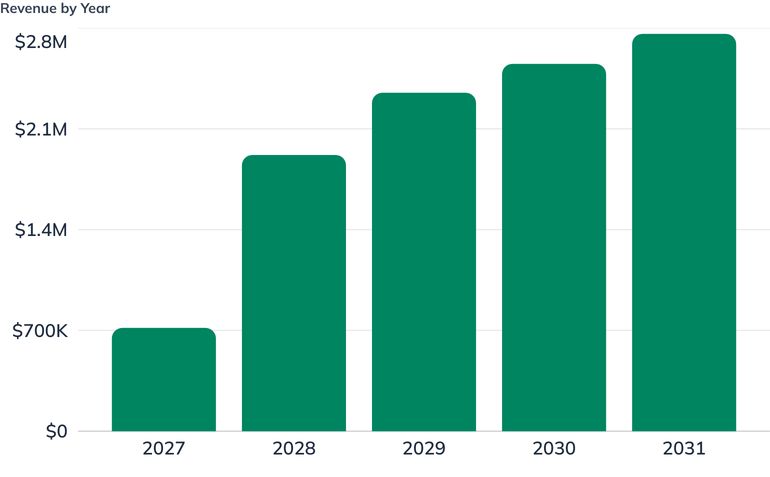
Wildcraft earns revenue from four wholesale product lines drawn from a single crop. Every stream is priced against current Oregon market conditions, where bulk outdoor flower trades around $150–250 per pound and quality indoor realizes roughly $480–600. We price a craft light-dep product between those poles and hold it.
Volume assumptions throughout are deliberately conservative. The model runs on roughly 30 grams per square foot per cycle across about two and a half cycles a year — near 75 grams per square foot annually — against a 40–50 gram per-cycle planning target, on the view that first-generation living-soil beds under-perform mature ones and that a new farm should not build a five-year plan on its best possible season.
Craft flower — bulk (A-grade). Hand-trimmed, slow-cured top-shelf flower sold by the pound to independent dispensaries and wholesalers. Priced at $560 per pound in 2027, rising to $610 by 2031 as the brand establishes and the market's worst oversupply works through. Volume grows from about 463 pounds in the partial first season to roughly 1,913 pounds at maturity. This is our largest single line and the one that carries the farm's reputation.
Wildcraft packaged eighths. The same A-grade flower, jarred retail-ready in 3.5-gram glass under our own label at $11.00 wholesale in 2027 rising to $12.00 by 2031. Roughly 16,150 units in the first partial year growing to 57,800 units at maturity. Packaging the product ourselves captures margin that would otherwise go to a wholesaler and puts our name — not a shop's private label — in the consumer's hand.
Smalls and pre-roll grade. Dense lower-canopy flower and B-grade material sold by the pound to pre-roll producers and value-tier retailers at $210 rising to $230. Volume of roughly 590 pounds in year one to 1,998 pounds at maturity. This line exists so that no part of the crop has to be dumped into the biomass market at distress pricing.
Fresh-frozen whole plant. Frozen material sold to solventless hash processors at $175 per pound rising to $195, growing from about 893 pounds in the first season to 2,253 pounds at maturity. Sold largely on contracts negotiated the winter before planting, which makes it the most predictable revenue on the farm.
Revenue trajectory
Year | Bulk flower | Packaged eighths | Smalls | Fresh-frozen | Total |
|---|---|---|---|---|---|
2027 | $259,280 | $177,650 | $123,900 | $156,275 | $717,105 |
2028 | $848,160 | $439,875 | $347,225 | $283,140 | $1,918,400 |
The step between 2027 and 2028 is large and it is a production fact, not an assumption about demand. In 2027 only three of six greenhouses are planted, the first harvest does not come off until late July, and the first sale does not occur until August. 2028 is the first year with all 30,000 square feet in production for a full season. Growth after 2028 is deliberately modest — mid-single-digit volume gains from maturing beds and improving A-grade share, plus small annual price increases — because our canopy is capped by our license and we do not intend to grow by adding acreage into a soft market.
Seasonality is real and it is modeled. Revenue is heaviest from September through January as each year's harvests are cured, tested, and sold, and lightest from April through July. Fresh-frozen revenue is concentrated almost entirely in July, September, and October, when material moves within hours of being cut. We deliberately hold roughly half of each harvest into the following spring, which lifts February–April revenue above what a single-harvest outdoor farm would see and is the reason our slow months are soft rather than empty.
Expenses & Costs
Need real financials? Explore a spreadsheet-free path to generating financial data for your business.Create your own business plan
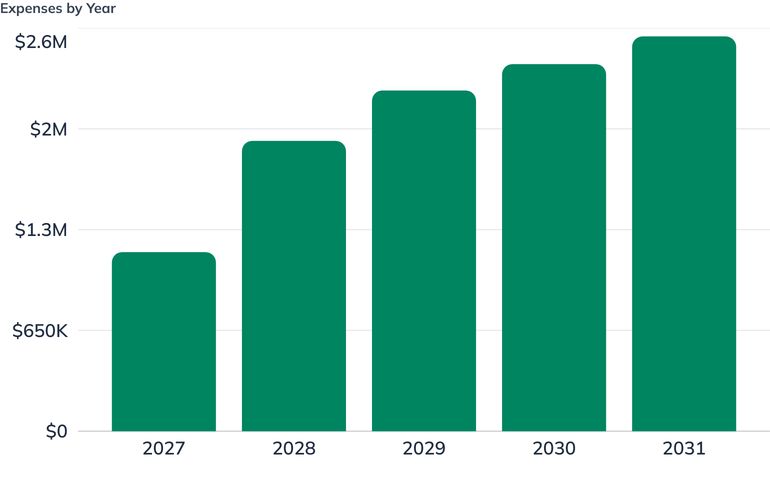
Cost of goods sold. Everything it takes to put a finished pound in a buyer's hands sits in direct costs: growing inputs, the people who grow and process the crop, greenhouse energy and water, compliance testing, and packaging.
Direct cost | Basis | Notes |
|---|---|---|
Soil amendments, nutrients & IPM inputs | 11% of revenue in 2027 falling to 7% by 2031 | Living soil beds get cheaper as they mature — this declining curve is the whole economic argument for no-till |
Direct labor (cultivation, post-harvest, seasonal crew) | Headcount-driven | The largest single cost in the business |
Greenhouse power, propane & water | $59,000 (2027) to $127,000 (2031) | No supplemental flowering lights; load is fans, controls, pumps, dehumidification, and the freezer |
Lab testing, Metrc tags & compliance | 4.5% of revenue | OLCC flower compliance panels run about $550 per batch, and batches are capped at 50 pounds |
Retail packaging, jars & labels | $1.60 per packaged eighth | Glass, child-resistant closure, label, and COA printing |
Bulk packaging, freight & delivery | 2% of revenue | Turkey bags, totes, frozen transport, and delivery runs |
Gross margin lands at 30% in the partial 2027 season and holds near 49% thereafter. That is at the upper end of the 40–48% range Oregon's better-run cultivators report, and the reason is structural rather than optimistic: with no supplemental lighting, our energy cost per pound is roughly an order of magnitude below an indoor grower's. All-in production cost runs near $300 per pound from 2029, inside the $250–400 range typical for greenhouse cultivation. Note that we carry the farm lease and equipment depreciation in operating expenses rather than allocating them into COGS; a cultivator that allocates them the other way would report a gross margin closer to 38%.
Operating expenses. The fixed cost of being a licensed, insured, compliant business in Oregon.
- Farm and facility lease — $8,500 per month escalating 3% annually, paid to the affiliated real-estate entity that holds the land and permanent buildings.
- Insurance — $27,600 in 2027 rising to $46,000 by 2031. Cannabis crops are excluded from federal crop insurance and must be placed in surplus lines, which makes coverage disproportionately expensive for an outdoor and greenhouse operator. This line is not padding.
- Legal, accounting and 280E tax compliance — $54,000 in the licensing year, settling around $40,000. Higher than a comparable farm would spend, and deliberately so.
- Marketing and budtender education — $21,000 in 2027 growing to $66,000. Concentrated in in-store education, packaging design, photography, and competition entries rather than paid media, which cannabis brands cannot buy on the major platforms anyway.
- OLCC license, permits and worker cards — roughly $11,000 annually. The Tier II producer license itself is $5,750 per year plus a $250 application fee at issuance and renewal, with $100 worker permits for every employee.
- Employee health benefits — introduced in 2028 at $28,800 and growing to $56,000, once the farm is close enough to profitability to offer them.
- Plus vehicles and fuel, repairs and maintenance, software subscriptions, banking and cash-handling fees, security monitoring, office and farm supplies, and travel and association dues.
Payroll burden. Employer costs run roughly 20% on top of gross wages: 7.65% FICA, Oregon unemployment insurance at the 2.4% new-employer rate on the first $56,700 of wages, FUTA, Paid Leave Oregon's employer share once we cross 25 employees, the Workers' Benefit Fund assessment, and workers' compensation — which is the largest and least predictable component for agricultural field and harvest work. Siting in Jackson County avoids the TriMet and Lane Transit payroll taxes entirely — roughly 0.8% of payroll a Portland or Eugene operation would pay.
Income tax. The forecast applies a 34% effective income tax rate, which is higher than the 21% federal corporate rate for a specific reason: IRC §280E disallows federal deduction of ordinary business expenses for adult-use cannabis operators, so our federal taxable income is computed on gross profit rather than net profit. Oregon decouples from §280E and allows normal deductions, which softens but does not eliminate the effect. The blended rate reflects both computations. The 2027 operating loss shelters taxable income through 2030, so the first meaningful tax payment falls in 2031. If federal rescheduling eventually reaches adult-use cannabis, this line falls materially — we treat that as upside and do not model it.
Profitability
Need real milestones? Establish a clear path for your business with real-world examples.Create your own business plan
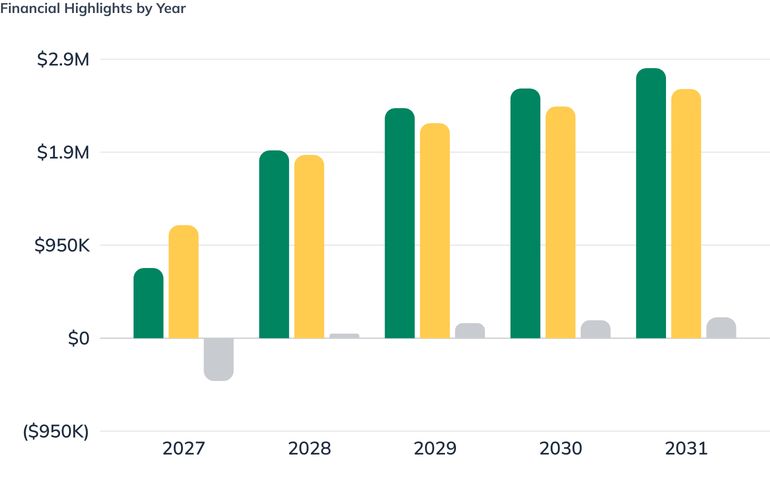
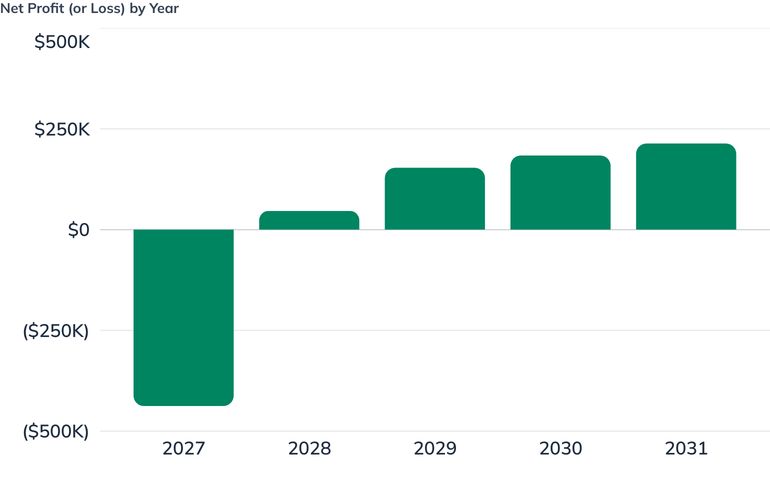
Wildcraft loses money in 2027, roughly breaks even in 2028, and is solidly profitable from 2029 onward. That shape is not a rhetorical device — it is what happens when a farm spends the first five months of its existence building greenhouses, does not make its first sale until August, and models yields conservatively rather than optimistically.
Year | Revenue | Gross margin | Operating income (EBITDA) | Net profit | Net margin |
|---|---|---|---|---|---|
2027 | $717,105 | 30.3% | $(241,539) | $(437,558) | — |
The 2027 loss is the cost of getting to a crop. Payroll, lease, insurance, licensing, and professional fees all run from January while revenue starts in August. The year closes at a net loss of about $438,000 against $717,000 of revenue from a half-canopy, half-season harvest. Cash never runs short — the funding is sized for exactly this — and the loss generates a net operating loss carryforward that shelters income through 2030.
2028 is the first real year and it lands close to break-even. All six greenhouses in production for a full season roughly triples revenue and turns a $294,000 operating profit on a 49.9% gross margin. After $107,000 of interest and $141,000 of depreciation, net profit is a thin $46,000. This is honest rather than flattering: a farm carrying $1.75 million of equipment out of its first full harvest should not be showing a large accounting profit in year two.
2029 through 2031 compound quietly. Revenue grows in the mid-single digits, gross margin holds around 49%, and net profit climbs from $153,000 to $214,000. Interest expense falls every year as the term loan amortizes, which is most of what drives net profit upward while operating income grows more slowly. Income tax first appears in 2031, once the 2027 loss carryforward is exhausted.
How this compares to the industry. EBITDA margins of 15–18% from 2028 onward sit right alongside what Oregon's best-run public cultivator reports, and gross margins near 49% are comparable. Net margins in the 2–8% range are modest by most industries' standards and respectable by this one's: roughly a quarter of U.S. cannabis operators are profitable at all, and Oregon is the hardest market in the country in which to be one. The gap between our EBITDA and our net profit is almost entirely §280E tax, interest, and depreciation — the same three things that keep otherwise healthy cannabis operators reporting losses.
Cash tells a cleaner story than profit. Ending cash never falls below about $519,000 — the low point comes in September 2027, as the first harvest is still being cured and sold — and climbs every year thereafter, from $635,000 at the end of 2027 to roughly $1.44 million by the end of 2031. The farm is cash-flow positive from its first selling season onward, and the seasonal dips visible each summer are working capital tied up in a growing crop, which is simply what farming looks like.
What would break this. A further 15% fall in wholesale flower prices would cut roughly $350,000 a year from gross profit and push the farm back to break-even without threatening solvency. A lost harvest in one greenhouse costs about 15% of a year's flower revenue — survivable, which is precisely why we run six houses on staggered schedules rather than one crop with one harvest date. Conversely, if yields reach the 40–50 grams per square foot per cycle our cultivation plan targets rather than the roughly 30 modeled here, revenue and profit are materially higher than shown.
Use of Funds
Wildcraft is raising $3,100,000 to license, build, plant, and operate the farm through its first full production season. About 56% of that is capital equipment; the balance is the eight months of payroll and operating cost that run before the first sale, plus a working capital reserve sized so the farm never has to sell a harvest into a bad week because it needs cash.
Capital expenditures — $1,748,000
Item | Amount |
|---|---|
Light-dep greenhouse structures & blackout systems (30,000 sq ft) | $660,000 |
Drying, curing & post-harvest equipment | $210,000 |
Irrigation, fertigation & water storage systems | $185,000 |
Propagation & mother room build-out | $145,000 |
Living soil establishment & permanent beds | $135,000 |
Blast freezer & fresh-frozen cold chain | $125,000 |
Tractor, utility vehicle & delivery truck | $118,000 |
Standby generator & electrical infrastructure | $92,000 |
Security, access control & compliance systems | $78,000 |
Pre-revenue operations and working capital — $1,352,000
Item | Amount |
|---|---|
Payroll, January through August 2027 (before first sale) | $290,000 |
Licensing, legal, accounting & professional services | $100,000 |
First-crop inputs, lease, insurance & operating costs pre-harvest | $190,000 |
Working capital reserve & inventory carry | $772,000 |
Why the reserve is that large. Three things make a cannabis farm's working capital needs heavier than they first appear. Inventory is carried for months between harvest and sale, and our strategy deliberately holds half of each crop into the spring window. Oregon wholesale runs on 14- and 30-day terms with chronic slow payment across the industry. And §280E means the business pays federal tax on gross profit, so cash tax obligations arrive whether or not the P&L shows much net income. A farm that under-reserves for these ends up dumping product at harvest to make payroll — which is exactly the behavior that created Oregon's price collapse, and exactly what we are capitalized not to do.
The reserve is also sized against our own conservative yield assumption. Because the plan models roughly 30 grams per square foot per cycle rather than the 40–50 our cultivation plan targets, the business runs thinner in 2028 than a more optimistic model would show, and the capital cushion is what lets us reach 2029 without a second raise if the first two harvests disappoint.
Not included in this raise. The 22-acre parcel and permanent buildings are acquired separately by an affiliated real-estate entity and leased to the operating company at $8,500 per month, so land cost does not sit in this figure. The rooftop solar array planned for mid-2030 ($150,000) is funded from operating cash flow, not from this raise.
Runway. The funding carries the business from January 2027 through its first two production years with cash never dropping below roughly $519,000. The low point falls in September 2027, while the first harvest is still curing and selling through. No further capital is required at any point in the five-year plan.
Sources of Funds
The $3,100,000 comes from a mix weighted toward equity, for a reason worth stating plainly: cannabis debt is expensive, SBA financing is unavailable to plant-touching businesses, and a farm with a heavy fixed debt service in a price-compressed market has no room to hold inventory for a better market. Equity buys us the patience the strategy requires.
Source | Type | Amount | Timing |
|---|---|---|---|
Founders' equity contribution | Equity | $300,000 | January 2027 |
Seed equity round | Equity | $1,600,000 | January 2027 |
Seed extension (working capital) | Equity | $300,000 | January 2028 |
Equipment & term loan (cannabis lender) | Debt | $900,000 | March 2027 |
Total | $3,100,000 |
Founders' equity — $300,000. Both founders contribute cash alongside their below-market salaries. Investors reasonably expect founders to have their own money at risk in a business this dependent on operator judgment.
Seed equity round — $1,600,000. Raised from investors with cannabis or specialty agriculture experience, closing at the start of the buildout. This is the tranche that funds greenhouse construction and the pre-revenue year. We are targeting investors who understand a five-year agricultural payback rather than a software return curve.
Seed extension — $300,000. A smaller commitment drawn in January 2028 to fund working capital as the farm scales from three houses to six and inventory carry roughly triples. Committed at the same time as the seed round rather than raised separately, so it is not a financing risk sitting in the middle of the plan.
Equipment and term loan — $900,000. Seven-year amortizing debt at 12.5% from a cannabis-industry lender, drawn in March 2027 against greenhouse structures, post-harvest equipment, cold chain, and vehicles. The first nine months are interest-only, which keeps debt service light through the pre-revenue period; full principal and interest payments begin in December 2027, after the first harvest has been sold. The rate reflects the real cannabis lending market — real estate and term debt for plant-touching operators runs 9–17%, and equipment financing at prime plus 3.5% or higher — not a rate we wish existed. Personal guarantees from both founders are assumed.
Why this mix. Debt covers 29% of the raise and is secured against hard assets with real resale value, which is the only kind of cannabis borrowing that prices sensibly. Interest expense peaks at about $107,000 in 2028 and declines every year thereafter as principal amortizes, falling to $61,000 by 2031 — most of the improvement in net profit over the plan comes from that decline. Total debt service stays under 10% of revenue from 2028 onward, comfortably serviceable from operating cash flow even under a materially worse price scenario.
Investor return. This is not a business that returns capital through a quick exit. Returns come from distributions once the farm is consistently profitable and reserves are built — realistically from 2030 onward — and from the underlying value of an established craft brand, a mature living-soil asset, an Applegate-adapted genetics library, and an OLCC production license in a state that has not issued new ones since 2019. If federal rescheduling ever reaches adult-use cannabis, or if interstate commerce opens, a low-cost, high-quality Oregon sun-grown producer is unusually well positioned — but nothing in this plan depends on either happening.
Projected Statements
Frequently Asked Questions
A cannabis cultivation plan needs everything a normal farm plan needs — site and facilities, growing method, target market, marketing and sales, team, and financial projections — plus the licensing, seed-to-sale tracking, and tax structure that plant-touching businesses live under. Wildcraft Cultivation's plan pairs its 30,000-square-foot light-deprivation greenhouse and living-soil growing method with an OLCC Tier II license application timeline, Metrc compliance, a four-line wholesale revenue model, a $3.1 million funding plan, and five-year projections. It also documents why the business is organized as a C corporation, which is a direct consequence of federal tax rules rather than a formality.
Startup costs vary enormously with scale, state, and whether you grow outdoor, greenhouse, or indoor — a small outdoor grow can start in the low six figures, while indoor canopy routinely runs into the millions. Wildcraft Cultivation raises $3,100,000 to license, build, plant, and operate through its first full season: about $1,748,000 in capital equipment, including $660,000 for greenhouse structures and blackout systems and $210,000 for drying and curing, plus $1,352,000 for the eight months of payroll and operating cost that run before the first sale and a working capital reserve. The reserve exists so the farm never has to sell a harvest into a bad week because it needs cash.
Yes — cannabis cultivation is one of the most heavily licensed businesses there is, and requirements are entirely state-specific. Wildcraft operates under an OLCC Tier II mixed producer license in Oregon, tracks every plant, harvest lot, and transfer in the state-mandated Metrc system, holds worker permits for all staff, and sites on Exclusive Farm Use land under ORS 475C.489 and Jackson County's own marijuana production ordinance. The plan also budgets compliance testing at roughly $550 per batch against a 50-pound batch cap, and confirms parcel-level land-use compliance before purchase rather than after.
Wholesale cultivators sell harvested product to licensed buyers rather than to consumers, and the smart ones sell more than one grade. Wildcraft draws four revenue lines from a single crop: A-grade craft flower sold in bulk at $560 per pound rising to $610 by 2031; retail-ready 3.5-gram eighths jarred under its own label at $11.00 to $12.00 wholesale; smalls and B-grade flower for pre-roll producers at $210 to $230 per pound; and fresh-frozen whole-plant material for solventless hash makers at $175 to $195 per pound. That mix means no single price collapse can take the farm down and every gram has a home at an appropriate price.
Wildcraft loses money in 2027, roughly breaks even in 2028, and is solidly profitable from 2029 onward — a shape driven by spending the first five months building greenhouses and not making a first sale until August. The 2027 net loss is about $438,000 on $717,000 of revenue from a half-canopy, half-season harvest; 2028 revenue roughly triples to $1.9 million for a thin $46,000 net profit, and net profit climbs to $214,000 by 2031. The gap between healthy EBITDA margins of 15–18% and those modest net margins is almost entirely IRC §280E tax, interest, and depreciation — the three things that keep otherwise sound cannabis operators reporting losses.
By refusing to compete on price at all. Oregon has been structurally oversupplied since 2018 — consumers buy roughly 57 cents' worth of cannabis for every dollar produced, and bulk outdoor flower now trades at or below what it costs most farms to grow — but that collapse hollowed out the commodity middle while leaving a premium tier that buyers say they cannot fill. Wildcraft targets that gap specifically, competing on living-soil terpene expression, freshness, and consistency rather than cost per pound, and accepts that it will never take a price-driven account from a large outdoor biomass grower.
Wildcraft sells business-to-business only; every customer is an OLCC-licensed entity, and the consumer who eventually smokes the flower is designed for but never transacted with. Its primary segment is the 120–180 craft-forward independent dispensaries among Oregon's roughly 800 retailers — shops whose budtenders can name the farm behind the top shelf — with a target of 40–60 active accounts ordering one to five pounds every two to four weeks. Beyond that it sells to the 20–30 Oregon processors buying fresh-frozen material, to wholesalers and pre-roll manufacturers as a release valve for smalls, and selectively to multi-location retail chains that treat craft flower as its own margin category.
Light deprivation uses motorized blackout curtains to control photoperiod independently of the calendar, letting a greenhouse force flowering on the grower's schedule instead of the season's. For Wildcraft this is the central strategic bet: six greenhouse bays on staggered blackout schedules produce roughly two and a half harvest cycles a year rather than one, which spreads labor and cash flow across the calendar and puts fresh, current-season flower on shelves in March and April when competitors are selling nine-month-old October inventory. It also limits crop risk — losing one greenhouse costs about 15% of a year's flower revenue rather than the entire harvest.

Business Plan Outline
Start your plan