





Physical Fitness Gym Business Plan


Business Plan Summary
This fitness gym business plan example features Ladies Only Fitness, Eugene, Oregon's only women-only strength gym, founded by Joan Sullivan and Marge Williamson. It covers Ladies Only Fitness's staffed, on-site childcare built to keep mothers training, its positioning against seven categories of local competitors, and a $650,000 launch funded through owner equity and an SBA 7(a) loan. Use it as inspiration for your own plan, and read our guide on how to start a gym or fitness center for step-by-step advice. Download a free business plan template to get started, or browse more business plan examples.
Ladies Only Fitness
Executive Summary
Problem
Two groups of women in Eugene are underserved by every gym in this market. Women who want to build strength get pushed off the free-weight floor and end up doing a workout they did not come for. Mothers of young children face a ninety-minute logistics problem for a forty-five-minute workout, because clubs here have either cut childcare entirely or reduced it to a back room with limited hours. A woman in her thirties with a toddler who wants to get strong has to solve both problems at once, and no club in this market lets her.
Solution
Ladies Only Fitness is a women-only strength and conditioning club built around one idea: a woman should be able to train seriously and bring her kid.
Our 5,500 square foot facility in south Eugene centers on a full free-weight floor — six half-racks, platforms, dumbbells to 80 pounds — not a token corner behind the treadmills. Every member receives a movement assessment and a written twelve-week program. Small-group strength training of four to six women is our second revenue stream and the format with the strongest retention in the industry.
The Kids' Room sits directly off the training floor behind a glass wall. A mother on a rack can see her child. It is open during all staffed hours, takes children from six weeks, and is staffed to certified-center ratios and background-check standards even though Oregon law exempts us from them.
Market
Eugene is Oregon's second-largest city at approximately 180,000 people, within a Lane County metro of roughly 382,000. About 14,000 women aged 25–54 here already pay for a gym membership somewhere, and roughly 8,000 women have at least one child under six.
At maturity we plan for approximately 590 members — around 4% of the women in this market who already pay for a gym. This is Track Town USA and the birthplace of Nike, a city with a deep athletic culture where a serious strength facility reads as native rather than novel.
We are direct about two constraints. Lane County's population has been flat since 2020, so every member must be won from a competitor or activated from home training. And Eugene's median household income of $66,562 sits about 18% below the national figure — our $89 and $119 tiers target dual-income professional households, not the median household. Eugene supports several operators in and above that price band today.
Competition
Eugene has budget chains at $15–35, full-service nationals at $45–70, the YMCA at $60–90, and boutique franchises at $99–179. None is women-only. Childcare survives mainly at the YMCA and one or two independents, generally with restricted hours.
Clubs across the country cut childcare during the pandemic and never restored it. What was once a standard amenity is now genuinely scarce, and expensive enough to bring back that incumbents are unlikely to follow quickly.
Why us
The women-only position is structural, not a feature — a competitor cannot match it without abandoning half its membership. The Kids' Room is a real operating burden we accept deliberately: staffed, insured, and 500 square feet that generates no membership revenue directly. It is the thing competitors will not copy, and it is the reason our target member leaves the club she is at now.
Joan Sullivan has run fitness facilities in Eugene for fifteen years and holds NSCA and pre/postnatal coaching credentials. Marge Williamson is a CPA with eleven years advising owner-operated service businesses.
Expectations
We open in July 2026 with a founding-member cohort recruited over the preceding ninety days. Membership builds to roughly 390 by the end of year one and 590 by year three.
Year 1 | Year 2 | Year 3 | |
|---|---|---|---|
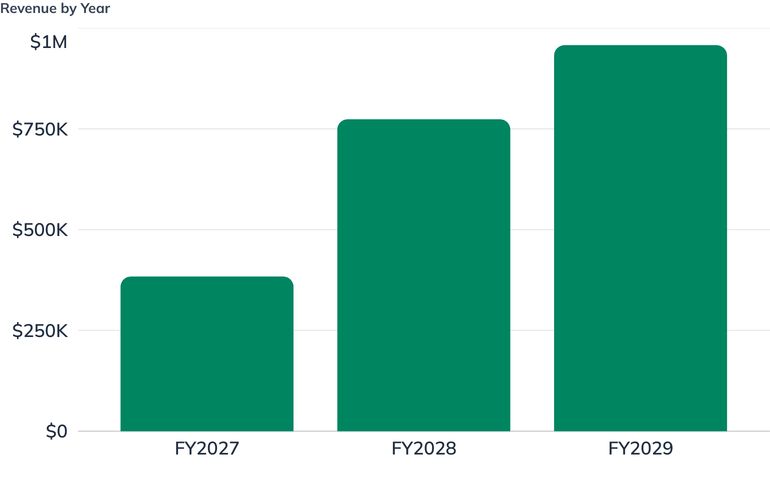
Revenue | $383,706 | $773,761 | $957,470 |
Gross margin | 84.4% | 83.8% | 83.9% |
Operating income (EBITDA) | ($170,643) | ($1,995) | $119,431 |
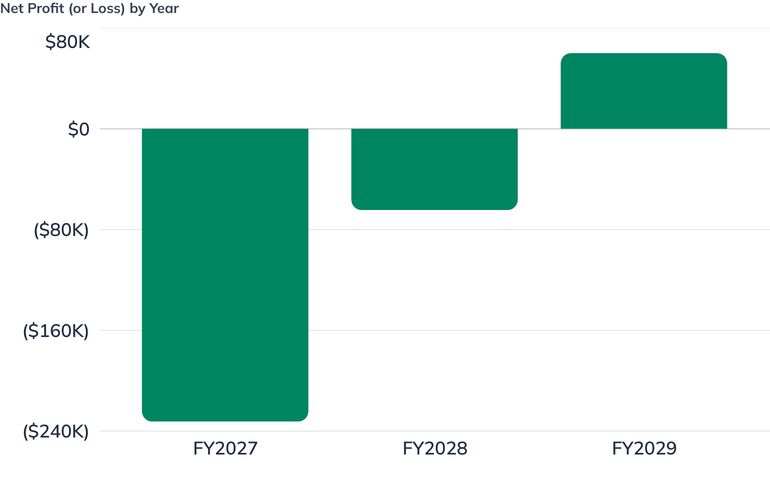
Net profit | ($232,294) | ($64,436) | $60,058 |
Ending cash | $176,961 | $96,377 | $140,568 |
The club reaches EBITDA breakeven in year two and net profitability in year three. That timeline is normal for a facility of this size and cost structure, and we have funded it honestly rather than assuming a faster ramp. Cash on hand never falls below $96,000, with the low point at the end of year two before the trajectory turns upward.
Payroll falls from 57% of revenue to 36%, and rent from 29% to 12% — both landing inside industry benchmark by year three. That convergence is the clearest indicator of whether this plan is working.
Financing needed
Total: $650,000
Source | Amount |
|---|---|
Owner equity (Joan Sullivan $70,000 + Marge Williamson $130,000) | $200,000 |
SBA 7(a) loan — 10 years at 9.5% | $450,000 |
Approximately $321,400 funds startup costs — leasehold improvements, the Kids' Room build-out, deposits, and the pre-opening campaign. The remaining $328,600 is a working capital reserve of close to six months of operating expense.
Undercapitalization is the most common reason new clubs fail. A club that runs short of cash in month eight starts discounting memberships and cutting Kids' Room hours — the exact moves that destroy what this business is built on. The reserve is what lets us hold our standard while the membership base builds.
The $200,000 equity injection is 31% of total project cost, well above the 10–20% SBA lenders typically require.
Opportunity

Problem Worth Solving
Two groups of women in Eugene are underserved by every gym in this market, and for different reasons.
The first is women who want to lift. Strength training is now the fastest-growing category in fitness for women, and the free-weight areas of most clubs remain the least welcoming rooms in the building. Women tell us the same things repeatedly: they get unsolicited coaching from strangers, they get watched, they get crowded off equipment, and they end up retreating to the cardio deck and doing a workout they did not come for. This is not a comfort problem to be solved with a better mirror layout. It is a programming problem — women who want to build strength are being pushed toward the part of the gym that will not build it.
This is a particularly conspicuous gap in Eugene. This is Track Town USA and the birthplace of Nike, a city with a serious athletic culture and a population that trains. The facilities have not kept pace with what women here actually want to do.
The second group is mothers of young children. For a parent of a two-year-old, the barrier is not motivation, it is the ninety-minute logistics chain that a forty-five-minute workout requires. Most Eugene clubs have either eliminated childcare entirely as a cost center or reduced it to a windowless back room with limited hours and a waitlist. A mother who cannot see her child, cannot get a spot at 9 a.m., or cannot bring an infant simply does not join. Nationally, this is a well-documented drop-off: membership among women falls sharply in the years immediately following a first child and often never recovers.
These two problems compound. A woman in her thirties with a young child who wants to get strong has to solve both at once, and no club in this market lets her. She is asked to choose between a facility that accommodates her schedule and one that accommodates her training goals. Most choose neither and train at home with an app, which works until it doesn't — home programs have among the lowest twelve-month adherence rates of any fitness format, precisely because they supply no coaching and no accountability.
The result is a large group of women in Eugene who are actively looking to train, can afford to pay for it, and are not being served by anyone.
Our Solution
Ladies Only Fitness is a women-only strength and conditioning club in Eugene, Oregon, built around one idea: a woman should be able to train seriously and bring her kid. We solve both of the problems above in a single 5,500 square foot building.
A strength-first floor, women only
The center of our club is a full free-weight floor — racks, platforms, dumbbells to 80 pounds, trap bars, and benches — not a token corner behind the treadmills. Because the entire membership is women, the equipment women actually want is sized and stocked for them, and no one has to negotiate for a rack. We keep a cardio and conditioning zone and three studio rooms for group work, but the barbell floor is the anchor, and that is a deliberate departure from how women-only clubs have historically been programmed.
Coaching, not a tour and a keycard
Every new member starts with a movement assessment and a written twelve-week program, included in the membership. Members who want more buy into small-group strength training — four to six women, one coach, twice a week — which is our second revenue stream and the format with the strongest retention numbers in the industry. One-to-one personal training is available for members who want it. Programming and progress tracking live in our member app, so a member's numbers follow her whether she is on the floor with a coach or traveling.
The Kids' Room, in the middle of the building
Our childcare room sits directly off the main training floor behind a glass wall. A mother on a rack can see her child, and her child can see her. This is the single design decision that defines our facility, and it is the reason we chose this floor plate over cheaper alternatives.
The Kids' Room is open during all staffed hours, not a narrow morning block, and takes children from six weeks through five years. Care is provided while the parent is on the premises and training, which places it outside Oregon's child care facility licensing requirement — but we staff it to certified-center standards anyway: background-checked attendants, CPR and first aid certification, posted ratios of one attendant to four children under two, and a check-in system that photographs and matches guardians at pickup. We are choosing to meet a standard we are not required to meet, because the mothers we are recruiting will ask, and because it is the right way to run a room full of infants.
What we are not
We are not a boutique studio selling a single format, and we are not a discount gym competing on price. We sit deliberately between them: full facility access, real coaching, and childcare, priced below the class-pack studios and above the budget clubs.
Market Overview
The Eugene market
Ladies Only Fitness is located in Eugene, Oregon, the seat of Lane County and the state's second-largest city. The city's population is approximately 180,000, and the Eugene metropolitan statistical area — coextensive with Lane County — is approximately 382,000.
We want to be precise about growth, because it is easy to overstate. The city of Eugene is growing at roughly 1.3% annually. The metro as a whole is not: Lane County's population has been essentially flat since the 2020 census, with recent estimates slightly below it. Portland State University's most recent forecast expects Eugene's growth rate to slow further over the coming planning period.
This plan does not rely on population growth. Every member in our forecast is won from an existing club or from a woman currently training at home. If the metro grows, that is upside we have not spent.
Who lives here
Eugene's median household income is $66,562 — about 18% below the national median. That number deserves a direct response, because our $89 and $119 memberships are not priced for the median household.
They are not meant to be. Our member is in a dual-income professional or university-affiliated household, most often in south or east Eugene, and she is already paying $45 to $159 a month at another club or studio. Eugene supports several operators in that price band today. What we are competing for is where that money goes, not whether it exists.
The median age here is 35.2, which sits directly on our target range. Eugene is also an unusually good market for a strength-first concept: this is Track Town USA and the birthplace of Nike, with a deep, genuine athletic culture and a population that takes training seriously. A club built around barbells rather than aerobics reads as normal here in a way it would not in many cities this size.
Our addressable market
Segment | Estimate | Why they fit |
|---|---|---|
Lane County population | ~382,000 | Total market |
Women 25–54 in the metro | ~66,000 | Core demographic |
Women 25–54 who currently pay for a gym | ~14,000 | Proven willingness to pay |
Women 25–45 with at least one child under six | ~8,000 | The childcare-constrained segment |
At maturity we plan for approximately 590 members — roughly 4% of the women in this market who already pay for a gym somewhere. That is a real number and we should treat it as one. It is not a rounding error, and it will not happen by accident. But it is a share a single differentiated club can hold in a metro this size, particularly one that is the only facility of its kind here.
What is happening in this category
Three shifts make this the right moment for this club.
Strength training has become the dominant modality for women. The share of women whose primary goal is building strength rather than losing weight has climbed steadily since 2020 and is now the majority position among women under 45. Facilities and marketing across the industry have not caught up — most still sell women a weight-loss narrative.
Childcare has become a scarcity good. Clubs across the country cut childcare during the pandemic and largely never restored it, treating the room as pure overhead. In Eugene it survives mainly at the YMCA and one or two full-service independents, generally with restricted hours. What was once a standard amenity is now a genuine differentiator, and it is expensive enough to restore that incumbents are unlikely to follow quickly.
Retention now matters more than acquisition. Industry churn has fallen to roughly 7% annually and average tenure has climbed toward five years, but that average conceals a wide spread: members who connect to a coached, social format cancel dramatically less often than members who train alone. Our entire model — assessments, written programs, small groups of four to six — is built on the side of that split that keeps people.
The honest constraint
A flat metro means we cannot grow into new demand. Every one of our 590 members has to be taken from a competitor or activated from home training. That is a harder plan than one written for a boomtown, and it is the reason our marketing is built on referral and community partnerships rather than on reaching newcomers.
Competitors
Current alternatives
Eugene has plenty of places to work out. It has nowhere that does what we do.
Category | Typical price | What they offer | Where they leave a gap |
|---|---|---|---|
Budget national chains (Planet Fitness, Crunch) | $15–$35/mo | 24-hour access, machines, minimal staff | No coaching, no childcare, no free-weight culture for women |
Full-service national chains (24 Hour Fitness) | $45–$70/mo | Large facility, pool, classes | Co-ed floor; childcare cut or reduced to limited hours |
Eugene Family YMCA | $60–$90/mo | Broad amenities, established childcare, community programming | Co-ed, family-oriented rather than training-oriented; not a strength environment |
Boutique franchises (Orangetheory and similar) | $99–$179/mo | Coached group classes, strong community | Single format only; no open floor, no barbell work, no childcare |
Independent full-service clubs | $55–$95/mo | Established local membership, varied amenities | Co-ed; childcare limited or absent; facilities vary widely in age |
CrossFit boxes and strength gyms | $150–$200/mo | Real strength coaching, tight community | Intimidating entry point for beginners; childcare rare and informal |
Home training apps | $10–$30/mo | Cheap, zero logistics | Lowest twelve-month adherence of any format; no equipment, no accountability |
We have described competitors by category and price band rather than making claims about specific local operators' internal practices. Prices reflect publicly advertised rates in the Eugene market and should be re-verified before this plan is presented to a lender.
Our advantages
We are the only women-only facility in the market. That is a structural position, not a feature. A competitor cannot match it without abandoning half its membership.
Our childcare is a real asset, not a closet. Full staffed hours, infants accepted from six weeks, and — critically — visible from the training floor. The YMCA is the one Eugene operator with genuinely established childcare, and it competes on family membership rather than on training. Restoring childcare at our level costs a commercial club a room it has already repurposed plus staffing it cut for a reason. The economics that made them exit are the same economics that make re-entry slow.
We combine an open strength floor with coaching. Boutique franchises sell one format on a fixed schedule. Budget clubs sell access with no guidance. We give a member a rack, a written program, and a coach who knows her name, which is the combination that keeps members past month four.
We fit this city. Eugene's athletic culture runs deep, and a serious strength facility reads as native here rather than as a novelty.
Our members are also our sales force. Women-only clubs consistently produce referral rates above the industry average, because the value proposition is easy to explain to a friend who has had the same bad experience. Our launch plan leans on this directly.
Where we are vulnerable
We should be honest about the risks. A well-capitalized national operator could open a women's concept here. Our rent is a fixed cost that does not flex if membership stalls. And our childcare room is a genuine operating burden — it is staffed, insured, and floor space that generates no direct membership revenue.
The sharpest risk is specific to this market: Eugene's median household income sits well below the national figure, and the metro is not growing. We are competing for a fixed pool of discretionary fitness spending against operators who have been here for years. We accept the Kids' Room cost deliberately because it is the thing competitors will not copy, and because it is the reason our target member leaves the club she is at now.
Execution
Market Plan Overview
Our marketing rests on a simple observation: our target member has already had a bad gym experience, and she can describe it precisely. We do not have to create demand. We have to be findable and credible at the moment she decides to try again.
Because Lane County is not growing, essentially every member we sign is currently a member somewhere else or is training at home. Our marketing is built for switching, not for discovery.
Pre-opening: the founding member campaign
We begin selling ninety days before we open. Founding memberships are offered at $79/month locked for twenty-four months, capped at 150 spots. This does three things: it funds a portion of the build-out from deposits, it gives us a room that feels full on opening day rather than echoing, and it converts 150 women into people with a personal stake in telling their friends.
Founding members are recruited through targeted social advertising, three in-person preview events held in the unfinished space, and partnerships described below. Our target is 120 signed founding members by opening day.
Digital acquisition
Local search is our highest-intent channel. "Women's gym near me" and "gym with childcare Eugene" are low-volume, high-conversion searches, and we intend to own them. That means a complete Google Business Profile, consistent review generation from members, and location pages built for those specific phrases.
Instagram and TikTok carry the proof. Our content is our members and coaches training — real sets, real weights, real Kids' Room. Women-only positioning performs unusually well organically because the content is legible in two seconds. We budget for paid amplification of the posts that earn traction rather than for produced campaigns.
Paid social is geo-fenced and audience-specific. We run two persistent audiences: women 25–45 within a fifteen-minute drive of south and east Eugene, and a parenting-interest audience within the same radius. The creative is different for each; the childcare audience sees the Kids' Room first.
Community and partnerships
The channels that will matter most for us are not paid. We are building referral relationships with prenatal and postpartum physical therapy practices, local OB-GYN and midwifery groups, pelvic floor specialists, and wellness coordinators at Eugene's largest employers — the University of Oregon, PeaceHealth, Lane Community College, and the school districts. A referral from a postpartum PT who knows we take infants from six weeks is worth more than any amount of ad spend, and those relationships take months to build, which is why they start pre-opening.
Eugene's running and athletics community is an unusually good fit for us. Local run clubs, race organizers, and masters athletics groups contain exactly the women who want structured strength work and cannot find a comfortable place to do it. We will be visible at those events from the first season.
We also host free monthly community events — a barbell fundamentals workshop, a postpartum return-to-training clinic — open to non-members. These are our most effective top-of-funnel activity and they cost us a coach's time and a Saturday morning.
Referral program
Every member who refers a friend who joins receives one month free; the friend receives her first month at half price. Women-only clubs consistently see referral rates above the industry average, and we expect referral to become our single largest acquisition channel by the end of year one, which is what brings our cost per acquired member down as we scale. In a flat market with a fixed pool of gym-goers, word of mouth inside that pool is the most valuable asset we can build.
Retention as marketing
We treat month four as the number that matters. Every member gets a scheduled check-in at week two, week six, and week twelve, and a member who misses fourteen consecutive days gets a personal call from her coach — not an automated email. Our marketing budget is deliberately weighted toward the first year and declines afterward, because a club that retains well eventually markets itself.
The Logistics-Locked Mother
Sarah Miller
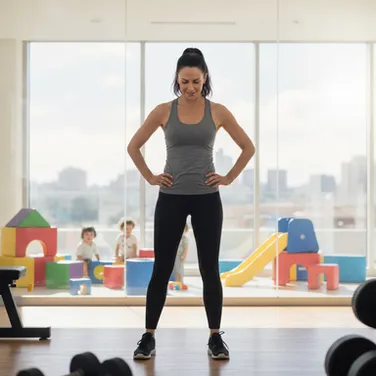
A busy professional currently working remotely who has struggled to maintain a fitness routine since the birth of her second child. She is highly motivated to regain her strength but is constantly thwarted by the 'logistics chain' of finding reliable, high-quality childcare that aligns with her limited workout windows.
Age
34
Location
South Hills, Eugene, OR
Family Status
Married, 2 children (ages 8 months & 3 years)
Education
Master of Business Administration
Profession
Marketing Director at a local tech firm
Opportunities
- Offer specialized 'Return to Lifting' programs specifically designed for the postpartum body, leveraging Joan Sullivan's credentials.
- Bundle childcare costs into a premium membership tier to simplify the transaction and emphasize the 'all-in-one' solution.
- Schedule small-group training during traditional 'drop-off' lulls to build a micro-community of women in the same life stage.
Pain Points
- Local gyms have cut childcare hours or have long waitlists for the 'back room'.
- Anxiety about leaving her infant with uncertified staff in windowless rooms.
- The 90-minute overhead required to get a 45-minute workout in at traditional clubs.
Needs
- Visual confirmation of her children's safety via the glass-walled Kids' Room.
- Childcare that accepts infants as young as six weeks.
- A structured, efficient workout plan that respects her limited time.
“I don't need a spa; I need a squat rack and a place where I know my baby is safe and visible while I use it.”

The Structured Accountability Seeker
Elena Rodriguez
A healthcare professional who understands the importance of functional strength as she ages but finds home-based apps uninspiring and difficult to stick to. She is willing to pay a premium for expert guidance and a small-group environment where she is expected to show up.
Age
49
Location
Ferry Street Bridge, Eugene, OR
Family Status
Married, teenagers
Education
Master of Science in Nursing
Profession
Senior Nurse Administrator
Opportunities
- Aggressively market the 4-6 person training format as a way to get 'personal training results' at a 'boutique class price'.
- Create 12-week blocks focused on bone density and functional mobility to appeal to the 45+ demographic.
- Use the initial movement assessment as a high-touch sales tool to demonstrate the 'medical-grade' expertise of the staff.
Pain Points
- Fear of injury when trying to follow generic YouTube or app-based workouts at home.
- Lack of social connection and accountability in 'big box' gyms.
- Frustration with 'one-size-fits-all' classes that don't account for her specific physical history.
Needs
- A written, personalized 12-week program that takes the guesswork out of her sessions.
- Expert coaching from credentialed professionals like Joan Sullivan.
- A clean, upscale environment that feels more like a professional studio than a warehouse.
“I’ve tried the apps, but without someone checking my form and a group waiting for me, I just don't go. I need a real plan.”
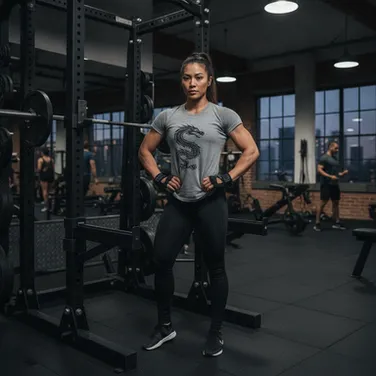
The Displaced Strength Enthusiast
Chloe Nguyen
An ambitious young professional who loves heavy lifting but has grown weary of the 'bro-culture' at local budget and national gyms. She often finds herself retreating to the cardio deck because the free-weight area is too crowded or uncomfortable due to unsolicited advice from male members.
Age
27
Location
Whiteaker District, Eugene, OR
Family Status
Single
Education
Bachelor of Science in Biology
Profession
Lab Technician at University of Oregon
Opportunities
- Host monthly clinics on powerlifting basics (deadlift, bench, squat) to attract women looking to move beyond basic dumbbells.
- Provide a digital version of the 12-week program that allows her to log 'PRs' and see tangible strength gains.
- Marketing the 80lb dumbbells and six half-racks specifically to women who feel 'capped out' by the token weights at other gyms.
Pain Points
- Feeling watched or judged while performing heavy lifts in co-ed spaces.
- Getting 'mansplained' to by strangers while trying to focus on her programming.
- Waiting 20+ minutes for a power rack at high-volume budget clubs like Crunch or Planet Fitness.
Needs
- A dedicated, women-only space where the free-weight floor is the priority, not an afterthought.
- High-quality equipment (half-racks and platforms) that isn't tucked away in a corner.
- A community of like-minded women who take strength training seriously.
“I’m tired of being pushed off the squat rack by guys who just want to curl in it. I want a place built for how I train.”
Sales Plan
How we sell
We do not run a commission sales floor. Prospective members book a free intro session online — a 45-minute movement assessment with a coach, not a facility tour with a closer. She trains, she gets a written summary of where she is, and she is asked to join at the end. This converts substantially better than a tour for our specific customer, who has usually been sold hard by a gym before and disliked it.
Front desk staff and coaches both run intro sessions. Every member of staff is trained to sell this way, and no one earns a per-signup commission, which removes the pressure dynamic that our target member is specifically trying to avoid.
The opening sequence
Pre-plan (April–May 2026). The founding-member campaign launches ninety days before opening, funded from the members' own capital ahead of the forecast period. Deposits are collected and preview events run in the unfinished space. Target: 120 signed founding members before doors open.
Month 1 — June 2026. Build-out completes, equipment is installed, staff are hired and trained. No revenue. The founding-member campaign continues through this month.
Month 2 — July 2026. We open. Every member — founding and new — gets July free. Revenue in this month is zero by design; the objective is a full, working room and a body of members who have completed an assessment and started a program before we ask anyone to pay.
Month 3 — August 2026. First billing month. Founding members convert at their locked rate. We expect to hold the large majority of the launch cohort, because they have a written program and a coach relationship rather than a keycard.
Months 4–12. Steady acquisition through referral, local search, and community events. Growth is gradual and deliberate — we add roughly 25 to 35 net members per month early, tapering as the base grows and churn begins to offset new joins.
Year 2 onward. Net growth slows as we approach comfortable capacity. Attention shifts from acquisition to attachment rate: moving members from the base tier into the Kids' Room tier and into small-group training, which is where our revenue per member increases without adding a single body to the floor.
Seasonality
Our forecast reflects the real seasonal pattern of this business. January and September are the strongest joining months; June through August are the weakest, and summer is also when the Kids' Room is busiest as school-age siblings appear. We have staffed and budgeted for that pattern rather than assuming flat demand across the year.
Churn
We plan on losing members. Industry churn sits near 7% annually with average tenure approaching five years, but the spread between coached and uncoached members is wide, and our model is built entirely on the coached side of it. Our forecast assumes monthly churn of 3.0% — meaningfully better than a budget club, and appropriate for a facility built on assessments, written programming, and small groups.
Locations and Facilities
Ladies Only Fitness occupies a 5,500 square foot end-cap storefront in a second-generation retail center in south Eugene, near the Willamette Street corridor. We hold a seven-year lease with two five-year renewal options.
Our rent assumption is $20 per square foot plus CAM, or approximately $9,200 per month. Eugene retail space currently averages $18–$19 per square foot, so we are budgeting slightly above the market average — appropriate for an end-cap with good visibility and parking, and deliberately not an optimistic assumption.
Why this location
Trade area. South and east Eugene contain the highest concentration of the dual-income professional households our pricing is built for, and the site sits within a fifteen-minute drive of most of them.
Parking and safety. The center offers ample lit surface parking directly at the door. For a club whose peak hours include 5:30 a.m. and 8 p.m., and whose entire membership is women, this is not a nice-to-have.
Co-tenancy. Neighboring tenants in a center of this type — grocery, personal services, coffee — produce the trip-chaining our member is already doing.
The floor plate. The end-cap gives us the depth we need for a glass-walled Kids' Room adjacent to the main floor, plus existing plumbing on the demising wall for locker rooms. Plumbing is the single most expensive element of a gym build-out, and inheriting a usable stack saves a substantial share of construction cost.
A specific site has not been finalized. The economics in this plan reflect a site of this type at this rate, and any executed lease will be underwritten against these assumptions before signing.
Layout
Area | Square feet | Purpose |
|---|---|---|
Main strength floor | 2,100 | Racks, platforms, dumbbells, benches, turf lane |
Cardio and conditioning | 800 | Treadmills, bikes, rowers, ski ergs |
Studio 1 (large) | 700 | Group classes up to 24 |
Studio 2 (small group) | 400 | Small-group training, 4–6 |
Studio 3 (recovery/mobility) | 300 | Mobility, stretch, compression, sauna |
Kids' Room | 500 | Glass wall to main floor; capacity 20 |
Locker rooms and showers | 500 | |
Reception, retail, office, storage | 200 |
Total occupancy capacity is 110 people at a time, and the building comfortably supports a membership of approximately 600 at typical utilization rates.
Hours
Staffed hours are 5:00 a.m.–9:00 p.m. Monday through Friday and 7:00 a.m.–5:00 p.m. weekends. The Kids' Room is open during all staffed hours — not a restricted morning window — which is a direct competitive decision and the most common reason members tell us they left their previous club.
Future locations
We have deliberately not built a second location into this plan. A single club with strong retention and a waitlist is a better foundation for expansion than two half-full clubs, and in a metro that is not growing, the case for a second Eugene site would need to be made on evidence rather than optimism. We intend to prove the model here first.
Technology
Our technology stack is deliberately small. A club this size cannot afford to run four systems that do not talk to each other, and every integration we avoid is an hour a week our staff spends on the floor instead of at a screen.
Core platform
ABC Glofox runs membership management, recurring billing, class and small-group booking, member check-in, and the branded member app on a single platform. We evaluated Mindbody and Zen Planner alongside it; Glofox won on the quality of its member-facing app and on native support for the small-group booking model that drives our second revenue stream. Billing runs through the platform's integrated payment processing, which keeps failed-payment recovery automated rather than manual.
The member app is where our programming lives. Each member's assessment results, written twelve-week program, and lift history are in her app, and her coach updates them there. This is the connective tissue that makes a $89 membership feel coached rather than transactional.
Kids' Room check-in
The Kids' Room runs a dedicated check-in tablet that photographs each child at drop-off, records the guardian, and requires a matching PIN at pickup. Attendance is logged against the member record, which is how we bill drop-in visits and how we spot members hitting the $40 monthly cap who should be moved to the $119 tier.
Point of sale and access
Retail runs on Square, integrated to the same member record so purchases post to the member's account. After-hours access uses fob entry tied to membership status in Glofox, so a lapsed membership automatically stops working without staff intervention.
Back office
QuickBooks Online handles accounting, with the Glofox revenue feed reconciled monthly. Gusto runs payroll, benefits, and Oregon-specific requirements including Paid Leave Oregon contributions and OregonSaves retirement enrollment. Marge Williamson reviews the reconciliation and the monthly close.
Data and reporting
We review five numbers weekly: net member change, month-four retention on the current cohort, small-group attach rate, Kids' Room utilization by hour, and revenue per member. All five come out of Glofox without a spreadsheet. Kids' Room utilization by hour is the one most clubs never look at, and it is how we staff that room accurately rather than by guess.
Where we use AI, and where we don't
We use AI for the unglamorous work: drafting social copy from member results, summarizing assessment notes into a first-draft program for a coach to edit, and generating first passes at class descriptions. We do not use it to write member programs unsupervised, and we do not use chatbots for member communication. Our entire differentiation is that a real person knows a member's name and notices when she disappears for two weeks. Automating that away would remove the product.
Equipment and Tools
Equipment: leased, not purchased
We lease our fitness equipment rather than buying it. A $120,000 commercial package on a 60-month fair-market-value lease costs us approximately $2,400 per month and includes preventive maintenance and parts. Three reasons drove that decision:
- It keeps roughly $120,000 of capital available for build-out and working capital, which is where a new club actually fails
- Maintenance is bundled, so a treadmill going down is the lessor's problem, not an unbudgeted repair bill in month seven
- At the end of the term we can refresh the cardio fleet, which is the equipment members notice aging
The trade-off is real: over five years we will pay more than the purchase price and own nothing. We accept that in exchange for the cash flexibility during the ramp, and we will revisit the buy-versus-lease question at renewal when the business is established.
What's in the package
Category | Detail |
|---|---|
Racks and platforms | 6 half-racks, 2 combo racks, 4 lifting platforms, competition and training barbells |
Free weights | Dumbbells 5–80 lb, kettlebells 8–70 lb, bumper and iron plate sets, trap bars, benches |
Selectorized strength | 10-piece circuit — leg press, lat pulldown, chest press, row, hip thrust, glute-focused stations |
Cardio | 6 treadmills, 4 upright/recumbent bikes, 4 rowers, 2 ski ergs, 2 stair climbers |
Studio | Mats, bands, medicine balls, TRX, step platforms, sound systems in all three rooms |
Recovery | Compression boots, foam rollers, infrared sauna (2-person), massage guns |
The dumbbell range to 80 pounds and the six half-racks are the two line items that separate this from a typical women's club package, and they are not negotiable. A strength-first floor that runs out of weight at 30 pounds is not a strength-first floor.
Capitalized build-out
Separate from the leased equipment, we are purchasing and capitalizing the following:
Item | Cost | Depreciation |
|---|---|---|
Leasehold improvements — locker rooms, showers, three studio builds, flooring, glass wall, HVAC | $185,000 | 10 years |
Kids' Room furnishing, safety build-out, play equipment | $18,000 | 7 years |
Reception, POS, check-in tablets, computers, AV | $12,000 | 5 years |
The glass wall between the Kids' Room and the main floor is a small line inside the leasehold number and the most important thing we are building.
Consumables and ongoing
Towel service and laundry, cleaning supplies, chalk, Kids' Room consumables, and equipment wear items run through operating expenses. We contract janitorial nightly rather than asking coaches to clean — a decision that costs us real money and protects the thing members judge us on fastest.
Milestones
120 founding members signed Close the pre-opening founding-member campaign with 120 signed members at the $79/month locked founding rate, so the club opens to a full working room rather than an empty one. | Joan Sullivan June 30, 2026 |
Initial launch Grand opening of Ladies Only Fitness with first month free promotion | Joan Sullivan July 4, 2026 |
Month-four retention checkpoint First formal read on month-four retention for the launch cohort. Target is 80%+ of joining members still active at month four — the metric that determines whether the coaching model is doing what the plan assumes. | Joan Sullivan Nov 30, 2026 |
Spring promotion Spring membership promotion campaign | Joan Sullivan Mar 6, 2027 |
Plan vs. actual review Review plan vs. actual performance and adjust forecast | Marge Williamson Apr 19, 2027 |
Summer promotion Summer membership promotion campaign | Joan Sullivan June 5, 2027 |
EBITDA breakeven Reach EBITDA breakeven at the close of year two, with membership at approximately 530 and payroll down to roughly 42% of revenue. This is the point the cash trajectory turns from declining to climbing. | Marge Williamson May 31, 2028 |
Net profitable at ~590 members Close year three net profitable at approximately 590 members, with payroll inside the 25-40% industry benchmark and rent below 15% of revenue. Reassess a second location only after this is achieved. | Marge Williamson May 31, 2029 |
Key Metrics for Success
We review five numbers every week. They are chosen because each one, moving in the wrong direction, tells us something different is broken.
Weekly operating metrics
Metric | Why it matters | Target |
|---|---|---|
Net member change | The single number that summarizes acquisition and churn together | +25 to +35/month in year 1, tapering as the base grows |
Month-four retention | The industry's real cliff. Members who reach month four typically stay years. | 80%+ of each joining cohort |
Monthly churn | Our forecast depends on it directly | 2.5–3.5% |
Small-group attach rate | Members in small groups both spend more and stay longer — this is our revenue and retention lever in one | 20% of members by end of year 2 |
Kids' Room utilization by hour | Tells us how to staff that room accurately; also flags members who should move to the $119 tier | 60–75% of capacity during peak blocks |
Health of the business
Metric | Why it matters | Target |
|---|---|---|
Revenue per member per month | Rises without adding a single body to the floor, via tier upgrades and training attach | $98 blended at launch, climbing toward $115 by year 3 |
Cost to acquire a member | Must fall as referral takes over from paid | Under $120 in year 1, under $70 by year 3 |
Referral share of new joins | Our cheapest and highest-retaining channel | 40%+ of new members by end of year 1 |
Payroll as a share of revenue | The industry benchmark is 25–40%; a new club starts above it and must come down | Below 40% by year 3 |
Rent as a share of revenue | Benchmark is 15–25% | Below 15% by year 3 |
Visits per member per month | A member who does not come does not renew | 8+ |
What we deliberately do not track
We do not report social media follower counts or page likes as success metrics. They correlate with nothing we care about. We track content that produces booked intro sessions, and we ignore the rest.
We also do not track weight loss as a member outcome. Our programming is strength-first and our members' goals are strength goals. Progress is measured in lifts, not pounds, and that is a positioning decision as much as a programming one.
Financial milestones
Detailed projections appear in the Financial Plan chapter. The three dates that matter operationally are: reaching cash-flow-positive operations, reaching net profitability, and reaching the membership level at which the club supports owner compensation at full market rate. Each is tracked monthly against forecast, with a formal plan-versus-actual review each quarter.
Pricing
Our pricing is positioned deliberately between the budget clubs and the boutique franchises: more than a member pays for access alone, less than she pays for a single-format class studio, and structured so that childcare is a paid tier rather than a free amenity absorbed into overhead.
Membership tiers
Tier | Monthly | What's included |
|---|---|---|
Strength | $89 | Full facility and free-weight floor access, all group classes, movement assessment, written 12-week program, member app |
Strength + Kids' Room | $119 | Everything above, plus unlimited Kids' Room access during all staffed hours |
Off-Peak | $65 | Facility and classes, 10 a.m.–3 p.m. weekdays only. No Kids' Room. |
Memberships are month-to-month with no initiation fee and no annual contract. We looked hard at contracts and rejected them. In this market, the twelve-month commitment is the single most common complaint women raise about their previous gym, and removing it is worth more to us in referrals and in reduced sales friction than it costs us in churn.
We expect roughly a third of members to take the Kids' Room tier, which puts our blended membership revenue at approximately $98 per member per month.
Training
Service | Price |
|---|---|
Small-group strength training (4–6 women, per session) | $28 |
Small-group, 8-session monthly block | $196 ($24.50/session) |
One-to-one personal training, per session | $75 |
One-to-one, 10-session package | $680 ($68/session) |
Coaches are paid a percentage of session revenue rather than a flat salary, which keeps this line variable and lets us add coaching capacity as demand appears rather than in advance of it.
Kids' Room drop-in
Members on the Strength or Off-Peak tiers can use the Kids' Room at $8 per visit, capped at $40 in any calendar month. The cap exists so that a member who starts using childcare regularly has an obvious reason to move up to the $119 tier, which is where we would rather have her.
Retail
We carry a small retail selection — lifting shoes, belts, sleeves, branded apparel, and cold drinks — priced at standard market rates. Retail is a member-service item, not a profit center, and we have not built it into the forecast as a separate revenue stream.
How this compares
At $89 for the base tier we sit above Eugene's budget chains and the full-service nationals, at the upper end of the local YMCA and independent club range, and well below Orangetheory's $99–$179. A member choosing us over a boutique franchise gets an open training floor and childcare for less money. A member choosing us over a budget club pays more and gets coaching, programming, and a room where she can actually train.
The affordability question
Eugene's median household income is $66,562, about 18% below the national median, and we should address that directly rather than around it. At $89 a month, our base tier costs roughly 1.6% of that median household income annually — real money, and more than the median household is likely to spend on a gym.
We are not pricing for the median household. We are pricing for dual-income professional and university-affiliated households in south and east Eugene, which is where our marketing and our site selection are both aimed. Eugene already supports boutique operators charging $99 to $179 a month, which tells us this segment exists and is being served at higher price points than ours. Our Off-Peak tier at $65 exists partly to give a lower-cost entry point to women for whom $89 is the barrier rather than the concept.
Regulatory Requirements
Two areas of regulation matter materially for this business: child care rules and employment law. Both are Oregon-specific and both shaped decisions elsewhere in this plan.
Child care — we are exempt, and we will exceed the standard anyway
Oregon defines what counts as a "child care facility" in ORS 329A.250. The definition specifically excludes a facility providing care while the child's parent remains on the premises and is engaged in an activity offered by the facility. Our Kids' Room falls squarely inside that exclusion: a parent must be in the building and training, and we enforce it — a member cannot check a child in and leave.
That means we are not required to hold a Certified Child Care Center license from Oregon's Department of Early Learning and Care, and we are not required to meet its staffing ratios, facility standards, or training requirements. This materially reduces our regulatory cost and our time to open, and it is the reason a competitor could copy the room without a licensing barrier.
We have chosen to meet certified-center standards voluntarily:
- Background checks. Every Kids' Room attendant clears a criminal history check through Oregon's Central Background Registry before an unsupervised shift, the same standard licensed centers must meet.
- Ratios. One attendant per four children under two years, one per seven for ages two to five. These are the licensed-center ratios. They are posted at the door.
- Certification. All attendants hold current CPR and First Aid certification for infants and children, plus Oregon's Introduction to Child Care Health and Safety training.
- Capacity. Twenty children maximum, enforced by the booking system.
- Incident and allergy protocols documented, with parents notified same-day.
We do this because our target member will ask, and because the honest answer — "we're exempt, so we don't" — would cost us the exact customer this club is built for. We will state our exempt status plainly in member materials rather than implying a license we do not hold.
Employment
Minimum wage. Eugene sits in Lane County, which falls under Oregon's standard minimum wage tier — $15.55 per hour effective July 1, 2026, rising annually each July based on CPI. Lane County is neither in the Portland metro tier (higher) nor the non-urban counties tier (lower). Oregon permits no tip credit and no youth or training wage. Every wage in our personnel plan is set against local market rates for the occupation, all well above this floor.
Paid Leave Oregon. As an employer, we contribute to the state paid family and medical leave program on behalf of all employees. This is included in our payroll burden.
OregonSaves. Oregon requires employers without a qualifying retirement plan to facilitate employee enrollment in the state program. We will register before our first payroll.
Overtime and scheduling. Standard Oregon overtime applies above 40 hours weekly. Our coaching staff includes part-time employees, and we schedule to avoid unintended overtime at the front desk during our long staffed hours.
Other requirements
Requirement | Authority |
|---|---|
Business registry and assumed business name | Oregon Secretary of State |
City business license and land use compliance | City of Eugene |
Health club / fitness facility registration and bonding for prepaid contracts | Oregon Department of Justice |
Certificate of occupancy, ADA compliance, fire and building inspection | City of Eugene Building and Permit Services |
Sanitation and plumbing permits for locker rooms and showers | City of Eugene / Lane County |
Workers' compensation coverage | Oregon Workers' Compensation Division |
Music licensing for studio classes | ASCAP / BMI |
AED on premises, staff trained in use | Best practice; strongly advised for facilities of this size |
Notably, Oregon has no state sales tax, so we collect none on memberships, training, or retail. Eugene does levy local taxes on certain business activities, but none applies to fitness memberships or personal training services. This is reflected in our forecast.
Company
Ownership and Structure
Structure
Ladies Only Fitness is organized as an Oregon limited liability company, registered with the Oregon Secretary of State and operating under an assumed business name. The LLC is member-managed and taxed as a pass-through entity — the company itself pays no federal or state income tax, and profits and losses flow to the members' personal returns.
We chose an LLC over an S-corporation for two reasons. First, the operating agreement lets us allocate distributions flexibly between two members with very different capital contributions and very different day-to-day roles. Second, in the early years when the club is generating losses, pass-through treatment lets those losses offset the members' other income, which materially improves the after-tax economics of the launch.
Oregon has no state sales tax, so the company collects no sales tax on memberships, training, or retail.
Ownership
Member | Capital contribution | Ownership | Role |
|---|---|---|---|
Joan Sullivan | $70,000 | 40% | Managing Member — operations, coaching, staff |
Marge Williamson | $130,000 | 60% | Member — finance, reporting, compliance |
Total | $200,000 | 100% |
Ownership percentages track capital contributed. Joan's day-to-day operating role is compensated separately through salary as Managing Member, so her lower ownership share reflects capital at risk rather than contribution to the business.
The operating agreement includes a buy-sell provision funded by cross-purchase life insurance on both members, a right of first refusal on any transfer, and a requirement that distributions beyond guaranteed payments require unanimous consent. Neither member may encumber her interest without the other's approval.
Liability
Because the business involves both physical training and the care of young children, we carry liability protection well beyond the LLC shield: general liability with a professional liability endorsement covering training instruction, a specific rider for the Kids' Room, an umbrella policy, and workers' compensation as required by Oregon law. Every member signs a waiver and health questionnaire at enrollment, and every Kids' Room registration includes a separate authorization and medical release from the guardian.
Debt
The company's SBA 7(a) loan is personally guaranteed by both members, as is standard for SBA lending at this size. The commercial lease also carries a limited personal guaranty from Marge Williamson, stepping down after year three of the term. Both members entered these obligations knowingly, and the funding structure described in the Financial Plan is sized so that the business services its debt from operations rather than from further capital calls.
Management Team
Joan Sullivan — Managing Member, Operations and Head Coach
Joan has run fitness facilities in Eugene for fifteen years, in both management and coaching roles at established local clubs, and membership grew in every year she held a management position. She holds an NSCA Certified Strength and Conditioning Specialist credential and a Pre- and Postnatal Coaching certification, and she is the reason this club is strength-first rather than another circuit-training concept — she has spent a decade watching women get pushed off the free-weight floor and knows precisely what has to change.
Her fifteen years in this specific market matter more than they would elsewhere. In a metro that is not growing, every member we sign comes from a competitor, and Joan knows those competitors, their staff, and their members. She also knows Eugene's running and athletics community, which is where a disproportionate share of our early members will come from.
Joan runs the floor. She owns hiring, coaching quality, programming standards, member experience, and the Kids' Room. She will personally deliver every new member assessment for the first six months, which is deliberate: it is how we set the standard the rest of the coaching staff will be held to, and how Joan hears directly what members want before we are large enough for that signal to get filtered.
Marge Williamson — Member, Finance and Compliance
Marge is a CPA with eleven years of practice and a client base concentrated in owner-operated service businesses. She is the larger capital contributor and handles the financial side: monthly close, cash forecasting, payroll compliance, the QuickBooks reconciliation against the club platform, the SBA loan relationship, and the quarterly plan-versus-actual review.
Marge remains at her firm and works in the business roughly ten hours a month. This is a real constraint and we have planned around it — the club is designed to be run day-to-day by one operator, and Marge's role is oversight and finance, not operations.
The gap we know we have
Neither member has a marketing background. For the first eighteen months we are contracting a local marketing consultant on retainer for paid social management and local search, with Joan owning organic content and community partnerships herself. We would rather buy this capability than pretend we have it.
Personnel plan
All wages below are set against Lane County, Oregon market rates for each occupation, benchmarked to BLS Occupational Employment and Wage Statistics (May 2025) and current Oregon posting data. Lane County falls in Oregon's standard minimum wage tier — $15.55/hour as of July 1, 2026 — and every role here sits well above that floor.
Role | Headcount | Year 1 | Year 2 | Year 3 |
|---|---|---|---|---|
Managing Member — Operations & Head Coach (Joan) | 1.0 | $62,000 | $70,000 | $80,000 |
Group Fitness & Programming Lead | 0 → 1.0 (hired month 7) | $54,000 | $56,200 | $58,500 |
Kids' Room Attendants | 1.5 → 2.0 | $38,500 each | $40,000 each | $41,600 each |
Front Desk / Member Services | 1.0 → 1.5 | $40,500 each | $42,100 each | $43,800 each |
Benchmark basis:
- Operations & Head Coach — BLS first-line supervisors of personal service workers, $52,360 mean annual nationally; small-club general managers in Oregon run $58,000–$78,000. Joan starts below market and steps up as the club stabilizes.
- Group Fitness & Programming Lead — BLS exercise trainers and group fitness instructors, $52,420 mean annual / $25.20 mean hourly. Oregon runs slightly above national for this occupation.
- Kids' Room Attendants — Oregon childcare workers average $35,134 / $16.89 hourly; early-childhood staff average $37,390. We pay $18.50/hour, above the Oregon average, because we compete for these people against licensed centers in Eugene and because turnover in this room is the fastest way to lose the members it exists to serve.
- Front Desk / Member Services — BLS receptionists and information clerks, $39,460 mean annual / $18.97 mean hourly. We pay $19.50/hour.
Coaches are not on this table. Small-group and personal training coaches are compensated as a percentage of session revenue — 55% — rather than salary. This is standard practice in the industry, it keeps our largest variable cost genuinely variable, and it lets us add coaching capacity when demand appears rather than carrying it in advance. That cost appears in the Financial Plan as a direct cost against training revenue.
Employer burden — payroll taxes, workers' compensation, Paid Leave Oregon, and benefits — runs approximately 20% on top of the wages above and is carried in the forecast.
Owner compensation over time
Joan's salary rises from $62,000 to $80,000 across the plan period. This is not automatic escalation; it is tied to the club reaching sustained profitability. Starting an owner-operator below market and stepping up as the business supports it is both what actually happens and what a lender expects to see. Additional member distributions beyond salary are not modeled in the first three years — profits are retained to build the cash position and service debt.
Advisors
We have assembled a small advisory group rather than a formal board. None of these relationships carries equity or compensation; each exists because we identified a specific gap in the two members' experience.
Current advisors
Fitness operations. A former multi-club regional operator in the Pacific Northwest, retired from a mid-size chain, meets with Joan quarterly. Her value is on the operational questions we have never faced at this scale — staffing a facility across a sixteen-hour day, equipment lease negotiation at renewal, and the specific failure modes of a club's second and third year, which is where most independents get into trouble.
Pediatric and early childhood. A registered nurse with a background in licensed center administration reviewed our Kids' Room protocols, ratios, incident procedures, and staff training plan before we finalized them. She reviews the room annually. Because we are license-exempt, no state inspector will ever walk through that room; we wanted someone qualified doing it anyway.
Legal. A Eugene-area business attorney handles our operating agreement, commercial lease review, membership terms and waivers, and employment policies. Employment law is where a small operator with sixteen-hour staffed days and part-time employees is most likely to get something wrong, and we would rather pay for the review than discover the error later.
Financial and lending. Marge's own firm provides tax planning at arm's length, and our SBA lender's business development officer has reviewed our forecast assumptions. Bringing the lender into the assumptions early — rather than presenting a finished plan — improved the model and the relationship.
SBA resources
We are working with the Lane County Small Business Development Center for no-cost advising and with SCORE for a mentor match in fitness retail operations. Both relationships were established during planning, not after opening.
What we will add
As the club stabilizes we intend to add one advisor with genuine multi-unit expansion experience. That conversation belongs after we have proven retention at a single site, not before, and we have deliberately not sought it yet.
Financial Plan
Revenue
Need real financials? We recommend using LivePlan as the easiest way to create financials for your own business plan.Create your own business plan
Expenses & Costs
Need impressive charts? Discover the simplest way to create detailed graphs for your business plan.Create your own business plan
Profitability
Need real milestones? Establish a clear path for your business with real-world examples.Create your own business plan
Use of Funds
Ladies Only Fitness requires $650,000 to open and reach self-sustaining operations. Roughly half funds the physical build; the other half is working capital to carry the club through a membership ramp that takes about two years.
Startup costs — $321,400
Item | Amount |
|---|---|
Leasehold improvements (locker rooms, showers, three studios, glass wall, flooring, HVAC) | $185,000 |
Kids' Room build-out and furnishing | $18,000 |
Reception, POS, check-in tablets, computers, AV | $12,000 |
Equipment lease — first, last, delivery and installation | $9,600 |
Rent deposit plus first month | $27,600 |
Legal, entity formation, permits, licensing | $6,500 |
Brand, website, member app configuration | $9,000 |
Pre-opening marketing and founding-member campaign | $28,000 |
Pre-opening payroll and staff training | $16,000 |
Insurance binder and initial premium | $3,200 |
Opening supplies, towels, retail inventory | $6,500 |
Total startup costs | $321,400 |
Note what is not on this list: fitness equipment. Our $120,000 equipment package is leased on a 60-month fair-market-value term at approximately $2,400 per month, which keeps that capital available for the build-out and the reserve. That decision is explained in Equipment and Tools.
The three largest capitalized items — leasehold improvements, the Kids' Room build-out, and reception technology, totaling $215,000 — are depreciated over ten, seven, and five years respectively.
Working capital reserve — $328,600
This is the line most gym business plans get wrong, and undercapitalization is the single most common reason new clubs fail in years one and two.
Our forecast shows an operating loss of approximately $232,000 in year one and a further $64,000 in year two as the membership base builds toward capacity. The club does not become net profitable until year three. That is normal for a facility of this size and cost structure — it is not a flaw in the plan, it is the shape of the business — but it has to be funded honestly rather than wished away.
At roughly $57,000 in monthly operating cost at maturity, a $328,600 reserve represents close to six months of full operating expense, which is the upper end of what lenders and operators recommend for a club launch.
What this buys us
The reserve is what lets us hold our positioning when the ramp is slower than hoped. A club that runs short of cash in month eight starts discounting memberships, cutting Kids' Room hours, and deferring maintenance — the exact three moves that destroy the differentiation this plan is built on. We would rather borrow more at the start than be forced into those decisions later.
Our forecast shows cash on hand never falling below $96,000 at any point in the three-year plan. The low point falls at the end of year two — roughly a month and a half of operating cost — before the trajectory turns upward and cash closes year three at $140,568.
We want to be plain about that trough. It is positive but it is not comfortable, and it is the single tightest point in this plan. If the membership ramp runs materially behind forecast through year two, we would need either a line of credit drawn against operating history or an additional member contribution to hold the position. We intend to establish a modest line of credit in year two specifically as insurance against this scenario, as described in Sources of Funds.
Sources of Funds
Total funding: $650,000
Source | Amount | Share |
|---|---|---|
Owner equity — Joan Sullivan | $70,000 | 11% |
Owner equity — Marge Williamson | $130,000 | 20% |
SBA 7(a) term loan | $450,000 | 69% |
Total | $650,000 | 100% |
Owner equity — $200,000
Both members contribute cash at closing, in month one of the plan. Joan Sullivan contributes $70,000 and Marge Williamson contributes $130,000, and ownership percentages track those contributions at 40% and 60%.
The $200,000 equity injection represents 31% of total project cost. SBA lenders typically look for 10–20% on a startup of this type, so we are meaningfully above the threshold. That matters: it lowers the lender's loss-given-default, it improves our odds of approval as a first-time operator in a category lenders view cautiously, and it gives us room to absorb a slower ramp without an immediate covenant problem.
SBA 7(a) term loan — $450,000
Term | Detail |
|---|---|
Amount | $450,000 |
Program | SBA 7(a) |
Rate | 9.5% (variable, tied to WSJ Prime) |
Term | 10 years / 120 monthly payments |
Monthly payment | Approximately $5,824 |
Collateral | Business assets, leasehold improvements |
Guaranty | Personal guaranty from both members |
The rate assumption is grounded in current conditions. WSJ Prime stands at 6.75%, and SBA caps the lender's spread on 7(a) loans above $350,000 at Prime plus 3.0% — a ceiling of 9.75%. We have modeled 9.5%, just under the cap, which is a conservative assumption for a first-time borrower rather than an optimistic one. Because the rate is variable, a rise in Prime would increase our payment; the working capital reserve is sized with that in mind.
A ten-year term is appropriate here. The loan funds leasehold improvements with a useful life well beyond the term, and stretching amortization across ten years keeps the monthly payment at a level the club can service during the ramp.
Debt service
Year | Interest | Principal | Total debt service |
|---|
Debt service is roughly $70,000 a year and does not flex with membership. This is the single largest fixed obligation in the plan after rent and payroll, and it is the reason the working capital reserve is sized as generously as it is.
What we are not doing
We are not raising outside equity. Neither member wants a third party in a business whose entire value proposition depends on holding a specific standard about who the club is for and how it is staffed. We are not using equipment financing beyond the operating lease already described, and we are not opening a line of credit at launch — though we intend to establish one in year two, once there is operating history to underwrite, as a buffer rather than a funding source.
Repayment and return
The SBA loan amortizes fully over ten years from operations. Member distributions beyond Joan's salary are not modeled during the three-year plan period; profits are retained to rebuild the cash position and service debt. The members' return in this plan is equity value in a cash-generating business, not near-term distributions, and both have planned their personal finances accordingly.
Projected Statements
Key Assumptions
Every number in this forecast rests on the assumptions below. Where an assumption is aggressive, we have said so.
Membership
Assumption | Value | Basis |
|---|---|---|
Blended revenue per member per month | $98 (years 1–2), $103 (year 3) | ~2/3 of members at $89, ~1/3 at $119 |
Monthly churn | 3.0% | Industry churn near 7% annually with tenure approaching five years; coached members retain far better than average |
Members at end of year 1 | ~390 | |
Members at end of year 2 | ~530 | |
Members at end of year 3 | ~590 | ~4% of Lane County women who already pay for a gym |
Facility capacity | ~600 members | 5,500 sq ft, 110 simultaneous occupancy |
First billing month | Month 3 (August 2026) | July is free for all opening members |
Revenue mix and pricing
Assumption | Value |
|---|---|
Small-group and personal training, blended per session | $45 (year 1) → $48 (year 3) |
Training sessions per month at maturity | ~365 |
Kids' Room drop-in | $8 per visit ($8.50 in year 3) |
Retail | Excluded from the forecast entirely |
Retail is deliberately not modeled. We will sell shoes, belts, and apparel, but treating it as a revenue stream in a plan of this size invites overestimation, and none of our conclusions should depend on it.
Costs
Assumption | Value | Basis |
|---|---|---|
Coach session compensation | 55% of training revenue | Standard industry split; keeps our largest variable cost variable |
Payment processing and club supplies | 4% of total revenue | |
Resulting gross margin | ~84% | |
Employer burden on wages | 20% | Payroll taxes, workers' comp, Paid Leave Oregon, benefits |
Rent | $110,400 year 1, escalating ~3% annually | 5,500 sq ft at $20/sq ft plus CAM; Eugene retail averages $18–19/sq ft |
Equipment lease | $2,400/month | $120,000 package, 60-month FMV term |
Wage assumptions for every role are stated with their BLS and Oregon benchmark basis in the Management Team section. Oregon's standard-tier minimum wage — which covers Lane County — is $15.55/hour as of July 1, 2026; all roles sit well above it.
Financing and tax
Assumption | Value |
|---|---|
Owner equity | $200,000, contributed month 1 |
SBA 7(a) loan | $450,000 at 9.5%, 10-year term |
Rate basis | WSJ Prime 6.75% + spread, under the SBA cap of Prime + 3.0% |
Entity income tax | 0% — Oregon LLC taxed as a pass-through; members pay personally |
Sales tax | 0% — Oregon has no state sales tax |
Member distributions | None modeled in years 1–3 |
Resulting projections
Year 1 | Year 2 | Year 3 | |
|---|---|---|---|
Revenue | $383,706 | $773,761 | $957,470 |
Gross margin | 84.4% | 83.8% | 83.9% |
Operating income (EBITDA) | ($170,643) | ($1,995) | $119,431 |
Net profit | ($232,294) | ($64,436) | $60,058 |
Cash from operations | ($232,165) | ($49,677) | $78,165 |
Ending cash | $176,961 | $96,377 | $140,568 |
Payroll as % of revenue | 57% | 42% | 36% |
Rent as % of revenue | 29% | 15% | 12% |
Payroll and rent both start well above industry benchmark and fall inside it by year three — payroll into the 25–40% range, rent below the 15–25% range. That convergence is the clearest single indicator of whether this plan is working, and it is the pair of ratios we watch most closely.
What we are assuming that could be wrong
The ramp is the biggest risk. We assume roughly 25–35 net new members per month in year one. If we land at 20, year three revenue falls short by well over $100,000 and the cash position tightens considerably. The founding-member campaign exists specifically to de-risk the first ninety days of this curve.
The year-two cash trough is tight. Cash bottoms at $96,377 at the end of year two — roughly a month and a half of operating cost. The plan works, but it does not have much slack at that point. A line of credit established in year two is our intended buffer.
We are pricing above the local median. Eugene's median household income is $66,562, roughly 18% below the national figure. Our $89 and $119 tiers are aimed at dual-income professional households, not the median household. If that segment is thinner in Eugene than we estimate, our ramp slows and our pricing comes under pressure.
The market is not growing. Lane County's population has been flat since 2020. Every member must be won from a competitor or activated from home training; there is no demographic tailwind to absorb a miss.
We assume no direct competitive response. If a national operator opens a women's concept in Eugene during the plan period, our acquisition cost rises and our pricing power falls. We think this is unlikely within three years given the capital required, but we are not entitled to it.
The loan rate is variable. A 200-basis-point rise in Prime adds roughly $9,000 a year to interest expense.
We assume the Kids' Room stays license-exempt. Our exemption depends on parents remaining on premises, which we enforce. If Oregon narrows that exemption, we would need to pursue a Certified Center license — adding cost and lead time, though we already staff to those standards voluntarily.
Competitor pricing needs re-verification. The price bands in the Competitors section reflect publicly advertised Eugene rates and should be confirmed before this plan goes to a lender.
What we deliberately left out
No revenue from retail, no second location, no corporate wellness contracts, and no growth from population increase. Each is a plausible upside. None is needed for this plan to work.
Frequently Asked Questions
A fitness gym business plan should cover the underserved niche you're targeting, your positioning against every price and format tier of competitor, your amenity strategy, and a funding plan. Ladies Only Fitness's plan, for example, identifies two underserved Eugene segments, benchmarks itself against seven categories of local competitors from budget chains to CrossFit boxes, and details a $650,000 funding plan blending owner equity and an SBA loan.
Ladies Only Fitness raised $650,000 in total start-up funding: $200,000 in owner equity ($70,000 from Joan Sullivan and $130,000 from Marge Williamson) plus a $450,000 SBA 7(a) loan at 9.5% interest over a 10-year term, with monthly payments of about $5,824. That covers leasehold improvements, a dedicated Kids' Room build-out, and gym equipment.
Yes — gyms typically need a general business license and liability and professional insurance, and Ladies Only Fitness's on-site childcare adds another layer: a dedicated Kids' Room insurance rider and umbrella coverage on top of general and professional liability. Facilities offering childcare also need to meet local staffing ratio and licensing requirements for the childcare space specifically.
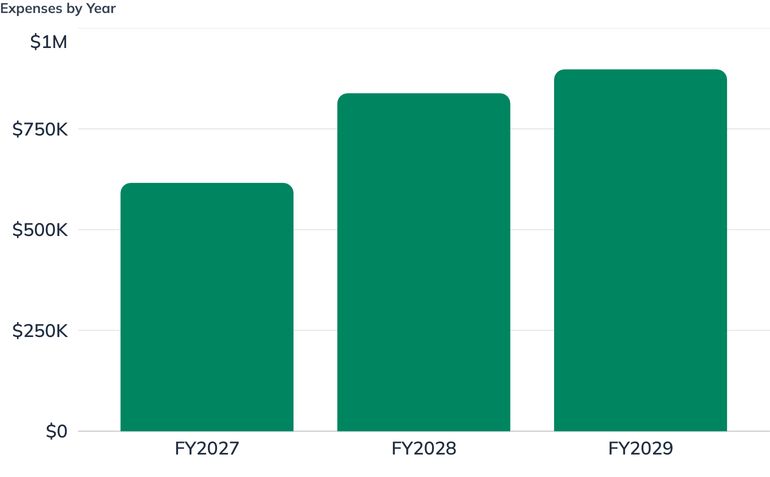
Ladies Only Fitness earns revenue across three lines: memberships, small-group and personal training, and Kids' Room drop-in fees. Its five-year forecast projects about $2.11 million in total revenue against roughly $2.35 million in expenses, reflecting the deliberate up-front cost of building out its childcare differentiator.
Ladies Only Fitness's plan is candid that its multi-year forecast shows a net loss overall of about $236,672, driven by fixed costs like roughly $70,000 a year in SBA loan debt service and a childcare room that generates no direct membership revenue on its own. The plan frames this as a deliberate trade-off: it accepts near-term losses because the childcare investment is the one thing competitors won't copy and the reason a target member leaves the club she's at now.
Ladies Only Fitness is the only women-only facility in the Eugene market, a structural position competitors can't match without abandoning half their membership. Its childcare is a genuinely staffed asset visible from the training floor with infants accepted from six weeks — unlike the YMCA's family-oriented, non-training focus or budget and national chains that have cut childcare entirely — and it pairs an open strength floor with real coaching, unlike boutique franchises selling a single fixed-format class or budget clubs offering access with no guidance.
Ladies Only Fitness targets two underserved Eugene segments: women who want to strength train but get unsolicited coaching, feel watched, or get crowded off equipment in mixed-gender free-weight areas, and mothers of young children who can't solve the logistics of a workout without childcare they can actually see and trust. The plan notes these two problems compound — a woman with a young child who wants to get strong currently has to choose between a club that fits her schedule and one that fits her training goals.
The Kids' Room is a deliberate cost center — staffed, insured, and occupying floor space that generates no direct membership revenue on its own — but the plan accepts that cost specifically because it's the one investment competitors won't copy. Restoring childcare at this level would cost an established club a room it's already repurposed plus staff it cut for a reason, making re-entry slow, which is exactly why it's the reason Ladies Only Fitness's target member leaves the club she's at now.

Business Plan Outline
Start your plan