




Coffee Shop Business Plan


Business Plan Summary
This coffee shop business plan example features Java Culture, an independent coffee bar built to be the "third place" that's missing near the University of Oregon campus — serving roughly 30,000 students, faculty, and staff plus Eugene's broader 200,000-person community. It covers Java Culture's positioning against Starbucks and other campus-area cafes, its $170,000 in startup funding from owner investment and bank loans, and its path to profitability starting in year one. Use it as inspiration for your own plan, and read our guide on how to start a coffee shop for step-by-step advice, or how to write a coffee shop business plan for a section-by-section breakdown. Download a free business plan template to get started, or browse more business plan examples.
Java Culture
Executive Summary
Problem
People near the University of Oregon need not just coffee and tea, or pastries and snacks, but also a place to meet comfortably, have a group discussion, or just sit quietly, work, and read. That is available now near the University of Oregon campus, but too crowded too often, and not the right combination of factors for everybody.
Solution
Java Culture coffee bar is determined to become a daily necessity for local coffee addicts, a place to dream of as you try to escape the daily stresses of life and just a comfortable place to meet your friends or to read a book, all in one.
Market
Java Culture will focus its marketing activities on reaching the University students and faculty, people working in offices located close to the coffee bar and on sophisticated teenagers. Our market research shows that these are the customer groups that are most likely to buy gourmet coffee products. Since gourmet coffee consumption is universal across different income categories and mostly depends on the level of higher education, proximity to the University of Oregon campus will provide access to the targeted customer audience.
Competition
Java Culture’s direct competitors will be other coffee bars located near the University of Oregon campus. These include Starbucks, Cafe Roma, The UO Bookstore, and other Food service establishments that offer coffee.
Why Us?
Great coffee, pastries, additional options for tea etc, very welcoming atmosphere, good wireless, desk space, comfortable chairs and tables, good pastries, a location close to the university campus.
Expectations
Forecast
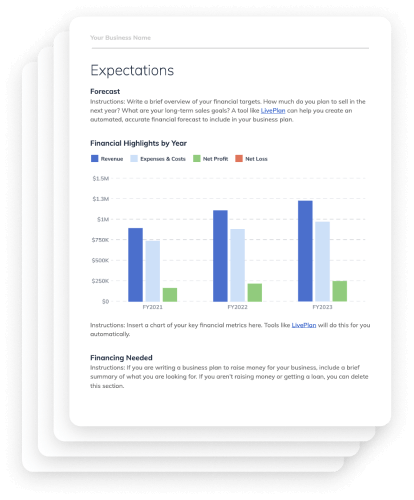
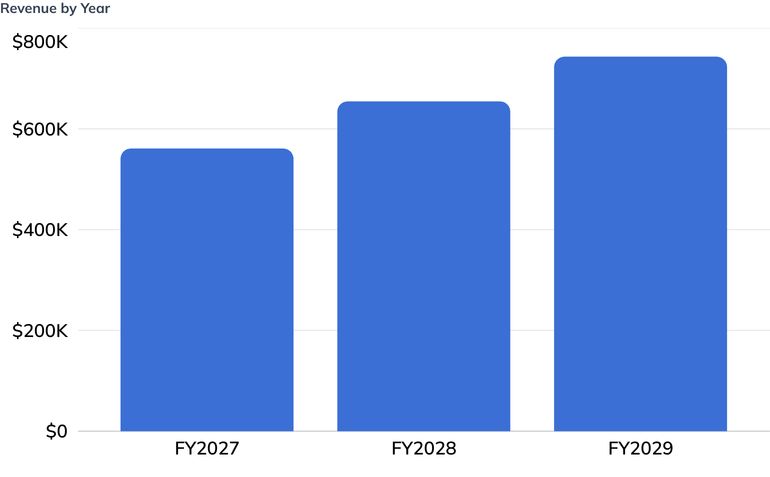
We plan to grow as shown in the chart below, taken from our sales forecast. We aim to maintain an industry-standard 60% gross profit margin and reasonable operating expenses, and to produce reasonable profits in the second and third year.
Financial Highlights by Year
Year 1 | Year 2 | Year 3 | |
|---|---|---|---|
Revenue | $561,010 | $654,500 | $743,088 |
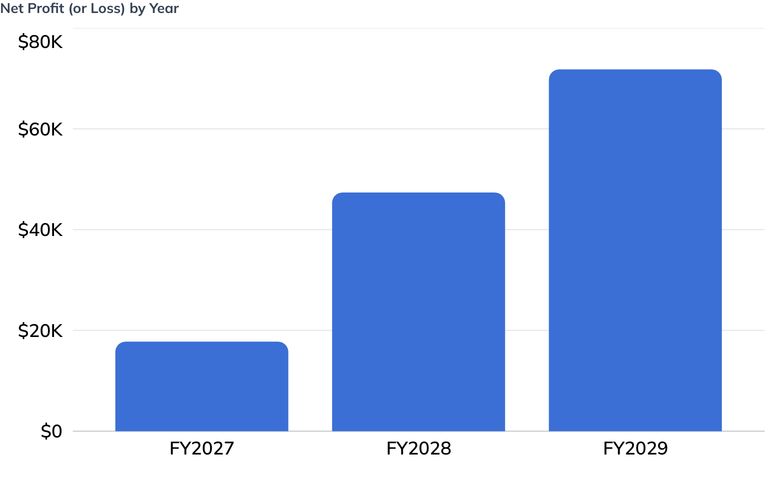
Net Profit | $17,780 | $47,360 | $71,794 |
Net Profit / Sales | 3% | 7% | 10% |
Financing Needed
The owners will invest $140,000 and take out a bank loan for $30,000 to cover the start-up expenses and assets needed plus deficient spending in the early months.
The start-up expenses of $27,680 include:
- Legal expenses for obtaining licenses and permits as well as the accounting services totaling $1,300.
- Marketing promotion expenses for the grand opening of Java Culture in the amount of $3,500 and as well as flyer printing (2,000 flyers at $0.04 per copy) for the total amount of $3,580.
- Consultants fees of $3,000 paid to ABC Espresso Services for the help with setting up the coffee bar.
- Insurance (general liability, workers' compensation and property casualty) coverage at a total premium of $2,400.
- Pre-paid rent expenses for one month at $1.76 per square feet in the total amount of $4,400.
- Premises remodeling in the amount of $10,000.
- Other start-up expenses including stationery ($500) and phone and utility deposits ($2,500).
These expenses will be incurred before launch, so they take their place in our financial projections as negative retained earnings of $27,680 at the end of the month before we begin. That number shows up in the balance sheet.
The required start-up assets of $142,320 include coffee beans, baked goods, retail supplies, office supplies, espresso and food service equipment, store fixtures, and $66,320 cash in the bank to cover early payroll and operating reserves.
Funding for the company comes from two major sources–owners' investments and bank loans. Two major owners, Arthur Garfield and James Polk, have contributed $70,000 and $30,000 respectively. All other investors have contributed $40,000, which brings the total investments to $140,000. The remaining $30,000 needed to cover the start-up expenses and assets came from the two bank loans–a one-year loan in the amount of $10,000 and a long-term (five years) loan of $20,000. Both loans were secured through the Bank of America.
Opportunity

Problem Worth Solving
The University of Oregon campus and the surrounding West 13th Avenue corridor support roughly 30,000 students, faculty, and staff, plus another 200,000 residents across greater Eugene — but the neighborhood has too few places that work as a genuine "third place" between class, work, and home.
The existing options fall short in specific ways. Starbucks and the UO Bookstore café get overwhelmed between class periods, with lines that discourage anyone hoping to sit and work rather than grab a drink and leave. Seating is limited, outlets are scarce, and the atmosphere is built for fast turnover, not for lingering over a laptop or a study group. Independent alternatives like Cafe Roma fill up quickly during peak study seasons (midterms, finals), and few coffee options within walking distance of campus combine strong Wi-Fi with a layout that comfortably supports both solo studying and small-group discussion.
At the same time, students, faculty, and neighborhood residents want more than a transaction — they want a comfortable, welcoming space that treats them as regulars, not order numbers. That gap between "fast coffee" and "a place worth returning to every day" is what Java Culture is built to close.
Our Solution
Java Culture is an independent coffee bar built specifically to fill the gap between fast, corporate coffee and truly comfortable community space. We combine high-quality, consistently brewed coffee and espresso with a home-like atmosphere — comfortable seating, dimmed lighting, relaxed music, and enough table space to genuinely work, study, or meet without feeling rushed.
Beyond the physical space, we make it easy for our regulars to fit us into their daily routine: mobile order-ahead through our loyalty app so a study break doesn't mean losing a spot in line, reliable Wi-Fi and outlets at every table, and a menu built around the coffee, tea, and pastry choices our campus-adjacent customers actually want. Baristas are trained not just on espresso technique but on remembering regulars' names and orders — the kind of personal touch a corporate chain can't replicate at scale.
We believe great coffee is table stakes; the real differentiator is making people feel like they belong here. Every decision — from furniture layout to our social media voice to our hiring — is built around that. Java Culture will reinvest profits into employee training and retention, since baristas who stay are the ones who build the regular relationships that keep customers coming back, while still providing a stable return to our owners.
Market Overview
Coffee consumption has shown a steady 2.5% growth rate in the United States over the last decade. The retail coffee industry is flourishing in the U.S. Pacific Northwest. The local climate, with a long rainy season, is very conducive for the consumption of hot non-alcoholic beverages. At the same time, hot dry summers drive people into cafes to order iced drinks. Furthermore, coffee has really become a part of the lifestyle in the Pacific Northwest. Its discerning coffee drinkers are in favor of well-prepared, strong coffee-based beverages, which they can consume in a relaxing environment.
More specifically, the University of Oregon has close to 25K students and another 5–10K faculty and staff. And it is embedded in the Eugene, OR community of 200K people. Our main market will be students, faculty, staff, and nearby residents. But the campus area is a hub for the community and will attract other customers.
Java Culture will focus its marketing activities on reaching University students and faculty, people working in offices located close to the coffee bar, and sophisticated teenagers. Our market research shows that these are the customer groups that are most likely to buy gourmet coffee products. Since gourmet coffee consumption is universal across different income categories and mostly depends on the level of higher education, proximity to the University of Oregon campus will provide access to the targeted customer audience.
Competitors
Java Culture's direct competitors will be other coffee bars located near the University of Oregon campus. These include Starbucks, Cafe Roma, The UO Bookstore, and other food service establishments that offer coffee.
Starbucks will definitely be one of the major competitors because of its strong financial position and established marketing and operational practices. However, despite Starbucks' entrenched market position, many customers favor smaller, independent establishments that offer cozy atmosphere and good coffee at affordable prices. Cafe Roma is a good example of such competition. We estimate that Starbucks holds approximately 35% market share in that neighborhood, Cafe Roma appeals to 25% of customers, The UO Bookstore caters to another 10%, with the remaining market share split among other establishments.
Java Culture will position itself as a unique coffee bar that not only offers the best tasting coffee and pastries but also provides home-like, cozy and comfortable environment, which established corporate establishments lack. We will cater to customers' bodies and minds, which will help us grow our market share in this competitive market.
Java Culture will cater to people who want to get their daily cup of great-tasting coffee in a relaxing atmosphere. Such customers vary in age, although our location close to the University campus means that most of our clientele will be college students and faculty. Our market research shows that these are discerning customers that gravitate towards better tasting coffee. Furthermore, a lot of college students consider coffee bars to be a convenient studying or meeting location, where they can read or meet with peers without the necessity to pay cover charges.
Execution
Market Plan Overview
Java Culture will position itself as a unique coffee bar where its patrons can not only enjoy a cup of perfectly brewed coffee but also spend their time in an ambient environment. Comfortable sofas and chairs, dimmed light and quiet relaxing music will help the customers to relax from the daily stresses and will differentiate Java Culture from incumbent competitors.
In order to build up its client base, Java Culture will use strategic banners and fliers during the launch period, utilize customer referrals and cross-promotions with other businesses in the community, and a mobile loyalty and order-ahead app compatible with Android and iOS — letting regulars skip the line between classes, which is what our market expects from a coffee shop today.
Our main thrust will be getting people to know, like, and trust us through content and engagement on Instagram, TikTok, and Facebook — the platforms where our student and young-professional audience actually spends time. Short-form video (behind-the-counter content, latte art, new drink launches) drives most of our organic reach, supplemented by geo-targeted paid social around the start of each term. We intend to maintain a social media presence that is light on self-serving promotional content and heavy on community participation and engagement.
The keys to success will be:
- Store design that will be both visually attractive to customers, and designed for fast and efficient operations.
- Employee training to ensure the best coffee preparation techniques and a consistently warm customer experience.
- Marketing strategies aimed to build a solid base of loyal, app-connected customers, as well as maximizing the sales of high margin products, such as espresso drinks.

The Focused Scholar
Maya Rodriguez
A PhD candidate at the University of Oregon who spends most of her week researching and writing. She finds the campus libraries too sterile and corporate coffee chains too chaotic for deep work, needing a 'third place' that balances productivity with comfort.
Age
28
Location
West University Neighborhood, Eugene, OR
Family Status
Single, lives with a roommate
Education
Master's in Environmental Science, currently pursuing a PhD
Profession
Graduate Teaching Fellow at University of Oregon
Opportunities
- Provide 'work-friendly' zones with dedicated power outlets and ergonomic seating to encourage long-term residency during study seasons.
- Implement a 'Refill Club' for drip coffee to support students during midterms and finals when they stay for 3+ hours.
Pain Points
- Unreliable Wi-Fi at local independent cafes
- Feeling pressured to leave by staff in high-turnover shops
- Lack of healthy, protein-rich snack options to sustain long study sessions
Needs
- Consistent high-speed internet for research databases
- A quiet, welcoming atmosphere that respects the 'library' vibe in certain sections
- Proximity to campus to minimize commute time between classes
“I just need a place where the Wi-Fi doesn't drop and I can write my dissertation without being nudged to leave the second my cup is empty.”
The Trend-Seeking Socialite
Chloe Jensen
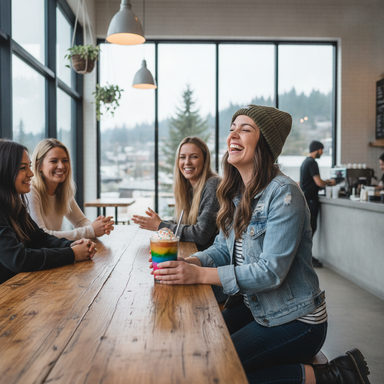
A sophomore undergraduate who views coffee shops as a primary social hub. She is heavily influenced by specialty coffee trends and looks for 'Instagrammable' drinks and a vibrant, cool atmosphere to hang out with friends between classes.
Age
20
Location
On-campus housing, Eugene, OR
Family Status
Single, undergraduate student
Education
Currently pursuing a BA in Journalism
Profession
Student and part-time social media intern
Opportunities
- Create signature, visually appealing drinks and a 'photo-ready' interior to leverage organic social media marketing.
- Focus on creative iced lattes and tea infusions to capture the 46% of 18-24 year olds who consume specialty coffee daily.
Pain Points
- High prices for gourmet drinks on a student budget
- Boring, clinical atmospheres in standard campus dining halls
- Long wait times at the UO Bookstore cafe that cause her to be late for lectures
Needs
- Fast, efficient service for 'grab-and-go' moments between lectures
- A 'cool' factor that makes the cafe a destination for her social circle
- Affordable but trendy drink options like matcha or cold brew
“I'm always looking for a spot that has the right vibe—good music, great iced lattes, and enough space for my friends to actually sit together.”

The Community Connector
Dr. David Miller
An Associate Professor who values high-quality gourmet coffee and uses local cafes as informal meeting spaces for students and faculty. He prefers supporting local businesses over national brands and appreciates a sophisticated, mature atmosphere.
Age
48
Location
South Hills, Eugene, OR
Family Status
Married, two teenagers
Education
PhD in Sociology
Profession
Associate Professor at University of Oregon
Opportunities
- Designate specific larger tables that can be reserved for small group discussions or faculty-student mentorship sessions.
- Offer premium pour-over options and retail bags of beans to appeal to the highly educated, high-income demographic in Eugene.
Pain Points
- Inability to find seating for 3-4 people during peak hours
- Excessive noise levels that make professional conversation difficult
- Generic, low-quality coffee served at institutional campus kiosks
Needs
- A sophisticated beverage menu featuring high-end specialty roasts
- Comfortable, high-quality furniture that accommodates professional meetings
- A sense of community and recognition as a 'regular' customer
“Coffee is the catalyst for good academic discourse. I want a place that feels like a neighborhood living room, not a fast-food assembly line.”
Sales Plan
Java Culture baristas will handle all sales transactions in-store, in-app, and through third-party delivery. During peak periods (morning rush, between-class breaks), at least two employees will staff the counter — one preparing orders while the other manages the register and mobile pickup queue — to keep wait times short even when the line is long.
In-store purchases run through a modern point-of-sale system that also powers our mobile order-ahead app, so a customer can order and pay from their phone and walk straight to the pickup counter. We also list our core menu on DoorDash and Uber Eats to capture customers who want Java Culture delivered to a dorm, office, or study spot rather than picked up in person — a channel that's become table stakes for coffee shops near a campus this size.
Baristas are trained to upsell thoughtfully — suggesting a pastry pairing or a size upgrade rather than pushing add-ons — since food and larger drink sizes carry higher margins than a standard drip coffee. All sales data, whether rung up in-store, through the app, or via delivery, flows into the POS system, where we review it weekly to spot best-selling items, slow hours, and opportunities to adjust staffing or promotions.
Locations and Facilities
Java Culture coffee bar will be located on the ground floor of the commercial building at the corner of West 13th Avenue and Patterson Street in Eugene, OR. The company has secured a one-year lease of the vacant 2,500 square feet premises previously occupied by a hair salon. The lease contract has an option of renewal for three years at a fixed rate that Java Culture will execute depending on the financial strength of its business.
The floor plan will include a 200 square feet back office and a 2,300 square feet coffee bar, which will include a seating area with 15 tables, a kitchen, storage area and two bathrooms. The space in the coffee bar will be approximately distributed the following way—1,260 square feet (55% of the total) for the seating area, 600 square feet (26%) for the production area, and the remaining 440 square feet (19%) for the customer service area.
This property is located in a commercial area within a walking distance from the University of Oregon campus on the corner of a major thoroughfare connecting affluent South Eugene neighborhood with the busy downtown commercial area. The commercially zoned premises have the necessary water and electricity hookups and will require only minor remodeling to accommodate the espresso bar, kitchen and storage area. The coffee bar's open and clean interior design with modern wooden decor will convey the quality of the served beverages and snacks, and will be in-line with the establishment's positioning as an eclectic place where people can relax and enjoy their cup of coffee. The clear window displays, through which passerby will be able to see customers enjoying their beverages, and outside electric signs will be aimed to grab the attention of the customer traffic.
Technology
Java Culture will rely on modern coffee shop technology to deliver efficient service and gather actionable sales data:
- Point-of-sale system — A Square (or equivalent) POS terminal handles in-store transactions, tracks sales by item and daypart, and integrates directly with our mobile ordering and loyalty app.
- Mobile order-ahead and loyalty app — Android and iOS compatible app that lets customers order, pay, and earn rewards from their phone, then skip the line at pickup — the format our student and professional customers expect from any coffee shop today.
- Third-party delivery integration — Java Culture's menu is listed on DoorDash and Uber Eats, extending our reach to customers who want delivery to a dorm, office, or apartment near campus.
- Digital menu board — Screen-based menu behind the counter that lets us update pricing, promote seasonal drinks, and swap out items without reprinting signage.
- Wireless internet — Reliable, free Wi-Fi for students and professionals who use the coffee bar as a study or meeting space.
- Social media platforms — Active presences on Instagram, TikTok, and Facebook for community engagement, short-form video content, and promotions.
Equipment and Tools
Start-up equipment and tools include:
- Espresso machine — $6,000
- Coffee maker — $900
- Coffee grinder — $200
- Food service equipment (microwave, toasters, dishwasher, refrigerator, blender, etc.) — $18,000
- Storage hardware (bins, utensil rack, shelves, food case) — $3,720
- Counter area equipment (counter top, sink, ice machine, etc.) — $9,500
- Serving area equipment (plates, glasses, flatware) — $3,000
- Store equipment (cash register, security, ventilation, signage) — $13,750
- Office equipment (PC, fax/printer, phone, furniture, file cabinets) — $3,600
Consultants fees of $3,000 were paid to ABC Espresso Services for help with setting up the coffee bar. Total long-term assets of $60,000 will depreciate over five years.
Key Metrics for Success
We track net profit margin and gross margin as our headline profitability metrics, growing from a 3% net margin in Year 1 to 7% in Year 2 and 10% by Year 3, while holding a steady 60% gross margin throughout.
Beyond the top-line financials, we watch the operating metrics that actually drive them:
- Average ticket size — tracked weekly, with a target to grow steadily as we build pastry and food attach rates alongside drink orders.
- Daily transaction count by daypart — identifies whether the morning rush, midday study crowd, or afternoon/evening traffic needs additional staffing or promotion.
- Mobile app order share — the percentage of transactions placed through order-ahead, a proxy for how well we're converting customers into habitual, loyalty-connected regulars.
- Loyalty program enrollment and redemption rate — measures whether our rewards program is actually changing customer behavior, not just accumulating sign-ups.
- Customer retention — repeat-visit rate among loyalty members, tracked monthly.
- Labor cost as a percentage of sales — kept in line with the food-service benchmark of roughly 25–30% to protect margin as we scale staffing with demand.
We review these metrics weekly during the first year and monthly thereafter, adjusting staffing, menu, and promotions based on what the data shows rather than gut feel.
Pricing
Java Culture's menu is built around the drinks our customers order every day, priced to stay competitive with Starbucks and Cafe Roma while protecting the ~60% gross margin built into our financial plan.
Coffee & Espresso
- Drip Coffee (12 oz / 16 oz) — $2.75 / $3.25
- Espresso (single shot) — $2.50
- Americano — $3.25
- Latte — $4.50
- Cappuccino — $4.25
- Mocha — $4.95
- Cold Brew — $4.25
- Iced Latte — $4.75
Tea & Other Beverages
- Brewed Tea — $2.75
- Chai Latte — $4.50
- Steamer / Hot Chocolate — $3.75
Food
- Pastries (croissants, muffins, scones) — $3.25 to $4.50
- Breakfast Sandwich — $5.95
- Bagel with Cream Cheese — $3.50
Our pricing sits at or slightly below Starbucks on comparable drinks, which lets us compete on price while differentiating on atmosphere and service rather than trying to out-discount a national chain. Espresso drinks and food carry the highest margins, so our menu design, staff training, and in-app promotions are all built to nudge customers toward a latte-and-pastry order rather than a standalone drip coffee — without it ever feeling like a hard upsell.
We review pricing twice a year against local competitors and our cost of goods sold, adjusting individual items rather than making an across-the-board increase whenever input costs shift.
Milestones
Social Media Setup Set up Facebook, Instagram, and TikTok presences for community engagement ahead of launch. | Marketing Completed |
Launch Promotion Grand opening launch promotion for Java Culture coffee bar. | Team Completed |
Summer Promotion Summer promotional campaign to build awareness near the University of Oregon campus. | July 31, 2026 |
Back to School Promotion Back-to-school promotion targeting University of Oregon students and faculty. | team Sept 15, 2026 |
Lease Renewal Decision Evaluate first-year performance and execute the three-year lease renewal option at the West 13th Avenue location. | Ownership Apr 15, 2027 |
Fall Term Menu & Loyalty Push Launch Year 2 seasonal menu items and a fall-term loyalty app enrollment campaign timed to the start of the University of Oregon school year. | Marketing Sept 15, 2027 |
Three-Year Performance Review Full review of financial performance, customer retention, and lease/growth options at the end of the three-year plan horizon. | Ownership May 31, 2029 |
Company
Ownership and Structure
Java Culture is majority-owned by Arthur Garfield and James Polk. Mr. Garfield holds a Bachelor's Degree in Business Administration from the University of ZYX. He's worked for several years as an independent business consultant. Previously, he owned the ABC Travel Agency, which he profitably sold four years ago. Mr. Garfield has extensive business contacts in Oregon that he will leverage to help his new venture succeed. Mr. Polk has a Bachelor's Degree in Psychology from the XYZ State University. For the last five years he has worked as a manager of DEF Ristorante, a successful Italian restaurant in Portland, OR. Under Mr. Polk's management, the restaurant has consistently increased sales while maintaining a lower than average level of operating expenses.
Investors will not be involved in the daily management decisions at Java Culture. They will hire a professional manager who will oversee all the coffee bar operations. Three full-time baristas will be in charge of coffee preparation. They will hire two more part-time employees to fulfill the staffing needs. In the second and third year of operation we will add additional employees if and when needed.
Management Team
A full-time manager will be hired to oversee the daily operations at Java Culture. The candidate (whose name is withheld due to his current employment commitment) has had three years of managerial experience in the food service industry in Oregon. This person's responsibilities will include managing the staff, ordering inventory, dealing with suppliers, developing a marketing strategy and performing other daily managerial duties. We believe that our candidate has the right experience for this role. A profit-sharing arrangement for the manager may be considered based on the first year operational results.
Personnel plan (annual salaries):
Advisors
Java Culture does not currently rely on a formal advisory board. Owners Arthur Garfield and James Polk bring complementary business and food-service experience, and ABC Espresso Services provided consulting support during setup. As the business grows, we may add advisors with local restaurant and retail expertise.
Financial Plan
Revenue
Need real milestones? Establish a clear path for your business with real-world examples.Create your own business plan
Expenses & Costs
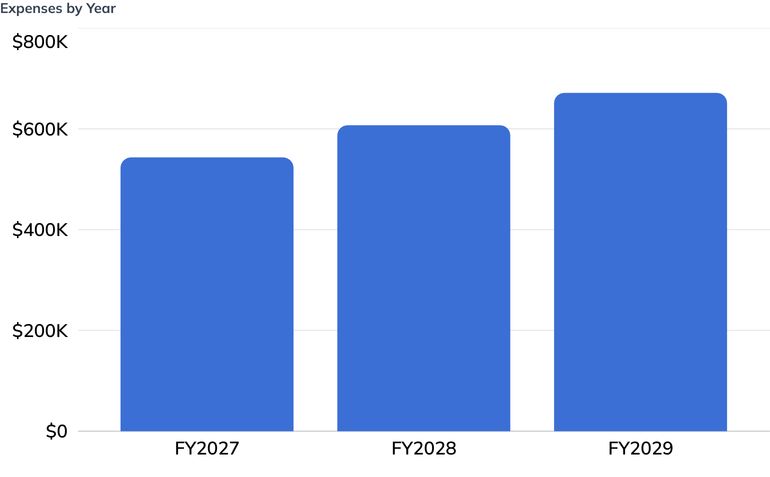
Need real financials? Explore a spreadsheet-free path to generating financial data for your business.Create your own business plan
Profitability
Need real financials? We recommend using LivePlan as the easiest way to create financials for your own business plan.Create your own business plan
Use of Funds
The start-up expenses of $27,680 include:
- Legal expenses for obtaining licenses and permits as well as accounting services totaling $1,300.
- Marketing promotion expenses for the grand opening of Java Culture in the amount of $3,500 plus flyer printing (2,000 flyers at $0.04 per copy) for a total of $3,580.
- Consultants fees of $3,000 paid to ABC Espresso Services for help with setting up the coffee bar.
- Insurance (general liability, workers' compensation and property casualty) coverage at a total premium of $2,400.
- Pre-paid rent expenses for one month at $1.76 per square foot in the total amount of $4,400.
- Premises remodeling in the amount of $10,000.
- Other start-up expenses including stationery ($500) and phone and utility deposits ($2,500).
The required start-up assets of $142,320 include coffee beans, baked goods, retail supplies, office supplies, espresso and food service equipment, store fixtures, and $66,320 cash in the bank to cover early payroll and operating reserves.
Sources of Funds
Funding for the company comes from two major sources—owners' investments and bank loans. Two major owners, Arthur Garfield and James Polk, have contributed $70,000 and $30,000 respectively. All other investors have contributed $40,000, which brings the total investments to $140,000. The remaining $30,000 needed to cover start-up expenses and assets came from two bank loans secured through the Bank of America:
- Short-term loan: $10,000 (12-month term, 8% interest) — Year 1 interest $433, paid down by Year 2
- Long-term loan: $20,000 (60-month term, 8% interest) — Year 1 interest $1,365, Year 2 $1,220, Year 3 $917
Total forecast interest expense: $1,797 (Year 1), $1,226 (Year 2), $917 (Year 3).
Key Assumptions
- We assume a steadily growing potential market in line with growth at the university and local Eugene trends.
- We assume industry-standard 60% gross margins (40% cost of goods sold on coffee and food sales).
- We assume relative status quo regarding technology and trends in the coffee industry.
- Interest: Short-term bank loan ($10,000 at 8%) and long-term bank loan ($20,000 at 8%, 5-year term). Forecast interest expense totals $1,797 in Year 1, $1,226 in Year 2, and $917 in Year 3.
- Income tax: Corporate tax rate of 15%, paid quarterly. Forecast income taxes are $3,138 (Year 1), $8,357 (Year 2), and $12,670 (Year 3).
- Depreciation: $60,000 in coffee shop equipment depreciated over 5 years ($12,000/year).
- Accounts Receivable & Accounts Payable: Java Culture is a cash-and-card retail business — customers pay at the counter or through the mobile app at the time of purchase, so we assume 0 days sales outstanding, in line with the near-zero AR that's standard for a coffee bar (the only meaningful collection lag would be the 1–2 day card-network settlement and weekly payout cycles from DoorDash/Uber Eats, both immaterial to cash planning at this scale). On the payables side, this forecast conservatively assumes vendor invoices (coffee, milk, pastries, paper goods) are paid as incurred rather than on the net 15–30 day terms typical for food-service and retail vendors (per standard retail days-payable-outstanding benchmarks of 30–45 days). We flag this as a deliberate conservative simplification: real-world net-30 vendor terms would improve near-term cash position by giving Java Culture an interest-free float on COGS purchases, so the cash balances shown throughout this plan should be read as a floor, not a ceiling.
Projected Statements
Frequently Asked Questions
A strong coffee shop business plan lays out the problem you're solving for customers, like Java Culture's plan does by identifying the lack of a comfortable "third place" near the University of Oregon campus, then covers your market and competitive analysis (in Java Culture's case, sizing up Starbucks, Cafe Roma, and the UO Bookstore cafe), your menu and revenue model, staffing, and a three-year financial forecast with startup costs and funding sources.
In this plan, Java Culture's owners raised $170,000 in total funding — $140,000 from owner investment and a $30,000 bank loan — to cover $27,680 in startup expenses (licenses, insurance, marketing for the grand opening, and remodeling) plus $143,000 in startup assets like espresso equipment, store fixtures, and opening cash reserves. Costs will vary by market and space size, but this plan's breakdown is a useful benchmark for a campus-adjacent coffee bar.
Yes — coffee shops typically need a business license, a food service permit from the local health department, and food handler certifications for staff, plus a certificate of occupancy and signage permit tied to the specific location. Java Culture's plan budgets $1,300 for legal expenses covering its licenses, permits, and accounting setup, which is a reasonable starting estimate for a single-location cafe.
Java Culture's revenue comes from coffee and espresso drinks, tea, and pastries and snacks sold to students, faculty, and neighborhood regulars, with the plan targeting an industry-standard 60% gross profit margin. The forecast shows revenue growing from $561,010 in year one to $743,088 by year three as the customer base and average order size build.
This plan shows Java Culture turning a net profit in its very first year — $17,780, or a 3% margin — and growing that to $47,360 (7% margin) in year two and $71,794 (10% margin) in year three as fixed costs are spread across a larger, more loyal customer base.
Java Culture is built around feeling like a neighborhood living room rather than a fast-turnover chain: comfortable seating, dimmed lighting, reliable Wi-Fi and outlets at every table, and a mobile order-ahead loyalty app so regulars don't lose their spot in line. Baristas are trained to remember regulars' names and orders, a personal touch the plan positions as the real differentiator over a corporate competitor like Starbucks.
Java Culture's core customers are the roughly 25,000 students and 5,000–10,000 faculty and staff at the University of Oregon, along with people working in nearby offices and "sophisticated teenagers" in the surrounding Eugene neighborhood. The plan targets these groups because gourmet coffee consumption correlates with proximity to a university and higher education levels rather than income alone.
The plan places Java Culture directly on the West 13th Avenue corridor next to the University of Oregon campus, an area with roughly 30,000 students, faculty, and staff plus another 200,000 residents across greater Eugene — but too few coffee spots that combine strong Wi-Fi with a layout built for lingering rather than fast turnover. That gap between quick-service options and a genuine gathering space is central to Java Culture's site selection and positioning.
Business Plan Outline
Start your plan