





Microbrew Bar Business Plan


Business Plan Summary
This microbrew bar business plan example features The Bottlecap, a specialty beer tavern near the University of Oregon campus in Eugene, Oregon, co-owned by Dashiell Lavine and Tyler Vogel. It covers The Bottlecap's rotating lineup of eight or more hard-to-find microbrews, the companion website that lets regulars vote on each week's tap selections, and a $75,000 start-up funded entirely through owner and private investor equity. Use it as inspiration for your own plan and read our guides on how to start a bar and how to write a bar business plan for step-by-step advice.. Download a free business plan template to get started, or browse more business plan examples.
The Bottlecap
Executive Summary
The Bottlecap is a specialty beer tavern located near the campus of the University of Oregon in Eugene, a city widely regarded as one of the country's premier craft beer destinations.
The Bottlecap serves the university and greater Eugene community with a constantly rotating lineup of premium, hard-to-find microbrews for the discerning beer connoisseur — curated in part through a companion website that lets regulars vote on what goes on tap each week.
The Bottlecap is a privately-funded venture led by co-owners Dashiell Lavine and Tyler Vogel.
The Market The Pacific Northwest remains the country's premier microbrew hub, and Oregon in particular is home to one of the highest concentrations of craft breweries of any state. Enjoying fine beer is part of the culture here, and the market for people who appreciate it is substantial.
The Bottlecap targets three distinct customer segments. The largest is the general bar-going public — working professionals who use taverns to unwind and socialize after work — a segment growing at roughly 8% annually with about 30,000 potential customers in the area. The beer connoisseur segment, smaller but growing fastest at 12% annually with over 12,000 potential customers, is drawn by the depth and rotation of the tap list. University of Oregon and Lane Community College students make up the third segment, growing at 10% annually with roughly 20,000 potential customers; this group is more price-sensitive and less focused on beer quality.
The Competition The Bottlecap has three direct competitors, all centrally located near the U of O campus: Rennie's Landing, Taylor's Bar & Grill, and Max's Tavern. Each competes primarily on price and caters to the college crowd.
The Bottlecap differentiates itself in two ways. First, through an emphasis on an outstanding, constantly rotating selection of premium beers rather than the lowest price. Second, through its companion website — customers vote on which beers go on tap each week, giving them a direct hand in shaping the offerings and a sense that The Bottlecap exists to meet their tastes specifically.
The Management Team The Bottlecap was founded and is run by Dashiell Lavine and Tyler Vogel. Dashiell built his career in the restaurant industry: after earning his undergraduate degree from Reed College, he spent two years serving at Il Piatto, a fine Italian restaurant in Northwest Portland, before being promoted to general manager, a role he held for five years overseeing both front-of-house and back-end operations.
Tyler brings a financial and operational background, having spent several years in public accounting in Portland before transitioning to hospitality. His experience building financial controls and reporting systems will be essential to tracking the significant daily cash volume that flows through The Bottlecap.
The Bottlecap will succeed by meeting the substantial demand for premium beer in a market that loves it, offering a friendly social atmosphere where customers can catch up with old friends, meet new ones, and enjoy fine beer. Business is seasonal — busiest in the spring and fall around the academic calendar, quieter over the summer break and the December holidays — but The Bottlecap is forecast to be profitable for the year in its first year of operation, with net profit growing from roughly $36,000 in Year 1 to nearly $64,000 by Year 3 as the tap rotation and customer base mature.
To create an economically healthy organization that provides a variety of quality beers in a casual and classy environment that appeals to a wide range of customers.
The keys to the success of The Bottlecap can be summarized by the following points:
- Maintain good relationships with reliable beer distributors.
- Well designed bar with a unique and entertaining atmosphere.
- Quality entertainment.
- Repeat customers.
Below is a list of the objectives for The Bottlecap.
- Have eight or more good quality, hard-to-find beers on tap.
- Have business grow at least 10% per month.
- Create customer awareness of what The Bottlecap offers through the companion website. Measure popularity by tracking hits on the website.
Opportunity
Problem Worth Solving
Despite Eugene's reputation as a microbrew mecca, beer lovers near the University of Oregon campus lack a dedicated destination that combines a classy atmosphere with a constantly rotating selection of premium, hard-to-find craft beers.
Existing bars near campus — Rennie's Landing, Taylor's Bar & Grill, and Max's Tavern — cater primarily to college students with lower price points and conventional tap lists. Beer connoisseurs and professionals who want quality and variety have few options that meet their expectations.
The Bottlecap addresses this gap by offering a specialty beer tavern with eight or more unique microbrews on tap, a companion website where customers vote on weekly beer selections, and an inviting environment that serves connoisseurs, professionals, and students alike.
Our Solution
The Bottlecap solves this gap with a specialty beer tavern built entirely around variety and quality: eight or more taps stocked with a constantly rotating lineup of premium, hard-to-find microbrews sourced from breweries across Oregon, Washington, and beyond.
What sets the experience apart is the companion website, where regulars vote each week on which beers make the next rotation. This gives our most engaged customers direct influence over the tap list and turns beer selection into an ongoing conversation with the community, rather than a decision made behind the bar.
Beyond the tap list, The Bottlecap offers a classy-but-relaxed atmosphere with a pool table and a big-screen television for sporting events — a space where beer connoisseurs, after-work professionals, and students can all find a reason to become regulars.
Competitive Comparison
Rennie's Landing, Taylor's Bar & Grill, and Max's Tavern — our three direct competitors near campus — all compete primarily on price and cater to a college-student crowd with conventional, largely static tap lists.
The Bottlecap takes a different position: a classy, beer-first tavern with a constantly rotating selection of premium and hard-to-find microbrews, priced to remain accessible rather than positioned as an upscale cocktail bar. No competitor near campus offers the same depth of rotation, and none gives customers a direct vote in what goes on tap through a companion website — a differentiator that keeps connoisseurs and professionals coming back even though our prices sit slightly above the campus-bar norm.
Market Overview
Oregon remains one of the country's leading craft beer markets, and the culture of appreciating well-made beer runs deep in the Pacific Northwest generally and Eugene specifically. That reputation, combined with a steady flow of new craft releases from breweries across the region, is why we believe The Bottlecap — a specialty beer tavern — will thrive here.
Our target market includes three distinct segments: beer connoisseurs, working professionals, and college students. Segmenting the market this way lets us tailor advertising, pricing, and the weekly tap rotation to what each group actually wants, rather than treating "bar customers" as a single undifferentiated audience.
Market Segmentation
Our numbers are based upon the approximate population of Eugene and Springfield. Because many people are not drinkers, we decided upon the number 100,000 for the total of people considered available customers. We then segmented the available customers into the following groups:
Beer Connoisseur: These people will be drawn to The Bottlecap because of their love and passion for beer. The main appeal to this segment will be the large number of hard-to-find beers that are available at our establishment.
Professionals: The general bar-attending public from Eugene. This group will be drawn to the bar after work to relax in a friendly and classy atmosphere.
College Students: University of Oregon and Lane Community College students. More bargain marketing will be aimed at the segment of the market.
Market Analysis | |||||||
|---|---|---|---|---|---|---|---|
Year 1 | Year 2 | Year 3 | Year 4 | Year 5 | |||
Potential Customers | Growth | CAGR | |||||
Beer Conniseurs | 12% | 20,000 | 22,400 | 25,088 | 28,099 | 31,471 | 12.00% |
Professionals | 8% | 30,000 | 32,400 | 34,992 | 37,791 | 40,814 | 8.00% |
College Students | 10% | 20,000 | 22,000 | 24,200 | 26,620 | 29,282 | 10.00% |
Other | 2% | 30,000 | 30,600 | 31,212 | 31,836 | 32,473 | 2.00% |
Total | 7.60% | 100,000 | 107,400 | 115,492 | 124,346 | 134,040 | 7.60% |
Main Competitors
Competitor | Positioning | Price Point | Tap Rotation |
|---|---|---|---|
Rennie's Landing | Campus bar, college crowd | Low | Static, mainstream domestics |
Taylor's Bar & Grill | Bar and grill, food-forward | Low-Mid | Static, mainstream selection |
Max's Tavern | Campus-adjacent tavern | Low | Static, limited variety |
The Bottlecap | Specialty beer tavern | Mid | Constantly rotating, customer-voted |
All three direct competitors sit within a few blocks of the U of O campus and compete for the same student foot traffic. None currently offers the tap-list depth, rotation, or customer-driven selection that The Bottlecap will bring to the market, which is where we see the clearest opening during our first six months of aggressive campus-focused advertising.
Service Business Analysis
Eugene's bar and tavern industry has grown steadily, driven by the city's deep craft beer culture, a mild climate suited to patio and outdoor seating, and a large, recurring population of students and young professionals. Regional interest in unique, small-batch microbrews continues to grow each year, and Eugene, within easy reach of dozens of breweries across the Willamette Valley, is well positioned to capture that demand.
Competition among bars near campus is intense, which makes differentiation essential to building a sustainable customer base. The founders of The Bottlecap believe that combining serious beer credibility — depth of selection, rotation, and strong sourcing relationships with distributors — with a classy, comfortable atmosphere is the clearest path to standing out. Rather than competing on price with the college bars nearby, The Bottlecap competes on quality and choice, backed by a companion website that keeps customers engaged with the tap list between visits.
Competitors
The Bottlecap has three direct competitors centrally located near the U of O campus:
- Rennie's Landing — A popular campus-area bar targeting college students with conventional pricing and atmosphere.
- Taylor's Bar & Grill — A bar and grill competing on food and drink for the student crowd.
- Max's Tavern — Another campus-adjacent tavern focused on the university student market.
The Bottlecap differentiates itself from these competitors through its emphasis on fine beer rather than lowest price. While competitors target college students with lower price points, The Bottlecap serves the discerning beer connoisseur with a constantly rotating lineup of premium, unique microbrews. A companion website allows customers to vote on weekly tap selections, giving regulars direct influence over the beer lineup and a sense that The Bottlecap exists to truly meet their needs.
Target Market Segment Strategy
Each of our three target segments responds to a different approach:
Beer connoisseurs are reached through the depth and rotation of the tap list itself, word-of-mouth in the craft beer community, and the companion website, which gives this segment a direct voice in what we pour — the single strongest driver of loyalty for this group.
Professionals are reached primarily through proximity and atmosphere — positioning The Bottlecap as the after-work spot near campus with a classy, low-key environment, reinforced by consistent word-of-mouth from repeat regulars.
College students are the most price-sensitive segment and are reached through targeted, bargain-oriented promotions, campus advertising, and the built-in social draw of the pool table and big-screen TV for game days.
Word-of-mouth and the companion website work across all three segments simultaneously, since a beer list shaped by customer votes gives every segment a reason to keep coming back and to bring friends.
Execution
Market Plan Overview
Our core audience is University of Oregon students and the broader campus community, so our marketing centers on channels this audience actually uses: campus and local social media (Instagram and community Facebook groups for Eugene nightlife), the Daily Emerald and Eugene Weekly for print reach, and partnerships with campus organizations and student groups for event-based promotion. Local radio remains a secondary channel for reaching the professional segment during commute hours.
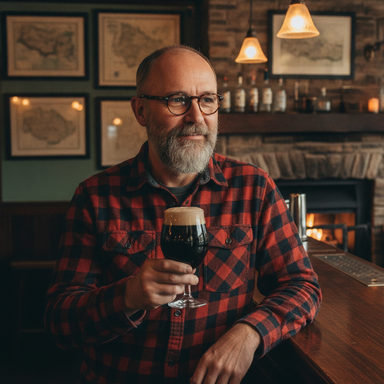
The Rare-Pour Hunter
David Miller
A long-time Eugene resident and craft beer enthusiast who has seen the local scene explode. He is no longer satisfied with standard IPAs and actively seeks out 'whales' and limited-release barrels that typically require a trip to Portland or Bend.
Age
42
Location
South Hills, Eugene, OR
Family Status
Married, 1 teenager
Education
Bachelor's in Environmental Science
Profession
Environmental Consultant
Opportunities
- Host monthly events featuring one-off kegs from Oregon's 181+ breweries that aren't distributed to larger venues like The Bier Stein.
- Leverage the companion website to allow connoisseurs to nominate specific rare styles (like Barrel-Aged Sours or Goses) for the next rotation.
Pain Points
- Frustrated by 'static' tap lists at local bars that rarely change their premium offerings
- Dislikes the high-decibel, chaotic environment of campus-adjacent bars like Max's Tavern
- Tired of driving across town to find a seat in overcrowded taprooms
Needs
- A curated, constantly rotating tap list of at least 8 unique microbrews
- Knowledgeable bartenders who can discuss IBU, ABV, and hop profiles in detail
- A sophisticated atmosphere suitable for a quiet evening out with his spouse
“I've tried every flagship IPA in the valley. I want to go somewhere where I'm guaranteed to find a beer I've never even heard of.”
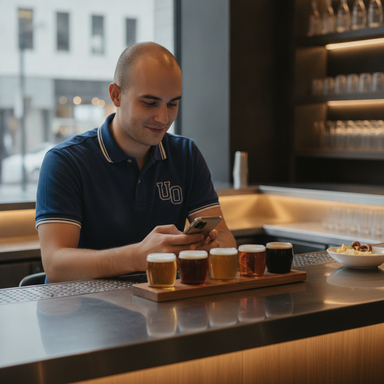
The Upgrading Senior
Marcus Thompson
A UO senior who has outgrown the 'pitchers of PBR' phase. He represents the segment of the 21.5% youth population in Eugene that is beginning to develop a palate for craft beer and wants to feel like a 'real adult.'
Age
22
Location
Near UO Campus, Eugene, OR
Family Status
Single, lives with roommates
Education
Senior, Business Administration
Profession
Part-time Marketing Intern
Opportunities
- Utilize the voting website to gamify the beer selection process, appealing to his tech-savvy nature.
- Offer 'Intro to Craft' tasting flights with cards explaining the notes of local Oregon brews to build his confidence as a consumer.
Pain Points
- Feeling like he's 'too old' for the freshman-heavy bars but not yet wanting to leave the campus area
- Limited budget requires him to choose quality over quantity, making bad beer choices a financial waste
- Boredom with the conventional tap lists found at most 13th Avenue establishments
Needs
- A 'cool' but mature vibe that makes him feel like he's transitioning into his professional life
- Interactive elements (like the voting system) that allow him to feel part of the community
- Access to local, high-quality beer (53% of consumers prefer local) at a fair price point for a student
“I'm done with the frat bar scene. I'd rather spend $8 on one incredible local pour than $15 on a pitcher of watery domestic.”
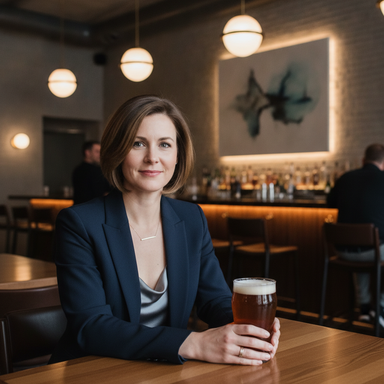
The Sophisticated Academic
Dr. Sarah Jenkins
One of the many University of Oregon professionals reaching career milestones, Sarah wants a refined 'third space' near campus. She values quality and atmosphere over price and avoids the rowdy undergraduate scene.
Age
38
Location
Fairmount, Eugene, OR
Family Status
Single
Education
Ph.D. in Sociology
Profession
Assistant Professor at University of Oregon
Opportunities
- Create a 'Professional Hour' with slightly elevated pricing that naturally filters for a more mature, quiet crowd.
- Offer high-end small plates or local charcuterie that complements the complex flavors of premium craft beers.
Pain Points
- Lack of 'classy' venues within walking distance of the UO campus for post-seminar drinks
- Sticky floors and domestic-heavy menus at student-focused spots like Rennie's Landing
- Feeling out of place in bars that cater primarily to the 15-24 age demographic
Needs
- A clean, upscale interior design that feels more like a wine lounge than a college pub
- High-quality glassware appropriate for different beer styles
- A location close to campus that maintains a professional boundary
“I'd love to grab a drink with my colleagues after a long day of grading, but I don't want to shout over a jukebox or drink out of a plastic cup.”
Marketing Strategy
Our marketing strategy rests on two pillars: word-of-mouth and a distinctive digital presence. The companion website — where regulars vote on the weekly tap rotation — is itself a marketing tool, giving customers a reason to check in between visits and to talk about The Bottlecap with friends.
On top of that foundation, we'll run a targeted campus advertising push during our first six months to build awareness quickly, supported by social media content showcasing the rotating tap list, promotions tied to game days on the big screen, and periodic themed nights to create repeat-visit occasions for all three customer segments.
Competitive Edge
The Bottlecap's edge comes from two reinforcing advantages. First, the sheer number and rotation of specialty beers on tap — far deeper and more current than any competitor near campus. Second, the companion website, which gives regular customers real influence over what's poured each week and a reason to keep returning to see whether their picks made the cut.
We reinforce both advantages with a classy, laid-back atmosphere — a big-screen television for sporting events and a high-quality pool table — that gives customers a reason to stay once they've come for the beer.
Milestones
The Bottlecap's management team has established the milestones tracked in the table below to keep the business's launch priorities on schedule. Responsibility for hitting each milestone falls to co-owners Tyler Vogel and Dashiell Lavine, who review progress together on a regular basis. New milestones will be added as the business moves from planning into its first year of operations.
Sales Plan
The Bottlecap's sales forecast was estimated by breaking down each day we are open into hours, and then estimating the number of beers we will sell during those hours. Our starting hours of operation will be 12 p.m.–3 a.m. Saturday, 12 p.m.–12 a.m. Sunday, and 4 p.m.–3 a.m. Wednesday–Friday.
- On average, our numbers for Saturday turned out to be 35 beers an hour.
- On Sunday, we estimated approximately 15 beers an hour.
- Finally, the average for Wednesday–Friday turned out to be 25 beers an hour.
We then estimated that approximately 30% of our sales will be domestic beer, 38% specialty microbrew beer, and 32% local microbrew beer. The unit prices and direct unit costs were based upon the cost of the same type of beers sold at local bars and the cost of kegs from local distributors.
Sales also follow the University of Oregon's academic calendar: strongest January through June and again each fall (October–November) around the return of students and football season, and softer over the summer break (July–September) and the December holidays.
Sales Forecast | Year 1 | Year 2 | Year 3 |
|---|---|---|---|
Specialty Microbrewed Beer | $168,352 | $185,185 | $213,364 |
Normal Microbrewed Beer | $130,868 | $143,996 | $166,839 |
Domestic Beer | $101,617 | $111,735 | $132,349 |
Total Sales | $400,837 | $440,916 | $512,552 |
Locations and Facilities
The Bottlecap's location will be chosen based upon the following criteria listed in order of importance:
- Proximity to the University of Oregon campus
- Visibility and foot traffic
- Adequate parking availability
- Reasonable lease terms
All of these qualities are consistent with The Bottlecap's goal of providing a central hub of communication and socialization for the Eugene community. In addition to a main area of the bar, there will be two additional rooms. One of the rooms will be the manager's office and will also house the computer that the website will be maintained on. The second room will be a storage facility for supplies and extra kegs of beer.
Technology
The Bottlecap will maintain a companion website that serves as an active feedback mechanism for customers to express their preference for the beer selection. Regular customers can vote for which beers will be featured each week, giving them direct influence over the tap offerings.
The website will be maintained on a dedicated computer in the manager's office. In addition to the voting feature, the site will support customer awareness campaigns and track website hits as a measure of marketing effectiveness — one of our key objectives.
A point-of-sale system will track daily sales and inventory, integrating with our financial controls managed by Tyler Vogel's accounting expertise.
Equipment and Tools
Start-up equipment for The Bottlecap includes:
- Eight beer taps
- Carbon Dioxide tanks
- Glassware
- Big screen television for sporting events
- Pool table
- Stereo system
- Furniture for the bar and seating areas
- Point of sale systems ($5,000)
- Computer system for website maintenance ($1,500)
- Exterior sign ($2,500)
- Bathroom supplies and misc. supplies & equipment
- Fixtures and re-model ($25,000)
- Site renovation to prepare for opening in May
All equipment will be purchased from various vendors in Eugene. The furniture, site renovation, permits and fees, and entertainment equipment account for the largest portion of our $65,800 in start-up expenses.
Milestones
Business Plan Complete the business plan document. Budget: $1,000. Department: Admin. | Tyler Vogel and Dashiell Lavine May 30, 2026 |
Secure Start-up Funding Secure all start-up funding from owners and investors. Budget: $1,000. Department: Admin. | Tyler Vogel and Dashiell Lavine July 1, 2026 |
Site Selection Select and secure the bar location near U of O campus. Budget: $1,000. Department: Admin. | Tyler Vogel and Dashiell Lavine July 15, 2026 |
Architect Designs Complete architect designs for site renovation. Budget: $1,000. Department: Admin. | Tyler Vogel and Dashiell Lavine Sept 1, 2026 |
Designer Proposal Obtain designer proposal for bar interior. Budget: $1,000. Department: Admin. | Tyler Vogel and Dashiell Lavine Sept 15, 2026 |
Technology Design Design technology infrastructure including website and POS systems. Budget: $1,000. Department: Admin. | Tyler Vogel and Dashiell Lavine Sept 15, 2026 |
Accounting Plan Establish accounting systems and financial controls. Budget: $1,000. Department: Admin. | Tyler Vogel and Dashiell Lavine Oct 5, 2026 |
Year 1 Plan Develop detailed Year 1 operating plan. Budget: $1,000. Department: Admin. | Tyler Vogel and Dashiell Lavine Oct 5, 2026 |
Personnel Plan Finalize personnel plan including manager and part-time staff. Budget: $1,000. Department: Admin. | Tyler Vogel and Dashiell Lavine Oct 10, 2026 |
Licensing Obtain all required liquor and business licenses. Budget: $1,000. Department: Admin. | Tyler Vogel and Dashiell Lavine Dec 15, 2026 |
Key Metrics for Success
The Bottlecap tracks the following key financial metrics to measure success:
Metric | Year 1 Target | Year 2 Target | Year 3 Target |
|---|---|---|---|
Net Profit Margin | 9.0% | 11.4% | 12.5% |
Revenue Growth | — | 10.0% | 16.3% |
Break-even (monthly units, approx.) | ~9,600 beers | — | — |
Break-even (monthly revenue, approx.) | ~$28,200 | — | — |
- Eight or more good quality, hard-to-find beers on tap
- Business growth of at least 10% per month during ramp-up
- Website traffic as a measure of customer awareness and engagement
- Repeat customer rate through the companion voting website
The forecast shows The Bottlecap exceeding industry average net profit margins for bars and taverns (SIC 5813 industry profile: 2.8% pre-tax return), even after fully staffing the bar with a full-time manager and a six-person part-time team. Revenue and profit follow the academic calendar, running leaner over the summer and December holiday months and peaking each spring and fall.
Company
Ownership and Structure
The Bottlecap will be a privately funded company owned and operated by Dashiell Lavine and Tyler Vogel as equal partners. Joe Smith and Bob Adler will hold minority stock positions as private investors but will not participate in day-to-day management decisions.
- Dashiell Lavine — 26.7% (equal partner, co-owner)
- Tyler Vogel — 26.7% (equal partner, co-owner)
- Joe Smith — 23.3% (private investor)
- Bob Adler — 23.3% (private investor)
Dashiell Lavine and Tyler Vogel handle management decisions and back-end operations including the website and administrative duties. The simple organizational structure allows the owners and one manager to make all major management decisions with minimal coordination overhead.
Company Locations and Facilities
The Bottlecap occupies a single street-level space within easy walking distance of the University of Oregon campus, chosen for its visibility and foot traffic along a corridor popular with students and Eugene residents alike.
The main room houses the bar, seating, the pool table, and the big-screen television. Two smaller rooms support operations: a manager's office that also houses the computer running the companion website, and a storage room for supplies and extra kegs. The layout keeps day-to-day operations — receiving deliveries, managing inventory, and restocking taps — separate from the customer-facing floor.
Start-up Summary
The Bottlecap’s start-up costs will cover beer serving equipment, site renovation and remodeling, capital to cover losses during the first year, a computer to maintain The Bottlecap’s Web presence, and the entertainment equipment, including a big screen television for sports, a pool table, and a stereo. In addition, costs will be allocated for the beer serving equipment. Eight taps, Carbon Dioxide tanks, and glassware will be purchased from various equipment vendors in Eugene.
The site will require funds for renovation and modification. A single estimated figure will be allocated for this purpose. The renovation/modification cost estimate will include the costs associated with preparing the site for opening business in May.
The furniture, the site renovation, permits and fees, and the entertainment equipment will account for a large amount of our start-up costs.
Because of the competitive nature of the marketplace, we have accounted for more money than necessary when it comes to the cash balance. By doing so, we will be in a good position should our numbers not match what we have forecasted and will not lose the large amount invested to start the business.
Start-up | |
|---|---|
Requirements | |
Start-up Expenses | |
Fees & Permits | $7,500 |
Exterior Sign | $2,500 |
Pool Table | $5,000 |
Stereo System | $350 |
Legal | $500 |
Consultants | $1,000 |
Insurance | $700 |
Rent | $1,500 |
Taps | $800 |
Glassware | $500 |
Computer System | $1,500 |
Misc. Supplies & Equipment | $700 |
Bathroom Supplies | $250 |
Marketing | $1,000 |
Fixtures & Re-Model | $25,000 |
Big Screen Television | $2,000 |
Point of Sale Systems | $5,000 |
Furniture | $10,000 |
Total Start-up Expenses | $65,800 |
Start-up Assets | |
Cash Required | $7,920 |
Start-up Inventory | $1,280 |
Other Current Assets | $0 |
Long-term Assets | $0 |
Total Assets | $9,200 |
Total Requirements | $75,000 |
Start-up Funding | |
|---|---|
Start-up Expenses to Fund | $65,800 |
Start-up Assets to Fund | $9,200 |
Total Funding Required | $75,000 |
Assets | |
Non-cash Assets from Start-up | $1,280 |
Cash Requirements from Start-up | $7,920 |
Additional Cash Raised | $0 |
Cash Balance on Starting Date | $7,920 |
Total Assets | $9,200 |
Liabilities and Capital | |
Liabilities | |
Current Borrowing | $0 |
Long-term Liabilities | $0 |
Accounts Payable (Outstanding Bills) | $0 |
Other Current Liabilities (interest-free) | $0 |
Total Liabilities | $0 |
Capital | |
Planned Investment | |
Dashiell Lavine | $20,000 |
Tyler Vogel | $20,000 |
Joe Smith | $17,500 |
Bob Adler | $17,500 |
Other | $0 |
Additional Investment Requirement | $0 |
Total Planned Investment | $75,000 |
Loss at Start-up (Start-up Expenses) | ($65,800) |
Total Capital | $9,200 |
Total Capital and Liabilities | $9,200 |
Total Funding | $75,000 |
Company Ownership
The Bottlecap is organized as a privately held Oregon business, formed and capitalized by its two founding partners, Dashiell Lavine and Tyler Vogel, alongside two minority private investors, Joe Smith and Bob Adler. The founders structured ownership so that day-to-day management decisions rest solely with Dashiell and Tyler, while Joe and Bob hold a financial stake without operational involvement — a structure chosen to keep decision-making fast and simple as the business gets off the ground. See Ownership and Structure for the specific equity breakdown.
Management Team
The Bottlecap is owned and operated day-to-day by co-founders Dashiell Lavine and Tyler Vogel, supported by one on-site manager and a part-time staff of bartenders and servers who handle daily service behind the bar. Given the size of the business, the organizational structure stays intentionally simple: the two owners and the manager make all major decisions together and split oversight of daily operations.
Dashiell Lavine brings hands-on restaurant experience. After earning his undergraduate degree from Reed College, he spent two years serving at Il Piatto, a fine Italian restaurant in Northwest Portland, before being promoted to general manager — a role he held for five years, gaining deep experience in both front-of-house customer service and back-of-house operations.
Tyler Vogel brings financial and analytical discipline to the partnership. He worked in restaurants during school, then spent several years in public accounting in Portland after graduating, where he built strong financial control and reporting skills. Those skills will be critical to tracking the significant daily cash volume that moves through The Bottlecap and to keeping the business financially disciplined in its first, most vulnerable year.
Advisors
The Bottlecap does not currently rely on a formal advisory board. Joe Smith and Bob Adler serve as private investors with minority equity positions but are not involved in management decisions.
As the business grows, The Bottlecap may seek advisors with expertise in the Eugene hospitality market, craft beer distribution, and restaurant operations to support expansion planning.
Financial Plan
Revenue
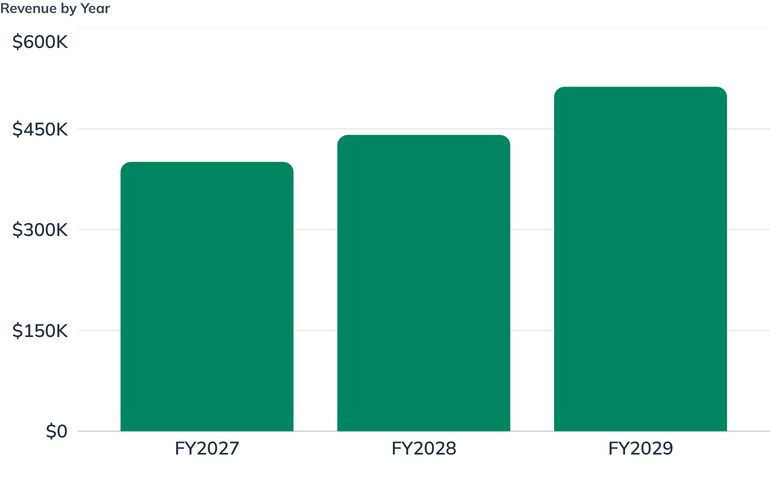
Need real financials? Explore a spreadsheet-free path to generating financial data for your business.Create your own business plan
Expenses & Costs
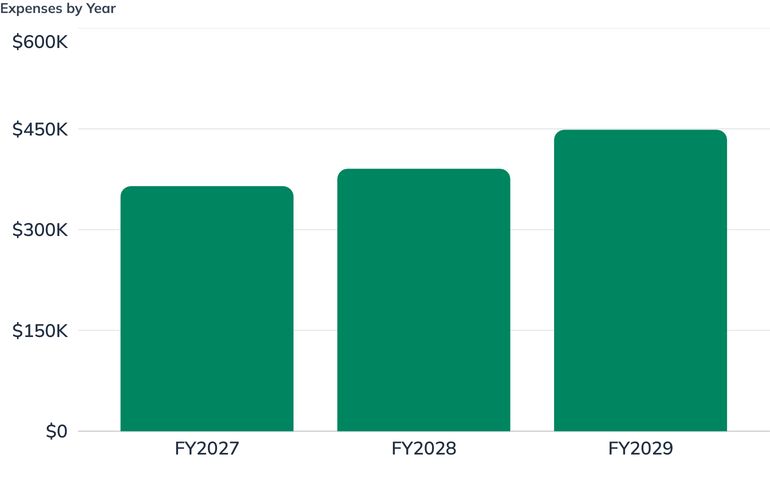
Need real financials? Explore a spreadsheet-free path to generating financial data for your business.Create your own business plan
Profitability
The Bottlecap is profitable for the year in its first year of operation. Net profit grows from approximately $36,200 in Year 1 to $50,400 in Year 2 and $63,900 in Year 3, with net profit margin improving from 9.0% to 12.5% over the same period as revenue grows and fixed costs like rent are renegotiated down after the first year.
Because the business is seasonal — busiest in the spring and fall around the university calendar, quieter over the summer and December holidays — individual summer and December months can run at a modest loss even in a profitable year. Cash reserves are sized to absorb that swing without the business ever running short.
Use of Funds
The Bottlecap requires $75,000 in total start-up funding to cover expenses and assets before opening.
- Fixtures & Re-Model: $25,000
- Furniture: $10,000
- Point of Sale Systems: $5,000
- Pool Table: $5,000
- Fees & Permits: $7,500
- Big Screen Television: $2,000
- Exterior Sign: $2,500
- Computer System: $1,500
- Marketing: $1,000
- Consultants: $1,000
- Rent (pre-opening): $1,500
- Taps: $800
- Glassware: $500
- Legal: $500
- Insurance: $700
- Stereo System: $350
- Misc. Supplies & Equipment: $700
- Bathroom Supplies: $250
- Cash Required: $7,920
- Start-up Inventory: $1,280
Because of the competitive nature of the marketplace, we have accounted for more cash than strictly necessary to ensure we can weather forecast variance without jeopardizing the business.
Sources of Funds
The Bottlecap requires $75,000 in total start-up funding, all from owner and investor equity contributions.
Investor | Amount | Type |
|---|---|---|
Dashiell Lavine | $20,000 | Owner equity |
Tyler Vogel | $20,000 | Owner equity |
Joe Smith | $17,500 | Private investor |
Bob Adler | $17,500 | Private investor |
Total Planned Investment | $75,000 |
- Start-up expenses: $65,800 (renovation, equipment, permits, furniture)
- Start-up assets: $9,200 (cash reserve and inventory)
No long-term debt is planned at launch. With a fully staffed manager and part-time team and seasonal swings in monthly revenue, cash reserves cover the leaner summer and holiday months while the business remains profitable for the year overall. Cash on hand is projected to reach approximately $231,000 by the end of the three-year forecast period.
Projected Statements
Key Assumptions
General Assumptions | Year 1 | Year 2 | Year 3 |
|---|---|---|---|
Corporate Tax Rate | 25.42% | 25.42% | 25.42% |
Tax Payment Frequency | Quarterly | Quarterly | Quarterly |
Debt Financing | None planned | None planned | None planned |
- Beer sales follow the academic calendar: strongest January–June and during the fall (October–November), softer over the summer (July–September) and in December
- Three beer categories: specialty microbrew (38%), normal microbrew (32%), domestic (30%)
- Average unit revenue approximately $2.94 per beer
- COGS at approximately 22.4% of total revenue
- Manager employed at $39,360/year (roughly 40 hrs/week at $19/hr)
- Six part-time employees at $12,792/year each (20 hrs/week at $13/hr)
- Owner compensation: Dashiell Lavine and Tyler Vogel start at $24,000/year each, rising to $27,000 in year two and $32,000 in year three as the business matures and cash position strengthens
- Payroll taxes at approximately 15% of total payroll
- Rent decreases from $18,000/year to $12,000/year after year one
- Advertising increases from $39,000 to $75,000 over three years
- Monthly units break-even: approximately 9,600 beers
- Monthly revenue break-even: approximately $28,200
- Estimated monthly fixed cost: approximately $21,900
Frequently Asked Questions
A microbrew bar business plan should cover market segmentation, competitive positioning, a start-up budget, and a financial forecast. The Bottlecap's plan, for example, breaks its market into three segments near the University of Oregon campus, positions itself against price-focused competitors like Rennie's Landing and Taylor's Bar & Grill through its rotating tap list, and lays out a $75,000 equity-funded start-up budget.
The Bottlecap's plan budgets $75,000 in total start-up funding: $65,800 in start-up expenses (including $25,000 for fixtures and remodeling, $10,000 for furniture, $7,500 for fees and permits, and $5,000 each for a point-of-sale system and a pool table) plus $9,200 in start-up assets for cash reserves and inventory. Costs will vary by location and buildout, but this gives a realistic benchmark for a campus-area beer tavern.
Yes — a bar serving alcohol typically needs a liquor license from its state's alcohol authority (in Oregon, the Oregon Liquor and Cannabis Commission) along with a city business license and health and occupancy permits before opening. The Bottlecap's own plan sets aside $7,500 for fees and permits as part of its start-up budget.
The Bottlecap makes money primarily through on-premise beer sales across eight or more rotating taps, drawing repeat visits with entertainment features like a pool table and big-screen TV and a companion website where customers vote on what goes on tap next. That combination is designed to turn casual visitors into regulars across all three of its target customer segments.
The Bottlecap is forecast to be profitable for the year in its first year of operation, with net profit projected to grow from roughly $36,000 in Year 1 to nearly $64,000 by Year 3 as the tap rotation and customer base mature. Actual timelines will vary with location, competition, and how quickly a rotating tap list builds a following.
Unlike nearby competitors such as Rennie's Landing, Taylor's Bar & Grill, and Max's Tavern, which compete mainly on low prices for a college crowd, The Bottlecap competes on depth and freshness of its beer selection. Its companion website lets regulars vote on weekly tap choices, giving customers direct influence over the offerings rather than a fixed, conventional tap list.
The Bottlecap targets three segments near the University of Oregon: the general bar-going public of working professionals (about 30,000 potential customers, growing roughly 8% a year), beer connoisseurs drawn by the rotating tap list (over 12,000 potential customers, the fastest-growing segment at about 12% a year), and University of Oregon and Lane Community College students, who are more price-sensitive (roughly 20,000 potential customers, growing about 10% a year).
The Bottlecap sources eight or more constantly rotating, hard-to-find microbrews and lets customers weigh in through a companion website where regulars vote on which beers appear each week. That direct feedback loop is central to the concept — it's what gives beer connoisseurs, in particular, a reason to keep coming back and spreading the word.

Business Plan Outline
Start your plan