





Lodgely


Business Plan Summary
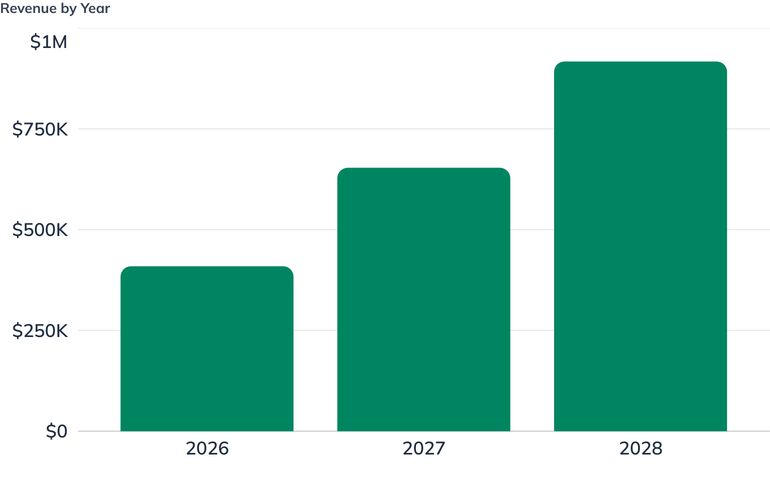
This short-term rental business plan example features Lodgely, a Charleston-area vacation rental company that owns and operates four whole-home rentals across Isle of Palms, Mount Pleasant, and North Charleston while co-hosting four more on behalf of third-party owners at an 18% management fee — meaningfully below the 20% to 30% full-service managers charge. It covers the deliberate pairing of the two sides of the business — a capital-hungry owned portfolio growing to seven homes by 2028, and a near-zero-capital co-hosting book scaling to 38 managed homes — alongside the Charleston market analysis behind it, the Hostaway and PriceLabs operating stack that lets a very small team run it, a compliance approach built for a tightening permit environment, and a $750,000 owner-funded capital plan paired with conventional investor mortgages, with three-year projections taking revenue from $409,052 to $916,951. Use it as inspiration for your own plan. Download a free business plan template to get started, or browse more business plan examples.
Lodgely
Executive Summary
Lodgely is a Charleston-area short-term rental company. We own and operate four whole-home vacation rentals across the Lowcountry — one beach house on Isle of Palms, two homes in Mount Pleasant, and one in North Charleston's Park Circle — and we manage four more on behalf of other owners under a co-hosting service we are now putting on a formal footing.
Our plan over the next three years is straightforward: add one owned home per year while scaling the co-hosting business that runs alongside it. By the end of 2028 we will own seven homes and manage 38 more for third-party owners.
The two halves of the business are deliberately paired. Owned homes build long-term equity but are capital-hungry and slow to compound — every acquisition ties up roughly $175,000 to $230,000 in down payment, closing costs, and furnishings, and carries a mortgage that consumes most of the property's operating income for the first several years. Co-hosting requires almost no capital, generates fee income at high margin, and carries the fixed overhead — software, insurance brokerage relationships, our cleaning and maintenance bench, marketing, compliance expertise — that the owned portfolio would otherwise have to absorb alone. Each managed home also makes the next one cheaper to serve.
What makes this work is that we already do the hard part for ourselves. Most Charleston owners hand their home to a full-service manager and give up 20% to 30% of gross bookings. We run our own homes without that layer — dynamic pricing, direct booking, our own cleaning and turnover crew, and a compliance process we rebuilt after watching the region's permit rules tighten. That single decision is what puts our property-level net operating income at roughly 41% of owned-home revenue, at the top of the 34% to 40% industry benchmark, despite Charleston carrying heavier property taxes and insurance than the national average. Co-hosting is that same operation, sold at 18% — meaningfully below the market rate, and profitable for us because the cost of adding the twentieth home is far lower than the cost of the first.
Charleston is a strong market to do this in. The region drew 7.9 million visitors in 2025 and generated $14.3 billion in tourism economic impact, a record and up 2.4% over 2024 — and notably, economic impact has grown 48% since 2019 while visitor counts grew only 7%. Charleston is attracting higher-spending travelers, not simply more of them, which favors well-appointed whole-home rentals over budget inventory.
We are equally clear-eyed about the risks. Short-term rental permitting across the Charleston area has tightened significantly, insurance on coastal property is expensive and getting more so, and South Carolina taxes investment property at the 6% assessment ratio rather than the 4% owner-occupied rate — a difference that runs to five figures a year per home. Our acquisition discipline is built around these facts rather than in spite of them: we only buy where whole-home rental is expressly permitted and a permit is actually obtainable, we underwrite insurance and property tax at full cost before we make an offer, and we do not chase trophy beachfront where the purchase price has outrun what the property can earn.
The numbers
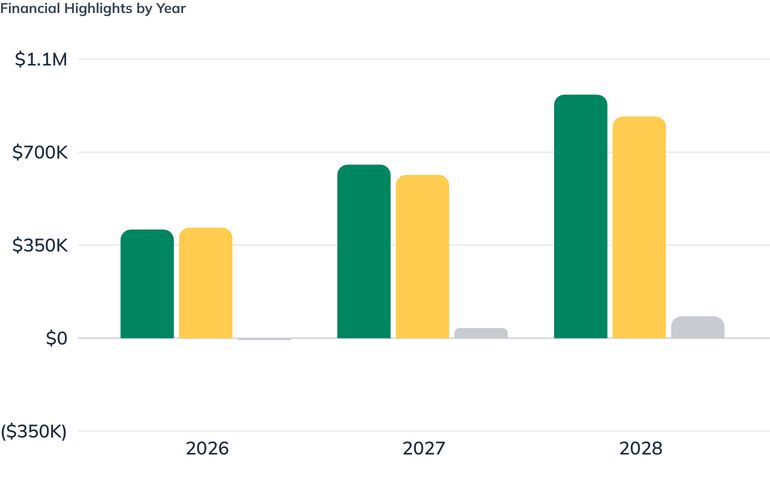
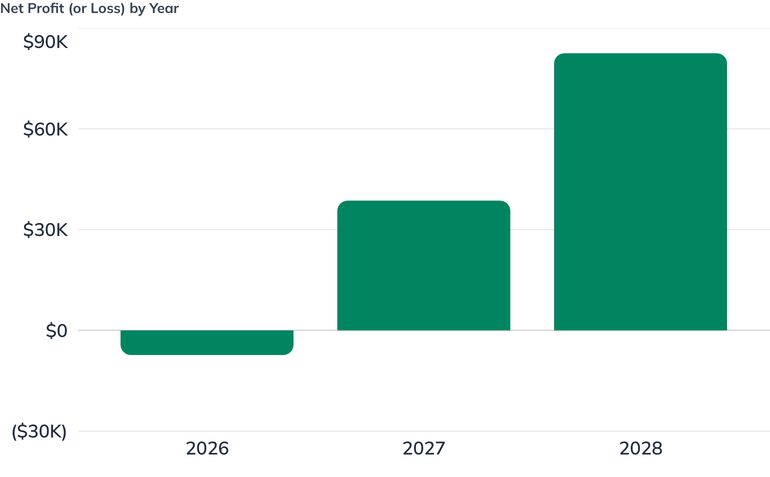
Revenue grows from $409,052 in 2026 to $916,951 in 2028. Operating profit runs $100,278, $205,450, and $304,608 across the three years. Net income is suppressed early by mortgage interest and depreciation — normal for a leveraged real estate holding business — showing a loss of $7,330 in 2026 before turning positive at $38,620 in 2027 and $82,496 in 2028.
We want to be direct about 2026: cash from operations that year is essentially break-even at $333. The business is carried through its first year by owner capital, not by its own earnings, and it does not genuinely fund itself until 2027, when cash from operations reaches $77,211, and 2028, when it reaches $137,111. Cash on hand never goes negative across the forecast, with a low point of $104,136 in March 2027.
Funding comes entirely from owner capital contributions totaling $750,000 across the three years, alongside conventional investor mortgages at 25% down on each acquisition. Total portfolio debt reaches $2,530,229 by the end of 2028.
One note for anyone reading the balance sheet: the four homes we already own could not be entered into this forecast as opening asset balances, so the statements carry their mortgages as liabilities without the matching properties. Total assets and equity are understated by roughly $2.1 million as a result, and reported equity is negative. The profit and loss and cash flow statements are unaffected. Projected Statements explains this in full.
Need real milestones? Establish a clear path for your business with real-world examples.Create your own business plan

Opportunity
Problem Worth Solving
There are two problems here, and they belong to two different people.
The guest problem. Charleston visitors are increasingly traveling in groups that hotels serve badly — multigenerational families, wedding parties, groups of couples, remote workers extending a trip into a week. A downtown hotel gives them separate rooms, no kitchen, no shared living space, and a bill that scales linearly with headcount. The vacation rental inventory that should serve them is wildly inconsistent. A large share of Charleston-area listings are absentee-owned and managed at arm's length: photos that oversell the property, listings that haven't been updated in two years, check-in instructions that arrive late, a broken air conditioner on a July weekend with nobody local to fix it. Guests booking a $600-a-night beach house have no reliable way to tell, before they pay, whether they are getting a well-run home or a neglected one.
The owner problem. Charleston has thousands of second-home and investment-property owners who want rental income without becoming innkeepers. Their realistic options today are both bad. Full-service management companies take 20% to 30% of gross bookings — on a home grossing $90,000, that is $18,000 to $27,000 a year — and many of them are regional or national operators running dozens of properties from a call center, with no local presence when something breaks. Self-managing is the alternative, and it means learning dynamic pricing, building a cleaning bench, handling guest messages at eleven at night, tracking accommodations tax filings across state and local jurisdictions, and keeping current with permit rules that have changed materially in the last three years. Most owners try it, burn out, and hand the home to a manager at 25%.
Compliance has become its own problem. Short-term rental regulation across the Charleston region has tightened sharply and now varies enormously from one municipality to the next — different permit categories, different caps, different occupancy limits, different annual license fees calculated off gross receipts, different renewal calendars. Several jurisdictions now use listing-monitoring software to find unpermitted operators, and penalties are significant. An owner who buys a home without confirming that a permit is available and transferable can find themselves holding an investment property that cannot legally do the thing they bought it for. Most owners do not know how to check this, and most agents are not equipped to advise on it.
And the economics have gotten harder. Purchase prices in the Charleston area have risen faster than rental income. Investment-property mortgage rates sit meaningfully above owner-occupied rates. Coastal insurance — where the dwelling policy, wind and hail coverage, and flood coverage are frequently three separate policies — has climbed steeply. South Carolina assesses non-owner-occupied property at 6% rather than the 4% owner-occupied ratio, and the 4% ratio also carries an exemption from school operating millage, so the swing between the two is roughly double the headline difference. The result is that a Charleston short-term rental bought carelessly today does not cover its own debt service. Buying well now requires real underwriting, not enthusiasm.
Our Solution
Lodgely runs a small portfolio of whole-home Charleston-area vacation rentals to a consistent standard, and sells that same operating capability to other owners at a fee well below what full-service managers charge.
The owned portfolio. We currently operate four homes and will add one per year through 2028:
Home | Location | Size | Role in the portfolio |
|---|---|---|---|
The Palmetto House | Isle of Palms | 4 BR / 3.5 BA | Beach flagship. Strong summer peak, highest nightly rate, longest average stay |
Shem Creek Cottage | Mount Pleasant | 3 BR / 2 BA | Year-round mainland demand, spring and fall peaks |
The Sweetgrass | Mount Pleasant | 3 BR / 2.5 BA | Our best-reviewed home; benchmark for renovation standard |
Park Circle Craftsman | North Charleston | 3 BR / 2 BA | Highest yield relative to purchase price; proves the mainland thesis |
Coleman Boulevard | Mount Pleasant | 3 BR / 2 BA | 2026 acquisition |
Olde Village | North Charleston | 4 BR / 2 BA | 2027 acquisition |
Riverfront Park | North Charleston | 4 BR / 2.5 BA | 2028 acquisition |
Every home is furnished to the same specification, photographed by the same photographer, priced by the same algorithm, cleaned by the same crew, and covered by the same maintenance response commitment. A guest who has stayed in one Lodgely home knows exactly what the next one will be like. That consistency is the product.
Self-managed, deliberately. We do not use a third-party property manager, and this is the single largest driver of our margin. A 25% management fee on our owned portfolio would cost roughly $126,000 in 2028. Instead we run the stack ourselves: dynamic pricing tuned weekly against local comparables and the Charleston event calendar, listings across Airbnb and Vrbo plus a direct booking site that carries no platform commission, in-house cleaning and turnover, and a local maintenance bench that can be at any of our homes within an hour.
Co-hosting: the same operation, sold. We manage other owners' Charleston-area homes for 18% of gross bookings — below the 20–30% regional norm — and we do it without the call-center distance that characterizes the larger operators. The owner keeps title, control, and the ability to block their own dates. We handle listing creation and optimization, professional photography, dynamic pricing, all guest communication, cleaning and turnover coordination, maintenance dispatch, accommodations tax filing, and permit renewal tracking. We grow this from eleven managed homes at the end of 2026 to roughly 38 by the end of 2028.
The co-hosting business is what makes the acquisition plan work. It generates fee income at high margin with essentially no capital tied up, and it carries the fixed cost base — software, insurance relationships, our cleaning crew's guaranteed hours, marketing, compliance expertise — that the owned homes would otherwise have to absorb alone. Every additional managed home spreads that overhead further.
Acquisition discipline. We buy on three tests, in order. First, is whole-home rental expressly permitted at this address, and is a permit actually obtainable rather than capped out or waitlisted? We confirm this with the jurisdiction directly before making an offer, and we walk away from otherwise attractive properties that fail it. Second, does the home cover its full carrying cost — mortgage, property tax at the 6% investment ratio, insurance including separate wind and flood coverage, and a real maintenance reserve — at conservative occupancy, not optimistic occupancy? Third, is the purchase price reasonable against what the property can actually earn? This third test is why we are buying on the mainland rather than adding beachfront: trophy coastal property in this market has appreciated well past what its rental income supports, while well-located mainland homes at a third of the price generate two-thirds of the revenue.
Compliance as a service, not an afterthought. We maintain a working file on permit rules, caps, occupancy limits, license fee structures, and renewal calendars for every jurisdiction we operate in, and we update it as ordinances change. This protects our own portfolio, and it is a genuine reason owners hire us — several of our co-hosting clients came to us after receiving a notice they did not understand.
Target Market
We serve two distinct markets: the guests who book our homes, and the owners who hire us to run theirs.
Guests
Charleston drew 7.9 million visitors in 2025 and generated $14.3 billion in tourism economic impact — a record, and up 2.4% over 2024. The more useful number is the trend underneath it: since 2019, economic impact has grown 48% while visitor volume grew only 7%. Average spend per visitor is now roughly $1,212, and lodging is the largest single category of it. Charleston is winning higher-spending travelers rather than simply more of them, and that shift favors whole-home rentals over budget inventory.
Our guests fall into four groups.
Multigenerational family trips (roughly 35% of bookings). Three generations traveling together, typically 6–10 people, booking 5–8 nights. They need a kitchen, separate sleeping areas, a yard or porch, and enough bathrooms. Hotels serve them poorly at any price. They book the furthest ahead — often 4–6 months — and they are our least price-sensitive segment because the alternative is four hotel rooms.
Wedding and event groups (roughly 25%). Charleston is one of the highest-volume wedding destinations in the Southeast, concentrated in spring and fall. Bridal parties, groomsmen, and out-of-town family book blocks of 3–4 nights, often multiple homes at once. This segment is the main reason our mainland Mount Pleasant homes peak in April and October rather than July. Group bookings are also where owning several homes in one area is an advantage — we can house a whole wedding party.
Couples and small groups on shoulder-season trips (roughly 25%). Two to four adults, 3–5 nights, drawn by food, history, and golf. They fill March, October, and November — the months that determine whether a Charleston rental is a good business or a seasonal one. They book closer in, respond well to dynamic pricing, and are the segment most influenced by review quality.
Beach weeks (roughly 15%, concentrated in our Isle of Palms home). Saturday-to-Saturday summer rentals, families of 6–8, booking 6–9 months ahead. Highly seasonal and highly predictable: our Isle of Palms occupancy runs above 80% in June and July and around 26% in January.
Charleston's seasonality is real and differs sharply by submarket. Our beach home peaks hard in summer, and because occupancy and nightly rate rise together the revenue swing compounds — June revenue at the Isle of Palms house runs close to seven times what January produces, even though occupancy only slightly more than triples. Our mainland homes follow the city's own rhythm, peaking in April and October with a softer summer, because downtown Charleston in July is hot and the festival calendar runs in spring, and their peak-to-trough spread is much narrower. Holding both patterns in one portfolio smooths the year considerably, and it is a deliberate design choice rather than an accident of what we happened to buy.
Owners
This is the market that drives our growth. The Charleston region has thousands of second-home, inherited, and investment properties that are either sitting idle, rented long-term below their potential, or managed by a company taking 25% of gross.
Absentee investment owners — out-of-state buyers who purchased a Charleston property as an investment and have no local presence. They are our most natural client: they need everything done for them, they are comparing us directly against a 25% manager, and the 7-point fee difference on a $90,000 home is $6,300 a year.
Second-home owners who use the property several weeks a year and want it earning the rest of the time. They care most about control — blocking their own dates, protecting the house, knowing who is in it. They are less fee-sensitive and more service-sensitive, and they stay with us the longest.
Burned-out self-managers. Owners who tried running the home themselves and found that guest messaging, cleaner scheduling, tax filings, and permit renewals amount to a part-time job. They arrive already knowing what the work is worth, which makes them fast to close.
Owners with a compliance problem. A growing group. They have received a notice, or discovered their permit does not renew, or bought a home assuming a license transferred with it. We can usually tell them within a day whether the situation is fixable. Two of the four homes we manage today came to us this way.
Our co-hosting target is owners of 3–5 bedroom whole homes in jurisdictions where investor short-term rental is permitted, grossing $50,000 to $120,000 a year. We are not pursuing condos, rooms, or homes in capped markets where we cannot guarantee a permit.
Competition
We compete in two arenas at once. On the guest side we compete for bookings against every other Charleston-area rental and against hotels. On the owner side we compete for management contracts against full-service property managers and against the owner's own willingness to do it themselves.
Competing for guests
Other short-term rentals. The Charleston market carries roughly 3,300 active listings, with about 1,800 more on Isle of Palms. Folly Beach is a hard-capped market — licenses are limited to 800 island-wide by voter referendum, with a waitlist of roughly 200 properties and effectively no new investor licenses being issued — which is precisely why it does not appear in our acquisition plan. Listing counts have fallen year over year across the region, down about 9% in Charleston proper and 6% to 8% in the beach markets, as tighter permitting and softer occupancy push marginal operators out. Market-wide occupancy has slipped several points while nightly rates rose only modestly, which means rate growth is no longer covering occupancy loss for the average operator. This is a market that is getting harder for casual hosts and easier for disciplined ones. Our advantage is straightforward: professional photography, weekly-tuned pricing, sub-hour response times, and reviews that reflect all of it. We compete on being demonstrably better run, not on being cheaper.
Hotels. Charleston has added significant hotel inventory downtown, and hotel rates have risen while occupancy softened slightly. Hotels beat us on downtown location, on one-or-two-night stays, and on business travel. We beat them decisively on groups: a family of eight pays for four hotel rooms with no kitchen and no shared space, or one of our homes for less. We do not try to win the solo business traveler.
Boutique inns and bed-and-breakfasts. Genuinely strong competition for the couples segment, particularly downtown, where they offer walkability we cannot match from the mainland. We do not compete for that guest and do not try to.
Competing for owners
This is where we win, and it is worth being specific about who we are up against.
Regional and national full-service managers. These are the dominant option, charging 20% to 30% of gross bookings. They have real advantages: scale, brand recognition, distribution relationships, and professional systems. Their weakness is distance and standardization. An owner with one home is a small account managed from a queue, guest issues route through a call center, and the local presence is a contractor network rather than a team. We charge 18%, we are local, and the owner talks to the person who actually runs their home. On a $90,000 home, our fee difference alone is $6,300 to $10,800 a year.
Discount and software-only co-hosts. A growing tier charging 10% to 15%, often little more than listing management and automated messaging. They are cheaper than us and will win some owners on price. What they do not do is show up when the water heater fails on a Saturday, handle a difficult guest in person, file accommodations tax across multiple jurisdictions, or track permit renewals. We lose the price-driven owner and are content to.
Traditional long-term property managers charging 8% to 12% on annual leases. Much cheaper, far less revenue. This is the right choice for an owner who wants simplicity over yield, and we say so when it is true — occasionally we advise an owner that long-term leasing suits their property better. That candor has produced referrals.
The owner doing it themselves. Our most common competitor. Free, and viable for a motivated owner with one home. We win when they realize what their time is worth, when a compliance issue frightens them, or when they compare their own occupancy to what we produce on a comparable home.
Where we are exposed
We should be honest about our weaknesses. We are small, which means less brand recognition than a national manager and no distribution relationships of our own. Our owned portfolio is concentrated in a single metropolitan area and a single hazard geography — a major hurricane would hit every property and both revenue streams simultaneously. Our fee advantage is not defensible on its own; a larger competitor could match 18% tomorrow. And regulatory change is a genuine threat we do not control: rules across the region have tightened repeatedly, and a further tightening in a jurisdiction where we operate would affect both our own homes and our managed portfolio at the same time.
What we do have is difficult to copy quickly: a reputation built on consistency, a cleaning and maintenance bench that took years to assemble, real compliance expertise across a fragmented regulatory landscape, and an owned portfolio that proves we run homes the way we say we do. We are asking owners to trust us with an asset worth several hundred thousand dollars. Having seven of our own on the line is the most credible answer to that.
Execution
Marketing Plan
Our marketing splits cleanly along the two sides of the business. Guest marketing is largely a distribution and conversion problem. Owner marketing is a trust problem, and it is where the money actually goes.
Guest marketing
Platform distribution and ranking. Airbnb and Vrbo drive the majority of our bookings, and on those platforms the algorithm is the marketing. Ranking is driven by response time, review scores, acceptance rate, and booking conversion. We treat these as operating metrics, not marketing metrics: we respond to inquiries within 15 minutes during waking hours, we never decline a qualified booking, and we maintain a 4.9 average. Platform commissions are a real cost — roughly 15% on Airbnb for hosts using management software, 8% on Vrbo — which is why the next item matters.
Direct booking. Our own site takes reservations with no platform commission, and every point of revenue we shift there drops straight to margin. We drive it three ways: a rate that is modestly better than the platform price, past-guest email marketing offering returning guests a discount and early access to their previous dates, and a QR code in each home linking to the direct site for the next visit. Repeat and referral guests are our highest-margin bookings and our most reliable shoulder-season fill.
Our target is 20% of owned-home bookings direct by the end of 2028, which is what brings our blended commission rate down from 10.5% in 2026 to 9.0% in 2028. That 1.5-point reduction is worth roughly $7,600 in 2028 alone. The site launches in Q3 2026, but the forecast conservatively holds the 2026 commission rate flat and takes no credit for savings until 2027 — a new direct channel takes a season to build an email list worth mailing.
Photography and listing quality. Every home is professionally photographed on acquisition and re-shot after any significant refresh. This is the single highest-return marketing spend in this business — listing photos determine click-through, click-through determines ranking, and ranking determines occupancy. Budgeted at roughly $1,200 per home.
Dynamic pricing. We price with PriceLabs, reviewed weekly against local comparables, the Charleston event calendar, and our own booking pace. Charleston's calendar is unusually spiky — Spoleto Festival, wedding weekends, the Cooper River Bridge Run, the Credit One Charleston Open on Daniel Island — and a static rate leaves meaningful money on the table in both directions. This is pricing, not advertising, but it does more for revenue than any ad we could buy.
Search and content. A modest amount of location content on our site — neighborhood guides, where to eat near each home, what to do on a rainy day in Charleston — that earns organic search traffic and feeds the direct booking funnel. This is a slow compounding channel and we treat it that way.
Owner marketing
This is where the growth is, and owners do not come from ads. They come from proof and from people they already trust.
Referrals from existing owner clients. We expect this to become our strongest channel, and it is already how two of our four current managed homes arrived. A co-hosting client who sees their revenue rise and their workload disappear tells other owners. We ask directly, at the six-month mark, and we pay a referral fee equal to one month of management fees. We expect roughly 40% of new owner clients to arrive this way by 2028.
Real estate agent relationships. Agents who sell investment property in the Charleston area have a recurring problem: their buyer wants to know what the home will actually earn and whether it can legally be rented at all. We provide that analysis free, including a direct read on permit availability at the specific address. It makes the agent look good, it is genuinely useful, and it puts us in front of a new owner at the exact moment they are deciding who will manage the home. This is our highest-conversion owner channel and it costs us time rather than money.
The revenue comparison. Our most effective single piece of sales material is a side-by-side showing an owner what their home currently earns net of a 25% management fee versus what a comparable Lodgely-managed home earns net of 18%. It is concrete, it is specific to their property, and it usually ends the conversation.
Compliance as a door-opener. We publish plain-English summaries of permit rules and renewal deadlines for the jurisdictions we work in, and we update them when ordinances change. Owners find these when they go looking for answers, and a meaningful number of them become clients. It costs almost nothing and it demonstrates exactly the expertise we are selling.
Local presence. Charleston real estate investor meetups, the local short-term rental owner community, and neighborhood association relationships. Small, unglamorous, and consistently productive in a market this size.
Marketing spend runs $11,000 in 2026, $16,000 in 2027, and $22,000 in 2028 — roughly 2.5% of revenue, weighted toward photography, the direct booking site, referral fees, and pricing software rather than paid advertising. In this business, operational quality is the marketing; the budget mostly pays for showing people that it exists.

The High-End Family Curator
Sarah Jenkins
Sarah represents the modern high-spending traveler who has shifted away from luxury hotels toward whole-home rentals. She travels with her extended family and values privacy, high-end amenities, and a seamless 'local' experience in historic or beach settings.
Age
42
Location
Charlotte, NC
Family Status
Married, 2 children (ages 9 & 12), often travels with elderly parents
Education
Master of Business Administration
Profession
Senior Marketing Director at a FinTech firm
Opportunities
- Offer curated 'Charleston Spring' or 'Beach Summer' packages that include private chef bookings and pre-stocked groceries to appeal to high-spend travelers.
- Market 4-5 bedroom homes specifically for multi-generational travel, highlighting ground-floor bedrooms for elderly parents and entertainment zones for kids.
Pain Points
- Frustrated by the lack of space and privacy in luxury hotels on the peninsula
- Tired of vacation rentals that look great in photos but have poor maintenance or cheap linens
- Struggles to find properties that accommodate both young children and aging parents comfortably
Needs
- A 'hotel-standard' cleaning and amenity level within a private home environment
- Reliable recommendations for high-end dining and seasonal festivals (like Spoleto)
- Premium location that allows for easy access to either the beach or the historic district
“When we come to Charleston, we want the soul of the city without the cramped quarters of a hotel; I'm happy to pay more for a home that actually feels like a home.”

The Yield Optimizer
Marcus Thorne
Marcus is a data-driven investor who owns two properties and wants to scale his portfolio. He is looking for a management partner who can help him identify his next acquisition and maximize RevPAR through aggressive seasonal pricing and professional marketing.
Age
38
Location
Greenville, SC
Family Status
Married, no children
Education
Bachelor of Science in Finance
Profession
Commercial Real Estate Consultant
Opportunities
- Provide market data to help him select his 'one home per year' expansion, positioning the management company as a growth partner.
- Utilize advanced software to capitalize on the 3.4x revenue peak in summer months for beach properties and the April/October peaks for mainland homes.
Pain Points
- Current management is passive and misses opportunities for higher daily rates during peak festival seasons
- Lack of granular data on occupancy rates and competitive RevPAR analysis
- Difficulty finding managers who understand the specific ROI of 3-5 bedroom whole-home rentals
Needs
- Professional-grade financial reporting and performance dashboards
- High-performance marketing that ensures occupancy stays above the 48.9% regional average
- A management partner that can handle the scaling of his portfolio (1 new home per year) without losing quality
“Charleston's tourism is booming, but I'm not interested in 'average' returns. I need a partner who treats my properties like the high-yield assets they are.”

The Legacy Guardian
Robert 'Bob' Miller
Bob recently inherited a large family home on the Isle of Palms. He wants to maintain the property for future generations but is overwhelmed by the logistics of short-term renting and is wary of large management firms that charge 30% and treat his home like a number.
Age
67
Location
Mount Pleasant, SC
Family Status
Retired, widowed, 3 adult children
Education
Juris Doctor
Profession
Retired Real Estate Attorney
Opportunities
- Provide a 'done-for-you' service for the complex Isle of Palms and Charleston STR permitting processes to alleviate his legal anxieties.
- Implement a high-touch maintenance schedule that preserves the long-term value of the home, appealing to his desire to keep it in the family.
Pain Points
- High management fees (25-35%) from national companies that eat into his inheritance income
- Anxiety over property damage or 'party' guests ruining a sentimental family asset
- Complexity of local parking permits and short-term rental regulations
Needs
- A local, boutique partner who provides personalized attention and frequent updates
- Strict guest screening processes to ensure only high-value, respectful travelers stay in the home
- Transparent reporting that shows the home is grossing near its $120,000 potential without high overhead
“This house has been in my family for forty years. I don't want a faceless corporation running it; I want someone who cares about the floorboards as much as the booking rate.”
Sales Plan
We have two sales motions. Guest bookings are almost entirely automated. Owner acquisition is a consultative sale that takes weeks and closes on evidence.
Guest bookings
There is no salesperson in this process, and there should not be. A guest searches on Airbnb, Vrbo, or Google, sees the listing, reads reviews, and books. Our job is to remove every point of friction between the search and the confirmed reservation.
Instant Book is on for every home, with guest requirements set to verified ID and no prior negative reviews. Requiring approval costs ranking and loses bookings to whoever answers faster.
Inquiries get a substantive reply within 15 minutes during waking hours and within an hour otherwise, handled through our property management system with templates that are edited, not sent raw. Response speed is both a conversion driver and a ranking input.
Minimum stays flex with the calendar. Two nights in the low season to fill gaps, three to four nights in shoulder months, and full-week Saturday-to-Saturday at the beach house in peak summer. Orphan nights between bookings drop to a one-night minimum at a discount rather than sitting empty.
Group bookings across multiple homes are handled personally. When a wedding party needs to house 20 people, we quote across our Mount Pleasant homes together and coordinate check-in. These are our largest single transactions and worth handling by hand.
Rebooking is part of checkout. Departing guests get a thank-you with a direct booking link and a returning-guest discount. Our best-performing acquisition channel is a guest who already stayed with us.
Owner acquisition
This sale is about trust, and it moves through four stages over roughly three to six weeks.
1. First contact and qualification. An owner reaches us through a referral, an agent, or our compliance content. We establish quickly whether their property is one we can actually serve: is it a whole home of 3–5 bedrooms, is it in a jurisdiction where investor short-term rental is permitted, and is a permit obtainable at that address? We check the permit question before anything else, because it can end the conversation and it is better to find out on day one. If the answer is no, we tell them plainly and suggest alternatives — sometimes long-term leasing is genuinely the right call, and saying so has earned us referrals.
2. The revenue analysis. We build a property-specific projection: realistic annual gross based on comparable homes in that submarket, the full operating cost picture including property tax at the 6% investment ratio and coastal insurance at real quoted cost, and a net-to-owner figure under our 18% fee compared against a 25% full-service manager and against self-management. This is free, it takes us a few hours, and it is the single most persuasive thing we do. We are careful to make it honest — a projection the owner later fails to hit costs us the relationship.
3. The walkthrough. We visit the home and produce a specific, prioritized list of what it needs to perform: furnishing gaps, photography, any deferred maintenance, and the compliance steps required. Owners consistently say this is the moment they decide, because it is the first time anyone has told them concretely what to do rather than generally what is possible.
4. Agreement and onboarding. Our management agreement runs 12 months with a 60-day termination clause on either side. We do not lock owners in — a long lock-up signals that we expect them to want out. Onboarding takes two to three weeks: professional photography, listing creation across Airbnb, Vrbo, and our direct site, pricing setup, smart lock installation, permit and business license filing, accommodations tax registration, and a full inventory of linens and supplies.
Pipeline targets
Start of 2026 | 2026 | 2027 | 2028 | |
|---|---|---|---|---|
Managed homes at period end | 4 | 11 | 24 | 38 |
New owner clients signed | — | 7 | 15 | 18 |
Owner clients lost | — | — | 2 | 4 |
We begin with four homes already under management, taken on informally through word of mouth. The first quarter of 2026 is about formalizing that arrangement — standard agreement, documented fee structure, proper onboarding and reporting — before we scale it.
Attrition is real and we plan for it. Owners sell their properties, move into them, or decide to self-manage. The two losses in 2027 and four in 2028 work out to roughly 11% and 13% of the average book size in those years, which is our planning assumption; measured against the opening book instead they read closer to 17%, and we would rather show the more conservative reading than pretend churn is lower than it is. Our retention effort is concentrated on the first six months of any new relationship, when an owner is still deciding whether the decision was right.
Our close rate on qualified owner leads runs near 45%, which is high because we disqualify aggressively at the first stage. We would rather have fewer conversations that go somewhere than a large pipeline of homes we cannot legally or profitably operate.
Locations & Facilities
Lodgely has no storefront and no office. Our facilities are the homes themselves, a converted garage that serves as our storage and laundry base, and a distributed team that works from wherever they are.
The owned portfolio
Home | Location | Configuration | Acquired |
|---|---|---|---|
The Palmetto House | Isle of Palms | 4 BR / 3.5 BA, sleeps 10, private pool | 2018 |
Shem Creek Cottage | Mount Pleasant | 3 BR / 2 BA, sleeps 6, screened porch | 2021 |
The Sweetgrass | Mount Pleasant | 3 BR / 2.5 BA, sleeps 8, fenced yard | 2022 |
Park Circle Craftsman | North Charleston | 3 BR / 2 BA, sleeps 6, walkable to Park Circle | 2024 |
Coleman Boulevard | Mount Pleasant | 3 BR / 2 BA, sleeps 6 | Planned Q2 2026 |
Olde Village | North Charleston | 4 BR / 2 BA, sleeps 8 | Planned Q1 2027 |
Riverfront Park | North Charleston | 4 BR / 2.5 BA, sleeps 8 | Planned Q1 2028 |
The geographic spread is intentional. Isle of Palms delivers the highest nightly rates and a hard summer peak. Mount Pleasant delivers year-round mainland demand with spring and fall peaks driven by Charleston's wedding and festival calendar. North Charleston delivers the best yield relative to purchase price — a home at roughly a third the cost of a beach property generates a meaningful fraction of the revenue, and carries proportionally lower property tax and insurance. Holding all three patterns smooths the calendar considerably: when the beach house is empty in February, the mainland homes are filling with shoulder-season couples.
Our acquisition targets stay within about a 30-minute drive of Mount Pleasant. This is a deliberate constraint. Turnovers happen on a tight window between checkout and check-in, maintenance calls need an in-person response inside an hour, and a portfolio spread across a wider area would require either a second crew or a slower service standard. Density is an operational asset.
Support facilities
Storage and laundry base — the converted garage at The Sweetgrass, Mount Pleasant. Roughly 400 square feet, holding backup linens, towels, consumables, small appliances, and staging inventory, plus the commercial washers and dryers we bought when the portfolio reached three homes. Using space we already own rather than leasing a commercial unit keeps roughly $18,000 a year of rent out of our overhead, and there is nothing about linen storage that justifies a lease.
This base is what allows same-day turnovers across the portfolio: cleaners swap fresh linen sets rather than washing on site, which cuts turnover time substantially and removes the risk of a delayed changeover on a peak Saturday. It serves our managed homes as well as our own, and it is the reason our cost per turnover holds steady as the portfolio grows.
We will outgrow it. At somewhere around fifteen to twenty homes in circulation the volume will justify a proper leased facility with more capacity and better vehicle access, and we expect that decision to arrive during 2028. It is not in this forecast because it is not yet needed.
No office. We work from home and from the properties. Guest communication, pricing, bookkeeping, and owner reporting all run on cloud software from anywhere. Avoiding a lease keeps roughly $30,000 a year out of our overhead, and there is no part of this business that requires a desk in a building with our name on it. Owner meetings happen at the owner's property, which is where they should happen anyway.
Vehicle. One vehicle used for property visits, supply runs, and maintenance response, with mileage tracked for tax purposes.
Compliance and jurisdiction
Every home we own or manage operates under a valid short-term rental permit and local business license in its jurisdiction, plus a South Carolina accommodations tax registration. Permit requirements, occupancy limits, annual license fee structures, and renewal calendars differ substantially from one Charleston-area municipality to the next, and several have changed materially in the last three years. We maintain a live compliance calendar covering every property, tracking permit renewal dates, business license filings, accommodations tax deadlines, and any inspection requirements. Renewal dates cluster in spring across most jurisdictions, which makes February through April our heaviest administrative period.
Insurance is handled property by property rather than under one blanket policy, because coastal Charleston County frequently requires three separate coverages — the dwelling and liability policy, wind and hail, and flood — and the right structure differs by flood zone and distance from the water. Our Isle of Palms home carries by far the highest premium of the portfolio, and we underwrite that cost fully before any coastal acquisition rather than discovering it at closing.
Technology
Our technology stack is what lets three people run seven owned homes and nearly forty managed ones without a call center. None of it is proprietary — it is all commercially available software, assembled and operated well. The advantage is in the operating discipline, not the tools.
Hostaway — property management system. The core of the operation. Hostaway synchronizes calendars, rates, and availability across Airbnb, Vrbo, and our direct booking site, so a booking on one channel closes the dates everywhere within seconds. Double-bookings are the fastest way to destroy a listing's ranking and an owner's confidence, and channel management exists to make them impossible. It also runs our automated guest messaging, task assignment to cleaners, and owner reporting.
PriceLabs — dynamic pricing. Sets nightly rates by property against local comparable supply, booking pace, day of week, and seasonality, with manual overrides we apply weekly. Charleston's calendar is unusually spiky — Spoleto Festival, wedding weekends, the Cooper River Bridge Run, the Credit One Charleston Open — and a static rate underprices peak dates while leaving shoulder dates empty. We review pricing every Monday rather than letting the algorithm run unattended, because local knowledge still beats the model on event weekends.
Breezeway — cleaning and inspection workflow. Turnover checklists with photo verification at each step. Cleaners work from a structured task list and photograph the finished result, which gives us a timestamped record of the home's condition between guests. This resolves damage disputes definitively and is the main reason our managed owners trust us with their property.
Smart locks and access. Every home has a code-based smart lock generating a unique code per reservation, active only for the stay dates. No key handoffs, no lockbox codes circulating, no 11pm calls about a lost key. Codes expire automatically at checkout.
Noise and occupancy monitoring — NoiseAware. Decibel-level sensors in common areas that alert us when sound crosses a threshold. They do not record audio. This matters enormously in residential neighborhoods where a single party can trigger a complaint, and in several Charleston-area jurisdictions a small number of founded complaints can put a permit at risk. We disclose the sensors in every listing.
Direct booking site. Built on Hostaway's booking engine with Stripe processing, carrying no platform commission. Every booking we shift here from Airbnb saves roughly 15% of the reservation value.
QuickBooks Online with Baselane for property-level accounting. Each home is tracked as its own class so we can see true per-property profitability, which is essential both for our own acquisition decisions and for the statements we send managed owners monthly.
AI-assisted guest communication. Hostaway's AI drafts responses to routine guest questions — check-in timing, wifi passwords, parking, restaurant suggestions — which a person reviews before sending. It handles the majority of inbound volume and lets us maintain 15-minute response times without anyone sitting at a screen all day. Anything involving money, damage, a complaint, or a booking change goes to a human immediately, and unedited AI text never reaches a guest.
Compliance tracking. A structured record per property covering permit number and expiration, business license renewal date, accommodations tax filing schedule, occupancy limit, inspection requirements, and any jurisdiction-specific conditions. Renewal deadlines feed a shared calendar with reminders at 60 and 30 days. This is deliberately boring and it is one of the more valuable things we maintain — permit lapses in this market are expensive and sometimes not recoverable.
Security and data handling. Guest data lives in the platforms and in Hostaway rather than in spreadsheets. Access is on individual accounts with two-factor authentication, and we remove access immediately when someone leaves. Payment data never touches our systems directly.
Total software cost runs approximately $6,600 in 2026 and grows to roughly $13,200 by 2028, most of it priced per property. It scales with the portfolio, which is the correct shape for this cost.
Equipment & Tools
Beyond the homes themselves, the physical requirements of this business fall into three buckets: what goes into a home when we acquire it, what keeps it running, and what supports the operation across the portfolio.
Furnishing and setup for a new acquisition
Every home we buy gets furnished to the same specification before it takes a booking. We budget $38,000 to $42,000 per home, and we treat this as non-negotiable — an under-furnished home photographs poorly, reviews poorly, and takes a year to recover from.
Category | Budget | Notes |
|---|---|---|
Bedroom furnishings | $9,500 | Quality mattresses in every room. This is the single most reviewed item in any rental |
Living and dining | $8,500 | Durable upholstery, seating for everyone the home sleeps |
Kitchen | $4,500 | Full cookware, service for 12, coffee setup, small appliances |
Outdoor | $4,000 | Porch or patio seating, grill, beach or yard gear by property |
Linens and towels | $3,200 | Three complete sets per bed and bath, enabling same-day turnover |
Electronics and connectivity | $2,800 | Smart TVs, mesh wifi, streaming |
Smart lock, sensors, safety | $1,400 | Lock, noise sensors, smoke and CO detectors, fire extinguishers, first aid |
Décor, art and staging | $2,600 | Local artwork; each home gets its own character within our standard |
Professional photography | $1,200 | Shot after staging is complete, never before |
Initial consumables | $1,300 | Paper goods, cleaning supplies, welcome basket, starter pantry |
We furnish for durability rather than for the photograph. A rental sofa takes roughly five years of abuse that a home sofa never sees, and replacing it early costs more than buying the right one initially. Furnishings are depreciated over five years, the standard IRS schedule for furniture and appliances in a residential rental activity.
Ongoing operations
Laundry and linen. Commercial washers and dryers in the converted garage at The Sweetgrass — equipment we purchased outright when the portfolio reached three homes — plus a rotating linen inventory sufficient to keep three complete sets per bed in circulation. Cleaners swap sets rather than washing on site, which is the mechanism that makes a same-day checkout-to-check-in turnover reliable on a peak Saturday.
Cleaning and turnover supplies purchased in bulk and staged at the same base: cleaning chemicals, paper goods, toiletries, coffee, replacement small items. Running these through one inventory rather than per-property purchasing saves both money and cleaner time.
Maintenance tools and stock. Basic tools, a stock of commonly failed items — HVAC filters, light bulbs, batteries, toilet components, door hardware, remote controls — and replacement linens and towels. Most maintenance calls in a rental are small and predictable, and having the part on hand converts a two-day vendor wait into a same-day fix.
Vehicle. One vehicle for property visits, supply runs, and maintenance response, with mileage tracked.
Replacement and capital reserve
Rental furnishings wear out on a schedule and we plan for it rather than reacting. Mattresses run five to seven years, upholstered furniture five, linens and towels eighteen months to two years in continuous rotation, and small appliances three to four years. Major systems — HVAC, roof, water heater, appliances — follow the ordinary useful life of any home, accelerated modestly by constant occupancy.
We budget repairs and maintenance at 5% of owned-home revenue, running from roughly $16,400 in 2026 to $25,200 in 2028, and we hold a separate reserve for major system replacement. Coastal Charleston property has an additional consideration: salt air is hard on HVAC condensers, exterior hardware, and outdoor furniture, and our Isle of Palms home consumes noticeably more maintenance per dollar of revenue than the mainland properties. We underwrite that into any coastal acquisition.
What we deliberately do not own
We do not own cleaning vehicles, landscaping equipment, or pool servicing gear. Cleaning is done by our own crew but they work from our supply, not our fleet. Landscaping, pool service, pest control, HVAC servicing, and licensed trade work all run through local vendors on standing agreements. Owning that equipment would mean employing the people to run it, and at our scale the vendor relationships are both cheaper and more reliable — particularly for the licensed trades, where a good electrician who answers the phone on a Saturday is worth more than any tool we could buy.
Milestones
Formalize and systematize the co-hosting service Put the four homes already managed informally onto a standard footing: management agreement template, documented 18% fee structure, onboarding checklist, monthly owner reporting pack, and a repeatable agent referral process. Reach five managed homes by the end of Q1. | Max Faulhaber Mar 31, 2026 |
Close on Coleman Boulevard (fifth owned home) Close the 2026 acquisition in Mount Pleasant at approximately $650,000 with 25% down. Confirm STR permit availability at the address before making an offer. Form the property LLC before closing so the deed records correctly. | Max Faulhaber May 29, 2026 |
Coleman Boulevard live and taking bookings Complete furnishing to standard specification ($42,000 budget), professional photography, STR permit and business license, accommodations tax registration, smart lock install, and listings live on Airbnb, Vrbo and the direct booking site. | Max Faulhaber July 15, 2026 |
Direct booking site live with past-guest remarketing Launch commission-free direct booking on the Hostaway engine with Stripe processing, plus a past-guest email list and returning-guest discount. Target 20% of owned-home bookings direct by end of 2028. | Max Faulhaber Sept 30, 2026 |
11 managed homes under contract Reach eleven third-party homes under co-hosting agreement. Fee revenue of roughly $82,000 across 2026 as the book ramps, equivalent to a ~$139,000 annual run rate at year-end scale. Establish the agent referral channel as a repeatable source. | Max Faulhaber Dec 31, 2026 |
Engage Guest Services Specialist Bring on a contract guest services specialist ($1,800/month) to handle inbound guest messaging, booking changes and first-line issue triage as the managed portfolio passes a dozen homes. | Max Faulhaber Jan 31, 2027 |
Close on Olde Village (sixth owned home) Close the 2027 acquisition in North Charleston at approximately $475,000 with 25% down. Live and taking bookings by May 2027. | Max Faulhaber Mar 31, 2027 |
24 managed homes and first profitable year Reach 24 managed homes. First year of positive net income (~$38,600) with net cash from operations near $77,000 — the year the business begins funding itself rather than being carried by owner capital. Secure financing for the 2028 acquisition. | Max Faulhaber Dec 31, 2027 |
Close on Riverfront Park (seventh owned home) Close the 2028 acquisition in North Charleston at approximately $485,000 with 25% down, completing the seven-home owned portfolio. Live and taking bookings by May 2028. | Max Faulhaber Mar 31, 2028 |
Hire full-time Operations Manager Hire a full-time operations manager at $52,000 to own day-to-day operations across seven owned and ~38 managed homes. Preference to an internal candidate from the existing cleaning and maintenance bench. This role is also the first real step toward reducing single-person dependency. | Max Faulhaber July 1, 2028 |
38 managed homes; $917K revenue run rate Close the plan period at 7 owned homes and 38 managed homes, roughly $917,000 in revenue, $305,000 operating profit, and $82,500 net income after interest and depreciation. Engage an advisor experienced in scaling a property management company past owner-operated size. | Max Faulhaber Dec 31, 2028 |
Key Metrics
We track a small number of metrics weekly. Most of them are operational rather than financial, because in this business the financial results are downstream of how well the homes are run.
Portfolio performance
RevPAR (revenue per available night) — our primary measure of property performance, because it captures rate and occupancy in one number. Occupancy alone rewards underpricing; average nightly rate alone rewards leaving the home empty. We track RevPAR per home against comparable properties in the same submarket.
Occupancy rate, monitored against the seasonal curve rather than a flat target. Our Isle of Palms home should run above 80% in June and around 26% in January; a flat annual target would be meaningless. What we watch is variance from the expected curve for that month.
Average daily rate, reviewed weekly alongside booking pace. If ADR is up and pace is down, we are priced above the market.
Booking pace — reservations on the books for a future month versus the same point last year. This is our earliest warning signal, typically 60 to 90 days ahead of a revenue problem, and it is what triggers a pricing intervention.
Direct booking share. Currently modest; target 20% of owned-home reservations by the end of 2028, which is what carries our blended platform commission from 10.5% down to 9.0%.
Guest experience
Overall review rating, target 4.9 or above on every home. Below 4.8 on any property triggers an immediate review of what changed.
Response time, target under 15 minutes during waking hours. This drives both conversion and platform ranking.
Repeat guest rate, target 15% of owned-home bookings by 2028.
Turnover failure rate — the number of turnovers where the home was not fully ready at check-in. Target zero, tracked absolutely rather than as a percentage. One failure is one guest whose trip started badly.
Co-hosting business
Managed homes under contract, our clearest growth measure: 4 at the start of 2026, 11 at the end of 2026, 24 at the end of 2027, 38 at the end of 2028.
Owner retention. The forecast assumes we lose two clients in 2027 and four in 2028 — roughly 11% to 13% of the average book in those years, or closer to 17% measured against the opening book. Our operating goal is to beat that: we aim to hold annual churn under 10%, and the gap between the plan's assumption and that target is deliberate, because a forecast built on our best-case retention is a forecast that breaks the first time an owner sells. We watch the first six months of any new relationship most closely, since that is when an owner is still deciding whether the choice was right.
Revenue lift versus the owner's prior year — how much more a home earns under our management than it did before. This is our single most persuasive sales number, and it is also the honest test of whether we are delivering.
Fee revenue per managed home. Roughly $11,000 in 2026 as the book ramps through a seasonal year, rising to about $13,200 in 2027 and $13,300 in 2028 — against a benchmark of $12,600 for an 18% fee on a typical $70,000 home.
Homes per operations staff member. The number that determines whether co-hosting scales or simply adds work. We are watching for the point where quality begins to slip, which is where the next hire belongs.
Financial health
Property-level net operating income per home, before mortgage but after all property costs — the true measure of whether a property was a good purchase. Portfolio-wide this runs about 41% of owned-home revenue, and a home materially below that is a home we underwrote wrong.
Debt service coverage ratio per property and portfolio-wide. This is the number that determines whether we can finance the next acquisition and the discipline that keeps us from over-leveraging.
Cash from operations, watched monthly rather than annually because this business has a pronounced seasonal cash cycle. Revenue concentrates in spring and summer while mortgage payments, insurance premiums, and property taxes fall due on their own schedule. Our thinnest cash months are consistently January and February, and 2026 cash from operations is essentially break-even for the full year — so this is the metric that matters most in the near term.
Cost per turnover, tracked against the guest cleaning fee. When all-in turnover cost rises above what we recover, either the fee or the process needs to change.
Compliance
Permits current and renewals filed on time, tracked as a simple pass or fail across every owned and managed property. There is no acceptable number other than 100%. A lapsed permit in this market is expensive and, in some jurisdictions, not recoverable.
Founded neighbor complaints, target zero. In several Charleston-area jurisdictions a small number of founded complaints can put a permit at risk, which makes this a business-continuity metric rather than a customer service one.
Company
Ownership & Structure
Lodgely LLC is a South Carolina limited liability company, wholly owned by Max Faulhaber. It has elected to be taxed as an S corporation. This election is the reason the owner can take a W-2 salary through payroll rather than irregular draws: a single-member LLC treated as a disregarded entity cannot pay its owner wages, so the S-corp election is what makes the compensation structure in this plan valid. Income and losses still flow through to the owner's personal return, so the company itself pays no federal or state income tax at the entity level, and the forecast reflects that — no corporate income tax is modeled.
Property-holding structure
Each home is held in its own single-member LLC, with Lodgely LLC as the sole member and the operating company. This is standard practice for rental real estate and exists for one reason: liability isolation. A guest injury, a property damage claim, or a dispute at one home is contained to that property's entity rather than exposing the entire portfolio. The cost is modest — annual filing fees, separate bank accounts, and the discipline of keeping records genuinely separate — and the protection only holds if that separation is maintained in practice, which is why each property LLC keeps its own account and its own books rather than existing only on paper.
Entity | Holds |
|---|---|
Lodgely LLC (S-corp election) | Operating company; co-hosting contracts; employs staff; sole member of each property LLC |
Palmetto House LLC | The Palmetto House, Isle of Palms |
Shem Creek Holdings LLC | Shem Creek Cottage, Mount Pleasant |
Sweetgrass Property LLC | The Sweetgrass, Mount Pleasant |
Park Circle Rentals LLC | Park Circle Craftsman, North Charleston |
Each future acquisition will be held the same way, with the property LLC formed before closing so the deed is recorded correctly the first time. Lenders on investment property generally accept this structure, though some require a personal guarantee from the owner — which we expect and have provided.
The co-hosting business runs entirely through Lodgely LLC. We never take title to, or an ownership interest in, a client's property. Our relationship with a managed owner is a management agreement, not a partnership.
Capitalization
The business is funded by owner capital and mortgage debt. There are no outside equity investors, no partners, and no profit-sharing arrangements.
Owner capital contributions total $750,000 over the plan period — $385,000 in January 2026, $195,000 in January 2027, and $170,000 in December 2027 — funding the down payments, closing costs, and furnishing budgets for each acquisition plus working capital for the seasonal cash cycle. This is Max's own capital, contributed as equity with no repayment obligation to the company.
Mortgage debt consists of the four existing property mortgages, carrying a combined balance of approximately $1,441,000 at the start of 2026, plus a new conventional investor mortgage on each acquisition at 25% down. All mortgages are conventional 30-year amortizing loans. Total portfolio debt reaches approximately $2.53 million by the end of 2028, against a property portfolio of comparable and appreciating value.
Governance and succession
As a single-member entity, decision-making rests with the owner and there is no board. This suits a business of this size, and we are candid that it also concentrates risk — Max is the sole decision-maker, the primary owner relationship for every managed client, and the person who holds the compliance knowledge. Reducing that concentration is an explicit goal of the plan: the operations manager role added in 2028 is intended to build a genuine second point of continuity, not simply to add capacity.
An operating agreement, updated in 2026, governs the company. It addresses transfer restrictions, valuation methodology, and succession in the event of the owner's death or incapacity. Given that the business holds several million dollars of real property and manages assets belonging to other people, having that document current and specific is not a formality.
Distributions
Owner compensation is taken as a W-2 salary through payroll — $54,000 in 2026, $66,000 in 2027, and $84,000 in 2028 — rather than as irregular distributions. Under the S-corp election this salary must be reasonable for the work performed, and our CPA reviews it annually against comparable property management compensation. Paying it through payroll also keeps the company's true operating cost visible in the financials rather than hidden below the line, which matters both for lender conversations and for honestly assessing whether each property is carrying its weight. Additional distributions beyond salary are not modeled during the plan period; retained cash funds the next acquisition.
Management Team
Lodgely is deliberately small. The operating model depends on software doing the repetitive work and on a tight bench of local contractors doing the physical work, which means the team grows slowly and only where quality would otherwise slip.
Max Faulhaber — Owner and Operator
Max founded Lodgely and runs it. He handles acquisitions and underwriting, pricing strategy, every owner relationship, compliance across all jurisdictions, and financial management. He bought the first home on Isle of Palms in 2018, learned the business by making the mistakes personally — under-furnishing a property, mispricing a shoulder season, nearly missing a permit renewal — and built the current operating standard out of those lessons.
His background is in product and customer engagement at a software company, which shows in how the business is run: the operation is systematized rather than improvised, decisions are made against measured metrics rather than instinct, and the technology stack is chosen and configured deliberately. It is also why co-hosting exists as a product at all — the instinct to package a capability you already have and sell it is not one most individual property owners bring to this.
Compensation: $54,000 in 2026, rising to $66,000 in 2027 and $84,000 in 2028 as the co-hosting book matures and the portfolio reaches seven homes. This is below market for the scope of the role in the early years, which reflects a deliberate choice to reinvest in acquisitions rather than to pay the owner what the job is worth.
Guest Services Specialist — contract, from early 2027
As the managed portfolio passes roughly a dozen homes, guest communication volume outgrows what one person can absorb alongside acquisitions and owner relationships. This role handles inbound guest messaging, booking modifications, check-in support, and first-line issue triage, working remotely with AI-drafted responses reviewed before sending. Engaged as a contractor at approximately $21,600 in 2027 and $28,800 in 2028, scaling with volume.
We hire this role second, not first, because guest messaging is the function that most benefits from software leverage and is therefore the one we can defer longest without quality suffering.
Operations Manager — full-time, from mid-2028
By 2028 we own seven homes and manage close to forty. At that scale the coordination load — cleaner scheduling across dozens of turnovers a week, maintenance dispatch, property inspections, vendor management, owner reporting — becomes a full-time job and a genuine single point of failure if one person holds it all. This role takes on day-to-day operations so Max can concentrate on acquisitions and owner growth.
Budgeted at $52,000 annually, joining mid-2028 (approximately $26,000 in that year). We expect to hire from within our existing cleaning and maintenance bench where possible; someone who already knows the homes and the standard is worth more here than someone with a better résumé and no context.
Extended team — contractors
The people who do most of the physical work are not employees, and this is a deliberate structure rather than a cost-avoidance measure. Turnover work is intensely seasonal, and a fixed crew sized for July would be idle in January.
Cleaning crew. Three regular cleaners working on contract, paid per turnover, with a fourth added seasonally for summer peaks. They work from structured checklists with photo verification at each step. This bench took years to build and is one of our genuinely hard-to-replicate assets — reliable cleaners who show up on a peak Saturday are the scarcest resource in this business.
Maintenance and trades. A general handyman on standing call with an under-one-hour response commitment, plus established relationships with licensed HVAC, plumbing, electrical, and roofing contractors. Landscaping, pool service, and pest control run on standing schedules per property.
Professional services. A CPA experienced in rental real estate and multi-entity structures, an attorney for entity formation and closings, and an insurance broker who specializes in coastal property — the last of these is not optional in this market, where the dwelling policy, wind and hail, and flood coverage are frequently three separate policies with meaningfully different terms.
The honest gap
The concentration of knowledge in one person is the most significant weakness in this plan. Max holds every owner relationship, the compliance detail across multiple jurisdictions, the pricing judgment, and the acquisition thesis. If he were unavailable for a month, the business would function; if he were unavailable for six, it would not. The 2028 operations manager hire is the first real step toward fixing this, and documenting process rather than carrying it in one head is an ongoing priority in the interim.
Advisors
Lodgely does not have a formal advisory board, and at this size one would be more ceremony than substance. What we do have is a set of professional relationships that function as advisory in practice, and we are deliberate about maintaining them.
CPA — rental real estate and multi-entity structures. Meets quarterly rather than only at tax time. Advises on entity structure, the reasonableness of owner compensation under our S-corporation election, depreciation strategy including cost segregation on larger acquisitions, the treatment of passive activity losses, and the tax consequences of each acquisition before it happens rather than after. This relationship has direct financial value: real estate tax treatment is complicated enough that good advice pays for itself several times over, and depreciation is the single largest non-cash item in our financial statements.
Real estate attorney. Handles entity formation, property closings — South Carolina is an attorney-closing state, so this is required rather than optional — the operating agreement, our management agreement template, and any dispute that escalates beyond a phone call. Consulted before each acquisition on title, easements, and any HOA covenant that might restrict short-term rental use.
Insurance broker specializing in coastal property. Genuinely consequential in this market. Coastal Charleston County property frequently requires three separate coverages — the dwelling and liability policy, wind and hail, and flood — with different carriers, different deductible structures, and named-storm deductibles that can run to a meaningful percentage of the dwelling value. A broker who knows this landscape saves us money on premiums and, more importantly, prevents coverage gaps we would only discover after a claim. We review the entire portfolio annually and obtain quotes before any coastal acquisition closes.
Investment-focused real estate agent. Sources off-market opportunities, provides comparable sales analysis, and — critically — understands short-term rental permitting well enough to flag a problem address before we spend time on it. The relationship runs both ways: we provide free rental revenue analysis to their buyers, which puts us in front of new owners at the moment they are choosing a manager.
Mortgage broker experienced in investment property. Sources financing on each acquisition, compares conventional investor products against debt-service-coverage loans, and gives us a realistic read on what terms we can actually obtain before we make an offer. Since our acquisition test depends on the property covering its full carrying cost, knowing the real rate rather than the advertised one is part of the underwriting.
Peer network. Max participates in the Charleston-area short-term rental owner community and a regional investor group. This is where regulatory changes surface first — usually weeks before they appear in a formal notice — and where we hear which jurisdictions are tightening enforcement. In a business where a permit rule change can materially affect the portfolio, informal early warning has real value.
What we would add
As the co-hosting business approaches forty managed homes, we would benefit from a formal advisor with experience growing a property management company through the transition from owner-operated to genuinely delegated. That is a different discipline from operating rentals well, and it is the transition where businesses of this type most often stumble — the founder who can run ten homes personally frequently cannot run sixty, and recognizing that in advance is easier than recovering from it afterward. We expect to seek that relationship in 2028.
Financial Plan
Revenue
Revenue comes from two sources: nightly bookings at the homes we own, and management fees on the homes we run for other owners.
2026 | 2027 | 2028 | |
|---|---|---|---|
Owned-home rental revenue | $326,690 | $422,849 | $503,694 |
Co-hosting management fees | $82,362 | $230,395 | $413,257 |
Total revenue | $409,052 | $653,244 | $916,951 |
Homes owned (year end) | 5 | 6 | 7 |
Homes managed (year end) | 11 | 24 | 38 |
Need real financials? We recommend using LivePlan as the easiest way to create financials for your own business plan.Create your own business plan
Expenses & Costs
Need real milestones? Establish a clear path for your business with real-world examples.Create your own business plan
Profitability
Need real milestones? We recommend using LivePlan as the easiest way to create milestones for your own business plan.Create your own business plan
Use of Funds
Capital in this plan goes almost entirely into acquiring homes. Each acquisition requires cash for the down payment, closing costs, and furnishing, with the balance of the purchase price financed by a conventional investor mortgage.
Cost of each acquisition
Coleman Boulevard (Q2 2026) | Olde Village (Q1 2027) | Riverfront Park (Q1 2028) | |
|---|---|---|---|
Purchase price | $650,000 | $475,000 | $485,000 |
Closing costs (~3.5%) | $22,750 | $16,625 | $16,975 |
Furnishing & setup | $42,000 | $38,000 | $40,000 |
Total project cost | $714,750 | $529,625 | $541,975 |
Investor mortgage (75% LTV) | $487,500 | $356,250 | $363,750 |
Cash required | $227,250 | $173,375 | $178,225 |
South Carolina is an attorney-closing state, and closing costs average around 3.5% of purchase price — attorney fees, title search and insurance, deed recording at $1.85 per $500, appraisal, inspection, and loan origination. Prepaid property taxes and the first year's insurance premium are also settled at closing and are real cash at the table, but they are period costs rather than part of the property's basis, so they appear in the property tax and insurance expense lines rather than in the capitalized figures above.
How each acquisition is recorded on the balance sheet:
Land (no depreciation) | Building & closing costs (27.5 yr) | Furnishings (5 yr) | |
|---|---|---|---|
Coleman Boulevard | $134,550 | $538,200 | $42,000 |
Olde Village | $98,325 | $393,300 | $38,000 |
Riverfront Park | $100,395 | $401,580 | $40,000 |
We allocate 20% of each property's capitalized cost — purchase price plus closing costs — to land, which is not depreciable. That works out to about 20.7% of the purchase price alone. This is a conservative allocation for the Charleston market and one our CPA reviews per property: a higher land share reduces the annual depreciation deduction, so we would rather understate the deduction in the plan than have the figure revised downward later.
The $38,000 to $42,000 furnishing budget is not padding. A home that is under-furnished photographs poorly, reviews poorly, and takes a year to recover from a weak start. We furnish to a fixed specification covering bedrooms, living and dining, kitchen, outdoor space, three complete linen sets per bed, electronics, smart locks and safety equipment, professional photography, and starting consumables.
Three-year use of funds
Amount | |
|---|---|
Property acquisitions (purchase price + closing costs) | $1,666,350 |
Furnishing & setup for three homes | $120,000 |
Total invested in the portfolio | $1,786,350 |
Funded by investor mortgages | $1,207,500 |
Cash required from the owner | $578,850 |
Working capital and seasonal cash reserve | $171,150 |
Total owner capital contributed | $750,000 |
Working capital — why the reserve matters
The remaining $171,150 is not slack. This business has a pronounced seasonal cash cycle that a purely annual view hides completely, and 2026 cash from operations is essentially break-even at $333 — so the reserve is what actually carries the business through its first year.
Revenue concentrates heavily in spring and summer. Costs do not follow it. Mortgage payments are level year-round, property tax bills arrive on the county's schedule, insurance premiums on coastal property are frequently due in full at renewal rather than monthly, and short-term rental permit and business license renewals cluster in February through April across most Charleston-area jurisdictions — precisely our weakest revenue months. January and February are consistently our thinnest cash months, and the reserve exists so that a slow winter never forces a decision we would not otherwise make.
We also hold reserve specifically against the coastal hazard risk. Named-storm deductibles in this market run 2% to 10% of dwelling value, meaning a single event could require a five-figure cash outlay before insurance responds. Carrying that capacity is a condition of operating here responsibly.
Capital reserve for the existing portfolio
Beyond acquisitions, we fund ongoing repairs and maintenance at 5% of owned-home revenue — $16,417 in 2026 rising to $25,184 in 2028 — and hold a separate reserve for major system replacement. Rental furnishings wear on a predictable schedule: mattresses five to seven years, upholstered furniture five, linens eighteen months to two years in continuous rotation. Coastal salt air accelerates wear on HVAC condensers, exterior hardware, and outdoor furniture, and our Isle of Palms home consumes noticeably more maintenance per dollar of revenue than the mainland properties.
What we are not spending on
We carry no office lease, no leased storage or laundry facility, no owned service vehicles beyond one, no proprietary software development, and no paid advertising of consequence. Every dollar of capital that is not required for a property acquisition or a working capital reserve stays in the business to fund the next one.
Sources of Funds
Lodgely is funded by owner capital and conventional mortgage debt. There are no outside investors, no partners, and no equity is being offered.
Owner capital contributions
Amount | Timing | Purpose | |
|---|---|---|---|
Contribution 1 | $385,000 | January 2026 | Coleman Boulevard down payment, closing, furnishing, plus opening working capital |
Contribution 2 | $195,000 | January 2027 | Olde Village acquisition |
Contribution 3 | $170,000 | December 2027 | Riverfront Park acquisition, pre-funded ahead of a Q1 2028 closing |
Total | $750,000 |
This is Max's own capital, contributed as equity with no repayment obligation and no interest. Contributing ahead of each acquisition window rather than at each closing is deliberate: it means the cash is in place before we go looking, so we can move on a property that fits our criteria without waiting on a funding decision. In a market where the right property is scarce, being able to close quickly is a real advantage.
We considered financing the down payments with an equity line against the Isle of Palms home, which carries substantial equity. We chose owner capital instead. A line of credit would have added roughly $25,000 to $45,000 a year in interest on top of already-significant debt service, and in a business where cash from operations in year one is essentially break-even, layering another interest-bearing obligation onto it would have narrowed the margin for error more than the flexibility was worth. Preserving the existing low-rate first mortgages untouched was the other consideration — the Palmetto House and Shem Creek loans carry rates that cannot be replaced in today's market.
Existing mortgage debt
Four mortgages carry into the plan, with a combined balance of $1,441,000 at January 2026:
Property | Acquired | Balance at 1/2026 | Rate | Monthly P&I | Payments left |
|---|---|---|---|---|---|
The Palmetto House | 2018 | $385,000 | 4.625% | $2,297 | 270 |
Shem Creek Cottage | 2021 | $333,000 | 3.375% | $1,634 | 303 |
The Sweetgrass | 2022 | $432,000 | 4.875% | $2,422 | 318 |
Park Circle Craftsman | 2024 | $291,000 | 6.500% | $1,867 | 344 |
The rates on the first three are a genuine asset. They cannot be replicated today, and protecting them is a real consideration in how we finance future growth — it is the main reason we are not refinancing to pull equity.
New acquisition financing
Each acquisition is financed with a conventional 30-year investor mortgage at 25% down:
Property | Loan | Rate | Monthly P&I | Funded |
|---|---|---|---|---|
Coleman Boulevard | $487,500 | 7.250% | $3,326 | May 2026 |
Olde Village | $356,250 | 7.000% | $2,370 | March 2027 |
Riverfront Park | $363,750 | 6.875% | $2,390 | December 2027 |
The Riverfront Park loan is shown funding in December 2027 rather than at its March 2028 closing. This is a modeling constraint rather than a plan: LivePlan does not accept new funding inside a year modeled at annual resolution, so the proceeds have to be placed in the last monthly period available. In practice the loan would fund at closing, and the effect on the forecast is one extra quarter of interest — a conservative distortion rather than a favorable one.
Investment property rates currently run roughly 0.5 to 1.0 percentage point above owner-occupied rates, and lenders require 20% down at minimum with 25% preferred on single-unit investment property. We underwrite at 25% down both because it secures better pricing and because it leaves the property with debt service it can actually cover. We have modeled rates at current market levels rather than assuming improvement; if rates fall during the plan period, that is upside we have not counted on.
Debt-service-coverage loans were considered as an alternative. They price competitively and qualify on the property's income rather than the borrower's, but they typically carry origination points and additional pricing add-ons for short-term rental income. Conventional investor financing is cheaper for a borrower who qualifies conventionally, which we do.
Total sources and total debt
Amount | |
|---|---|
Owner capital contributions | $750,000 |
New acquisition mortgages | $1,207,500 |
Existing mortgage debt carried in | $1,441,000 |
Total capital deployed by end of 2028 | $3,398,500 |
Total portfolio debt outstanding at the end of 2028 is $2,530,229 — $1,441,000 carried in plus $1,207,500 of new acquisition mortgages, less $118,271 of principal retired over the three years.
Against that debt sits real property. The three homes acquired during the plan period appear on the balance sheet at their full $1,786,350 cost. The four homes we already own do not: LivePlan's forecast could not accept opening asset balances, so those four properties are absent from the balance sheet while their mortgages are carried as liabilities. Total assets and equity are understated by roughly $2.1 million as a result, and the balance sheet shows negative equity of about $577,000. On a true basis the portfolio's market value comfortably exceeds the debt against it — Charleston-area home prices have grown at roughly 2% to 3.5% annually since the post-2022 stabilization — but the statements as generated do not show that, and this should be corrected by entering opening balances directly in LivePlan. We underwrite acquisitions on rental income rather than on expected appreciation; appreciation is welcome, but it is not the plan.
What we would need outside capital for
Nothing in this plan requires it. If we wanted to accelerate beyond one acquisition a year — or if a portfolio of several homes came available at once — we would need either an equity partner or a portfolio loan. We are not pursuing that. One home a year is a pace we can underwrite carefully, furnish properly, and integrate without straining the operation, and the discipline of that constraint is part of why the plan works.
Projected Statements
Frequently Asked Questions
A short-term rental business plan should define which properties you'll operate and where, how you'll price and fill them across a seasonal calendar, your permitting and tax compliance approach, and financial projections covering acquisition costs, financing, and a realistic path to profitability. Lodgely's plan, for example, pairs a seven-home owned portfolio spread deliberately across Isle of Palms, Mount Pleasant, and North Charleston with a co-hosting book growing to 38 third-party homes, and models each acquisition down to the down payment, closing costs, and $38,000 to $42,000 furnishing budget. Because this is a leveraged real estate business, the plan also separates operating performance from net income — operating profit reaches $304,608 by 2028 while net income is held to $82,496 by mortgage interest and depreciation.
Lodgely's plan budgets $227,250 in cash for its 2026 acquisition — a $650,000 Mount Pleasant home at 25% down, roughly $22,750 in closing costs, and $42,000 to furnish it to the company's standard specification — with the balance financed by a conventional investor mortgage. Later acquisitions in North Charleston cost less, requiring $173,375 and $178,225 in cash against purchase prices of $475,000 and $485,000. Across the three-year plan the owner contributes $750,000 of his own capital, which is what a buy-and-hold rental model demands; the co-hosting side of the business, by contrast, adds a home for almost no capital at all.
Yes — and in the Charleston area permitting is strict enough that Lodgely treats it as an acquisition criterion rather than paperwork. Each home needs a short-term rental permit, a local business license, and accommodations tax registration, and the rules differ by jurisdiction: Folly Beach caps licenses at 800 island-wide by voter referendum with a waitlist of roughly 200 properties, which is precisely why it does not appear in the plan's acquisition list. Lodgely confirms permit availability at a specific address before making an offer and sells that compliance expertise as part of its co-hosting service — two of the four homes it manages today came from owners who arrived with a permit problem.
Lodgely earns from two streams that behave very differently. Nightly bookings at the homes it owns produce $326,690 in 2026 and $503,694 by 2028, distributed through Airbnb and Vrbo with a target of shifting 20% of reservations to a commission-free direct booking site. Management fees on co-hosted homes — a flat 18% of gross bookings — start smaller at $82,362 but grow far faster, reaching $413,257 by 2028 as the managed portfolio expands from 11 homes to 38, which is why fee income rather than property ownership is what actually drives the plan's growth.
Lodgely is profitable at the property level immediately — operating profit is $100,278 in 2026 — but posts a net loss of $7,330 that year once mortgage interest and depreciation are applied, which is normal for a leveraged real estate holding business. Net income turns positive at $38,620 in 2027 and reaches $82,496 in 2028. The more telling line is cash: operations are essentially break-even in 2026 at $333, meaning owner capital carries the business through its first year, and it only begins funding itself in 2027 when cash from operations reaches $77,211.
Full-service managers take 20% to 30% of gross bookings and typically run an owner's home from a regional office or call center; Lodgely charges 18% and the owner deals directly with the person operating the property. On a home grossing $90,000 a year, that fee gap alone is worth $6,300 to $10,800. The plan is candid that 18% is not defensible by itself — a larger competitor could match it tomorrow — so the real argument is the owned portfolio: running seven of its own homes to the same standard is a more credible answer to an owner weighing whether to hand over a half-million-dollar asset than any pitch could be.
Lodgely serves two distinct customer sets at once. Its guests are groups that hotels serve badly — multigenerational families of six to ten booking five to eight nights (roughly 35% of bookings), wedding and event parties (25%), shoulder-season couples and small groups (25%), and Saturday-to-Saturday beach weeks at the Isle of Palms house (15%). On the co-hosting side, the target owner has a three- to five-bedroom whole home grossing $50,000 to $120,000 a year in a jurisdiction where investor short-term rental is permitted: absentee out-of-state investors, second-home owners, burned-out self-managers, and owners facing a compliance problem.
The three-submarket spread is a deliberate hedge against Charleston's seasonality rather than an accident of what came up for sale. The Isle of Palms beach house peaks hard in summer — June revenue runs close to seven times what January produces — while the Mount Pleasant and North Charleston homes follow the city's own rhythm, peaking in April and October with the wedding and festival calendar and showing a far narrower peak-to-trough spread. North Charleston also delivers the best yield relative to purchase price, which is why both remaining acquisitions in the plan are there rather than on the beach.

Business Plan Outline
Start your plan