





Cannabis Dispensary Business Plan


Business Plan Summary
This cannabis dispensary business plan example features Crafted Cannabis, a proposed retailer in Boulder, Colorado that positions itself as a calm, wellness-clinic-style alternative to the roughly 20 existing dispensaries competing in the city. It covers Crafted Cannabis's plan to win over cannabis-curious customers, pain and insomnia patients, and older adults uneasy with typical dispensary experiences, backed by $180,000 in owner funding — the only financing option available, since cannabis's federal Schedule I status blocks conventional bank lending. Use it as inspiration for your own plan, and read our guides on how to open a marijuana dispensary and how to write a cannabis business plan for step-by-step advice. Download a free business plan template to get started, or browse more business plan examples.
Crafted Cannabis
Executive Summary
Boulder's cannabis market is currently saturated, with 20 dispensaries competing for similar customers. Most of these establishments share a common aesthetic: black-light signs, glass display cases, and staff who often assume customers have extensive product knowledge. While this approach appeals to frequent cannabis users, it tends to deter those who are new to cannabis, patients seeking relief from chronic pain or insomnia, and older adults who may be uncomfortable with the ID verification process.
This hesitation among potential customers impacts sales. Colorado's legal cannabis market generated $1.18 billion in sales in 2025, a 9% decrease year-over-year, largely due to falling wholesale prices and market saturation (Colorado Department of Revenue). Stores that compete solely on price are struggling. This presents an opportunity for a dispensary built on trust and a different customer experience.
Crafted Cannabis offers a distinct approach, providing an experience similar to a well-run wellness clinic. Our sales floor is designed to be calm, featuring soft lighting and a comfortable seating area. The check-in process resembles a doctor's office rather than a security checkpoint. New customers receive a guided walkthrough and clear explanations of ID verification and Colorado's METRC tracking system. Returning customers can browse at their leisure and consult with staff as needed.
Colorado's legal cannabis industry generated approximately $1.18 billion in retail sales in 2025 across 668 dispensaries, supporting 32,900 jobs and contributing $206 million in tax revenue (Colorado Department of Revenue). Although sales have declined due to lower prices, unit volume and category innovation, particularly in pre-rolls and ready-to-drink beverages, continue to grow.
Boulder is a competitive submarket with 108,000 residents and 20 recreational retailers. The regulatory landscape is evolving; in April 2026, medical marijuana was reclassified to Schedule III, which eased federal taxes. Broader rescheduling for all marijuana is anticipated by June 29, 2026.
Boulder's 20 recreational dispensaries are concentrated in commercial areas due to mandated buffer zones. Every operator faces several structural pressures:
- Federal status: Recreational marijuana remains a Schedule I controlled substance federally. (Medical marijuana was reclassified to Schedule III in April 2026, but adult-use sales are not covered.)
- Taxation: Retail marijuana sales are heavily taxed, including a 15% state sales tax, a 15% state excise tax, plus Boulder's 3.86% city sales tax and 3.5% city marijuana tax—totaling a combined 25–30%.
- Banking: Most national banks avoid cannabis retailers, forcing businesses to rely on a few cannabis-friendly credit unions.
- Cash and security: Marijuana retail involves handling more cash than typical retail, necessitating standard cameras, access controls, and robust security measures.
- Price competition: Differentiating solely on product selection and price is challenging, as most Boulder dispensaries have similar appearances and shopping experiences.
We are dedicated to transforming the dispensary experience in Boulder. Our staff are trained to help customers find the right product for their specific goals, whether they are seeking recreational strains for classic experiences or tinctures, low-dose edibles, or CBD-forward options for benefits without smoking or a strong high.
Opportunity

Problem Worth Solving
Boulder is one of the most saturated cannabis retail markets in Colorado — roughly 20 recreational dispensaries competing for the same stretch of Pearl Street, Broadway, and 30th Street foot traffic, most with the same look and feel: black-light signage, wall-to-wall glass cases, and staff who assume every customer already knows their preferred terpene profile.
That works for the regular customer. It doesn't work as well for the cannabis-curious customer, the patient managing pain or insomnia, or the older adult who's uneasy about handing over a driver's license and having their name run through Colorado's METRC tracking system before they've asked a single question. Some potential customers stay away entirely, worried about what being on record as a cannabis purchaser might mean for them.
In short: there's real demand in Boulder for cannabis products, but a meaningful slice of that demand goes unmet because the typical dispensary experience doesn't feel comfortable to a cautious or first-time buyer.
Our Solution
Crafted Cannabis is designed to feel less like a head shop and more like a well-run wellness clinic. The front of the store is a calm reception area — comfortable seating, soft lighting, and a check-in process modeled on a doctor's office rather than a security checkpoint. We walk every new customer through what our ID verification and Colorado's METRC seed-to-sale tracking are actually used for, since that unfamiliarity is one of the biggest reasons cautious buyers hesitate.
We keep a deep, consistently in-stock selection across flower, concentrates, edibles, pre-rolls, and cannabis beverages — one of the fastest-growing categories in the Colorado market — at competitive prices. New customers get a short guided tour to get oriented; returning customers are free to shop at their own pace and ask questions only when they want to. Staff are trained to make specific product recommendations rather than generic ones: a low-dose tincture for someone who wants relief without smoking, a particular strain or beverage for someone chasing a specific effect.
Market Overview
Colorado's legal cannabis market generated an estimated $1.18 billion in retail sales in 2025 — about $1.05 billion recreational and $133 million medical — across 668 licensed retail stores statewide, supporting roughly 32,900 full-time jobs and generating $206 million in state cannabis tax revenue (Colorado Department of Revenue). Sales have fallen for several consecutive years, down about 9% in 2025 alone, driven primarily by steep declines in wholesale and retail flower prices as the market matures and supply outpaces demand. Unit volume tells a different story: pre-rolls and ready-to-drink cannabis beverages are both growing meaningfully even as total dollar sales shrink, and newly legalized markets such as Colorado Springs are adding incremental statewide demand.
Boulder itself is a mature, competitive submarket — a city of roughly 108,000 residents, with the University of Colorado Boulder adding tens of thousands of students, faculty, and visitors to the local customer base for much of the year. Around 20 recreational dispensaries currently operate in and around the city, most concentrated along Pearl Street, Broadway, and 30th Street.
Regulation is also moving in real time. In April 2026, the Department of Justice ordered state-licensed medical marijuana reclassified from Schedule I to Schedule III, removing the Section 280E deduction disallowance for the medical side of cannabis businesses and delivering meaningful federal tax relief on that portion of sales. A DEA hearing on whether to extend that rescheduling to all marijuana, including adult-use retail, is scheduled to begin June 29, 2026 — a decision that, if it lands in the industry's favor, would materially change the economics of every dispensary in the state, including ours.
Competitors
Our customers have plenty of alternatives. Roughly 20 recreational marijuana dispensaries currently operate in and around Boulder, most clustered along Pearl Street, Broadway, and 30th Street, where state-mandated buffer-zone rules (distance requirements from schools and, in many jurisdictions, from other dispensaries) push new stores into the same handful of commercial corridors as everyone else.
Every operator in this market — including us — contends with the same structural pressures:
Federal Illegality — Recreational marijuana remains a Schedule I controlled substance under federal law. State-licensed medical marijuana was reclassified to Schedule III in April 2026, but that relief does not currently extend to adult-use retail sales, which make up the bulk of dispensary revenue statewide.
Taxation — Retail marijuana carries a 15% state retail marijuana sales tax and a 15% state excise tax collected upstream at the wholesale level, on top of Boulder's 3.86% city sales tax plus an additional 3.5% city marijuana tax — a combined effective burden in the 25–30% range depending on the transaction. Because recreational marijuana revenue remains tied to Schedule I status, we can't yet deduct ordinary business expenses under Section 280E on that portion of sales.
Banking Issues — Most national banks still won't extend accounts or lending to marijuana retailers due to federal status, which routes the industry toward a small number of cannabis-friendly local credit unions.
Black Market and Unlicensed Delivery — Colorado's high effective tax rate and price-sensitive customer base continue to create an opening for unlicensed sellers and delivery services undercutting licensed retailers on price.
Cash, Crime, and Security — Even with electronic payment workarounds, marijuana retail handles more cash than typical retail, which is why cameras, access controls, and a security presence are standard operating costs rather than optional ones.
Execution
Market Plan Overview
Cannabis's image problem has largely faded in a market as mature as Boulder's, but the retail experience most dispensaries offer hasn't kept pace. We'll reach customers using the channels that actually drive cannabis retail traffic today:
Online menu and ordering — A live, always-current menu on our website and on Weedmaps and Leafly, with online ordering for in-store pickup so customers can browse and decide before they ever walk in.
Google Business Profile — Keeping our listing, hours, and review responses current, since Google and Maps search are the primary way new customers in Boulder find a dispensary.
Instagram — Product spotlights, new-arrival posts, and short educational content aimed at the cannabis-curious customer rather than the daily user.
Email and SMS loyalty program — First-party communication with our own customer list for restock alerts, promotions, and new-product education — channels we own instead of renting from a platform.
Local partnerships — Cross-promotion with Boulder wellness businesses (yoga studios, massage therapists, sleep and recovery clinics) that reach the same health-conscious customer we're trying to serve.
Underneath all of it is the same principle: never underestimate the value of remembering people and making them feel at home in your store.

The Cautious Wellness Seeker
Margaret 'Maggie' Sullivan
A retired professor who suffers from chronic arthritis and insomnia but has avoided dispensaries because they feel like 'head shops.' She is highly educated and values privacy, feeling anxious about her personal information being entered into a government database.
Age
68
Location
Mapleton Hill, Boulder, CO
Family Status
Widowed, 2 adult children
Education
Ph.D. in Literature
Profession
Retired Professor (University of Colorado Boulder)
Opportunities
- Offer one-on-one sessions that explain the METRC system and state regulations in a transparent, non-intimidating way to build trust.
- Host daytime educational events focused on non-combustible products like tinctures and topicals for pain management.
- Provide a first-time visitor walkthrough that mirrors a clinical intake process rather than a retail transaction.
Pain Points
- Intimidated by high-energy, loud, or poorly lit retail environments
- Fear of judgment or being labeled a 'stoner' by staff or peers
- Confusion over complex product menus and lack of clear dosage guidance for medical needs
Needs
- A quiet, brightly lit, and professional atmosphere that feels safe
- Detailed explanations of how cannabis interacts with other medications
- Assurance that her ID and data are handled with the utmost security and discretion
“I want relief from my hip pain, but I don't want to feel like I'm breaking the law or walking into a nightclub just to get it.”

The Holistic Health Practitioner
Elena Rodriguez
A physical therapist who views cannabis as a legitimate component of a holistic health regimen. She is skeptical of the 'saturated' market's focus on recreational highs and seeks a partner-dispensary she can confidently recommend to her own patients.
Age
34
Location
South Boulder, CO
Family Status
Single
Education
Doctor of Physical Therapy (DPT)
Profession
Self-employed Physical Therapist
Opportunities
- Designate private consultation areas that feel like a doctor's office for in-depth symptom-matching sessions.
- Build relationships with local wellness providers by offering an environment they feel comfortable referring their patients to.
- Provide expanded educational materials on Schedule III reclassification and the science of the endocannabinoid system.
Pain Points
- Lack of evidence-based information in typical retail settings
- Staff who prioritize sales over patient outcomes and wellness goals
- Overstimulating environments that are unfriendly to patients with sensory sensitivities or anxiety
Needs
- Staff with advanced knowledge of the physiological effects of cannabinoids
- A calm, clinical environment that emphasizes 'wellness' over 'recreation'
- Reliable access to specific medical-grade strains and formulations
“My patients need a sanctuary where they can learn about plant medicine without the pressure or the black-lights.”
The High-Performance Professional
David Chen
A busy tech executive who uses cannabis as a tool for recovery after mountain biking and as a replacement for evening cocktails. He values his time and prefers a curated, upscale experience that matches his lifestyle in Boulder's high-income bracket.
Age
42
Location
Chautauqua, Boulder, CO
Family Status
Married, 2 school-aged children
Education
MBA, Stanford University
Profession
VP of Engineering at a Boulder Tech Startup
Opportunities
- Focus on the growing ready-to-drink cannabis beverage market to offer a sophisticated alternative to alcohol.
- Develop a high-end 'returning customer' flow that allows for quick, clinical-style pickup without the wait.
- Create product sets specifically curated for 'Recovery,' 'Focus,' or 'Social' use cases.
Pain Points
- Frustrated by staff who assume he wants the 'highest THC' rather than the best effect
- Dislikes the 'counter-culture' aesthetic of most Pearl Street dispensaries
- Limited time to browse through 1,400 different pre-roll options without guidance
Needs
- Data-driven product recommendations based on terpene profiles and specific effects
- A sophisticated retail environment where he wouldn't mind being seen by a colleague
- High-quality, low-dose options that don't interfere with his early-morning productivity
“I'm looking for a curated experience, not a bargain bin. I want to know exactly how a product will help me recharge after a 20-mile ride.”
Sales Plan
Our sales plan focuses on building trust with new customers through guided store tours and a low-pressure check-in process, while returning customers are free to shop at their leisure. Staff are trained to recommend products based on what a customer is actually looking for — popular strains and beverages for recreational users, and tinctures or low-dose edibles for those who want the benefits of cannabis without smoking or an intense high. Online ordering through our website, Weedmaps, and Leafly lets Boulder customers browse and decide before they arrive, shortening the in-store decision time for people who'd rather not linger at the counter.
Locations and Facilities
We're targeting roughly 1,500 square feet in a Boulder commercial corridor that meets Colorado's retail marijuana siting rules — sufficient distance from schools and other buffer-zone-protected uses, and zoned for retail marijuana sales under the city's land use code. A ground-floor location close to the street keeps our signage visible to foot and drive-by traffic along corridors like Pearl Street, Broadway, or 30th Street.
The space includes a back area for inventory, storage, and a safe, along with a break area for staff. The main sales floor is set up with counters and glass display cases — customers can see what we carry but handle product only with staff assistance, consistent with MED display requirements.
The front area is a calm reception space: a check-in desk, comfortable seating, and a small table with reading material, designed to feel like a waiting room rather than a line at a counter.
Technology
Crafted Cannabis will rely on modern retail and compliance technology to run a professional, low-cash dispensary:
Point of Sale & Inventory — A cannabis-specific POS system will track inventory from receipt through sale, manage compliance reporting, and integrate with METRC, Colorado's statewide seed-to-sale tracking system that all licensed marijuana businesses are required to use.
Banking & Payments — We've secured a relationship with a cannabis-friendly local credit union that will provide a business bank account and support electronic payment options at the register. Routing sales electronically rather than through cash reduces how much cash we hold on premises.
Security Systems — Security cameras and access controls will monitor the sales floor, inventory room, and safe, supporting both customer safety and Marijuana Enforcement Division (MED) compliance requirements.
Online Ordering & Digital Marketing — A live online menu with pickup ordering, listings on Weedmaps and Leafly, a Google Business Profile, Instagram, and an owned email/SMS list will drive awareness and repeat visits in the Boulder market.
Equipment and Tools
Our startup investment includes an estimated $17,500 in store furniture, fixtures, and signage. Key equipment and tools include:
- Display fixtures — Glass shelves and counters similar to a jewelry store, allowing customers to view products while staff assist with handling
- Lounge furniture — Front desk, comfortable chairs, sofa, and a table with magazines to create a welcoming reception area
- Security equipment — Cameras, access controls, and a safe in the back inventory area
- Signage — Street-facing signage on our first-floor location for high visibility
- Break area — Staff lunch and break space in the back of the 1,500 sq ft facility
Additional equipment purchases of $3,000 are planned in Years 2 and 3 as the business scales.
Milestones
Legal entity established | Ownership Dec 15, 2025 |
List of top 10 inventory items set | Ownership Dec 29, 2025 |
List of top 10 vendors complete | Ownership Jan 12, 2026 |
Location locked in | Ownership Jan 26, 2026 |
Location fix-up contracted and underway | Ownership Feb 9, 2026 |
Location ready to launch | Ownership Feb 23, 2026 |
Initial inventory in place | Ownership Mar 9, 2026 |
Launch | Ownership Mar 23, 2026 |
Launch promotion | Ownership Apr 6, 2026 |
Key Metrics for Success
We track the following metrics to measure business health and growth:
- Sales — total dispensary revenue per day, week, and month
- Customer email/SMS list — growing list for promotions and product announcements
- Customer visits — foot traffic and repeat visit rate
- Gross margin by product line — tracked separately across flower, concentrates, edibles, beverages, and pre-rolls
- Sales per day and hour — peak hours and staffing alignment
- Number of items stocked — inventory breadth and availability
- Online menu conversion — the share of online browsers who complete an in-store pickup purchase
Detailed profitability targets by year are maintained in the Financial Plan.
SWOT Analysis
We will distinguish ourselves from the competition.
1. The look. We will take the care to update the cold warehouse look into an inviting lounge. The receptionist will get the customer's information and license. They will offer water and there will be non cannabis snacks, candy and fruit.
2. Federal Illegality and Black market. This risk is minimal since we will follow all the state laws. Our dispensary will be small — a large operation is more likely to get Federal attention. We will not participate in the black market.
3. Taxation — we will pay our taxes correctly and on time. We will cut our costs by keeping our staff small but extremely knowledgeable.
4. Banking issues. There is a community credit union that will give us a bank account that will allow us to charge credit cards. All sales will go directly to our bank account.
5. Crime and Security — We will have a security guard as well as security cameras. We will be less of a target than shops around us because we won't have cash to steal.
- Name and brand recognition
- Reliable inventory — we always have the products our customers want
- Knowledgeable staff
- Customer word of mouth
Company
Ownership and Structure
This business to be established as an LLC owned at the beginning by the founder, who will be investing her own savings.
Management Team
Crafted Cannabis is owner-operated at launch, with a small, deliberately experienced team rather than a large staff — cannabis retail margins reward knowledgeable employees who can build trust with cautious customers, not headcount.
Owner — Holds the MED retail marijuana store license and oversees purchasing, vendor relationships, and day-to-day operations. Responsible for maintaining the store's compliance standing with the Marijuana Enforcement Division and City of Boulder licensing.
Security Guard — Provides an on-floor security presence during business hours, consistent with standard practice for cannabis retailers handling cash and high-value inventory.
Sales Associates — Trained on product knowledge across flower, concentrates, edibles, beverages, and pre-rolls, and on our low-pressure, consultative approach to helping cautious or first-time customers find the right product.
We expect to add part-time sales and inventory support as revenue grows. Compensation by role and year is detailed in the Financial Plan's personnel section.
Advisors
No formal board of advisors is planned at launch. The owner will consult regularly with a Colorado-licensed cannabis attorney on MED and City of Boulder compliance, a CPA experienced with cannabis-industry tax treatment (including Section 280E and the evolving federal rescheduling landscape), and a METRC-compliant point-of-sale and inventory consultant during setup. Legal and compliance costs are budgeted in the Financial Plan to support this ongoing guidance.
Financial Plan
Revenue
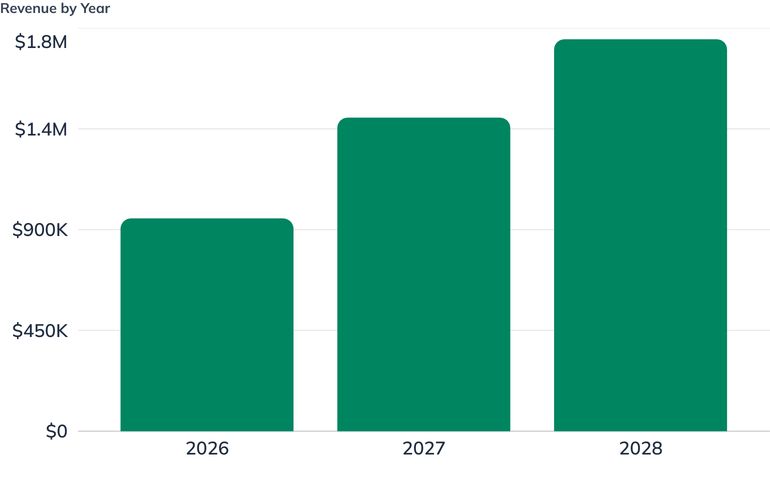
Need actual charts? We recommend using LivePlan as the easiest way to create graphs for your own business plan.Create your own business plan
Expenses & Costs
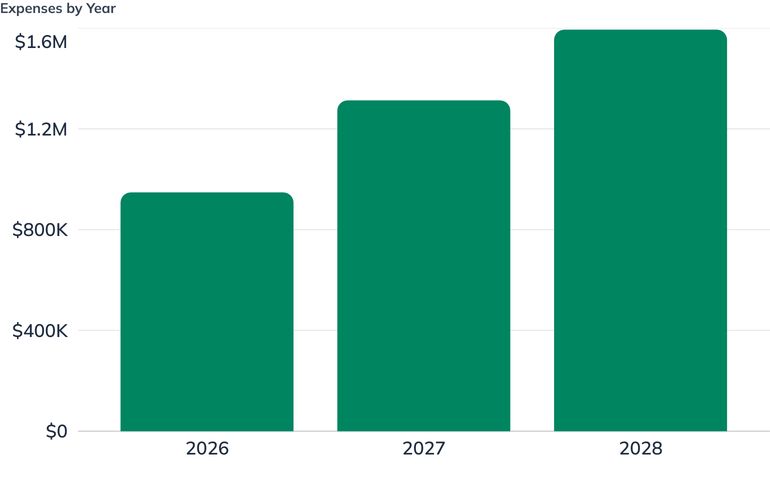
Need actual charts? We recommend using LivePlan as the easiest way to create graphs for your own business plan.Create your own business plan
Profitability
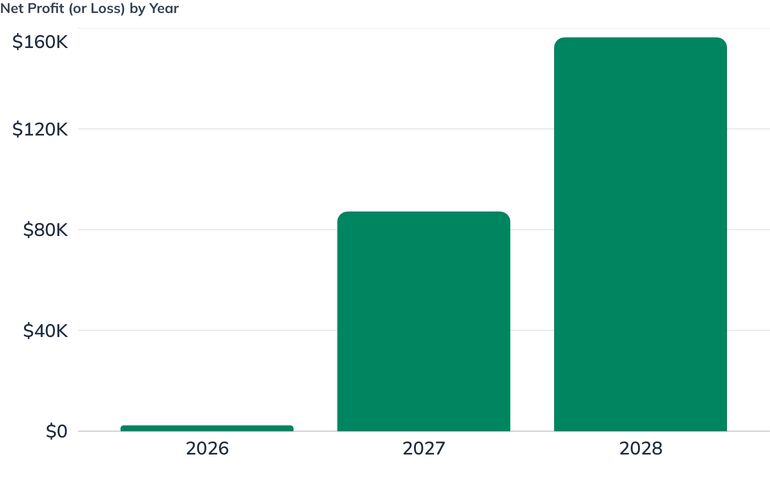
Need impressive charts? Discover the simplest way to create detailed graphs for your business plan.Create your own business plan
Use of Funds
Our projections indicate roughly $180K in total funding needed to open and sustain Crafted Cannabis through its ramp-up period in Boulder's competitive dispensary market. That covers an estimated $17.5K in store furniture, fixtures, and signage; upfront licensing, legal, and compliance setup costs; build-out and security infrastructure for a roughly 1,500 sq ft space; and a working-capital cushion to carry operating expenses and initial inventory through the first several months, before monthly revenue fully covers costs.
Sources of Funds
Owner will commit $180,000 of personal funds to finance the business from the beginning through its ramp-up period in the competitive Boulder market. That figure covers store build-out and fixtures, initial inventory, licensing and legal setup costs, and a working-capital cushion through the first several months, when revenue is still ramping up from a new-store base.
There is no loan financing in this plan — cannabis's continued federal Schedule I status makes conventional bank and SBA lending unavailable to marijuana retailers, so all startup and operating capital comes from the owner's investment. With no debt, there are no principal or interest payments.
The business turns cash-flow positive within the first several months as the revenue ramp builds, and cash accumulates steadily from there. Owner distributions are planned only in Year 3 — $60,000 for the year — drawn from accumulated cash after two full years of profitable, cash-generating operations.
Projected Statements
Key Assumptions
- No significant change in regulation and enforcement related to cannabis businesses in the state of Colorado, Boulder County, or the City of Boulder.
- We assume fierce competition among the roughly 20 recreational dispensaries already operating in and around Boulder. Not all retailers will survive continued price compression. This makes differentiation essential.
- Continued competition between relatively equal-sized players, with no emergence of a single dominant retail brand in the Boulder submarket.
- Cost of goods at 60% of dispensary sales, yielding a 40% gross margin — consistent with a mixed-category dispensary (flower, concentrates, edibles, beverages) in a competitive but not bottom-of-market Colorado retailer.
- No debt financing — the business is funded entirely by $180,000 in owner investment, with no loan interest expense. (Cannabis's federal Schedule I status continues to limit conventional bank lending, so equity is the realistic funding path.)
- No corporate income taxes modeled in the forecast (LLC pass-through structure); a 22.36% combined Colorado/Boulder retail marijuana sales tax is modeled as a pass-through collected from customers and remitted monthly.
- Owner distributions of $60,000 in Year 3 only, drawn from accumulated cash once the business has two full profitable years behind it — no distributions in Years 1 or 2 while cash is being built up.
Frequently Asked Questions
A cannabis dispensary business plan should cover local market saturation, the regulatory and tax landscape specific to cannabis, a funding plan that accounts for limited access to conventional financing, and a clear customer differentiation strategy. Crafted Cannabis's plan, for example, documents Boulder's 20-dispensary saturated market, Colorado's $1.18 billion in 2025 statewide sales, a $180,000 all-equity funding plan, and its wellness-clinic-style positioning against typical dispensary experiences.
Crafted Cannabis is funded entirely by $180,000 in owner personal funds, covering build-out and fixtures, initial inventory, licensing and legal setup, and a working-capital cushion for its roughly 1,500-square-foot Boulder location. There's no loan financing in the plan at all — cannabis's continued federal Schedule I status makes conventional bank and SBA lending unavailable to marijuana retailers, so every dollar comes from ownership.
Yes — cannabis dispensaries need a state retail marijuana license and must comply with strict operational rules, including Colorado's METRC seed-to-sale tracking system and Marijuana Enforcement Division display requirements that limit customers to viewing product behind glass rather than handling it directly. Crafted Cannabis's Boulder location also has to meet city buffer-zone siting rules requiring sufficient distance from schools and other protected uses.
Crafted Cannabis sells across flower, concentrates, edibles, pre-rolls, and cannabis beverages — one of the fastest-growing categories in the Colorado market even as overall dollar sales have declined due to falling wholesale flower prices. Its five-year forecast projects about $4.1 million in total revenue against roughly $3.85 million in expenses, reflecting a maturing market where unit volume keeps growing even as prices soften.
Crafted Cannabis expects to turn cash-flow positive within its first several months of operation as the new-store revenue ramp builds, and the plan holds off on owner distributions until Year 3 — $60,000 that year — only after two full years of profitable, cash-generating operations. That patience reflects the reality of opening in an already-saturated 20-dispensary market rather than a fast, easy ramp.
Where most of Boulder's 20 dispensaries share the same black-light-and-glass-case aesthetic and assume customers already know what they want, Crafted Cannabis is designed to feel like a well-run wellness clinic — calm reception, soft lighting, and a doctor's-office-style check-in that walks new customers through ID verification and Colorado's METRC tracking before they buy anything. That's aimed squarely at the cannabis-curious customer, the pain or insomnia patient, and the older adult who typical dispensaries tend to make uncomfortable.
Crafted Cannabis targets three groups: recreational users looking for classic strains, patients managing chronic pain or insomnia who want a low-dose tincture or edible rather than a strong high, and cannabis-curious or older adults who are hesitant about ID verification and being tracked in Colorado's METRC system. Boulder's customer base includes roughly 108,000 residents plus the tens of thousands of students, faculty, and visitors the University of Colorado Boulder adds for much of the year.
Crafted Cannabis absorbs a combined 25–30% effective tax rate on recreational sales — a 15% state retail marijuana sales tax, a 15% state excise tax, plus Boulder's 3.86% city sales tax and 3.5% city marijuana tax — and can't deduct ordinary business expenses under Section 280E on that portion of revenue since recreational marijuana remains federally Schedule I. (Medical marijuana was reclassified to Schedule III in April 2026, easing that specific burden on medical sales, and a DEA hearing on broader rescheduling is scheduled for June 29, 2026.) With no bank financing available, cash-handling security and a small number of cannabis-friendly credit unions are simply built into how the business operates.

Business Plan Outline
Start your plan