





Canyon Vista Home Care


Business Plan Summary
This home care business plan example features Canyon Vista Home Care, a private-pay, non-medical home care agency serving Arizona's East Valley from Gilbert, with a specific focus on clients living with Alzheimer's, other dementias, and Parkinson's disease. It covers Canyon Vista's caregiver-retention model — small, consistent care teams paid above-market wages — its real-time family portal app, and a $305,000 launch funded through owner equity and an SBA loan. Use it as inspiration for your own plan, and read our guide on how to start a home healthcare business for step-by-step advice. Download a free business plan template to get started, or browse more business plan examples.
Canyon Vista Home Care
Executive Summary
Canyon Vista Home Care is a private-pay, non-medical home care agency based in Gilbert, Arizona, serving seniors and their families across the East Valley — Gilbert, Chandler, Mesa, Queen Creek, and San Tan Valley. We provide personal care, companionship, and daily living support that helps older adults age safely in their own homes, with a specific focus on clients living with Alzheimer's, other dementias, and Parkinson's disease.
The problem. Gilbert is one of the fastest-growing communities in the Phoenix metro, and its senior population is growing even faster than the town as a whole. Families searching for in-home care today are met with agencies that rotate caregivers through a shared pool, so a parent with dementia might see three or four different faces in a single week — a disorienting experience for someone who depends on routine and familiarity, and a source of real anxiety for adult children, many of whom live out of state and can't verify day-to-day that care is actually happening as promised. That churn is not an accident: it traces directly back to an industry that has historically underpaid caregivers, driving the turnover families experience as instability.
Our solution. We build every client relationship around a small, consistent care team — typically one primary and one backup caregiver, both trained specifically in dementia and Parkinson's care, matched for personality fit and never rotated without cause. We make that consistency possible by paying caregivers, our care coordinator, and our clinical leadership above typical East Valley home care wages — targeting pay close to or above the MIT Living Wage Calculator's benchmark for Maricopa County — because a caregiver who can afford to stay in the role is the real foundation of continuity of care, not a scheduling policy alone. Every visit is logged in real time through a family portal app, so an adult child in Chicago can see exactly when a caregiver arrived, what was done, and how their parent is doing that day — without a phone call.
The market. Arizona's non-medical home care market prices in the $35–$36 per hour range statewide; we price modestly above that market average to fund our wage commitment. Gilbert's senior population (roughly 31,000 residents 65 and older, out of a town of nearly 292,000, per 2026 estimates) is growing on top of median household incomes near $122,500 — a base of families who can afford consistent, higher-touch private-pay care and are actively looking for an alternative to high-turnover agencies.
Why we'll win. Canyon Vista's caregiver consistency model, above-market wages, and family transparency app directly answer the two complaints that show up most often in reviews of existing East Valley agencies: unfamiliar caregivers and lack of visibility into care. We are not trying to be the lowest-cost provider in the market — we compete on trust, consistency, and communication for families willing to pay for it, and we believe a well-paid, well-retained caregiver workforce is what actually delivers on that promise.
Financial highlights. We are raising $305,000 in startup financing — funded through owner equity and an SBA loan — to cover caregiver recruitment and training, licensing and insurance, the family portal software build, and a working capital runway sized for our wage commitments through our first two years of operations, with a path to sustained profitability by our third year as our active client caseload builds.
Opportunity

Problem Worth Solving
Families caring for an aging parent in the East Valley face two problems at once, and most home care agencies solve neither well.
Caregiver churn breaks trust. Traditional home care staffing models pull from a large rotating pool of caregivers and schedule whoever is available for a given shift. For a healthy senior needing occasional help, that's a minor inconvenience. For someone living with dementia or Parkinson's, it's disruptive: unfamiliar faces increase agitation, safety risk goes up when a new caregiver doesn't know a client's fall history or medication routine, and families end up re-explaining the same care plan to a new person every few weeks.
Families can't see what's actually happening. Roughly a third of Gilbert's adult children with aging parents live outside Arizona or work full-time jobs that make it hard to be present during care visits. When something feels off — a missed visit, a shortened shift, a caregiver who never showed — families often don't find out until there's already been a problem. Most agencies still rely on paper logs left on a kitchen counter or an end-of-week phone call, not real-time visibility.
The result is a market where families are paying $35+ an hour for care they can't verify, delivered by people their loved one may not recognize from one week to the next. That gap between what families are paying for and what they're confident they're getting is the problem Canyon Vista Home Care exists to close.
Our Solution
Canyon Vista Home Care delivers non-medical, private-pay in-home care built around two commitments: a consistent caregiver team for every client, and full visibility for the families who can't be there in person.
Consistent-caregiver matching. Each new client is matched with a primary caregiver and one trained backup, selected for both clinical fit (dementia and Parkinson's-specific training) and personality fit with the client and household. Those same two caregivers cover that client's shifts going forward; we do not fill open shifts from an unassigned pool except in a genuine emergency, and even then a family is notified in advance whenever possible.
Specialized training. All caregivers complete our onboarding curriculum before their first shift, covering dementia care techniques (redirection, communication strategies, fall prevention), Parkinson's-specific mobility and medication-timing support, and de-escalation for behavioral symptoms — building on baseline curricula from a program like CareAcademy rather than generic orientation.
Family transparency app. Every visit is logged through a caregiver-facing mobile app at check-in and check-out, capturing tasks completed, meals, medication reminders, mood, and any notable observations. Family members get a private portal login showing real-time visit status and care notes, so an out-of-state adult child can check in from their phone rather than waiting for a weekly call.
Flexible service tiers. We offer companion care (light housekeeping, meal prep, transportation, socialization), personal care (bathing, dressing, mobility, and hygiene assistance), and specialized dementia/Parkinson's care, scheduled from a few hours a week up to live-in coverage, so a family's care plan can grow with their loved one's needs instead of requiring a switch to a new provider.
Care coordination. A registered nurse care coordinator builds and reviews each client's care plan at intake and reassesses quarterly or after any hospitalization, giving families a clinical point of contact beyond the caregivers themselves.
Target Market
Our primary market is seniors aged 65+ living in Gilbert and the surrounding East Valley — Chandler, Mesa, Queen Creek, and San Tan Valley — along with the adult children who are typically the ones researching, hiring, and paying for their care.
Local market size. Gilbert's population has reached roughly 292,000 residents as of 2026, up more than 8% since the 2020 census, with a median age of 36.1 — a young town overall, but its senior population is growing faster than that headline number suggests. An estimated 31,000 Gilbert residents are 65 or older today, and Maricopa County's 65+ population is projected to keep expanding well into the next decade as the broader retiree migration into the Phoenix metro continues. Median household income in Gilbert sits near $122,500, well above the Arizona and national averages, supporting a base of families who can sustain private-pay care rates without relying on Medicaid waiver programs.
Primary client profile. Our core client is a senior living with early-to-moderate dementia, Parkinson's, or a related mobility or cognitive condition, still living at home (their own or an adult child's), whose family has decided professional in-home care is safer and more sustainable than the family providing all care themselves. Care typically starts at a few hours a few days a week and expands over time as needs increase.
Primary buyer profile. In most cases, the person selecting and paying for care is not the client — it's an adult daughter or son, frequently 45-65 years old, often managing care long-distance or around a full-time job, who is comparing agencies online, reading reviews, and prioritizing communication and reliability as heavily as price.
Secondary market. A smaller share of clients are recovering from surgery or a hospital stay and need short-term transitional care, or are couples where one spouse needs support and the other wants respite care to avoid caregiver burnout.
Payer mix. Nearly all of our target clients pay privately (out of pocket or through long-term care insurance) rather than through Arizona's Medicaid (AHCCCS) programs, since non-medical home care of the kind we provide sits outside Medicare coverage and most AHCCCS home care benefits target a lower-income population than Gilbert's median household.
Competition
The East Valley has no shortage of home care options — that's both the challenge and the validation of the opportunity. Families searching for care in Gilbert today typically find:
National franchise agencies — Right at Home, Home Instead, Senior Helpers, and Always Best Care all operate locations serving Gilbert and neighboring Chandler/Mesa. These brands offer name recognition, established intake processes, and broad geographic coverage, but they staff from a larger caregiver pool by design, which is exactly the inconsistency problem our target families are trying to escape. Franchise economics also mean less local flexibility on how care teams are structured.
Independent local agencies — Sunland Home Care, Like Family Home Care, and Endeavor In Home Care are smaller, locally-run competitors with strong review profiles and a family-run feel. They compete closely with us on service philosophy, but none currently market a dedicated family-facing visit transparency app, and none specifically position around dementia/Parkinson's caregiver-matching the way we do.
Home health agencies — providers like Canyon Home Care & Hospice deliver Medicare-certified skilled nursing and therapy under physician orders. They're a referral partner more than a direct competitor: we regularly receive clients being discharged from home health once their skilled-care episode ends and they still need non-medical support, and we refer clients the other direction if their needs become clinical.
Tech-enabled/gig models — newer entrants like CareYaya use a lower-cost student-caregiver model with app-based booking, undercutting agency rates. They compete well on price for lighter companion-care needs but are a weaker fit for clients with complex dementia or Parkinson's care needs that require trained, consistent caregivers.
Our competitive position. We're not positioned as the cheapest option in the market — at roughly market-rate hourly pricing, we compete on the two things families tell us matter most once a parent's condition gets more complex: the same trained caregivers showing up every time, and being able to see what happened during a visit without having to call and ask.
Execution
Marketing Plan
Our marketing has to reach two different audiences: the professionals who refer families to us at the moment of need, and the adult children who are actively researching options online.
Referral partnerships. The single highest-converting channel for home care is a warm referral from a trusted professional, so we prioritize relationships with discharge planners at Banner Gateway Medical Center and Mercy Gilbert Medical Center, geriatric care managers, elder law attorneys, and Gilbert-area senior living communities that need a home care partner for residents who want to stay independent longer. We assign a dedicated point of contact to build and maintain each of these relationships rather than treating referrals as a one-time cold outreach.
Local SEO and online reputation. Most family caregivers start their search with "home care Gilbert AZ" or a similar query, so we invest early in a Google Business Profile optimized for our service area, active review generation after each new client's first 90 days, and a website built to rank for East Valley home care searches. Review volume and recency matter more in this category than almost any paid channel — families comparison-shop review profiles the way they'd compare contractors.
Content and community presence. We publish practical guides for family caregivers (recognizing signs a parent needs help, questions to ask any home care agency, managing a long-distance caregiving situation) both to support SEO and to build credibility with the adult-child buyer before they're ready to hire. We also maintain a visible presence at East Valley senior resource fairs and Alzheimer's Association support group meetings, where trust matters more than a sales pitch.
Paid digital, in support. We run targeted Google and Facebook campaigns aimed at adult children (35-65, within a defined radius of caregivers with aging parents) as a smaller, measurable complement to referrals and organic search — not our primary acquisition engine in year one.
Retention as marketing. Because our model depends on consistent caregivers rather than a rotating pool, client and family satisfaction directly drives our best marketing channel: word of mouth and five-star reviews from families who felt genuinely cared for, not just staffed.

The Overwhelmed Advocate
Sarah Miller
Sarah is a busy professional in the 'sandwich generation,' juggling a high-demand career in Gilbert's manufacturing sector while caring for her aging mother. She is frustrated by the lack of transparency and the revolving door of caregivers from her current agency, which makes her feel like she is paying premium prices for unreliable service.
Age
52
Location
Power Ranch, Gilbert, AZ
Family Status
Married, 2 teenagers, caring for 80-year-old mother
Education
Bachelor's in Business Administration
Profession
Marketing Director at a Gilbert Manufacturing Firm
Opportunities
- Implement a primary caregiver model that ensures the same 1-2 faces visit every week, addressing the 80% industry turnover concern.
- Provide a real-time app where Sarah can see clock-in/out times and completed care tasks, justifying the $35+ hourly rate.
Pain Points
- Constant turnover requiring her to retrain new caregivers every few weeks
- Anxiety over whether her mother is actually receiving the care she's paying for
- Lack of communication from agency management regarding schedule changes
Needs
- A reliable, consistent caregiver who knows her mother's routine
- Transparent billing and task verification to ensure value for money
- Proactive communication from the agency to reduce her mental load
“I'm paying top dollar for care, but I feel like I'm still the one managing everything because the agency can't keep a consistent schedule.”

The Precision-Seeking Strategist
David Nguyen
David works in healthcare administration and understands the 'back end' of care better than most. He is looking for a home care agency for his father that operates with the same clinical precision and accountability he expects in a hospital setting, specifically during peak morning and evening hours.
Age
46
Location
Morrison Ranch, Gilbert, AZ
Family Status
Married, 3 young children, primary decision-maker for father
Education
Master's in Healthcare Administration
Profession
Senior Administrator at Banner Ocotillo
Opportunities
- Offer guaranteed staffing during the high-demand 7 AM - 9 AM and 6 PM - 8 PM windows to solve the 'peak hour' complaint.
- Develop care plans with measurable goals (e.g., hydration levels, physical activity) to appeal to his data-driven mindset.
Pain Points
- Agencies that fail to respond to negative reviews or online inquiries
- The lack of scheduled care during critical peak morning hours
- Non-medical agencies that lack a structured, professional approach to caregiving
Needs
- A data-driven approach to tracking his father's health and daily activities
- Guaranteed coverage during the times his father is most vulnerable
- High-level responsiveness and professional management from the agency office
“In my line of work, if it isn't documented, it didn't happen. Why should my father's home care be any different?”

The Dignity-First Retiree
Robert 'Bob' Harrison
Bob is a retired engineer who values his independence and his well-maintained home in Sun Lakes. While he recognizes he needs help with daily tasks, he is resistant to 'strangers' coming into his home and is highly skeptical of caregivers who lack professional training or appear disinterested.
Age
79
Location
Sun Lakes, AZ (East Valley)
Family Status
Widowed, lives alone, adult children live in Phoenix
Education
Master's in Mechanical Engineering
Profession
Retired Aerospace Engineer
Opportunities
- Use a detailed intake process to match Bob with caregivers who share his interests or professional background to build trust.
- Highlight advanced training in mobility and nutrition to differentiate from 'sitters' and appeal to his respect for expertise.
Pain Points
- Feeling like a 'patient' in his own home rather than a resident
- Caregivers who show up late or seem untrained for his specific physical needs
- The social awkwardness of having a different person in his house every week
Needs
- A caregiver who respects his autonomy and engages in meaningful conversation
- Punctuality and professional conduct that aligns with his own values
- Assistance that feels like a 'helper' rather than a 'babysitter'
“I don't need a babysitter; I need a professional who knows what they're doing and actually remembers how I like my coffee.”
Sales Plan
Home care sales are relationship-driven and typically begin with a family in crisis or approaching one, so our process is built around responsiveness and trust rather than a hard-sell pitch.
Inquiry to intake. Every inquiry — whether from our website, a referral partner, or a phone call — is answered by our care coordinator within one business hour during business hours, and we offer a free in-home assessment within 48 hours. That assessment is where we build the client's initial care plan, meet the family, and walk through pricing and scheduling; it is the single most important step in our sales process, since families are choosing an agency they trust with a parent's safety, not comparing line items.
Care plan and caregiver match. Following the assessment, we present a written care plan and a proposed caregiver match, along with a clear explanation of our consistency model — this is typically the point where we differentiate most clearly from larger competitors, since families can ask directly how many different caregivers to expect and hear "one, plus a backup" rather than "it depends on the week."
Trial period and conversion. New clients start on a two-week trial schedule so both the family and the caregiver can confirm fit before committing to an ongoing care plan. We track trial-to-ongoing conversion as a core sales metric and treat any trial that doesn't convert as a signal to review our caregiver-matching process.
Growth within existing accounts. A large share of our revenue growth comes not from new clients but from expanding hours with existing ones, as a client's condition progresses and families add shifts, overnight coverage, or weekend care. Our care coordinator proactively reassesses every client's plan quarterly, which naturally surfaces these expansion conversations rather than requiring a separate sales push.
No long-term contracts. We do not lock families into long-term contracts — care can be adjusted or paused with short notice. This removes a common objection during the sales conversation and reflects our belief that retention should come from care quality, not contractual lock-in.
Locations & Facilities
Canyon Vista Home Care operates from a small administrative office in Gilbert, near the Highway 60/Val Vista Drive corridor, positioning us within a short drive of our core service area across Gilbert, Chandler, Mesa, Queen Creek, and San Tan Valley.
Care delivery location. Nearly all client-facing care happens in clients' own homes, not at our office — this is a field-based service business, and our real estate footprint reflects that. The office exists to support caregiver hiring, training, and scheduling, not to receive client visits, though we do hold periodic family meetings and caregiver in-service trainings there.
Office footprint. We lease a modest office suite sized for our administrative team (scheduling coordinators, HR/recruiting, and management) plus a small training room where new caregivers complete in-person components of onboarding — dementia care technique practice, safe transfer and mobility training, and CPR/first aid certification — that don't translate well to an online module alone.
Growth path. As our caseload grows, we expect to need additional office space primarily for a larger scheduling and recruiting team rather than for client-facing purposes; a second East Valley location becomes worth evaluating once our caregiver headcount and geographic spread make centralized scheduling and drive-time logistics harder to manage from a single site.
Service area discipline. We intentionally cap our service radius rather than accepting every inquiry statewide, since caregiver drive time directly affects both care quality (arriving on time, unrushed) and our unit economics — a tighter geographic footprint lets us build denser caregiver schedules and respond faster to schedule changes.
Technology
Technology is core to how we deliver on our transparency promise to families, not a back-office afterthought.
Caregiver visit app and family portal. We run our scheduling, electronic visit verification, and care documentation on a home care platform built for this purpose (in the vein of AlayaCare or ClearCare/WellSky) rather than paper logs or generic scheduling software. Caregivers clock in and out through the app at each visit, complete a structured care note covering tasks performed and any observations, and that information is visible to the assigned family contact through a secure portal in near real time.
Electronic visit verification (EVV). Our visit-verification system captures GPS-confirmed check-in/check-out times, giving families (and us) an objective record that scheduled visits happened as planned — an important trust signal in a category where the biggest fear families have is a missed or shortened shift going unnoticed.
Scheduling and matching software. The same platform manages our caregiver-to-client matching and shift scheduling, letting our coordinators keep each client with their assigned primary and backup caregiver by design rather than by manual effort, and flagging any gap in coverage early enough to solve it before a shift is missed.
Caregiver training platform. Onboarding and ongoing dementia/Parkinson's-specific training is delivered through an online caregiver training platform (such as CareAcademy), supplemented by in-person practical sessions at our office, so every caregiver's certifications and completed training modules are tracked centrally.
Communication tools. Beyond the family portal, we use secure messaging for care coordinators to communicate quickly with caregivers and family members about schedule changes, care plan updates, or day-of questions, keeping a documented record of every material conversation about a client's care.
Equipment & Tools
As a field-based care business, most of our equipment and tools support caregivers in clients' homes rather than a central facility.
Caregiver mobile devices. Each caregiver uses a company-issued smartphone or tablet running our scheduling, EVV, and care-documentation app for check-in/check-out and visit notes, ensuring consistent, secure record-keeping regardless of a caregiver's personal device.
Care and safety equipment. We supply caregivers with basic personal protective equipment (gloves, masks, hand sanitizer), gait belts and transfer aids for clients with mobility needs, and blood pressure and pulse oximetry monitors for caregivers trained to take basic vitals as part of a client's care plan.
Office equipment. Our administrative office is equipped with standard workstations, a secure filing system for employment and client records (physical records that must be retained are kept in locked storage), and a small training room set up for hands-on caregiver skills practice, including a training bed and mobility equipment for transfer technique instruction.
Vehicles. Caregivers use their own vehicles for transportation between shifts and for client errands/appointments when that's part of a care plan; we maintain proof of insurance and a valid driver's license as a condition of employment and reimburse mileage for client-related driving.
Software licenses. Beyond our core scheduling/EVV/family-portal platform, we license background-check services for caregiver hiring, payroll and HR software built for hourly shift-based employees, and our online caregiver training platform.
Milestones
Finalize business registration, insurance, and policies Register the Arizona LLC, secure general/professional liability and workers' comp coverage, and finalize written care policies and procedures ahead of launch. | Founder & CEO Sept 15, 2026 |
Launch caregiver app, EVV, and family portal platform Select and configure the scheduling/EVV/family-portal platform and complete initial caregiver training on the system before the first client visit. | Director of Care Operations Sept 30, 2026 |
Open for business and serve first client Officially launch operations in Gilbert, AZ with initial caregiver roster in place. | Founder & CEO Oct 1, 2026 |
Establish first three referral partnerships Formalize referral relationships with at least three of: Banner Gateway Medical Center, Mercy Gilbert Medical Center discharge planning, local elder law attorneys, and East Valley senior living communities. | Founder & CEO Dec 15, 2026 |
Reach 15 active clients Grow the active caseload to 15 clients, triggering the planned Care Coordinator hire. | Director of Care Operations June 30, 2027 |
Hire dedicated Care Coordinator Bring on a full-time care coordinator to manage scheduling, matching, and family communication as caseload growth exceeds founding team capacity. | Founder & CEO July 31, 2027 |
Evaluate second East Valley office location Assess whether caregiver headcount and geographic spread justify a second administrative location to support scheduling and recruiting. | Founder & CEO Sept 30, 2028 |
Reach monthly operating profitability Achieve positive monthly net operating profit as active caseload and caregiver utilization reach target levels. | Founder & CEO Jan 31, 2029 |
Key Metrics
We track a small set of metrics closely, because in home care, the operational numbers and the quality-of-care numbers are the same numbers.
Active client count and average weekly hours per client. Our two primary growth drivers — new client acquisition and hours-per-client expansion as care needs increase — are both visible here, and we track them separately because they call for different actions (marketing and referrals versus care plan reassessment).
Caregiver retention rate. Caregiver turnover is the single biggest threat to our consistency model — we cannot promise families the same caregiver every visit if our own staff turnover is high. We track trailing 90-day and annual retention and treat any decline as an immediate priority, not a lagging HR statistic.
Caregiver utilization. The percentage of each caregiver's available hours that are actually scheduled with clients — too low and we're overstaffed relative to demand; too high and we risk burnout, which drives the turnover we're trying to avoid.
Client retention and case duration. How long a client stays with us, and how often a client's care plan grows versus shrinks or ends. Rising average case duration is a leading indicator that our care quality and family trust are working as intended.
Trial-to-ongoing conversion rate. The share of two-week trial clients who convert to an ongoing care plan — our clearest single signal of whether our caregiver-matching process is working.
Referral source mix. The proportion of new clients coming from professional referrals versus organic search versus paid channels, so we can see which relationships and channels are actually converting rather than just generating inquiries.
Electronic visit verification compliance rate. The percentage of scheduled visits with a clean, on-time GPS-verified check-in and check-out — a direct, auditable measure of whether we're delivering on our core transparency promise.
Company
Ownership & Structure
Canyon Vista Home Care is organized as an Arizona limited liability company (LLC), taxed as an S-corporation, headquartered in Gilbert, Arizona.
Ownership. The company is majority-owned and operated by its founder, who holds primary decision-making authority over strategy, hiring, and finances. A minority equity stake is reserved for a co-founder/director of care operations, reflecting their operational leadership role in caregiver training and clinical oversight.
Regulatory status. As a non-medical home care agency, Canyon Vista is not subject to Arizona Department of Health Services licensure, which applies to home health agencies delivering skilled nursing and therapy services under physician orders. We are, however, registered with the Arizona Secretary of State, carry general and professional liability insurance, workers' compensation coverage for all caregiver employees, and maintain written policies and procedures covering client intake, caregiver background checks, incident reporting, and care plan documentation — the standard of practice expected of a credible agency even where state licensure isn't legally required.
Employment model. All caregivers are W-2 employees of Canyon Vista, not independent contractors — a deliberate choice that lets us require specific training, enforce our consistency-of-caregiver model, and carry the liability coverage families expect, rather than relying on a loosely affiliated contractor network.
Governance. As the company grows past its founding team, we intend to form an informal advisory group (see Advisors) rather than a formal board, preserving founder control while adding outside expertise in home care operations and elder care clinical practice.
Management Team
Founder & CEO. Our founder spent over a decade as a hospital discharge planner and case manager at a Phoenix-area health system, coordinating post-acute care for thousands of patients and their families as they transitioned home. That role exposed her directly to the gap this business exists to close: families leaving the hospital with a loved one who needed ongoing support, and few good options for consistent, trustworthy in-home care. She holds a bachelor's degree in social work and is a licensed nursing home administrator candidate, and leads strategy, finance, referral partnerships, and overall operations.
Director of Care Operations. Our co-founder is a registered nurse with clinical experience in geriatrics and dementia care, and leads caregiver recruiting, training curriculum, care plan development, and quality oversight. She conducts every new client's initial in-home assessment personally during our first two years of operation, ensuring care plans reflect real clinical judgment rather than a standardized intake form, and reviews all caregiver training completion and client care plan reassessments on a quarterly cycle.
Care Coordinator (planned Year 1 hire). As client volume grows beyond what the founding team can manage directly, we plan to hire a dedicated care coordinator to handle scheduling, caregiver-client matching, and day-to-day family communication, reporting to the Director of Care Operations.
Caregiver team. Our direct-care staff are hired specifically for personal care and dementia/Parkinson's-focused experience, complete our full onboarding and training curriculum before their first unsupervised shift, and are evaluated on both task competence and the interpersonal fit that our consistency model depends on.
Advisors
We are building an informal advisory group of professionals whose experience complements the founding team's operational and clinical background:
Elder law attorney. An East Valley elder law and estate planning attorney advises on client agreements, liability exposure, and compliance with Arizona employment and healthcare-adjacent regulations, and serves as a referral source for clients whose families are working through broader elder care and estate planning decisions.
Home care industry operator. An experienced owner or executive from an established (non-competing market) home care agency advises on caregiver retention strategy, scheduling density, and the operational metrics that most affect margin in this business — informed by direct experience scaling a similar model elsewhere.
Healthcare finance advisor. A local accountant or fractional CFO with home care or healthcare services experience advises on private-pay billing practices, payroll structure for a caregiver workforce, and cash flow management specific to a labor-intensive services business.
We intend to formalize this group into a quarterly advisory meeting once the business reaches a stable client base, using their input primarily to pressure-test growth decisions like adding a second care coordinator or expanding into an adjacent service area.
Financial Plan
Revenue
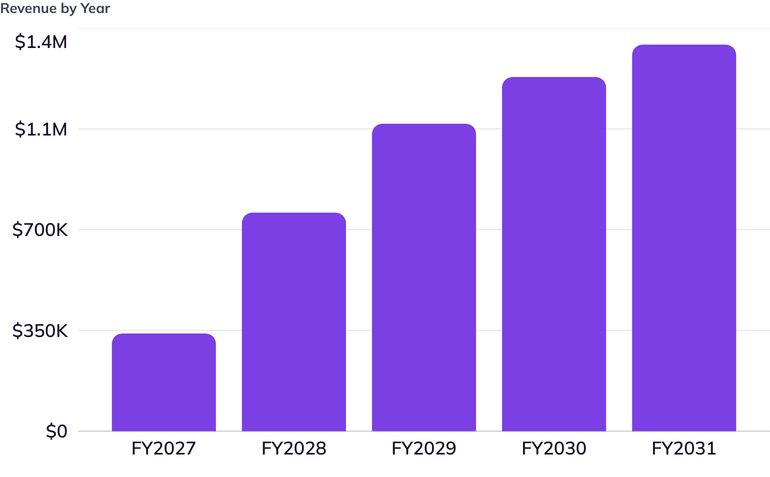
Need real financials? Explore a spreadsheet-free path to generating financial data for your business.Create your own business plan
Expenses & Costs
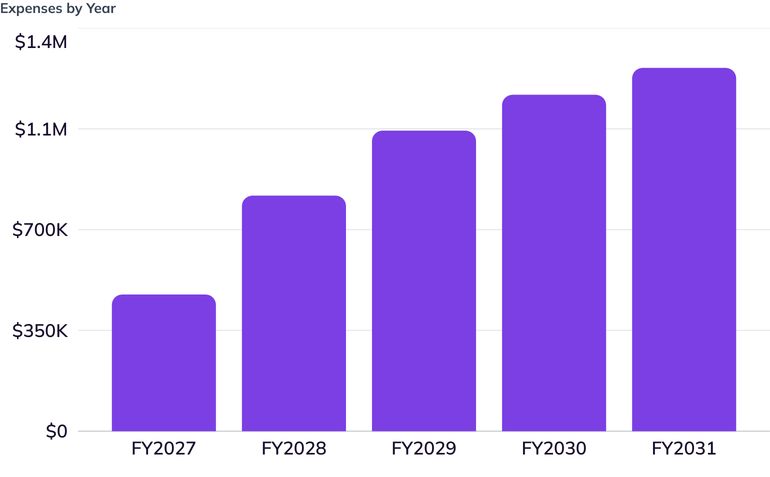
Need impressive charts? Discover the simplest way to create detailed graphs for your business plan.Create your own business plan
Profitability
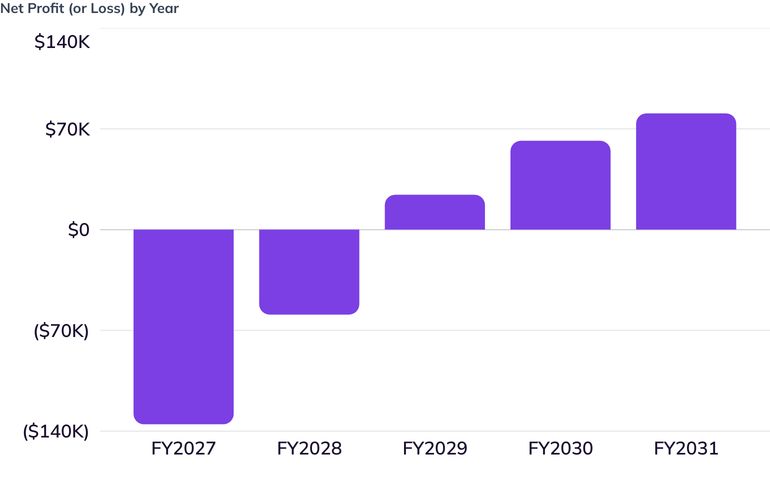
Need real financials? We recommend using LivePlan as the easiest way to create financials for your own business plan.Create your own business plan
Use of Funds
We are raising $305,000 to fund Canyon Vista Home Care's launch and its first several years of operations while paying our people livable, above-market wages, allocated as follows:
Startup formation and compliance (~$10,000). Arizona LLC formation and attorney review, general and professional liability insurance setup, workers' compensation coverage, and initial written policies and procedures.
Office and training setup (~$21,000). Office furniture and training room build-out, a security deposit on our Gilbert office lease, and initial training and care equipment (gait belts, transfer aids, blood pressure and pulse oximetry monitors).
Technology (~$6,000). Initial fleet of caregiver mobile devices for our scheduling, EVV, and family-portal platform.
Working capital (~$268,000). The large majority of our funding covers caregiver payroll, founding team salaries, marketing and referral development, and other operating costs during our ramp-up period. We deliberately fund a larger cushion than a bare-minimum home care startup would, because our wage philosophy is a strategic choice, not an afterthought: we pay caregivers, our care coordinator, and our clinical leadership above typical East Valley home care rates — targeting wages close to or above the MIT Living Wage Calculator's Maricopa County benchmark for a single adult — because caregiver retention is the foundation of the consistent-caregiver model families are paying us for. That wage commitment means a longer runway to profitability, which this funding is sized to cover without ever running the business's cash balance to zero.
Sources of Funds
Our $305,000 in startup funding comes from two sources:
Owner investment — $110,000. The founder is contributing personal capital as equity, reflecting her direct financial commitment to the business and reducing the debt burden the company carries into its early, lower-revenue years.
SBA 7(a) loan — $195,000. We are pursuing a 7-year SBA 7(a) loan at approximately 10.5% interest, a standard structure for a small service business with limited hard collateral — SBA-backed lending is typically the most accessible debt option for a home care startup at this scale, since a bank is unlikely to extend a comparable unsecured loan on reasonable terms without it.
We are not seeking outside equity investment beyond the founder's own contribution. The business does not require the kind of capital-intensive buildout that typically justifies bringing in investors, and the founder intends to retain full ownership and control through the funded growth period reflected in this plan. The larger-than-typical funding total reflects a deliberate choice to fund livable, retention-driving wages from day one rather than start lean and underpay the people the business depends on.
Projected Statements
Frequently Asked Questions
A home care business plan should cover your caregiver retention and wage strategy, market positioning, family communication technology, and funding plan. Canyon Vista Home Care's plan, for example, covers its above-market caregiver wage commitment, its private-pay-only positioning in Arizona's East Valley, its real-time family portal app, and a $305,000 funding plan blending owner equity and an SBA loan.
Canyon Vista Home Care raised $305,000 in total start-up funding: $110,000 in owner equity plus a $195,000 SBA 7(a) loan at about 10.5% interest over a seven-year term. That covers caregiver recruitment and training, licensing and insurance, the family portal software build, and a working capital runway sized specifically for its wage commitments through the first two years.
Yes — non-medical home care agencies typically need state home care licensure, thorough caregiver background checks, and general and professional liability insurance. Canyon Vista Home Care budgets general and professional liability insurance and caregiver recruiting and background checks as standing operating expenses.
Canyon Vista Home Care earns revenue entirely from private-pay in-home care hours, priced modestly above Arizona's statewide market average of roughly $35 to $36 an hour specifically to fund its above-market caregiver wage commitment. Its five-year forecast projects about $4.74 million in total revenue against roughly $4.77 million in expenses.
Canyon Vista Home Care's plan targets sustained profitability by year three, as its active client caseload builds. Its multi-year forecast shows a small net loss overall of about $27,591 on roughly $4.74 million in revenue, reflecting the deliberate cost of funding livable, retention-driving wages from day one rather than starting lean.
Most home care agencies in the area rotate caregivers through a shared pool, so a client with dementia might see three or four different faces in a single week. Canyon Vista Home Care builds every client relationship around a small, consistent care team — typically one primary and one backup caregiver, matched for personality fit and never rotated without cause — and pays caregivers close to or above the MIT Living Wage Calculator benchmark for Maricopa County, arguing that a well-paid, well-retained caregiver is the real foundation of consistency, not scheduling policy alone.
Canyon Vista Home Care serves seniors and their families across Gilbert, Chandler, Mesa, Queen Creek, and San Tan Valley, particularly clients living with Alzheimer's, other dementias, and Parkinson's disease. The plan targets families with median household incomes near $122,500 who can afford consistent, higher-touch private-pay care and are actively looking for an alternative to high-turnover agencies.
Canyon Vista Home Care's plan argues that caregiver turnover — the instability families experience as different faces showing up each week — traces directly back to an industry that has historically underpaid caregivers. By targeting pay close to or above the MIT Living Wage Calculator benchmark for Maricopa County, the company treats a well-paid caregiver as the actual mechanism behind care consistency, and prices its service modestly above the Arizona market average specifically to fund that commitment.

Business Plan Outline
Start your plan