





Clinical Glow Med Spa



Business Plan Summary
This medical spa business plan example features Clinical Glow Med Spa, a physician-directed practice opening a five-treatment-room, 1,800-square-foot suite on Ventura Boulevard in Sherman Oaks, California. It covers the practice's positioning as a mid-luxury alternative to both discount injectable storefronts and Beverly Hills pricing, a California-compliant MSO and professional corporation ownership structure, a $129/month membership built for recurring revenue, and a financial plan funded by an $820,000 SBA 7(a) loan and $230,000 in owner equity. Use it as inspiration for your own plan. Download a free business plan template to get started on your own plan, or browse more business plan examples.
Clinical Glow Med Spa
Executive Summary
Clinical Glow Med Spa is a physician-directed medical spa opening on Ventura Boulevard in Sherman Oaks, California, serving the Sherman Oaks, Studio City, Encino, and Toluca Lake corridor of the San Fernando Valley. We provide injectables (neuromodulators and dermal fillers), laser and energy-based skin treatments, body contouring, and IV nutrient therapy under the direct oversight of a licensed physician medical director, with day-to-day clinical care delivered by a board-certified nurse practitioner and RN injectors.
We exist to close the gap between the two extremes of the Los Angeles aesthetics market: high-volume, discount "Groupon Botox" storefronts that compete on price and turn over undertrained injectors, and the ultra-luxury Beverly Hills and Westside clinics that price out most working professionals. Clinical Glow offers board-certified clinical expertise, standardized safety protocols, and transparent, published pricing in a warm, unintimidating setting — priced for the Valley's affluent but value-conscious client base rather than Rodeo Drive rents.
Our core service lines are neuromodulators (Botox/Dysport/Xeomin), dermal fillers, laser hair removal, IPL and RF microneedling skin resurfacing, non-invasive body contouring, and physician-supervised IV vitamin therapy, supported by a curated medical-grade skincare retail line and a $129/month Glow Membership that drives visit frequency and recurring revenue. We use integrated scheduling, EMR/photo-documentation, and marketing automation software (Boulevard and Aesthetic Record) to run a tight, compliant, data-driven practice from day one.
We are opening with a build-out of a 1,800-square-foot suite with five treatment rooms and a full clinical equipment package (laser hair removal platform, IPL/RF microneedling combo device, and a body contouring system), staffed by a core clinical and operating team of six: a founder/CEO, a fractional medical director, a nurse practitioner/clinical director, an RN injector, a licensed medical esthetician, and a practice manager. A patient care coordinator joins at the start of year two and a second full-time RN injector at the start of year three as patient volume builds. Total startup investment is approximately $1,050,000 — covering leasehold improvements, our full medical device suite, opening working capital, and the ramp-up period before the practice reaches steady utilization — funded through a $820,000 SBA 7(a) loan and $230,000 in owner equity.
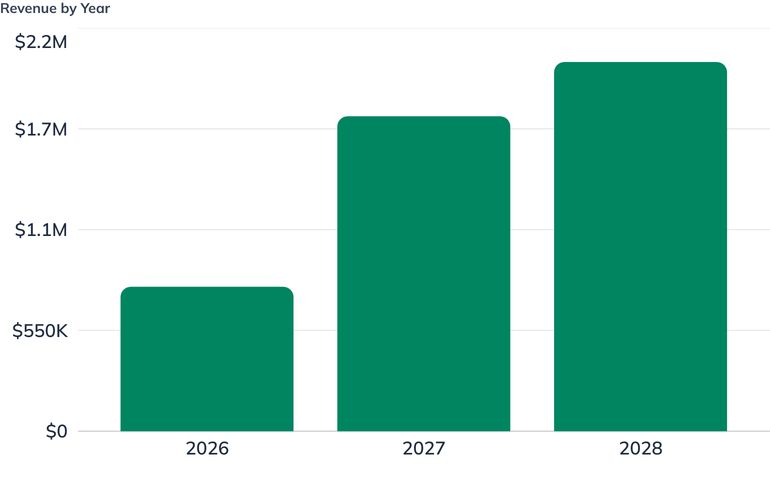
We project revenue of approximately $788,000 in our first year (a ten-month operating year, opening in March), growing to roughly $1.72 million in year two and $2.01 million in year three as provider utilization builds toward roughly 55% of clinical capacity across our five treatment rooms. The practice reaches monthly profitability late in its first year and sustained positive cash flow in early 2027, delivering net profit of approximately $138,000 in year two and $165,000 in year three, with cash on hand growing to just over $400,000 by the end of the plan.
Clinical Glow is founded and led by an experienced med-spa operator partnering with a California-licensed physician medical director and nurse practitioner to build a practice built on safety, consistency, and long-term patient relationships rather than one-time transactional visits.
Opportunity

Problem Worth Solving
Los Angeles has one of the densest medical aesthetics markets in the country, but density has not translated into consistent quality or fair pricing for the average patient. Two extremes dominate the landscape. At one end are high-volume "injection bars" and daily-deal storefronts that compete almost entirely on price, frequently rotate contract injectors with limited longevity at any one location, and rush consultations to maximize daily volume. Patients in this tier report inconsistent results, minimal follow-up care, and — increasingly, per state medical board complaint data — safety incidents tied to under-credentialed or improperly supervised injectors performing procedures that legally require physician oversight in California.
At the other end are the ultra-premium clinics concentrated in Beverly Hills, West Hollywood, and Brentwood, where a single unit of Botox can run $18–$25 and package pricing assumes a client base with essentially unconstrained discretionary income. These practices deliver excellent clinical care, but their pricing and geography put them out of reach for the large population of working professionals living in the San Fernando Valley — nurses, entertainment-industry crew, teachers, small business owners — who want the same clinical standard without a 45-minute drive over the hill and Rodeo Drive rents baked into every price list.
The result is a real gap in the middle: patients who want board-certified, physician-supervised care, transparent pricing they can plan around, and a provider they can build a long-term relationship with, delivered close to home in the Valley. Many currently patch together care across multiple providers — a dermatologist for annual skin checks, a discount injector for Botox, an online marketplace for laser hair removal packages — with no single practice coordinating their aesthetic and skin-health goals, no consistent photo-documented treatment history, and no accountability if something goes wrong.
This fragmentation also creates real safety exposure. California law requires a supervising physician for neuromodulator and filler injections and for most energy-based device treatments, yet enforcement is inconsistent among storefront operators, and patients often have no easy way to verify who is actually overseeing their care before they book.
Our Solution
Clinical Glow Med Spa is built to be the trustworthy, mid-luxury alternative that the Valley's aesthetics market is missing: full clinical rigor at Sherman Oaks pricing, not Beverly Hills pricing.
Physician-directed, NP/RN-delivered care. Every treatment protocol at Clinical Glow is established and periodically reviewed by our physician medical director, with hands-on care delivered by our on-site nurse practitioner (who also serves as clinical director) and a credentialed RN injector — never by unsupervised aestheticians performing services that require medical oversight under California law. Patients can see our team's licenses and the medical director's credentials posted in our intake materials and on our website.
Consistency through documentation, not guesswork. We use Aesthetic Record for standardized consultation intake, informed consent, and before/after photo documentation at every visit, so a patient's treatment history and progress are tracked over time by whichever provider sees them — not locked in one injector's memory. This lets us maintain consistent, predictable results even as our team grows.
Transparent, published pricing. Unlike practices that quote per-visit based on what a client appears able to pay, we publish per-unit and package pricing for every service. Patients know the cost of a treatment plan before they sit in the chair.
A membership model built for repeat relationships, not one-off visits. Our Glow Membership is a $129 monthly program that includes one facial or light peel per quarter, member pricing on all injectable and device treatments, 20% off our retail skincare line, and priority booking. The membership fee covers the included quarterly treatment and access to member pricing — it does not bank credit toward injectables, which are billed separately at our published member rates. This keeps the program simple to explain at the point of sale, gives us a recurring revenue base that reduces our dependence on constant new-patient acquisition, and measurably increases visit frequency among enrolled patients.
A curated, not overwhelming, service menu. Rather than trying to be a full-service day spa, we focus on the six service lines where physician-led medical aesthetics adds the most value — neuromodulators, fillers, laser hair removal, RF microneedling/resurfacing, body contouring, and IV therapy — plus a tightly curated, dermatologist-formulated skincare retail line, so every consultation can recommend the right treatment rather than upselling from a sprawling menu.
Target Market
Our primary market is adults aged 28–58 living or working within a 15-minute drive of Sherman Oaks — the Ventura Boulevard corridor spanning Sherman Oaks, Studio City, Encino, Toluca Lake, and Van Nuys. This is one of the more affluent submarkets of the San Fernando Valley, with median household income in Sherman Oaks and Studio City running well above the Los Angeles County median, a large concentration of entertainment-industry, healthcare, legal, and small-business professionals, and strong existing demand for wellness and personal-care services evidenced by the density of boutique fitness studios, day spas, and dermatology practices already operating along Ventura Boulevard.
Within that geography, we're focused on three patient segments. The largest is women 32–55 seeking preventative and corrective injectables and skin treatments — our anchor segment and the one most likely to convert into membership. The second is a fast-growing segment of men 28–50 seeking neuromodulators, jawline filler, and laser hair removal, a category that has grown from a small share of med spa visits to a meaningful and still-expanding share of industry revenue nationally. The third is younger patients, generally 25–34, entering the category through "prejuvenation" — laser hair removal and light preventative Botox — who represent our long-term membership pipeline even at lower initial spend.
Across all three segments, our target patient is not price-insensitive but is actively researching credentials before booking: reading Google and Yelp reviews, checking whether a practice has a real medical director, and comparing published pricing across two or three practices before committing. This is a meaningfully different buyer than the deal-site shopper chasing the cheapest unit price, and it's the patient our positioning is built to win.
We estimate our addressable patient base at roughly 45,000–55,000 adults in our core 15-minute drive-time radius who have household income and demographics consistent with regular med spa spend, based on U.S. Census ACS data for the relevant Los Angeles ZIP codes and industry benchmarks on med spa patient demographics from the American Med Spa Association.
Competition
The Los Angeles med spa market is crowded but fragmented, which creates room for a well-positioned mid-luxury entrant even without displacing any single dominant player.
Solo RN/NP injector studios. Independent injectors operating out of small suites are common throughout the Valley, often built around one provider's personal following on Instagram. They compete well on relationship and price but typically lack a formal medical director structure, an energy-device suite (laser, RF microneedling), or the capacity to see patients when their single provider is unavailable — capacity constraints we solve by design with a multi-provider team from day one.
Franchise and multi-location chains (e.g., Ideal Image, SkinSpirit, and similar regional operators with Southern California locations). These bring brand recognition and marketing budgets we can't match directly, but they're frequently criticized in reviews for high staff turnover, rushed consultations, and inconsistent injector assignment visit to visit. We compete by offering a smaller, more consistent care team and a neighborhood presence rather than a corporate one.
Dermatology and plastic surgery practice med spas, common on the Westside and in Beverly Hills, which offer the highest level of physician involvement but at premium pricing and often with long wait times for anything short of a surgical consult. We compete on accessibility and price while matching their standard of physician oversight for every injectable and device treatment.
Discount and daily-deal storefronts, concentrated in strip malls throughout the Valley, competing purely on unit price with minimal or absent physician supervision. We do not compete for this segment's price-first customer directly; our marketing and consultation process is built to educate prospective patients on why credentialing and supervision matter, converting price-shoppers who are willing to pay a moderate premium for documented safety.
Our differentiation rests on three things none of these competitor types combine simultaneously: a real, named, accountable medical director; multi-provider capacity so patients aren't tied to one injector's schedule; and published, transparent pricing at a level accessible to Valley professionals rather than Westside pricing.
Execution
Marketing Plan
Our marketing is digital-first and locally targeted, built to reach the credential-checking, research-driven patient described in our Target Market, rather than chasing broad reach.
Local search and Google Business Profile. Most new med spa patients start with a Google search for "med spa near me" or a specific treatment plus neighborhood ("Botox Sherman Oaks"). We invest in Google Local Services Ads and a fully built-out Google Business Profile with regularly updated photos, service pricing, and review responses, since local map-pack placement drives a disproportionate share of new-patient calls in this category.
Instagram and TikTok, consent-based content. We maintain an active before/after content program on Instagram and TikTok, built entirely on patients who sign a separate marketing consent form (distinct from clinical consent) — a practice we treat as non-negotiable both for compliance and for patient trust. Content mixes real (consented) results, educational posts on what to expect from each service, and provider introductions that put a face to our medical director and clinical team, since patients in our target segment specifically look for that transparency before booking.
Reputation and referral program. We actively solicit Google and Yelp reviews via automated post-visit texts through Boulevard, and run a structured referral program (credit toward services for both referring and referred patient) since referral-driven patients in this category typically have higher lifetime value and lower acquisition cost than paid-channel patients.
Local partnerships. We build relationships with complementary Ventura Boulevard businesses — boutique fitness studios, hair salons, and dermatology practices that don't offer injectables — for cross-promotion and reciprocal referrals, an approach well suited to our neighborhood-anchored positioning.
Email and SMS lifecycle marketing. Using Boulevard's marketing automation, we run automated recall campaigns timed to each service's typical re-treatment window (roughly every 3–4 months for neuromodulators, 6 weeks apart for laser hair removal series), membership renewal reminders, and seasonal promotions, keeping acquisition cost low by maximizing revenue from our existing patient base.
We do not rely on print, radio, or broad-reach traditional advertising; our target patient's research and booking behavior is overwhelmingly digital.

The Quality-Conscious Professional
Sarah Miller
A high-achieving entertainment industry professional who values her time and safety. She is moving away from discount 'injection bars' after a poor experience and is looking for a long-term, physician-led relationship that doesn't require a 45-minute commute to Beverly Hills.
Age
42
Location
Sherman Oaks, CA
Family Status
Married, 2 children (ages 9 & 12)
Education
Master of Fine Arts
Profession
Senior Talent Manager
Opportunities
- Offer a tiered membership that includes a set number of Botox units and annual skin checks to simplify her maintenance routine.
- Leverage the presence of a board-certified medical director to provide the clinical reassurance she lacks at high-volume storefronts.
Pain Points
- Inconsistent results from rotating contract injectors at discount clinics
- The 'Beverly Hills Tax' where prices are inflated by high-rent locations
- Rushed appointments that don't allow for a comprehensive treatment plan
Needs
- Transparent, published pricing for Botox and fillers (e.g., $14-$16/unit)
- Photo-documented treatment history to ensure aesthetic consistency
- A local clinic within a 15-minute drive of her home in the Valley
“I'm done chasing Groupon deals for my face. I want a doctor I can trust who is actually in the building when I'm there.”

The Educated Prejuvenator
Chloe Nguyen
A savvy, research-oriented young professional focused on preventative skin health. She spends significant time reading reviews and checking medical credentials on the California Medical Board website before booking any service.
Age
27
Location
Encino, CA
Family Status
Living with partner
Education
Bachelor of Arts in Marketing
Profession
Digital Content Creator
Opportunities
- Create a 'First-Timer' package focused on light preventative Botox and medical-grade facials at a mid-tier price point.
- Highlight the medical director's credentials and the supervising physician's involvement on social media to build early trust.
Pain Points
- High cost of entry for premium Beverly Hills clinics on a younger salary
- Safety concerns regarding under-credentialed injectors at 'deal' sites
- Overwhelming and conflicting information about skincare on social media
Needs
- A long-term skin-health roadmap rather than a one-off procedure
- Transparent pricing that allows for monthly budgeting (e.g., $10.50-$12/unit membership rates)
- Educational consultations that explain the 'why' behind each treatment
“I'm investing in my skin now so I don't have to 'fix' it later, but I need to know the person holding the needle is actually qualified.”
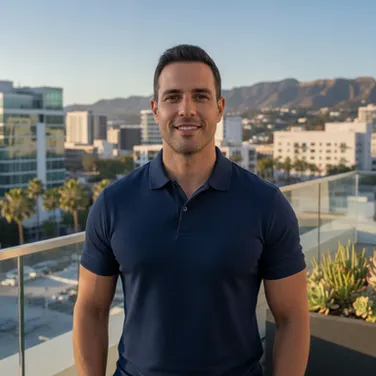
The Groomed Executive
David Rodriguez
A health-conscious professional who views aesthetic maintenance as part of his overall wellness and professional branding. He is looking for subtle, masculine-focused treatments like jawline contouring and 'Bro-tox' in a discreet, high-end environment.
Age
38
Location
Studio City, CA
Family Status
Single
Education
Bachelor of Science in Healthcare Administration
Profession
Director of Operations at a Private Medical Group
Opportunities
- Market specific 'Jawline & Profile' packages using dermal fillers tailored for masculine facial structures.
- Offer early morning or late evening blocks to cater to professionals who want to avoid high-traffic waiting room times.
Pain Points
- Clinics that feel overly 'feminine' or spa-like rather than clinical
- Fear of looking 'overdone' or losing natural facial expressions
- Lack of clarity on which procedures are best for male skin and aging
Needs
- Subtle results that look refreshed rather than 'worked on'
- Efficient appointments that respect his busy work schedule
- Evidence-based treatments backed by physician oversight
“In my industry, looking tired is a liability. I want to look like the best version of myself, not a different person.”
Sales Plan
Our sales process runs through a consistent five-step funnel designed to convert inquiries into long-term membership patients rather than one-off transactions.
1. Inquiry and booking. Prospective patients book a complimentary consultation online through Boulevard, by phone, or via Instagram DM. Every inquiry receives a response within one business hour during operating hours — a response-time standard we track weekly, since med spa research consistently shows most inquiries book with whichever practice responds first.
2. Consultation. Consultations are conducted by our nurse practitioner or RN injector, never by a non-clinical sales role, since California law requires a licensed provider to assess and recommend injectable and device treatments. The consultation includes a skin/aesthetic assessment, photo documentation in Aesthetic Record, and a written treatment plan with published pricing — no verbal-only quotes.
3. Same-visit treatment when appropriate. For straightforward services (neuromodulator touch-ups, single-session laser hair removal), we treat in the same visit as the consultation whenever clinically appropriate, since same-day conversion meaningfully outperforms asking a new patient to rebook.
4. Membership offer at point of treatment plan. Once a clinician has proposed a multi-session treatment plan (a laser series, quarterly neuromodulator maintenance), our patient care coordinator presents the $129/month Glow Membership as the lower-cost path through that plan — member pricing on every treatment in it, plus a quarterly facial and retail discount. Because the membership fee buys pricing and included services rather than banked treatment credit, the value is easy to state plainly and easy for the patient to verify against our published rates.
5. Structured recall and retention. Post-visit, patients enter an automated recall sequence timed to their specific treatment's re-treatment window, with a live outreach call from the patient care coordinator if a recall reminder goes unanswered after two touches, since retained patients are dramatically less expensive to serve than new-patient acquisition. Members are recalled on the same cadence with the added prompt of their quarterly included treatment, which is the single biggest driver of the higher visit frequency we expect from enrolled patients.
We deliberately keep clinical recommendation and financial conversation separated in steps 2 and 4 — our clinicians are never compensated in a way that ties their treatment recommendations to add-on sales, which we view as essential both to patient trust and regulatory compliance.
Locations & Facilities
Clinical Glow occupies a 1,800-square-foot second-generation medical/retail suite on Ventura Boulevard in Sherman Oaks, chosen for its street visibility, dedicated parking, and proximity to the dense residential and office population of our target ZIP codes. The location sits within the existing commercial corridor that already hosts several dermatology practices, boutique fitness studios, and day spas, putting us directly in our target patients' regular routine rather than requiring a special trip.
The buildout includes five private treatment rooms (four for injectables/facial treatments, one dedicated laser/device room with reinforced electrical service for our energy-based equipment), a reception and retail area displaying our curated skincare line, a private consultation room for new-patient assessments, a staff break room, and a compliant medical waste and sharps disposal area. All treatment rooms are built to accommodate wheelchair access per ADA requirements, and the suite includes a dedicated HVAC zone for the device room to manage equipment heat load.
Interior design follows a calm, clinical-but-warm aesthetic — natural materials, soft neutral tones, and clear sightlines from reception into the retail display — deliberately avoiding both the sterile, purely clinical feel of a dermatology office and the overly spa-like ambiance that can undersell our medical credentialing. Signage and window treatments are designed to be visible from the street and from passing traffic on Ventura Boulevard, an important driver of walk-in inquiries in this corridor.
We hold a five-year lease with a five-year renewal option, negotiated with a tenant improvement allowance from the landlord that offsets a portion of our buildout costs. Operating hours are Tuesday–Saturday, 9:00 a.m.–6:00 p.m., with extended Thursday hours until 8:00 p.m. to accommodate patients booking after standard work hours — a schedule we'll revisit based on demand patterns after our first two quarters of operation.
Technology
Our technology stack is built around three priorities: clinical documentation and compliance, patient experience, and operational visibility for a lean team — all cloud-based so our medical director can review charts remotely between on-site visits.
Practice management and booking: Boulevard, a scheduling, point-of-sale, and marketing automation platform purpose-built for med spas, handles online booking, payment processing, membership billing, automated recall campaigns, and review requests in one system, eliminating the patchwork of a generic salon booking tool plus a separate CRM.
EMR, consent, and photo documentation: Aesthetic Record serves as our electronic medical record, capturing structured intake forms, informed consent (clinical and separately, marketing-use consent), standardized before/after photography, and treatment notes tied to each patient's chart — critical both for continuity of care across multiple providers and for medical-board documentation requirements.
Patient financing: We offer point-of-sale financing through Cherry for patients who prefer to spread the cost of a larger treatment plan (a full laser hair removal series or body contouring package) over several months, which we've found in industry benchmarking meaningfully increases average treatment-plan size without requiring us to discount.
Remote medical director oversight: Our medical director conducts scheduled chart review and case consultation sessions via a HIPAA-compliant video platform, supplementing required in-person visits, so oversight is continuous rather than limited to monthly site visits.
Inventory and device management: We track injectable and consumable inventory (a meaningful cost center given cold-chain and expiration requirements for neuromodulators and fillers) through Boulevard's integrated inventory module, with device maintenance and service-contract schedules tracked in a shared calendar to avoid unplanned equipment downtime.
We deliberately chose specialty med-spa software over general-purpose alternatives because compliance documentation (consent, photo records, controlled-substance-adjacent inventory tracking) is core to our regulatory risk, not an afterthought.
Equipment & Tools
Our clinical equipment package is built around our six core service lines, purchased new with manufacturer service contracts rather than secondhand, given the safety and warranty stakes of energy-based medical devices.
Injectables supplies: Cold-chain storage refrigeration for neuromodulators and fillers, injection trays and sharps management, and a rotating stock of FDA-approved neuromodulators (Botox, Dysport, Xeomin) and hyaluronic acid dermal fillers from established manufacturers, managed on a just-in-time ordering schedule given product expiration windows.
Laser hair removal platform: A diode/Nd:YAG combination laser system suited to a broad range of skin tones, addressing a real gap in the market since several lower-end Valley providers still operate older platforms poorly suited to darker Fitzpatrick skin types — a differentiator we highlight in marketing.
IPL and RF microneedling device: A combination platform for photofacial/pigmentation treatment and radiofrequency microneedling for skin resurfacing and mild laxity, covering our two highest-demand energy-based services beyond hair removal.
Body contouring system: A non-invasive fat reduction and muscle toning device (cryolipolysis or EMS-based), the newest addition to our menu and the one we'll evaluate most closely against utilization data in year one before considering a second unit.
IV therapy setup: Physician-approved standing orders, IV supplies, and a dedicated semi-private IV lounge area within the treatment suite, staffed by our RN.
Skincare retail: A curated, dermatologist-formulated professional skincare line (retinoids, medical-grade SPF, growth-factor serums) sold exclusively through licensed providers, both as a revenue line and as a way to extend treatment results between visits.
General clinical and office equipment: Exam tables/treatment chairs for each room, medical-grade lighting, an autoclave and sterilization setup, front-desk POS hardware, and standard office equipment.
All equipment purchases include manufacturer training for our clinical staff and an ongoing service contract, and we've built annual maintenance and consumables costs into our operating budget rather than treating equipment as a one-time capital expense.
Milestones
Form P.C. and MSO entities, engage healthcare counsel | Founder/CEO Jan 10, 2026 |
Sign Ventura Boulevard lease and finalize medical director agreement | Founder/CEO Jan 25, 2026 |
Complete build-out and pass health department/building inspections | Practice Manager Feb 20, 2026 |
Hire and credential clinical team (NP, RN injector, esthetician) | Clinical Director Feb 25, 2026 |
Install and validate clinical equipment (laser, RF microneedling, body contouring) | Practice Manager Mar 1, 2026 |
Soft opening with friends-and-family and local influencer visits | Founder/CEO Mar 5, 2026 |
Grand opening and launch marketing campaign | Founder/CEO Mar 15, 2026 |
Reach monthly cash-flow breakeven | Founder/CEO Mar 1, 2027 |
Reach 150 active membership patients | Practice Manager May 31, 2027 |
Hire second full-time RN injector and evaluate second-location feasibility | Founder/CEO Jan 31, 2028 |
Key Metrics
We track a focused set of metrics weekly and monthly, chosen because they're the earliest reliable signals of both clinical quality and financial health in a med spa model — most lagging financial metrics move too slowly to catch a problem early.
New consultation volume — the number of first-time consultations booked per week, our lead indicator of top-of-funnel marketing performance and the metric most predictive of revenue two to three months out given typical treatment-plan cycles.
Consultation-to-treatment conversion rate — the share of consultations that convert to a booked treatment plan, tracked by provider, since a consistently low rate for one clinician signals a coaching need rather than a marketing problem.
Provider utilization rate — booked treatment hours as a percentage of available clinical hours per provider per week, our primary signal of whether we're overstaffed, understaffed, or need to adjust scheduling templates or marketing spend.
Average revenue per visit and per patient (annualized) — tracked separately by service line, since our margin profile differs meaningfully between injectables, device treatments, and IV therapy.
Membership enrollment and retention rate — net new memberships per month and monthly membership churn, since our margin structure depends on a growing base of recurring membership revenue rather than one-off visits.
Rebooking/recall rate — the share of patients who rebook within their service's expected re-treatment window, our best early signal of clinical satisfaction distinct from review scores.
Online review rating and volume — average Google/Yelp rating and monthly new review count, tracked given how heavily our target patient relies on reviews before booking.
No-show and late-cancellation rate — tracked because unfilled chair time is effectively lost revenue in a services business with high fixed clinical labor cost, and it's a metric we can influence directly through deposit policy and reminder cadence.
We review these metrics in a standing weekly huddle with the practice manager and clinical director, and in a monthly full-team review alongside the financial statements.
Company
Ownership & Structure
Clinical Glow Med Spa operates under the ownership and management structure required by California's corporate practice of medicine (CPOM) doctrine, which prohibits a non-physician from owning a medical practice or directly employing clinicians who perform medical procedures. We use the standard, widely accepted management services organization (MSO) model built specifically for this constraint.
Clinical Glow Medical Group, a Professional Corporation (P.C.), is owned and controlled by our licensed physician medical director. The P.C. holds the clinical licenses, employs or contracts the nurse practitioner and RN injectors, and is the legal entity responsible for all patient care, treatment protocols, and medical recordkeeping.
Clinical Glow MSO, LLC is owned by our founder/CEO and any additional non-clinical investors, and contracts with the P.C. under a management services agreement to provide all non-clinical operations: the facility lease, equipment, front-desk and administrative staff, marketing, booking and EMR software, and financial management. The MSO is compensated through a management fee structured to comply with California's fee-splitting and CPOM restrictions, a structure reviewed and documented by healthcare counsel prior to launch.
This split ensures that all clinical judgment — treatment recommendations, protocols, and supervision — remains under physician control, while allowing our founder/CEO to build and scale the business side of the practice, including any future additional locations, without running afoul of state licensing law.
Founding ownership is split between our founder/CEO, who is contributing initial capital and operating leadership, and our physician medical director, who holds the P.C. and contributes clinical leadership and credibility. We've structured founder vesting and buy-sell provisions with healthcare counsel to address the practical realities of a physician-owned clinical entity paired with non-clinical operating leadership, including a defined process for medical director transition if that relationship ever needs to change.
Management Team
Our founding team combines operating experience with the clinical credibility California law requires for a medical spa.
Founder & CEO — Leads business strategy, finance, real estate, marketing, and day-to-day operations. Brings prior experience managing multi-location service businesses, with direct responsibility for the MSO entity, staffing, vendor and lease negotiations, and growth planning. The CEO does not direct or influence clinical treatment decisions, consistent with our CPOM-compliant structure. The CEO draws a deliberately modest salary during the launch year, stepping up as the practice reaches sustained profitability.
Medical Director (Physician, MD/DO) — A California-licensed physician who owns the professional corporation, establishes and periodically reviews all clinical protocols, conducts required in-person and remote chart review, and holds ultimate medical responsibility for every patient outcome. Engaged on a fractional 1099 basis at a moderate-oversight level appropriate for a single-location practice of our size, with a defined schedule of on-site visits and remote case review, formalized in a written medical director agreement drafted by healthcare counsel.
Clinical Director / Nurse Practitioner — Our on-site clinical leader, a board-certified NP with aesthetic injectable training and experience, who manages daily clinical operations, performs advanced injectable and device treatments, trains and supervises RN and esthetician staff, and serves as the primary point of contact between the clinical team and the medical director between scheduled visits. Compensated at the Los Angeles market rate for an aesthetic nurse practitioner.
RN Injector — A registered nurse with aesthetic injectable certification, delivering neuromodulator and filler treatments under physician-established protocols and NP supervision, and cross-trained on our energy-based devices. Compensated in line with the Los Angeles aesthetic nurse injector market, which runs well above the national average.
Licensed Medical Esthetician — Delivers facials, chemical peels, and the included quarterly member treatments, supports device treatments within scope of practice, and leads our skincare retail consultations.
Practice / Spa Manager — Oversees scheduling, front-desk operations, inventory, vendor relationships, and day-to-day patient experience, reporting to the CEO on operations and coordinating closely with the Clinical Director on scheduling and staffing.
Planned additions. A full-time Patient Care Coordinator joins at the start of year two to own membership enrollment, recall outreach, and front-desk conversion once patient volume justifies separating that work from the Practice Manager's role. A second full-time RN injector joins at the start of year three, when projected chair utilization reaches the point at which our first injector's schedule becomes the constraint on growth. Both hires are compensated at Los Angeles market rates for their roles.
Advisors
Given the regulatory complexity of operating a medical spa in California, we've assembled a small group of specialized advisors alongside our core team rather than relying solely on internal expertise.
Healthcare/CPOM Attorney — Advises on our MSO/P.C. structure, medical director agreement, fee-splitting compliance, HIPAA policies, and clinical staff scope-of-practice questions. Given how frequently California's medical board updates guidance on aesthetic medicine supervision requirements, we retain this advisor on an ongoing basis rather than a one-time setup engagement.
CPA / Healthcare Accountant — Manages the accounting complexity of the dual-entity MSO/P.C. structure, including intercompany management fee documentation, payroll across both entities, and tax planning specific to a physician-owned professional corporation.
Med Spa Operations Consultant — An independent consultant with prior experience launching and scaling multi-provider med spas, engaged during our pre-opening phase to review our clinical protocols, staffing model, and service menu pricing against current industry benchmarks, and available for ongoing quarterly check-ins through our first year.
Insurance Broker (Medical Malpractice & Business) — Places and reviews our professional liability, general liability, cyber, and property coverage annually, with specific attention to coverage adequacy for energy-based device treatments, which carry different risk profiles than injectables alone.
Marketing Advisor — A digital marketing specialist with med spa or broader healthcare/wellness vertical experience, engaged to set up and periodically audit our Google Local Services Ads, SEO, and social content strategy, ensuring our patient acquisition cost stays disciplined as we scale past our initial launch marketing push.
We meet formally with our healthcare attorney and CPA quarterly, and convene the full advisory group semi-annually to review overall practice performance and any regulatory changes relevant to our operations.
Financial Plan
Revenue
Need real financials? Explore a spreadsheet-free path to generating financial data for your business.Create your own business plan
Expenses & Costs
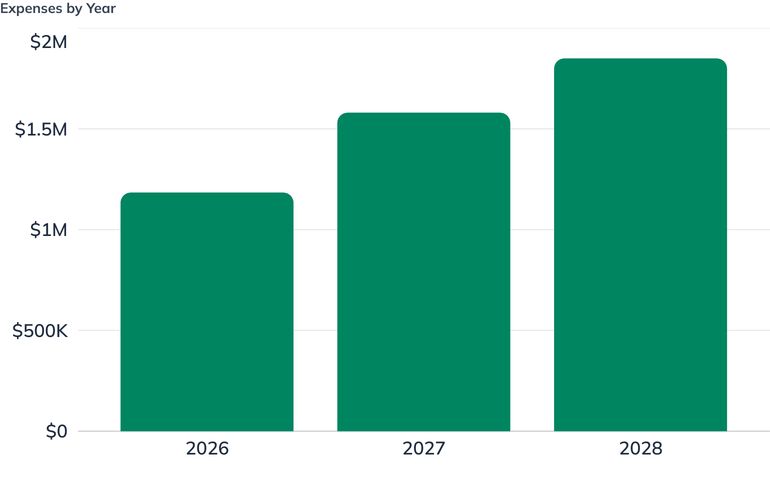
Need real milestones? Establish a clear path for your business with real-world examples.Create your own business plan
Profitability
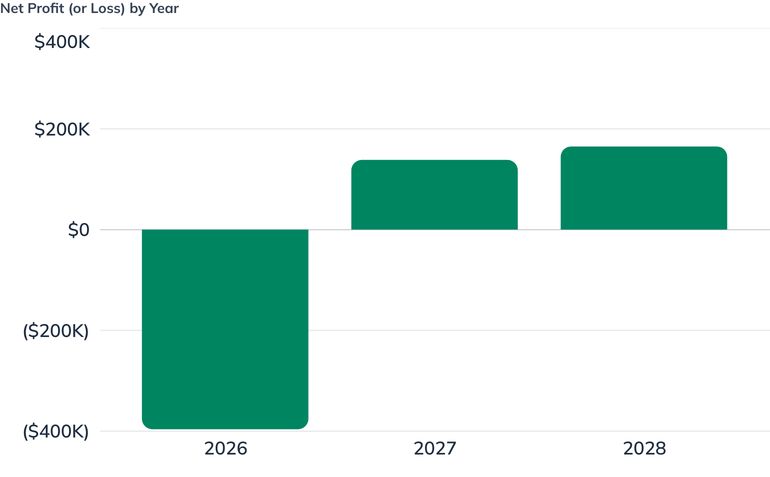
Need impressive charts? Discover the simplest way to create detailed graphs for your business plan.Create your own business plan
Use of Funds
The total startup investment for Clinical Glow Med Spa is approximately $1,050,000, funded through a combination of an $820,000 SBA 7(a) loan and $230,000 in owner equity. These funds are strategically allocated to balance the high upfront costs of a premium medical facility with the necessary operational runway to reach sustained profitability in the competitive Los Angeles market.
Physical Infrastructure and Capital Expenditures
A significant portion of the initial capital is dedicated to establishing a high-end clinical environment on Ventura Boulevard. This includes the build-out of our 1,800-square-foot suite, which features five dedicated treatment rooms designed to meet California’s strict clinical standards while providing a mid-luxury patient experience. Our capital expenditure plan prioritizes a full medical device suite, including:
- Laser Hair Removal Platform: A high-performance system to anchor one of our primary revenue streams.
- IPL / RF Microneedling Combo Device: Essential for delivering the skin resurfacing and "prejuvenation" treatments favored by our target demographic.
- Body Contouring System: A non-invasive platform to capture high-margin, multi-session treatment plans.
- Clinical Furniture and Fixtures: Ensuring all treatment rooms are fully equipped for medical-grade services from day one.
Operational Runway and Scaling
Beyond the physical build-out, the financing provides a critical operational cushion. Because we are launching with a complete core team—including a Nurse Practitioner/Clinical Director and an RN Injector—our initial labor costs are substantial. The allocated funds cover these professional salaries and the fractional Medical Director’s oversight fees during the ramp-up period before patient volume reaches steady-state utilization.
Marketing and technology also represent key uses of funds. We are investing in a digital-first acquisition strategy focused on local search and social media content to build our patient base in Sherman Oaks and Studio City. Additionally, the funds support our integrated technology stack, including Boulevard for scheduling and Aesthetic Record for EMR and photo documentation, ensuring we maintain clinical rigor and data-driven operations from our first consultation.
This balanced allocation ensures that the practice is not only well-equipped but also financially resilient. By funding the gap between our March opening and our projected move into monthly profitability late in the first year, we can focus on clinical excellence and membership enrollment without the pressure of immediate, high-volume discounting.
Sources of Funds
The launch of Clinical Glow Med Spa is supported by a total startup investment of approximately $1,050,000. This capital is structured to provide the necessary resources for a high-end clinical build-out in Sherman Oaks while maintaining a robust operational cushion as the practice ramps up toward steady-state utilization.
Our capital strategy relies on a balanced mix of debt and owner equity, ensuring the business is well-capitalized without being over-leveraged. The primary source of funding is an $820,000 SBA 7(a) loan. This long-term financing is specifically allocated to cover the significant upfront costs associated with leasehold improvements for our 1,800-square-foot facility and the acquisition of our core medical device suite, including laser hair removal, RF microneedling, and body contouring platforms.
Complementing this debt is $230,000 in owner equity. This personal investment demonstrates a strong commitment to the venture and provides the essential "skin in the game" required for SBA financing. By utilizing equity to cover a portion of the startup costs, we reduce the total debt service burden on the practice during its first year of operation, allowing more of our early revenue to be reinvested into patient acquisition and clinical staffing.
This combined funding provides a critical operational runway. Because we are launching with a complete professional team—including a Nurse Practitioner and RN Injector—our initial labor costs are substantial. The current funding plan ensures we can maintain these high clinical standards and execute our digital marketing strategy through the initial months of operation, covering the gap until the practice reaches monthly profitability late in the first year. This conservative approach to capitalization allows the management team to focus on clinical excellence and membership growth rather than immediate, high-volume discounting to meet short-term cash needs.
Projected Statements
Frequently Asked Questions
A strong med spa business plan covers the market gap you're filling, your clinical service menu and who is licensed to deliver each treatment, the ownership structure your state's medical practice laws require, your equipment and buildout costs, and a financial forecast that accounts for a slow ramp to full provider utilization. Clinical Glow's plan works through all of this for a physician-directed practice launching on Ventura Boulevard in Sherman Oaks, including its MSO/professional corporation structure and a five-room clinical buildout.
Clinical Glow launches with approximately $1,050,000 in total startup investment, funded through an $820,000 SBA 7(a) loan and $230,000 in owner equity. That covers leasehold improvements on an 1,800-square-foot suite, a full medical device package including a laser hair removal platform, an IPL/RF microneedling combination device, and a body contouring system, plus enough working capital to carry a fully staffed clinical team through the ramp-up period before the practice reaches steady utilization.
Yes, and the requirements go well beyond a standard business license. In California, the corporate practice of medicine doctrine prevents a non-physician from owning a medical practice, so Clinical Glow uses a two-entity structure: a professional corporation owned by its licensed physician medical director holds the clinical licenses and employs the providers, while an MSO owned by the founder/CEO handles the lease, equipment, staffing, and marketing under a management services agreement. Neuromodulator and filler injections and most energy-based device treatments also require physician oversight, which is why the plan budgets for a fractional medical director from day one.
Clinical Glow earns revenue across six clinical service lines — neuromodulators like Botox, Dysport, and Xeomin; dermal fillers; laser hair removal; IPL and RF microneedling resurfacing; non-invasive body contouring; and physician-supervised IV vitamin therapy — supported by a curated medical-grade skincare retail line. On top of that sits the $129/month Glow Membership, which adds a recurring revenue base and drives visit frequency. The plan projects roughly $788,000 in revenue in a ten-month first year, growing to about $1.72 million in year two and $2.01 million in year three.
Clinical Glow reaches monthly profitability late in its first year and sustained positive cash flow in early 2027, delivering net profit of approximately $138,000 in year two and $165,000 in year three. The timeline is driven by provider utilization building toward roughly 55% of clinical capacity across five treatment rooms — the practice opens with a full clinical team, so labor costs are substantial before patient volume catches up, which is exactly the gap the startup funding is sized to cover.
Clinical Glow's differentiation rests on three things its plan argues no competitor type combines at once: a real, named, accountable medical director; multi-provider capacity so patients aren't tied to one injector's schedule; and published, transparent per-unit and package pricing rather than quotes based on what a client appears able to pay. Every patient's treatment history and before/after photos are documented in Aesthetic Record at each visit, so results stay consistent across providers instead of living in one injector's memory.
Clinical Glow targets adults aged 28–58 within a 15-minute drive of Sherman Oaks, an addressable base it estimates at 45,000–55,000 adults across the Ventura Boulevard corridor. The plan breaks that into three segments: women 32–55 seeking preventative and corrective injectables, the anchor segment most likely to convert to membership; men 28–50 seeking neuromodulators, jawline filler, and laser hair removal; and patients 25–34 entering through “prejuvenation.” Across all three, the target patient researches credentials, reads reviews, and compares published pricing before booking.
The $129/month Glow Membership includes one facial or light peel per quarter, member pricing on all injectable and device treatments, 20% off the retail skincare line, and priority booking. Clinical Glow deliberately structured it so the fee buys pricing and included services rather than banking credit toward injectables, which are billed separately at published member rates — that keeps it simple to explain at the point of sale and easy for patients to verify. The membership is presented by the patient care coordinator once a clinician has proposed a multi-session treatment plan, framed as the lower-cost path through that plan.

Business Plan Outline
Start your plan