





Element Health Walk-In



Business Plan Summary
This urgent care business plan example features Element Health Walk-In, an independent, physician-supervised walk-in clinic opening on Santa Fe's south side in March 2027 with on-site digital X-ray, a CLIA-waived point-of-care lab, and seven-day hours that run into every evening. It covers the clinic's decision to contract with all four New Mexico Turquoise Care Medicaid managed care organizations, its bilingual-by-default staffing standard and publicly posted self-pay prices, the occupational health book it builds with Santa Fe's hospitality, construction, and public-sector employers, and a $1,825,000 launch funded through $500,000 in founder equity and a $1,325,000 SBA 7(a) loan. Use it as inspiration for your own plan. Download a free business plan template to get started, or browse more business plan examples.
Element Health Walk-In
Executive Summary
Element Health Walk-In is an independent, physician-supervised urgent care clinic opening on Santa Fe's south side in March 2027. We treat the everyday medical problems that are too urgent to wait two weeks for a primary care appointment and too minor to justify an emergency department visit: sprains and fractures, lacerations, respiratory and urinary infections, rashes, minor burns, sports and school physicals, and occupational injuries. We are open seven days a week, 8am to 8pm on weekdays and 9am to 5pm on weekends, with on-site digital X-ray and CLIA-waived point-of-care laboratory testing so most visits are diagnosed and resolved in a single stop.
Santa Fe has one hospital emergency department, at CHRISTUS St. Vincent, and a primary care market where new-patient waits routinely run several weeks. The result is an emergency department carrying a large volume of non-emergent visits at emergency-department prices, and a working population that defers care until it becomes expensive. Element Health exists to absorb that middle tier of demand at a fraction of the cost and a fraction of the wait.
Three decisions define how we operate. First, we contract with every major payer in the market, including all four New Mexico Turquoise Care Medicaid managed care organizations. Medicaid covers roughly a third of New Mexicans, and most independent clinics decline the panel. New Mexico is unusual: the state's Medicaid-to-Medicare fee index sits at 1.21 and many primary care codes were reset to 150% of the Medicare benchmark effective January 2025, which makes full-panel participation both a community service and a defensible business decision. Second, every shift is staffed to be functionally bilingual in English and Spanish, which reflects how Santa Fe actually works rather than treating interpretation as an exception workflow. Third, we post our self-pay prices publicly, on the wall and on our website, because price opacity is the single most common reason people in our market avoid seeking care.
Alongside walk-in patient care, we build a deliberate occupational health book with Santa Fe's hospitality, construction, trades, and public-sector employers: pre-employment and DOT physicals, drug and alcohol screening, and workers' compensation injury care. Employer services smooth our weekday volume, arrive by appointment rather than by chance, and give us a business-to-business revenue base that does not depend on flu season.
The clinic occupies roughly 3,500 square feet on the Cerrillos Road corridor, with six exam rooms, a procedure room, a dedicated X-ray suite, and a point-of-care lab. The business is organized as a New Mexico limited liability company, funded through a combination of owner equity and an SBA 7(a) loan, and led by a founding nurse practitioner with a contracted, board-certified family medicine physician serving as medical director. We expect to reach a mature volume in the mid-thirties of patient visits per day by the second full year of operation.
Need real financials? Explore a spreadsheet-free path to generating financial data for your business.Create your own business plan

Opportunity
Problem Worth Solving
Santa Fe has a structural gap in the middle of its care continuum, and everyone in the city has felt it.
There is one emergency department for the entire county. CHRISTUS St. Vincent Regional Medical Center is the sole full-service hospital serving Santa Fe County's roughly 155,000 residents plus a steady tourist population. Nationally, a large share of emergency department visits are for conditions that could be treated in a lower-acuity setting; in a single-ED market with no meaningful walk-in alternative on the south side, that share climbs. The consequence is familiar to anyone who has sat in that waiting room with a sprained wrist: multi-hour waits, and a bill that arrives weeks later at a scale wildly out of proportion to the care delivered.
Primary care cannot absorb the overflow. New Mexico ranks among the worst states in the country for primary care physician access, and Santa Fe's established practices are largely closed to new patients or booking new-patient appointments weeks out. A patient with a productive cough on a Thursday afternoon has no realistic path to being seen by their own doctor before the following week. The practical options are the emergency department, a long drive to Albuquerque, or waiting it out.
Coverage does not equal access. Roughly a third of New Mexicans are covered by Medicaid, and Medicare covers another sixteen percent. Together that is more than half the population. Yet many independent clinics decline Medicaid panels on the assumption that the reimbursement does not clear their cost per visit — an assumption that is broadly true nationally but is no longer true in New Mexico specifically. The effect is a two-tier market: commercially insured patients have choices, and the largest single coverage group in the state is routed to the emergency department and to federally qualified health centers that are themselves at capacity.
Language is a real barrier, not a checkbox. A substantial share of Santa Fe County residents speak Spanish at home. Clinics that handle this with a phone interpreter line add friction to every encounter — longer visits, weaker histories, worse adherence to discharge instructions, and patients who simply do not come back.
Cost is unknowable in advance. The single most common reason a working uninsured or high-deductible patient in Santa Fe delays care is that they cannot find out what it will cost before they walk in. Federal price transparency rules have improved hospital disclosure on paper, but the published files are unusable for an ordinary person deciding on a Saturday morning whether they can afford to have a cut looked at.
The result is a market where a large, geographically concentrated population of working adults, families, hospitality and construction workers, state employees, and retirees has no convenient, affordable, predictable place to get treated for the ordinary medical problems that make up the overwhelming majority of care episodes.
Our Solution
Element Health Walk-In is a full-scope, physician-supervised urgent care clinic built around one promise: walk in without an appointment, be seen in under thirty minutes, know what it costs before you are treated, and leave with the problem resolved.
Same-day, single-stop care
We are open 8am to 8pm Monday through Friday and 9am to 5pm Saturday and Sunday — 72 hours a week, including every evening after the primary care market closes. No appointment is required, and patients can hold a place in line from their phone before they leave home.
Because we operate a digital X-ray suite and a CLIA-waived point-of-care laboratory on site, the diagnostic loop closes inside the visit. A patient with a possible fracture is imaged, read, splinted, and referred in one encounter. A patient with a sore throat leaves knowing whether it is strep. There is no "come back tomorrow for results," which is the step where continuity most often breaks down for hourly workers who cannot take a second afternoon off.
Everyone's insurance, on purpose
We contract with the commercial plans operating in the market, with Medicare, and — deliberately — with all four New Mexico Turquoise Care Medicaid managed care organizations. This is the decision that most distinguishes us from the independent walk-in clinics in our market, and it is not charity. New Mexico's Medicaid-to-Medicare fee index is 1.21, among the highest in the nation, and the state reset many primary care codes to 150% of the 2024 Medicare benchmark effective January 2025. Full-panel participation gives us access to the single largest coverage group in the state at rates that support our cost structure, while our competitors compete over a smaller commercial pool.
Bilingual by default
Every clinical shift is staffed so that a patient can be greeted, triaged, examined, and discharged in Spanish without an interpreter line. Our intake forms, discharge instructions, signage, and after-visit summaries are bilingual. This is a staffing and hiring standard written into our job descriptions, not an accommodation we arrange on request.
Posted prices
Our self-pay prices are printed on the wall behind the front desk and published on our website: a flat price for a standard visit, a flat price for a visit with in-house labs, a flat price for a visit with X-ray, and a flat price for complex procedural care. A patient without insurance, or with a deductible they have not met, can know their cost before they consent to be seen. Cash-pay patients pay at time of service and receive an itemized receipt they can submit themselves.
Employer and occupational health
We serve Santa Fe employers directly with pre-employment physicals, DOT examinations, DOT and non-DOT drug and alcohol screening, respirator clearance, and workers' compensation injury care with return-to-work documentation returned same-day. Employer accounts are invoiced monthly rather than billed through insurance, which gives us predictable weekday volume and a receivable that collects reliably.
Referral, not replacement
We are explicit about our scope. Chest pain, stroke symptoms, major trauma, and other true emergencies are stabilized and transferred to CHRISTUS St. Vincent. Patients who need ongoing management are connected to a primary care home, and our after-visit summary is transmitted to their existing provider where one exists. We are the layer between primary care and the emergency department — not a substitute for either.
Target Market
Our market is Santa Fe County and the immediately adjacent communities that already drive into Santa Fe for work, school, and shopping — Eldorado, Pojoaque, La Cienega, Edgewood, and the northern end of the I-25 corridor. Santa Fe County holds roughly 155,000 residents, of whom about 90,000 live within the city limits, and the city hosts a large daily inflow of commuters and visitors that materially expands the population actually present in the market on any given day.
Four characteristics of this market shape our plan.
It is a working, service-economy city. Santa Fe's employment base is concentrated in hospitality and tourism, state and local government, construction and the trades, healthcare, retail, and arts. These are occupations with physical injury exposure, shift schedules that conflict with weekday-daytime clinic hours, and — for the hospitality and construction segments in particular — high rates of both employer-sponsored high-deductible coverage and no coverage at all. They are the archetypal urgent care patient.
It skews older than the national average, and it is getting older. Santa Fe County's median age runs well above the national figure and the county has one of the higher shares of residents over 65 in the state, driven by decades of in-migration by retirees. Medicare covers roughly 16% of New Mexicans. Older patients generate more episodes of acute care per capita and are more likely to be managing chronic conditions that produce urgent exacerbations.
Its coverage mix is unlike most of the country. Medicaid covers roughly 34% of New Mexicans — essentially the same share as employer-sponsored insurance, which nationally covers nearly half the population. Medicare adds another 16%. Combined public coverage exceeds half the state's population, and about 9% of New Mexicans are uninsured. Any Santa Fe clinic that models a commercially insured panel is modeling a market that does not exist here.
It is substantially Hispanic and substantially bilingual. Santa Fe County's population is roughly half Hispanic or Latino, and Spanish is spoken at home by a large minority of households. Language capability is a market access requirement, not a differentiator we invented.
Who we serve
We segment our market into five groups:
- Working adults aged 25 to 54 with commercial coverage — state employees, healthcare workers, professionals, and their families. The highest-value segment per visit and the most likely to choose on convenience, wait time, and online reputation. They typically find us on a phone search at 6pm.
- Hospitality, construction, and trades workers — often Spanish-preferred, often on high-deductible or no coverage, and disproportionately likely to present with occupational injuries and deferred acute problems. Reached through employer relationships and word of mouth rather than digital advertising.
- Medicaid-covered families — the largest coverage group in the state and the most poorly served by the existing independent walk-in market. Pediatric acute care, school and sports physicals, and respiratory illness are the dominant use cases. Reached through community organizations, schools, and MCO provider directories.
- Medicare beneficiaries and retirees — high per-capita utilization, strong preference for a clinic that is calm, unhurried, and staffed by someone who will explain things. Reached through primary care referral relationships and neighborhood presence.
- Employers as accounts, not individuals — the occupational health book described in Key Customers. A distinct buyer, a distinct sales motion, and a distinct revenue profile.
Geography within the market
We are deliberately siting on the Cerrillos Road / Rodeo Road corridor on Santa Fe's south and southwest side. This is where the majority of the city's residential growth, its working-age households, and its light-industrial and retail employment sit, and it is the part of the city furthest from the existing concentration of medical facilities. It is also the corridor with the highest daily traffic volume in the city, which matters more for a walk-in business than for almost any other kind of healthcare practice.
How the market is changing
Three trends work in our favor. New Mexico's 2025 Medicaid rate increases materially improved the economics of serving public-coverage patients. Employers in the state continue to shift toward high-deductible plan designs, which pushes price-sensitive patients away from hospital-based care and toward transparent, lower-cost settings. And Santa Fe's residential growth continues to concentrate on the south side, away from the existing supply of care.
One trend works against us: national urgent care visit volumes have flattened as telehealth absorbs the lowest-acuity encounters. This is precisely why our model is built on things telehealth cannot do — imaging, laboratory testing, laceration repair, splinting, and occupational health examinations — rather than on the sore-throat visit that a virtual platform will always price below us.
Competition
Santa Fe's acute care market is unusually concentrated. There is no national urgent care chain operating a dense network here, and the competitive set is best understood as four distinct alternatives a patient chooses between, not four clinics competing on the same terms.
CHRISTUS St. Vincent Emergency Department
The only hospital emergency department in the county, and by default the destination for anything after hours or anything a patient is unsure about.
Strengths: 24/7, full imaging and laboratory capability, admitting privileges, absolute trust for genuine emergencies, and an established brand that has served Santa Fe for over a century.
Weaknesses: Multi-hour waits for low-acuity complaints because triage correctly prioritizes true emergencies. Facility fees make the cost of a minor visit an order of magnitude higher than ours. The experience is impersonal by design.
How we compete: We do not. We compete for the subset of ED volume that should never have been there — the sprains, the sutures, the sinus infections. Our marketing message is explicitly "know where to go," and we are as clear about what we do not treat as about what we do. Over time, our goal is a referral relationship in which the ED can direct low-acuity walk-ins to us rather than turning them away.
Presbyterian Santa Fe Medical Center
Presbyterian Healthcare Services operates a multi-specialty facility in Santa Fe with urgent care capability, backed by New Mexico's largest integrated health system and its own health plan.
Strengths: System integration — a Presbyterian Health Plan member sees a Presbyterian provider, records flow into one chart, and referrals stay in network. Deep capital, strong brand, and a full specialty bench behind the front door.
Weaknesses: The integration that helps their own members is friction for everyone else. Hours are narrower than a dedicated urgent care. Patients report that walk-in access is inconsistent when the schedule is full, and the facility's orientation is toward its established panel rather than the passing walk-in.
How we compete: On hours, on access without a system relationship, and on being genuinely payer-agnostic. We want the patient who is not a Presbyterian member and does not want to become one to have somewhere to go at 7pm on a Tuesday.
Independent walk-in and primary care clinics
A small number of independent clinics in Santa Fe offer same-day or walk-in appointments alongside a primary care panel.
Strengths: Established local relationships, physician continuity, and community trust built over years. Lower overhead than ours.
Weaknesses: Most operate weekday-daytime hours with limited or no weekend coverage. Most lack on-site radiography, which means a suspected fracture becomes a referral rather than a resolved visit. Walk-in capacity is subordinate to the scheduled panel, so wait times are unpredictable. Critically, most decline or sharply limit Medicaid participation.
How we compete: Hours, imaging, and panel. We are open when they are closed, we can image what they have to refer out, and we accept the coverage they decline. Our intent is complementary rather than adversarial — these practices are a natural referral source for after-hours and imaging-dependent visits, and we return the patient to them with a same-day summary.
Telehealth and virtual-first platforms
Teladoc, Amazon One Medical Pay-per-visit, plan-embedded virtual care, and the virtual front doors of the regional systems.
Strengths: Immediate, cheap, available at 2am, and increasingly bundled into commercial plan designs at zero copay. They will always beat us on price and convenience for a complaint that requires no hands and no equipment.
Weaknesses: Cannot image, cannot test, cannot suture, cannot splint, cannot perform a DOT physical, and cannot examine an injury. A meaningful share of virtual visits end in a referral to in-person care, which means the patient pays twice and waits longer.
How we compete: By ceding the ground we cannot defend and owning the ground they cannot enter. Our service mix is deliberately weighted toward the procedural, diagnostic, and regulatory visits telehealth structurally cannot deliver. We also convert: our own online queue tool is positioned as "get in line from your couch," which serves the same convenience instinct without giving the visit away.
Where we sit
Our defensible position is the intersection of four things no single competitor in this market offers together: extended seven-day hours, on-site imaging and laboratory, full-panel payer participation including Medicaid, and posted transparent self-pay pricing — delivered by a clinical team that operates in English and Spanish without an interpreter line. The barrier to a competitor replicating this is not any one element; it is that the combination requires accepting a payer mix most independent operators have been trained to avoid, in a state where that avoidance is no longer economically rational.
Key Customers
Most of our patient volume arrives unannounced and unaffiliated — that is the nature of walk-in care. But a meaningful and deliberately cultivated portion of our business comes from named accounts and institutional relationships, and these are the relationships we actively sell and manage.
Employer accounts (occupational health)
Employer services are our business-to-business book. These are contracted or invoiced relationships with named companies, and they are the accounts our clinic manager is directly responsible for growing.
Hospitality and food service. Santa Fe's hotels, resorts, and restaurant groups employ thousands of people in roles with high turnover and physical injury exposure — kitchen burns and lacerations, back strains, slips. High turnover means a steady, predictable flow of pre-employment physicals and drug screens, and injury exposure means workers' compensation volume. These employers value one thing above all: getting an injured employee evaluated, documented, and back to work the same day. Target accounts include the major resort properties, the downtown hotel operators, and the larger restaurant groups.
Construction and the trades. Santa Fe's residential and commercial construction firms, electrical and plumbing contractors, and roofing companies. This segment generates the highest-value occupational visits — workers' compensation injury care in the West region reimburses well above a standard urgent care visit — and requires respirator clearance, hearing conservation testing, and post-accident screening on regulatory schedules we can anticipate and staff for.
Transportation and logistics. Regional trucking, delivery, transit, and any employer with commercial drivers. DOT physical examinations recur on a two-year cycle, which makes this the most predictable recurring revenue in the occupational book. Our medical director and mid-level providers will be listed on the FMCSA National Registry of Certified Medical Examiners.
Public sector and education. Santa Fe is the state capital. State agencies, Santa Fe County, the City of Santa Fe, Santa Fe Public Schools, and the local higher education institutions collectively represent one of the largest employment blocks in the market, with structured pre-employment and periodic examination requirements.
Staffing and temporary labor agencies. Agencies placing workers in Santa Fe need fast-turnaround physicals and screens and are among the least price-sensitive occupational buyers because a delayed clearance means an unfilled placement.
Payer relationships
Our contracted payers are institutional customers in their own right, because a contract determines whether a whole population can walk through our door.
Turquoise Care Medicaid managed care organizations. New Mexico's Medicaid program operates through a small set of contracted MCOs. Full participation with all of them is a founding commitment of this business and the single most important contracting objective of our pre-opening period. Inclusion in their provider directories is also, functionally, a free patient acquisition channel.
Commercial carriers. The Blue Cross Blue Shield of New Mexico, Presbyterian Health Plan, UnitedHealthcare, Cigna, and Aetna networks, plus the regional TPAs administering self-funded employer plans in the market.
Medicare. Straight Medicare and the Medicare Advantage plans active in Santa Fe County, which matters disproportionately given the county's age profile.
Workers' compensation carriers and third-party administrators. Distinct from health plan contracting, with its own fee schedule and its own documentation requirements under New Mexico's Workers' Compensation Act.
Referral and community relationships
Primary care practices. Independent Santa Fe primary care practices are a referral source, not a competitor, for after-hours, weekend, and imaging-dependent visits. Our commitment to them is simple and enforced: their patient comes back to them, with a same-day summary, and we never solicit the ongoing relationship.
Schools and youth sports. Santa Fe Public Schools, the private and charter schools, and the club sports organizations all require annual physicals on a predictable August–September cycle and generate acute injury volume through the fall and spring seasons.
Community health organizations. The federally qualified health centers and community organizations serving Santa Fe's Medicaid and uninsured populations are at capacity. A reliable, welcoming after-hours option that accepts the same coverage they do is genuinely useful to them, and referral flows in both directions.
CHRISTUS St. Vincent. The long-term relationship we most want is an emergency department diversion pathway — a formal arrangement under which low-acuity walk-ins presenting to the ED can be redirected to us. This benefits the hospital's throughput and our volume simultaneously, and it is a realistic objective once we have demonstrated a year of consistent quality and hours.
Execution
Marketing Plan
Urgent care is a proximity-and-moment business. Almost nobody chooses a walk-in clinic in advance; they choose it in the twenty seconds after something goes wrong, usually on a phone, usually within three miles of where they are standing. Our marketing is built around being the obvious answer in that moment, and around a second, entirely different motion for employer accounts.
The core principle
We are not building brand affection. We are winning a search result, a map pin, and a review score at the moment of need, and we are earning the second visit through the experience of the first. Our marketing budget in year one runs at startup levels — meaningfully higher as a share of collections than a mature clinic would spend — and steps down as organic search, reviews, and word of mouth compound.
Local search and digital presence
Google Business Profile is our single most important marketing asset, ahead of our website. "Urgent care near me" is the query that decides this business. We manage the profile actively: complete and accurate hours including holiday hours, current wait time, photographs of the actual clinic and actual staff, service and insurance attributes, and same-week responses to every review. Duplicate and stale listings across Apple Maps, Bing Places, Yelp, and the healthcare directories are claimed and reconciled at launch.
Reviews are the ranking factor and the conversion factor. We ask every satisfied patient for a review through a post-visit text message, and we respond to negative reviews individually, publicly, and without defensiveness. A ninety-day review-generation sprint at launch is a specific, staffed workstream, not a hope.
Our website is a fast, mobile-first, bilingual site whose home page answers four questions above the fold: are you open right now, how long is the wait, do you take my insurance, and what does it cost. Everything else is secondary. Insurance and posted self-pay pricing get dedicated, indexable pages. We publish plain-language content on the questions people actually search — "urgent care or ER," "how long does strep take to test," "do I need an X-ray for this" — in English and Spanish, because Spanish-language local health content is thin in this market and ranks with far less effort.
Paid search runs on a tight geographic radius against high-intent terms with a strong evening and weekend day-parting bias, plus seasonal pushes during respiratory illness season, back-to-school physical season, and the summer injury months. This is the majority of our digital spend in year one and steps down as organic position strengthens.
Social media is a service channel more than a promotional one: hours changes, wait times, seasonal reminders, staff introductions, and community presence, posted bilingually.
Physical presence
Our site selection on the Cerrillos Road corridor is itself a marketing decision — it is the highest-traffic corridor in the city. Building signage is specified for maximum legibility at driving speed, with an illuminated OPEN indicator visible after dark, because a lit sign at 7pm is a more effective advertisement than any campaign we could buy.
Community and grassroots
We sponsor youth sports leagues and school athletics, which puts our name on the sideline of exactly the events that generate the injuries we treat. We staff first aid tents at Santa Fe's community events and race series. We offer school and sports physical clinics at reduced flat rates during the August back-to-school window, which is both a genuine community service and the single most efficient patient acquisition event on our calendar.
We build relationships with Santa Fe's primary care practices through direct outreach from our medical director — a physician-to-physician conversation about after-hours coverage, not a sales call — and we honor the referral compact absolutely: their patient comes back to them.
Bilingual outreach as a channel, not a translation
Our Spanish-language marketing is authored in Spanish rather than translated from English, and it runs through the channels this segment actually uses: Spanish-language radio, community organizations, church bulletins, and the neighborhood networks around the south-side corridor. The message is specific — we speak your language, we accept your insurance including Medicaid, and our prices are posted.
Employer marketing
Employer accounts are sold, not marketed, and the motion is covered in detail in our Sales Plan. Marketing's contribution is a dedicated employer services section on our website, printed capability sheets and rate cards, and presence at Santa Fe Chamber of Commerce and industry association events.
What we measure
Cost per new patient acquired by channel; Google Business Profile impressions, direction requests, and calls; organic search position on the handful of queries that matter; review volume and average rating; new versus returning patient ratio; and — the number that decides whether any of this worked — patients per day against plan. Marketing spend is reallocated monthly against these figures rather than set annually.
The Community Caretaker
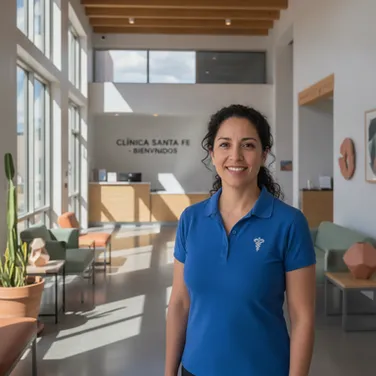
Elena Rodriguez
Elena is a lifelong Santa Fe resident who manages a multi-generational household. As a retail supervisor on the Cerrillos Road corridor, she balances a demanding work schedule with her children's school activities and her elderly mother's health needs, often finding that traditional primary care schedules don't align with her life.
Age
38
Location
South Side, Santa Fe, NM
Family Status
Married, 3 children (ages 6, 10, and 14)
Education
Associate's Degree in Business Administration
Profession
Retail Supervisor at Santa Fe Place Mall
Opportunities
- Utilize the functionally bilingual staff to build trust with her Spanish-speaking family members, ensuring clear communication of treatment plans.
- Capitalize on the full-panel Medicaid participation (Turquoise Care) to attract families who are often turned away by other independent clinics.
- Market the 8pm closing time to capture the 'after-work' rush for children's minor illnesses and school physicals.
Pain Points
- Waiting weeks for a primary care appointment for acute issues like ear infections
- Language barriers when taking her mother to specialists who require external interpreters
- Fear of the high costs associated with the CHRISTUS St. Vincent emergency department
Needs
- Reliable walk-in care that accepts her family's Medicaid plan
- A bilingual clinical environment where she doesn't have to translate for her mother
- One-stop diagnostics (X-ray and labs) to avoid multiple trips across town
“I shouldn't have to choose between a six-hour wait at the emergency room or waiting two weeks for my son to see a doctor.”

The Essential Builder
Tomas Vigil
Tomas is a skilled tradesman working in Santa Fe's booming construction and hospitality-service sector. His livelihood depends on his physical health and maintaining certifications like his DOT medical card, yet he often defers care for minor injuries due to the complexity of the local health system.
Age
29
Location
La Cienega, NM
Family Status
Single
Education
High School Diploma and HVAC Certification
Profession
Lead HVAC Technician for a regional contractor
Opportunities
- Become the go-to provider for his employer's DOT physicals and pre-employment drug screenings to ensure steady weekday volume.
- Offer efficient injury care and paperwork management for workers' comp cases to reduce 'discovery costs' for employers and downtime for workers.
- Promote laceration repair and fracture stabilization as a faster, cheaper alternative to the emergency room for workplace accidents.
Pain Points
- Losing a full day's wages to wait for a mandatory DOT physical
- Navigating the bureaucracy of workers' compensation at large hospital systems
- The lack of urgent care options near the industrial and light-commercial south side
Needs
- Quick turnaround for employment-related medical clearances
- A clinic location close to his job sites on the south side corridor
- Straightforward treatment for workplace injuries like sprains and minor burns
“If I'm not on the site, the job doesn't get done. I need a place that understands I can't spend all day in a waiting room.”

The Value-Driven Strategist
David Miller
David is a self-employed consultant who lives in a high-growth community outside the city. He is highly educated and price-sensitive, utilizing a high-deductible health plan that makes him scrutinize every medical bill. He values efficiency and transparency above all else.
Age
52
Location
Eldorado at Santa Fe, NM
Family Status
Married, empty nester
Education
Master of Fine Arts
Profession
Independent Art Consultant and Gallery Owner
Opportunities
- Leverage the publicly posted self-pay price list to win over patients who are weary of the 'opaque' billing cycles of hospital-owned practices.
- Target the daily inflow of residents from Eldorado and the I-25 corridor who pass the Cerrillos/Rodeo Road location for work.
- Highlight on-site digital X-ray and CLIA-waived labs to appeal to his need for immediate, definitive answers in a single visit.
Pain Points
- Frustration with surprise medical bills and hidden 'facility fees' from hospital-based clinics
- Inability to get quick imaging for sports injuries (cycling/hiking) without an ED referral
- The high cost of simple procedures under a high-deductible insurance plan
Needs
- Upfront, predictable pricing for self-pay or high-deductible visits
- Fast, professional service that respects his time as a business owner
- High-quality, physician-supervised care without the hospital price tag
“I'm tired of healthcare feeling like a financial trap. I just want to know what it costs and get back to my work.”
Sales Plan
Element Health Walk-In has two entirely different sales motions. Patient visits are not sold at all — they are captured at a moment of need and converted through the quality of the experience. Employer accounts are sold, deliberately and by a named person, through a conventional business-to-business process.
Motion one: converting the walk-in
There is no salesperson in the patient journey. The "sale" is a sequence of friction points, and our job is to remove each one.
Before arrival. The patient searches, finds us, sees that we are open, sees the current wait, sees that we take their insurance, and can hold a place in line from their phone. Online check-in is not a scheduling system — walk-ins are never turned away or deprioritized — it is a queue position that lets someone wait at home instead of in a chair.
At arrival. Registration is completed on a tablet in English or Spanish, with insurance cards captured by photograph and eligibility verified in real time before the patient sits down. For self-pay patients, the front desk quotes the posted price and collects at check-in, so there is no surprise and no chase.
During the visit. Our operational target is under thirty minutes from door to provider at typical volumes. This is the single strongest driver of both return visits and reviews, and it is the metric our staffing model is built to protect during predictable surges.
At discharge. Bilingual written instructions, prescriptions sent electronically to the patient's pharmacy of choice, a clear statement of what to watch for and when to come back, and a same-day summary transmitted to the patient's primary care provider.
After the visit. A text follow-up within 48 hours checking on recovery and inviting a review. Patients with pending send-out results are called by clinical staff, not left to wonder.
The return. Repeat visits are the economics of urgent care. A household that has a good first experience returns for the next episode and brings the rest of the household. We do not run a loyalty program; we run a clinic people are willing to come back to.
Motion two: selling the employer account
Employer occupational health is a real sales pipeline with named targets, a defined cycle, and an owner. Our clinic manager holds this responsibility with direct support from the founding provider and medical director, and it is written into the role rather than treated as spare-time business development.
Target list. We build a named account list before opening: hospitality and food service operators, construction firms and specialty trade contractors, transportation and logistics employers with commercial drivers, staffing agencies, state and local government agencies and school districts, and mid-sized professional employers. The list is prioritized by employee count, injury exposure, and proximity to our site.
Outreach sequence. Direct approach to the person who actually owns the decision — usually an HR manager, safety director, or office manager, not an executive. An introductory call or drop-in, a capability sheet and rate card, an invitation to tour the clinic, and a follow-up cadence tracked in a simple CRM. Chamber of Commerce membership, industry association events, and the local safety council provide warm entry points.
The pitch. Three things employers care about, in order: turnaround time, documentation quality, and predictable cost. An injured employee seen, treated, and returned to work with compliant paperwork the same day is worth far more to an employer than a discount. We commit to same-day appointment availability for occupational visits, same-day return-to-work documentation, a single named point of contact, and monthly consolidated invoicing rather than per-visit billing.
Closing. A written services agreement covering scope, rates, turnaround commitments, and invoicing terms. No exclusivity is demanded and none is offered — employers value the option to send someone elsewhere, and demanding exclusivity kills more deals in this segment than pricing does.
Retention and growth. Quarterly account reviews with volume and turnaround reporting. Accounts that start with drug screens expand into physicals, then into workers' compensation care, then into on-site services. Land-and-expand is the pattern, and the expansion is where the margin sits.
Sales realism
The national data on urgent care occupational health is blunt: the market is top-heavy, with a small fraction of clinics capturing most of the volume, and independents without dedicated business-to-business effort capture almost none of it. This is precisely why we assign the pipeline to a named owner with defined targets rather than assuming employer business will arrive because we offer the service. Our plan assumes employer services build gradually across the first two years rather than arriving at opening.
What we measure
On the patient side: door-to-provider time, visits per day against plan, return patient rate, review volume and rating, online check-in usage, and left-without-being-seen rate. On the employer side: named accounts in pipeline, accounts closed, occupational visits per month per account, average revenue per account, and account retention.
Locations & Facilities
The site
Element Health Walk-In operates from a single leased location of approximately 3,500 square feet on the Cerrillos Road / Rodeo Road corridor on Santa Fe's south side.
The corridor is chosen deliberately. It carries the highest daily traffic volume in the city, it is where the majority of Santa Fe's working-age households and residential growth are concentrated, and it is the part of the city furthest from the existing supply of medical facilities, which cluster toward the north and near the hospital. For a business where the majority of patients arrive because they drove past the sign or because a map application put us three minutes away, visibility and drive-time coverage matter more than prestige of address.
Our site selection criteria, in priority order: a hard corner or highly visible in-line position on the corridor with unobstructed signage sightlines; a minimum of thirty dedicated parking spaces with clear ADA access and a covered patient drop-off; ground-floor space with a single accessible entry; adequate ceiling height and structural capacity for radiography shielding; three-phase or upgradable electrical service; proximity to a pharmacy and to complementary retail that generates its own traffic; and a landlord willing to fund a meaningful tenant improvement allowance against a ten-year term.
A market caveat we plan around openly: Santa Fe has effectively no purpose-built medical office inventory available for lease. The commercial listings in this market are general office and retail, which means our site will be a conversion rather than a move-in, and our tenant improvement burden is correspondingly higher than a comparable clinic in a larger metro would carry. We budget for this rather than discovering it, and we prioritize landlords who will contribute to it.
Lease structure. A ten-year triple-net lease with renewal options, negotiated with a tenant improvement allowance and a rent abatement period covering the construction phase. Santa Fe retail and office space in our size band leases in a range that makes a corridor location affordable at our projected volumes, and we underwrite occupancy cost including the full NNN load rather than base rent alone.
The build
Approximately 3,500 square feet laid out around patient flow rather than administrative convenience:
- Reception and waiting for roughly twenty seated patients, with a separate small area that can be used to isolate respiratory or immunocompromised patients during illness season, bilingual signage throughout, and a posted price board behind the desk
- Two registration and triage positions with privacy separation adequate for HIPAA-compliant conversation
- Six exam rooms, each equipped identically so that any provider can work in any room without hunting for supplies
- One procedure room sized for laceration repair, incision and drainage, and orthopedic splinting, with dedicated lighting and equipment
- A dedicated radiography suite with lead shielding designed by a qualified medical physicist to New Mexico Environment Department Radiation Control Bureau standards, and an adjacent control area
- A point-of-care laboratory with analyzer bench, specimen refrigeration, and a separate DOT-compliant collection restroom with the required water controls and chain-of-custody workspace
- A clean supply and medication room with controlled-access storage, vaccine-grade refrigeration with continuous temperature monitoring and alarm, and a soiled utility room
- Staff areas — provider workstation and dictation space, a break room, lockers, and a small manager's office
- A dedicated occupational health intake position so that a scheduled DOT physical is not queued behind walk-in acute volume
Construction is a medical-grade buildout: infection control finishes and sealed flooring, exam room plumbing and headwall power, structured network cabling throughout, shielded radiography walls, ADA compliance in every patient-accessible area, and a nurse call and duress system. The work is permitted through the City of Santa Fe with plan review and inspection, and the facility is designed to satisfy the applicable New Mexico Health Care Authority requirements determined during our pre-lease regulatory review.
Hours
Monday through Friday, 8:00am to 8:00pm. Saturday and Sunday, 9:00am to 5:00pm. Seventy-two hours a week, three hundred sixty-two days a year, closing only Thanksgiving, Christmas Day, and New Year's Day. Extended weekday evening coverage is the core of our differentiation against a primary care market that closes at five.
Future locations
This plan covers a single site. A second Santa Fe location, most plausibly on the north or northwest side, is a realistic consideration once the first site has sustained mature volume through a full seasonal cycle and demonstrated stable collections. We do not model it here, and we do not commit capital to it until the first site is proven.
Technology
Our technology choices follow one rule: buy purpose-built urgent care systems rather than adapting primary care tools, because the workflows are fundamentally different. A primary care EHR is built around a scheduled panel and longitudinal records. An urgent care EHR is built around an unscheduled queue, rapid documentation, on-the-spot coding, and discharging a patient we may never see again.
Electronic health record and practice management
We run Experity, the dominant urgent-care-specific EHR and practice management platform, licensed per provider with an implementation engagement before opening. The reasons are specific: charting templates designed for episodic acute care rather than problem lists; an integrated queue and tracking board that shows every patient's position and elapsed time on one screen; coding assistance built for urgent care evaluation and management levels and procedure coding; discharge instruction libraries available in English and Spanish; and integrated patient engagement including online check-in and post-visit messaging.
The platform carries our registration, eligibility verification, charting, order entry, coding, claim generation, and reporting in a single system. We deliberately avoid stitching together a general-purpose EHR with bolt-on modules, because every seam is a place a claim goes missing.
Interoperability
We participate in New Mexico's health information exchange so that patient records are visible to and from other providers in the state, and we transmit after-visit summaries to primary care providers through standard interoperability protocols rather than by fax. For patients within the CHRISTUS St. Vincent and Presbyterian systems, record exchange flows through the same pathways.
Imaging
Our digital radiography system writes directly to a cloud-hosted PACS, integrated with the EHR so images attach to the encounter automatically. A contracted teleradiology service provides formal overread within a defined turnaround, with results returned into the chart and a documented callback protocol when the formal read differs from the provider's initial interpretation.
Laboratory
Point-of-care analyzers interface to the EHR so results post to the chart without transcription — the transcription step is where point-of-care errors happen. Our reference laboratory interface is bidirectional: orders flow out electronically, results flow back into the chart, and pending results appear on a worklist that is reviewed and closed daily.
Revenue cycle
Claims generate from the EHR and flow to our outsourced revenue cycle management partner through a clearinghouse with automated eligibility and claim scrubbing. Real-time eligibility verification runs at registration, before the patient is roomed, which is what prevents the most common category of denial. We maintain read access to our own accounts receivable dashboard rather than depending on a monthly report from the biller.
Patient-facing technology
Online check-in and live wait time display on our website and Google Business Profile. Bilingual tablet-based registration with card capture. Text-based post-visit follow-up and review requests. A patient portal for records, results, and self-pay balances. Electronic prescribing including EPCS for controlled substances, with mandatory New Mexico Prescription Monitoring Program queries integrated into the prescribing workflow. Card-present and contactless payment at the front desk and a payment link for balances after the visit.
Occupational health systems
DOT physical documentation submits electronically to the FMCSA National Registry. Drug screening runs through an electronic chain-of-custody system integrated with our contracted laboratory and the mandated Medical Review Officer. Employer accounts receive a portal or a scheduled report showing their employees' completed services and clearance status.
Security, compliance, and continuity
Full HIPAA technical safeguards: role-based access control, unique user credentials, multi-factor authentication, automatic session timeout, encryption at rest and in transit, and audit logging reviewed on a defined schedule. Business associate agreements with every vendor touching protected health information. Annual security risk assessment and annual staff HIPAA and security awareness training. Cyber liability insurance.
Redundant internet service, because a clinic whose EHR is unreachable cannot register a patient. Documented downtime procedures with paper forms and a defined recovery sequence. Cloud-hosted systems with vendor-managed backup, and uninterruptible power supply on the network, server, and imaging equipment.
Artificial intelligence in the workflow
Ambient clinical documentation is standard practice by 2027 and we adopt it from opening: providers dictate naturally during the encounter and the note is drafted automatically, reviewed and signed by the provider. In a high-throughput setting where documentation time directly limits patients seen per hour, this is one of the highest-return operational investments available to us. We also use the coding assistance and denial-pattern analytics built into our platform. What we do not do is allow any automated system to make a clinical decision, a triage determination, or a discharge determination — every clinical judgment is made and signed by a licensed provider, and we say so plainly to patients who ask.
Equipment & Tools
Equipment is a major capital line in this business, and the sequencing matters as much as the selection: radiography must be installed, shielded, surveyed by a qualified medical physicist, and registered with the New Mexico Environment Department Radiation Control Bureau before we can see a single patient who needs an X-ray.
Imaging
Digital radiography suite — leased, not purchased. A direct-capture DR system with a floor-mounted tube, elevating table, wall stand, flat-panel detector, generator, and acquisition workstation, sized for extremity, chest, spine, and abdominal imaging at urgent care volumes. We specify a system in the urgent-care-appropriate tier rather than a hospital-grade room — the capacity difference is irrelevant at our volumes and the price difference is substantial.
We acquire this system on a 60-month equipment lease including PACS, at approximately $2,600 per month, rather than buying it outright. Two reasons. It removes roughly $130,000 from our capital requirement at exactly the moment capital is scarcest, converting it to a predictable operating cost. And imaging technology moves — a lease leaves us free to upgrade at term rather than depreciating a system we have outgrown. The lease includes installation, calibration, applications training, and service coverage.
Lead shielding and radiation safety. Shielding design by a qualified medical physicist, lead-lined wall construction, leaded glass control window, personnel dosimetry badges, lead aprons and thyroid shields, and annual physicist survey. Shielding is built into the leasehold improvement package rather than the equipment lease. Registration with the Radiation Control Bureau is required before use; New Mexico charges no registration fee, and the Bureau must be notified within fifteen days of any machine removal or replacement.
PACS. Cloud-hosted image storage and viewing, included in the equipment lease, integrated with the EHR and with our teleradiology overread service.
Point-of-care laboratory (purchased)
Operating under a CLIA Certificate of Waiver, renewed on a two-year cycle:
- Rapid antigen analyzer for influenza A/B, COVID-19, RSV, strep A, and mononucleosis
- Handheld blood analyzer for basic chemistry, electrolytes, and cardiac markers
- Urinalysis analyzer with microscopy capability
- Glucose and hemoglobin A1c analyzers
- Coagulation meter for INR
- Centrifuge, specimen refrigerator with continuous temperature monitoring, phlebotomy supplies, and biohazard handling and disposal infrastructure
- Reference laboratory courier arrangement for send-out testing
Clinical equipment (purchased)
Per exam room, identically outfitted across all six rooms: power exam table, exam light, wall-mounted diagnostic set with otoscope and ophthalmoscope, blood pressure apparatus, digital vital signs monitor, pulse oximeter, thermometer, scale, provider and patient seating, glove and supply organization, sharps disposal, and a wall-mounted workstation.
Procedure room: procedure table, surgical lighting, minor surgical instrument sets in adequate rotation for same-day sterilization turnaround, electrocautery, suture and wound care inventory, orthopedic splinting and casting supplies, crutches and immobilizers in a full size range, and a dedicated instrument processing area with autoclave and ultrasonic cleaner.
Shared clinical equipment: twelve-lead ECG machine, nebulizer units, portable oxygen with regulators, suction unit, automated external defibrillator, fully stocked crash cart with emergency medications on a daily-checked log, audiometer with sound-attenuating booth for occupational hearing conservation, spirometer for respirator clearance, breath alcohol testing device with calibration schedule, vision screening equipment, and vaccine-grade refrigeration with alarmed continuous temperature monitoring.
The point-of-care laboratory and clinical equipment above are purchased together as a single capital package with the exam room fit-out.
Furniture, fixtures, and signage
Waiting room seating for approximately twenty with a separable respiratory area, reception millwork and registration workstations, the posted price board, bilingual wayfinding signage, staff break room and locker fittings, manager's office furnishings, secure medication and supply storage, and exterior building and monument signage with illuminated after-dark visibility.
Information technology hardware
Workstations at each registration position, exam room and provider documentation devices, tablets for patient registration, network switching and wireless access points, a redundant internet configuration, uninterruptible power supply protecting network, imaging, and refrigeration monitoring, label and prescription printers, card-present and contactless payment terminals, and a security and access control system with camera coverage of the entry, waiting area, and medication storage.
Consumable inventory
Opening inventory of pharmaceuticals for in-clinic administration, injectables, vaccines, wound care and suture materials, splinting and casting supplies, personal protective equipment, exam room disposables, laboratory reagents and test cartridges, and office and administrative supplies. Consumables are re-ordered on par levels managed through our primary medical-surgical distributor with a secondary supplier maintained for continuity, and they run at roughly 8% of revenue in our forecast.
Maintenance and replacement
Service contracts on the autoclave, laboratory analyzers, and refrigeration; radiography service is bundled into the equipment lease. Annual calibration and preventive maintenance on all clinical measurement equipment with documented logs. Annual physicist survey of the radiography installation. Purchased assets are depreciated over their useful lives — medical and laboratory equipment over five years, furniture and fixtures over seven, IT hardware over three, and leasehold improvements over the ten-year lease term.
Milestones
Obtain written facility licensure determination from NM Health Care Authority Secure a written determination under 8.370.18 NMAC on whether Element Health requires licensure as a diagnostic and treatment center or falls within the private practitioner exemption. This gates lease execution, build standard, and malpractice tier. | Founding NP / Regulatory Counsel Sept 15, 2026 |
Form LLC, secure SBA 7(a) financing, and execute lease New Mexico LLC formation, EIN, CRS number, group NPI, SBA 7(a) loan close, and a ten-year NNN lease on a ~3,500 sq ft Cerrillos Road corridor site with tenant improvement allowance and construction-period rent abatement. | Founding NP Oct 15, 2026 |
Begin payer credentialing — Medicare, Medicaid MCOs, commercial Submit Medicare and all four Turquoise Care Medicaid MCO applications first, then commercial carriers in parallel. Tracked weekly against a dated pipeline. Opening date is set against credentialing completion, not construction completion. | Credentialing Service / Clinic Manager Oct 31, 2026 |
Complete buildout, equipment installation, and X-ray registration Medical buildout complete and City of Santa Fe inspections passed. DR system installed, shielding surveyed by a qualified medical physicist, and registered with the NMED Radiation Control Bureau. CLIA Certificate of Waiver in hand. POC lab, EHR, and PACS live. | Founding NP / General Contractor Feb 15, 2027 |
Hire and onboard the opening team Clinic manager, three medical assistants, one radiologic technologist, and two patient service representatives hired at or above Santa Fe market wages, with bilingual coverage on every shift. Systems training, protocol review, and first emergency drill complete before opening. | Founding NP / Clinic Manager Feb 20, 2027 |
Open to patients Doors open seven days a week: 8am–8pm weekdays, 9am–5pm weekends. Google Business Profile live with hours, wait time, insurance attributes, and posted self-pay pricing. Paid search and Spanish-language outreach campaigns active. | Founding NP Mar 1, 2027 |
First five employer occupational health accounts signed Five signed employer services agreements across hospitality, construction, and transportation, with DOT examiner certification on the FMCSA National Registry complete and monthly consolidated invoicing live. | Clinic Manager June 30, 2027 |
Reach 20 patient visits per day sustained Sustained daily volume of 20 visits over a rolling four-week period, with median door-to-provider under 30 minutes and 50+ Google reviews at a 4.5 average or better. | Founding NP Aug 31, 2027 |
Hire second advanced practice provider Second NP or PA hired at Santa Fe market compensation, triggered by sustained volume rather than by calendar. Provides overlapping provider coverage through peak afternoon and evening hours to protect the door-to-provider commitment. | Founding NP Sept 1, 2027 |
Reach 30 visits per day and monthly operating cash-flow break-even Sustained 30+ visits per day, with operating cash flow covering operating costs. Roughly 18 months after opening, at the outer edge of the 13-18 month industry norm — a deliberately conservative plan given a full-scope buildout and 72 open hours a week from day one. | Founding NP Sept 30, 2028 |
First profitable month and 40+ visits per day First month at net profit after debt service, approximately 22 months after opening, with December volume above 40 visits per day, 20+ active employer accounts, and days in accounts receivable under 40. Full-year profitability follows in 2029. | Founding NP Dec 31, 2028 |
Establish ED diversion pathway with CHRISTUS St. Vincent and evaluate second site Formal low-acuity referral arrangement with the hospital emergency department, and a go/no-go decision on a second Santa Fe location based on a full seasonal cycle of mature performance at the first site. | Medical Director / Founding NP Sept 30, 2029 |
Key Metrics
We manage this clinic against a short list of numbers reviewed on a fixed cadence — daily at the front desk, weekly by the clinic manager, monthly by ownership. Urgent care fails in predictable ways, and each metric below is chosen because it is a leading indicator of one of those failure modes.
Volume
Patients per day. The number that determines whether this business works. National urgent care centers average in the high twenties to low thirties of visits per day, with mature single sites planning in a thirty to fifty range and profitability generally requiring more than thirty. We track daily against plan, by day of week and by hour, and we staff to the pattern rather than to an average.
Visits by service line. Acute illness, injury and procedural, physicals and preventive, and occupational health. The mix drives revenue per visit far more than total volume does, and a drift toward low-acuity illness visits is an early warning.
New versus returning patients. Returning patients are the compounding asset in this business. A returning share that fails to build through year one means the visit experience is not earning the second visit.
Throughput and experience
Door-to-provider time. Our operational commitment is under thirty minutes at typical volume. This is the strongest single driver of reviews, return visits, and left-without-being-seen rate. Tracked as a median and as a ninetieth percentile, because the tail is what generates the one-star review.
Total visit length. Door to discharge, segmented by whether the visit included imaging or laboratory testing.
Left without being seen. Any patient who registers and leaves before being seen is lost revenue and a probable negative review. A rate above low single digits means we are understaffed for our volume pattern.
Google rating and review volume. The de facto public scorecard for a walk-in clinic and a direct input to local search ranking. We track average rating, monthly new review count, and response rate.
Patient satisfaction and net promoter score from post-visit text surveys, segmented by language of service so we can see whether our bilingual commitment is actually being delivered.
Revenue and collections
Net revenue per visit. Collected, not billed. The figure that matters, tracked in total and by payer class. National urgent care commercial net revenue per visit runs around a median in the mid-one-sixties, with a wide spread; our blended figure across a payer mix weighted more heavily toward Medicaid and Medicare will sit below that, and we manage to our own baseline rather than a national one.
Payer mix by visit and by revenue. Watched for drift, and watched specifically for any payer converting our contract to a bundled case rate, which would silently convert our imaging and laboratory capability from a revenue center into a cost center.
Ancillary attachment rate. The share of visits including radiography, point-of-care laboratory, or a procedure. Ancillary services are the margin in urgent care.
Days in accounts receivable, clean claim rate, denial rate by payer, and net collection rate against contracted allowable. These four are reviewed monthly with our revenue cycle partner. Denials are worked within a defined window and payer-specific patterns escalate to contract renegotiation.
Cost and productivity
Provider cost per visit and total labor cost as a share of net revenue. Clinical labor is the dominant expense line in an urgent care and the one most easily allowed to drift out of proportion during a slow ramp.
Visits per provider hour. The productivity measure that tells us whether a slow day is a demand problem or a throughput problem.
Medical supply and laboratory cost as a share of net revenue, tracked against the industry range and investigated when it moves.
Occupancy cost as a share of net revenue, which is fixed and therefore purely a function of volume — a useful proxy for how far up the ramp we actually are.
Employer book
Named accounts in pipeline, accounts closed, occupational visits per account per month, revenue per account, and account retention. Tracked separately because this is a sales pipeline with a sales cadence, not a walk-in flow.
Cash and compliance
Monthly cash balance against plan and months of operating runway remaining. During the ramp, this is the metric that matters more than profitability, because an urgent care that runs out of cash in month nine never gets to month eighteen.
Compliance calendar completion: CLIA certificate currency, radiography registration and annual physicist survey, provider license and DEA renewals, payer re-credentialing dates, malpractice and Patient Compensation Fund qualification, OSHA training, emergency drill completion, and refrigeration temperature log integrity. Tracked as a binary — current or not — with no partial credit.
Pricing
Price transparency is a founding commitment of this business, not a marketing device. Our self-pay prices are printed on a board behind the front desk and published on our website, and a patient is quoted their price before they consent to be treated.
Insured patients
For patients with coverage, we bill their plan at our standard fee schedule and collect the copay, coinsurance, or deductible amount their plan determines, verified through real-time eligibility at registration so the patient knows their responsibility before they are roomed. We are contracted with the commercial carriers, Medicare and Medicare Advantage, and all New Mexico Turquoise Care Medicaid managed care organizations, which means the overwhelming majority of patients in our market pay an in-network cost share rather than a full-price bill.
Self-pay price list
Posted, flat, and inclusive. There is no separate facility fee, and there are no surprise add-ons.
- Standard visit — evaluation and treatment, no imaging or labs: $150
- Visit with in-house laboratory testing (up to two rapid tests): $185
- Visit with X-ray (up to two views): $240
- Visit with both laboratory and X-ray: $275
- Complex procedural visit — laceration repair, incision and drainage, splinting, IV fluids: $325
- Each additional rapid test: $35
- Each additional X-ray view: $50
- Send-out laboratory test: $40–$100 per test, quoted before collection
- School, sports, or camp physical: $50
- Adult employment or wellness physical: $95
- Vaccination (influenza, Tdap, and similar): $45–$95, quoted at the desk
Payment is due at time of service. Patients receive an itemized receipt suitable for submission to a health savings account or an out-of-network plan.
Occupational health and employer rate card
Employer services are invoiced to the employer monthly rather than billed through insurance, at contracted rates:
- DOT commercial driver physical examination: $110
- Pre-employment or post-offer physical: $95
- Non-DOT urine drug screen (5-panel, chain of custody): $55
- DOT urine drug screen (chain of custody, MRO review included): $75
- Breath alcohol test: $45
- Respirator medical clearance questionnaire and evaluation: $60
- Audiometric testing: $45
- Workers' compensation injury evaluation and treatment: billed to the carrier at the New Mexico Workers' Compensation Administration fee schedule
- On-site flu vaccination clinic: quoted by headcount
Volume discounts are available to accounts above defined annual thresholds, negotiated as part of the services agreement.
How we set these prices
Three anchors. First, the emergency department comparison — a low-acuity emergency department visit in this market costs a multiple of our highest posted price once the facility fee is included, and our pricing is set to make that comparison obvious rather than merely favorable. Second, the regional urgent care self-pay market, where posted flat-rate visit pricing at comparable clinics runs broadly in line with our figures for the equivalent bundle. Third, our own cost per visit, so that a self-pay visit contributes at least as much as an average insured visit — otherwise transparent pricing becomes a subsidy rather than a service.
Occupational health rates are set against a different logic. Employer services reimburse well below a standard urgent care visit nationally, and we price them accordingly, but they arrive by appointment during predictable weekday hours, they fill capacity that would otherwise sit idle, they collect reliably on a monthly invoice rather than through a claims cycle, and they are entirely insulated from payer contracting risk. We price them to win the account, not to maximize the visit.
Financial assistance
We maintain a written sliding-scale discount policy for uninsured patients below a defined household income threshold, applied consistently and documented in the chart. Our front desk staff are trained to screen uninsured patients for Medicaid eligibility and to help them begin enrollment — a patient covered at their next visit is better off, and so are we.
Review cadence
Posted prices are reviewed annually against our cost per visit, local market movement, and our payer contract rates. Any change is published at least thirty days before it takes effect. Employer rate cards are reviewed at contract renewal.
Regulatory Requirements
Regulatory compliance in an urgent care setting is a launch-critical path, not a background administrative function. Several requirements below carry lead times measured in months and gate our opening date. We engage New Mexico healthcare regulatory counsel before signing a lease.
The threshold question: facility licensure
New Mexico regulates outpatient facilities under 8.370.18 NMAC, which covers ambulatory surgical centers, diagnostic and treatment centers, limited diagnostic and treatment centers, rural health clinics, and "new or innovative" clinic models. The rule contains a significant exemption: it does not apply to the offices and treatment rooms of licensed private practitioners.
This creates real ambiguity for an urgent care. A clinic structured and operated as a private practitioner's office may fall outside the licensure requirement; one structured or marketed as a diagnostic and treatment center likely falls inside it. The determination drives our building code requirements, our construction cost, and our malpractice insurance tier.
We obtain a written determination from the New Mexico Health Care Authority's Health Facility Licensing and Certification bureau before we sign a lease. This is the single highest-value regulatory step in our launch sequence, because discovering the answer after construction has begun is expensive in a way no other item on this list is.
Entity, business, and tax registration
New Mexico limited liability company formation with the Secretary of State; a New Mexico CRS identification number and gross receipts tax registration with the Taxation and Revenue Department (medical services receive specific treatment under New Mexico gross receipts tax law, and we confirm the applicable deductions with our accountant); a City of Santa Fe business registration; a federal Employer Identification Number; and an organizational National Provider Identifier alongside individual NPIs for each provider.
Provider licensure and credentialing
Every clinician holds a current New Mexico license: physicians and physician assistants through the New Mexico Medical Board, nurse practitioners and registered nurses through the New Mexico Board of Nursing. Physician licensure runs $500 initially with a $500 triennial renewal; physician assistant licensure runs $150 initially with a $150 biennial renewal. New Mexico offers a statutory expedited licensure pathway for physicians, which matters when recruiting from out of state.
Each prescriber holds a federal DEA registration and a New Mexico controlled substance registration, and each is enrolled in the New Mexico Prescription Monitoring Program with queries integrated into the prescribing workflow. Nurse practitioners in New Mexico practice with full practice authority, which shapes our staffing model, though our medical director provides collaborative oversight and quality review regardless.
Providers performing DOT examinations must be certified and listed on the FMCSA National Registry of Certified Medical Examiners.
Payer credentialing — Medicare, Medicaid MCOs, and commercial carriers — runs 60 to 180 days and is described in detail in our Payer Mix and Insurance Contracting section. It begins approximately six months before our target opening.
Laboratory
A CLIA Certificate of Waiver covering all waived point-of-care testing, at $248 for a two-year certificate, obtained through the New Mexico Health Care Authority as the CLIA state agency. We restrict our on-site menu strictly to waived tests; moving to moderate-complexity testing would require a different certificate, a qualified laboratory director, and proficiency testing enrollment, and we do not plan one.
Radiography
Registration of the X-ray machine with the New Mexico Environment Department Radiation Control Bureau before use. New Mexico charges no registration fee and turnaround runs roughly two weeks. We must comply with 20.3 NMAC, maintain a shielding design plan prepared by a qualified medical physicist, perform annual physicist surveys, maintain personnel dosimetry, and notify the Bureau within fifteen days of any machine removal or replacement. The installation is subject to periodic inspection.
Malpractice insurance and the New Mexico Medical Malpractice Act
This is a New Mexico-specific requirement with significant financial consequence, and it is non-negotiable.
To be a "qualified healthcare provider" under the New Mexico Medical Malpractice Act, an individual provider must carry at least $250,000 per occurrence in malpractice coverage. An independent outpatient health care facility must carry $500,000 per occurrence. Qualified providers gain the Act's cap on non-economic damages — $750,000, adjusted annually for inflation — and its statute of limitations protections, and gain access to the Patient Compensation Fund for excess exposure, funded by a surcharge set actuarially by the Superintendent of Insurance.
Failing to qualify forfeits both the damages cap and the Fund. New Mexico's standard market writes occurrence-based policies, which carry a higher premium than claims-made coverage but eliminate tail liability. We budget for facility-level coverage at the required threshold plus individual provider coverage, and we note that the Patient Compensation Fund surcharge has historically been assessed below actuarially indicated levels against a growing fund deficit — future surcharge increases are a real cost risk we monitor.
Clinical operations compliance
HIPAA privacy and security compliance including annual risk assessment, workforce training, business associate agreements, and a documented breach response plan. OSHA compliance including the bloodborne pathogen exposure control plan, hazard communication, personal protective equipment provision, and injury and illness recordkeeping. Medical waste handling and disposal through a licensed contractor. Emergency preparedness planning with documented quarterly drills. Vaccine storage and handling meeting CDC standards with continuous alarmed temperature monitoring and documented excursion response.
Employment compliance
New Mexico wage and hour law, and specifically the City of Santa Fe Living Wage Ordinance, which sets a minimum well above both the federal and New Mexico state minimums for work performed within the city and steps up substantially at the start of 2027 before moving to an indexed annual adjustment. Our compensation plan is built against the ordinance rate applicable in each year, not against the state minimum. Also: New Mexico Healthy Workplaces Act paid sick leave, workers' compensation insurance coverage and the New Mexico Workers' Compensation Administration assessment fee, unemployment insurance registration with the Department of Workforce Solutions, and I-9 and E-Verify compliance.
Ongoing compliance calendar
Every item above with a renewal date sits on a single compliance calendar owned by the clinic manager and reviewed monthly: CLIA certificate, radiography registration and physicist survey, provider licenses and DEA registrations, payer re-credentialing, malpractice policy and Patient Compensation Fund qualification, business registrations and gross receipts tax filings, OSHA and HIPAA training cycles, and emergency drill completion. A lapse in any one of these can stop the clinic from operating or from being paid, so the calendar is treated as an operational system rather than a filing cabinet.
Risks & Mitigation
Urgent care startups fail in a small number of well-documented ways. We name each of them here, along with what we do to prevent it and what we do if it happens anyway.
Credentialing delay strands us with revenue we cannot collect
The risk. Payer enrollment runs 60 to 180 days, with Medicaid MCOs at the long end. A clinic that opens before credentialing completes sees patients it cannot bill, and every idle provider-month costs tens of thousands of dollars in unrecoverable revenue. This is the most common and most expensive urgent care launch failure, and it is largely self-inflicted — incomplete CAQH profiles, address mismatches, unexplained employment gaps.
Mitigation. Credentialing begins approximately six months before target opening, sequenced Medicare and Medicaid first because they queue longest and because commercial plans often require them. We engage a specialist credentialing firm rather than handling it in house. Applications are tracked against a dated pipeline reviewed weekly. Our opening date is set against credentialing completion, not construction completion — if the buildout finishes first, we wait.
If it happens anyway. We open on a self-pay and employer-invoiced basis for the affected payers, communicate clearly at the front desk, and hold retroactive-eligibility claims where the payer permits back-dating to the effective date.
The facility licensure question resolves against us after we have committed capital
The risk. New Mexico's outpatient facility rule contains a private practitioner exemption whose application to an urgent care is genuinely ambiguous. If we build to office standard and are later determined to require licensure as a diagnostic and treatment center, we face retrofit construction cost, delay, and a higher malpractice tier.
Mitigation. A written determination from the New Mexico Health Care Authority before we sign a lease, obtained through New Mexico healthcare regulatory counsel. If the determination is ambiguous or unfavorable, we build to the higher standard and price it into the buildout budget from the start.
The ramp is slower than planned
The risk. Our forecast assumes a conventional urgent care ramp from single-digit daily volume at opening toward the mid-thirties by the second full year. If awareness builds more slowly, or a competitor responds, we burn working capital faster than we build revenue. Five fewer visits per day is a material monthly revenue gap.
Mitigation. Working capital sized to fund 12 to 18 months of operation rather than to the projected break-even month, which is the difference between a plan and a hope. Weekly volume tracking against plan from the first week, with marketing spend reallocated monthly rather than annually. Deferred hiring — the second provider and additional support staff are added on volume triggers, not on calendar dates, so a slow ramp does not compound into an overstaffed clinic.
If it happens anyway. Hiring pauses immediately, marketing reallocates toward the highest-converting channel, employer sales effort intensifies because occupational volume is the fastest lever available to us, and we approach the lender about an interest-only period well before we need one.
Payer contracts convert to bundled case rates
The risk. Urgent care reimbursement is shifting nationally from fee-for-service toward flat per-visit case rates. Under a case rate, our on-site X-ray and laboratory convert from revenue centers into pure cost centers overnight, and the ancillary contribution our model depends on disappears.
Mitigation. We model ancillary contribution separately by payer so a conversion is visible in the month it happens rather than in an annual review. We negotiate against bundled rates where we have leverage. And the employer-invoiced occupational health book — which sits entirely outside insurance reimbursement — is a deliberate structural hedge against exactly this.
New Mexico Medicaid rates fall back
The risk. Our full-panel Medicaid participation is economically viable specifically because New Mexico's Medicaid-to-Medicare fee index sits at 1.21 and many codes were reset to 150% of the Medicare benchmark in 2025. That is a state budget decision, and state budget decisions reverse. New Mexico's revenue is heavily oil-and-gas dependent, which makes the fiscal picture more volatile than most states'.
Mitigation. We monitor New Mexico Health Care Authority rate actions and legislative budget sessions directly rather than learning about changes from a remittance advice. Our forecast does not assume rate growth above general inflation. A meaningful rate reduction would require rebalancing our payer mix rather than exiting the panel, and our commercial, Medicare, occupational, and self-pay lines are large enough that Medicaid is a major segment rather than a dependency.
We cannot hire, or cannot keep, our clinical staff
The risk. Santa Fe's clinical labor pool is small — a few hundred medical assistants and a few dozen radiologic technologists in the entire metropolitan area. Provider turnover is the most expensive failure mode available to us: recruiting cost, months of reduced capacity, and fresh credentialing lead time with every single payer.
Mitigation. Compensation benchmarked at or above the Santa Fe market midpoint for every role, an equity path for the core clinical team, predictable published schedules, hard limits on shift extension, continuing education support, and a bilingual pay differential. We recruit from Albuquerque with a premium for the roles the local pool cannot fill, and we maintain relationships with locum tenens providers so a sudden provider departure does not close the clinic.
Seasonality strains us in both directions
The risk. Urgent care volume swings severely — respiratory season can run well above the annual average while late spring and summer run well below it. Winter overwhelms capacity and produces the wait times that generate one-star reviews; summer produces months where fixed costs are covered by too few visits.
Mitigation. A staffing model built around a core of full-time staff supplemented by part-time and per-diem coverage that flexes with the season. Occupational health volume, which is counter-seasonal to acute illness and arrives by appointment, deliberately fills the summer trough. Cash planning that treats the summer months as a drawdown period rather than as a surprise.
A quality or safety event
The risk. A missed diagnosis, a medication error, or a patient who deteriorates after discharge. In a small market, a single serious event carries reputational consequences well beyond its legal ones.
Mitigation. An independent medical director with authority over clinical protocols that is structurally insulated from throughput pressure. Standardized protocols and standing orders. Teleradiology overread with a documented callback protocol when the formal read differs from the provider's initial interpretation. Chart review on a defined sample. Documented emergency drills quarterly. Clear, posted scope boundaries and a low threshold for transfer. Occurrence-based malpractice coverage at New Mexico Medical Malpractice Act qualification levels, with Patient Compensation Fund participation for excess exposure.
A competitor enters our corridor
The risk. A regional system or a private-equity-backed urgent care platform opens on the south side with deeper capital and an integrated referral network behind it.
Mitigation. Our defensibility is not any single feature; it is the combination of extended hours, on-site imaging and laboratory, full-panel payer participation including Medicaid, posted pricing, and genuinely bilingual delivery — plus a contracted employer book and a set of local referral relationships that take years to build. We secure a long lease with renewal options on the best available corridor site, and we invest in the employer relationships and community presence that a new entrant cannot buy quickly.
Concentration risk
The risk. A single site, a single market, a single founding clinician. Disability or departure of the founder is an existential event, not an inconvenience.
Mitigation. Key person life and disability insurance on the founding member, funding the buy-sell obligation in the operating agreement. Documented protocols and cross-trained staff so operations do not live in one person's head. A medical director and clinic manager with sufficient authority and knowledge to run the clinic through an absence. Business interruption insurance covering physical events.
Company
Ownership & Structure
Legal structure
Element Health Walk-In is organized as Element Health Walk-In, LLC, a New Mexico limited liability company registered with the New Mexico Secretary of State and headquartered in Santa Fe. The LLC is taxed as a pass-through entity, so the business itself does not pay entity-level income tax; profits and losses flow to the members' personal returns, and the company makes quarterly distributions sized to cover members' estimated tax obligations.
An LLC is the right structure here for three reasons. It provides liability separation between the business and its owners' personal assets, which matters in a clinical setting even with malpractice coverage in place. It avoids the double taxation a C corporation would impose on a single-site operating business with no plan to raise institutional equity. And New Mexico's full practice authority for nurse practitioners, combined with the absence of a strict corporate practice of medicine prohibition of the kind found in some states, allows a clinician-owned LLC to operate a clinic directly rather than requiring a separate professional corporation and management company structure. We confirm this structure with New Mexico healthcare counsel as part of our pre-launch legal review.
Ownership
Ownership sits with the founding clinician-operator, who holds the substantial majority of membership interests and contributes the owner equity component of our capitalization. A minority interest is reserved for an equity pool available to key early team members — specifically the medical director and, at the operator's discretion, the second provider and clinic manager — vesting over a four-year schedule with a one-year cliff. In a market where clinical labor is the binding constraint and provider turnover is the most expensive failure mode in urgent care, giving the core clinical team a stake is a retention strategy rather than a generosity.
The operating agreement addresses capital contributions and distributions, management authority and decision thresholds, transfer restrictions and rights of first refusal, buy-sell provisions triggered by death, disability, or voluntary departure, and dispute resolution. Buy-sell obligations are funded by life and disability insurance on the founding member, which is a lender requirement under an SBA loan and sound practice regardless.
Governance and management authority
The founding member serves as managing member with day-to-day operational authority. Decisions above defined thresholds — capital expenditures beyond a set amount, new debt, lease commitments, opening a second location, admitting new members, or changes to the operating agreement — require a supermajority vote of the membership.
Clinical governance is deliberately separated from business governance. The contracted medical director holds independent authority over clinical protocols, scope of practice, quality review, credentialing and privileging of clinical staff, and any decision where a clinical judgment and a financial incentive could come into tension. The medical director reports to the membership on quality and to no one on clinical judgment. This separation is documented in the medical director agreement, and it exists because the failure mode it prevents — throughput pressure quietly reshaping clinical decisions — is the one that ends urgent care businesses.
We hold a formal quarterly business review covering financial performance, quality and patient safety indicators, compliance calendar status, and the employer account pipeline, with the medical director and the clinic manager both present.
Capitalization
The business is capitalized through a combination of owner equity contributed by the founding member and an SBA 7(a) term loan, sized together to fund the leasehold buildout, equipment, pre-opening costs, and a working capital reserve sufficient to carry the clinic through its ramp to cash-flow break-even. The specific amounts, terms, and uses are set out in the Sources of Funds and Use of Funds sections of the Financial Plan.
The SBA 7(a) loan is personally guaranteed by the founding member and secured by the business's assets, which is standard for this instrument and this size of borrower. We have not raised and do not currently plan to raise outside equity; the ownership structure is deliberately kept simple and clinician-controlled.
Insurance and risk transfer
Professional liability coverage at the levels required for qualification under the New Mexico Medical Malpractice Act — facility-level and individual provider coverage, written on an occurrence basis through the New Mexico standard market, with Patient Compensation Fund participation. Alongside it: general liability, property and business personal property, business interruption, workers' compensation, employment practices liability, cyber liability, and key person life and disability coverage on the founding member.
Management Team
Element Health Walk-In opens with a deliberately small leadership group. In a single-site clinic, layers of management are overhead that patients pay for and do not benefit from. Three roles carry the business.
Founding Nurse Practitioner and Managing Member
The founder is a board-certified family nurse practitioner with substantial urgent care and emergency department experience, licensed in New Mexico with full practice authority, and a long-standing resident of the Santa Fe area. The founder practices clinically as a primary provider on the schedule — this is a working-owner business, not an absentee one — while holding managing member authority over the business.
The founder's responsibilities: clinical care delivery as the lead provider; overall business leadership and financial management; lease, vendor, and payer contract negotiation; hiring and culture; and the ultimate accountability for whether this clinic delivers on the promise it makes to its patients.
What the founder brings that matters here: direct clinical familiarity with the acuity mix that walks into a Santa Fe urgent care, existing relationships within the local clinical community that shorten both recruiting and referral development, and fluency in the operational realities of high-throughput episodic care — the difference between a clinic that runs at 30 minutes door-to-provider and one that runs at 90.
Medical Director (contracted, part-time)
A board-certified family medicine physician, New Mexico licensed, engaged under a written medical director agreement at a defined weekly commitment with additional on-call availability for clinical consultation.
The medical director holds independent authority over clinical protocols and standing orders, quality assurance and chart review, credentialing and privileging of clinical staff, incident review and root cause analysis, and the clinical policy questions where a business incentive and a patient's interest could diverge. The medical director also serves as our physician-to-physician ambassador to Santa Fe's primary care practices and to CHRISTUS St. Vincent, which is a relationship-building function no marketing spend substitutes for.
Structuring this role as a contracted part-time engagement rather than a full-time employed physician is a deliberate economic decision. Physician compensation in this market runs at roughly double a nurse practitioner's, and a single-site urgent care with a mid-level-led staffing model — entirely appropriate under New Mexico's full practice authority — does not need a physician on the floor for every hour of operation. It needs a physician accountable for the standard of care, and that is what this role is.
Clinic Manager
A full-time operational leader responsible for everything that is not a clinical decision: staff scheduling and payroll, front desk and patient flow operations, supply and inventory management, vendor relationships, the compliance calendar, revenue cycle liaison with our outsourced billing partner, and — importantly — ownership of the employer account sales pipeline.
We recruit for this role from healthcare practice management rather than from general business management, because the person needs to already understand eligibility verification, prior authorization, payer credentialing, and why a chart that is not closed is a claim that is not paid. Bilingual English and Spanish capability is a requirement for the role, not a preference.
The employer sales responsibility deserves emphasis. National data shows that independent urgent cares without a dedicated business-to-business effort capture almost none of the occupational health market, while a small fraction of clinics capture most of it. Assigning that pipeline to a named person with defined targets is the difference between a real employer book and an aspirational one.
The gap we acknowledge
Our leadership group has clinical depth and operational depth. It does not have a dedicated finance function, and we do not pretend otherwise for a business of this size. We address this with an outsourced arrangement rather than a hire: a Santa Fe CPA firm with healthcare practice experience handles bookkeeping, gross receipts tax filings, and tax preparation, and a healthcare-specialized revenue cycle management firm handles billing, coding audit, and collections. The founder reviews monthly financial statements and the accounts receivable dashboard directly rather than receiving a summary.
Culture
Two commitments shape how we hire and how we operate. First, the bilingual standard is a hiring requirement, written into job descriptions across clinical and front desk roles, and supported with a pay differential for demonstrated Spanish fluency. Second, we compensate at or above the Santa Fe market for every role, benchmarked against published wage data for the Santa Fe metropolitan area rather than against the state minimum or the Santa Fe living wage floor. Clinical staffing is the binding constraint on this business and turnover is its most expensive failure mode; paying market is cheaper than replacing people.
Advisors
A single-site clinic cannot afford full-time expertise in every discipline it needs, and does not need to. We buy specialist judgment by the engagement, and we engage the following advisors before opening rather than after a problem appears.
New Mexico healthcare regulatory counsel
The most important advisory relationship in our launch. Engaged before we sign a lease, to resolve the facility licensure question under 8.370.18 NMAC — whether an urgent care structured as ours falls within the private practitioner exemption or requires licensure as a diagnostic and treatment center — and to obtain a written determination from the New Mexico Health Care Authority. That answer drives our construction standard, our build cost, and our malpractice insurance tier, and discovering it after construction has begun is the most expensive mistake available to us.
Counsel also reviews our LLC operating agreement, medical director agreement, employment agreements, HIPAA policies, patient financial policy, and employer services contracts.
Healthcare CPA (Santa Fe)
A local accounting firm with medical practice clients, handling bookkeeping, monthly financial statement preparation, New Mexico gross receipts tax registration and filing — including the specific deductions available to medical services under New Mexico law, which are not obvious and are worth real money — payroll tax compliance, entity tax returns, and the members' estimated tax planning. Local matters here: New Mexico gross receipts tax is unlike a conventional sales tax, and a national online bookkeeping service will get it wrong.
Revenue cycle management partner
A billing firm with specific urgent care and New Mexico Medicaid managed care experience, compensated as a percentage of collections so that our incentives are aligned. Their scope covers claim submission, denial management, payer follow-up, coding audit, and monthly reporting on days in accounts receivable, clean claim rate, denial rate by payer, and net collection rate. We select for demonstrated experience with the Turquoise Care MCOs specifically, because that is where our denial risk concentrates.
Credentialing service
A specialist credentialing firm managing provider enrollment across Medicare, the Medicaid MCOs, and the commercial carriers, plus CAQH profile maintenance and re-credentialing cycles. This is outsourced because credentialing is the longest lead-time item in our launch, a delay directly and immediately costs us collectible revenue, and it is a full-time job for the months it runs — not something a founding clinician should be doing between shifts.
Commercial real estate broker and construction team
A Santa Fe commercial broker with tenant representation experience, given that this market has effectively no listed medical office inventory and our site will be a retail or general office conversion. Alongside the broker: an architect experienced in medical office buildout and City of Santa Fe plan review, a general contractor with healthcare project experience, and a qualified medical physicist for radiography shielding design, acceptance survey, and the annual surveys required under 20.3 NMAC.
Insurance broker
A broker specializing in New Mexico medical malpractice, who understands the Medical Malpractice Act qualification thresholds, the facility-versus-individual coverage distinction, the Patient Compensation Fund surcharge mechanics, and the state's occurrence-based standard market. Also placing our general liability, property, business interruption, workers' compensation, employment practices, and cyber coverage.
Clinical and quality advisors
An informal clinical advisory relationship with one or two experienced Santa Fe emergency or urgent care physicians, providing protocol review and a second opinion on scope-of-practice boundary questions. Membership in the Urgent Care Association for benchmarking data, operational best practice, and the peer network — the industry's benchmarking reports are the reference point against which we measure our own throughput, staffing, and cost structure.
Lender relationship
An SBA-preferred lender with healthcare lending experience, ideally a New Mexico institution familiar with the local market. We treat the lender as an advisor and not only a source of capital: an experienced healthcare lender's underwriting scrutiny of our ramp assumptions is free diligence on our own plan, and a lender who has financed clinics before will tell us where our projections diverge from what they have watched actually happen.
Community and business network
Santa Fe Chamber of Commerce membership for employer relationship development, the New Mexico Medical Society and New Mexico Nurse Practitioner Council for clinical community connection, and relationships with the federally qualified health centers and community organizations serving Santa Fe's Medicaid and uninsured populations — organizations whose patients we serve after hours and who are, in practice, referral partners in both directions.
Key Planned Hires
Clinical labor is both the largest cost in this business and the constraint that determines how many patients we can see. Our hiring plan is therefore sequenced against volume rather than against optimism: we staff the opening team to handle our expected ramp with the founder working clinically, and we add each subsequent position when sustained visit volume justifies it, not before.
Compensation philosophy
Every role is benchmarked against published wage data for the Santa Fe metropolitan area and paid at or above the local market midpoint. We do not benchmark against the New Mexico state minimum wage of $12.00 per hour, and we do not benchmark against the City of Santa Fe Living Wage Ordinance floor, which rises to $17.50 per hour on January 1, 2027 and indexes annually thereafter. Both sit far below what any of our roles command. We benchmark against what a Santa Fe medical assistant, radiologic technologist, or nurse practitioner is actually paid, and we position above the midpoint for the roles where turnover would hurt most.
Two Santa Fe-specific factors shape this. First, the Living Wage Ordinance steps up sharply at the beginning of 2027, which compresses the bottom of every pay scale in the city; our entry-level rates are set with headroom above the new floor rather than being overtaken by it. Second, Santa Fe is a high-cost-of-living market with a small clinical labor pool — the metropolitan area employs only a few hundred medical assistants and a few dozen radiologic technologists in total. Underpaying by two dollars an hour in a pool that thin does not save money; it produces vacancies.
We pay a bilingual differential for demonstrated Spanish fluency, because it is a core operating requirement and we should pay for it explicitly rather than expecting it for free.
Benefits include employer-subsidized health coverage, paid time off, paid sick leave under the New Mexico Healthy Workplaces Act, continuing education and license renewal reimbursement for clinical staff, and a retirement plan introduced once the clinic reaches sustained profitability. Payroll taxes, unemployment insurance, and workers' compensation add roughly 20% to gross wages, with employer-paid health coverage carried separately — a combined employment cost of about 28% above wages.
Opening team (February–March 2027)
Hired and onboarded in the weeks before opening, with clinical staff starting early enough for systems training, protocol review, and emergency drills before the first patient arrives.
- Founding Nurse Practitioner (owner, working clinically) — the lead provider on the schedule. $150,000, rising to $190,000 by the third year as the business reaches profitability.
- Medical Director (contracted physician, 0.2 FTE) — clinical governance, protocol authority, quality review, and physician-to-physician outreach. Approximately $58,000 annually, priced against the Santa Fe family medicine physician market rate.
- Clinic Manager (full time) — operations, scheduling, compliance calendar, revenue cycle liaison, and owner of the employer account pipeline. Bilingual required. $115,000.
- Medical Assistants (two, full time) — rooming, vitals, point-of-care testing, procedure assistance, and injections. $50,000 each, approximately $24 per hour. At least one bilingual.
- Radiologic Technologist (one, full time) — imaging, cross-trained to support clinical flow between studies. This is the hardest role to fill in this market and we pay accordingly: $82,000.
- Patient Service Representatives (two, full time) — registration, eligibility verification, point-of-service collection, phones, and check-out. $46,000 each, approximately $22 per hour. Both bilingual.
Billing, coding, and collections are handled by our outsourced revenue cycle partner rather than in house, and credentialing by an outsourced specialist firm. Per-diem and locum provider coverage is budgeted from opening — a single founding provider cannot personally cover 72 open hours a week, and this budget funds days off, vacation, and peak overlap until the second provider arrives.
Hires added as volume builds
Third medical assistant — July 2027. Added as daily volume moves through the high teens and the occupational health book begins generating assistant-intensive work: drug screens, audiometry, and spirometry are largely delivered by support staff.
Second advanced practice provider — nurse practitioner or physician assistant, October 2027. The most important addition in the plan. A single provider caps our throughput regardless of how many rooms are open, and overlapping provider coverage during peak afternoon and evening hours is what protects our door-to-provider commitment. Budgeted at $152,000, rising to $164,000 by the third year. The hire is triggered by sustained daily volume rather than by the calendar; if volume lags, so does the hire.
Third patient service representative — January 2028. Added when front desk queue times begin to erode the door-to-provider metric, which typically happens before the clinical staff feel any strain.
Fourth medical assistant — January 2029. Added as mature volume moves into the forties per day, bringing the clinical support team to four medical assistants plus the radiologic technologist.
Beyond the forecast horizon
Two roles are anticipated but deliberately not carried in the financial model, because committing to them before the volume exists is exactly the error this staffing plan is built to avoid:
- A part-time second radiologic technologist, if imaging volume grows to the point that single-technologist coverage becomes a bottleneck across the extended evening and weekend blocks rather than an efficiency. Until then, cross-training and per-diem coverage handle the gap.
- A part-time registered nurse, to support higher-acuity presentations, IV therapy volume, and triage during peak respiratory season.
Both are added only against demonstrated volume, and both would be funded from operating cash flow rather than from the startup capital raised.
Recruiting approach
We recruit clinical staff through the New Mexico Nurse Practitioner Council, the state nursing and medical assistant program pipelines, Santa Fe Community College's allied health programs, and — most effectively in a market this size — direct relationships and referral from within the local clinical community. We offer referral bonuses to existing staff, which in a labor pool this small is consistently our best-performing channel.
For the radiologic technologist role, where the local pool is genuinely thin, we are prepared to recruit from Albuquerque with a compensation premium and to support certification for a cross-trained candidate through a limited-scope pathway if the right person is otherwise a fit.
Retention
Provider turnover is the most expensive failure mode in a single-site urgent care: it costs us recruiting expense, months of reduced capacity, credentialing lead time with every payer, and the continuity our returning patients came back for. We manage against it with market-leading compensation, a genuine equity path for the core clinical team, predictable schedules published well in advance, hard limits on shift extension, and continuing education support. These are cheaper than a vacancy.
Financial Plan
Revenue
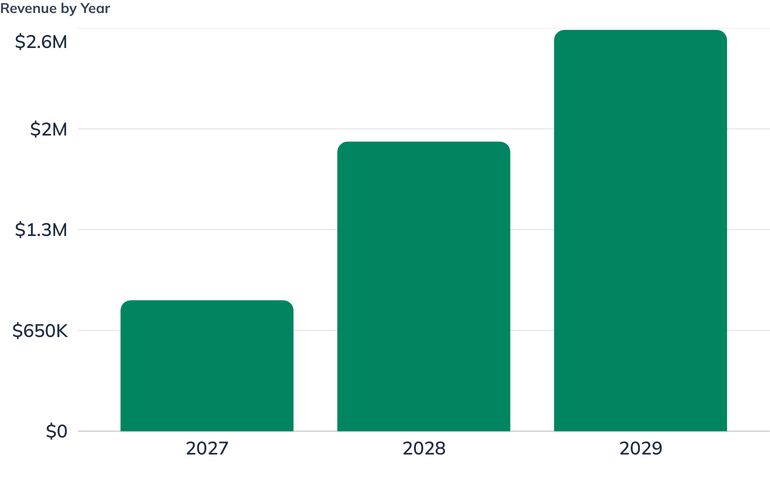
Need real financials? We recommend using LivePlan as the easiest way to create financials for your own business plan.Create your own business plan
Expenses & Costs
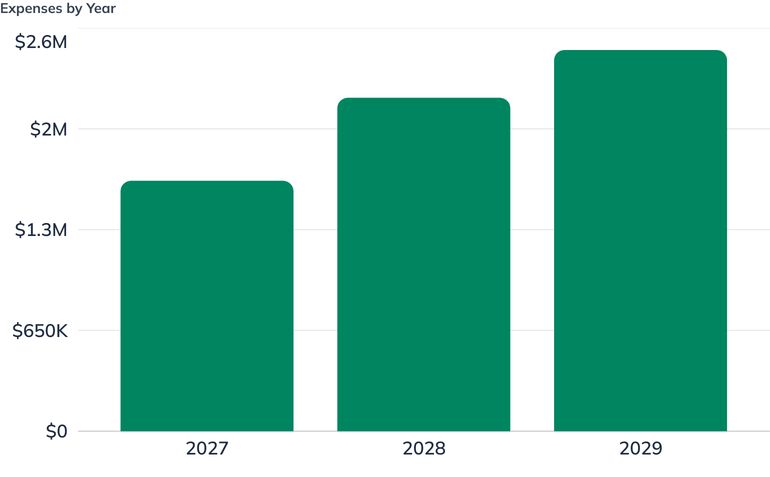
Need impressive charts? Discover the simplest way to create detailed graphs for your business plan.Create your own business plan
Profitability
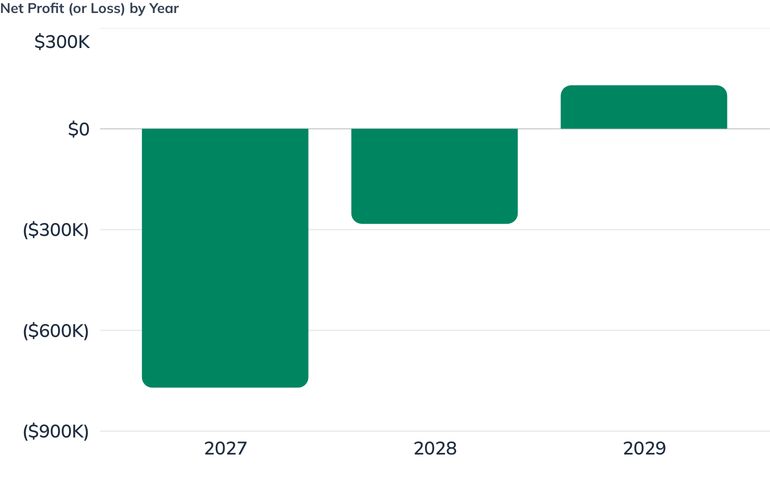
Need real financials? We recommend using LivePlan as the easiest way to create financials for your own business plan.Create your own business plan
Use of Funds
The $1,825,000 raised is deployed across two categories: $667,000 in capital assets and $1,158,000 in working capital that funds the buildout period and the ramp to profitability. The working capital share is deliberately the larger of the two, and that is the most important thing to understand about this plan.
Capital assets — $667,000
Item | Amount | Timing |
|---|---|---|
Leasehold improvements — medical buildout, net of tenant improvement allowance | $420,000 | Jan 2027 |
Medical equipment, point-of-care lab analyzers, and exam room fit-out | $135,000 | Feb 2027 |
Furniture, fixtures, and exterior signage | $55,000 | Feb 2027 |
IT hardware and network infrastructure | $32,000 | Jan 2027 |
Lease and utility security deposits | $25,000 | Jan 2027 |
Leasehold improvements are the largest single line and reflect a market reality: Santa Fe has effectively no purpose-built medical office inventory available for lease, so our 3,500 square feet will be a retail or general office conversion. Medical-grade buildout runs materially above standard office finish — infection control surfaces, exam room plumbing and headwall power, lead-shielded radiography walls designed by a qualified medical physicist, structured cabling, and full ADA compliance. The figure above is stated net of a negotiated tenant improvement allowance; the gross construction cost is meaningfully higher, and securing that allowance is a specific objective of our lease negotiation.
The digital X-ray system and PACS are leased rather than purchased, at approximately $2,600 per month on a 60-month term. This is a deliberate decision that removes roughly $130,000 from the capital requirement and converts it to an operating cost that scales with the clinic's life rather than sitting on the balance sheet from day one. Imaging technology also moves; a lease leaves us free to upgrade at term rather than depreciating a system we have outgrown.
Assets are depreciated over their useful lives — leasehold improvements over 120 months to match the lease term, medical equipment over 60, furniture and fixtures over 84, and IT hardware over 36.
Working capital — $1,158,000
This is what funds the business from the day the lease is signed until the month operations sustain themselves.
Pre-opening period (January–February 2027). Payroll for the founding provider and clinic manager, hiring and onboarding the opening clinical team ahead of the first patient, regulatory counsel and the facility licensure determination, credentialing service fees, licensing and permits, CLIA certification, radiography registration, EHR implementation, opening inventory of pharmaceuticals and supplies, and pre-launch marketing. Roughly $210,000.
Operating losses during the ramp (March 2027 – late 2028). The largest use of working capital by a wide margin, and the one most often underestimated. The clinic opens at approximately 8 patient visits per day and reaches the mid-thirties by the second year. Fixed costs — the full clinical team, rent, malpractice coverage, and systems — are incurred in full from opening, while revenue builds over roughly twenty months.
Accounts receivable. Insurance claims are submitted, adjudicated, and paid over a cycle measured in weeks, not days. Every dollar of growth in insured visit volume ties up cash before it releases it, and this working capital requirement grows through the entire forecast rather than resolving after the ramp.
Debt service during the ramp. Interest-only payments through the first twelve months and full amortization thereafter are paid from working capital until operations cover them.
Why the split is weighted toward working capital
The industry data on urgent care startups is consistent: total investment for a single site runs from roughly $850,000 to $1.6 million, cash-flow break-even arrives 13 to 18 months after opening, and the working capital reserve needs to fund 12 to 18 months of operation. Element Health's total sits at the upper end of that range because we are building a full-scope clinic — six exam rooms, a procedure room, on-site radiography and laboratory — and operating 72 hours a week across seven days from the day we open.
The most common way a clinic like this fails is not that it never finds patients. It is that it runs out of cash in month nine and never reaches month eighteen. We have sized working capital to make that outcome structurally unavailable, and the forecast reflects it: cash on hand never falls below approximately $173,000 at its lowest point, in December 2028, before climbing through the third year.
What we deliberately did not fund
No second location. No owner distributions during the ramp. No purchased radiography system. No in-house billing department — revenue cycle management and credentialing are outsourced to specialists paid as a share of collections, which converts a fixed overhead into a variable cost aligned with our own performance.
Sources of Funds
Element Health Walk-In is capitalized with $1,825,000, combining owner equity with an SBA 7(a) term loan. Both sources are in place before construction begins, and the full amount is committed at the outset rather than drawn in tranches — a de novo urgent care cannot pause halfway through a buildout.
The two sources
Owner equity — founding member capital contribution: $500,000 (27%)
Contributed by the founding nurse practitioner at the start of the forecast period, booked as paid-in capital with no repayment obligation. A 27% equity injection is at the level an SBA lender expects for a startup with no operating history and no real estate collateral, and it is what makes the loan request underwritable. It also means the business is not carrying debt service against 100% of its capital structure through the ramp, which is what kills most thinly capitalized clinic startups in their second year.
SBA 7(a) term loan: $1,325,000 (73%)
- Rate: 10.25% (variable, priced at prime plus a spread within the SBA maximum)
- Term: 120 months, fully amortizing
- Structure: 12 months interest-only from funding, then principal and interest for the remaining 108 months
- Security: all business assets, plus a personal guarantee from the founding member and key person life insurance assigned to the lender
- Payments: roughly $11,300 per month during the interest-only period, rising to approximately $18,500 per month once amortization begins in 2028
The twelve-month interest-only period is the single most important term in this facility. It aligns the start of principal repayment with the point at which the clinic is generating meaningful collections, rather than demanding full debt service during the months when we are building out, credentialing, and seeing eight patients a day. This is a standard accommodation for a de novo healthcare startup and one we negotiate for explicitly.
Why this mix
The 27/73 equity-to-debt split reflects three judgments.
First, an SBA 7(a) loan is the correct instrument for this business. It offers a ten-year term on a working-capital-and-equipment package that a conventional commercial lender would want repaid in five, and the longer amortization is what keeps monthly debt service survivable through the ramp.
Second, we are not raising outside equity. Element Health is a single-site, clinician-owned operating business with a defined market and a defined ceiling. It does not have the growth profile that justifies giving away ownership, and taking institutional equity into a clinic creates exactly the throughput-versus-clinical-judgment pressure our governance structure is designed to prevent. A minority equity pool is reserved for the core clinical team, but that is a retention mechanism, not a fundraise.
Third, debt is cheaper than equity here even at 10.25%. The business is expected to generate a return on invested capital well above its cost of debt from the third year forward, and the founder retains full ownership of that upside.
Lender relationship
We work with an SBA-preferred lender with healthcare lending experience, ideally a New Mexico institution. We treat the lender's underwriting as free diligence on our own assumptions: a lender who has financed clinics before will tell us where our ramp diverges from what they have actually watched happen, and that is worth as much as the money.
Reserve capacity
Beyond the committed capital above, we establish a $150,000 revolving line of credit with our lender as standby liquidity, undrawn at close and not modeled in this forecast. Its purpose is to absorb a temporary payer denial cycle or a slower-than-planned quarter without forcing an operating decision we would regret. If our ramp tracks plan, it stays undrawn.
Repayment and distributions
Debt service is paid from operating cash flow throughout the forecast. No owner distributions are taken during the ramp beyond the founder's salary, which is set at a market clinical wage rather than a founder-optimism number. Once the business sustains profitability and a healthy cash position — which the forecast shows in the third year — the operating agreement provides for quarterly distributions sized first to cover members' personal tax obligations on pass-through income, and thereafter at the managing member's discretion with the cash reserve and debt covenants maintained.
Projected Statements
Key Assumptions
Every number in this forecast rests on the assumptions below. They are stated explicitly so that a reader can test them, and so that we can tell quickly which one broke if the results diverge from plan.
Timing
The forecast runs January 2027 through December 2029. The clinic opens to patients on March 1, 2027, with January and February devoted to buildout completion, equipment installation and radiography registration, hiring and onboarding the opening team, and closing out payer credentialing that began roughly six months earlier. Those two months carry full payroll for the founding provider and clinic manager and partial payroll for the clinical team, with no revenue.
Patient volume
The core driver of this model. We assume a conventional urgent care ramp:
Period | Average visits per day |
|---|---|
March 2027 (opening) | 8 |
December 2027 | 33 |
2028 full-year average | 36 |
2029 full-year average | 48 |
This totals approximately 6,100 visits in 2027, 12,900 in 2028, and 17,300 in 2029. The shape is grounded in industry ramp data — single-digit daily volume in the first quarter, 20 to 25 per day around month six, stabilizing in the 35 to 45 range across months 12 to 24 — and in the mature single-site planning range of 30 to 50 visits per day. Profitability in this industry generally requires sustaining more than 30 visits per day, which our model reaches during 2028.
Seasonality is built into the monthly detail rather than smoothed. Respiratory illness season drives December through February well above the annual average, and late spring through summer runs well below it. Our occupational health volume is deliberately counter-seasonal and helps fill the summer trough.
Revenue per visit
We model four revenue streams with distinct economics rather than a single blended visit price:
Stream | 2027 | 2028 | 2029 | Share of visits (2028) |
|---|---|---|---|---|
Insured patient visits (commercial, Medicare, Medicaid) | $138 | $145 | $150 | 72% |
Self-pay patient visits (posted pricing) | $180 | $185 | $195 | 10% |
Occupational health and employer services | $85 | $88 | $92 | 12% |
Workers' compensation injury care | $176 | $181 | $190 | 6% |
These are net collected revenue per visit, not billed charges — the figure that actually matters.
The insured rate is the assumption most worth scrutinizing. National urgent care commercial net revenue per visit runs around a median in the mid-$160s, with a wide spread by market. We plan below that because commercial coverage is a minority of our panel, but we do not plan at the depressed level a low-Medicaid-rate state would require. New Mexico's Medicaid-to-Medicare fee index stands at 1.21 — Medicaid pays more than Medicare here — and the state reset many primary care codes to 150% of the 2024 Medicare benchmark effective January 2025. Our blended net revenue per visit works out to roughly $139 in 2027, $144 in 2028, and $150 in 2029.
Occupational health is priced well below a standard urgent care visit, consistent with industry data showing employer services generating roughly 8% of revenue on 12% of volume. Workers' compensation is priced against the West region benchmark, which is the highest in the country.
Year-over-year price growth is modest — 3 to 5% annually — reflecting contracted rate adjustments and general inflation. We do not assume any real rate expansion.
Direct costs
Direct costs total roughly 14% of revenue, consistent with urgent care benchmarks:
- Medical supplies, pharmaceuticals, and PPE: 8% of revenue
- Reference laboratory, point-of-care reagents, and teleradiology reads: 4.5% of revenue
- Drug screen kits, laboratory confirmation, and Medical Review Officer fees: 18% of occupational health revenue
- Card processing on self-pay collections: 2.8% of that stream
This produces a gross margin of approximately 86%, which is normal for a clinical services business where the dominant cost is labor rather than materials.
Personnel and wages
All wages are benchmarked against published Santa Fe metropolitan area occupational wage data, escalated to the forecast period, and positioned at or above the local market midpoint. They are not benchmarked against the New Mexico state minimum wage of $12.00 per hour, nor against the City of Santa Fe Living Wage Ordinance floor, which rises to $17.50 per hour on January 1, 2027 and indexes annually thereafter. Every role in this plan sits well above both.
Role | 2027 | 2028 | 2029 | FTE by 2029 |
|---|---|---|---|---|
Founding Nurse Practitioner (owner-operator) | $150,000 | $165,000 | $190,000 | 1.0 |
Nurse Practitioner / Physician Assistant (2nd provider, from Oct 2027) | $152,000 | $158,000 | $164,000 | 1.0 |
Medical Director — physician, contracted 0.2 FTE | $58,000 | $60,000 | $62,000 | 0.2 |
Clinic Manager | $115,000 | $119,000 | $124,000 | 1.0 |
Medical Assistants (~$24–26/hour) | $50,000 | $52,000 | $54,000 | 4.0 |
Radiologic Technologist | $82,000 | $85,000 | $88,000 | 1.0 |
Patient Service Representatives (~$22–24/hour) | $46,000 | $48,000 | $50,000 | 3.0 |
The founding provider's compensation grows from $150,000 to $190,000 across the horizon, tracking the business reaching sustained profitability. Support staff are added on volume triggers rather than calendar dates: the third medical assistant in July 2027, the second provider in October 2027, the third patient service representative in January 2028, and the fourth medical assistant in January 2029.
Employer burden is modeled at approximately 20% of wages for payroll taxes, New Mexico unemployment insurance, workers' compensation, and the state Workers' Compensation Administration assessment, with employer-paid health insurance carried as a separate line running to roughly $68,000 by 2029. Combined, total employment cost runs about 28% above gross wages.
The medical director is engaged as a contracted 1099 physician at 0.2 FTE, priced against a Santa Fe family medicine physician market rate. Employing a physician full time would roughly double this line for capability we do not need on the floor every hour under New Mexico's nurse practitioner full practice authority.
Per-diem and locum provider coverage is budgeted from opening — a single founding provider cannot personally cover 72 open hours a week, and this line funds days off, vacation, and peak overlap.
Operating expenses
- Occupancy: approximately $91,000 in 2027 growing to $97,000 in 2029 — 3,500 square feet at roughly $20 per square foot base plus a $6 NNN load, reflecting Santa Fe retail and office comparables in our size band
- Marketing: $77,000 in 2027 (startup level, consistent with the industry guidance of 8–12% of first-year collections and a $50,000 minimum), stepping down to $60,000–$68,000 as organic search and reviews compound
- Revenue cycle management: 6% of collections, paid to an outsourced billing partner
- Malpractice insurance and New Mexico Patient Compensation Fund surcharge: $32,000 in 2027 rising to $52,000 by 2029, covering facility-level coverage at the $500,000 per occurrence Medical Malpractice Act qualification threshold plus individual provider coverage on an occurrence basis
- X-ray and PACS equipment lease: $2,600 per month on a 60-month term, in place of a capital purchase
- EHR and practice management (Experity): $28,000 in 2027 rising to $35,000
- Plus utilities and medical waste, business insurance, professional fees, equipment service contracts and the annual physicist survey, licensing and continuing education, and administrative supplies
Capital and funding
Capital assets total $667,000, depreciated over useful lives of 36 to 120 months. Funding totals $1,825,000 — $500,000 owner equity and a $1,325,000 SBA 7(a) loan at 10.25% over 120 months with a 12-month interest-only period. Details are in Sources of Funds and Use of Funds.
Tax treatment
Element Health Walk-In, LLC is a pass-through entity. The business itself owes no entity-level income tax; profits and losses flow to the members' personal returns, and no corporate income tax is modeled. Members' personal tax liability is covered through quarterly distributions once the business is profitable. New Mexico gross receipts tax treatment of medical services is confirmed with our accountant; the deductions available to healthcare providers under New Mexico law are specific and are not modeled as a revenue reduction here.
What the model produces
2027 | 2028 | 2029 | |
|---|---|---|---|
Revenue | $844,000 | $1,867,000 | $2,588,000 |
Gross margin | 86% | 86% | 86% |
Net profit | −$770,000 | −$283,000 | +$129,000 |
Ending cash | $459,000 | $173,000 | $287,000 |
The clinic reaches its first profitable month in December 2028, approximately 22 months after opening, and delivers a full profitable year in 2029 at roughly a 5% net margin — consistent with the mature single-site urgent care benchmark of around 8% operating margin before debt service, which in our case absorbs the difference.
Cash on hand never goes negative at any point in the forecast. The low point is approximately $173,000 in December 2028, after which cash climbs.
The assumptions most worth stress-testing
- Visit volume. Five fewer visits per day at plan revenue is roughly a $22,000 monthly revenue gap. This is the assumption with the most leverage over every other number in the model.
- New Mexico Medicaid rates holding. Our full-panel participation depends on the state's current Medicaid-to-Medicare fee index. A reversal would require rebalancing the payer mix.
- Credentialing completing on schedule. The forecast assumes we can bill from the day we open. Every month of delay is a month of uncollectible revenue against full fixed costs.
- Payer contracts staying fee-for-service. A conversion to bundled per-visit case rates would eliminate the ancillary contribution from on-site imaging and laboratory.
- Clinical hiring in a thin local labor pool. The forecast assumes we can hire and retain at the wages modeled. In a metropolitan area employing only a few dozen radiologic technologists, that is an assumption and not a certainty.
Frequently Asked Questions
An urgent care business plan should resolve the facility licensure question for your state, define your payer mix and credentialing timeline, size the working capital that carries the clinic through its volume ramp, and show how you compete against the emergency department rather than with it. Element Health Walk-In's plan works through New Mexico's 8.370.18 NMAC licensure determination, its full-panel payer strategy, a staffing model built on a founding nurse practitioner with full practice authority and a contracted physician medical director, and a $1,825,000 capitalization weighted deliberately toward working capital rather than equipment.
Industry data puts total investment for a single urgent care site at roughly $850,000 to $1.6 million. Element Health Walk-In raises $1,825,000 — deployed as $667,000 in capital assets and $1,158,000 in working capital — because Santa Fe has effectively no purpose-built medical office inventory, so its 3,500 square feet requires a full medical-grade conversion including lead-shielded radiography walls. The clinic leases its digital X-ray system and PACS at about $2,600 per month rather than buying, which keeps roughly $130,000 off the capital requirement.
Yes, and the requirements stack across several agencies. Element Health Walk-In's plan budgets for a facility licensure determination under New Mexico's 8.370.18 NMAC outpatient facility rules, a CLIA Certificate of Waiver at $248 on a two-year cycle through the New Mexico Health Care Authority, registration of the X-ray machine with the New Mexico Environment Department Radiation Control Bureau before first use, and individual provider licenses through the New Mexico Medical Board or Board of Nursing alongside federal DEA and state controlled substance registrations. Entity formation as a New Mexico LLC, a CRS number for gross receipts tax, City of Santa Fe build permits, and payer credentialing round out the pre-opening list.
Urgent care revenue is driven by visit volume multiplied by net collected revenue per visit, with ancillary imaging and laboratory testing lifting the average on a meaningful share of encounters. Element Health Walk-In bills commercial plans, Medicare, all four New Mexico Turquoise Care Medicaid managed care organizations, and posted-price self-pay patients, then layers on an employer-invoiced occupational health book — DOT and pre-employment physicals, drug and alcohol screening, and workers' compensation injury care — that arrives by appointment and smooths weekday volume independent of flu season. The clinic opens at roughly 8 patient visits per day and plans to reach the mid-thirties by its second full year.
Cash-flow break-even for a new urgent care site typically arrives 13 to 18 months after opening, and profitability generally requires sustaining more than thirty visits per day. Element Health Walk-In's forecast follows that shape: revenue builds over roughly twenty months while the full clinical team, rent, malpractice coverage, and systems are carried at full cost from day one, with sustained profitability and a healthy cash position arriving in the third year. That is exactly why the plan sizes its working capital reserve to fund 12 to 18 months of operation rather than to the projected break-even month.
Santa Fe County's roughly 155,000 residents are served by a single hospital emergency department at CHRISTUS St. Vincent, a Presbyterian multi-specialty facility oriented toward its own health plan members, and a handful of independent clinics with narrow hours. Element Health Walk-In's defensible position is the intersection of four things no single competitor there offers together: 72 hours a week including every evening, on-site imaging and laboratory testing that closes the diagnostic loop in one visit, participation with every major payer in the market, and self-pay prices posted on the wall and on the website. Its marketing message is explicitly “know where to go” — it targets the low-acuity emergency department volume that should never have been there.
The plan segments Santa Fe into five groups shaped by a coverage mix unlike most of the country: Medicaid covers roughly 34% of New Mexicans, Medicare another 16%, and about 9% are uninsured. The core segments are commercially insured working adults aged 25 to 54 who choose on wait time and online reviews, hospitality and construction workers with high-deductible or no coverage, older residents in a county whose median age runs well above the national figure, Spanish-speaking households in a population that is roughly half Hispanic or Latino, and employer accounts sending staff for occupational health services.
Because the usual reason to decline a Medicaid panel does not hold in New Mexico. The state's Medicaid-to-Medicare fee index sits at 1.21, among the highest in the nation, and many primary care codes were reset to 150% of the Medicare benchmark effective January 2025. Contracting with all four Turquoise Care managed care organizations gives Element Health Walk-In access to the single largest coverage group in the state at rates that support its cost structure, while competitors compete over a smaller commercial pool.

Business Plan Outline
Start your plan