





Self-Storage Business Plan



Business Plan Summary
This self-storage business plan example features Westbury Storage, Inc., a proposed 300-unit facility converting a century-old brick building into 45,000 square feet of heated storage in Westbury, New York, led by owners Roger Black, Sebastian Stote, and Daley Thompson. It covers the company's $1,054,487 project funded through owner equity and a commercial mortgage, its referral pipeline from co-owner Sebastian Stote's moving company, and a three-year occupancy ramp from about 70% to 97%. Use it as inspiration for your own plan. Download a free business plan template to get started, or browse more business plan examples.
Westbury Storage, Inc.
Executive Summary
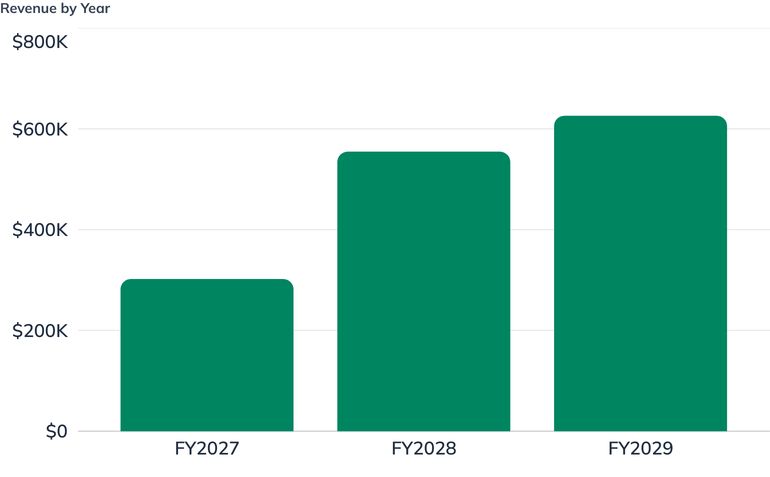
This storage business plan describes a proposed self-storage facility to be established in Westbury, New York involving the conversion of an existing building. Total project costs are estimated at $1,054,487 including purchase price, conversion costs, and pre-opening expenses (see section on Start-up Summary). Units are offered across three size tiers — Small, Medium, and Large — priced and modeled as monthly subscriptions with a realistic 10% monthly churn rate. Based on current and projected strong demand for self-storage units, rental revenue is projected to grow from the first year's target of approximately $302,000 to approximately $626,000 by year three.
The keys to success in the self-storage business are:
- To provide dry, secure, and clean facilities with convenient access.
- To have good connections in the moving industry to direct customers needing temporary storage space.
- To be able to adapt as storage and market needs change.
The mission of the principals is to serve the Long Island community's local residential and commercial storage and moving needs.
After achieving experience and success in their present self-storage facility in Plainview, New York the principals of this proposed project plan to take advantage of the strong demand in the self-storage industry to achieve a major presence in Westbury. The ownership connection with Stote Moving will assist in gaining full occupancy quickly. Across the three unit tiers (Small, Medium, and Large), the company targets roughly 70% combined occupancy of the proposed 300 unit spaces by the end of Year 1, climbing to the low-90% range by Year 2 and approximately 97% by Year 3, as steady new sign-ups continue to outpace the industry-typical 10% monthly churn rate.
Opportunity

Problem Worth Solving
The Westbury area faces a significant shortage of self-storage capacity. Local residents and small businesses need reliable, safe, dry, and accessible storage facilities — especially during moves, renovations, or when storing excess household or commercial property. Surveys of existing facilities show near-full occupancy and rates well above national averages, indicating that demand substantially exceeds local supply.
Residential customers need temporary storage while relocating or long-term space for oversized items that do not fit in garages. Small commercial customers need convenient storage for inventory, samples, and merchandise. In both segments, convenient location is the primary buying criterion, and customers are less price-sensitive when supply is constrained.
Our Solution
Westbury Storage will provide short- and long-term self-storage in the heart of Westbury and the surrounding North Shore Long Island community. Converting a solid three-story, 1910 brick building into approximately 45,000 square feet of heated, well-lit storage units, we offer residential and small-business renters a dry, secure, and easily accessible alternative to the mostly unheated, aging inventory currently available nearby.
Our ownership group brings direct operating experience: Roger Black and Sebastian Stote co-own Plainview Storage, a fully-occupied 110-unit facility, and Sebastian Stote also owns Stote Movers, a Long Island moving company operating since 1917. That relationship gives Westbury Storage a built-in referral channel — moving customers who need short-term storage are directed to us before they ever search for a facility on their own.
Renters can reserve and pay for a unit online through our storage management platform (storEDGE), check availability in real time, and access their unit using an app-based keypad entry system — a step up from the manual sign-in process still used at most competing facilities in the area. Combined with an oversized passenger elevator serving all three floors and in-unit electric outlets for hobby and workshop use, Westbury Storage is built to compete on convenience and service quality, not just on the current supply shortage.
Competitive Comparison
All self-storage facilities that could be found in Westbury or the area bordering Westbury were surveyed with the following results:
Name | Size | Price |
|---|---|---|
Oliver St. Mini Storage | 5X10 | $48 |
E-Z Mini Storage | 5X5 | $37 |
S. Centreport | 5X10 | $67 +$25 deposit |
Extra Space Storage | 5X5 | $49 + $9 fee |
– | 10X10 | $106 (second floor) |
– | – | $139 (ground floor) |
Washington | 8X6 | $50 |
47 State | 9X9 | $50 (second floor) |
Public Storage | 5X5 | $35 |
Merrick Road. | 5X10 | $55 |
North Shore Self | 5X5 | $45 + $5 fee |
Storage | 5X10 | $70 (second floor) |
U-Haul | 5X10 | $42.95 |
Prices average at $1.20 per sq. ft. per month. Mean price is closer to $1.40.
Market Overview
In a similar split experienced by management’s existing storage facilities, Westbury Storage is expecting to rent 70% of its available units to non-commercial renters and the remaining 30% to the commercial sector of the market. A total of 300 self-storage units of various sizes will be created and offered for rent by Westbury Storage in a central location in downtown Westbury. The present supply of these units is insufficient to meet the demand as evidenced by a survey of all self-storage facilities within easy reach of Westbury residents. The price realized by these existing units is more than double the national average.
Main Competitors
The Competitive Comparison table lists every self-storage facility identified within easy reach of Westbury, spanning national chains (Public Storage, Extra Space Storage, U-Haul) and independent local operators (Oliver St. Mini Storage, E-Z Mini Storage, Washington Storage, 47 State, North Shore Self Storage). Every facility surveyed reported near-full occupancy, and several keep waitlists rather than posting current vacancies online. In practical terms, that means Westbury Storage's near-term competition is less about winning customers away from a rival and more about being ready — with heated, elevator-served units and an online reservation system — the moment new capacity is needed in the market.
Business Participants
The self-storage industry includes both large publicly traded operators and small independent facilities, and Westbury will see both. Nationally, REITs such as Public Storage, Extra Space Storage, CubeSmart, and U-Haul dominate market share and brand recognition, and several already operate locations within reach of Westbury (see Competitive Comparison). Independent, family-run facilities — the more common model on Long Island — make up the rest of the local supply and typically compete on relationships and location rather than national marketing budgets.
Westbury Storage falls into this second category. As an independent operator backed by an established moving company (Stote Movers) and a proven facility (Plainview Storage), the company can move faster on pricing and service decisions than a REIT-owned location while still offering the online reservation and app-based access convenience customers now expect from any storage provider, large or small.
Main Competitors
Should local supply catch up with demand, competition would most likely intensify along two lines: national chains adding capacity through new construction or acquisition, and technology-forward independents differentiating on digital convenience — online booking, keyless entry, and video monitoring — rather than price alone. Westbury Storage's plan to launch with online reservations, app-based unit access, and heated units puts it ahead of most of the independent operators surveyed, and on par with the amenities offered by the national chains, without their overhead.
The company's referral relationship with Stote Movers also gives it a durable acquisition channel that a new entrant without a moving-company connection would need years to replicate, which should insulate occupancy even if the broader supply-demand balance shifts.
Market Needs
Customer needs in the self-storage industry have certain similarity across different market segments. The underlying need is for a reliable, safe, dry and accessible self-storage facility. Due to the overwhelming demand, customers are less price sensitive and consider convenient location as the major buying decision criterion.
Residential customers use self-storage facilities to temporarily store their property while moving to a new location. This need originates in the mobility of the American population and the affordability of rental accommodations. Such customers usually rent 25 to 100 square feet depending on the size of their household and they rent on a weekly or monthly basis. The other cluster of residential customers rents self-storage facilities for longer periods to keep their oversize property like boats or other equipment that either does not fit in their garages or is not used on a constant basis.
Small business customer segment requires self-storage facilities to temporarily store their stock or merchandise. These customers may use the storage facilities more often than residential customers and they benefit from convenient loading areas, extended operating hours and better equiped storage units of bigger size.
Target Market Segment Strategy
Since demand for local self-storage substantially exceeds supply, Westbury Storage will market simultaneously to its two primary customer segments — residential renters and small businesses — rather than sequencing one before the other. The company will not pursue large commercial accounts, which require a scope of service (freight elevators, loading docks, bulk-rate contracts) beyond what a single 45,000-square-foot facility can support.
Local self-storage rates run well above national averages, so Westbury Storage will position itself as a conveniently located, full-service facility rather than compete purely on price. The company will reach both segments through a Google Business Profile and local SEO presence, listings on storage marketplaces such as SpareFoot and Neighbor, and — most importantly — referrals from Stote Movers, whose customers are already in the market for storage at the exact moment they need it. Local newspaper advertising will supplement these channels around the facility's opening.
Competition and Buying Patterns
Convenience is probably the single most import factor in the decision of where to rent a self-storage unit. For example, Hicksville and Huntington have no self-storage facilities. Residents choose to rent one in a nearby town probably based on proximity to the route taken by the renter to and from work. If no units are available nearby, then renters will travel further afield. Units on the ground floor are favored, especially if no elevator is available.
Service Business Analysis
According to an article in the November 15th issue ofInside Self-storagethe national industry average rental income generated by self-storage units is $6.00 per square foot per year, or $.50/sq. ft. per month. In the market to be served by Westbury Storage the average storage rate (see section on Competitive Comparison) is more than double this amount. Washington Storage in Westbury is a typical example. They charge $50/month for an 8X6 ft unit which works out to $12.50 per sq. ft. per year. A 9X9 unit on the second floor also rents for this same amount only because there is no elevator. All of their units are fully rented! All units within the area were surveyed. The average rate is $1.20/sq. ft. per month ($14.40 per year) and the mean was closer to $1.40/sq. ft. per month ($16.80 per year). The story concerning availability was uniform. Either the facility was full or only had one or two available units to chose from. E-Z Mini Storage in S. Centreport said, “There’s some turn-over at the end of every month. Leave your name and we will call you when one becomes vacant.” Extra Space Storage in Springfield said, “We need one week advanced notice.” North Shore Self-Storage said, “We have nothing available on the ground floor.” U-Haul reported, “We have one small unit available, otherwise we are all full.”
The self-storage industry really only started in the late 1960’s when a few far-sighted people recognized the growing need for residential and commercial storage. The industry has doubled in size each decade. Returns on investment have been very impressive–often twice that of other forms of real estate investment. The reasons for this have been the mobile society, the tendency to live in rental apartments, and the general increase in the accumulation of property, especially leisure articles such as skis, wind-surfers, exercise equipment, etc.
The industry lends itself relatively easily to financial modelling. The magazine article mentioned earlier explains the economics of an average self-storage project which is of similar size to the proposed Westbury Storage project. The total building square footage in the model is 41,000 (Westbury Storage is approximately 45,000 after deducting the office space portion of 9,600 sq. ft.). The model shows total gross income based on $6.00/sq. ft. or $240,000 annually. (Westbury Storage’s gross revenues will be more than double that.) Total project costs for the model come to over $1,150,000 versus $1,054,500 for Westbury Storage. The loan amounts are virtually the same as well as the interest rates used (8.5%). Normal operating costs generally come to about $2.00 per sq. ft. Westbury Storage’s operating costs are projected at nearly twice this amount due to generous provisions for maintenance and payroll. However, the model’s net operating income is slightly less than $4/sq. ft. versus Westbury Storage’s $11.40/sq. ft.
It could be argued that the higher than national average rates enjoyed by local self-storage facilities may not continue indefinitely, but there is no indication of any downward pressure at this time. It should also be pointed out that during an economic down-turn the self-storage industry does not suffer to the extent that other industries suffer.
Should the supply of self-storage units begin to outstrip demand, Westbury Storage should be well positioned to deal with the competition due to its ability to offer heated units (nearly all competing units are unheated) and its ability to supply electric outlets to individual units (for hobby/workshop purposes).
Market Segmentation
Self-storage units are needed by residential customers for storage of personal items as well as by commercial customers for storage of stock. It is envisaged that 70% of the planned self-storage units will be taken up by the residential segment of the market and the remaining 30% will be directed toward the commercial segment. This split is expected based on the existing customers of management’s present self-storage facilities in Plainview. The commercial segment are small businesses, many of which are run out of people’s homes such as an interior designer who needs space to store hundreds of expensive sample fabric books, or a retail shop with inadequate on premises storage.
The market research shows that the annual market potential for the commercial self-storage service in the Westbury area is about 10,000 customers. As stated above, these are mostly small businesses. The residential segment potential is substantially higher at 150,000 customers per year and is based on the Self Storage Association’s assumption that 40% to 55% of population has used self-storage facilities. This estimate includes individuals who need storage facilities due to moving arrangements or to store excess household property. Both of the market segments are expected to grow at a 5% annual rate. The table and chart below outline the market potential for the both customer segments.
Market Analysis | |||||||
|---|---|---|---|---|---|---|---|
Year 1 | Year 2 | Year 3 | Year 4 | Year 5 | |||
Potential Customers | Growth | CAGR | |||||
Commercial | 5% | 10,000 | 10,500 | 11,025 | 11,576 | 12,155 | 5.00% |
Residential | 5% | 150,000 | 157,500 | 165,375 | 173,644 | 182,326 | 5.00% |
Total | 5.00% | 160,000 | 168,000 | 176,400 | 185,220 | 194,481 | 5.00% |
Competitors
Westbury Storage competes in a supply-constrained local market served by a mix of national chains and independent operators (full list and pricing in Competitive Comparison). Because every facility surveyed in the area is at or near full occupancy, the near-term competitive dynamic favors any operator that can bring new, well-located capacity online quickly and run it well — which is exactly Westbury Storage's plan.
Longer term, the company's competitive position rests on three things existing local facilities mostly lack: heated units, an elevator serving all three storage floors, and a modern online reservation and access system. Add to that a referral pipeline from Stote Movers, an established Long Island moving company, and Westbury Storage is positioned to compete on service and convenience even after the current supply shortage eases.
Execution
Market Plan Overview
Westbury Storage's marketing strategy starts from a simple fact: local self-storage facilities are already running near full occupancy, so the job is not persuading skeptical customers but making sure Westbury Storage is the first facility they find and the easiest one to book.
The company will build a Google Business Profile and local SEO presence so the facility surfaces in "self storage near me" searches, list availability on storage marketplaces like SpareFoot and Neighbor, and lean on its referral relationship with Stote Movers, whose moving customers are a built-in, ready-to-convert audience. Local newspaper ads will run around the December opening to build awareness in the immediate community, with spend scaled back once the facility approaches full occupancy.

The Upscale Transitioner
Sarah Jenkins
Sarah is a high-earning professional living in Old Westbury who is currently overseeing a major home renovation. She needs a secure, climate-controlled environment for her high-end furniture and art during the construction process.
Age
48
Location
Old Westbury, NY
Family Status
Married, 2 children in college
Education
Juris Doctor (JD)
Profession
Partner at a Manhattan Law Firm
Opportunities
- Market specialized humidity and temperature-controlled units specifically for high-value wooden furniture and delicate items.
- Partner with high-end white-glove moving services to offer a seamless 'pack-and-store' experience for busy professionals.
- Highlight advanced surveillance and individual unit alarms to appeal to her need for peace of mind regarding expensive assets.
Pain Points
- Local facilities are currently at 100% capacity
- Concerned about the lack of cleanliness in older, existing storage buildings
- Frustrated by the need to drive long distances to find available premium units
Needs
- A facility that reflects the high standards of her neighborhood
- Easy digital access and management of her account
- Short-term flexibility during her 6-month renovation project
“I'm not looking for the cheapest price; I'm looking for a place where I don't have to worry about my grandmother's antiques getting ruined.”

The Inventory Strategist
Marcus Rivera
Marcus runs a rapidly growing e-commerce business specializing in vintage sneakers. He has outgrown his home office and needs a central, accessible location to store inventory and manage daily shipments.
Age
34
Location
Westbury, NY
Family Status
Single
Education
Bachelor's in Marketing
Profession
E-commerce Business Owner
Opportunities
- Provide a designated area for package pickups and a small workstation with WiFi to facilitate his daily operations.
- Offer the ability to easily move between 5x10 and 10x10 units as his inventory fluctuates seasonally.
- Implement secure, round-the-clock access to accommodate his non-traditional working hours.
Pain Points
- Commercial warehouse leases in the area are too large and expensive
- Inventory is currently cluttering his living space and impacting his productivity
- Existing local storage rates are double the national average, eating into his margins
Needs
- A central downtown location to minimize travel time between home and inventory
- Dry, well-lit spaces to ensure product photos can be taken on-site
- Reliable loading docks or easy-access ground floor units
“My business is taking over my apartment. I need a professional 'hub' in Westbury that doesn't require a five-year commercial lease.”

The Multi-Generational Organizer
Elena Rodriguez
Elena lives in a high-density household in Westbury Village with her husband, their adult son, and her elderly mother. She needs to reclaim space in their home by moving seasonal items and family heirlooms to a nearby facility.
Age
55
Location
Westbury Village, NY
Family Status
Married, multi-generational household
Education
Master's in Healthcare Administration
Profession
Senior Administrator at NYU Langone Long Island
Opportunities
- Offer discounted rates for customers who commit to 12+ months of storage for family keepsakes.
- Sell or rent heavy-duty shelving units and bins on-site to help families maximize their vertical storage space.
- Leverage her deep community ties by offering 'refer-a-neighbor' credits to drive word-of-mouth growth.
Pain Points
- The 2.97 persons-per-household density makes her home feel claustrophobic
- Garage is overflowing with sports gear and holiday decorations, preventing car parking
- Struggles to find reliable local units that feel safe for her to visit alone in the evening
Needs
- A location within a 5-minute drive of her home
- Bright, well-lit hallways and a strong sense of personal safety
- An easy-to-use mobile app for gate access and bill pay
“With three generations under one roof, we love our family time, but we desperately need our space back.”
Strategic Alliances
The company's most important strategic alliance is its common ownership with Stote Movers, a Long Island moving company operating since 1917. Because Stote Movers is in daily contact with people relocating — exactly the moment someone is most likely to need temporary storage — it can direct a steady stream of qualified leads to Westbury Storage at effectively no acquisition cost. This same relationship model has already proven out at Plainview Storage, the owners' existing 110-unit facility, which stays fully rented in large part through Stote Movers referrals.
Milestones
The following table shows the milestones that Westbury Storage has established.
Milestones | |||||
|---|---|---|---|---|---|
Milestone | Start Date | End Date | Budget | Manager | Department |
Purchase Building | 6/1/2026 | 6/1/2026 | $550,000 | Black/Stote | Mngmt |
Elevator Contract | 7/1/2026 | 7/1/2026 | $89,760 | Black/Stote | Mngmt |
Conversion Contract | 7/1/2026 | 7/1/2026 | $300,000 | Black/Stote | Mngmt |
Opening Ads | 12/15/2026 | 12/15/2026 | $1,000 | Black/Stote | Mngmt |
Brochures/Stationery | 12/15/2026 | 12/15/2026 | $6,000 | Black/Stote | Mngmt |
Totals | $946,760 |
Sales Strategy
Most inquiries will arrive through the facility's Google Business Profile, its listings on storage marketplaces such as SpareFoot and Neighbor, and online reservation requests submitted directly through the storEDGE booking system. Even with demand outpacing supply, a slow reply to an online inquiry or an unfriendly phone call will cost the company a sale it should have won — so response time and professionalism on every channel matter as much as the underlying supply shortage.
As at the owners' existing Plainview Storage facility, a significant share of sales will continue to come through Stote Movers, whose moving crews are in daily contact with people who need short-term storage. That referral channel, combined with a fast, self-service online booking process, is expected to fill the facility faster than either channel could on its own.
Competitive Edge
Although the current local demand exceeds the supply and Westbury Storage will have no problems fully utilizing its capacity, the market situation may change in the future. The company will fully utilize its management’s seasoned experience in the storage business in order to establish a strong foothold in the local community. This will be reached by providing excellent service and offering extra service features like the heated and well-lit rental units, which will supplement the great location of the storage facility.
To develop good business strategies, perform a SWOT analysis of your business. It's easy with our free guide and template.Learn how to perform a SWOT analysis
Sales Plan
Westbury Storage offers three unit-size tiers, modeled as monthly subscriptions to reflect the recurring, renewal-driven nature of self-storage revenue — including a realistic 10% monthly churn rate as tenants move out, downsize, or relocate.
Tier | Approx. Size | Monthly Price | Target Capacity |
|---|---|---|---|
Small | ~5x10 (50 sq. ft.) | $110/month | 150 units |
Medium | ~10x10 (100 sq. ft.) | $200/month | 100 units |
Large | ~10x20 (200 sq. ft.) | $360/month | 50 units |
Larger units command a higher monthly price in absolute terms, consistent with the additional square footage, even though the per-square-foot rate declines slightly at larger sizes — a standard self-storage pricing pattern that rewards volume.
Each tier grows through a steady pace of new sign-ups (15/month for Small, 10/month for Medium, 5/month for Large) offset by 10% monthly churn as renters move out. This produces a realistic curve: meaningful early fill-up, then a gradual approach toward full capacity as new sign-ups increasingly offset departing tenants rather than adding net-new occupancy indefinitely.
Period | Annual Total |
|---|
By the end of Year 3, the facility reaches roughly 97% combined occupancy (about 292 of 300 units) — consistent with the strong, supply-constrained local demand described elsewhere in this plan, while the churn model keeps the projection grounded in how tenants actually come and go rather than assuming a one-way ramp to permanent full occupancy.
Referrals from Stote Movers and administration fees, deposits, and moving-supply sales continue to provide supplemental revenue and offset credit losses, as noted elsewhere in this plan.
Locations and Facilities
Westbury Storage will be located in Westbury, in a central location about 1/2 mile from the monument in the center of Westbury. The facility occupies a large brick building originally constructed around 1910, with three floors of heavy-duty wood and steel beam construction ideally suited to self-storage units.
The building measures 240 ft. × 80 ft., with a section at one end (40′ × 80′ per floor) reserved for future offices. Total rentable self-storage space is approximately 45,000 square feet across three floors (~15,000 sq. ft. per floor after partitioning and walkways).
Key facility features:
- Heated units — oil heating, a competitive advantage over most local unheated facilities
- Oversized passenger elevator — transports storage contents to second and third floor units
- Electric outlets in individual units for hobby/workshop purposes
- Separate parking lot — included with building, potential for future expansion
- Operating hours — 7 a.m. to 7 p.m. Monday–Friday, 9 a.m. to 5 p.m. Saturday, closed Sunday
Technology
Westbury Storage runs on storEDGE, a cloud-based self-storage management platform that handles online reservations, unit assignment, automated billing, and delinquency tracking — the same category of system used at the owners' existing Plainview Storage facility, at a cost of roughly $300 per month. Customers can browse available units, reserve online, and set up autopay without a phone call or site visit.
Unit access is controlled through an app-based keypad entry system tied to each renter's account, so access can be granted or revoked in real time as leases start, renew, or end. Security is reinforced with a network of security cameras covering entrances, hallways, and the parking lot, supplementing on-site night guard coverage. Each of the three storage floors is lit with low-draw, energy-efficient LED fixtures, and an oversized passenger elevator moves customers and their belongings between floors. Individual units include electric outlets for hobby and workshop use, and the building's oil heating system keeps every unit dry and heated — a feature most local competitors, which store goods in unheated space, don't offer.
Equipment and Tools
Major equipment and tools for the facility include:
- Oversized passenger elevator ($89,760) — installed in one of two existing elevator shafts for transporting storage contents between floors
- Oil heating system — maintains heated storage units, a key differentiator from competitors
- Low-draw tube lighting — energy-efficient lighting throughout all storage floors
- Security systems — night watchman coverage and building access controls
- Moving supplies — cardboard boxes, tape, packing materials, storage containers, and plastic mattress covers available for sale to customers
Milestones
Purchase Building Purchase the Westbury building for conversion to self-storage. Budget: $550,000. | Black/Stote June 1, 2026 |
Conversion Contract Building conversion to self-storage units. Budget: $300,000. | Black/Stote July 1, 2026 |
Elevator Contract Contract for oversized passenger elevator installation. Budget: $89,760. | Black/Stote July 1, 2026 |
Brochures/Stationery Produce brochures and stationery for facility opening. Budget: $6,000. | Black/Stote Dec 15, 2026 |
Opening Ads Launch opening advertising campaign. Budget: $1,000. | Black/Stote Dec 15, 2026 |
Key Metrics for Success
Westbury Storage will track these financial and operational benchmarks:
Metric | Year 1 Target | Year 2 Target | Year 3 Target |
|---|---|---|---|
Net Profit Margin | 8.2% | 48.7% | 53.9% |
Combined Occupancy Rate | ~72% (end of Y1) | ~93% (end of Y2) | ~97% (end of Y3) |
Monthly Revenue Break-even | ~$23,800 | ~$23,800 | ~$23,800 |
Monthly Subscriber Churn | 10% (all tiers) | 10% (all tiers) | 10% (all tiers) |
Occupancy milestones: With three unit tiers (Small, Medium, Large) each growing through steady new sign-ups net of 10% monthly churn, combined occupancy reaches roughly 216 of 300 units by the end of Year 1 and approximately 292 of 300 units by the end of Year 3.
Cash flow: Positive net cash flow from operations beginning in Year 1, with cash balance growing to approximately $684,000 by the end of the forecast period.
Company
Ownership and Structure
Westbury Storage is a start-up project to be located in Westbury. The owners are experienced in the moving and storage field, owning a well-established moving company (Stote Movers) and a successful self-storage facility in nearby Plainview (Plainview Storage). The building to be purchased for this project is a large brick building originally constructed as a bleachers around 1910. This building as well as surrounding buildings, were connected with the now dying leather industry which flourished a few decades ago. A large building of similar size located next door and connected by a walk bridge has already been converted successfully and is operating well. The Westbury Storage building contains three floors of heavy-duty wood and steel beam construction ideally suited to the planned purpose of self-storage units. The building is heated by oil. One of the two elevator shafts will be the home for a new over-sized passenger elevator suitable for transporting storage contents from the ground level to the units on the second and third floors. A large separate parking lot area comes with the building but will not be needed for this project. This lot could be sold or could be the site of additional future storage units to be set up using one of several one-story steel storage systems.
It is estimated that, with purchase of the building taking place in June of this year, the conversion into storage units could be completed and ready for occupancy by the end of the year. Demand for the units is strong, as evidenced by the market survey of existing self-storage facilities. Bank financing for 70% of the project costs is expected with the remainder supplied by shareholder equity.
Start-up Summary
Advertising and promotion will combine digital marketing with a smaller local print presence. We assume $495 per month for a Google Business Profile, local SEO, and paid listings on storage marketplaces such as SpareFoot and Neighbor — a modern equivalent of the three-directory print advertising this budget once funded. Local newspaper ads in Long Island community papers are estimated at $300 monthly for the first year only; they will be reduced by half in year two and phased out by year three once organic search traffic and Stote Movers referrals are carrying most of the lead volume.
Property taxes ($11,946) are projected at the actual rate of the last tax year. Significant increases are not expected.
Building maintenance is normally a very substantial item on a building of this size built in 1910. However, the roof has been completely redone fairly recently and the basic structure of the building is very robust. The start-up costs reflect adequate amounts to ready the building for opening in good order. Also, it should be noted that expenditures for building maintenance would need to be larger if the building were being used for offices rather than storage. We assume an annual amount for maintenance equal to 5% of the purchase price which works out to $27,500.
- Water and sewer assumed at historical levels of $262 per year.
- Westbury Municipal Light's bills totalled $13,714 last year when the present tenant was operating production with full staffing. As a self-storage facility electricity is needed only to power the rows of low-draw tube lighting and the security camera network. We estimate electricity to run about $250/month.
- Fuel oil for heating ran $13,881 last year. Since as a self-storage facility the level of heating does not need to be nearly as high, we estimate an annual bill of half this amount, or $7,000.
- Trash removal is projected at historical levels of $536 per year.
- The total for utilities is estimated to be $900 monthly.
Insurance: Property and Liability Insurance amounted to $15,000 annually for the present tenant. We'll assume the same annual cost.
Telephone: We assume the telephone and customer inquiry lines to amount to $150/month.
Bookkeeping/auditors/legal: Bookkeeping and billing will be handled by the storEDGE platform, the same system used at Plainview Storage, at a rate of $300 per month. Auditor charges will run about $4,000 annually.
Start-up | |
|---|---|
Requirements | |
Start-up Expenses | |
Legal | $3,000 |
Stationery, etc. | $500 |
Brochures | $1,500 |
Consultants | $2,000 |
Insurance | $4,000 |
Rent | $0 |
Guard/Supervision | $15,000 |
Other | $23,739 |
Total Start-up Expenses | $49,739 |
Start-up Assets | |
Cash Required | $18,000 |
Other Current Assets | $0 |
Long-term Assets | $986,748 |
Total Assets | $1,004,748 |
Total Requirements | $1,054,487 |
Start-up Funding | |
|---|---|
Start-up Expenses to Fund | $49,739 |
Start-up Assets to Fund | $1,004,748 |
Total Funding Required | $1,054,487 |
Assets | |
Non-cash Assets from Start-up | $986,748 |
Cash Requirements from Start-up | $18,000 |
Additional Cash Raised | $0 |
Cash Balance on Starting Date | $18,000 |
Total Assets | $1,004,748 |
Liabilities and Capital | |
Liabilities | |
Current Borrowing | $0 |
Long-term Liabilities | $691,487 |
Accounts Payable (Outstanding Bills) | $0 |
Other Current Liabilities (interest-free) | $0 |
Total Liabilities | $691,487 |
Capital | |
Planned Investment | |
Roger Black | $121,000 |
Sebastian Stote | $121,000 |
Daley Thompson | $121,000 |
Additional Investment Requirement | $0 |
Total Planned Investment | $363,000 |
Loss at Start-up (Start-up Expenses) | ($49,739) |
Total Capital | $313,261 |
Total Capital and Liabilities | $1,004,748 |
Total Funding | $1,054,487 |
Company Ownership
The company will be incorporated as an S Corporation, and will be owned by three individuals: Roger Black, Sebastian Stote and Daley Thompson. Each will own 1/3 of the stock. Roger Black and Sebastian Stote are 50-50 owners of Plainview Storage which is a 110 unit self-storage facility converted in 1993 from a former piano factory. All units are fully rented. Sebastian Stote is owner of Stote Movers, which is a family business providing residential and commercial moving since 1917. In addition to being the source of many of the rentals at Plainview Storage, Stote Movers has 52 filled 45-foot trailers located in Roslyn-by-the-Sea. These trailers contain customers’ stored goods pending delivery at a new location.
Company Locations and Facilities
The owners bring an established storage and moving footprint to this project. Plainview Storage, a 110-unit self-storage facility co-owned by Roger Black and Sebastian Stote, has operated at full occupancy since converting from a former piano factory in 1993. Stote Movers, the moving company owned by Sebastian Stote, operates from Roslyn-by-the-Sea, where 52 trailers currently hold customers' stored goods pending delivery to a new location — additional evidence of sustained, unmet demand for storage capacity in the area.
The new Westbury Storage facility itself — a converted three-story, 45,000-square-foot brick building in downtown Westbury — is detailed in the Locations and Facilities section of the Execution chapter.
Management Team
Westbury Storage will be managed directly by two of its three owners, Roger Black and Sebastian Stote, both of whom bring direct, hands-on experience in the local storage and moving industries.
Roger Black co-owns and helps operate Plainview Storage, a 110-unit self-storage facility that has run at full occupancy since its 1993 conversion from a former piano factory. He will oversee day-to-day operations at Westbury Storage, including facility maintenance, tenant relations, and the rollout of the storEDGE reservation and billing system.
Sebastian Stote co-owns Plainview Storage alongside Roger Black and separately owns Stote Movers, a Long Island moving company operating since 1917. He will manage the referral pipeline between Stote Movers and Westbury Storage and oversee pricing and leasing strategy, drawing on decades of firsthand insight into when and why Long Island residents and businesses need storage.
Daley Thompson, the company's third equal owner, provides additional capital and will serve in an advisory capacity on major financial and strategic decisions rather than day-to-day management.
Advisors
Westbury Storage will draw on a small group of outside advisors to supplement its owner-operators:
- Legal counsel — a commercial real estate attorney will handle the building purchase, zoning and occupancy compliance for the conversion, and the company's S-Corporation formation documents.
- Accounting — an outside CPA firm will handle annual audited financials, tax filings, and ongoing bookkeeping oversight alongside the storEDGE billing system.
- Insurance broker — a commercial property and liability broker familiar with self-storage risk (including bailee's/warehouse legal liability coverage) will place and review the facility's insurance program.
- Banking relationship — the company's commercial lender will be consulted on covenant compliance and future financing needs as the facility reaches full occupancy.
Financial Plan
Revenue
Need real milestones? We recommend using LivePlan as the easiest way to create milestones for your own business plan.Create your own business plan
Expenses & Costs
Need impressive charts? Discover the simplest way to create detailed graphs for your business plan.Create your own business plan
Profitability
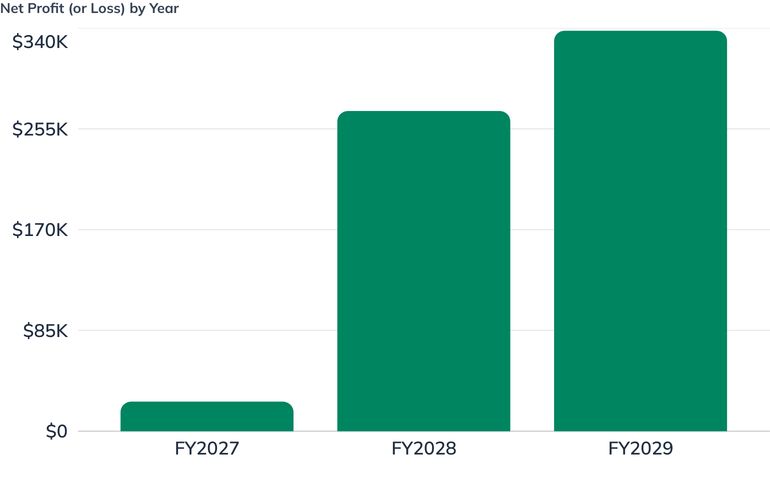
Need real financials? We recommend using LivePlan as the easiest way to create financials for your own business plan.Create your own business plan
Use of Funds
Total project costs of $1,054,487 are allocated as follows:
Item | Amount |
|---|---|
Legal | $3,000 |
Stationery, etc. | $500 |
Brochures | $1,500 |
Consultants | $2,000 |
Insurance | $4,000 |
Guard/Supervision | $15,000 |
Other | $23,739 |
Item | Amount |
|---|---|
Cash Required | $18,000 |
Building & Conversion (long-term assets) | $986,748 |
Major capital expenditures include building purchase ($550,000), elevator installation ($89,760), and conversion to self-storage units ($300,000), plus pre-opening costs for advertising, legal, and supervision.
Sources of Funds
Total project funding of $1,054,487 is sourced from two components:
Three equal shareholders contribute $121,000 each:
- Roger Black
- Sebastian Stote
- Daley Thompson
A 15-year commercial loan at 8.5% interest, covering approximately 70% of total project costs. The loan funds building purchase, conversion, and pre-opening expenses. Monthly principal and interest payments continue over the 15-year term.
Source | Amount | % of Total |
|---|---|---|
Owner Investment | $363,000 | 34.4% |
Commercial Mortgage | $691,487 | 65.6% |
Total Funding | $1,054,487 | 100% |
Annual interest expense on the mortgage is reflected in the forecast P&L. No short-term debt is planned.
Projected Statements
Frequently Asked Questions
A self-storage business plan should cover local supply-and-demand evidence, unit mix and occupancy targets, funding structure, and a revenue forecast. Westbury Storage's plan, for example, documents a supply-constrained Westbury, New York market, lays out 300 units across Small, Medium, and Large tiers, and details $1,054,487 in project funding split between owner equity and a commercial mortgage.
Westbury Storage's total project cost is $1,054,487, covering the purchase and conversion of an existing three-story brick building into heated storage units, funded by $363,000 in owner equity (three partners contributing $121,000 each) and a $691,487, 15-year commercial mortgage at 8.5% interest. Costs vary significantly based on whether a project converts an existing building, as Westbury Storage does, or builds new.
Yes — self-storage facilities typically need a local business license and zoning approval, and a conversion project like Westbury Storage's, which is turning a 1910 brick building into heated storage space, also requires building, renovation, and fire-code permits before it can open. Requirements vary by municipality, so it's worth confirming specifics with the local building department early in planning.
Westbury Storage earns recurring monthly rental income across three unit-size tiers — Small, Medium, and Large — modeled with a conservative 10% monthly churn rate typical of the industry. The plan projects rental revenue growing from about $302,000 in Year 1 to approximately $626,000 by Year 3 as occupancy across its 300 units climbs.
Westbury Storage's plan doesn't state a single breakeven date, but it does model occupancy climbing from about 70% combined by the end of Year 1 to the low-90% range in Year 2 and roughly 97% by Year 3, with profitability building as occupancy fills and the 15-year mortgage amortizes. Over its multi-year forecast, the plan projects about $632,000 in cumulative net profit against roughly $1.48 million in total revenue.
Unlike most nearby facilities, which are mostly unheated and rely on manual sign-in, Westbury Storage offers heated, well-lit units, an oversized passenger elevator serving all three floors, in-unit electric outlets, and app-based keypad entry paired with online reservations through the storEDGE platform. It also has a referral pipeline unavailable to most competitors: co-owner Sebastian Stote's moving company, Stote Movers, in business since 1917.
Westbury Storage expects about 70% of its 300 units to go to residential renters — people storing belongings during a move or renovation, or oversized items that don't fit in a garage — and the remaining 30% to small businesses needing space for inventory, samples, or merchandise. The company deliberately isn't pursuing large commercial accounts, which need freight elevators and loading docks beyond what its 45,000-square-foot building can support.
Westbury Storage leans on a direct referral relationship with Stote Movers, a Long Island moving company owned by co-owner Sebastian Stote that currently has 52 trailers holding customers' goods awaiting delivery — a built-in pipeline of renters who need storage the moment they need it. That's backed by the owners' track record at Plainview Storage, a 110-unit facility they've kept fully occupied since converting it from a former piano factory in 1993, plus local SEO, a Google Business Profile, and listings on storage marketplaces like SpareFoot and Neighbor.

Business Plan Outline
Start your plan