





BlinkBuy


Business Plan Summary
This dropshipping business plan example features BlinkBuy, a Dallas, Texas online retailer of home fitness and recovery equipment that holds no inventory and routes every order directly to vetted U.S. suppliers. It covers a deliberately small catalog of roughly 180 physically tested SKUs, the Kit Builder tool that turns three questions about space, goal, and budget into a complete and compatible home gym, a domestic supplier base that supports honest two-to-four-day delivery windows, and a three-year forecast funded by $85,000 in owner investment alongside a $275,000 SBA 7(a) term loan. Use it as inspiration for your own plan. Learn how to start a dropshipping business, download a free business plan template to get started on your own plan, or browse more business plan examples.
BlinkBuy
Executive Summary
BlinkBuy is a Dallas, Texas-based online retailer of home fitness and recovery equipment, operating on a vendor-direct (dropship) model. We do not hold inventory. Instead, we curate a deliberately small catalog of roughly 180 tested SKUs and route every order directly to one of a handful of vetted U.S. suppliers, most of them warehousing in Texas, Georgia, and Tennessee, so the majority of customers receive their order in two to four days.
The home fitness category collapsed into two unhelpful extremes after the 2020–2022 boom and bust. On one end sit the big-box marketplaces, where a customer searching for an adjustable dumbbell is shown four thousand near-identical listings with no way to tell a well-made product from a rebadged import. On the other sit the premium connected-equipment brands, whose hardware and subscription pricing puts a functional home gym out of reach for the average household. The person in the middle — someone with a spare bedroom, a garage corner, or 40 square feet of apartment floor and a real intention to train — is badly served by both.
BlinkBuy is built for that customer. Our catalog is organized into four programs rather than endless categories: Strength Corner, Cardio Compact, Recovery and Mobility, and Studio Essentials. Every SKU we list has been physically tested by our team against a published checklist covering build quality, assembly time, noise, footprint, and warranty terms. Our Kit Builder tool asks three questions — available space, primary goal, and budget — and returns a complete, compatible setup rather than a list of parts the customer has to reconcile themselves. This is the difference between selling products and selling an outcome, and it is the reason our conversion rate and average order value both run ahead of generic dropship storefronts.
Our operating advantage is structural rather than promotional. Because we hold no inventory, our capital goes into demand generation, merchandising, and customer experience instead of warehouse leases and dead stock. Because our supplier base is domestic and narrow, we can negotiate real terms, enforce quality standards, and quote honest delivery windows — the single biggest failure point in consumer perception of dropshipping. Because our catalog is small, we can produce genuinely useful content for every product we carry: setup videos, space-planning guides, and comparison pieces that earn organic search traffic and reduce our dependence on paid acquisition over time.
BlinkBuy is a Texas limited liability company headquartered in Dallas and operated remotely, with founder Max Faulhaber contributing owner capital alongside an SBA 7(a) term loan. Funds are directed toward platform build-out and merchandising systems, a working-capital reserve to cover the gap between customer payment and supplier settlement, initial paid-media testing, and the content library that drives our long-term acquisition strategy. Dallas gives us a central-time-zone customer service window, no state income tax, and proximity to the DFW logistics corridor our supplier partners already use.
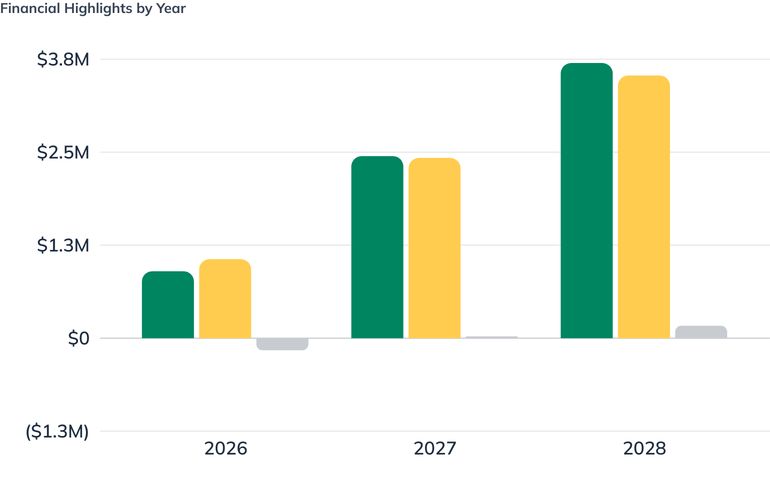
The plan that follows details the market opportunity, our supplier and fulfillment operations, our acquisition strategy, the regulatory environment we operate in, and a three-year financial forecast covering 2026 through 2028.
Need impressive charts? Discover the simplest way to create detailed graphs for your business plan.Create your own business plan

Opportunity
Problem Worth Solving
Buying home fitness equipment online is a genuinely bad experience, and it has gotten worse rather than better.
The catalog is unnavigable. A customer who searches a major marketplace for "adjustable dumbbells" is served thousands of listings, most of them the same three or four factory products under different brand names, differentiated only by photography and review-manipulation. There is no reliable signal for build quality, no consistent specification format, and no way to know whether the 52.5 lb set will actually fit the shelf it is meant to live on. Shoppers respond the way anyone would when facing undifferentiated choice: they either default to the cheapest option and are disappointed, or they abandon the purchase entirely.
Delivery promises are unreliable. Much of the fitness equipment sold online through dropship storefronts ships from overseas on 15 to 30 day timelines that are disclosed only after checkout, if at all. Fitness purchases are motivated purchases — they are made in a window of intent that closes fast. A three-week wait does not just annoy the customer; it converts an enthusiastic buyer into a refund request.
Nobody sells the setup, only the parts. Almost no home gym is a single product. It is a rack, a bar, plates, a mat, storage, and something to recover on, and those pieces have to physically and functionally fit together in a specific room. Retailers sell each of those items in isolation and leave the integration problem to a customer who has never done it before. The predictable result is mismatched purchases, returns, and equipment that ends up unused in a corner.
The premium tier priced most people out and then retrenched. The connected-fitness brands that defined 2020 and 2021 solved the guidance problem with expensive hardware and recurring subscriptions. As that segment contracted and consolidated, it left behind a large population of consumers who still want to train at home but were never going to spend four figures on a single machine plus a monthly fee. That demand did not disappear. It moved down-market and is currently being absorbed by exactly the unnavigable marketplaces described above.
Returns are punishing and poorly handled. Fitness equipment is heavy, awkward, and expensive to ship. When a purchase goes wrong, the return process is slow and often disputed, and the customer's experience of the category is permanently damaged. Small storefronts without negotiated supplier return terms routinely eat these costs or, worse, push them onto the customer and absorb the chargeback and review damage instead.
The underlying problem is one of curation and trust, not selection. There is more home fitness equipment available to an American consumer today than at any point in history, and it has never been harder to confidently buy the right piece of it.
Our Solution
BlinkBuy is a curated, vendor-direct online store for home fitness and recovery equipment. We solve the curation and trust problem by carrying less, testing everything we carry, and shipping domestically.
A catalog small enough to stand behind. We launch with approximately 180 SKUs and hold the catalog under 300 through the planning period. Every product passes a documented intake review before it is listed: we obtain a sample, assemble it, and score it against a fixed checklist covering material and weld quality, assembly time and instruction clarity, noise and floor impact, actual assembled footprint versus advertised dimensions, warranty terms, and supplier return policy. Products that fail do not get listed, and we publish the checklist results on the product page. This is a merchandising discipline that a 10,000-SKU competitor structurally cannot replicate.
Four programs instead of endless categories. The catalog is organized around how people actually train, not how manufacturers classify goods:
- Strength Corner — adjustable dumbbells, kettlebells, benches, squat stands, barbells and plates, storage
- Cardio Compact — air bikes, rowers, folding treadmills, jump and agility gear sized for apartments and garages
- Recovery and Mobility — massage guns, foam rollers, compression boots, mobility bands, sauna blankets
- Studio Essentials — flooring, mirrors, racks, lighting, and the unglamorous infrastructure that makes a space usable
Kit Builder. Our core differentiating tool asks three questions — how much space you have, what you are training for, and what you want to spend — and returns a complete, physically compatible setup with a scaled floor plan showing how the pieces fit in the room. The customer buys an outcome, not a shopping list. Kit Builder outputs are purchasable in one click as a bundle, which meaningfully lifts order value and dramatically reduces the mismatched-purchase returns that plague the category.
Domestic supply, honest delivery windows. We work with a small number of vetted U.S. suppliers warehousing primarily in Texas, Georgia, and Tennessee. Delivery estimates are calculated per SKU from real supplier ship-time data and displayed on the product page before the customer adds to cart, not after. Most orders arrive in two to four business days. Where a product genuinely requires a longer window — a freight-delivered rack, for example — we say so plainly and set the expectation up front.
Content that earns the sale. For every product we carry we produce an assembly walkthrough, a space-fit guide, and honest comparison content against the obvious alternatives, including alternatives we do not sell. This serves two purposes: it converts the customer who is one question away from buying, and it builds an organic search and short-form video footprint that reduces our dependence on paid acquisition as the business matures.
Service that closes the loop. We operate a central-time-zone support window with real humans, pre-negotiated supplier return authorizations so a return decision can be made on first contact, and a 30-day fit guarantee on Kit Builder bundles. In a category where the default experience is a slow dispute, decisive service is itself a differentiator.
The result is a store that a first-time home-gym buyer can trust to make the decision with them, delivered on a cost structure light enough to compete on price with sellers offering none of it.
Target Market
Market size and direction
The U.S. home fitness equipment market was valued at roughly $5.1 billion and is forecast to reach approximately $8.5 billion by 2030, a compound annual growth rate near 7.6%. Cardiovascular equipment accounts for the largest share at roughly 55% of category revenue, with strength training the second-largest segment; recovery and mobility products are the fastest-growing sub-segment and the one least well served by incumbent retail. Online has been steadily taking share from offline as the primary purchase channel, and the pandemic-era buyers who were introduced to home training are now in their second and third replacement and upgrade cycles rather than their first purchase.
This matters for how we position. We are not betting on a new wave of first-time home-gym buyers. We are serving a category that has normalized: households that have already decided home training is part of their life and are now buying better, more specific, and more space-appropriate equipment than they did the first time.
Who we sell to
The Space-Constrained Upgrader. Ages 28 to 45, household income $75,000 to $150,000, living in an apartment, townhome, or a house where the "gym" is one corner of a garage or spare bedroom. They own a mat, some bands, and possibly a cheap dumbbell set they have outgrown. Their binding constraint is square footage, not money. They are looking for equipment that folds, stacks, stores, or does two jobs. They research heavily before buying and respond to content that shows the product in a room the size of theirs. This is our primary segment and the natural user of Kit Builder.
The Recovery Buyer. Ages 30 to 55, often a recreational runner, lifter, or cyclist, frequently coming to us through a specific product search — massage gun, compression boots, sauna blanket. Their order values are lower than the strength buyer's but their purchase cycle is faster, their return rate is much lower, and they are the most likely of our segments to buy again within twelve months. They are the entry point for a customer relationship that later includes strength and cardio purchases.
The Garage Gym Builder. Ages 25 to 50, skews male, building a genuine multi-piece setup over six to eighteen months. Highest lifetime value of any segment and the most demanding on product knowledge — they will know the specifications better than a generic retailer's staff. They reward honest comparison content and punish marketing language. They are the reason our product pages publish real test results rather than manufacturer copy.
The Gifting and Household Buyer. Concentrated in Q4 and January, buying for a partner or family member. Lower knowledge, higher price sensitivity, strongly influenced by bundles and clear "this is the complete thing you need" framing. Kit Builder converts this segment unusually well because it removes the need for the buyer to understand the category at all.
Geography
We sell nationally from day one — this is the point of an e-commerce model — but our supplier footprint gives us a real delivery-speed advantage across Texas and the Southeast, which is also where population and household formation are growing fastest. The Dallas–Fort Worth metroplex alone represents a metro of over eight million people and one of the fastest-growing large metros in the country. We treat DFW as a home market for local content, community partnerships with independent gyms and physical therapy practices, and same-week delivery messaging that no national competitor bothers to make.
Market trends we are building around
Hybrid work has permanently increased the number of hours Americans spend at home and the willingness to allocate household square footage to fitness. Recovery has moved from professional-athlete niche to mainstream consumer category. Consumers have become measurably more skeptical of marketplace reviews and more responsive to demonstrated, video-based product proof. And the retrenchment of the premium connected-fitness segment has left a large, under-served middle of the market that wants structured guidance without a subscription attached to it.
Competition
Amazon. The default first stop for the category and, in practice, our largest competitor. Amazon wins on delivery speed, price, and return frictionlessness. It loses badly on curation: search results are dominated by rebadged commodity products, review integrity in fitness equipment is poor, and there is no mechanism for helping a customer assemble a coherent multi-product setup. We do not compete with Amazon on price or shipping speed for a single commodity item. We compete on the decision — the customer who does not yet know what to buy is not well served there, and that is the customer we acquire through content and convert through Kit Builder.
Dick's Sporting Goods and big-box retail. Strong brand trust, physical demonstration, and an omnichannel returns advantage. Their weakness is assortment depth and staff expertise: the in-store fitness section is a narrow, brand-driven selection, and the associate is rarely a category specialist. They also index heavily toward mid-tier national brands and carry very little in recovery and mobility. We take share by carrying the specific products they do not and by being demonstrably more knowledgeable in the content the customer reads before they ever walk into a store.
Rogue Fitness, REP Fitness, Titan Fitness and the direct manufacturers. These are the credible operators in serious strength equipment and they command real loyalty among the Garage Gym Builder segment. They are single-brand by definition, which is exactly the gap: a customer building a room needs a rack from one maker, a bar from another, flooring from a third, and recovery gear from a fourth. We are the cross-brand assembler and the neutral comparison source, and we carry recovery and compact-cardio categories that pure strength manufacturers do not.
Peloton, Tonal, Hydrow and the connected-fitness tier. Excellent products with subscription-attached business models at price points that exclude most of our target market. Their contraction over the past several years has moved a substantial pool of demand down into our price band. We are not attempting to compete on guided programming; we compete by serving the customer who wants capable equipment without recurring software fees.
Generic dropship storefronts. A large, fragmented population of Shopify stores running the same overseas catalogs with paid-social arbitrage. They are our closest structural analogue and our easiest competitor to beat, because their model is fundamentally short-term: long delivery windows, untested products, no return infrastructure, no content asset, and rising ad costs that erode the arbitrage the whole model depends on. The reputational damage they inflict on the word "dropshipping" is real, which is precisely why our domestic supply base, published delivery windows, and product-testing disclosure are positioned as prominently as they are.
Walmart.com, Target, and Wayfair. Broad marketplaces with strong price perception and, in Walmart's case, a rapidly improving delivery network. Their fitness assortment is thin and gifting-oriented, and none of them offer meaningful category guidance. They are a threat primarily to our lowest-consideration, most price-sensitive orders, which is not where our margin lives.
Our defensible position
Our advantage is not any single product — every SKU we carry can be found elsewhere. It is the combination of a tested and published catalog standard, a cross-brand setup-planning tool, honest domestic delivery windows, and a compounding content library that improves organic acquisition economics every quarter. A large competitor could replicate any one of these; the reason they do not is that curation is economically irrational at their catalog scale. A small competitor could copy the positioning, but not the supplier terms and content depth, which accrue over time. Our real risk is not being out-competed on strategy but being out-spent on paid acquisition during the window before our organic footprint matures, which is why the acquisition plan front-loads content investment rather than treating it as a later-stage optimization.
Execution
Marketing Plan
Our marketing strategy rests on a simple premise: paid acquisition buys us time, and content buys us a business. We spend on ads from launch because we have to, and we invest in organic assets from the same day because paid-only dropshipping models die when acquisition costs rise.
Positioning
BlinkBuy is "the home gym store that has actually used the equipment." Every message ladders back to three proof points: we test everything we list and publish the results, we ship from U.S. warehouses with delivery dates shown before checkout, and Kit Builder plans the whole room instead of selling you one piece of it.
Paid social — Meta and TikTok
Short-form video is the workhorse of this category and the format our differentiation demonstrates best. Our creative library is built around four repeatable formats: the unboxing-and-assembly timer ("rack assembled in 34 minutes, here's every step"), the space-fit demo (the same product placed in a 6x8 apartment corner, a one-car garage, and a spare bedroom), the honest comparison (two products side by side, including when we recommend the cheaper one), and the Kit Builder reveal (three questions in, complete room out). We produce creative in batches, run structured tests against a fixed number of concepts per month, and kill anything that fails to clear our target return on ad spend after a defined learning window. Creative volume, not audience targeting, is the lever that matters on these platforms now.
Paid search — Google and Bing Shopping
Bottom-of-funnel capture. We bid on high-intent product and comparison queries where the customer already knows what they want and is choosing a seller. Shopping feeds are managed against per-SKU margin data, not blended targets, so we stop paying to acquire orders on products that cannot support the acquisition cost. Brand-defense bidding scales as our organic footprint grows.
Organic search and the content library
This is the long-term asset and the reason our unit economics improve over the planning period. Three content pillars:
- Buying guides — "best folding treadmill for an apartment," "adjustable dumbbells under 40 lbs per hand," written against our own test data rather than aggregated manufacturer specs
- Space planning — room-by-room guides with real dimensions, the natural top-of-funnel entry point for the Space-Constrained Upgrader and the direct feeder into Kit Builder
- Product deep-dives — one assembly walkthrough and one long-form review per SKU we carry, which is only tractable because our catalog is deliberately small
We treat AI-assisted drafting as standard production tooling, but every piece is grounded in first-hand product testing and reviewed by a human who has handled the equipment. Content that could have been written without touching the product is content that will not rank and will not convert.
Email and SMS lifecycle
Owned channels are where a dropship model recovers its margin. Kit Builder is gated behind an email capture, which gives us a list of people who have just described their space, goal, and budget — the most useful segmentation data in the category. From there: an abandoned-cart and abandoned-builder sequence, a post-purchase assembly and onboarding flow that measurably reduces returns, a 45-day accessory and progression sequence timed to when a customer typically outgrows their first purchase, and a win-back flow for the Recovery Buyer's replacement cycle. SMS is reserved for order status and a small number of high-value promotional moments.
Partnerships and community
We partner with independent gyms, CrossFit affiliates, and physical therapy practices across DFW and, over time, other Texas metros — settings where our target customer already is and where a credible recommendation carries far more weight than an ad. We run an affiliate program for fitness creators with an emphasis on mid-tier accounts whose audiences trust them, and we seed products to creators who will show real assembly and real use rather than produce a scripted endorsement.
Seasonality
The category has two strong peaks: Black Friday through December for gifting, and the first six weeks of January for resolution buying. A third, smaller lift occurs in late summer as households reorganize around the school year. Our media budget is weighted accordingly, with creative and content produced well ahead of each peak rather than during it.
Measurement
We manage to contribution margin after advertising, not to revenue or to platform-reported return on ad spend. Every channel is evaluated against blended customer acquisition cost, contribution margin per order, and the ratio of lifetime value to acquisition cost by segment. Channels that cannot demonstrate contribution are cut, regardless of how good their in-platform attribution looks.
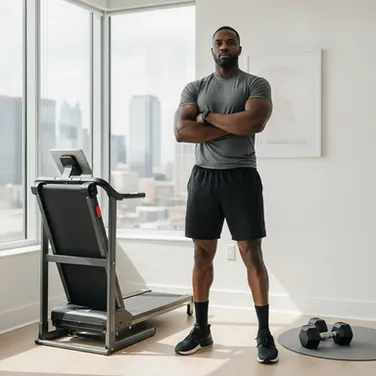
The Efficiency Enthusiast
Marcus Reed
A hybrid-working professional living in a high-rise apartment who values his time and square footage. He is moving away from a gym membership in favor of a home setup but is frustrated by the 'analysis paralysis' of online marketplaces.
Age
34
Location
Uptown Dallas, TX
Family Status
Single, lives in a 1-bedroom apartment
Education
Bachelor of Business Administration
Profession
Marketing Account Manager at a Dallas Agency
Opportunities
- Utilize the 'Cardio Compact' program to offer Marcus equipment that fits within a 40-square-foot footprint without sacrificing build quality.
- Leverage the 3-question Kit Builder to eliminate his decision fatigue and provide a 'complete setup' rather than a list of disparate parts.
Pain Points
- Overwhelmed by thousands of identical-looking adjustable dumbbell listings on Amazon
- Limited apartment floor space makes traditional gym equipment impractical
- Doesn't want a monthly subscription fee just to use a treadmill or bike
Needs
- Tested equipment with a small footprint and quiet operation for apartment living
- Fast, reliable delivery (2-4 days) to match his fast-paced lifestyle
- Clear assembly guides to minimize setup time during his busy work week
“I don't have room for a full rack, and I don't have time to read 500 conflicting reviews. I just want a kit that works in my corner and shows up this week.”
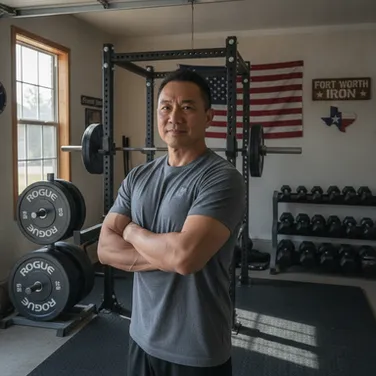
The Practical Powerhouse
David Nguyen
A seasoned lifter who is converting his garage into a serious training space. He is in his 'second upgrade cycle' and is willing to pay for quality but refuses to pay for the 'premium brand' name markup.
Age
52
Location
Fort Worth, TX
Family Status
Married, empty nester
Education
Bachelor of Science in Civil Engineering
Profession
Construction Project Supervisor
Opportunities
- Position the 'Strength Corner' program as the professional-grade alternative to both cheap imports and overpriced 'connected' brands.
- Highlight the DFW-proximate warehousing to offer him 'same-week delivery' messaging that national competitors cannot match.
Pain Points
- Tired of paying for 'brand prestige' and subscriptions he never uses
- Bad past experiences with dropshippers who quoted 3 days but took 3 weeks
- Dislikes the lack of technical specs (noise, build material, footprint) on marketplace listings
Needs
- Heavy-duty strength equipment with a published checklist of build quality specs
- Direct access to a central-time-zone customer service team for order tracking
- A 'Kit Builder' that ensures his power rack and bench are perfectly compatible
“I've been lifting for thirty years. I don't need a tablet on my squat rack; I need steel that's been tested and a delivery date that's actually true.”

The Longevity Strategist
Sarah Jenkins
A suburban homeowner and former athlete who is now focused on injury prevention and functional movement. She is skeptical of 'connected' fitness hype and wants high-quality, tested gear for her and her family.
Age
46
Location
Plano, TX
Family Status
Married, 2 teenage children
Education
Master of Science in Nursing
Profession
Senior Nurse Administrator
Opportunities
- Target her interest in the 'Recovery and Mobility' program, which is the fastest-growing and least-served segment in the market.
- Use video-based product proof and 'build quality' checklists to satisfy her professional need for evidence and durability.
Pain Points
- Frustrated by flimsy equipment that breaks after a year of family use
- Wary of 'rebadged imports' that lack proper warranty terms or safety testing
- Struggles to find specific mobility tools that complement her physical therapy routine
Needs
- High-quality foam rollers, mobility tools, and strength gear tested for durability
- Honest delivery windows so she can coordinate equipment arrival with her busy family schedule
- A curated selection that avoids the 'junk' found in big-box retail stores
“I'm not looking for a screen with a trainer; I'm looking for equipment that won't fall apart when my kids use it and helps me stay mobile as I get older.”
Sales Plan
BlinkBuy sells direct to consumers through a single owned storefront. We are deliberately not a marketplace seller at launch, and the reasons are strategic rather than incidental: marketplace channels take the customer relationship, the email address, and the ability to merchandise a multi-product setup, all of which are the substance of our model.
The sales process
Most of our selling happens before the customer ever speaks to us. A prospect typically arrives from a short-form video or a search result, lands on a buying guide or a product page, reads test results we produced ourselves, and either buys directly or runs Kit Builder. The site does the consultative work: published test scorecards, real assembled dimensions, honest delivery dates, and side-by-side comparisons including products we do not stock.
Kit Builder as the primary conversion mechanism
Kit Builder is the closest thing we have to a salesperson. Three inputs — available space, primary training goal, and budget — produce a complete, compatible setup with a scaled floor plan and a single add-to-cart. It lifts average order value substantially over single-item purchases, and because the pieces are pre-validated to work together, it reduces the mismatched-purchase returns that are the category's largest hidden cost. Builder sessions are saved and emailed, which converts a browsing session into a re-engageable lead even when the customer is not ready to buy.
Kit Builder releases in July 2026, roughly three months after the storefront opens. That sequencing is intentional. The compatibility and dimension model behind the tool is only as good as the intake testing that feeds it, and we would rather launch the store on curated single-product merchandising and add the planner once the full catalog has been physically tested than ship a planner that recommends setups we have not verified. The forecast reflects this: bundle revenue begins in July, not April, and the first two quarters of trading are carried by single-product and attachment sales.
Assisted sales
A meaningful share of higher-value orders — racks, full garage setups, anything freight-delivered — involve a human touchpoint. We staff a live chat and phone line during a central-time business window with people trained on the catalog, not on scripts. Their remit is explicitly to talk customers out of the wrong purchase as readily as into the right one; the return cost of a bad heavy-equipment sale exceeds the margin on it. Chat transcripts feed directly back into content, because the questions customers ask are the buying guides we have not written yet.
Cart and checkout
Checkout is optimized for the two things that kill conversion in this category: shipping ambiguity and payment friction. Delivery dates are shown per line item on the product page and again in cart. We offer major cards, PayPal, Apple Pay, Shop Pay, and buy-now-pay-later financing, which matters disproportionately for the Garage Gym Builder assembling a multi-hundred-dollar setup. Free shipping is applied above a threshold set just above our average order value to encourage attachment of a second item.
Attachment and progression
Every product page and every Kit Builder output includes contextual attachments — flooring with a rack, a recovery item with a strength purchase, storage with plates. Post-purchase, a timed sequence introduces the logical next piece at the point a customer typically outgrows their current setup. Because we sell the outcome rather than the object, the second and third orders are a natural continuation of the first rather than a fresh acquisition.
Returns as part of the sale
Our supplier agreements carry pre-negotiated return authorizations, which means a support agent can resolve most return requests on first contact rather than opening a multi-day supplier dispute. Kit Builder bundles carry a 30-day fit guarantee. This is expensive to offer and worth it: in a category where the default is a slow argument, a decisive return policy is a conversion asset at the top of the funnel, not just a cost at the bottom.
Channel expansion
Once the owned storefront is operating at a stable contribution margin, we evaluate selective marketplace listings for a narrow set of high-margin recovery and accessory SKUs — products where the customer relationship matters less and incremental volume improves our supplier terms. We do not list our strength or Kit Builder assortment on marketplaces, because those sales depend on the guidance a marketplace cannot deliver. A wholesale channel to independent gyms and physical therapy practices is a longer-term possibility supported by the same supplier relationships.
Locations & Facilities
BlinkBuy holds no inventory and operates no warehouse. Our physical footprint is intentionally minimal, and our facilities strategy exists to keep it that way.
Headquarters — Dallas, Texas
Our registered address and operating base is a small private office in a coworking facility in Dallas. It provides a mailing address, a conference room for supplier and lender meetings, and desks for the founder and the first two hires. We deliberately did not sign a conventional multi-year commercial lease: a company whose cost advantage comes from not carrying fixed overhead should not begin its life by carrying fixed overhead. The arrangement scales in single-desk increments as we hire.
Dallas is a considered choice rather than a default. Texas levies no state personal income tax, which materially affects the cost of compensating a small team. The Dallas–Fort Worth logistics corridor is one of the densest in the country, which is why several of our supplier partners already warehouse within it and why our delivery-speed advantage across Texas and the Southeast is real rather than marketed. Central time gives us a support window that covers both coasts within a single business day. And DFW's depth in e-commerce, logistics, and performance-marketing talent means our hiring pool is local even though our team is not required to be.
Product testing space
The one piece of physical infrastructure our model actually requires is somewhere to assemble and test equipment. We maintain a small leased flex/warehouse bay in the Dallas area — a few hundred square feet with a roll-up door, adequate ceiling height for racks, and rubber flooring — used exclusively for product intake testing and content production. Every SKU we list passes through this space before it is listed. It doubles as our video studio: the assembly walkthroughs, space-fit demos, and comparison videos that drive our organic acquisition are all shot here. This is the room that makes the "we have actually used the equipment" claim true, and it is the only square footage in the business we consider non-negotiable.
Fulfillment locations — our suppliers'
Customer orders never touch a BlinkBuy facility. They are routed to supplier warehouses located primarily in Texas, Georgia, and Tennessee, with a secondary node in the Inland Empire for West Coast coverage on select SKUs. Ninety-plus percent of the continental U.S. population sits within a two-to-four day ground transit window of this footprint. Supplier facility standards, capacity, and performance monitoring are covered in the Suppliers and Fulfillment section.
Remote operations
Outside of testing and content production, BlinkBuy operates remotely by default. Customer support, merchandising, paid media, and content are all location-independent roles, and we hire accordingly — the constraint is coverage of our stated support window, not proximity to Dallas. The team meets in person at the Dallas office on a recurring cadence and for content production sprints. This keeps our facilities cost structurally low and our talent pool national, both of which are the point of building this business the way we have.
Suppliers & Fulfillment
Supplier quality and fulfillment reliability are not operational details in a vendor-direct business — they are the product. Everything a customer experiences after clicking "buy" is executed by someone else on our behalf. This section describes how we make that dependable.
Supplier selection criteria
We work with a small, deliberately concentrated set of partners. A supplier must meet all of the following before we list a single SKU:
- Domestic warehousing in the continental U.S., with a stated cutoff time and a same-or-next-business-day ship commitment on stocked items
- Real-time inventory access via API or a scheduled feed we can ingest at least hourly, so we never sell what cannot ship
- Written return authorization terms that let us issue an RMA without case-by-case negotiation
- Blind or white-label shipping — no competitor packing slips, no supplier marketing inserts
- Verifiable product compliance documentation, including CPSC conformity where applicable, weight-rating test data on load-bearing equipment, and lithium-battery shipping documentation for powered recovery devices
- Business liability and product liability insurance, with BlinkBuy named as an additional insured where the supplier's policy permits
We maintain at least two qualified suppliers for every product category, and dual-source our highest-volume SKUs outright, so that no single partner's outage takes a category offline.
Product intake testing
No product is listed on the basis of a spec sheet. We purchase or request a sample, assemble it in our Dallas testing bay, and score it against a published checklist: weld and material quality, assembly time and instruction clarity, hardware completeness, noise and floor impact, assembled footprint measured against advertised dimensions, weight rating validation on load-bearing items, warranty terms, and packaging integrity. Products that fail are not listed. Products that pass have their scorecard published on the product page, and the same session produces the assembly video and space-fit content used in marketing. One intake process, three outputs: a merchandising decision, a trust asset, and a content asset.
Order routing and settlement
Orders flow automatically from our storefront to the assigned supplier through an integration layer, with routing logic that selects the warehouse offering the fastest transit to the customer's ZIP code among suppliers holding stock. Tracking numbers are written back to the order and released to the customer automatically. Because the customer pays us at checkout and we settle with suppliers on net terms, our working capital cycle is favorable — but we hold a dedicated reserve against it rather than treating supplier float as available cash, since a rapid growth month consumes that float faster than intuition suggests.
Delivery windows and freight
Per-SKU delivery estimates are calculated from actual supplier ship-time and carrier transit performance, not from a generic site-wide promise, and they are displayed on the product page before add-to-cart. Most parcel-shipped items land in two to four business days. Heavier goods — racks, rowers, plate sets over a threshold weight — ship via LTL freight with curbside delivery and a scheduled appointment, and we disclose that plainly, including what the customer will need to do on arrival. Setting a longer expectation honestly costs us some conversion; setting a short one dishonestly costs us the customer.
Performance monitoring
Every supplier is scored monthly on on-time ship rate, order accuracy, damage rate, in-stock rate against our forecast, RMA turnaround time, and responsiveness. Scores are reviewed in a standing quarterly business review with each partner. Persistent underperformance triggers a reallocation of volume to the secondary source for that category and, if unresolved, delisting. Because our catalog is small, moving volume between partners is a merchandising decision we can execute in days.
Returns and damage
Pre-negotiated RMA terms allow our support team to authorize most returns on first contact. Damaged-in-transit claims are filed by us, not by the customer — the replacement ships before the claim resolves. Return shipping on parcel items is prepaid by BlinkBuy within the return window; freight returns are handled case by case, which we disclose in the policy rather than burying. Return rates and their causes are reviewed monthly by SKU, and a product whose returns are driven by a defect or a misleading specification is delisted, not discounted.
Risks and how we hold them
The obvious exposures are supplier insolvency, sudden stock-outs during a demand peak, tariff or freight cost shocks passed through to our cost of goods, and a partner deciding to sell direct in competition with us. Dual sourcing addresses the first two structurally. Cost shocks are absorbed through per-SKU margin monitoring and repricing rather than blanket discounting. Channel conflict is managed through supplier agreements and, more durably, by being a partner whose content and testing generate demand a supplier cannot easily replicate on their own. We also keep a small buffer stock of our top accessory SKUs at a third-party logistics provider — an exception to our no-inventory rule, taken deliberately to protect peak-season availability on the items most likely to sell out.
Technology
Our technology stack is assembled from proven commercial platforms wherever the capability is a commodity, and built in-house only where it is genuinely differentiating. We are a retailer, not a software company; the one exception is Kit Builder, which is the product.
Storefront and commerce
Shopify is our commerce platform. It handles the storefront, catalog, checkout, payments, and the app ecosystem that covers most of what a store our size needs without engineering. We use a customized theme rather than a headless build — headless is the right answer at a scale we have not reached and would consume engineering capacity we would rather spend on Kit Builder. Payments run through Shopify Payments with PayPal, Apple Pay, Shop Pay, and a buy-now-pay-later provider enabled.
Kit Builder
Our proprietary setup-planning tool, built as a custom application embedded in the storefront. It takes three inputs — available space, primary training goal, and budget — and returns a compatible, purchasable equipment set with a scaled floor plan. Behind it sits a compatibility and dimension model we maintain ourselves: every SKU carries structured attributes for real assembled and stored footprint, clearance requirements, floor load, and category role, which is only maintainable because our catalog is small and every product has physically passed through our testing bay. Builder sessions are saved against an email address, which makes it our best lead-capture mechanism as well as our best conversion mechanism.
Order routing and supplier integration
An integration layer sits between Shopify and our suppliers, ingesting inventory feeds at least hourly, routing each order to the warehouse offering fastest transit to the customer, and writing tracking data back to the order. Where a supplier offers a modern API we integrate directly; where they do not, we ingest scheduled flat-file feeds. This layer also computes the per-SKU delivery estimates displayed on product pages, which is the operational fact behind our central marketing promise.
Customer support
Gorgias for the shared inbox, live chat, and order-context-aware support, integrated with Shopify so an agent sees the order, the supplier, and the shipment status in one place. AI-assisted drafting handles routine order-status and policy questions; anything involving a product recommendation, a return decision, or a damaged shipment routes to a human. We do not deploy a support bot that pretends to be a person.
Marketing and lifecycle
Klaviyo for email and SMS, segmented against Kit Builder inputs and purchase history. Meta and TikTok ad platforms for paid social, Google Ads and Merchant Center for search and shopping. Northbeam or a comparable multi-touch attribution tool to measure blended acquisition cost across channels, because platform-reported performance is not a basis on which to allocate a media budget.
Analytics and finance
GA4 for site analytics, with a Shopify-native profitability tool tracking contribution margin per order and per SKU after product cost, shipping, payment processing, and advertising. QuickBooks Online for accounting, synced to Shopify. Merchandising and forecasting analysis runs in Google Sheets against exported data — the right tool at our current scale, revisited when it stops being.
Content and internal operations
Notion for documentation, supplier records, and the product intake scorecards. Linear for the Kit Builder development backlog. Figma for design. Slack for internal communication. Video production runs on standard prosumer equipment in the Dallas testing bay with editing in Adobe Premiere.
AI in the workflow
AI tooling is embedded in ordinary operations rather than treated as a strategic initiative: drafting product copy from our own test notes, generating first-pass buying-guide outlines, summarizing support transcripts into content gaps, and clustering keyword data. Every customer-facing output is reviewed by someone who has handled the product. The judgment stays human because the judgment is what we are selling.
Security and data
PCI compliance is handled by Shopify as the payment processor; we never store card data. Access to admin systems is role-based with mandatory multi-factor authentication and a password manager. Customer data handling complies with applicable state privacy laws, and our privacy policy and cookie consent are maintained accordingly. Nightly backups cover the store configuration, the Kit Builder compatibility database, and our supplier records.
Equipment & Tools
Because BlinkBuy holds no inventory and operates no fulfillment centre, our equipment needs are modest and concentrated in two places: the Dallas product testing and content bay, and the remote workstations our team uses.
Product testing and content bay
This is where the "we have actually used it" claim is made true, and it is the only capital-equipment cluster in the business.
- Rubber gym flooring and a lifting platform section, so load-bearing equipment can be assembled and tested as it would be in a customer's garage
- A basic assembly workbench with a torque wrench set, socket and hex tooling, a rubber mallet, digital calipers, and a laser measure for verifying assembled dimensions against manufacturer claims
- A calibrated floor scale and load-testing rig for validating weight ratings on racks, benches, and storage
- A decibel meter for measuring noise and floor impact, one of the specifications apartment-dwelling customers care most about and almost no retailer publishes
- Shelving and a rolling cart for sample storage and staging
- Hand truck and appliance dolly for moving freight-delivered items
Video and photography
The intake bay doubles as our studio, so production equipment lives permanently in place:
- Two mirrorless cameras with prime and wide lenses, capable of vertical and horizontal capture in the same session
- A continuous LED lighting kit with softboxes, plus a portable light for overhead assembly shots
- Tripods, an overhead boom arm, and a gimbal for walkaround footage
- Wireless lavalier and shotgun microphones
- Seamless backdrop system and a small set of neutral staging props used to mock a 6x8 apartment corner, a garage bay, and a spare bedroom
- An editing workstation with sufficient GPU capability for multi-camera 4K timelines
Office and team equipment
- Laptops for the founder and each hire, replaced on a three-year cycle
- External monitors, keyboards, headsets, and a modest home-office stipend for remote team members
- Coworking desks and meeting room access in Dallas, provided under the membership rather than purchased
Software and subscriptions
Detailed in the Technology section. Commercially, these are recurring operating costs rather than capital purchases: Shopify and its app stack, Klaviyo, Gorgias, attribution and profitability tooling, Notion, Linear, Figma, Adobe Creative Cloud, QuickBooks Online, and the hosting and development cost of Kit Builder.
What we deliberately do not buy
No warehouse racking, no forklift, no packing stations, no shipping-carrier equipment, no inventory. Every one of those is a fixed cost our competitors carry and we do not, and the discipline of not acquiring them as the business grows is a core part of the model. The single planned exception is a small buffer-stock position on top accessory SKUs held at a third-party logistics provider ahead of peak season, which requires no equipment on our part — only the 3PL's storage and pick fees.
Milestones
Entity formed, funding closed, banking in place Texas LLC registered, EIN and Texas Sales and Use Tax Permit obtained, business bank account and credit facility opened, owner capital contributed and SBA 7(a) term loan closed. | Max Faulhaber Jan 31, 2026 |
First five suppliers signed and integrated Supplier agreements executed with domestic warehousing, net terms, blind shipping and pre-negotiated RMA terms. Inventory feeds ingesting hourly and resale exemption certificates on file. | Max Faulhaber Mar 15, 2026 |
Dallas testing bay operational and first 120 SKUs tested Flex bay leased and fitted out with flooring, assembly bench, load-test rig and video kit. First 120 SKUs assembled, scored against the intake checklist, and photographed, with the balance of the launch catalog completed during April. | Max Faulhaber Mar 31, 2026 |
Storefront launch with 180 SKUs Shopify storefront live with published test scorecards, per-SKU delivery estimates, order routing to suppliers, and checkout including BNPL financing. First paid social tests begin. Kit Builder follows in July. | Max Faulhaber Apr 30, 2026 |
Kit Builder v1 released Three-input setup planner live with scaled floor plan output, one-click bundle purchase, saved sessions and email capture. Compatibility and dimension data complete for the full catalog. | Contract engineering July 31, 2026 |
First two hires onboarded Customer Experience Lead and Growth and Content Marketer hired, trained on the catalog, and covering the full central-time support window and creative production calendar. | Max Faulhaber Sept 30, 2026 |
First peak season executed (Black Friday through January) Buffer stock positioned at 3PL on top accessory SKUs, creative and content produced ahead of the window, delivery-estimate accuracy held above target through both peaks. | Max Faulhaber Jan 31, 2027 |
Catalog at 250 SKUs, all with published scorecards Catalog expanded across all four programs with every listed SKU intake-tested. Bottom-decile SKUs by contribution reviewed and delisted. | Merchandising and Operations Associate June 30, 2027 |
Organic revenue share reaches one third Content library covering every SKU plus buying and space-planning guides drives at least a third of revenue from organic search and unpaid social, reducing blended acquisition cost. | Growth and Content Marketer Dec 31, 2027 |
Selective marketplace channel launched High-margin recovery and accessory SKUs listed on selected marketplaces to add incremental volume and improve supplier terms, with strength and Kit Builder assortment held back to the owned storefront. | Merchandising and Operations Associate Mar 31, 2028 |
Repeat purchase rate above 30 percent at 365 days Lifecycle marketing, progression sequences and the recovery replacement cycle drive repeat purchase behaviour, lifting lifetime value to acquisition cost ratio above target across all segments. | Growth and Content Marketer Sept 30, 2028 |
Key Metrics
We manage BlinkBuy to contribution margin after advertising, not to revenue. A dropship storefront can grow top-line indefinitely while destroying value, and the metrics below are chosen specifically to make that impossible to hide.
Acquisition and demand
- Blended customer acquisition cost — total marketing spend divided by new customers, across all channels. Platform-reported figures are treated as directional only.
- Contribution margin after advertising, per order — revenue less product cost, shipping, payment processing, and allocated ad spend. This is our primary decision metric at the SKU, channel, and campaign level.
- Return on ad spend by channel and by creative concept — measured against a fixed learning window, with a defined kill threshold.
- Organic sessions and organic revenue share — the health check on our long-term thesis. If organic share is not rising quarter over quarter, our content investment is not working and our acquisition economics will not improve.
Conversion and merchandising
- Site conversion rate, segmented by traffic source and by device, since paid social traffic converts very differently from bottom-of-funnel search.
- Kit Builder completion rate and Builder-to-purchase conversion — the single most important product metric we have. A Builder session that ends without an output is a failure of the tool, not the customer.
- Average order value, tracked separately for Builder-assisted and single-item orders, to verify that the bundling thesis holds.
- Attachment rate — percentage of orders containing more than one line item.
- Email and SMS list growth and revenue share from owned channels.
Operations and supplier performance
- On-time ship rate by supplier — measured against the ship commitment, not the delivery estimate.
- Delivery-estimate accuracy — the percentage of orders delivered within the window we displayed before checkout. This is the operational number behind our central marketing claim, and we treat a miss here as seriously as a stock-out.
- In-stock rate on listed SKUs, since selling something a supplier cannot ship is the fastest way to lose a customer permanently.
- Order accuracy and damage rate by supplier.
- RMA turnaround time, from customer request to resolution.
Customer and quality
- Return rate by SKU and by cause — reviewed monthly. Returns driven by a defect or a misleading specification trigger a delisting review, not a discount.
- Repeat purchase rate at 90 and 365 days, segmented by entry category. The Recovery Buyer's repeat behaviour is a leading indicator of whether our lifecycle marketing is working.
- Customer lifetime value to acquisition cost ratio, by acquisition channel and by first-purchase segment.
- Support first-response and resolution time within our stated central-time window.
- Net promoter score and review rating, collected post-delivery rather than post-purchase, so we are measuring the experience the supplier actually delivered.
Catalog discipline
- SKU count — tracked deliberately as a constraint. Growth in SKU count without a corresponding rise in revenue per SKU means our curation advantage is eroding.
- Revenue and contribution per SKU, with a standing review of the bottom decile.
- Percentage of catalog with completed intake testing and published scorecards — target is one hundred percent, permanently. A listed product without a scorecard is a broken promise.
Review cadence
Acquisition and conversion metrics are reviewed weekly. Supplier performance, return causes, and SKU-level contribution are reviewed monthly. Lifetime value, cohort retention, and catalog composition are reviewed quarterly alongside supplier business reviews.
Pricing
BlinkBuy prices for margin and confidence, not for the bottom of a search-results page. Competing on price against Amazon and the commodity dropship storefronts is a race we would lose on structure; competing on certainty is a race we are built to win.
Pricing approach
We set price per SKU using a keystone-anchored model, marking up supplier cost roughly 2x on accessories and recovery goods and somewhat less on higher-ticket strength and cardio equipment, where absolute dollar margin does the work instead of percentage margin. Every price is checked against three references before it goes live: the manufacturer's suggested retail price and any minimum advertised price policy we are bound by, the prevailing Amazon and big-box price for the same or an equivalent product, and our own contribution-margin floor after shipping, payment processing, and expected returns. A product that cannot clear the floor at a competitive price is not listed.
Typical price bands
- Recovery and mobility — $35 to $250. Massage guns, foam rollers, mobility bands, compression boots. Highest percentage margins in the catalog, lowest return rates, fastest repeat cycle.
- Accessories and Studio Essentials — $40 to $400. Flooring, mats, storage, mirrors, lighting. Strong attachment items rather than standalone destinations.
- Strength equipment — $150 to $1,200. Adjustable dumbbells, kettlebells, benches, squat stands, barbells and plate sets. Moderate percentage margin, high dollar margin.
- Cardio equipment — $400 to $1,800. Air bikes, rowers, folding treadmills. Lowest percentage margin, freight-sensitive, and the most price-shopped category we carry.
- Kit Builder bundles — $600 to $3,500 depending on space, goal, and budget inputs. Bundles carry a modest discount against the sum of their parts, funded by the higher order value and the materially lower return rate that comes from selling pre-validated compatible sets.
Average order value across the catalog runs meaningfully above single-item dropship benchmarks because of bundling and attachment, and that gap is the economic engine of the model.
Shipping and thresholds
Free ground shipping applies above a threshold set just above our average order value, which encourages a second item without giving away margin on small orders. Below the threshold, shipping is charged at real cost. Freight-delivered items carry a separately quoted delivery charge disclosed on the product page. We do not embed freight cost silently into product price on heavy goods — customers comparison-shopping racks and rowers notice, and the goodwill from transparency is worth more than the conversion we lose.
Promotional policy
We discount on a schedule, not reactively. Black Friday through Cyber Monday and the first two weeks of January are our two real promotional windows, with a smaller back-to-school-season event in late summer. Outside those windows, we run bundle offers and attachment incentives rather than sitewide percentage-off sales, because habitual discounting trains customers to wait and permanently resets price perception. Clearance is reserved for SKUs being delisted.
We also decline to discount as a remedy for a bad product. If returns on a SKU are being driven by a defect or a specification that does not match reality, the answer is delisting, not a price cut — a discounted bad product still generates a return, a negative review, and a lost customer.
Financing at checkout
Buy-now-pay-later financing is offered on orders above a modest threshold. For the Garage Gym Builder assembling a multi-hundred-dollar setup and for January resolution buyers, financing availability measurably increases both conversion and order size. The provider fee is treated as a cost of the sale and included in our per-SKU margin floor calculations.
Price maintenance
Supplier costs in this category move with freight rates and tariff exposure, sometimes sharply. We review per-SKU margin monthly and reprice individual items when their contribution falls below the floor, rather than absorbing the erosion quietly across the catalog or applying a blanket increase customers will notice. Price changes on high-visibility SKUs are timed away from promotional windows.
Regulatory Requirements
BlinkBuy operates in a regulated retail environment despite holding no inventory. Selling nationally means our compliance obligations are national, and the fact that a supplier ships the goods does not transfer liability for the sale away from us.
Entity and Texas registration
BlinkBuy is organized as a Texas limited liability company, registered with the Texas Secretary of State, with a registered agent of record and a federal Employer Identification Number. We file the Texas Franchise Tax Report and Public Information Report annually; Texas levies no state personal income tax, and the franchise tax applies only above the state's revenue threshold, though the informational report is filed regardless. A Dallas assumed name certificate is filed for any trade name we operate under other than the registered entity name.
Sales tax
We hold a Texas Sales and Use Tax Permit and collect and remit Texas sales tax on in-state orders. Because we sell nationally, we are subject to economic nexus rules in every state that has them following South Dakota v. Wayfair — thresholds vary by state, commonly around $100,000 in sales or a stated transaction count in a twelve-month period. We monitor state-by-state thresholds continuously through automated tax software integrated with our storefront, register in each state as thresholds are crossed, and collect and remit accordingly. A dropship arrangement adds a second wrinkle: resale exemption certificates must be on file with each supplier so we are not charged tax on goods we are reselling, and those certificates must be maintained for every state where the supplier has nexus.
Product safety and compliance
Fitness equipment falls under Consumer Product Safety Commission jurisdiction, and as the seller of record we are responsible for the safety of what we ship even though we never touch it. Our supplier agreements require conformity documentation, and our intake testing independently validates weight ratings on load-bearing equipment. Powered recovery devices — massage guns, compression systems, sauna blankets — carry additional obligations: lithium-ion batteries are regulated in transit under Department of Transportation hazardous materials rules, and we require suppliers to hold and provide UN 38.3 test documentation and to ship compliantly. Electrical products must carry appropriate certification marks. We maintain a documented process for handling recalls, including the ability to identify and contact every purchaser of an affected SKU from our order records.
Advertising and marketing law
The Federal Trade Commission's rules on endorsements and testimonials govern our affiliate and creator program: all sponsored content, seeded product, and affiliate relationships must be clearly and conspicuously disclosed, and we contractually require it. The FTC's rule on fake and manipulated reviews prohibits purchasing, incentivizing, or suppressing reviews, and our review collection is post-delivery, unincentivized, and unfiltered. Health and fitness claims are a particular exposure in this category — we do not make therapeutic, medical, or weight-loss claims about any product we sell, and recovery devices are described in terms of use rather than outcome. Our "tested" and delivery-window claims are substantiated by documentation we retain.
Consumer protection and e-commerce rules
The FTC Mail, Internet, or Telephone Order Merchandise Rule requires that we ship within the time we advertise or, failing that, notify the customer and offer a cancellation with a prompt refund. This is a direct operational constraint on the delivery estimates we display and one of the reasons those estimates are calculated from real supplier data. The Restore Online Shoppers' Confidence Act governs any recurring billing, which currently does not apply to us but would if we introduced a membership. Marketing email must comply with CAN-SPAM, and SMS marketing with the Telephone Consumer Protection Act, meaning documented express written consent and a functioning opt-out on every message. Our storefront targets WCAG 2.1 AA accessibility standards, both because it is right and because e-commerce accessibility litigation is a real and growing exposure.
Privacy
We comply with applicable state privacy statutes, including the Texas Data Privacy and Security Act and the California Consumer Privacy Act as amended, along with the other state comprehensive privacy laws now in effect. In practice this means a published privacy policy, a cookie consent mechanism, honoring universal opt-out signals, a documented process for consumer access and deletion requests, and data processing agreements with our marketing and analytics vendors. We never store payment card data; PCI DSS obligations are carried by our payment processor.
Insurance and contracts
We carry general liability and product liability coverage appropriate to a national consumer-goods seller, along with cyber liability coverage given the customer data we hold. Supplier agreements include indemnification for product defects, minimum insurance requirements with BlinkBuy named as an additional insured where permitted, and defined return and recall cooperation terms. Our site terms of service, return policy, and shipping policy are reviewed by counsel and updated as the regulatory landscape and our operations change.
Import and tariff exposure
Because our suppliers warehouse domestically, BlinkBuy is not the importer of record and does not clear customs. We are nonetheless economically exposed to tariff and trade policy changes through supplier cost pass-through, which is monitored as a margin risk rather than a compliance obligation.
Company
Ownership & Structure
BlinkBuy LLC is a member-managed limited liability company organized under the laws of the State of Texas, with its principal place of business in Dallas, Dallas County, Texas. The entity is registered with the Texas Secretary of State, maintains a registered agent of record, and holds a federal Employer Identification Number and a Texas Sales and Use Tax Permit.
Ownership
The company is wholly owned by its founder, Max Faulhaber, who holds one hundred percent of the membership interests. There are no outside equity holders at this time and no options or convertible instruments outstanding. Capital contributed by the founder is recorded as owner investment in the financial plan and is not structured as a loan to the company.
Capital structure
BlinkBuy is capitalized through a combination of founder equity and an SBA 7(a) term loan from a participating commercial lender. The loan is secured by the assets of the business and personally guaranteed by the founder, as is standard for SBA lending to a company at this stage. Detailed amounts, terms, and the intended application of proceeds are set out in the Sources of Funds and Use of Funds sections of the Financial Plan.
We chose debt over outside equity deliberately. A curated dropship retailer with no inventory and a small team does not need the capital an equity round would provide, and taking dilution to fund working capital at this stage would be an expensive way to solve a problem the SBA facility solves cheaply. Retaining full ownership also preserves our ability to make merchandising decisions — declining to list a profitable but poor-quality product, for example — that are correct over a five-year horizon and awkward to justify to an investor optimizing for a three-year one.
Tax treatment
As a single-member LLC, BlinkBuy is treated as a disregarded entity for federal income tax purposes by default, with business income and losses flowing through to the founder's personal return. We will evaluate an S corporation election with our accountant once the business supports a reasonable salary for the founder, as the payroll tax treatment becomes advantageous at that point. Texas imposes no state personal income tax; the company files the Texas Franchise Tax Report annually.
Governance
As a single-member company, formal governance is light, but we operate with the discipline of a company that expects to be examined. The LLC maintains a written operating agreement, a dedicated business bank account and credit facility with no commingling of personal and business funds, and monthly bookkeeping reconciled by an outside accountant. Financial statements are prepared monthly and reviewed against the forecast in this plan. An informal advisory group, described in the Advisors section, meets quarterly and functions as a de facto board without holding formal authority.
Future structure
If BlinkBuy raises outside equity or admits a second member — most plausibly to fund an acceleration of the Kit Builder product or a wholesale channel — the operating agreement provides for conversion to a multi-member structure with defined capital accounts, distribution provisions, and transfer restrictions. Any such change would be undertaken with counsel and, given the SBA facility, with the lender's consent.
Management Team
BlinkBuy launches as a founder-led company with a deliberately small team. In a model whose cost advantage comes from not carrying fixed overhead, headcount is the fixed overhead, and we add it only where the work cannot be absorbed by tooling or a contractor.
Max Faulhaber — Founder and Chief Executive
Max leads merchandising, supplier relationships, and overall strategy, and personally runs the product intake testing process that the business is built on. His background is in product engagement at a B2B software company, where he spent his career working on the question of why users do or do not complete the action a product is asking them to take — which is, structurally, the same question a conversion-rate problem asks. That discipline shows up throughout this plan: in Kit Builder's three-input design, in the decision to publish test scorecards rather than manufacturer copy, and in the choice to manage the business to contribution margin rather than revenue.
Max is a long-time home training enthusiast who built out his own garage gym over several years and encountered every failure mode this plan describes — the unnavigable catalogs, the three-week delivery surprise, the rack that did not fit the space it was measured for. BlinkBuy exists because that experience was needlessly bad and obviously fixable. In year one he carries merchandising, supplier negotiation, content direction, and financial management directly.
Planned hires
We hire against constraints, in this order:
Customer Experience Lead (September 2026). The first hire, brought on ahead of the holiday peak once order volume makes founder-handled support the binding constraint. Owns the support inbox, live chat, and phone line during our central-time window, plus return authorizations and supplier claims. This role is intentionally not treated as a cost centre — it is our most direct source of intelligence about which products disappoint, which specifications confuse, and which buying guides we have not written.
Growth and Content Marketer (September 2026). Owns paid social and search execution, the content production calendar, and the email and SMS lifecycle. The critical requirement is a creative operator who can produce short-form video at volume, not a channel manager who briefs an agency. Our acquisition model depends on creative throughput.
Merchandising and Operations Associate (January 2027). Takes over supplier performance monitoring, inventory feed integrity, order routing exceptions, and the administrative half of product intake, freeing the founder to focus on supplier negotiation and category expansion.
Customer Experience Associate (2028). A second support hire added once volume and the marketplace channel justify it, extending coverage and protecting response times through the two seasonal peaks. We hold this hire until year three deliberately — adding it earlier would consume the thin margin that makes year two profitable, and the tooling described in Technology absorbs the intervening growth.
Contractors and outside support
Kit Builder development is handled by a contract engineering resource rather than an in-house team; the tool needs sustained iteration, not a standing payroll line. Video editing runs through a freelance editor working from footage shot in the Dallas bay. Bookkeeping and tax are handled by an outside accounting firm with e-commerce and multi-state sales tax experience. Legal work — entity matters, supplier agreements, site policies — is engaged as needed from a Dallas business attorney.
Compensation philosophy
Salaries are set at market rates for the Dallas metro, adjusted for remote roles hired outside it, with a modest performance bonus tied to company-level contribution margin rather than individual revenue targets. We do not compensate on gross revenue anywhere in the business — it would create exactly the wrong incentives in a model where an unprofitable order is easy to generate. Founder compensation begins modestly in year one and rises as the business supports it, consistent with the financial plan and with SBA lender expectations.
How we work
The team operates remotely with a recurring in-person cadence at the Dallas office and for content production sprints. Documentation lives in Notion and is treated as a requirement rather than a courtesy: supplier terms, intake scorecards, and operating procedures are written down so that the business does not depend on any one person's memory, including the founder's.
Advisors
BlinkBuy is a single-member LLC with no formal board. In its place we have assembled a small advisory group that meets quarterly and is available between meetings on specific questions. The group is chosen to cover the four areas where a first-time e-commerce founder is most likely to make an expensive mistake: supply, acquisition economics, finance, and law.
E-commerce operator adviser. A founder or senior operator who has run a direct-to-consumer store through at least one full growth cycle, including the hard parts — a supplier failure during peak season, a paid-acquisition channel becoming uneconomic, a returns problem that only showed up at scale. Their value is pattern recognition on decisions that look novel to us and are not. Compensated with a modest quarterly advisory fee.
Supply chain and sourcing adviser. Someone with direct experience in consumer-goods sourcing and domestic third-party logistics, ideally with sporting goods or durable-goods exposure. Advises on supplier agreement terms, dual-sourcing strategy, freight and tariff cost exposure, and the point at which holding buffer stock stops being a peak-season exception and becomes a structural decision.
Performance marketing adviser. A practitioner currently running paid social and search budgets at scale, not a consultant describing the landscape from a distance. Reviews our media mix, creative testing methodology, and attribution setup quarterly. The specific failure this adviser exists to prevent is the one that kills most stores in our category: continuing to spend into a channel whose true, blended acquisition cost has quietly exceeded contribution margin while platform-reported returns still look healthy.
Accountant. An outside CPA firm with e-commerce and multi-state sales tax experience, engaged for monthly bookkeeping review, the Texas Franchise Tax Report, economic nexus registration as thresholds are crossed, and the S corporation election analysis described in Ownership and Structure. Not an adviser in the informal sense — a retained professional, and the one whose work the SBA lender will look at most closely.
Attorney. A Dallas business attorney handling entity matters, supplier agreements and indemnification terms, site terms of service and policies, and the advertising and privacy compliance questions set out in Regulatory Requirements. Engaged as needed rather than on retainer.
SBA lender relationship. Our lending officer is not an adviser, but the relationship functions as a governance discipline. Quarterly financial reporting against this plan is a covenant obligation, and preparing it forces a level of financial rigor a single-member company might otherwise defer.
How we use the group
Quarterly sessions review actual performance against this plan, with a standing agenda covering supplier scorecards, blended acquisition cost and contribution margin trends, catalog composition, and one strategic question chosen in advance. The group holds no formal authority — decisions remain the founder's — but its purpose is to make sure those decisions are made with the benefit of people who have already made them once.
Financial Plan
Revenue
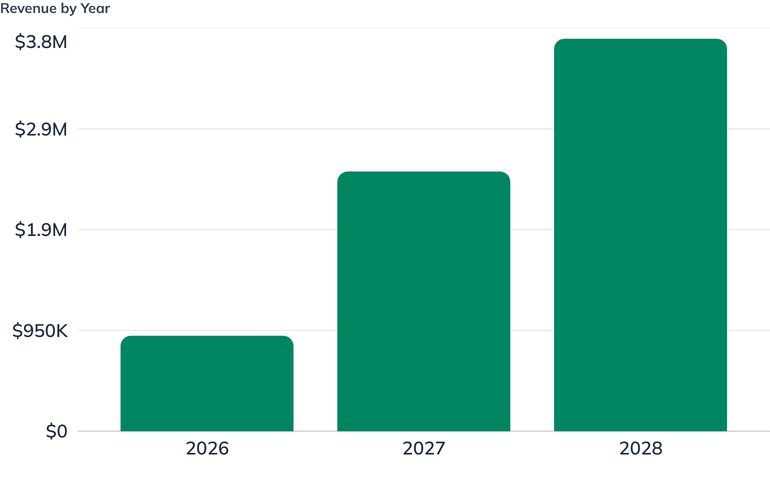
Need real financials? We recommend using LivePlan as the easiest way to create financials for your own business plan.Create your own business plan
Expenses & Costs
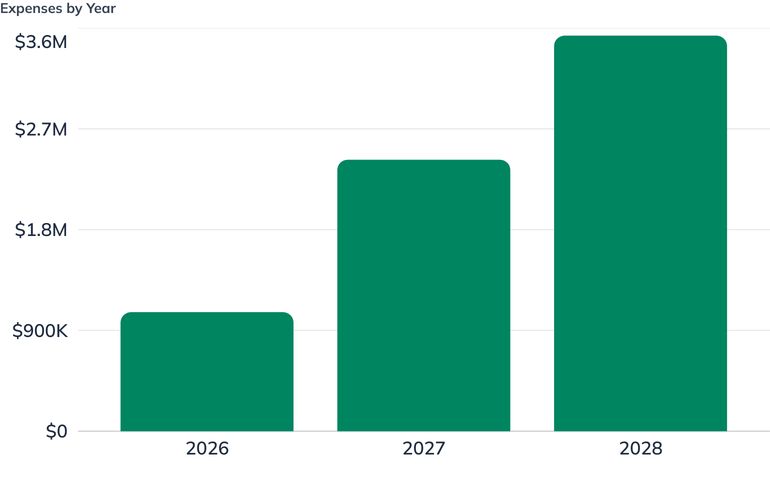
Need actual charts? We recommend using LivePlan as the easiest way to create graphs for your own business plan.Create your own business plan
Profitability
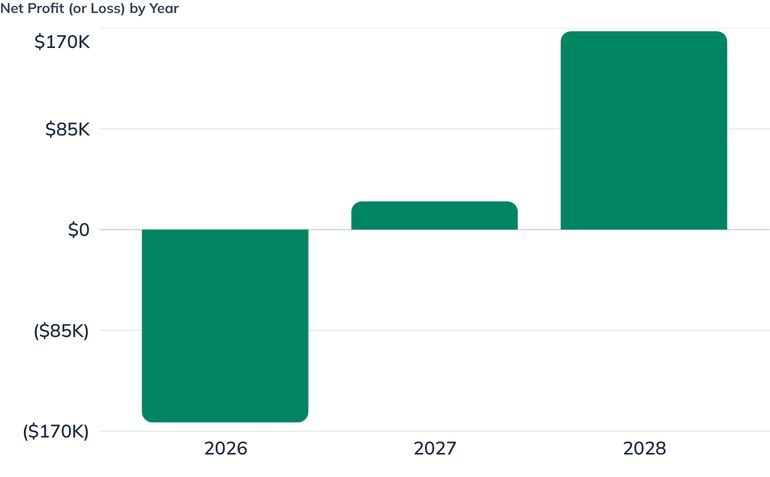
Need real milestones? Establish a clear path for your business with real-world examples.Create your own business plan
Use of Funds
The $360,000 raised is applied across three categories: capital assets, pre-launch operating costs, and a working capital and launch marketing reserve.
Use of funds | Amount |
|---|---|
Kit Builder platform development (capitalized) | $45,000 |
Testing bay build-out and test equipment | $28,000 |
Video and photography production kit | $16,000 |
Computers and office equipment | $9,000 |
Pre-launch operating costs (January–March 2026) | $47,000 |
Working capital and launch marketing reserve | $215,000 |
Total | $360,000 |
Capital assets — $98,000
Kit Builder platform development ($45,000). Contract engineering to build the three-input setup planner, the compatibility and dimension model behind it, the scaled floor-plan output, and the one-click bundle purchase flow. Capitalized and depreciated over three years. This is the largest single line in our use of funds and the one that most directly buys differentiation — it is the difference between a store that sells products and one that sells outcomes.
Testing bay build-out and test equipment ($28,000). Fit-out of the leased Dallas flex bay: rubber flooring and platform, assembly workbench and tooling, a load-testing rig for validating weight ratings, calipers, laser measure, decibel meter, sample shelving, and material handling equipment. Depreciated over seven years. This is the physical infrastructure behind the published test scorecards that our positioning depends on.
Video and photography production kit ($16,000). Two mirrorless camera bodies with lenses, continuous lighting, tripods and overhead boom, audio, backdrop system, and an editing workstation. Depreciated over five years. Our acquisition model runs on short-form video volume, and owning production capacity rather than contracting it out is materially cheaper at the cadence we need.
Computers and office equipment ($9,000). Laptops, monitors, and peripherals for the founder and the first two hires. Depreciated over three years.
Pre-launch operating costs — $47,000
Covering January through March 2026, before the storefront opens: entity formation and legal fees, the Texas Sales and Use Tax Permit and registered agent, insurance binding, the coworking and testing bay leases, initial software and platform subscriptions, supplier onboarding and sample purchases, the first wave of content production, early paid-media testing, and founder compensation during the build period.
Working capital and launch marketing reserve — $215,000
The largest use of funds and the one an inexperienced operator most often under-sizes. It covers three things:
Launch-year marketing. Advertising and paid media run approximately $170,000 across 2026, front-loaded relative to revenue because customer acquisition necessarily precedes customer revenue. Content production adds a further $25,000. This spend is what buys the trading history and the organic footprint that make later years cheaper to grow.
Payroll runway. The Customer Experience Lead and Growth and Content Marketer join in September 2026, ahead of the holiday peak rather than in response to it. Their compensation is funded from reserve until the business generates enough contribution margin to carry it.
Operating cushion. Although a dropship model has a favorable working capital cycle — customers pay us at checkout, we settle with suppliers on net terms — that float is not free cash, and a fast-growing month consumes it faster than intuition suggests. The reserve also absorbs the seasonal concentration of our business: Q4 requires marketing and buffer stock commitments weeks before the revenue arrives.
What the funds are not used for
No inventory purchase, no warehouse lease, no fulfillment equipment, no vehicles. These are the fixed costs our competitors carry and we deliberately do not, and holding that discipline as we grow is central to the model. The single planned exception is a modest buffer-stock position on top accessory SKUs held at a third-party logistics provider ahead of peak season, funded from operating cash rather than from the raise.
Repayment
SBA loan service is paid from operating cash flow. Following a six-month interest-only period, principal and interest payments begin in July 2026, amortizing over the ten-year term. The forecast carries this debt service throughout while maintaining a positive cash position in every month of the plan.
Sources of Funds
BlinkBuy is capitalized with $360,000, combining founder equity with an SBA 7(a) term loan. Both sources are in place at the start of the plan period in January 2026.
Source | Type | Amount | Share |
|---|---|---|---|
Owner investment — Max Faulhaber | Equity | $85,000 | 23.6% |
SBA 7(a) term loan | Debt | $275,000 | 76.4% |
Total | $360,000 | 100% |
Owner investment — $85,000
Founder capital contributed at formation and recorded as paid-in equity, not as a loan to the company. It carries no repayment obligation and no preference. This contribution represents meaningful founder risk capital and is the equity base the SBA lender underwrites against.
SBA 7(a) term loan — $275,000
A ten-year amortizing term loan at an assumed 10.5% annual interest rate, drawn in full in January 2026, with an initial six-month interest-only period before principal and interest payments begin. The interest-only window is deliberate: it aligns the start of principal repayment with the storefront's April 2026 launch and the first months of trading revenue, rather than forcing full debt service during the pre-revenue build period.
The loan is secured by the assets of the business and personally guaranteed by the founder, which is standard for SBA 7(a) lending at this stage. Interest expense runs approximately $26,000 in 2026, $27,000 in 2027, and $25,000 in 2028 as the principal balance amortizes.
Why debt rather than outside equity
A curated dropship retailer with no inventory does not need the capital an equity round would provide, and taking dilution to fund working capital would be an expensive way to solve a problem an SBA facility solves cheaply. Retaining full ownership also preserves the founder's ability to make merchandising decisions — declining to list a profitable but poorly built product, for instance — that are correct over a five-year horizon and awkward to defend to an investor optimizing for a three-year one.
Adequacy of funding
The forecast shows cash on hand never falling below approximately $83,000, with the low point in October 2026 during the pre-holiday marketing build. Cash ends 2026 at roughly $109,000, 2027 at roughly $139,000, and 2028 at roughly $311,000. The business is funded to reach profitability without a second raise. The $360,000 total is sized to carry a genuine working capital cushion rather than to the bare minimum, on the view that a thin cushion in a business with a seasonal Q4 concentration is a false economy.
Additional liquidity
We maintain a business credit card facility for short-term operating flexibility, used for advertising spend and settled monthly. We have not modeled a line of credit in this forecast and do not require one, though we expect to establish a modest revolving facility with our bank once we have twelve months of trading history — primarily as insurance against a supplier or payment-processor timing disruption during peak season.
Future capital needs
No additional funding is required to execute this plan. Should we choose to accelerate — a faster expansion of the Kit Builder product, a wholesale channel to independent gyms, or a substantial step up in paid acquisition — that would be a separate decision requiring either an expanded credit facility or outside equity, and would be undertaken with the SBA lender's consent as required under the loan agreement.
Projected Statements
Frequently Asked Questions
A strong dropshipping business plan covers the market opportunity and who is currently underserved, your positioning against both marketplaces and other dropship storefronts, how you select and vet suppliers, your fulfillment and returns process, an acquisition strategy, the regulatory obligations you carry as the seller of record, and a financial forecast. BlinkBuy's plan works through all of this for a curated home fitness and recovery store operating vendor-direct from Dallas, including its product intake testing standard and its supplier terms in Texas, Georgia, and Tennessee.
Dropshipping is often pitched as a near-zero-cost model, and a bare storefront can be launched cheaply, but a business built to last usually is not. BlinkBuy is capitalized with $360,000: $98,000 in capital assets, including $45,000 for Kit Builder platform development and $28,000 for a Dallas testing bay, $47,000 in pre-launch operating costs, and a $215,000 working capital and launch marketing reserve. Most of that total is the reserve and the product-testing infrastructure, not inventory, because the model deliberately buys none.
Yes, and holding no inventory does not reduce the obligation. BlinkBuy is registered as a Texas LLC with the Secretary of State, holds an EIN and a Texas Sales and Use Tax Permit, and files a Dallas assumed name certificate for any trade name. Because it sells nationally, it monitors economic nexus thresholds state by state following South Dakota v. Wayfair and registers as each is crossed, and it keeps resale exemption certificates on file with every supplier. As the seller of record it also carries CPSC product safety responsibility, including UN 38.3 documentation for the lithium-ion batteries in its recovery devices.
The margin is the spread between supplier cost and retail price, less shipping, payment processing, returns, and advertising. BlinkBuy prices on a keystone-anchored model, marking up roughly 2x on accessories and recovery goods and less on strength and cardio equipment where absolute dollar margin does the work, holding a 37% gross margin across the forecast. Revenue grows from $900,060 in 2026 to $3.7 million in 2028, with Kit Builder bundles priced between $600 and $3,500 lifting average order value well above single-item dropship benchmarks.
It depends on how front-loaded customer acquisition is relative to revenue. BlinkBuy's storefront opens in April 2026 and Kit Builder follows in July, so the first year carries a launch loss of about $163,000 against roughly $170,000 in paid media. The plan turns slightly profitable in 2027 at about $24,000 in net profit, then reaches roughly $167,000 and a 5% net margin in 2028 as the content library reduces dependence on paid acquisition.
Most dropship storefronts run large overseas catalogs on 15 to 30 day shipping timelines with no product testing and no return infrastructure. BlinkBuy inverts that: it launches with roughly 180 SKUs and holds the catalog under 300, physically assembles and scores every product against a published checklist covering build quality, assembly time, noise, footprint, and warranty, and ships from domestic suppliers so most orders arrive in two to four business days. Delivery estimates are calculated from real supplier data and shown before the customer adds to cart, and returns run on pre-negotiated supplier RMA terms so a decision can be made on first contact.
BlinkBuy sells to four segments within a U.S. home fitness market valued at roughly $5.1 billion and forecast to reach $8.5 billion by 2030. The primary one is the Space-Constrained Upgrader, aged 28 to 45 with a household income of $75,000 to $150,000, training in a spare bedroom or garage corner where square footage, not budget, is the binding constraint. The others are the Recovery Buyer, who arrives through a specific product search and repurchases fastest, the Garage Gym Builder, who has the highest lifetime value and the most product knowledge, and the Q4-concentrated Gifting and Household Buyer, who converts unusually well through Kit Builder.
BlinkBuy does not try to beat Amazon on price or shipping speed for a single commodity item. It competes on the decision itself, targeting the customer who does not yet know what to buy. For every product it carries it produces an assembly walkthrough, a space-fit guide, and honest comparison content that includes alternatives it does not sell, spending $25,000 on content production in 2026 alongside its paid media. That library is intended to raise organic revenue share every quarter, which the plan tracks as a core metric, and it is reinforced locally in Dallas-Fort Worth through partnerships with independent gyms and physical therapy practices.
Business Plan Outline
Start your plan