





Axon AI


Business Plan Summary
This AI implementation business plan example features Axon AI, a Denver-based implementation and operations firm — not a software vendor — that puts administrative AI agents into production inside multi-site outpatient provider groups and then runs them day to day, serving dental service organizations, veterinary consolidators, and physical therapy chains that run specialty practice management systems rather than Epic. It covers the three-stage service ladder of an $18,000 fixed-fee Diagnostic, a Build averaging $95,000, and a monthly Managed Operations retainer, competitive positioning against EHR-native AI and point solutions, a $620,000 launch capitalization split between founder equity and an SBA 7(a) term loan, and three-year projections built on a deliberately slow first year — a $372,806 loss in 2027 before profitability arrives in 2028. Use it as inspiration for your own plan, and read our guide on how to start a consulting business for step-by-step advice on launching a services firm. Download a free business plan template to get started, or browse more business plan examples.
Axon AI
Executive Summary
Axon AI puts administrative AI agents into production inside mid-size multi-site outpatient provider groups — dental service organizations, veterinary consolidators, physical therapy chains, and specialty MSOs — and then runs them. We are an implementation and operations firm, not a software vendor. Our promise is deliberately narrow: production, not pilots.
The problem. Administrative complexity is the largest category of waste in US healthcare, running at roughly $266 billion a year, and the 2025 CAQH Index found $21 billion in annual savings still sitting in transactions that remain manual. A manual prior authorization costs a provider $10.97 against $5.79 fully electronic. Yet adoption tracks size almost perfectly: more than 64% of health systems above $1 billion in revenue are piloting or implementing generative AI in the revenue cycle, against roughly 20% of systems between $500 million and $1 billion — and outpatient groups sit entirely below the smallest band anyone measures. Even the groups that start rarely finish. MIT found that roughly 95% of enterprise generative AI pilots produced no measurable financial effect, and that projects built around bought or partnered tools succeeded about 67% of the time while internal builds succeeded at a third of that rate. The constraint is not the models. It is that nobody on a fifteen-location dental group's payroll owns the work of connecting an agent to Dentrix Ascend, mapping it against three payer portals, writing the escalation rules, executing the business associate agreements, and running the thing every day once the consultant leaves.
Our solution. A three-stage ladder every client moves through in order. Axon Diagnostic — a fixed-fee, four-week assessment at $18,000 producing a ranked, costed workflow map. Axon Build — a fixed-fee production deployment, eight to fourteen weeks, averaging $95,000, across five workflow families: eligibility verification, prior authorization, denial triage and appeals, inbound patient phone handling, and treatment plan follow-up. Axon Managed Operations — a monthly retainer from $4,500 to $9,500 across our standard tiers that monitors accuracy daily, retunes against live denial data, absorbs model migrations, and reports hard-dollar results. Agents run inside the client's own cloud tenant under their keys, so protected health information never enters our environment, and we scope agents to administrative work only, which keeps our deployments outside clinical AI disclosure regimes.
Why we win where others cannot. Epic and athenahealth are shipping comparable agents free to their own bases, so we deliberately serve the groups they do not reach — those running Dentrix Ascend, Open Dental, ezyVet, WebPT, ModMed and similar platforms with no first-party agent layer. Accenture will not take a $95,000 engagement at $480 to $580 blended hourly rates. Point solution vendors sell software, not operational ownership. Our defensibility is not technology — foundation models are a commodity and we treat them as one — but a compounding library of payer-specific, platform-specific configuration that only accumulates by doing the work.
The team. Elena Vasquez spent fourteen years in outpatient revenue cycle operations, most recently as VP of Revenue Cycle at a sixty-location dental service organization, where she approved a six-figure AI initiative that never reached production. Marcus Chen spent eleven years in engineering, the last four building production agent infrastructure at a health technology company. Three design partners across dental, veterinary, and physical therapy are contracted or committed before launch.
The financials, presented conservatively. This plan assumes the pipeline takes six months to produce a first signed Diagnostic rather than one quarter, and roughly 15% fewer engagements at every stage than our own bottom-up math produces. On those assumptions: revenue of $303,731 in 2027, $1,709,006 in 2028, and $2,724,339 in 2029. A first-year loss of $372,806 — funded in advance, not discovered — then net profit of $52,447 in 2028 and $127,453 in 2029. Recurring retainer revenue grows from 8% of total revenue to 44%, covering annual debt service more than six times over by 2028. Cash never goes negative, bottoming at $179,365 in December 2027 and climbing each year thereafter to $268,161. Debt service coverage reaches 1.38 times in 2028 and 2.35 times in 2029 against the 1.1:1 SBA minimum. Margins are thin throughout — 3.1% in 2028, under a third of the 9.9% professional services industry average, and 4.7% in 2029, roughly half of it. That is the honest cost of a slow start. The structure is sound; the timeline to a normal margin runs to 2031.
The ask. $620,000 of committed capital plus a $150,000 revolving line. The equity piece is $120,000 from the founders — 19.4% of total project cost, nearly double the SBA minimum. The term piece is a $500,000 SBA 7(a) at 9.25% on a ten-year term, twelve interest-only payments followed by 108 amortizing payments with no balloon; at this size the loan carries the Prime plus 3.0% spread cap rather than the small-loan cap, which lowers our rate by roughly a point and a half. The revolving line, at 9.75%, finances receivables — we bill on milestones, so the book grows to $131,987 by 2029 — and is drawn for the first time in October 2028, with $60,000 still undrawn at the end of the plan. Term funds are used principally for working capital through a first year in which almost nothing sells before July, plus capital equipment, a SOC 2 Type II compliance program, and market entry.
Opportunity

Problem Worth Solving
Multi-site outpatient provider groups — dental service organizations, veterinary consolidators, physical therapy chains, dermatology and ophthalmology MSOs — are caught between two forces they cannot resolve on their own.
The first is administrative cost. Administrative complexity is the single largest category of waste in US healthcare, running at roughly $266 billion a year. The 2025 CAQH Index found that electronic transactions saved the industry $258 billion in 2024 and that another $21 billion in annual savings is still sitting on the table in transactions that remain manual or only partially automated. At the transaction level the gap is stark: a manual prior authorization costs a provider $10.97 and takes sixteen minutes through a payer portal, against $5.79 and eleven minutes when it is fully electronic. Denials compound the problem. Experian Health's 2025 State of Claims survey found that 41% of providers see at least one in ten claims denied, that 54% say denials are rising, and that a quarter of respondents trace roughly a tenth of their denials to bad or incomplete data captured at patient intake. Half of providers still review claims by hand.
The second force is that the tools to fix this now exist, and provider groups still cannot get them into production. This is the gap we were built for. Payers are automating faster than the providers who have to answer them — the 2025 CAQH Index put AI use in administrative workflows at more than 50% of health plans against just 25% of provider organizations. Among providers, adoption tracks size almost perfectly. A 2025 HFMA and AKASA survey of 519 revenue cycle leaders found that more than 64% of health systems above $1 billion in revenue were piloting or implementing generative AI in the revenue cycle, against roughly 20% of systems in the $500 million to $1 billion band. Outpatient groups sit entirely below the smallest band anyone bothers to measure.
Even the groups that start do not finish. MIT's 2025 study of enterprise generative AI found that roughly 95% of pilots produced no measurable effect on the income statement, and that projects built around bought or partnered tools succeeded about 67% of the time while internally built efforts succeeded at roughly a third of that rate. S&P Global found that 42% of companies abandoned most of their AI initiatives in 2025, up from 17% the year before, scrapping an average of 46% of proofs of concept before they reached production. MGMA's own polling makes the same point from inside medical groups: 71% report using AI somewhere around the patient visit, but 44% say it has not reduced anyone's workload.
The reason is not the models. It is that nobody on a fifteen-location dental group's payroll owns the work of connecting an agent to Dentrix Ascend, mapping it against three payer portals, writing the escalation rules for when it should stop and hand off to a human, executing the business associate agreements down the vendor chain, and then running the thing every day once the consultant leaves. A 500-employee provider group cannot hire an AI engineering team, cannot afford Accenture at a $480 to $580 blended hourly rate, and gets no meaningful implementation help from a point-solution vendor whose business model depends on shipping software, not changing how a front office works. That is a real, funded, recurring need, and it is currently unserved.
Our Solution
Axon AI puts administrative AI agents into production inside mid-size multi-site outpatient provider groups, and then runs them. We are an implementation and operations firm, not a software vendor and not a strategy shop. Our promise is deliberately narrow: production, not pilots.
We deliver through a three-stage ladder, and every client moves along it in the same order.
Axon Diagnostic is a fixed-fee, four-week engagement. We sit inside the client's front office and billing operation, pull twelve months of claim, denial, eligibility, and call data out of their practice management system, and produce a ranked workflow map: which administrative workflows are automatable today, what each one costs the group per transaction right now, what it would cost automated, where the escalation boundaries have to sit, and what has to be true technically and contractually before anything ships. The deliverable is a decision document with a defensible number attached to every line, plus a scoped statement of work for the workflows worth building. Roughly six in ten Diagnostic clients go on to a Build.
Axon Build is a fixed-fee production deployment, eight to fourteen weeks, covering one to three workflows. We build five workflow families: eligibility and benefits verification, prior authorization submission and follow-up, denial triage with appeal letter drafting, inbound patient phone handling for scheduling, rescheduling and recall, and treatment plan and estimate follow-up. Every build is fixed-fee, which puts the estimation risk on us rather than the client — the single most common reason mid-market groups refuse to start. A Build is not finished when the agent works in a demo. It is finished when it has run the client's real volume for two consecutive weeks inside agreed accuracy and escalation thresholds, when the front office staff have been retrained around it, and when the runbook has been handed over.
Axon Managed Operations is the monthly retainer that follows, and it is the centre of the business. Agents that touch payers degrade. Portals change, payer rules shift, denial patterns move, and an agent that was accurate in March quietly stops being accurate in September. Under Managed Operations we monitor accuracy and escalation rates daily, retune prompts and routing against live denial data, maintain the payer and PMS integrations, absorb model version changes, and report monthly on hard-dollar recovery — claims paid, hours returned, calls answered. Clients are tiered by location count and workflow count.
Two architectural decisions define how we work, and both exist because our clients are covered entities. First, agents run inside the client's own cloud tenant, on their Azure or AWS account, under their own keys. Protected health information never lands in an Axon-controlled environment, which turns a difficult security review into a short one and removes us from the client's breach surface. Second, we scope agents to administrative work only — scheduling, eligibility, authorization, billing, collections. We do not build agents that convey clinical information to patients, which keeps our deployments outside the disclosure requirements of laws like California's AB 3030 and keeps clinical liability where it belongs, with the licensed provider.
We are model-agnostic and integration-first. We compose our builds from the client's existing practice management system, commercially available foundation models, and, where a mature point solution genuinely wins, that vendor's product configured and operated by us. We have no software to defend, which means we can tell a client that the right answer is a $900-a-month tool plus good configuration rather than a custom build. That honesty is the reason we get the retainer.
Target Market
Our client is a multi-site outpatient provider group with five to forty locations, running a specialty practice management system rather than Epic, with a centralized billing or revenue cycle function and at least one executive — a COO, VP of Revenue Cycle, or CFO — who owns administrative cost as a number they are measured on. That last condition matters more than size. Groups without a centralized back office have no one to sell to.
Dental service organizations are our lead segment. The ADA Health Policy Institute put DSO affiliation at 16.1% of US dentists in 2024, and more than one in four dentists within ten years of graduation. The ten largest DSOs alone support roughly 7,350 offices, and Becker's tracked more than 200 DSO affiliations, acquisitions, and de novo openings across all fifty states in 2025. Below the ten largest sits a long tail of regional DSOs in exactly our range. Dental is attractive because the platforms these groups run — Dentrix Ascend, Open Dental, Curve, Denticon — have no first-party agent layer, because treatment plan follow-up is a direct revenue lever rather than a cost lever, and because the segment's phone problem is severe. Patient Prism's analysis of 8,280 dental and DSO locations found that 31% of patient inquiries never reach a live person at all.
Veterinary groups are our second segment. Corporate consolidators held roughly half of veterinary market share by revenue as of 2021 and around a quarter of general practices, with private equity deals exceeding $45 billion between 2017 and 2022. Veterinary medicine has essentially no payer prior authorization, which removes our most complex workflow, but it has acute front-desk phone volume, high no-show sensitivity, and estimate approval workflows that map cleanly onto what we build. Platforms are ezyVet, Cornerstone, and Vetspire.
Physical therapy and rehabilitation groups are our third. The US PT clinics market is roughly $53 billion, and the fifty largest competitors capture only 29% of it — one of the most fragmented outpatient segments in the country, and one where authorization-driven visit limits make eligibility and re-authorization work relentless. Platforms are WebPT, Prompt, and Raintree.
Dermatology, ophthalmology, and behavioral health MSOs form our expansion segment, entered in early 2029 once the first three verticals are producing reference clients and the delivery team can absorb a new platform. Dermatology and eye care lead private equity outpatient dealmaking, and behavioral health transactions rose 47% year over year through the third quarter of 2025. These groups run ModMed, Nextech, and a spread of behavioral health platforms. Entering a fourth vertical is the kind of investment a slower ramp defers rather than cancels, and we would rather be late to it than thin across four segments in a year when we have references in none.
We deliberately exclude three groups. We do not sell to hospitals or health systems: the sales cycle is eighteen months, the security review is a project in itself, and Epic already serves them — 85% of Epic customers now use Epic AI, and Epic has shipped named agents for scheduling, billing questions, prior authorization submission, and denial appeals. We do not sell to solo or two-location practices, which lack a centralized back office and cannot support our price point. And we are cautious about groups running athenahealth, which as of June 2026 bundles more than eighty revenue cycle AI features into athenaOne at no incremental cost, including voice agents that place prior authorization calls. Where an athenahealth group does engage us, it is for cross-system orchestration and change management the EHR vendor does not do, and we price and scope it as such.
One market dynamic shapes how we sell, and it is the reason this plan assumes a six-month sales cycle rather than a three-month one. Physician practice management deal volume has fallen from a 2021 peak of 851 transactions to 105 in the first half of 2026, roughly half of 2025's pace, as more than a dozen states have tightened oversight of private equity healthcare transactions. Our buyer in 2027 is therefore not a serial acquirer integrating a new practice every month. It is an existing platform that has stopped buying and is now under real pressure to make margin out of the locations it already owns. That is a better buyer for us, not a worse one — but it is a slower one, and we have budgeted for that.
Competition
We compete against four alternatives, and we are honest with prospects about all of them.
The EHR and PMS vendors' own AI. This is the most serious competitive force in our market, and it is the reason our segment definition is drawn where it is. Epic previewed four named agents at HIMSS26 — Art for clinical documentation, Emmie for patient scheduling and billing questions, Penny for coding, prior authorization submission and denial appeals, and an Agent Factory for customer-built agents — and reports that 85% of its customers now use Epic AI. athenahealth shipped more than eighty revenue cycle AI features into athenaOne in June 2026, including AI voice agents that make prior authorization calls, most of them at no additional cost. Where the client's EHR ships the capability free, we lose, and we should. Our answer is segment selection: the dental, veterinary, PT, and specialty MSO platforms our clients actually run have no first-party agent layer and no announced roadmap for one. Where a client is on Epic or athenahealth, we sell the work those vendors do not do — orchestration across systems the EHR does not touch, configuration against the group's own payer mix, and the operational change management that determines whether a shipped feature ever gets used.
AI point solutions. Assort Health raised $120 million at a $1.2 billion valuation in June 2026 and reports twentyfold revenue growth over fifteen months in patient voice. Hello Patient handles ten to twenty thousand conversations a day across urgent care, dermatology, orthopedics, and veterinary. Candid Health raised a $120 million Series D in July 2026 against roughly $7 billion in annual claim volume across 200-plus healthcare organizations, and Adonis raised $40 million in March 2026 on 4x revenue growth. These are strong products, and they are not our competitors so much as our supply chain — we deploy several of them. Where we do compete, we compete on the gap between buying a tool and operating one. A point solution sells software and a light onboarding; it does not own the client's denial rate. Notably, Assort is moving up-market into large health systems, which vacates the mid-size ground rather than contesting it.
The large consultancies. Accenture booked $5.9 billion in generative AI work in fiscal 2025 against $69.67 billion in total revenue, and added $2.2 billion in advanced AI bookings in the first quarter of fiscal 2026 alone. Deloitte, Slalom, EPAM, and Thoughtworks all have real practices. None of them will take a $95,000 engagement, and their realized blended rates of $480 to $580 an hour put a serious build well outside a fifteen-location group's budget. We win the segment beneath them by structure, not by being better consultants.
Doing it internally. The most common competitor in any deal is the client's own IT director with a ChatGPT Team seat and a mandate to "look at AI." MIT's 2025 research is the cleanest counterargument we have: bought or partnered tools succeeded roughly 67% of the time while internally built efforts succeeded at about a third of that rate, and 95% of pilots produced no measurable financial effect. Gartner expects more than 40% of agentic AI projects to be cancelled by the end of 2027. We open every Diagnostic by acknowledging that internal build is a legitimate option and by showing the client what it would actually cost them in engineering months.
How we win. Four things are ours specifically. Fixed-fee pricing at every stage, which moves estimation risk off the client. Deployment inside the client's own cloud tenant, which shortens security review and keeps PHI out of our environment. Depth in four verticals and the dozen practice management platforms they run, rather than shallow coverage of the whole market — depth that compounds, because the second dental client on Dentrix Ascend is faster and more profitable than the first, and the tenth is faster still. And operations as the product rather than the afterthought, which is what turns a one-time project into a retained relationship. Our defensibility is not technology; foundation models are a commodity and we treat them as one. It is a growing library of payer-specific, platform-specific, workflow-specific configuration that only accumulates by doing the work.
Execution
Marketing Plan
We are selling a six-figure engagement to a risk-averse buyer in a regulated industry who has probably already been disappointed by an AI vendor. Nothing about that buyer responds to advertising. Our marketing exists to do one thing: make a COO or VP of Revenue Cycle at a twenty-location group believe we have already solved their exact problem before we ever speak. Our plan assumes that takes six months to achieve for the first client, and we budget accordingly rather than assuming a fast start.
Proof over promotion. Our primary marketing asset is the published result. Every Managed Operations client is asked at contract signature for permission to publish anonymized outcome data at the six-month mark — denial rate movement, prior authorization turnaround, call answer rate, hours returned to the front desk. We publish these as short, numbers-first case studies segmented by vertical, because a dental group wants to read about a dental group. Our two launch design partner Diagnostics, delivered in July and August 2027, are discounted in exchange for named, attributable case studies. Because the six-month clock starts at go-live rather than at signature, our reference base builds in two steps: one named dental reference by April 2028, and three named references spanning dental, veterinary, and physical therapy by November 2028. Those two dates matter more than any traffic number we could report, and the whole 2028 revenue plan sits downstream of them.
Industry events, narrowly chosen. Our buyers concentrate at a handful of segment-specific conferences: the ADSO Summit and Becker's Dental for DSOs, VMX and the Veterinary Meeting & Expo for veterinary consolidators, the APTA Private Practice Annual Conference and Ascend for PT, and the AAO and AAD practice management tracks for specialty MSOs. We attend four to six a year, always with a speaking or panel slot rather than a booth where possible, and always presenting client results rather than a capabilities deck. Conference presence is our single largest marketing line and the one we protect first — it was trimmed but not cut in the lean first year, because cutting the demand engine to survive a slow ramp is how a slow year becomes a fatal one.
Owned content aimed at one reader. We publish a fortnightly technical newsletter written for operations leaders, not for a general audience: teardowns of specific payer authorization workflows, honest write-ups of what failed in a deployment and why, plain explanations of regulatory change like the CMS-0057-F prior authorization API deadlines, and running benchmarks on what administrative transactions actually cost by segment. We also publish an annual Outpatient Administrative Automation Benchmark drawn from anonymized client data, first issued in July 2029 once the client base is large enough to make it meaningful, which becomes our most reusable asset — a reason for prospects to give us their email, for journalists to cite us, and for conference organizers to invite us back.
Partner-sourced referral. Practice management consultants, DSO and MSO transaction advisors, fractional CFOs serving healthcare groups, and dental and veterinary CPA firms all sit upstream of our buyer and are frequently asked "who should we talk to about AI?" We build a small, actively managed referral network of these firms with a formal referral fee on closed Diagnostic engagements. In a plan with a six-month organic sales cycle, referral is the single most valuable channel we have, because a warm introduction is the only thing that reliably compresses it. We also cultivate relationships with the point-solution vendors whose products we deploy; their sales teams regularly encounter groups that need implementation help they do not provide.
Search and social, sized honestly. We maintain a search presence for a narrow set of high-intent terms — "dental prior authorization automation," "veterinary front desk AI," "WebPT eligibility automation" — rather than competing for generic AI consulting terms against firms with far larger budgets. Our founders publish consistently on LinkedIn, which is where this buyer actually reads. We do not run paid social.
What we will not do. No cold outbound email at volume, no generic AI thought leadership, no booth-and-swag conference presence, and no marketing claim we cannot show a client number behind. In a market where 95% of AI pilots produced nothing measurable, credibility is the scarce good, and it is spent faster than it is earned.

The Margin Protector
Chief Financial Officer
A results-oriented executive under pressure from private equity investors to increase EBITDA margins now that the acquisition phase has slowed. They view administrative waste and the $57 average cost per denied claim as direct threats to the organization's valuation.
Priorities
- Expanding EBITDA margins through operational leverage
- Reducing the total cost-to-collect across all sites
- Improving cash flow predictability by lowering denial rates
Evaluation Criteria
- Clear ROI and impact on the income statement within 12 months
- Total cost of ownership compared to hiring more billing FTEs
- Vendor's ability to handle implementation without internal engineering resources
Pain Points
- Rising labor costs for manual billing and administrative staff
- High denial rates (10%+) impacting net income margins
- Previous AI pilots that failed to produce measurable income statement impact
Common Objections
- We have already scrapped AI initiatives that didn't reach production
- The upfront implementation cost is hard to justify in a tight budget year
“We are no longer in a 'growth at all costs' phase; I need to find margin in the locations we already own, and that starts with fixing our $20 billion denial problem.”

The Workflow Guardian
Director of Clinical Operations
The bridge between the central office and the local clinics who cares deeply about staff burnout and patient experience. They advocate for tools that actually reduce workload rather than adding another 'point solution' for the front desk to manage.
Priorities
- Reducing administrative burnout for front-desk coordinators
- Ensuring patients have clear cost estimates before their appointments
- Maintaining high clinician satisfaction by ensuring they get paid for their work
Evaluation Criteria
- Ease of use for non-technical staff at the practice level
- Reduction in the number of manual touches per patient visit
- Quality of vendor support during the 'go-live' phase at each location
Pain Points
- Front office staff spending 25% of their day on the phone with payers
- Friction between clinics and the billing office over 'incomplete data'
- Software 'shelfware' that was purchased but never fully implemented at the site level
Common Objections
- Our staff is already fatigued by too many new software rollouts
- I don't have the bandwidth to manage a complex technical implementation
“I'll support any tool that actually takes work off my managers' plates, but it has to work on day one without us having to hire an engineer to fix it.”

The Efficiency Architect
VP of Revenue Cycle Management
A strategic leader responsible for the centralized billing office who is frustrated by the gap between payer automation and their own manual workflows. They are the primary evaluator of how a tool will integrate with their specialty PMS like Dentrix or Cornerstone.
Priorities
- Automating the 16-minute manual prior authorization process
- Standardizing RCM workflows across disparate clinical locations
- Moving revenue protection upstream to the point of patient intake
Evaluation Criteria
- Seamless mapping between the AI agent and our specific specialty PMS
- Robustness of escalation rules for human hand-offs
- Vendor's expertise in change management and front-office workflow
Pain Points
- High staff turnover due to repetitive, manual portal work
- Payers using AI to deny claims faster than the team can appeal them
- Bad data captured at intake causing 10% of total denials
Common Objections
- Our specialty practice management system is difficult to integrate with
- I am worried the AI will produce care denial rates higher than our manual process
“My team is drowning in payer portals. If we don't automate the transactions that take 11 to 16 minutes each, we will never be able to scale our operations.”
Sales Plan
Our sales process is built around one conviction: the Diagnostic is the sale. We do not try to close a six-figure build from a discovery call. We sell a small, fixed-fee, four-week engagement that produces something the client would want even if they never hired us again, and we let the Build sell itself off the evidence.
The funnel, and how long it actually takes. A qualified opportunity is a group with five or more locations, a centralized billing function, a named executive owner of administrative cost, and a practice management platform we support. We qualify hard and early; a group that fails any of those four is disqualified in the first call rather than nurtured. From qualified conversation to signed Diagnostic runs four to eight weeks once a relationship exists — but building the first relationships from a standing start takes considerably longer, and this plan assumes six months from opening our doors to a first signed Diagnostic in July 2027. From Diagnostic delivery to signed Build runs two to six weeks, and roughly six in ten Diagnostics convert. Managed Operations is not sold separately — it is contracted at the same time as the Build, beginning at go-live, because an agent nobody operates is an agent that fails, and we will not ship one.
The Diagnostic as the proof mechanism. Everything about the Diagnostic is designed to de-risk us in the buyer's mind. It is fixed-fee, so there is no scope exposure. It is four weeks, so it fits inside a quarter. It requires read-only data access rather than write access, so the security review is short. And it produces a ranked, costed workflow map that belongs to the client outright, including the finding that a given workflow is not worth automating. We have told clients not to build things. That is precisely why the Build converts.
Who sells. For the first year both founders sell, and in a year with six Diagnostics that is close to a full-time job for both. Elena leads every commercial conversation and Marcus joins for the technical and security review, which in a regulated buying process is usually the meeting that decides the deal. This is deliberate: early positioning, pricing discipline, and qualification criteria are learned in the room, and handing that to a junior seller before the pattern is understood destroys both. A business development representative joins in August 2028 to run top-of-funnel qualification and conference follow-up, and an account director joins in September 2029 to own expansion inside existing accounts. Founders remain in every deal above the Diagnostic stage.
Land and expand. Our best growth does not come from new logos. A group that automates eligibility verification at eight locations has three obvious next moves: extend the same workflow to the remaining locations, add prior authorization or denial triage, and add the practices acquired since go-live. Each is a smaller sale to a buyer who has already seen us deliver. We formalize this with a quarterly business review for every Managed Operations client, held with the executive sponsor, where we present measured results and the next ranked workflow from the original Diagnostic map. Expansion revenue carries no acquisition cost and closes in weeks rather than months — which is why a slow first year hurts twice: it costs the revenue and it delays the expansion base.
Contract structure. Diagnostics are invoiced half at signature and half at delivery. Builds are invoiced 40% at kickoff, 30% at integration milestone, and 30% at production acceptance, which protects our cash position and keeps client incentives aligned with getting to production rather than lingering in testing. Managed Operations runs on a twelve-month initial term with sixty-day termination for convenience after month six, billed monthly in advance. We sign a business associate agreement before any data moves, in every case, without exception.
Discipline we hold. We do not discount the Diagnostic, with one disclosed exception: the two launch design partners engaging in July and August 2027 receive it at $9,000 in exchange for named, attributable case studies, and no further discounts are contemplated after that. We do not begin a Build without a completed Diagnostic, whatever the client offers to pay, because the failures in this industry come from building the wrong workflow confidently. And we walk away from groups that want a pilot with no production commitment — that is the exact pattern that produced a 95% failure rate across the industry, and participating in it would cost us the only asset we have. A lean first year makes each of these harder to hold and none of them optional.
Locations & Facilities
Axon AI is headquartered in Denver, Colorado, and operates remote-first with a physical anchor rather than the reverse.
Why Denver. Three reasons, in order of weight. First, engineering cost: senior AI engineers in the Denver-Boulder market command roughly $150,000 to $195,000 in base salary against $210,000 to $250,000 in the San Francisco Bay Area for comparable experience, and the talent pool is deep enough that we are not competing for a handful of people. That difference is roughly a third of a headcount per engineer, and in a services business where labor is the dominant cost it is the difference between viable and not — more so in a plan with a slow first year, where every fixed salary dollar has to be carried through six months of no revenue. Second, our clients are not concentrated in coastal metros — the regional DSOs, veterinary groups, and PT chains we serve are distributed across the Mountain West, Midwest, Texas, and the Southeast, and Denver puts us within a two-hour flight of most of them with direct service to nearly every city we sell into. Third, Colorado's healthcare and health-tech density gives us a local hiring pool with existing HIPAA and provider-operations experience, which is far harder to teach than model engineering.
The office. We hold a small private office plus dedicated desks in a Denver coworking facility, sized for two to three people on site in the first year and scaling as we hire. A private, lockable office is not a preference — it is a control we are asked about in client security reviews, and a shared open desk is difficult to defend when the client is a covered entity and we are a business associate. The space provides a conference room for client calls, secure document handling, and enterprise network segmentation. Coworking rather than a lease is what makes the delayed ramp survivable: headcount goes from two at launch to five by the end of 2027 and twelve by the end of 2029, and we add desks in monthly increments rather than committing to square footage for people we have not yet hired. A three-year lease signed in January 2027 against the original hiring plan would have been an expensive mistake.
Remote-first delivery. Our engineers and implementation consultants work from wherever they are most effective, with two anchor days a week in the Denver office for the team within commuting distance and quarterly full-team on-sites for everyone. All delivery work is done remotely: we connect to client systems over VPN or through their cloud tenant, run working sessions on video, and use screen recordings and written runbooks rather than in-person shadowing wherever possible. This is not a cost measure. It is what lets a Denver firm serve a twenty-two location dental group in Tennessee without a travel budget that eats the engagement margin.
Client site visits. We travel deliberately and infrequently. Every Diagnostic includes two to three days on site at one to three of the client's locations, because you cannot understand a front office from a video call — the workarounds that matter are the ones nobody documents. Every Build includes a go-live visit for front office retraining. Managed Operations is delivered entirely remotely, with quarterly business reviews on video and an annual in-person visit for larger accounts. We budget travel per engagement rather than as general overhead, which keeps it visible in deal economics and made it straightforward to size the first-year travel line to six engagements rather than fifteen.
Data residency. We hold no client protected health information in our own environment. Agents run in the client's Azure or AWS tenant, in their region, under their keys, and Axon systems retain only engagement documentation, configuration artifacts, and de-identified performance metrics. Our own systems are US-hosted. All delivery work is performed by US-based personnel — a deliberate choice with a regulatory reason, since Texas SB 1188 prohibits the offshoring of electronic medical records and several client security policies impose the same restriction independently.
Technology
We build on commodity foundation models and treat them as commodities. Our technical advantage is not in the models; it is in the integration layer, the evaluation harness, and the operational tooling that keeps an agent accurate after the consultant leaves.
Model layer. We are model-agnostic by design and route by task. Reasoning-heavy work — denial analysis, appeal letter drafting, authorization decision logic — runs on frontier models from Anthropic and OpenAI. High-volume, low-complexity classification and extraction runs on smaller, cheaper models, which is where most of the margin on a retainer is won or lost. Voice workflows use a purpose-built speech stack rather than a general model. Every agent is built behind an abstraction layer so a model can be swapped without touching workflow logic, which matters more than it sounds: model deprecations and price changes are routine, and a client whose agent breaks on a vendor's release schedule does not stay a client. Where a client's own security policy requires it, we deploy through Azure OpenAI Service or Amazon Bedrock inside their tenant rather than calling a vendor API directly.
Integration layer — where the real work is. We maintain and extend a library of connectors and workflow patterns for the platforms our four verticals run: Dentrix Ascend, Open Dental, Curve, and Denticon in dental; ezyVet, Cornerstone, and Vetspire in veterinary; WebPT, Prompt, and Raintree in physical therapy; ModMed and Nextech in specialty MSOs. Where a documented API exists we use it. Where one does not — which is common in this tier of software — we use supported integration paths, database-level reads under client authorization, and browser automation as a last resort, always with explicit client sign-off on the method. On the payer side we maintain per-payer configuration for eligibility, authorization, and claim status against the portals and clearinghouses our clients actually use. This library is the compounding asset in the business, and it is the reason a slow start costs us more than a year of revenue: it costs a year of accumulation. The second dental client on Dentrix Ascend costs materially less to serve than the first.
Evaluation and guardrails. Every workflow ships with an evaluation suite built from the client's own historical transactions before a single agent action goes live, and accuracy is measured against that ground truth continuously in production, not once at acceptance. Every agent has hard escalation boundaries defined with the client and encoded rather than prompted — confidence thresholds, dollar thresholds, transaction types that always route to a human, and a full stop on anything the agent has not seen before. Every agent action is logged immutably with its inputs, its reasoning, its output, and its confidence, which is what makes an audit answerable and a denial appeal defensible. Nothing we build takes an irreversible action against a payer or a patient record without either a human approval step or an explicit, documented client decision to allow it.
Security architecture. Agents run in the client's own cloud tenant under the client's keys, so protected health information never enters an Axon-controlled environment. We hold least-privilege, time-bounded access to client systems, granted per engagement and revoked at close. Our internal environment enforces multi-factor authentication everywhere, encryption at rest and in transit, device management on every endpoint, network segmentation, and centralized secrets management — a control set chosen to match the direction of the proposed HIPAA Security Rule update rather than only today's minimum, because retrofitting later is more expensive than building now. This is one of the few line items the lean first year did not touch.
Internal tooling. We run our own engineering on Linear for delivery tracking, GitHub with Copilot and Cursor for development, Slack for internal and client-shared channels, HubSpot for pipeline, Notion for runbooks and the connector library, Vanta for continuous compliance monitoring, and 1Password for secrets. Client-facing agent monitoring runs on an internal dashboard we build and maintain, which surfaces accuracy, escalation rate, volume, and cost per transaction per client and feeds the monthly report. That dashboard is not a product we sell. It is the reason two managed operations specialists can run roughly twenty client deployments by the end of the plan period without adding an engineer per account — the operating leverage that makes the retainer book worth building.
Equipment & Tools
A services firm of our kind is light on capital equipment and heavy on subscriptions and compliance. Our equipment plan reflects that honestly, and the delayed ramp changed the timing of what we buy rather than what we buy.
Workstations. Every engineer and consultant receives a high-specification laptop — 32GB to 64GB of memory, current-generation processor — on a three-year replacement cycle, with an external monitor, dock, and peripherals. We buy rather than lease; at our headcount the administrative overhead of a lease is not worth the cash flow benefit, and the machines are fully depreciated well before they are retired. Because hiring is deferred, equipment follows it: $29,000 at launch in January 2027, a second tranche of $15,000 in July 2028 as the delivery team doubles, and $11,000 in January 2029 covering the year-three hires and replacement of the earliest machines. All devices are enrolled in mobile device management with full-disk encryption, remote wipe, and enforced patching from the day they are issued, which is both good practice and a line item every client security questionnaire asks about.
Office equipment. Desks, chairs, and monitors for the Denver space, a conference room video setup that is good enough for a client security review rather than adequate for an internal standup, a locking file cabinet for the small volume of physical documentation we hold, and a cross-cut shredder. The video setup matters more than it appears: most of our sales and delivery happens over video, and poor audio in a technical review is a real deal risk.
Software and platform subscriptions. These, not hardware, are our meaningful recurring technology cost, and they scale directly with headcount:
- Engineering — GitHub Copilot Business and Cursor Teams seats for every engineer, GitHub organization, cloud development environments
- Delivery and operations — Linear, Notion, Slack Business+, Zoom
- Commercial — HubSpot Sales Hub, LinkedIn Sales Navigator for founders and the business development representative
- Security and compliance — Vanta for continuous control monitoring, 1Password, Mosyle or Kandji for device management, an annual third-party penetration test
- Finance and administration — QuickBooks, Gusto for payroll and benefits, Ramp for spend management
- Foundation model access — Anthropic and OpenAI API accounts for internal development, evaluation, and demonstration work, plus Claude and ChatGPT team seats
Model and cloud consumption. We hold two distinct pools and account for them separately, because conflating them hides the economics of the business. Internal consumption — building, evaluating, and demonstrating agents — is our own operating expense and grows with engineering headcount. Client production consumption runs in the client's own cloud tenant on their account, is billed by their cloud provider directly to them, and is not marked up by us or carried on our books. This keeps our cost of delivery predictable and removes the most common source of dispute in AI services engagements.
Compliance infrastructure. SOC 2 Type II is the near-universal procurement gate for a business associate selling into provider groups, and we treat it as a first-year capital-equivalent investment rather than an eventual nice-to-have: compliance automation tooling, an independent auditor, a penetration test, and the internal time to build the control set. We pursue Type I in the second half of 2027, with the report issued in November, and Type II following the observation window in August 2028. Running the Type I audit alongside the first client engagements rather than ahead of them is a deliberate sequencing choice in a cash-constrained first year — the control environment is built from January, but the audit fee is spent when it unblocks a specific deal. HITRUST is deliberately deferred; it is demanded principally by large health systems and payers, which we do not sell to, and the assessor costs are not justified at our scale until a client requires it.
Insurance. Professional liability and errors and omissions, general liability, cyber liability with a limit sized to our client PHI exposure rather than to our revenue, workers' compensation, and key person life coverage on both founders assigned to the lender. Our cyber and E&O coverage sits materially above the median for a firm our size because we operate inside covered entities' systems, and clients routinely require certificates of insurance at specific limits before signing a business associate agreement. None of this was cut to absorb the slower ramp.
Milestones
SBA financing closes; operations begin Term loan and working capital line close, founder equity injection verified, business banking and payroll established, insurance bound, Denver coworking space and equipment in place. Both founders begin full time on pipeline building, referral partner activation and the SOC 2 control build; no delivery staff are hired until June. | Elena Vasquez Jan 15, 2027 |
First design partner Diagnostic delivered Ranked, costed workflow map delivered to the 22-location Tennessee DSO after a longer-than-planned six-month pipeline build. Establishes the Diagnostic methodology and produces our first scoped Build statement of work. | Elena Vasquez July 31, 2027 |
First Build reaches production acceptance; first retainer live Eligibility verification and treatment plan follow-up agents running the client's real volume for two consecutive weeks inside agreed accuracy and escalation thresholds. Managed Operations retainer begins at go-live. | Marcus Chen Oct 31, 2027 |
SOC 2 Type I report issued Control environment designed and audited, built to the control set proposed in the HIPAA Security Rule NPRM. Removes the most common procurement blocker in our sales cycle. | Marcus Chen Nov 30, 2027 |
Team at five; AI Engineer and Implementation Consultant onboarded Both hires deferred to December and made only against contracted Build pipeline, not forecast. Total headcount reaches five — two founders plus three delivery staff — and delivery capacity triples going into 2028, which is where the volume actually lands. | Marcus Chen Dec 31, 2027 |
First veterinary vertical Build delivered (ezyVet) Inbound phone handling and estimate approval agents live at the 14-location Colorado veterinary group. Proves the second vertical and starts the ezyVet connector library. | Marcus Chen Feb 29, 2028 |
First dental case study published Six-month outcome data published for the Tennessee DSO, live since October 2027. Year one closed with two Managed Operations clients; the veterinary and PT case studies follow later in 2028. | Elena Vasquez Apr 30, 2028 |
SOC 2 Type II report issued Type II observation window complete and the report in hand, removing the last standing procurement blocker. Trailing-twelve-month debt service coverage, which first cleared the 1.1:1 threshold in June 2028, is above 3x by this point. | Operations and Compliance Manager Aug 31, 2028 |
Three named references across dental, veterinary and PT Six-month outcome data published for all three launch design partners, giving us a named, attributable reference in every founding vertical — the reference base the year-two and year-three sales plan depends on. | Elena Vasquez Nov 30, 2028 |
Managed Operations reaches 10 live clients Recurring revenue reaches 30% of full-year revenue and covers annual debt service more than six times over. The retainer book becomes the base the business plans against rather than project wins. | Elena Vasquez Dec 31, 2028 |
Specialty MSO vertical entered (ModMed or Nextech) First dermatology or ophthalmology MSO Build delivered, adding the fourth vertical and reducing dependence on the dental segment. | Elena Vasquez Feb 28, 2029 |
First annual Outpatient Administrative Automation Benchmark published Anonymized cost-per-transaction and denial data across the client base, segmented by vertical. Becomes our most reusable marketing asset and our claim to a category position. | Elena Vasquez July 31, 2029 |
Recurring revenue exceeds 40% of total; no client above 20% Headcount reaches 12 across four verticals with roughly 18 retainer clients. Concentration risk resolved and the recurring base covers fixed cost, putting the company on a footing to accelerate hiring in 2030. | Elena Vasquez Dec 31, 2029 |
Key Metrics
We track a deliberately short list. In a services business it is easy to measure everything and manage nothing, so these are the numbers reviewed in every weekly leadership meeting and reported monthly to our lender.
Commercial
- Diagnostics signed per quarter — our single leading indicator. Everything downstream is a function of this number, and in a plan whose first six months produce none of them, it is the number that tells us earliest whether the ramp assumption is holding.
- Diagnostic-to-Build conversion rate — operating target 60%. Below 50% on a cohort basis means we are either selling Diagnostics to unqualified groups or the workflow maps are not making the case. Measured by cohort rather than by calendar year, since a Diagnostic sold in November converts in the following year.
- Build-to-Managed-Operations attach rate — target 100%, because we do not ship a Build without a retainer. Any miss is a policy exception we review individually.
- Average Build contract value and average monthly retainer value — watched for drift. Quiet erosion in average deal size is the most common way a fixed-fee firm loses margin without noticing.
- Sales cycle length — qualified conversation to signed Diagnostic, target four to eight weeks once a relationship exists; Diagnostic delivery to signed Build, target two to six weeks.
Delivery
- Billable utilization — target 70% to 75%. The professional services industry average fell to 66.4% in 2025, the lowest on record, against a high-performer benchmark of 75%. Below 65% we are carrying bench; above 80% we are about to miss a delivery date or lose someone.
- Build margin, per engagement — actual delivery weeks against the estimate the fixed fee was priced from. Every engagement is reconciled at close. Two consecutive quarters of erosion means our pricing model is wrong, not that our engineers are slow.
- On-time production acceptance — the percentage of Builds accepted by the contracted date. Firms applying generative AI widely in professional services delivery hit 81.5% on-time delivery against 70.8% for non-users; we should be at the top of that range or we are not practising what we sell.
- Revenue per billable employee — the industry benchmark sits around $210,000 with high performers above $225,000.
Client outcome — the metrics that renew the retainer
- Agent accuracy against the client's ground-truth evaluation suite, measured continuously in production
- Escalation rate — the share of transactions routed to a human. A rising escalation rate is the earliest signal of agent drift and the reason Managed Operations exists.
- Client-measured hard-dollar impact — denial rate movement, prior authorization turnaround time, call answer and abandonment rate, front-office hours returned. Reported monthly to the client and to us. This is the number that survives a budget review.
- Cost per automated transaction — tracked against the client's pre-automation baseline from the Diagnostic.
Retention and financial health
- Managed Operations logo retention and net revenue retention — retainer churn is the fastest way this business dies, and expansion inside existing accounts is our cheapest growth.
- Recurring revenue as a share of total revenue — the number our lender cares about most, because it determines whether debt service is covered by contracted income or by winning new projects.
- Days sales outstanding — we bill on milestones and collect roughly half of each engagement up front, which holds the book to an implied DSO of about eighteen days. Every ten days of slippage moves roughly $37,000 of cash by 2029, and DSO is the fastest-moving input to whether we need to draw the revolver.
- Available liquidity in months of operating expense — cash on hand plus undrawn revolver capacity. Our policy target is three months, reviewed weekly. The forecast holds it in every month of 2027 and 2028 and lands at approximately 2.9 months at the end of 2029 — a disclosed shortfall of roughly $7,900 that closing is the first call on any outperformance. This is the covenant-adjacent number and the one we manage most conservatively.
- Debt service coverage ratio — reviewed quarterly against our loan covenant, on a trailing-twelve-month basis.
Team
- Voluntary attrition — the professional services average is 11.4%, and in a firm where the connector library lives partly in people's heads, losing a senior engineer costs more than the recruiting fee suggests.
- Time to productivity for new hires — the industry average is 65.5 days against 54 for high performers.
Pricing
Every engagement we sell is fixed-fee or fixed-monthly. We do not bill hourly. Hourly billing punishes us for getting faster at exactly the work we intend to get faster at, and it asks a cost-conscious buyer to sign an open-ended commitment — the single most common reason mid-market groups stall before starting.
Axon Diagnostic — $18,000 flat. Four weeks, one to three sites of observation, twelve months of claim and call data analyzed, delivered as a ranked and costed workflow map plus a scoped statement of work. Priced to sit inside a departmental approval threshold rather than requiring board sign-off, which is the difference between a four-week close and a four-month one. Groups above twenty-five locations are quoted $24,000 to reflect the additional payer and site complexity; the forecast prices every engagement at the standard rate and treats that premium as upside rather than counting on it. We do not discount this fee. The two design partners engaging in July and August 2027 receive the Diagnostic at $9,000 in exchange for named, attributable case studies.
Axon Build — $65,000 to $185,000, typically around $95,000. Scoped by workflow count, location count, and integration difficulty. A single workflow at a ten-location group on a well-documented platform sits near the bottom of the range; three workflows across thirty locations with a legacy on-premise system sits near the top. Each build is priced bottom-up from estimated delivery weeks, targeting roughly 65% margin on that engagement after the delivery labour, subcontractor and inference costs attributable to it, then quoted as a single number. That engagement-level target is not the same as the company-wide gross margin reported in the Financial Plan, which carries the whole delivery team including time spent between engagements. Change orders exist but are rare by design, because the Diagnostic is where scope gets settled.
Axon Managed Operations — $4,500 to $14,000 per month. Tiered by location count and live workflow count:
- Essential — up to 10 locations, one workflow: $4,500/month
- Standard — 11 to 25 locations, up to two workflows: $6,800/month
- Advanced — 26 to 40 locations, up to three workflows: $9,500/month
- Enterprise — four or more workflows, or a client that grows beyond 40 locations: $14,000/month and up, quoted
The first three tiers cover our stated target market of five to forty locations and are the only ones the forecast assumes. The Enterprise tier exists because our best clients acquire practices, and a group that engages us at twenty-two locations may be at forty-five two years later — we would rather have the tier defined in advance than negotiate it under pressure. Every tier includes daily accuracy and escalation monitoring, prompt and routing retuning against live denial data, payer and platform integration maintenance, model version migration, a monthly written results report, and a quarterly business review with the executive sponsor. Inference and cloud costs run in the client's own tenant on their account and are not marked up by us — a point of trust that comes up in nearly every negotiation and costs us nothing to concede, since it is where the compute belongs anyway.
Annual escalation and mix. Managed Operations contracts carry a 3% annual increase at renewal, disclosed at signature, and no individual client is raised by more than that. The blended average retainer in the forecast nonetheless rises faster — from $6,000 to $6,400 to $6,800 a month, roughly 6.5% a year — because the book itself changes shape as it grows, shifting from Essential-tier clients toward Standard and Advanced tiers with more locations and more live workflows. Roughly half that increase is contractual and half is mix.
Billing terms, and why they matter to cash. Diagnostics are invoiced half at signature and half at delivery. Builds are invoiced 40% at kickoff, 30% at integration milestone and 30% at production acceptance. Managed Operations is billed monthly in advance. Terms are net 30 throughout. Collecting roughly half of each engagement before delivery completes is deliberate and is worth real money: it holds our receivables to about half a month of billings rather than a full one, which is the difference between the $150,000 revolving line being comfortable and being fully drawn.
We hold price rather than chase volume. This plan assumes a slow ramp and roughly 15% fewer engagements than our own pipeline math produces, and the obvious temptation in a lean first year is to discount to fill the calendar. We do not, for two reasons. A discounted Diagnostic sets the anchor for the Build and the retainer that follow it, so a 20% concession at the front compounds across the whole client relationship. And in a market where the buyer's real question is whether we are credible, a firm that cuts price to win the first deal answers that question badly. The lever we pull in a slow year is founder compensation and the hiring calendar, not price.
How the price is justified to the buyer. We anchor against the client's own measured numbers from the Diagnostic rather than against competitors. A group processing 1,400 prior authorizations a month at the CAQH manual cost of $10.97 each is spending roughly $184,000 a year on that one transaction type before counting the denials that follow from doing it badly. Against that, a $95,000 build and a $6,800 monthly retainer is an operating decision, not a technology bet. Where the honest answer is that the numbers do not support the work, we say so in the Diagnostic and keep the relationship.
Competitive positioning. We sit well beneath the large consultancies, whose realized blended rates of $480 to $580 an hour put a comparable engagement out of reach for our segment. We sit above bare point-solution subscriptions, which run $400 to $700 per provider per month at the enterprise end for ambient documentation and are typically sold with light onboarding and no operational ownership. And our retainer is priced in the same band a mid-size group already pays for outsourced billing services, which typically run 5% to 8% of net collections — a comparison our buyers make on their own and one we invite.
Regulatory Requirements
We operate as a business associate under HIPAA inside covered entities' systems. Compliance is not an overhead line for us; it is a precondition of every sale and a recurring topic in every security review. This section sets out what binds us and how we satisfy it.
HIPAA and business associate obligations. Handling protected health information on behalf of a covered entity makes us a business associate, directly liable under the HIPAA Privacy, Security, and Breach Notification Rules. We execute a business associate agreement with every client before any data moves, without exception, and we execute downstream agreements with every subcontractor and vendor in the processing path — including foundation model providers, which are business associate subcontractors when PHI passes through them. We use only model endpoints covered by an executed BAA, and we document the full data path for every workflow so a client can answer their own auditor without calling us.
Our architectural answer. The strongest compliance control we have is structural: agents run inside the client's own cloud tenant, in their region, under their keys, so PHI never enters an Axon-controlled environment. This narrows our obligations materially, removes us from the client's breach surface, and turns what is normally a multi-week security review into a short one.
The proposed HIPAA Security Rule update. HHS published a notice of proposed rulemaking on 6 January 2025 that would substantially tighten the Security Rule — mandatory multi-factor authentication, mandatory encryption at rest and in transit, network segmentation, a maintained technology asset inventory and network map, annual penetration testing and semi-annual vulnerability scanning, annual compliance audits, removal of the "addressable" category, and strengthened business associate oversight obligations. The proposal drew more than four thousand comments and has been moved to long-term actions with a July 2027 planning estimate, so it is not law and may be narrowed. We nonetheless build to its control set now. The direction is unambiguous, several of its requirements are already de facto procurement conditions in provider security questionnaires, and retrofitting a control environment later costs more than building it correctly at the start.
SOC 2. SOC 2 Type II is the practical gate for selling into provider groups. We build the control environment from January 2027 using continuous compliance monitoring tooling, pursue Type I with the report issued in November 2027, and complete Type II in August 2028 after the required observation window, supported by an independent auditor and an annual third-party penetration test. The audit fees are deliberately spent when they unblock specific deals rather than in advance, which is a cash decision in a first year with a slow ramp — the controls themselves are in place from the start. HITRUST is deferred deliberately; it is demanded principally by large health systems and payers, which are outside our target segment, and assessor costs are not justified at our scale until a client requires it.
State AI law. This is a moving landscape and we track it actively. California's AB 3030, effective 1 January 2025, requires health facilities and physician practices using generative AI for patient communications about clinical information to attach a disclaimer and instructions for reaching a human; it expressly does not reach administrative matters such as scheduling and billing. Because we scope agents to administrative work only, our deployments sit outside its requirements — a boundary we hold deliberately rather than incidentally. Texas HB 149, effective 1 January 2026, requires disclosure of AI use in diagnosis or treatment and imposes risk assessment, documentation, and human oversight duties; Texas SB 1188, effective 1 September 2025, requires provider review of AI-generated records and prohibits offshoring electronic medical records, which is one reason all our delivery work is performed by US-based personnel. Colorado's own AI Act was delayed and then repealed and reenacted in 2026 as a disclosure regime for automated decision-making technology with a 2027 effective date; as a Colorado-domiciled firm we monitor its rulemaking closely.
CMS-0057-F. The CMS Interoperability and Prior Authorization final rule binds payers rather than providers, but it reshapes the automation surface we build against. Decision timeframes of 72 hours expedited and seven calendar days standard took effect 1 January 2026 for Medicare Advantage, Medicaid and CHIP, and qualified health plan issuers, and the four required FHIR APIs — including the Prior Authorization API — become operational 1 January 2027, the month we open. A related MIPS promoting interoperability measure for electronic prior authorization begins its performance period in 2027. We treat this as a tailwind with a limit, and we have modeled none of it: it improves automation for Medicare Advantage and Medicaid-heavy specialties considerably more than for a commercial-and-cash-pay dental group or a veterinary practice, and we do not oversell it in the Diagnostic.
Corporate and general. Colorado entity registration and annual reporting, licensed contractor agreements for any specialist subcontractor with a flow-down BAA, standard employment and contractor compliance, and required insurance including professional liability, cyber, workers' compensation, and key person life coverage at limits our clients and our lender specify.
Partners & Resources
We are a small firm selling into a regulated industry, and we get there faster on other people's relationships than on our own. In a plan that assumes six months to a first signed engagement, that is not a nice-to-have — partnership is the only channel that reliably compresses the sales cycle. Four categories matter.
Design partners. Three groups anchor our launch, and between them they account for both of the Builds delivered in 2027.
- A twenty-two location dental service organization in Tennessee running Dentrix Ascend has signed a Diagnostic and letter of intent for a first build covering eligibility verification and treatment plan follow-up. The relationship comes from Elena's tenure at Meridian Dental Partners. Diagnostic delivered July 2027 at discounted design partner pricing; Build reaches production acceptance in October, making this our first live client and first retainer.
- A fourteen-location veterinary group in Colorado running ezyVet follows in August, focused on inbound phone handling and estimate approval, also at design partner pricing. Voice workflows carry a longer build cycle than data workflows, so this deployment goes live in February 2028 rather than inside the first year.
- A nine-clinic physical therapy group in Arizona on WebPT has verbally committed subject to Diagnostic findings, engages at full price in September 2027, and is the second Build to reach acceptance in December — our second retainer and the second of the two client relationships the 2027 forecast depends on.
That three commitments exist before launch and still produce only two live deployments and two retainers by 31 December 2027 is the clearest illustration of why this plan budgets the way it does.
Referral sources upstream of our buyer. Practice management consultants, dental and veterinary CPA firms, fractional CFOs serving healthcare groups, and transaction advisors working DSO and MSO deals all sit in the room when a group starts asking about administrative cost. We build a small, actively managed network of these firms rather than a large passive one, with a formal referral fee on closed Diagnostic engagements and a genuine commitment to send work back the other way. Two dental-specialist CPA firms and one veterinary practice management consultancy have agreed to referral relationships in principle. Activating this network properly is the highest-leverage thing we can do in the first half of 2027, when there is no delivery work to absorb founder time.
Technology and vendor partners. We deploy other companies' products where they win, and those companies' sales teams routinely meet groups that need implementation help they do not provide. We are building referral and implementation-partner relationships with AI voice and revenue cycle vendors serving our segments, and we maintain working relationships with the practice management platform vendors themselves — Dentrix Ascend, Open Dental, ezyVet, WebPT and others — for integration documentation, sandbox access, and partner listings. We take no reseller margin and disclose every commercial relationship to clients, because the moment a client suspects our recommendation is bought, the retainer is gone. Our credibility rests on being able to say a $900-a-month tool beats a custom build.
Foundation model and cloud providers. Anthropic, OpenAI, Microsoft Azure, and Amazon Web Services are suppliers rather than partners in any formal sense, but the relationships are operationally significant. We maintain executed business associate agreements with the model providers whose endpoints touch PHI, we track deprecation and pricing schedules closely because our clients' agents depend on them, and we pursue partner network listings with Azure and AWS for credibility in client security reviews and for startup credit programs that reduce our internal development cost — a small saving that matters more in a lean first year than it would otherwise.
Professional advisors. A Denver-based business attorney experienced in healthcare vendor contracting and business associate agreements. A healthcare regulatory counsel engaged on an as-needed basis for state AI law and PHI questions. A CPA firm handling S-corporation tax, payroll, and lender reporting. An independent SOC 2 auditor and a penetration testing firm. An SBA-preferred lender relationship established during the loan process and maintained through quarterly reporting.
Industry associations. Membership in the Association of Dental Support Organizations, the Veterinary Hospital Managers Association, and APTA Private Practice. These are not vanity memberships — they are where our speaking slots, referral conversations, and segment intelligence come from, and they are the cheapest credible route into a market where nobody knows us yet.
Risks & Mitigation
The ramp runs slower than even this plan assumes. This forecast already builds in a six-month lead time to a first signed Diagnostic and roughly 15% fewer engagements than our own pipeline math produces. It is still the largest risk we carry: pre-revenue operating outflow runs about $45,000 a month through the first three quarters of 2027, so every further month of delay costs roughly that much in cash and pushes the whole retainer curve right. Mitigation: three design partners are contracted or committed before launch, which is the only real hedge against a cold start. The twelve-month interest-only period on the term loan holds roughly $32,000 of principal out of 2027, and the $150,000 revolving line is undrawn through that year. The hiring calendar is explicitly conditional — the AI engineer and implementation consultant do not start until December 2027 and can be deferred further at no contractual cost. And we hold a weekly cash review with a defined action threshold: if no Diagnostic is signed by the end of August 2027, founder salaries are suspended and marketing is re-scoped to referral-only, which extends runway by roughly four months.
Receivables absorb more cash than modeled. We bill on milestones, so the company funds its own invoices: receivables grow to $62,411 by the end of 2027 and $131,987 by the end of 2029, and that working capital build is why operating cash flow trails net profit in every year of the plan. Mitigation: the $150,000 revolving line exists specifically for this and is sized above the $90,000 the forecast actually draws, leaving $60,000 undrawn at the end of the horizon. Days sales outstanding is a weekly metric, and collecting half of each engagement up front — Diagnostics half at signature, Builds 40% at kickoff — holds the implied DSO to roughly eighteen days rather than a full month. Residual exposure, and the most serious one in this plan: terms slipping from 30 to 60 days across the book would add roughly $95,000 to $130,000 to 2029 receivables against $60,000 of undrawn capacity. That does not stretch the line — it exhausts it and leaves a gap of $35,000 to $70,000. The response would be an increase in the facility, a deferral of the year-three hires, or both, and we would rather name that now than discover it in 2029.
The EHR vendors absorb our market. This is the most serious competitive force we face and we do not minimize it. Epic reports 85% of its customers now using Epic AI and has shipped agents for scheduling, billing questions, prior authorization submission, and denial appeals. athenahealth bundled more than eighty revenue cycle AI features into athenaOne in June 2026, most at no additional cost. If the specialty platforms our clients run follow, our wedge narrows. Mitigation: we chose our segments precisely because their platforms have no first-party agent layer and no announced roadmap for one, and because those vendors serve small practices where the economics of building agents are poor. We monitor platform vendor roadmaps as a standing agenda item. We also hold a durable position even where the platform ships the feature: configuration, payer-specific tuning, change management, and daily operations are work the software vendor does not do. If a platform ships a competing agent, we become its implementation partner rather than its competitor.
2028 debt service coverage is thin. At 1.38 times against a 1.1:1 minimum, year two clears the threshold with less room than we would like, and losing two of the nine forecast builds would put it under. This is the number a lender should stress first. Mitigation: founder compensation is set at $120,000 for 2028 with no in-year increase, for exactly this reason, and can be reduced further; the team profit share pool of $12,000 is discretionary and would be deferred before any covenant is threatened; and the retainer book alone covers annual debt service more than six times over by 2028, which means coverage depends on the recurring base holding rather than on project wins landing on schedule.
Liquidity runs below policy at the end of the horizon. Our policy target is three months of operating expenses available at all times, measured as cash plus undrawn revolver capacity. It holds in every month of 2027 and 2028, but at the end of 2029 available liquidity is $328,161 against a $336,033 requirement — about 2.9 months, a shortfall of roughly $7,900 — because the expense base grows faster than the reserve. Mitigation: this is disclosed rather than smoothed over, and closing it is the first call on any outperformance, ahead of hiring or founder pay. If the gap persists into 2030 the options are an increase in the revolver, a deferral of the year-three hires, or slowing the expense base; the plan does not assume any of them.
A failed first engagement. Our entire commercial strategy depends on published client results, and with only two builds in 2027 there is no margin for one to go wrong. In a segment as tightly networked as dental, one badly scoped Build that misses production acceptance would cost us more than the engagement is worth. Mitigation: the Diagnostic gate exists for this reason — we do not build without one, whatever the client offers. Every Build carries a fixed scope settled in writing, an evaluation suite built from the client's own historical data before anything ships, and a production acceptance definition agreed at kickoff. Founder-level review on every statement of work in the first eighteen months, and we would rather decline a deal than take one we cannot deliver.
Fixed-fee estimation error. Fixed-fee pricing moves estimation risk from the client to us, deliberately, and a systematic underestimate would compress margin quietly across a book that has little margin to spare. Mitigation: every engagement is reconciled at close, actual delivery weeks against the estimate the fee was priced from, and the results feed pricing quarterly. Our first builds in any new platform carry an explicit complexity premium until we have delivered two. Build margin per engagement is a weekly leadership metric, not an annual review item.
Key person dependency. Two founders hold the client relationships, the pricing judgment, and much of the platform knowledge, and through most of 2027 they are the delivery team as well. Mitigation: the connector library, payer configurations, and delivery runbooks are documented in a shared system as a condition of every engagement closing, not as an afterthought. Both founders carry key person life insurance assigned to the lender, funded in operating expenses. Hiring in 2028 and 2029 is sequenced explicitly to distribute both selling and delivery leadership, and no single engineer owns a platform alone past the first client on it.
Retainer churn. Recurring revenue is what covers our fixed cost and our debt service, and with only two retainers at the end of 2027 the early book is fragile. A group that loses its executive sponsor, gets acquired, or decides the agents "just run themselves now" can cancel with sixty days' notice after month six. Mitigation: monthly written reporting of hard-dollar impact and a quarterly business review with the executive sponsor keep the value visible to whoever holds the budget. Escalation rate and accuracy drift are monitored daily, so degradation is caught by us before the client notices. We deliberately spread across four verticals so no single segment shock takes the book.
Model provider disruption. Deprecations, price increases, and capability changes at Anthropic, OpenAI, or the cloud providers are routine and outside our control. Mitigation: every agent is built behind a model abstraction layer so a swap does not touch workflow logic, we route by task across multiple providers rather than standardizing on one, and absorbing version migration is a contracted part of Managed Operations rather than a change order — a cost to us and a selling point to the client.
Regulatory change. The proposed HIPAA Security Rule update, state AI statutes, and CMS interoperability requirements are all in motion. Mitigation: we build to the proposed Security Rule control set now rather than to today's minimum, we scope agents to administrative work only so we sit outside clinical AI disclosure regimes, we perform all delivery with US-based personnel, and we retain healthcare regulatory counsel on an as-needed basis. Regulatory tightening is more likely to help us than hurt us — it raises the cost of doing this badly in-house.
Interest rate exposure. Both facilities float against Prime, which stood at 6.75% in August 2026. Mitigation: our modeled term rate of 9.25% sits under the 9.75% SBA cap, so a move to the cap costs roughly $2,400 a year and tightens 2028 coverage to about 1.34 — absorbable. A sustained rise in Prime beyond that is not hedged and would be managed through the same levers as a coverage shortfall: founder pay, the profit share pool, and the year-three hiring plan.
Talent. Senior AI engineers are expensive and mobile, and losing one mid-engagement is a delivery risk as well as a cost. Mitigation: Denver's cost structure lets us pay competitively for the market we hire in, we offer genuinely varied work against real production systems rather than pilots, and we build in documentation discipline so knowledge does not leave with a person. We are also honest with 2027 candidates that the first year is lean, which costs us some candidates and saves us the ones who would have left anyway.
Concentration. In 2027 two clients represent nearly all revenue, and that does not resolve until well into 2028. Mitigation: we manage toward no client exceeding 25% of revenue by the end of 2028 and 20% by the end of 2029, we require a signed statement of work before allocating delivery capacity, and we hold the liquidity floor described above.
Company
Ownership & Structure
Axon AI, LLC is a Colorado limited liability company, member-managed, formed in October 2026 with its principal place of business in Denver. The company has elected S-corporation tax treatment, so profits and losses pass through to the members' personal returns and both founders take reasonable W-2 salaries with any residual distributed as profit — the standard structure for a two-owner professional services firm, and one that keeps self-employment tax exposure sensible as profitability improves.
Ownership. Elena Vasquez holds 52% of membership units and Marcus Chen holds 48%. The split is deliberate rather than symbolic. In a services business the commercial relationship is the constraint, Elena carries it, and a clear tiebreaker prevents the deadlock that stalls evenly split two-person companies at exactly the moment a fast decision is needed. Both founders have contributed personal capital as the equity injection supporting the company's SBA financing, in the same proportion as their ownership, and both provide unlimited personal guarantees on that loan as required. No outside investors hold any interest in the company, and we have no current plan to raise equity capital.
Governance. The operating agreement provides for member-managed governance with defined reserved matters requiring unanimous consent: taking on debt beyond the initial facility, admitting a new member, selling the company or substantially all its assets, changing the tax election, distributions above a set threshold, and any hire above a defined compensation level. Day-to-day authority is divided along function — Elena holds final authority on commercial matters, pricing, and client relationships; Marcus holds final authority on technical architecture, delivery methodology, and security. Where the two conflict, the ownership split resolves it. The founders meet weekly as a leadership team and formally review the operating plan and financial performance monthly.
Buy-sell and continuity. The operating agreement includes buy-sell provisions triggered by death, disability, voluntary departure, or a member's request to exit, with a valuation formula based on trailing twelve-month revenue and a defined multiple, and payment terms structured over time so a departure does not drain the company's cash. Both founders carry key person life insurance with the lender named as assignee to the extent of the outstanding loan balance, and cross-purchase coverage beyond that so a surviving member can acquire the departing member's interest without external financing. Founder units vest over a four-year schedule with a one-year cliff from the company's formation date, so an early departure does not leave a large passive holding on the cap table.
Employees. All personnel are W-2 employees rather than independent contractors, with the exception of narrowly scoped specialist subcontractors engaged for specific technical work and covered by written agreements including flow-down business associate obligations. This costs more than a contractor model and we accept that cost. Our clients are covered entities whose security reviews ask directly who has access to their systems and under what employment relationship, and a US-based W-2 workforce is materially easier to defend than a contractor bench — particularly given Texas SB 1188's prohibition on offshoring electronic medical records.
Intellectual property. All employees and subcontractors execute confidentiality and invention assignment agreements. Client deliverables — the configuration, integrations, and runbooks built for a specific client — are licensed to that client for their use, while our underlying methodology, connector library, evaluation harness, and internal tooling remain Axon property and are reusable across engagements. This boundary is stated plainly in every statement of work rather than buried, because the compounding value of the connector library depends on it and a client discovering the arrangement later would be a real dispute.
Management Team
Axon AI is led by two founders whose backgrounds map directly onto the two halves of the problem: knowing how an outpatient back office actually runs, and knowing how to build agents that survive contact with it. Neither of us could have started this company alone.
Elena Vasquez — Chief Executive Officer. Elena spent fourteen years in outpatient revenue cycle operations, most recently as Vice President of Revenue Cycle at Meridian Dental Partners, a sixty-location dental service organization, where she was responsible for a forty-person billing and patient access team, a payer contracting portfolio spanning eleven commercial plans and three state Medicaid programs, and the integration of revenue cycle operations across nineteen practice acquisitions. Before Meridian she held revenue cycle management roles at a regional physical therapy group and a multi-specialty MSO. She has run the front office, negotiated with payers, sat through the acquisition integrations, and been the executive who approved a six-figure AI initiative that never reached production — which is a more useful qualification than it sounds, because she can tell a prospect exactly which promises to disbelieve. Elena holds a BS in Health Administration and is a Certified Revenue Cycle Executive through HFMA. At Axon she owns commercial strategy, pricing, client relationships, and the P&L, and she personally leads every sales conversation in the first year.
Marcus Chen — Chief Technology Officer. Marcus is an engineer with eleven years of experience, the last four building production agent infrastructure at a health technology company serving provider organizations, where he was a staff engineer responsible for the orchestration, evaluation, and guardrail layer behind customer-facing automation. Before that he built data infrastructure at a claims clearinghouse, which is where he learned the payer side of this problem in detail. He has shipped agents into HIPAA-regulated production environments, been on call for them, and watched capable systems fail for reasons that had nothing to do with the models. Marcus holds a BS in Computer Science and is AWS Solutions Architect certified. At Axon he owns technical architecture, delivery methodology, the connector and evaluation libraries, and the company's security posture, and he joins every technical and security review in the sales process — in a regulated buying cycle, that is usually the meeting that decides the deal.
Why this pairing matters. The firms that fail in this market fail in one of two directions. Technology-led shops build elegant agents against a workflow they do not understand, and the client's front office quietly routes around them. Operations-led consultancies understand the workflow perfectly and cannot ship anything that survives a model deprecation or a payer portal change. Our division of authority is drawn to prevent both: Elena holds final say on what we build and for whom, Marcus holds final say on how it is built and whether it is safe to ship, and neither can override the other inside the other's domain.
Compensation, and what the first year asks of us. Both founders take W-2 salaries of $95,000 in 2027 — roughly half what either earned in their previous roles, and set at that level specifically because this plan assumes six months before the first engagement closes. Salaries move to $120,000 in 2028 and $175,000 in 2029. The 2028 step is deliberately modest, and no further increase is taken within that year, because 2028 is when debt service coverage is tightest and founder pay is the first line we would cut if it came under pressure. Compensation increases are tied to performance against the operating plan and to maintaining the company's liquidity floor and coverage ratio, not to a fixed schedule. Neither founder takes distributions beyond the tax distributions required by our pass-through structure until the company has been profitable for four consecutive quarters and holds three months of operating expenses in available liquidity. In the first half of 2027, when there is no delivery work, both founders are engaged full-time in pipeline building, referral partner activation, and the SOC 2 control build — the work that determines whether the second half of the year happens at all — and through most of that year they are also the delivery team.
Leadership gaps we acknowledge. Neither founder has previously run a company. Neither has built a professional services organization past roughly ten people, which is where delivery quality typically breaks without deliberate process. We address this in three concrete ways. First, through the advisory relationships described in the next section — specifically David Reyes, who scaled a healthcare IT implementation firm from three to sixty-five people, and who meets with us monthly through the first year for exactly this reason. Second, by hiring an experienced implementation consultant from provider operations rather than staffing delivery entirely with engineers, and adding a dedicated operations and compliance manager in June 2028 so that process discipline is owned by someone rather than by nobody. Third, through the operating discipline set out in our key metrics: a short list of numbers reviewed weekly, with defined thresholds that trigger action rather than discussion. A plan this tight in its first two years leaves no room for a slow response to a bad signal.
Advisors
We have assembled a small advisory group chosen to cover the specific gaps in our own experience rather than for names on a slide. Each advisor holds a defined remit, meets with us on a set cadence, and receives modest compensation — a quarterly honorarium or a small profits interest vesting over three years, disclosed in our operating agreement. We meet the full group quarterly and individual advisors as needed.
Dr. Sandra Okonkwo — Multi-site provider operations. Former Chief Operating Officer of a forty-location veterinary group that was acquired by a national consolidator, and previously an operations executive at a dermatology MSO. Sandra advises on segment expansion sequencing, on what an executive sponsor in a consolidated provider group is actually measured on, and on the integration dynamics that determine whether a group has the appetite for a project at all. She has been on the buying side of exactly the decision we are selling, and she is the reason our qualification criteria are as strict as they are. Meets monthly in year one.
David Reyes — Professional services scaling. Founder of a healthcare IT implementation firm that grew from three to sixty-five people over eight years before being acquired. David advises on the operational problems that arrive with headcount and that neither founder has faced: utilization management, delivery quality as the team outgrows founder review, the hiring sequence for a services firm, compensation design, and the specific failure modes of fixed-fee pricing at scale. His involvement is the most direct answer to our acknowledged leadership gap. Meets monthly in year one, quarterly thereafter.
Rachel Feldman, JD — Healthcare regulatory and privacy. Healthcare regulatory attorney specializing in HIPAA, business associate obligations, and the emerging state law landscape around AI in healthcare. Rachel advises on our compliance architecture, reviews our business associate agreement template and downstream subcontractor terms, and tracks state AI statutes as they move. She is retained separately for transactional work rather than providing legal services in the advisory capacity, and that boundary is documented. Meets quarterly and ad hoc as regulation changes.
Priya Anand — Applied AI engineering. Principal engineer at a large technology company working on agent evaluation and reliability. Priya reviews our evaluation harness, guardrail design, and model routing architecture, and provides a technical outside view on decisions Marcus would otherwise make alone. In a firm where a single architectural mistake propagates across every client deployment, having a genuinely qualified person willing to disagree with the CTO is a control, not a courtesy. Meets quarterly.
Tom Whitfield, CPA — Finance and lender relations. Partner at a Denver accounting firm with a healthcare services practice and substantial experience with SBA-financed businesses. Tom advises on financial controls, our reporting package to the lender, cash management discipline, and the S-corporation compensation and distribution questions that arise as profitability improves. He is not our engagement CPA, which keeps his advice independent of the firm doing our compliance work. Meets quarterly, and monthly during the first two quarters of operation.
What we ask of them. Advisors are asked for judgment, introductions, and disagreement — in that order. We circulate a short written update before each meeting covering performance against the operating plan, the metrics on our key metrics list, and the two or three decisions we are genuinely unsure about. We do not use advisory meetings to present good news. As the company grows past twenty people we intend to convert this group into a formal advisory board with a written charter, and to add a segment specialist as we enter each new vertical.
Company History
Axon AI began with a failed project neither founder was responsible for.
In early 2025, Elena Vasquez was Vice President of Revenue Cycle at Meridian Dental Partners, a sixty-location dental service organization. Her team was drowning in prior authorization and eligibility work — three full-time employees doing nothing but sitting on payer portals — and the executive team approved a six-figure AI initiative to fix it. A well-known vendor was selected. Nine months later the pilot was quietly shelved. The software worked. What never happened was the rest: mapping it against Meridian's actual payer mix, deciding what the agent should do when it was unsure, connecting it properly to Dentrix Ascend, retraining the front office around it, and giving anyone the job of watching it once the vendor's onboarding team moved on. Elena had budget, executive support, and a real problem, and she still could not get an agent into production.
Marcus Chen was, at the time, a staff engineer building agent infrastructure at a health technology company. He spent that year watching the same pattern from the other side — capable systems shipped to provider organizations that had no one to operationalize them, and customer success teams whose job description stopped well short of owning a client's denial rate. He had built the technology. He could see it was not the constraint.
They met in late 2025 on a panel at a regional dental industry event, where Elena had been asked to talk about what had gone wrong and had declined to be diplomatic about it. Over the following six months they tested the thesis the only honest way available to them: they talked to thirty-one operations and revenue cycle leaders at multi-site outpatient groups across dental, veterinary, and physical therapy. Twenty-four had attempted something with AI. Four had anything running in production a year later. Every one of them described the same shape of failure — not a technology failure, an implementation and operations failure. Three of those conversations turned into commitments to be the first clients.
That research is the reason the business is structured the way it is. The Diagnostic exists because groups could not tell which workflows were worth automating and were guessing. Fixed-fee pricing exists because every leader interviewed named open-ended consulting exposure as the reason they had not started. Deployment inside the client's own cloud tenant exists because the security review was the longest delay in every project described. And Managed Operations exists because in all four production cases, someone inside the organization had quietly taken on the job of keeping the agents working, and in three of them that person had no mandate and no time for it.
Axon AI was incorporated in Colorado in late 2026. Both founders left their positions to work on it full time and have committed personal capital alongside the SBA financing that funds the launch. The company opens for business in January 2027 with three design partners contracted or committed, a defined service ladder, and a deliberately narrow definition of who we serve. We named the company for the axon — the part of a neuron that carries a signal from where a decision is made to where the work actually happens. That distance is the entire problem we exist to close.
Key Planned Hires
Hiring is the largest decision we make repeatedly, and in a services business it is also the largest financial risk. Our sequence is paced against contracted work rather than against optimism: no delivery hire is made before the pipeline supporting it is signed or in final negotiation. Because this plan assumes a six-month lead time to a first signed Diagnostic, the whole hiring calendar sits roughly five months later than a founder's instinct would place it, and the company ends 2029 with twelve people rather than the fourteen an unconstrained plan would carry.
Year one — three delivery hires, all made late
Senior AI Engineer (June 2027). Our first hire and the most important one, and the only delivery person on payroll for most of the year. Six to nine years of experience, production agent or ML systems background, comfortable in a HIPAA environment. This person co-owns the connector and evaluation libraries with Marcus and is the technical lead on our first builds. We pay at the upper end of the Denver market because getting it wrong costs us our first engagements. The June start is deliberate: hiring in January against a pipeline that produces nothing until July would burn five months of a senior salary for no delivery, and that is cash we do not have.
AI Engineer and Implementation Consultant (both December 2027). Both were originally planned for mid-year and both are held until December, once the first two Builds are delivered and 2028's pipeline is contracted. They are hired for the year ahead rather than the year behind. The AI Engineer brings three to five years of integration and API engineering. The Implementation Consultant is the role that distinguishes us from an engineering shop — background in healthcare revenue cycle or practice operations rather than software, someone who has worked in an outpatient back office and can sit with a front desk team, map what actually happens, and run the retraining at go-live. Hiring both in the same month is not ideal for onboarding, and we accept that cost rather than carry them through a year with two builds.
Year two — the year the volume lands
Operations and Compliance Manager (June 2028). Owns SOC 2 maintenance, business associate agreement administration, vendor security questionnaires, insurance, and internal controls. This work sits with the founders until then and is already a drag on selling time; June is the point at which it becomes a full role, and it lands two months before the SOC 2 Type II report is due.
Senior AI Engineer II (July 2028) and Implementation Consultant II (September 2028) to support nine builds, with the senior engineer taking delivery lead on one vertical so Marcus is no longer the single point of technical review. Both are staged across the second half rather than hired together, so each is absorbed against work already signed.
Business Development Representative (August 2028). Runs top-of-funnel qualification, conference follow-up, and referral partner activation so founder time concentrates on deals past the Diagnostic stage. Base plus commission on signed Diagnostics. Given that the first-year lesson is a six-month sales cycle, this role earns its cost by shortening the front of that cycle.
Managed Operations Specialist (November 2028). The first dedicated retainer delivery hire and the beginning of real operating leverage — one specialist supports many client deployments against our internal monitoring dashboard, rather than each retainer consuming engineering time. Background in revenue cycle operations with strong analytical skills; a role we can develop internally.
Year three — scaling the recurring base, carefully
Managed Operations Specialist II (June 2029) as the retainer book approaches twenty clients. The ratio of specialists to live deployments determines whether our recurring margin holds, and it is tracked explicitly.
Account Director (September 2029). Owns expansion inside existing accounts — additional workflows, additional locations, practices acquired since go-live — which is our cheapest growth and work founders will no longer have capacity to do well.
What we cut. The original hiring plan added a third engineer to the delivery team and a third managed operations specialist during 2029. Both are deferred beyond the horizon, leaving the company at twelve people rather than fourteen. At $2.7 million of 2029 revenue the work is not there to justify them, and adding them would take an already-thin 4.7% net margin close to zero. Both roles come back onto the plan the moment build volume or the retainer book runs ahead of forecast — they are deferred, not abandoned, and restoring them sits behind closing the liquidity gap in the queue for any outperformance.
How we hire. We hire for judgment under uncertainty and for the ability to explain a technical decision to a non-technical operations executive, and we test both in the process rather than asking about them. Every technical candidate completes a paid work sample against a realistic problem; we do not run whiteboard interviews. Every delivery candidate meets a founder and, where possible, speaks with an existing client. We pay competitively for the Denver market with a transparent band structure, offer profit sharing once the company is consistently profitable, and are honest in interviews that this is a debt-financed company where compensation is cash rather than equity upside — and, for anyone joining in 2027, that the first year is a lean one.
Onboarding. New hires shadow a live engagement before owning one, and every hire has a named onboarding owner and a thirty-sixty-ninety plan. The industry average time to productivity is 65.5 days against 54 for high performers, and we treat that gap as a cost we can control — one that matters more when two people start in the same month.
Financial Plan
Revenue
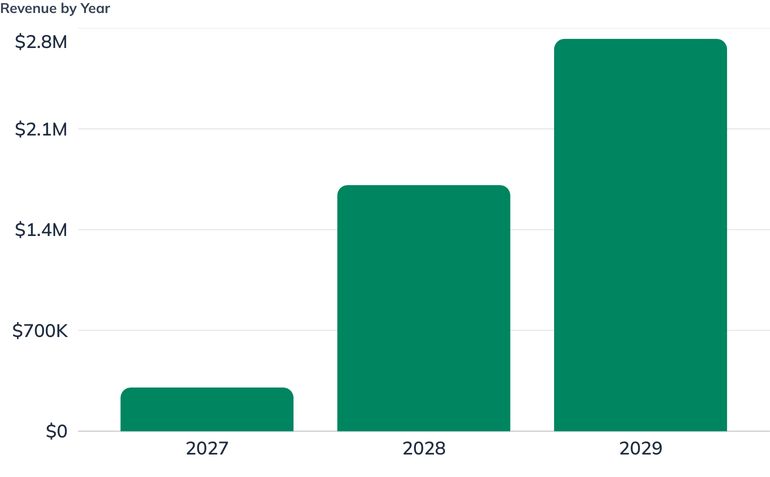
Need real financials? Explore a spreadsheet-free path to generating financial data for your business.Create your own business plan
This is a deliberately conservative case. Two assumptions shape it and both are stated up front. First, we assume the pipeline takes six months to produce its first signed Diagnostic rather than clearing in the first quarter — a five-month slower start than a founder's instinct would suggest, and the single most common way a first-year services forecast is wrong. Second, we assume roughly 15% fewer engagements at every stage than our own bottom-up pipeline math produces. A lender should read this plan as the case that has to work, not the case we hope for.
Axon Diagnostic is priced at $18,000 in 2027, rising to $18,500 and then $19,000. We forecast 6 Diagnostics in 2027, 17 in 2028, and 22 in 2029, producing $90,000, $314,500, and $418,000. Nothing sells in the first half of 2027; the first Diagnostic is delivered in July, and the two design partner engagements in July and August are priced at $9,000 in exchange for named case studies. The $24,000 tier for groups above twenty-five locations is not assumed anywhere and is treated as upside.
Axon Build is the largest stream in the first two years. We forecast 2 builds in 2027 at an average of $95,000, 9 in 2028 at $98,000, and 11 in 2029 at $101,000, producing $190,000, $882,000, and $1,111,000. Build count is a function of Diagnostic volume at our 60% conversion target, offset by the two-to-six week gap between Diagnostic delivery and Build signature and the eight-to-fourteen week delivery window. With the first Diagnostic landing in July, only two builds reach production acceptance inside 2027 — in October and December — which is what pushes almost the whole first-year loss into a single year and defines the size of the raise. Because the forecast counts only builds accepted inside the horizon, realized conversion across the three years reads as 49% rather than 60%; the difference is Diagnostics sold late in a year converting in the next one, and the 2029 cohort converting in 2030.
Capacity is not the constraint in year one; demand is. Two builds are delivered by a senior AI engineer hired in June alongside both founders, which is comfortable. The constraint arrives in 2028: nine builds at roughly two people over a ten-week average is about 180 person-weeks against four to five delivery full-time equivalents phased in across the year, which is why the second senior engineer and second implementation consultant are hired in July and September rather than at the start. By 2029, eleven builds against roughly five and a half delivery equivalents is comfortable, helped by reuse from the connector library.
Axon Managed Operations is the stream that matters most to a lender, and the one that grows fastest. Every Build converts to a retainer at go-live, so new retainer starts track build completions exactly. We model an average retainer of $6,000 per month in 2027, $6,400 in 2028, and $6,800 in 2029 — a blend across our three standard tiers, reflecting both the contractual 3% escalation and a mix shift toward larger clients on higher tiers — against a monthly churn rate of 1.5%, or roughly 17% annually, which is conservative against professional services norms of about 18% a year for retainer clients. The book reaches 2 clients at the end of 2027, roughly 10 at the end of 2028, and roughly 18 at the end of 2029, producing $23,731, $512,506, and $1,195,339.
The mix is the story. Recurring revenue is 8% of total revenue in 2027, 30% in 2028, and 44% in 2029. By the second year the retainer book alone covers annual debt service more than six times over, which means the company is not dependent on winning new projects to service its loan — the single most important structural fact in this forecast from a lender's point of view, and the one least affected by the slower ramp.
What we have deliberately not forecast. No revenue from software licensing, no reseller margin on the point solutions we deploy, and no markup on client cloud or inference consumption, which runs on the client's own account. No revenue from segments outside the four verticals named in the plan. And no acceleration from the CMS prior authorization APIs coming online in January 2027, which we expect to help but have not modeled.
Expenses & Costs
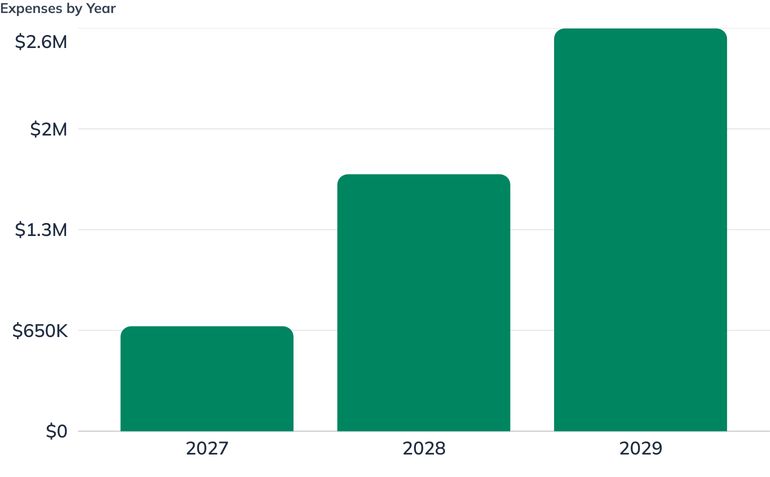
Need real milestones? Establish a clear path for your business with real-world examples.Create your own business plan
Direct costs. Four things sit in cost of delivery. Direct labor — the engineers, implementation consultants, and managed operations specialists who deliver client work — is by far the largest, at $123,747 in 2027 rising to $925,667 in 2029. Specialist subcontractors, engaged for narrowly scoped technical work we do not staff for, run at 8% of Build revenue. Model inference and cloud costs attributable to delivery run at 4% of Build revenue and 9% of Managed Operations revenue; the higher rate on retainers is correct, because continuous monitoring and daily transaction volume is where inference is actually consumed. Referral partner fees run at 5% of Diagnostic revenue.
Gross margin lands at 49.6% in 2027, 55.1% in 2028, and 56.4% in 2029 as reported. Two things to read alongside that. First, the 2027 figure is depressed because a senior engineer is on payroll from June against only two builds — direct labor is a fixed cost in a year with too little work to absorb it, which is exactly what a delayed ramp does to a services firm. Second, LivePlan carries employer payroll burden in operating expenses rather than allocating it to direct labor; adding the burden attributable to delivery staff brings true delivery margin to roughly 42% in 2027 and 48% to 50% thereafter. Against the professional services benchmark of 37.7% average project margin and 45.1% for high performers, the mature years sit in a defensible place — fixed-fee pricing, a senior-only team with no junior bench, and a growing high-margin retainer mix — while 2027 sits below the average, honestly.
Compensation. Founder salaries are $95,000 each in 2027 — well below what either earned previously, and cut from the original plan specifically to absorb the slower ramp — then $120,000 in 2028 and $175,000 in 2029. The 2028 figure is set deliberately low for a second-year founder salary because that is the year debt service coverage is tightest, and it is the first line we would cut further if it came under pressure. Delivery hires are paid at Denver market rates: senior AI engineers at $175,000 rising to $195,000, within the $150,000 to $195,000 market band set out in Locations and Facilities; AI engineers at $145,000 rising to $160,000; implementation consultants at $115,000 rising to $128,000; and managed operations specialists at $76,000 rising to $80,000. Employer payroll taxes and benefits add 20% on top and appear as a separate line. A team profit share pool of $12,000 lands in December 2028 and $30,000 in 2029 — smaller than we would like, sized to what those years actually earn, and discretionary if coverage tightens.
Operating expenses, in rough order of size. Marketing, conferences, and content at $36,000 rising to $90,000, weighted toward the four to six segment-specific industry events that are our primary demand channel. Travel at $24,000 rising to $54,000, driven by Diagnostic site visits and go-live retraining. Office and coworking in Denver at $18,000 rising to $54,000 as headcount grows from five to twelve. Legal and accounting at $26,400 rising to $42,000, higher than a typical firm our size because healthcare vendor contracting and business associate agreements require real legal work. Software and platform subscriptions at $14,400 rising to $46,000, scaling directly with headcount. Internal AI and cloud spend for development, evaluation, and demonstrations at $18,000 rising to $36,000 — distinct from client production consumption, which runs on the client's own account. Recruiting, professional development, sales commission, and bank and loan servicing fees make up the remainder.
What the slower ramp did and did not cut. Marketing and travel are trimmed in 2027 but not gutted, because they are the demand engine and cutting them would delay revenue further — the exact error that turns a slow year into a fatal one. What absorbed the hit instead was founder pay, the hiring calendar, and the year-three headcount plan, which is now twelve people rather than fourteen. Compliance and insurance were not cut: SOC 2 program costs, audit fees, and annual penetration testing run $24,000 in each of the first two years and $26,000 in 2029; business insurance runs $8,400 rising to $16,800; and a separate line carries advisory honoraria for our five advisors together with key person life insurance on both founders, assigned to the lender, at $16,800 rising to $21,600. These are conditions of selling to this buyer or of the loan itself, and cutting any of them would cost more in lost deals than it would save.
Profitability
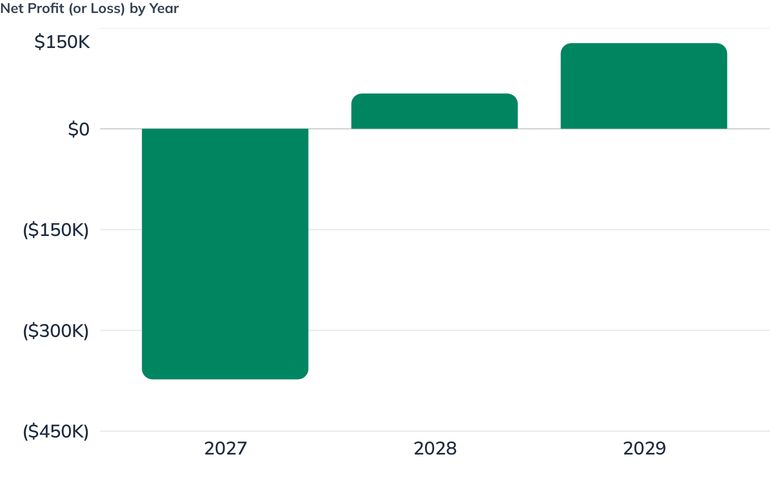
Need real financials? Explore a spreadsheet-free path to generating financial data for your business.Create your own business plan
2027: net loss of $372,806 on revenue of $303,731. Nothing sells for six months. Both founders and, from June, a senior AI engineer are on payroll against a pipeline that produces its first signed Diagnostic in July and its first Build acceptance in October. Only two builds complete inside the year. Operating income is negative $322,210; interest of $42,396 and depreciation account for the rest. This loss is the whole reason the raise is what it is — it is funded, deliberately and in advance, not discovered.
2028: net profit of $52,447 on revenue of $1,709,006 — a 3.1% net margin. Revenue grows 463% off a suppressed base as the pipeline that took six months to build finally converts: nine builds, and a retainer book that expands from two clients to roughly ten. Operating income reaches $108,918. A 3.1% net margin is well under a third of the professional services industry average EBITDA of 9.9%, and we do not dress that up — 2028 is a recovery year, not a good one. What matters is that it is profitable and that it clears debt service.
2029: net profit of $127,453 on revenue of $2,724,339 — a 4.7% net margin. Growth moderates to 59%. Margin improves on mix: Managed Operations reaches 44% of revenue and carries structurally higher margin than build work. It is still roughly half the industry average, which is the honest cost of losing a year of compounding. On the original ramp this business reached a mid-teens net margin by 2029; on this one it gets there in 2031. The structure is sound and the timeline is longer.
Working capital is a real cost of growing. A services firm that bills on milestones carries receivables, and ours grow with revenue — $62,411 at the end of 2027, $99,141 at the end of 2028, and $131,987 at the end of 2029, against payables of $15,382, $29,252 and $33,226. Because we collect half of every engagement up front (Diagnostics half at signature, Builds 40% at kickoff), the book runs at roughly half a month of closing-month billings — an implied DSO of about eighteen days on full-year revenue — rather than the full month a pure arrears biller would carry. That working capital swing is still why operating cash flow trails net profit in every year of the plan, and it is the specific reason we carry a revolving line alongside the term loan.
Distributions. As a Colorado LLC with an S-corporation election, profits pass through to the members, who owe tax whether or not cash is distributed. No distribution is taken in 2027, a loss year, or in 2028. The 2028 obligation of approximately $17,000 is distributed in 2029 when the return is filed, alongside approximately $47,000 of 2029 estimates — roughly $64,000 in total across that year. No distributions beyond the tax obligation are modeled anywhere in the horizon.
Debt service coverage. The term facility carries a twelve-month interest-only period, with amortization beginning February 2028, so 2027 debt service is interest alone at $42,396 and coverage that year is negative — expected for a startup underwritten on projected rather than historical cash flow, where the first-year cushion is the funding itself. From 2028 the term loan amortizes at roughly $82,000 a year. Coverage reaches 1.38 times in 2028 and 2.35 times in 2029, clearing the 1.1:1 minimum required for 7(a) underwriting; on a trailing-twelve-month basis it first crosses 1.1:1 in June 2028. The 2028 figure is the tightest number in this plan and the one a lender should stress first: it holds, but with less room than we would like, and it is why founder pay in that year is set at $120,000 rather than higher.
Cash. Cash on hand never goes negative at any point in the forecast. The low point is $179,365 in December 2027, and cash then climbs in each subsequent year — closing 2028 at $221,351 and 2029 at $268,161. Operating cash flow is negative $411,635 in 2027, turns positive at $40,287 in 2028, and reaches $115,448 in 2029. Our liquidity policy is three months of operating expenses available at all times, measured as cash on hand plus undrawn capacity on the revolving line and reviewed weekly — roughly $118,000 in 2027, $208,000 in 2028 and $336,000 in 2029. Measured that way the policy holds in every month of 2027 and 2028; at the end of 2029 available liquidity is $328,161 against a $336,033 requirement, or about 2.9 months — a shortfall of roughly $7,900, because the expense base grows faster than the reserve. Closing that gap is the first call on any outperformance.
What would break this. The forecast is most sensitive to how long the pipeline actually takes to convert. Pre-revenue operating outflow runs about $45,000 a month through the first three quarters of 2027, so every additional month of delay before the first Build costs roughly that much in cash and pushes the whole retainer curve right. It is second most sensitive to 2028 build volume: losing two of the nine would take the year to a loss and put debt service coverage under the 1.1:1 threshold. Third, and most acutely at the end of the horizon, it is sensitive to collection speed: terms slipping from 30 to 60 days across the book would add roughly $95,000 to $130,000 to receivables by 2029, which exceeds the $60,000 of undrawn revolver capacity and would require either an increase in the line or a deliberate slowing of hiring. It is least sensitive to model and cloud pricing, which is deliberate: client production consumption runs on the client's own account and is a pass-through, not a margin exposure.
Use of Funds
The $620,000 raised at launch is fully accounted for below, and a $150,000 revolving line sits behind it undrawn. Almost none of it buys equipment, because there is almost no equipment to buy. It funds a first year in which the company builds a pipeline, hires a delivery team, and delivers only two production builds.
Sources and uses, year one
Amount | |
|---|---|
Sources | |
Founder equity injection (Vasquez & Chen) | $120,000 |
SBA 7(a) term loan | $500,000 |
Total sources | $620,000 |
Uses | |
Operating cash deficit, January–December 2027 | $411,635 |
Capital equipment (laptops, workstations, furniture, AV) | $29,000 |
SBA term loan principal repaid during 2027 | $0 (interest-only period) |
Cash retained on hand at 31 December 2027 | $179,365 |
Total uses | $620,000 |
A separate $150,000 working capital line of credit is committed at closing and is not drawn at all in 2027. It appears in neither column above because nothing is borrowed against it in the first year.
Why the deficit is this large. The 2027 operating cash deficit of $411,635 is the entire case for the raise, and it has two components. The first is the $372,806 net loss, which comes from one fact: the pipeline produces its first signed Diagnostic in July and its first Build acceptance in October, while both founders are on payroll from January and a senior AI engineer from June. The second is $47,029 of working capital absorbed by receivables net of payables as billing finally begins in the second half — a growing services firm funds its own invoices, and the cash cost of that shows up exactly when revenue starts. This plan assumes the six-month lead time rather than hoping it away; a first-year services forecast that assumes a first-quarter close is the most common way these plans fail, and the failure is a cash failure, not a business failure.
What the operating deficit consists of. It is not a separate category from the costs described elsewhere in the plan — it is the net of all of them against first-year revenue, plus the working capital build. The largest components are compensation for a five-person team ending the year at $376,506 including employer burden; marketing, conferences and travel at $60,000, which in a market where nobody knows us is customer acquisition cost rather than overhead and is the line we most deliberately protected; legal and accounting at $26,400; the SOC 2 program with penetration testing at $24,000; and advisory honoraria with key person life insurance at $16,800.
Cash retained is a reserve, not a surplus. The $179,365 carried into 2028 looks thin against a $411,635 deficit, and it is — that is why the revolver exists. Cash falls to $185,711 in September 2027 before the first Build lands, recovers briefly, and closes the year at its low point of $179,365. Through 2028 it works between roughly $200,000 and $312,000 as builds complete unevenly. Our liquidity policy is three months of operating expenses available at all times, measured as cash plus undrawn revolver capacity: roughly $118,000 in 2027 and $208,000 in 2028, and the policy holds in every month of both years, with the tightest point being December 2028 at $321,351 available against $208,014 required. At the end of 2029 available liquidity is $328,161 against a $336,033 requirement — approximately 2.9 months, a shortfall of roughly $7,900 — which is the tightest point in the plan and the first call on any outperformance.
Fees. The SBA upfront guaranty fee of approximately $11,250 — 3.00% of the 75% guaranteed portion of $500,000 under the FY2026 fee schedule — plus lender legal, documentation and filing costs, is carried in the first month within the bank charges and loan servicing line. Closing costs are modest for a working capital facility with no real estate, no equipment purchase and no acquisition.
What we will not do with the money. We will not deploy the reserve into faster hiring, and the slower ramp makes that discipline more important rather than less. Every delivery hire in this plan is made against contracted or final-stage pipeline: the AI engineer and implementation consultant originally planned for July 2027 do not start until December, because in a year with two builds there is nothing for them to do. Nor will we draw the revolver to fund operating losses — it is a receivables facility, drawn against invoiced work and repaid as those invoices collect, and the plan draws it for the first time in October 2028. If the ramp runs ahead of plan, the first call on the improvement is closing the 2029 liquidity gap and restoring founder compensation, not adding headcount. Cash closes 2027 at $179,365, 2028 at $221,351, and 2029 at $268,161.
Sources of Funds
Axon AI is capitalized with $620,000 of committed funding at launch — $120,000 of founder equity and a $500,000 SBA 7(a) term loan — plus a $150,000 revolving working capital line that stays undrawn through the first year. No outside equity investors hold any interest in the company, and we have no current plan to raise one.
Founder equity injection — $120,000. Elena Vasquez and Marcus Chen contribute personal cash in proportion to their membership interests, 52% and 48%, in January 2027. The contribution is unborrowed cash, seasoned and documented with more than thirty days of bank statements, wire confirmations, and cancelled checks in the form SBA underwriting requires — promissory notes and gift letters would not satisfy it, and neither is used here. At 19.4% of total project cost, the injection is nearly double the 10% minimum SBA requires for a startup, defined as a business generating revenue from intended operations for one year or less. We treat exceeding the minimum as a deliberate signal rather than an accident: it is the clearest evidence available to a lender that both founders' own capital is genuinely at risk, and it matters more, not less, in a plan whose first year is a loss.
SBA 7(a) term loan — $500,000. Working capital, drawn in full in January 2027, priced at 9.25% on a 120-month term with no balloon payment: twelve interest-only payments followed by 108 amortizing payments. Three features of this structure are deliberate:
- Size. At $500,000 this is a Standard 7(a) rather than a 7(a) Small Loan, which caps at $350,000. The larger facility is what funds a first year in which nothing sells for six months.
- Rate. Loans above $350,000 carry a lower SBA spread cap — Prime plus 3.0% rather than Prime plus 4.5% — so against a WSJ Prime Rate of 6.75% as of August 2026 the ceiling is 9.75%. Our modeled 9.25% sits under it. Moving up in loan size lowered our rate by a point and a half relative to a small loan.
- Interest-only period. Twelve monthly interest-only payments are a standard accommodation for a startup borrower and hold roughly $32,000 of principal out of 2027. Amortization begins February 2028 at approximately $6,838 a month — roughly $82,000 a year. The principal balance stands unchanged at $500,000 on 31 December 2027.
Working capital line of credit — $150,000. A revolving facility committed at closing and priced at 9.75%, against which we borrow only when invoiced receivables are outstanding. This is the right instrument for the problem it solves: a firm billing on milestones funds its own invoices, and our receivables grow from $62,411 to $131,987 across the horizon. Financing that with term debt would mean paying interest on money we do not need in the months we do not need it. The forecast draws nothing in 2027, $50,000 in October 2028 as build volume peaks, and a further $40,000 across 2029 — $90,000 in total, leaving $60,000 of the line undrawn at the end of the plan. Undrawn capacity counts toward the liquidity policy described in Use of Funds, which is a large part of why the line is sized at $150,000 rather than at the $90,000 the forecast actually draws.
Total interest cost. Across both facilities, interest expense runs $42,396 in 2027, $45,771 in 2028, and $48,418 in 2029.
Fees and closing costs. The SBA upfront guaranty fee applies to the guaranteed portion of the term loan — 75% of $500,000, or $375,000 — at the FY2026 rate of 3.00% for loans between $150,001 and $700,000, giving approximately $11,250. Lender legal, documentation, and filing costs are modest for a working capital facility with no real estate, no equipment purchase, and no acquisition, which avoids the appraisal, environmental, and valuation costs that dominate closing on an acquisition loan. Total fees are budgeted in the first month and carried in the bank charges and loan servicing expense line. An ongoing SBA annual service fee of 0.55% of the guaranteed outstanding balance is included in the same line.
Collateral and guarantees. Both members hold more than 20% and therefore provide unlimited personal guarantees on both facilities. Because more than half of term loan proceeds fund working capital, we expect the lender to take a first lien on all business assets and to lien available equity in the founders' personal real estate until the loan is fully secured, consistent with current 7(a) collateral policy; the revolving line is additionally secured by the receivables it finances. Both founders carry key person life insurance with the lender named as assignee to the extent of the outstanding balance, which the current SOP requires and which is funded in the operating expenses. Both founders are US citizens residing in the United States, satisfying the ownership eligibility requirements in effect.
Why debt and not equity. Three reasons. Our capital need is for working capital through a single extended loss year followed by a receivables build, which is what these facilities are designed for. Professional services is among the better-performing sectors in SBA lending, with low fixed asset intensity, recurring client contracts, and strong founder credit profiles. And venture equity would impose a growth trajectory this market does not support — private equity physician practice management deal volume has fallen by roughly half in 2026, our buyer is consolidating rather than expanding, and a plan built on a six-month sales cycle and a slow first year is not a plan an equity investor would fund on terms we would accept.
Reporting to the lender. Monthly financial statements, a monthly borrowing base certificate supporting the revolver, quarterly debt service coverage calculations, annual reviewed financials, and annual personal financial statements from both guarantors. We report against the same short metric list we manage the business by, and we expect the 2028 coverage ratio to be the number reviewed most closely.
Projected Statements
Key Assumptions
Every number in this forecast rests on the assumptions below. They are stated plainly so a lender can test them rather than take them on trust, and each is flagged where it is optimistic or where the underlying benchmark is weak.
The two assumptions that shape everything else. First, the pipeline takes six months to produce a first signed Diagnostic rather than clearing inside the first quarter — five months slower than a founder's instinct, and the single most common way a first-year services forecast goes wrong. Second, engagement volume at every stage is set roughly 15% below what our own bottom-up pipeline math produces. Together these turn what would have been a modest first-year loss into a $372,806 one and push mid-teens net margin from 2029 out to roughly 2031. Everything below follows from them.
Pricing. Diagnostic at $18,000, escalating to $18,500 and $19,000, with two design partner engagements at $9,000 in July and August 2027. Build averaging $95,000, $98,000, and $101,000 against a quoted range of $65,000 to $185,000. No published, independent benchmark exists for AI implementation project fees or for per-location AI agent pricing — every available source is a vendor's own rate card — so these figures are triangulated from published consultancy rate guides and validated against what our design partners have committed to pay. This remains the weakest-sourced assumption in the plan.
Retainer pricing and mix. The average Managed Operations retainer is modeled at $6,000 per month in 2027, $6,400 in 2028 and $6,800 in 2029 — a rise of roughly 6.5% a year on the blended average. Only about half of that is the 3% contractual escalation our contracts carry; the rest is mix, as the book shifts from Essential-tier clients toward Standard and Advanced tiers with more locations and more live workflows. Contractual price increases to any individual client remain capped at 3%. Worth testing: if the mix does not shift as modeled and the blended average rises only at the contractual 3% — reaching $6,365 rather than $6,800 by 2029 — retainer revenue falls by roughly $76,000 in 2029 and about $94,000 across 2028 and 2029 together.
Volume and conversion. 6, 17, and 22 Diagnostics. 2, 9, and 11 Builds completed. Our operating target is 60% Diagnostic-to-Build conversion, and that is the rate we manage to — but the forecast only counts Builds that reach production acceptance inside the horizon, so realized conversion across the three years is 22 of 45 Diagnostics, or 49%. The gap is timing, not lost deals: the two-to-six week signature gap plus an eight-to-fourteen week delivery window means Diagnostics sold late in a year convert in the next one, and the 2029 cohort largely converts in 2030, outside the plan. Read the 49% as a deliberately conservative recognition boundary rather than as a forecast of the 60% target being missed.
Churn. 1.5% monthly, roughly 17% annually. Benchmarked against professional services norms of about 18% annual churn for retainer clients. Conservative relative to the sixty-day termination right our contracts carry. The retainer book reaches 2 clients at the end of 2027, roughly 10 at the end of 2028, and roughly 18 at the end of 2029.
Capacity. Builds are staffed at roughly two delivery people over a ten-week average, and hiring is sized against contracted work rather than forecast. Year one is demand-constrained rather than capacity-constrained: two builds against a senior engineer hired in June plus both founders. Tight: 2028 runs nine builds against four to five delivery full-time equivalents phased across the year, which is why the second senior engineer and second implementation consultant start in July and September. Year three runs eleven builds against roughly five and a half, assuming real reuse from the connector library. If that reuse does not materialize, build volume falls before margin does.
Cost of delivery. Specialist subcontractors at 8% of Build revenue. Model inference and cloud at 4% of Build revenue and 9% of Managed Operations revenue. Referral fees at 5% of Diagnostic revenue. Client production inference and cloud consumption runs on the client's own account and is neither a cost nor a revenue line for us — a deliberate structural choice that removes our single largest potential margin exposure.
Gross margin. 49.6%, 55.1%, and 56.4% as reported. Two caveats. The 2027 figure is depressed because direct labor is a fixed cost in a year with too little work to absorb it. And LivePlan carries employer payroll burden in operating expenses rather than allocating it to direct labor, so true delivery margin including burden is roughly 41% in 2027 and 48% to 50% thereafter. Against the professional services benchmark of 37.7% average project margin and 45.1% for high performers, the mature years are defensible and 2027 sits below average — honestly. Note that the roughly 65% target margin referenced in the Pricing section is an internal per-engagement build-pricing target measured after the delivery labour, subcontractor and inference costs attributable to that engagement, not the company-wide figure reported here, which carries the whole delivery team including time between engagements.
Compensation. Denver market rates throughout, roughly 20% to 25% below Bay Area equivalents, with senior AI engineers inside a $150,000 to $195,000 band. Employer payroll taxes and benefits at 20% of salary. Founder salaries rise from $95,000 to $120,000 to $175,000 — cut from the original plan at every step to absorb the slower ramp, with no in-year increase during 2028 because that is when debt service coverage is tightest. A team profit share pool of $12,000 in December 2028 and $30,000 in 2029, sized to what those years actually earn and discretionary if coverage tightens.
Working capital. We bill on milestones — Diagnostics half at signature and half at delivery, Builds 40/30/30 across kickoff, integration and production acceptance — and the model applies 50% of sales on credit at 30-day terms, which is the cash equivalent of collecting roughly half of each engagement before delivery completes. Receivables therefore run at about half a month of closing-month billings, or an implied DSO of roughly eighteen days on full-year revenue: $62,411, $99,141 and $131,987 at each year end, against payables of $15,382, $29,252 and $33,226. This is why operating cash flow trails net profit in every year and why the plan carries a revolving line rather than relying on term debt alone. Sensitivity, and the most consequential one in the plan: terms slipping from 30 to 60 days would add roughly $95,000 to $130,000 to 2029 receivables against $60,000 of undrawn revolver capacity — it would exhaust the line and leave a gap of $35,000 to $70,000, requiring either an increase in the facility or a deliberate slowing of hiring. This is the assumption a lender should test first.
Financing and distributions. $120,000 founder equity as unborrowed, seasoned cash, at 19.4% of total project cost. A $500,000 SBA 7(a) term loan at 9.25% on a 120-month term — twelve interest-only payments, then 108 amortizing payments from February 2028 — with no balloon. At this loan size the SBA spread cap is Prime plus 3.0%, a ceiling of 9.75% against a WSJ Prime Rate of 6.75% as of August 2026, so moving above the $350,000 small-loan threshold lowered our rate by roughly a point and a half. A $150,000 revolving working capital line at 9.75%, undrawn in 2027, drawn $50,000 in October 2028 and $40,000 across 2029, leaving $60,000 undrawn at the end of the plan. Sensitivity: a term rate at the cap would add roughly $2,400 a year in interest, tightening 2028 coverage from 1.38 to about 1.34 without changing any conclusion; a material rise in Prime would matter more here than it did on the original plan, since both facilities float. Member tax distributions of approximately $17,000 in April 2029 (on 2028 income, paid at filing) and $47,000 across 2029 (quarterly estimates); none in the 2027 loss year or in 2028, and none beyond the tax obligation.
Liquidity policy. Three months of operating expenses available at all times, measured as cash on hand plus undrawn revolver capacity and reviewed weekly. This holds in every month of 2027 and 2028 — the tightest point being December 2028 at $321,351 available against $208,014 required. At the end of 2029 available liquidity is $328,161 against a $336,033 requirement, or about 2.9 months, a shortfall of roughly $7,900, because the expense base grows faster than the reserve. Closing that gap is the first call on any outperformance.
Tax. Colorado LLC with S-corporation election, so income passes through to the members and no entity-level income tax is modeled. No sales tax is modeled; professional services of this kind are not subject to Colorado sales tax.
Modeling conventions worth knowing. Delivery staff are classified as direct labor and sit in cost of goods sold; founders, the operations and compliance manager, the business development representative, and the account director sit in operating expenses. Every hire other than the founders starts mid-year in the year they join and is modeled at a prorated annual salary for that year, so their first-year figures read lower than their actual full-year compensation. Monthly detail runs for 2027 and 2028; 2029 is modeled annually, so the month-by-month cash test can only be run directly on the first two years — worth noting because 2029 carries $64,000 of tax distributions and the tightest liquidity position in the plan.
Not modeled, deliberately. No revenue from software licensing or reseller margin. No use of the $24,000 large-group Diagnostic tier or the $14,000 Enterprise retainer tier. No acceleration from the CMS prior authorization APIs coming online in January 2027. No acquisition, no additional financing, and no equity raise across the horizon. No recession or material change in provider group formation, though we note that physician practice management deal volume has already fallen by roughly half in 2026 — which is part of why this version of the plan assumes a six-month sales cycle rather than a three-month one.
Frequently Asked Questions
An AI implementation business plan should cover the services you actually deliver and how they are scoped and priced, the customer segments you serve and why they can buy, your competitive position against vendors that ship the same capability natively, the technical and compliance requirements of operating inside a client's systems, your hiring sequence, and financial projections with startup costs, funding sources, and a realistic path to profitability. Axon AI's plan pairs its three-stage Diagnostic, Build, and Managed Operations ladder with a segment-by-segment target market definition, a model-agnostic technology architecture, a HIPAA and SOC 2 compliance roadmap, a $620,000 funding plan, and three-year projections.
Axon AI launches on $620,000 — $120,000 of founder equity from Elena Vasquez and Marcus Chen plus a $500,000 SBA 7(a) term loan at 9.25% over a 120-month term, with a $150,000 revolving working capital line committed at closing and left undrawn through the first year. Only $29,000 of that buys equipment, because a services firm has almost none to buy; the rest funds a $411,635 operating cash deficit across a first year in which nothing sells for six months. The founder injection is 19.4% of total project cost, nearly double the 10% minimum SBA underwriting requires for a startup.
There is no industry-wide license for AI implementation work, but operating inside healthcare adds real contractual and regulatory obligations. Axon AI works as a HIPAA business associate and executes a business associate agreement with every client before any data moves, and it targets a SOC 2 Type I report by November 2027 — built to the control set proposed in the HIPAA Security Rule NPRM — because the security review is the most common procurement blocker in its sales cycle. Standard state and local business registration still applies, so check both before signing a first client.
Axon AI sells a three-stage ladder that every client moves through in the same order, and nothing is billed hourly. Axon Diagnostic is a flat $18,000 for a four-week engagement producing a ranked, costed workflow map; Axon Build is a fixed fee of $65,000 to $185,000, typically around $95,000, that puts one to three agents into production over eight to fourteen weeks; and Axon Managed Operations is a monthly retainer of $4,500 to $9,500 that keeps those agents accurate afterward. Roughly six in ten Diagnostics convert to a Build, and the retainer book is the centre of the business, reaching 44% of revenue by 2029.
Axon AI's plan deliberately assumes a slow start rather than hoping one away: six months from opening the doors to a first signed Diagnostic in July 2027, and a first Build acceptance in October. That produces a $372,806 net loss on $303,731 of revenue in 2027, followed by a first profitable year in 2028 at $52,447 on $1,709,006 of revenue — a 3.1% net margin — and $127,453 on $2,724,339 in 2029. The plan is candid that this is a recovery rather than a good year, and that mid-teens net margin does not arrive until roughly 2031.
By choosing a segment where those features do not exist. Epic previewed four named agents at HIMSS26 and athenahealth shipped more than eighty revenue cycle AI features in June 2026, and Axon AI concedes outright that it loses — and should — wherever a client's EHR ships the capability free. Its answer is segment selection: the dental, veterinary, physical therapy, and specialty MSO platforms its clients actually run, such as Dentrix Ascend, Open Dental, ezyVet, WebPT, and ModMed, have no first-party agent layer and no announced roadmap for one. Against AI point solutions like Assort Health and Candid Health it competes differently again, treating them as supply chain rather than rivals and deploying several of them.
Axon AI sells to multi-site outpatient provider groups with five to forty locations that run a specialty practice management system rather than Epic, have a centralized billing or revenue cycle function, and have a named executive — a COO, VP of Revenue Cycle, or CFO — who owns administrative cost as a number they are measured on. Dental service organizations are the lead segment, followed by veterinary consolidators, physical therapy and rehabilitation chains, and dermatology and ophthalmology MSOs. Groups without a centralized back office are disqualified in the first call rather than nurtured, because there is no one there to sell to.
Because both founders watched the alternative fail. Elena Vasquez was the executive who approved a six-figure AI initiative at a sixty-location dental service organization that was quietly shelved after nine months, and the plan treats a first-quarter close as the single most common way a first-year services forecast goes wrong. Engagement volume at every stage is set roughly 15% below the company's own bottom-up pipeline math, no delivery hire is made before the work supporting it is signed or in final negotiation, and the resulting $372,806 first-year loss is funded in advance by the raise rather than discovered halfway through the year.

Business Plan Outline
Start your plan