





Element Printing Co


Business Plan Summary
This 3D printing business plan example features Element Printing Co, an engineer-run additive manufacturing service bureau in Portland, Oregon's Central Eastside Industrial District that turns CAD files into inspection-ready parts in three to five business days for hardware startups, medical device teams, and local manufacturers. It covers the four-line revenue model — FDM prototyping, high-detail SLA resin work, design-for-additive consulting, and recurring production runs — competitive positioning against national quoting platforms and in-house printers, a $155,000 funding plan split between founder equity and an SBA 7(a) loan, and three-year projections that show a first-year loss giving way to consistent profitability from month 16 onward. Use it as inspiration for your own plan. Download a free business plan template to get started, or browse more business plan examples.
Element Printing Co
Executive Summary
Element Printing Co is an additive manufacturing service bureau in Portland, Oregon's Central Eastside Industrial District. We turn CAD files into finished, inspection-ready parts — usually in three to five business days, and often in one — for hardware startups, medical device teams, industrial designers, and manufacturers who need prototype and short-run parts without the tooling cost or the six-week lead time of traditional machining.
The company is founded and owned by Dana Reyes, a mechanical engineer with nine years designing and qualifying parts for a Portland medical device manufacturer. That background is the differentiator. Most of what a customer can buy today falls into two camps: enormous online quoting platforms that are fast and cheap but treat every file as an anonymous upload, and local shops that are responsive but staffed by operators rather than engineers. Element sits deliberately in the middle — a local shop where the person quoting the job can also tell a customer that their wall thickness will warp, their tolerance stack won't hold in nylon, and the part will cost 40% less if they reorient it.
What we sell. Four revenue lines, in order of maturity:
- FDM prototyping and short-run parts — engineering-grade thermoplastics (PLA, PETG, ABS, ASA, PC, carbon-filled nylon) off a farm of professional enclosed CoreXY machines. The volume business, averaging around $195 per job.
- Resin / high-detail SLA parts — masters, dental and medical models, presentation-grade housings, and casting patterns where surface finish matters more than toughness. Roughly $145 per job.
- Design and DfAM consulting — CAD repair, design-for-additive-manufacturing review, topology optimization, and fixture design, billed at $95–105 per hour. Lower volume, highest margin, and the most reliable source of repeat print work.
- Repeat production runs — recurring monthly batches of end-use parts (jigs, fixtures, enclosures, spares) for customers who have moved past prototyping. This is where the business becomes durable rather than transactional; it starts in month 10 and reaches 28% of revenue by Year 3.
The market. US 3D printing and rapid prototyping services is a roughly $4.0 billion industry that grew at a 13.7% compound annual rate over the last five years, and it is extraordinarily fragmented — no single company holds more than 5% share. Portland is an unusually good place to serve it: a dense population of hardware startups, outdoor-goods and footwear product development teams, medical device firms, and contract manufacturers, most of whom currently ship prototype work out of state.
The financial picture. Element launches on $155,000 — $45,000 of founder equity and a $110,000 SBA 7(a) term loan at 11.5% over ten years. About $53,300 goes to equipment and shop build-out in month one; the rest is working capital carrying the business through sixteen months of ramp.
Year 1 | Year 2 | Year 3 | |
|---|---|---|---|
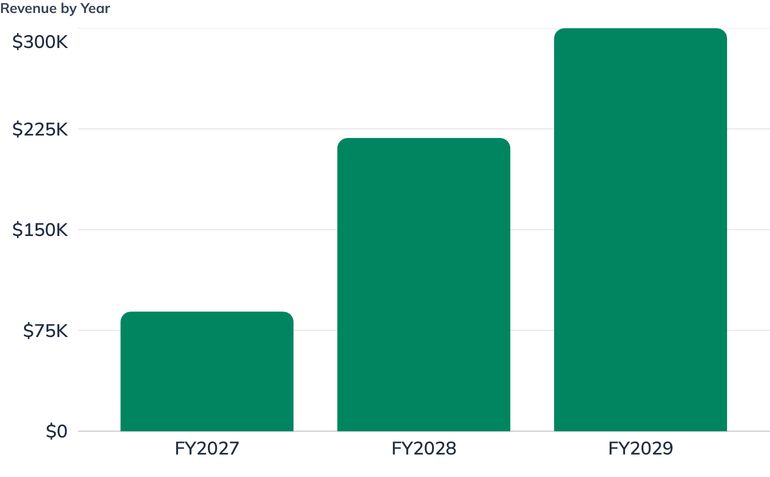
Revenue | $88,960 | $218,187 | $299,825 |
Gross margin | 84.3% | 82.4% | 81.8% |
Net profit | –$41,355 | $17,765 | $37,302 |
Ending cash | $57,048 | $48,135 | $89,400 |
The first profitable month is January 2028 — month 16 — and every month after it is profitable. Cash turns the corner a month later, in February 2028; unusually, profit leads cash here rather than following it, because a growing receivables balance absorbs cash faster than depreciation adds it back. Year 1 loses $41,355, which is the honest cost of building a customer base from zero while servicing debt at 11.5% — interest alone consumes 13% of Year 1 revenue.
Cash never falls below $30,631 (April 2028, the month the SLS system is bought) and finishes Year 3 at $89,400 — about 5.8 months of operating expenses, just short of the six-month reserve at which owner distributions would become appropriate. That threshold is reached early in Year 4, not inside this plan.
The plan stays deliberately capital-light. The expensive machine — a $26,000 benchtop SLS system — is not bought until month 19, by which point repeat production volume justifies it rather than merely anticipating it. Dana draws $33,000 in Year 1, rising to $72,000 by Year 3, and the sole hire is a part-time production technician added in month 8. A second full-time salary would consume nearly the entire operating margin at this revenue level, so it is a Year 4 decision made from an $89,400 cash position rather than a hopeful one made from a thin margin.
What has to go right. One assumption carries this plan: that roughly one first-time customer in six climbs from prototype work to a standing monthly production run within 18 months. That conversion produces $84,000 of Year 3 revenue. Without it, Element posts a Year 3 loss of about $26,000 rather than a $37,302 profit. It is why the first recurring production customer is a named month-10 milestone rather than a hope.
Why this works. The barrier to entry in printing is low; the barrier to entry in engineering judgment about printing is not. Element's plan is not to be the cheapest quote in the browser tab. It is to become the shop that a Portland hardware team calls first because the last four parts came back right the first time.
Opportunity

Problem Worth Solving
A hardware team in Portland that needs twelve prototype housings by Friday has three bad options.
Option one: the online quoting platform. Upload the STL, get an instant price, wait. The price is competitive and the interface is excellent. But the parts ship from a facility hundreds or thousands of miles away, standard lead time is five to ten business days before transit, and nobody looks at the file. If the geometry has a problem — a 0.6 mm rib that will delaminate, a press-fit boss dimensioned for injection molding rather than additive, an orientation that puts a visible seam across the show surface — the platform prints it exactly as submitted and the customer discovers the problem when the box arrives. The second attempt costs another week. On a three-week hardware sprint, that is the whole sprint.
Option two: buy a printer and do it in-house. Increasingly common, and for simple parts it works. But the machine is the cheap part. The expensive parts are the second machine you need when the first one is tied up, the engineering hours lost to failed prints and calibration, the material inventory across five polymers you use twice a year, the ventilation and fire-safety questions your facilities manager asks, and the fact that your most expensive engineer is now doing support removal. Teams that go this route generally handle their easy work in-house and still need somewhere to send anything demanding — large format, engineering resin, tight tolerance, or twenty identical parts by Thursday.
Option three: the local shop. Fast, personal, and responsive — genuinely a better experience than the platform. But most local print shops are operated rather than engineered. The person who takes the order can tell you what the machine can do; they usually cannot tell you what the part should do. When a customer asks "will this hold up as a living hinge in ASA, or should we go to nylon?", the honest answer from most shops is that they don't know, and they'll print whatever you specify.
Underneath all three sits a subtler problem: the handoff from prototype to production has no owner. A team gets ten good prototypes and then needs forty a month, indefinitely, at a predictable price. That volume is too small to justify tooling — a modest injection mold still runs five figures and weeks of lead time — and too large and too repetitive to keep re-quoting as one-off prototype jobs. It falls into a gap, and the customer usually solves it badly: by over-ordering prototypes at prototype prices, or by committing to tooling far earlier than the design is ready for.
The cost of all this is rarely a line item, so it rarely gets managed. It shows up as schedule. A design iteration that should take four days takes eleven. A product launch slips a quarter. An engineering team spends its Tuesday on support removal instead of on the next revision. For a hardware startup burning $80,000 a month, a two-week slip caused by a reprint is a real and largely invisible expense — and it is caused, most of the time, by a part that a knowledgeable person would have flagged before it ever went on a build plate.
Our Solution
Element Printing Co is a local additive manufacturing service bureau run by a mechanical engineer. Every quote is reviewed by someone who has designed, qualified, and shipped physical products — not merely operated a printer. That single fact shapes everything else about the service.
The core offer
Engineering review on every job, at no charge. Files are opened, not just sliced. Before a quote goes out, we check wall thickness, tolerance stack, orientation, likely warp, and material fit against the part's stated function. If something will fail, the customer hears about it before they pay — with a specific recommendation, not a disclaimer. Roughly one job in five gets a note back, and those notes are the single most effective marketing the business has.
Quotes within four business hours, parts in three to five days. Standard turnaround is three to five business days. Same-day and next-day rush service is available at a 40% and 25% premium respectively, and we hold deliberate capacity headroom on the FDM farm to make that promise real rather than aspirational.
Local pickup and delivery. Portland-metro customers can collect parts the hour they come off the machine, or take same-day courier delivery for a flat fee. For a team mid-sprint, the difference between "shipped" and "in your hands this afternoon" is often the difference between one iteration this week and none.
The four service lines
FDM prototyping and short-run parts. A farm of professional enclosed CoreXY machines running engineering thermoplastics — PLA and PETG for form studies, ABS and ASA for functional and outdoor parts, polycarbonate for heat and impact, and carbon-fiber-filled nylon for stiffness and dimensional stability. This is the volume business: typical job around $195, ranging from a $40 single fit-check part to a $900 batch of enclosures. $46,020 in Year 1, growing to $126,850 by Year 3.
Resin / high-detail SLA parts. Professional resin systems with wash and cure stations and dedicated fume extraction, for work where surface finish and fine feature resolution matter more than toughness — casting patterns, dental and anatomical models, presentation housings, textured masters. Typical job around $145. $18,560 in Year 1, $49,600 by Year 3.
Design and DfAM consulting. Billed at $95 per hour in Year 1, rising to $105 by Year 3. CAD repair and file cleanup, design-for-additive-manufacturing review, part consolidation, topology optimization, custom jig and fixture design, and material selection guidance. This is the highest-margin line, and — more importantly — it is the line that converts a one-time print customer into a standing account. A team that has had Element redesign a fixture does not shop that fixture around next quarter.
Repeat production runs.** Recurring monthly batches of end-use parts for customers who have moved past prototyping: assembly jigs, line fixtures, low-volume enclosures, discontinued spares, custom tooling. Priced as a standing monthly run at $1,250–1,400 rather than re-quoted each time, which is cheaper for the customer and vastly more predictable for us. This is the line that turns Element from a job shop into a business with a backlog — it starts in month 10 at $5,000 in Year 1, reaches $48,100 in Year 2, and **$84,000, or 28% of revenue, in Year 3.
What we deliberately do not do
We do not compete on price against the large online platforms, and we do not pretend to. For a customer who needs 500 identical simple parts at the lowest possible unit cost with no urgency, a platform is the correct answer and we will say so. We also do not offer metal printing, high-temperature aerospace polymers, or certified medical production — all of which require capital and quality-system investment well beyond a shop of this size. Element's advantage is speed, judgment, and proximity applied to prototype and low-volume polymer work. Trying to be everything to everyone is the most common way small bureaus fail.
Target Market
Industry context
The US 3D printing and rapid prototyping services industry is roughly $4.0 billion in 2026 and grew at a 13.7% compound annual rate over the preceding five years, including a 31.8% spike in 2025. Just over 1,000 establishments compete in it, a count that itself grew at nearly 21% annually — and no single company holds more than 5% market share. That combination matters: a growing, deeply fragmented market with low concentration is one where a well-positioned local operator can build a durable book of business without ever confronting a dominant incumbent. It is also one where undifferentiated capacity gets commoditized quickly, which is why Element's positioning rests on engineering judgment rather than machine hours.
Why Portland
Portland has an unusually dense concentration of the exact customer Element serves, and an unusually thin supply of shops serving them well. The metro area supports outdoor and athletic product development (a legacy of the footwear and apparel cluster), a substantial medical device and bioscience sector, a long-standing precision manufacturing base, and a steady flow of venture- and grant-funded hardware startups out of Portland State, OHSU, and the local accelerator ecosystem. Most of these teams currently send prototype work to out-of-state platforms by default — not because they prefer it, but because no local alternative has made itself obvious.
Primary segments
Hardware startups and small product companies (~40% of Year 3 revenue).
Teams of 3 to 30 people, pre-revenue through Series A, iterating fast on physical product. They order irregularly but intensely — five jobs in a sprint week, nothing for a month. They are extremely sensitive to lead time and almost indifferent to a $30 price difference, because their real cost is calendar time. They are also the segment most likely to need design help, and the most likely to graduate into repeat production runs when they reach launch. Element wins here on turnaround, proximity, and the free engineering review.
Established manufacturers and industrial teams (~30%).
Precision machine shops, contract manufacturers, equipment builders, and in-house engineering groups at mid-size Portland manufacturers. They buy assembly jigs, line fixtures, gauges, custom tooling, and replacement parts for machines whose OEM support ended a decade ago. Lower urgency, steadier volume, longer payment terms, and much higher repeat rates. This segment is the backbone of the repeat production line and the reason Element's revenue becomes predictable by Year 2.
Medical device, dental, and bioscience (~15%).
Anatomical models, surgical planning aids, dental appliance masters, lab fixtures, and enclosure prototypes. Higher price tolerance and a strong preference for resin work and fine surface finish. Dana's nine years in Portland medical device manufacturing is a direct credential here, and it shortens the trust-building cycle substantially. Note that Element serves prototype and non-patient-contact applications; certified production for implantable or patient-contact devices is explicitly out of scope.
Designers, architects, artists, and educators (~15%).
Industrial designers producing client presentation models, architects building massing and detail studies, sculptors and prop makers, and university and high school programs without their own capacity. Price-sensitive and project-driven, but excellent for filling machine capacity between engineering jobs, and a consistently strong source of word-of-mouth referral in a small design community.
Customer economics
The customer worth acquiring is not the one who places the largest first order. It is the one who comes back. Element's target profile is a Portland-area engineering or design team that places two to four jobs a quarter and, within a year, converts at least one recurring part into a standing monthly production run. On our Year 3 model, a customer of that profile is worth roughly $3,000–5,000 annually at approximately 80% gross margin, against an acquisition cost of well under $200 — which is what makes a marketing budget of $450 to $950 a month sufficient to support the growth in this plan.
Sources: IBISWorld — 3D Printing & Rapid Prototyping Services in the US
Competition
Element competes in a market with no dominant player — no company in US 3D printing services holds more than 5% share — but with four distinct kinds of competition, each strong in a different way.
National online quoting platforms
Large instant-quote bureaus and manufacturing marketplaces. They are the default choice and the volume leader.
Their strengths: genuinely excellent instant-quote software, enormous capacity across many processes and materials, aggressive pricing at volume, ISO and AS9100 certifications Element cannot match, and the ability to scale a job from 10 parts to 10,000.
Their weaknesses: the file is never reviewed by a human. Standard lead times run five to ten business days before transit. Support is a ticket queue. A design problem becomes an expensive reprint discovered a week later. There is no relationship, and no institutional memory of the customer's product.
How we compete: we do not compete on price or certification. We compete on the four hours between upload and a quote that includes an actual engineering comment, and on parts that can be picked up the same afternoon. For a customer whose real constraint is schedule rather than unit cost, that is the whole decision.
Local and regional print shops
Several small bureaus operate in the Portland metro, alongside sign shops and machine shops with a printer in the corner.
Their strengths: local, fast, personal, price-competitive, and already known to some of our target customers.
Their weaknesses: most are operator-run rather than engineer-run. They can execute a file well; they generally cannot evaluate one. Material ranges tend to be narrow — often PLA and PETG only — and capacity is thin, so a large batch or a rush job displaces everything else on the schedule.
How we compete: engineering review as a standing part of the service, a genuinely broad engineering-material range including polycarbonate and carbon-filled nylon, and enough parallel FDM capacity that rush work does not cannibalize the existing queue. This is our most direct competitive set and where most head-to-head losses and wins will occur.
In-house printing
The fastest-growing competitor is the customer themselves. A capable enclosed CoreXY printer now costs under $2,000 and a hardware team can justify one on a single project.
Its strengths: free at the margin, instantly available, no procurement friction, total control.
Its weaknesses: one machine is a bottleneck the moment two people need it. Failed prints consume engineering hours that cost far more than the parts. Material inventory across five polymers is expensive and mostly idle. Post-processing is nobody's job and everybody's Tuesday afternoon. And demanding work — large format, engineering resin, tight tolerance, twenty identical parts — still leaves the building.
How we compete: not by arguing against it. We position Element as overflow and escalation capacity, explicitly assuming the customer has their own machine. The pitch is "keep your printer for fit checks; send us the things that will ruin your week." In practice, teams with in-house printers are among our better customers, not our lost ones — they understand the value of what they're outsourcing.
Traditional machining and molding
CNC shops and injection molders, for parts where additive is one option among several.
Their strengths: superior material properties, tighter tolerances, better surface finish, and a decisively lower unit cost at volume.
Their weaknesses: tooling cost and lead time. A modest injection mold is still five figures and weeks out. Machined prototypes carry setup cost and programming time that additive does not.
How we compete: mostly we don't — we sit upstream of them. Element's role is to get the design right and carry low volumes until the geometry is frozen and the quantity justifies tooling. Machine shops and molders are better treated as referral partners than as rivals, and building two or three such relationships in Year 1 is an explicit goal.
Element's defensible position
Any competitor can buy the same printers; nothing about the equipment is proprietary. What is not easily copied is a mechanical engineer with nine years of product qualification experience answering the phone, and the accumulated knowledge of a hundred local customers' parts, materials, and tolerances. Our moat is the switching cost that builds once Element knows a customer's product line — and the standing monthly production runs that make leaving an operational decision rather than a purchasing one. The risk to manage is that this expertise lives in one person; the mitigation is documenting quoting logic and DfAM review standards from month one so that the second and third employee can execute it.
Execution
Marketing Plan
Element's marketing budget is small by design — $450 per month in Year 1 ($5,400), rising to $750 in Year 2 ($9,000) and $950 in Year 3 ($11,400) — because the highest-yield channels for a local engineering service bureau are earned rather than bought. As a share of revenue that is 6.1%, then 4.1%, then 3.8%: the budget grows, but acquisition is expected to get cheaper as referral and repeat business carry more of the load. If that does not happen, this is the first line in the plan that has to grow.
Positioning
One sentence, used everywhere: "3D printing run by a mechanical engineer. Quote in four hours, parts in three days, and we tell you when your file has a problem."
Every element of the marketing plan is a proof point for that claim. We are not the cheapest and never advertise as such.
Paid channels
Search advertising (~$250/mo Y1, ~$400/mo Y2–3). Local intent keywords only — "3D printing Portland," "rapid prototyping near me," "SLA printing Portland," "short run parts Oregon." Volume is modest but intent is extremely high, and we are bidding in a thin local field rather than against national platforms' national budgets. Landing pages are service-specific, and every one leads to the same call to action: upload a file, get a quote with an engineering note in four business hours.
Trade and community events (~$150/mo averaged, ~$1,800/yr). Two to three events annually: a regional design or manufacturing expo, the local maker faire, and one medical device or hardware meetup sponsorship. The deliverable at each is not a brochure but a table of printed parts in eight materials that people can pick up, flex, and break — which sells this service better than any description of it.
Earned and owned channels
The engineering review itself, as marketing. Roughly one job in five comes back with a note about wall thickness, orientation, tolerance, or material fit. Those notes are free, unmistakably expert, and get forwarded internally to people who have never heard of us. This is the single most effective acquisition mechanism in the plan and it costs nothing but Dana's attention.
Content and SEO. One substantial technical article per month — twelve in Year 1, a named milestone — written by Dana and published on our site: material selection guides, DfAM walkthroughs, real customer case studies with photographs and numbers, honest comparisons of when not to use additive. This is slow; meaningful organic traffic is a Year 2 outcome. But it is the durable asset, and it is the main reason the marketing budget can fall as a share of revenue rather than rise.
Referral relationships. Deliberate, named, and tracked. Target: three to five CNC and injection molding shops that receive work too small or too early for them and want somewhere trustworthy to send it; two to three industrial design consultancies; one or two hardware accelerators or coworking spaces. We reciprocate — a customer whose volume has outgrown additive gets referred to a partner molder, which is both correct advice and the reason the relationship holds. Three formalized partnerships by January 2027 is a named milestone.
Direct outreach. Twenty to thirty researched, personalized contacts per month to Portland-area engineering and design teams — not a mass mailing. Where possible the outreach leads with something specific and useful about their product rather than a capability list.
Social proof. A monthly customer story on LinkedIn and Instagram, with the customer's permission and their real numbers. Photographs of parts, not stock imagery of printers.
Sequencing
- Months 1–3: website live with instant file upload, Google Business Profile complete, search ads running, referral partner conversations begun, first three technical articles published.
- Months 4–9: direct outreach cadence established, first customer case studies published, first trade event, referral partnerships formalized.
- Months 10–24: content library reaching organic traction, referral flow becoming a measurable channel, and marketing emphasis shifting from acquisition toward converting existing prototype customers into standing production runs — which is materially cheaper than finding new customers, and is what the Year 2 and Year 3 revenue mix depends on.
What we measure
Cost per acquired customer (target under $200), quote-to-order conversion rate (target 35%+), share of revenue from repeat customers (target 60%+ by end of Year 2), and channel attribution on every inbound quote request — captured as a required field, so the budget can be reallocated on evidence rather than instinct.

The Burn-Rate Optimizer
VP of Product Development
This buyer is responsible for hitting aggressive product launch milestones while managing a high monthly burn rate. They are less concerned with individual part costs and more focused on the massive financial impact of schedule slips and 'invisible' engineering waste.
Priorities
- Protecting the product launch timeline
- Reducing engineering hours spent on non-design tasks
- Securing a reliable bridge from prototype to low-volume production
Evaluation Criteria
- Total cost of ownership including time-to-market impact
- Vendor reliability and engineering judgment
- Ability to scale from 10 to 500 units without new tooling
Pain Points
- Two-week schedule slips caused by failed prototype iterations
- High burn rate ($80k+/month) being wasted on manufacturing delays
- Lack of ownership in the handoff between prototyping and final production
Common Objections
- Concerned that a local shop cannot scale as fast as a global platform
- Skeptical about the 'free engineering review' being a hidden cost
“A two-week delay isn't just a reprint; it's $40,000 of burn down the drain. I need a partner who owns the outcome, not just the print.”

The Prototype Accelerator
Industrial Designer
The daily user of 3D printing services who needs to see physical iterations fast. They advocate for vendors who offer the least friction, fastest turnaround, and the ability to 'swing by' for a quick check on a part.
Priorities
- Achieving 24-48 hour turnaround for sprint weeks
- Maintaining a high aesthetic standard for client presentation models
- Reducing shipping friction and costs through local proximity
Evaluation Criteria
- Turnaround speed and local pickup options
- Quality of surface finish for client-facing models
- Responsiveness to quick design changes during a sprint
Pain Points
- Waiting 7 days for a part from a national bureau that arrives broken
- High shipping costs for small, frequent batch orders
- Difficulty communicating aesthetic requirements to faceless online platforms
Common Objections
- Price sensitivity for one-off aesthetic models
- Uncertainty if the shop can handle the volume if a client project scales suddenly
“If I can get this housing by Friday, we can test over the weekend and save an entire week of development time.”
The DFM Specialist
Senior Mechanical Engineer
A technical expert who evaluates vendors based on their ability to handle complex geometries and provide Design for Manufacturing (DFM) feedback. They are the primary gatekeeper for technical quality and material specifications.
Priorities
- Ensuring high-fidelity part accuracy and surface finish
- Minimizing internal labor spent on support removal and post-processing
- Validating material properties for functional testing
Evaluation Criteria
- Technical depth of the engineering team
- Precision of MJF and SLA resin capabilities
- Consistency of parts across repeat production runs
Pain Points
- Spending 'Tuesdays on support removal' instead of designing next revisions
- Receiving parts from automated bureaus that were doomed to fail due to poor orientation
- Lack of technical dialogue with out-of-state service providers
Common Objections
- Worried the local shop lacks the specific high-end resins required for medical models
- Concerned about the lack of an automated instant-quoting portal
“I don't just want machine hours; I want an engineer on the other end who will flag a part before it ever hits the build plate.”
Sales Plan
How a sale happens
Element's sales process is short, technical, and almost entirely inbound. A customer uploads a file or emails an STL. Within four business hours they receive a quote that includes price, lead time, recommended material and orientation, and — where warranted — a specific engineering observation about the part. They approve, we print, they pick up or we deliver. First-time customers pay on approval by card; established accounts move to net-30 terms after three completed jobs.
The critical moment is the quote, not a pitch. A quote that arrives fast, prices honestly, and demonstrates that someone actually looked at the geometry does more selling than any conversation. Quote-to-order conversion is the metric that governs the business, and the target is 35% or better.
Pricing
Pricing is built up from machine time, material, labor, and post-processing rather than quoted by feel, using a documented internal model so that the same part quoted six months apart returns the same number.
Line | Y1 price | Y3 price | Notes |
|---|---|---|---|
FDM prototyping & short-run parts | ~$195 avg job | ~$215 | $40 single fit-check part to $900 batch |
Resin / high-detail SLA | ~$145 avg job | ~$160 | Finish-critical work, casting patterns, models |
Design & DfAM consulting | $95/hr | $105/hr | CAD repair, DfAM review, fixture design |
Repeat production runs | $1,250 per monthly run | $1,400 | Standing batch, priced once, not re-quoted |
Price increases average about 5% a year and are largely mix-driven — larger batches and engineering materials — rather than rate increases imposed on existing customers.
Rush pricing: +40% for same-day, +25% for next-day. Capacity headroom on the FDM farm is held deliberately so these are real commitments rather than best efforts. Minimum order: $40. Below that, micro-orders lose money once handling and packaging are counted. Volume discounts: tiered at 10, 25, and 50 identical parts, capped at 20% off unit price.
We do not discount to win a competitive quote against a national platform. If price is the customer's only criterion, the platform is the correct answer and we say so — that honesty is worth more in referrals than the job is in revenue.
The revenue ladder
The plan's central sales motion is moving customers up a ladder, because each rung is cheaper to sell and more durable than the one below:
- First print job — usually FDM, usually small, usually won on turnaround.
- Repeat prototype work — the customer's default shop for the project.
- Consulting engagement — a DfAM review or fixture design. Crosses the line from vendor to advisor.
- Standing production run — recurring monthly batch of end-use parts. Predictable revenue and very high retention.
Roughly one first-time customer in six is expected to reach rung four within eighteen months. That conversion is why repeat production grows from nothing through month 9 to $48,100 in Year 2 and $84,000 — 28% of revenue — in Year 3, and why marketing emphasis shifts toward the installed base after month 10. It is also the single load-bearing assumption in the whole forecast: without it, Year 3 revenue is $215,825 and the business posts a loss of roughly $26,000 instead of a $37,302 profit.
Ramp assumptions
Year 1 volume ramps deliberately and is not smooth. FDM starts at 8 jobs in month 1 and reaches 30 by month 12, with a visible dip to 9 jobs in December — hardware teams slow down over the holidays, and the model reflects that rather than pretending otherwise. Resin runs 4 jobs to 16, and consulting 8 billable hours to 24, over the same period. Month 1 books $2,900 in total revenue, which is what a shop with no reputation and no referral base actually does.
Year 2 continues the FDM climb from 34 to 46 jobs a month with the same December softness, and repeat production becomes a genuine line at 2 to 4 standing runs a month. Year 3 growth comes disproportionately from production runs (+75%) and away from prototype volume (+30%) — which is the intended shape, since those are the lines that survive a slow quarter.
Capacity
The FDM farm's practical throughput at launch is roughly 60–70 jobs a month running two shifts of machine time with one operator; peak Year 3 volume of about 49 FDM jobs a month sits comfortably inside that, leaving room for rush work. The binding constraint is not machine capacity but operator hours for setup, post-processing, and quoting — which is precisely why the production technician is hired part-time in month 8, ahead of the volume rather than behind it, and takes on first-pass quoting through Year 2.
The technician stays part-time throughout the horizon (20 hrs/week, rising to 25 in Year 3) rather than converting to full-time. That is a financial constraint rather than a capacity one: at this revenue level, a second full-time salary plus 20% employer burden costs roughly $25,000 a year and consumes most of the operating margin. If volume runs materially ahead of plan, the conversion is the first thing to fund.
Terms and collections
Card payment on quote approval for new customers; net-30 for established accounts, which by Year 3 represent most revenue. Deposits of 50% on any single job over $2,000. Collections are managed weekly, and accounts more than 45 days past due revert to prepayment.
This is a bigger deal than it looks. Moving customers to net-30 is what makes Element credible to manufacturers, but it also means roughly $15,200 of Years 1–2 revenue is earned and uncollected at any moment — enough that the business keeps burning cash for a month after it turns profitable. Days sales outstanding is tracked as a headline metric for exactly this reason, and every extra week of it costs about $4,000 of available cash.
Locations & Facilities
The shop
Element operates from approximately 1,200 square feet of light-industrial flex space in Portland's Central Eastside Industrial District — a converted warehouse floor with a small storefront-facing office and a roll-up door at the back. Rent, including utilities and triple-net charges, runs $1,450 per month in Year 1, $1,600 in Year 2, and $1,700 in Year 3 on a three-year lease with a renewal option.
The Central Eastside is the right neighborhood for this business for reasons that are not incidental. It is five to fifteen minutes from most of Portland's hardware startups, design consultancies, and coworking spaces, which makes same-day pickup a genuine offer rather than a technicality. It sits within an existing cluster of fabricators, machine shops, sign shops, and prototyping businesses, which generates referral traffic that a suburban industrial park would not. Zoning permits light manufacturing without the conditional-use process a retail or mixed-use zone would require. And the space is affordable enough that a solo operator can carry it through a slow first year — the largest single reason small bureaus fail is signing for square footage they cannot yet fill.
Layout
The floor is organized around the path a job actually takes, so that parts move in one direction and finished work never mixes with queued work:
- Front office / consultation area (~200 sq ft). Quoting workstation, CAD machine, a wall of sample parts in every material we run, and a small table for customer meetings and pickups. The sample wall does more selling than any brochure.
- FDM print farm (~400 sq ft). Enclosed CoreXY machines on vibration-damped shelving with dedicated circuits, filament stored in a climate-controlled dry cabinet, and a build-plate staging bench.
- Resin bay (~200 sq ft). Physically separated and independently ventilated. Resin printers, wash and cure stations, IPA handling, PPE station, and chemical storage meeting fire-code requirements.
- Post-processing and finishing (~250 sq ft). Media blasting cabinet, ultrasonic cleaner, compressor, support-removal bench, sanding and finishing station with dust extraction, and assembly space.
- QC, packing and shipping (~150 sq ft). Metrology bench with calipers, gauges, and the structured-light scanner; packing table; outbound staging; and a customer pickup shelf organized by job number.
Facilities requirements
The build-out budget of $9,500 in month one covers what the space does not already provide: dedicated 20-amp circuits for the print farm, ducted fume extraction for the resin bay and the finishing station, benching and shelving, LED lighting, network cabling and a business-grade internet drop, and basic security. Fire suppression, chemical storage, and ventilation are specified to meet Portland Fire Bureau requirements for the resin and solvent volumes we hold — a small line item that is not optional and is frequently underestimated.
Hours and access
Staffed hours are 9:00 to 5:00 Monday through Friday, with Saturday pickup by arrangement. Machines run unattended overnight and through weekends under camera and smoke-detection monitoring, which is what makes the throughput assumptions in the Sales Plan achievable with one and later two people — the farm produces roughly two shifts of parts on one shift of labor.
Growth path
The 1,200 square foot floor supports the full three-year plan, including the benchtop SLS system added in month 19 and the second employee. Expansion beyond Year 3 — a larger space, additional processes, or a second shift — is deliberately left out of this plan. Committing to space ahead of demand is the failure mode this business is structured to avoid.
Technology
For a service bureau, the printers are the visible technology and the least differentiating. What actually determines whether Element can quote in four hours, deliver in three days, and stay profitable at $195 a job is the software and process layer around the machines.
Quoting and job management
The four-hour quote promise is only sustainable if quoting is largely mechanical. Element runs a quoting model built up from machine time, material mass, labor minutes, and post-processing, so that a part is priced by calculation rather than by intuition — and so the same part quoted six months apart returns the same number. Job intake, quote generation, status tracking, and customer notification run through a manufacturing job-management system with a customer-facing upload portal. Every job carries a number from intake through pickup, and the customer can see where it is without emailing to ask.
This is the highest-leverage software investment in the business. A solo operator who quotes by hand can process perhaps six or eight quotes a day before quoting eats the production schedule; a documented model plus a portal makes twenty realistic. It is also what allows the quoting logic to be handed to an employee rather than living only in the founder's head — the single biggest key-person risk in a business like this.
CAD, slicing, and simulation
Parametric CAD (Fusion 360) for design work, fixture creation, and the file repair that a surprising share of incoming STLs require. Professional slicing software with saved, validated profiles for every material and machine combination — profiles are treated as controlled assets, versioned and documented, not adjusted ad hoc. Mesh repair and analysis tooling for wall thickness checks, overhang detection, and manifold errors. Where a part's function warrants it, basic FEA in Fusion supports the DfAM consulting line, particularly for topology optimization and load-path work on fixtures.
Farm monitoring and unattended operation
Every FDM machine is network-connected and monitored through a print farm management layer with per-machine cameras, filament runout and jam detection, remote pause and abort, and push alerts to Dana's phone. This is what makes overnight and weekend running safe and therefore what makes the plan's throughput assumptions achievable with one operator: the farm produces roughly two shifts of parts on one shift of labor. Smoke detection and a monitored alarm cover the shop independently.
Quality and metrology
Inspection is documented, not assumed. Digital calipers and gauges for dimensional checks, and a structured-light scanner for verifying complex geometry against the source CAD on parts where it matters — production runs, tight-tolerance fits, and any customer with a documented inspection requirement. Every production run job carries a simple recorded inspection result tied to its job number. This is modest by aerospace standards and substantial by small-bureau standards, and it is a large part of why manufacturers will trust Element with recurring end-use parts.
Materials management
Filament and resin inventory is tracked by lot, with humidity-controlled storage for hygroscopic materials — nylon, PC, and PETG in particular, where a poorly stored spool produces parts that fail for reasons no one can diagnose. Material certificates are retained for customers who require traceability.
Business systems
Cloud accounting integrated with the job system, so job-level profitability is visible rather than inferred at year end. Website with instant file upload, CRM for the direct outreach and referral pipeline, encrypted file storage with customer NDAs honored by default, and offsite backup of all customer CAD. Customers in medical device and hardware are handing over unreleased product geometry; treating that data carefully is both an ethical obligation and a competitive credential.
Where technology spend goes
Software and subscriptions run $260 per month in Year 1, rising to $340 in Year 2 and $420 in Year 3 as the job system, CRM, and farm management tiers scale with volume — a deliberately small line relative to the leverage it provides.
Equipment & Tools
Element's equipment strategy is deliberately capital-light at launch. Total equipment and build-out in month one is $53,300, with one further $26,000 purchase in month 19 — after the volume that justifies it exists, not in anticipation of it. Buying a $60,000 machine on day one is the most common way a small bureau turns a good business into a debt-service problem.
Month 1 — launch equipment ($53,300)
Item | Cost | Useful life | Notes |
|---|---|---|---|
FDM print farm — 8 professional enclosed CoreXY printers | $12,800 | 5 yrs | ~$1,600 each with multi-material units and enclosures |
Resin / SLA station — 2 professional resin printers, wash & cure, fume extraction | $11,500 | 5 yrs | Includes ducting and PPE station |
Shop build-out — electrical, ventilation, benching, lighting, network | $9,500 | 7 yrs | Dedicated circuits, ducted extraction, fire-code compliance |
Post-processing & finishing — media blaster, ultrasonic cleaner, compressor, dust extraction, benches | $8,500 | 7 yrs | Where FDM parts become sellable parts |
Metrology & QC — structured-light scanner, calipers, gauges, inspection bench | $6,200 | 5 yrs | The credential that wins production-run work |
CAD workstation, monitors, farm server, office IT | $4,800 | 4 yrs | |
Total | $53,300 |
Why eight FDM machines rather than three. Parallel capacity is the product. Eight machines let a twenty-part batch run overnight in one pass instead of over four days, let rush jobs jump the queue without displacing scheduled work, and mean a single machine failure costs 12% of capacity rather than 33%. At roughly $1,600 apiece, professional CoreXY printers have become cheap enough that redundancy is the obvious purchase — the economics of low-cost print farms have shifted substantially in exactly this direction, with operators now building meaningful capacity for what a single industrial machine cost a few years ago. Eight complete machines cost $12,800, barely more than the two-printer resin station beside them.
Why the metrology bench is not optional. A $6,200 line item on a $53,300 budget looks like something to cut. It is the reason a contract manufacturer will hand over a recurring end-use part rather than only a prototype, and repeat production runs are 28% of Year 3 revenue — $84,000. Documented inspection is what separates a bureau from a hobbyist with good machines.
Month 19 — capacity expansion ($26,000)
Benchtop SLS system. Selective laser sintering in nylon — no support structures, isotropic mechanical properties, complex geometry, and genuine end-use part quality. Benchtop industrial SLS starts under $30,000 for the printer, with full powder-handling ecosystems running toward $60,000; Element budgets $26,000 for a printer-plus-basic-powder-handling configuration, depreciated over seven years.
It is deliberately deferred to month 19 (April 2028) for three reasons: the repeat production line that justifies it does not exist until Year 2; keeping the $26,000 in the bank for eighteen months avoids roughly $3,700 in interest at 11.5%; and by month 19 we will know from actual demand whether SLS or a large-format FDM machine is the better use of the money. The plan models SLS; the decision is made on evidence.
This purchase is also the forecast's cash low point — $30,631 in April 2028, about two months of operating cover. That is covered but not comfortable, which is exactly why the timing is a decision rather than a default: if Years 1–2 run behind plan, pushing the machine another two quarters is the cheapest available adjustment.
Materials inventory
Held as working capital rather than capitalized — roughly $3,000 of stock. About 60 kg of filament across eight to ten engineering polymers, four to six liters of resin in standard and specialty formulations, plus IPA, abrasive media, and consumables. Filament is stored in a humidity-controlled dry cabinet — nylon and polycarbonate absorb moisture from Portland air within days and produce parts that fail for reasons nobody can diagnose. Material and consumable cost runs 13% of FDM revenue, 16% of resin revenue, and 20% on production runs where bulk material dominates.
Maintenance and replacement
Consumables and servicing are budgeted at $175 per month in Year 1, $260 in Year 2, and $340 in Year 3 — nozzles, build plates, PTFE tubing, belts, resin tanks and FEP film, blast media, and filters. FDM machines are on a documented preventive schedule; resin tanks are treated as consumables with a defined replacement interval rather than run to failure.
The five-year depreciation on the FDM farm is realistic rather than conservative: a well-maintained CoreXY machine running production duty is typically replaced on that horizon, so farm renewal begins in Year 4. At $12,800 in current money it is a manageable call against the $89,400 cash position the model reaches — but it lands in the same year as the full-time technician question and any first owner distribution, and all three cannot be funded at once.
Sources: Formlabs — How much does a 3D printer cost · 3DPrint.com — 2026: The Year of the Low Cost Print Farm
Milestones
Business formed, funded and leased Oregon LLC registered, business bank account opened, insurance bound (general liability, property, product liability), SBA 7(a) loan funded, and the Central Eastside lease signed. | Dana Reyes Oct 15, 2026 |
Shop build-out complete, all equipment commissioned Dedicated circuits, ducted fume extraction and benching installed. All eight FDM machines, both resin printers, post-processing and metrology equipment installed, calibrated and producing acceptable parts. | Dana Reyes Oct 31, 2026 |
Website, upload portal and quoting model live Customer-facing file upload portal live, job management system configured, and the build-up quoting model documented and in use from job #1 — not improvised and formalized later. | Dana Reyes Oct 31, 2026 |
First 10 paying customers Ten distinct paying customers through the door, with channel attribution recorded for each so the marketing budget can be allocated on evidence. | Dana Reyes Nov 30, 2026 |
Slicer profiles validated for all launch materials Documented, versioned print profiles for every machine/material combination across the eight launch polymers — treated as controlled assets rather than ad hoc settings. | Dana Reyes Dec 31, 2026 |
Three referral partnerships formalized Named, reciprocal referral relationships with at least one CNC shop, one injection molder and one industrial design consultancy — work too small or too early for them, work past additive for us. | Dana Reyes Jan 31, 2027 |
20 FDM jobs in a single month The Year 1 ramp checkpoint. Falling materially short here means the acquisition assumptions, not the execution, need revisiting. | Dana Reyes Mar 31, 2027 |
Production technician hired part-time 20 hrs/week at $24/hour. Hired ahead of the operator-hour constraint rather than behind it — hiring late is the plateau failure mode for this business. | Dana Reyes May 31, 2027 |
First recurring production run customer signed The first standing monthly batch of end-use parts, priced once rather than re-quoted. Load-bearing: if prototype customers are not climbing the ladder to standing runs, the Year 3 revenue mix does not happen. | Dana Reyes July 31, 2027 |
Year 1 close — $89K revenue, quoting logic documented Year 1 revenue of $88,960 against a $41,355 net loss (expected), cash reserve of $57,048, twelve technical articles published, and quoting/DfAM review standards documented well enough to be executed by someone other than the founder. | Dana Reyes Sept 30, 2027 |
First profitable month Month 16. Net profit positive after depreciation and interest, and positive in every month thereafter, rising from $904 to $4,271 by September 2028. Note that profit turns positive a month BEFORE cash does — the reverse of the usual pattern — because receivables are building faster than depreciation adds cash back. | Dana Reyes Jan 31, 2028 |
60% of revenue from repeat customers The clearest single measure of whether Element has become a business rather than a job shop. | Dana Reyes Feb 29, 2028 |
First cash-flow-positive month Month 17 — the first month the cash balance rises rather than falls. It lands one month AFTER the first profitable month, not before: growing accounts receivable absorb cash faster than depreciation adds it back, so cash lags profit during a growth ramp. A materially later crossover means the ramp assumptions were wrong and the plan needs revisiting, not more optimism. | Dana Reyes Feb 29, 2028 |
Benchtop SLS system purchased and commissioned $26,000 capital purchase in month 19 — deliberately deferred until the repeat production volume that justifies it exists. The SLS-vs-large-format-FDM decision is made on Year 2 demand evidence, not on this plan's assumption. | Dana Reyes Apr 30, 2028 |
Technician quoting routine jobs independently First-pass quoting on routine FDM work executed against the documented pricing model without founder review — the practical test of whether the engineering judgment has successfully left one person's head. | Dana Reyes July 31, 2028 |
Year 2 close — $218K revenue, first profitable year $218,187 revenue and $17,765 net profit — Element's first full profitable year — with four standing production-run accounts. | Dana Reyes Sept 30, 2028 |
Technician hours increased to 25/week with a raise Technician moves from 20 to 25 hours a week at roughly $25.40/hour (about $33,000 annualized) as Year 3 volume builds. Deliberately not a full-time conversion: at this revenue level a second full-time salary plus 20% burden consumes the entire operating margin. | Dana Reyes Oct 31, 2028 |
Repeat production reaches 25%+ of monthly revenue The revenue mix shifting from transactional prototype work toward recurring end-use production — the shape that makes the business survive a slow quarter. | Dana Reyes Mar 31, 2029 |
Cash reserve exceeds five months of operating expenses Ending Year 3 cash of $89,400 against roughly $15,285 of monthly operating expense — about 5.8 months. The six-month threshold at which owner distributions become appropriate is reached early in Year 4, not inside this plan's horizon. | Dana Reyes Sept 30, 2029 |
Year 3 close — $300K revenue, $37K net profit $299,825 revenue and $37,302 net profit, cash on hand of $89,400, SBA loan current, and no distributions taken across the three-year horizon. | Dana Reyes Sept 30, 2029 |
Key Metrics
Element tracks a deliberately short list. A one- and two-person shop that measures twenty things measures none of them; these are the numbers reviewed weekly on a single dashboard, each chosen because it moves before revenue does.
Weekly
Quote-to-order conversion rate — target 35%+.
The single most diagnostic number in the business. Conversion falling means one of three specific things: pricing has drifted above market, quote turnaround has slipped past the point where speed is the reason to choose us, or lead quality has degraded. Each has a different fix, and the trend usually says which.
Quote turnaround time — target under 4 business hours, measured as median and worst case.
The core promise. The median staying good while the worst case degrades is the early warning that quoting has started competing with production for Dana's hours — which is the signal to move quoting work to the technician, not to work later.
On-time delivery rate — target 95%+.
The other core promise. A customer who is late once forgives it; a customer who is late twice goes back to the platform, where at least the lateness is predictable.
First-pass yield — target 90%+.
Jobs shipped without a reprint. Failed prints are invisible margin destruction: the material is trivial, the machine hours and operator time are not. A yield below 90% usually points at a slicer profile or a material-handling problem rather than at bad luck.
Monthly
Revenue by line, against forecast. FDM, resin, consulting, production runs — tracked separately, because the mix is the strategy. Repeat production runs should reach 22% of revenue in Year 2 and 28% in Year 3; that line growing as a share of total is the plan working. FDM prototype volume carrying everything is the plan not working, even at the same revenue total.
Repeat revenue share — target 60%+ by end of Year 2.
The clearest measure of whether Element is becoming a business or remaining a job shop.
Gross margin by line — expect ~82% blended.
Materials and consumables run 13% of FDM revenue, 16% of resin, and 20% on production runs, plus 4.5% of all revenue in shipping, packaging and card fees. Blended margin drifts from 84.3% in Year 1 to 81.8% in Year 3 as production runs grow — that decline is expected and acceptable. A line drifting below its own target means underpricing or waste, and job-level costing in the accounting system is what makes it visible.
Cash on hand, against forecast — the most important monthly number in this plan.
Checkpoints: about $57,048 at the Year 1 close, $48,135 at the Year 2 close, and a floor of $30,631 in April 2028 after the SLS purchase. Cash tracking materially below these is the signal to revisit the plan or defer the equipment, not to work harder.
Days sales outstanding — target under 35 days.
Usually a back-office metric; here it is a headline one. Element's receivables build absorbs about $15,200 of cash across Years 1–2, which is why cash keeps falling for a month after the business turns profitable. Every extra week of DSO is roughly $4,000 of cash that is earned but unavailable, and on a $30,631 floor that matters.
Customer acquisition cost — target under $200 — and channel attribution on every inbound quote.
Attribution is a required field at intake. Without it, the marketing budget gets allocated on instinct, and instinct in this business is usually wrong about which channel is working.
Machine utilization. Useful in both directions: consistently low means capacity was overbought, consistently high means rush capacity is gone and the next customer with an urgent job gets told no.
Quarterly
Job-level profitability, worst 10%. Which kinds of jobs actually lose money — reviewed as a group, because the pattern (a size, a material, a customer type, a finish requirement) is what needs a pricing change, not the individual jobs.
Ladder progression. How many customers moved from first job → repeat → consulting → standing production run. Target: one in six first-time customers reaches a standing run within eighteen months. This is the load-bearing assumption in the entire forecast — without it Year 3 swings from a $37,302 profit to a $26,000 loss — and it is the one metric worth reviewing even in a quarter when everything else looks fine.
Revenue per paid labour hour. Roughly $35/hour in Year 1 (founder plus the technician's five months) rising to about $89 by Year 3, counting both people in both years. The sanity check on whether growth is coming from leverage or simply from working more.
The number that decides Year 4
Cash as a multiple of monthly operating expenses. Below three months, no capital purchases and no hiring. The plan ends Year 3 at about 5.8 months ($89,400 against $15,285 of monthly operating expense) — good, but just under the six-month mark. Crossing six, which happens early in Year 4, is what turns the full-time technician conversion, farm renewal, or a first owner distribution into decisions made from strength rather than hope.
Company
Ownership & Structure
Legal structure
Element Printing Co is organized as a single-member limited liability company registered in the State of Oregon, taxed as a pass-through entity. Business income flows to Dana Reyes's personal return; the company itself pays no corporate income tax, which is why the forecast carries no entity-level tax line. Oregon levies no state sales tax, so no sales tax is collected on services or parts — a modest but real administrative advantage over operating in most other states.
The LLC structure was chosen over a sole proprietorship for liability separation — Element produces functional parts that customers put into products, and a defective fixture or a part that fails in service is a foreseeable exposure — and over an S-corp or C-corp for simplicity and cost at this scale. Revisiting S-corp election becomes worth modelling once distributable profit consistently exceeds roughly $80,000 annually; on this plan, Year 3 profit is $37,302, so that is a Year 5 question rather than a Year 1 one.
Ownership
Owner | Stake | Contribution |
|---|---|---|
Dana Reyes | 100% | $45,000 founder equity, month 1 |
Dana holds full ownership and sole control. There are no outside equity holders, no partners, and no options or promised equity. The $110,000 SBA 7(a) loan is debt and carries no ownership interest; it is personally guaranteed, as SBA loans of this size invariably are.
The plan takes no owner distributions during the three-year horizon. Dana is compensated through salary — $33,000 in Year 1, $48,000 in Year 2, and $72,000 in Year 3 — with all retained profit left in the business to fund working capital, the receivables build, the month-19 equipment purchase, and the cash reserve.
Distributions become appropriate once the cash balance comfortably exceeds six months of operating expenses. The model does not quite get there inside the horizon: ending Year 3 cash of $89,400 against roughly $15,285 of monthly operating expense is about 5.8 months. Crossing six is an early-Year-4 event, and it competes with two other Year 4 calls — converting the technician to full-time and beginning FDM farm renewal. A reader should not assume all three are affordable at once.
Retained earnings are negative through Year 2 — the Year 1 loss of $41,355 takes more than Year 2's $17,765 profit to work off — and turn positive during Year 3. A lender or reader should expect that, not be surprised by it.
Insurance and risk
Element carries general liability, commercial property and equipment coverage, and product liability — the last of which matters more here than in most service businesses, because customers install our parts into their own products. Professional liability (errors and omissions) covers the DfAM consulting line, where the deliverable is advice rather than a part. Coverage runs approximately $210 per month, or $2,520 a year.
Customer intellectual property is handled under mutual NDA by default. Customer CAD files are stored encrypted, backed up offsite, and never used as portfolio or marketing material without written permission. Several target segments — medical device and pre-launch hardware in particular — will not send files to a shop that cannot demonstrate this discipline.
Governance and key-person risk
As a single-member LLC with one employee for the first seven months, Element has no board and no formal governance requirement. Dana holds decision authority outright. The plan compensates for the informality with an advisory group (see Advisors) and with a specific, deliberate discipline: quoting logic, slicer profiles, DfAM review standards, and inspection procedures are documented from month one rather than kept in the founder's head.
That documentation is the plan's principal answer to key-person risk, which is the most serious structural vulnerability in this business — and one the financial model does not capture at all. Element's competitive advantage is one person's engineering judgment; if that judgment cannot be written down and taught, the company cannot grow past its founder and cannot survive an extended absence. The part-time production technician hired in month 8, taking on first-pass quoting through Year 2, is the first test of whether it can be.
Management Team
Element runs lean by design. The plan supports one full-time person for seven months, adds a part-time technician in month 8, and increases that technician's hours in Year 3. Total payroll never exceeds one full-time and one part-time person inside the three-year horizon.
Dana Reyes — Founder, Owner & Principal Engineer
Dana founded Element after nine years as a mechanical design engineer at a Portland medical device manufacturer, where the work ran from concept through design verification, tooling release, and production support. That last part matters most: Dana has repeatedly been the person who found out, six weeks and $14,000 into a tooling program, that a part should have been redesigned. It produced a specific conviction — that the cheapest place to fix a part is before it is made — that is now the operating premise of the business.
Dana holds a BS in Mechanical Engineering from Oregon State University, is fluent in parametric CAD and FEA, and has run additive equipment both in a corporate prototyping lab and in a home shop for most of the last decade. Element began as freelance DfAM consulting and weekend printing for former colleagues and two local hardware startups; by mid-2026 the inbound work exceeded what evenings could absorb, which is the immediate reason for this plan.
Responsibilities: all quoting and engineering review; the entire consulting line; customer relationships and business development; production scheduling; finance and administration; and, for the first seven months, all machine operation and post-processing.
Compensation: $2,500/month in months 1–6, rising to $3,000/month in months 7–12 — $33,000 in Year 1, deliberately below market for a senior mechanical engineer. Salary rises to $48,000 in Year 2 and $72,000 in Year 3 as the business stabilizes, still below what Dana left. The gap is the founder's investment, and it is priced into this plan honestly rather than assumed away.
Gaps, stated plainly: Dana is an engineer, not a salesperson or a bookkeeper. Sales here works because the product is technical credibility rather than persuasion, but pipeline development is the skill most likely to constrain growth — hence the structured outreach cadence in the Marketing Plan rather than a reliance on instinct. Bookkeeping is outsourced from month one.
Production Technician — hired month 8, part-time
20 hours per week at $24/hour from month 8 (May 2027), increasing to 25 hours per week at roughly $25.40 in Year 3. That is $10,400 in Year 1, $24,960 in Year 2, and $33,000 in Year 3.
Responsibilities: machine setup and teardown, print monitoring and recovery, support removal, finishing and post-processing, packing and shipping, inventory and material handling, and — increasingly through Year 2 — first-pass quoting on routine FDM jobs against the documented pricing model.
Why month 8, not month 12. Machine capacity is not the constraint in this business; operator hours are. The FDM farm produces roughly two shifts of parts on one shift of labor, which means the binding limit is how many hours Dana can spend on post-processing and packing before quoting and business development stop happening. By month 8 the volume ramp makes that trade visibly bad. Hiring ahead of the constraint rather than behind it is the difference between a growth curve and a plateau.
Why part-time, and not converted to full-time. This is the plan's single most consequential staffing decision, and it was tested against the model rather than assumed. Employer burden on Oregon payroll runs about 20% on top of wages. Converting the technician to full-time in month 18 costs an additional $17,470 in Year 2 and $25,200 in Year 3 in wages and burden — which, on this revenue, is very nearly the entire operating margin. Modelled that way, Element posts a $293 profit in Year 2 instead of $17,765, and $12,102 in Year 3 instead of $37,302. The business would still be solvent and would look considerably less viable.
A third day per week in Year 3 plus a raise gets most of the capacity for a fraction of the cost. A genuine full-time conversion becomes an early-Year-4 decision, made from an $89,400 cash position — and one that competes directly with FDM farm renewal and the first owner distribution, so it will need to be sequenced rather than assumed.
The profile: a maker-community technician or a community college manufacturing-program graduate — mechanically capable, meticulous about finish quality, comfortable with software. Portland's maker and technical-college ecosystem supplies this profile well, and part-time technical work is readily filled there. The role is explicitly designed to grow into a lead production position with quoting authority, which is both a retention argument and the plan's principal hedge against key-person risk.
What the plan does not include
No sales hire, no second engineer, no office manager, and no owner distributions inside three years. Every one of those would be a reasonable Year 4 conversation. Adding them now would produce a more impressive-looking plan and a less credible one: at $299,825 of Year 3 revenue, wages and burden already consume 42% of every dollar. A third person has to be justified by demand that does not yet exist.
Advisors
A single-member LLC has no board and no obligation to have one. Element nonetheless maintains a small, deliberate advisory group, for a specific reason: the founder's principal blind spots are commercial rather than technical, and a solo operator with strong engineering instincts and untested sales instincts is exactly the profile that runs a technically excellent business into a revenue wall.
The group is informal and unpaid — no equity, no fees, no fiduciary role — and meets as a group semi-annually, with individual conversations as needed.
Advisory group
Manufacturing operations advisor. A retired operations manager from a Portland contract manufacturer, with three decades in production scheduling, quality systems, and shop-floor cost control. Consulted on throughput planning, inspection procedures, the metrology approach, and the eventual quality documentation that recurring production customers will ask for. The most useful single question this advisor asks is "what does this actually cost you per hour of shop time?" — which is how the quoting model got built as a calculation rather than a feel.
Small business financial advisor / CPA. Element's outside accountant, engaged monthly for bookkeeping and quarterly for review. Advises on entity structure, the eventual S-corp election analysis, cash management, SBA loan compliance, and the discipline of tracking job-level profitability rather than discovering it at year end. Budgeted within the $250/month professional services line.
Hardware startup advisor. A founder of a Portland hardware company and an early Element customer, who provides what Dana most lacks: a customer's-eye view of the buying decision, honest feedback on pricing and messaging, and warm introductions into the local hardware and accelerator community. Also serves as a reality check on whether the four-hour quote and three-day turnaround promises are being kept in practice rather than in principle.
Legal counsel. A Portland small-business attorney engaged as needed for the commercial lease, customer terms and conditions, NDA templates, the SBA loan documentation, and product liability exposure — the last being materially more relevant here than in most service businesses, since Element's parts go into customers' products.
Institutional support
Element engages the Oregon Small Business Development Center Network for no-cost advising, particularly around the SBA loan application and financial planning, and maintains membership in a regional manufacturing association for peer benchmarking and referral flow. Both are inexpensive sources of exactly the operating perspective a first-time owner does not otherwise have.
What advisors are used for, specifically
The plan identifies three decisions where outside judgment is explicitly sought rather than optional: whether the month-19 capital purchase should be SLS or large-format FDM, decided on Year 2 demand evidence; whether and when to hire a third person; and whether the pricing model is leaving money on the table, which a solo operator is systematically the worst person to assess about their own work.
Financial Plan
Revenue
Need actual charts? We recommend using LivePlan as the easiest way to create graphs for your own business plan.Create your own business plan
The mix is the strategy
The most important number in this table is not the total — it is that repeat production runs go from 6% of revenue in Year 1 to 22% in Year 2 and 28% in Year 3, while FDM prototyping falls from 52% to 42% despite growing in absolute terms.
That shift is the difference between a job shop and a business. Prototype work is transactional: every month starts at zero and has to be re-won, and a slow quarter in the local hardware sector goes straight to the bottom line. A standing monthly production run is booked before the month begins. By Year 3, roughly $84,000 of revenue — more than five months of total operating expenses — is contracted rather than hunted. Consulting works the same way at smaller scale: it is not large, but it is the line that converts a one-time print customer into a standing account.
How each line is built
FDM (unit-driven). Jobs per month × average job value. Volume runs 8 jobs in month 1 to 30 by month 12, 34 to 46 through Year 2, and 590 jobs in Year 3. Average job value rises $195 → $205 → $215, reflecting mix drift toward larger batches and engineering materials rather than a price increase to existing customers.
Resin (unit-driven). 4 jobs in month 1 to 26 by month 24, then 310 jobs in Year 3, at $145 → $152 → $160.
Consulting (hours-driven). 8 billable hours in month 1 to 32 by month 24, then 375 hours in Year 3, at $95 → $100 → $105 per hour. Deliberately capped well below full utilization — consulting competes for the same founder hours as quoting and business development, and modelling it higher would be modelling a person who does not sleep.
Repeat production runs (unit-driven). Zero until month 10, then 1–2 standing runs a month through the rest of Year 1, 2 to 4 a month through Year 2, and 60 runs across Year 3, at $1,250 → $1,300 → $1,400 per run.
Assumptions worth challenging
December is modelled as a down month, twice. FDM volume drops from 11 to 9 jobs in Dec 2026 and from 35 to 28 in Dec 2027. Hardware teams slow down over the holidays and prototype orders slow with them. Most forecasts smooth this away; this one does not, because the December cash position is exactly when a first-year owner discovers whether the buffer was real.
The ramp is slow on purpose. Month 1 is 8 FDM jobs, 4 resin jobs and 8 consulting hours — a total of $2,900 in revenue. That is what a new shop with no reputation and no referral base actually books in its first month. A forecast that opens at steady-state is the most common way a plan becomes useless in month three.
Repeat production is the assumption to watch. It requires roughly one first-time customer in six to climb the ladder from prototype work to a standing run within eighteen months (see Sales Plan). If that conversion does not happen, Year 3 revenue is $215,825 rather than $299,825, and — because the line carries only about 24.5% in direct costs — the business swings from a $37,302 profit to a loss of roughly $26,000. It is the single load-bearing assumption in this forecast, which is why the first recurring customer is a named month-10 milestone rather than a hope.
Growth consumes cash. Revenue growing 145% and then 37% builds a receivables balance of roughly $15,200 across Years 1–2, since established customers are on net-30 terms. Revenue running ahead of plan would make that build larger, not smaller. This forecast is not one where beating the number solves a cash problem.
Price increases are modest and mix-driven. Roughly 5% a year, below the compounding growth many plans assume. Element's pricing power comes from turnaround and judgment, not from being able to raise rates on a captive customer base.
Expenses & Costs
Need impressive charts? Discover the simplest way to create detailed graphs for your business plan.Create your own business plan
Why the margin is so high, and why that is not a mistake. An 82% gross margin looks implausible next to a manufacturer's 30–40%, and the reason is a convention rather than an economic miracle: in this model, operator and founder labor sits in operating expense, not in cost of goods sold. What remains in COGS is filament, resin, IPA, abrasive media, packaging and card fees. Industry cost breakdowns for print services put material and electricity at roughly 10–15% of the quoted price, with machine time, labor and margin making up the rest — so 82% is the expected shape for a service bureau costed this way. The number that actually matters for this business is operating margin, which is a far more sober 20.6% in Year 3.
Why margin declines as revenue grows. Production runs carry the highest material cost (20%) and are the fastest-growing line, so the blended margin drifts down about 2.5 points across the horizon. This is the right trade: production revenue is lower-margin and dramatically more predictable, and predictability is worth more to a business this size than two points of margin.
Operating expenses
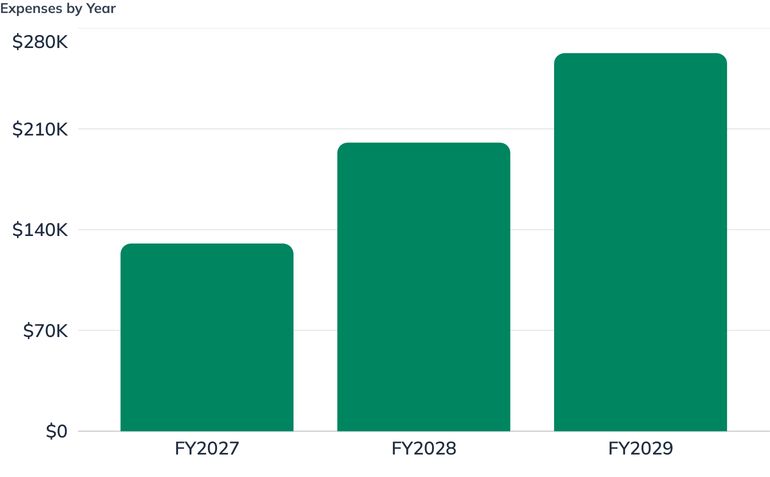
Operating expenses total $95,160 in Year 1, $138,732 in Year 2, and $183,420 in Year 3.
Expense | Y1 | Y2 | Y3 |
|---|---|---|---|
Salaries & wages | $43,400 | $72,960 | $105,000 |
Employer payroll taxes & benefits | $8,680 | $14,592 | $21,000 |
Owner health insurance | $6,240 | $6,240 | $6,240 |
Shop rent & utilities | $17,400 | $19,200 | $20,400 |
Marketing & sales | $5,400 | $9,000 | $11,400 |
Software & subscriptions | $3,120 | $4,080 | $5,040 |
Accounting, bookkeeping & legal | $3,000 | $3,000 | $3,000 |
Equipment maintenance, spares & repairs | $2,100 | $3,120 | $4,080 |
Insurance (liability, property, product) | $2,520 | $2,520 | $2,520 |
Vehicle & local courier delivery | $2,160 | $2,880 | $3,600 |
Licenses, permits & association dues | $1,140 | $1,140 | $1,140 |
Total | $95,160 | $138,732 | $183,420 |
People are the business. Wages plus employer burden and owner health insurance are 61% of Year 1 operating expenses and 72% by Year 3. Every other line is small by comparison, which means expense control in this business is almost entirely a staffing question — and why the part-time-versus-full-time technician decision (see Management Team) moves Year 3 net profit by $25,000, more than any other single lever in the model.
Employer burden is 20%, not 10%. Payroll taxes and benefits run about 20% on top of Oregon wages. This is routinely underestimated in first-time plans and is the reason a $54,000 salary is really a $65,000 commitment.
Rent is deliberately small. At $1,450/month rising to $1,700, shop rent is under 7% of Year 3 revenue. Signing for more square footage than the business can fill is the most common way a small bureau converts a good year into a bad one.
Marketing scales with revenue, but more slowly. $450/month to $950/month — 6.1% of revenue in Year 1, falling to 4.1% in Year 2 and 3.8% in Year 3. That declining share is an assumption, not an accident: it presumes the referral, content and repeat-customer channels described in the Marketing Plan carry an increasing share of acquisition as the business matures. If they underperform, this is the first line that has to grow, and holding marketing at Year 1's 6.1% through Year 3 would cost about $7,000 of the $37,302 profit.
Below the operating line
Depreciation: $9,871 / $11,729 / $13,586 — non-cash, on $53,300 of month-1 equipment and the $26,000 SLS system added in month 19.
Interest: $11,328 / $11,638 / $10,799 on the $110,000 SBA 7(a) loan at 11.5%. Year 2 is slightly higher than Year 1 because Year 1 carries only eleven payments — the first falls in the month after funding. Worth stating plainly: interest alone consumes 13% of Year 1 revenue. That is the real cost of launching on debt at current SBA rates, and it is the single largest reason Year 1 shows a loss.
Income tax: none at the entity level. Element is a pass-through single-member LLC, so income tax is Dana's personal obligation. Oregon levies no sales tax, so none is collected.
Profitability
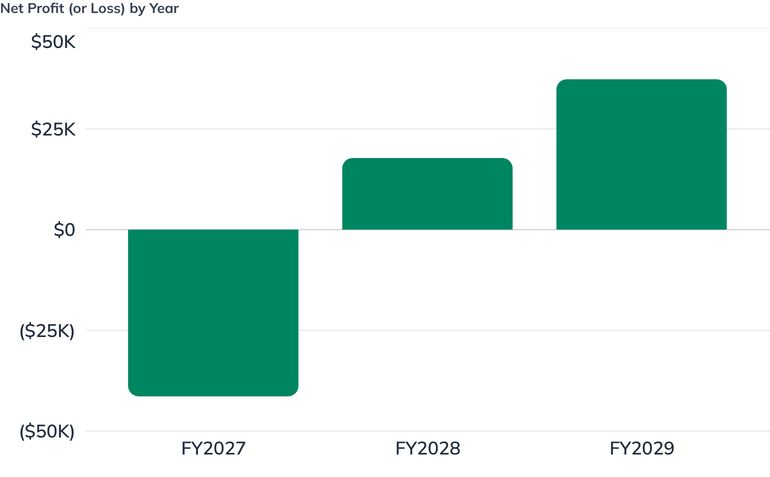
Need real milestones? We recommend using LivePlan as the easiest way to create milestones for your own business plan.Create your own business plan
When it turns
First profitable month: January 2028 — month 16. Every month from there to the end of the horizon is profitable, with monthly net profit climbing from $904 in January 2028 to $4,271 by September 2028.
Cash turns a month later, in February 2028. This is the reverse of the conventional pattern, where depreciation's non-cash add-back makes cash lead profit. Here the add-back is roughly $977 a month against about $577 a month of loan principal repayment — a net cash benefit of only $400 — while receivables are building at roughly $515 a month as customers move onto net-30 terms. The working-capital drag slightly outweighs the depreciation benefit, so cash crosses one month behind profit. Growth consumes cash here. That is normal for a business scaling on trade credit, but it means beating plan requires more working capital, not less.
Why Year 1 loses $41,355
Three causes, in order of size:
- The ramp. Month 1 books $2,900 of revenue against roughly $8,000 of monthly fixed cost. Revenue does not clear fixed cost until well into Year 2. This is the cost of building a customer base from zero, and it is unavoidable.
- Interest. $11,328 — 13% of Year 1 revenue — services the SBA loan. Launching on debt at 11.5% is expensive, and this line is the clearest argument for the founder equity component being as large as it is.
- Depreciation. $9,871 against $53,300 of month-1 equipment. Non-cash, but real: the machines are being consumed.
Strip out interest and depreciation and Year 1's operating loss is $20,155 — about seven months of Dana's Year 1 salary. That is the honest size of the hole, and the funding is sized to cover it comfortably.
What profitability actually means here
Year 3's $37,302 net profit sits on top of $72,000 of founder salary. The owner-benefit figure is therefore roughly $109,000 — a real, if not spectacular, outcome for a two-person shop, and roughly what Dana left behind at the medical device manufacturer. Element does not become a wealth-generating business inside three years; it becomes a business that pays its founder properly and accumulates a genuine cash reserve. That is the correct ambition at this scale, and a plan claiming more would not be credible.
Break-even
Break-even has to be measured against all fixed costs, not just operating expenses — interest and depreciation are both real charges against profit.
Year 2 | Year 3 | |
|---|---|---|
Operating expenses | $138,732 | $183,420 |
Interest | $11,638 | $10,799 |
Depreciation | $11,729 | $13,586 |
Total fixed cost | $162,099 | $207,805 |
Gross margin rate | 82.4% | 81.8% |
Break-even revenue | $196,700/yr ($16,400/mo) | $254,000/yr ($21,200/mo) |
Year 2 revenue of $218,187 clears its break-even by $21,500; Year 3's $299,825 clears by $45,800. Both are comfortable, but neither is generous — and the Year 3 cushion is 15% of revenue, which is the honest measure of how much room this business has.
Sensitivities
Scenario | Year 3 net profit |
|---|---|
Plan as modelled | $37,302 |
Revenue 10% above plan | ~$61,800 |
Revenue 10% below plan | ~$12,800 |
Technician converted to full-time in month 18 | $12,102 |
Repeat production runs fail to develop (–$84,000 revenue) | –$26,100 |
The asymmetry is the point. This business has high operating leverage — 82% gross margin against largely fixed costs — so a 10% revenue swing moves profit by about 66%, roughly six and a half times the variance in percentage terms. That cuts favourably above plan and hard below it, and it is why the cash reserve, not the profit line, is the number to manage in Years 1 and 2.
Use of Funds
Element requires $155,000 to launch. About a third buys equipment; the rest is working capital that carries the business through sixteen months of ramp before cash begins to build.
Where the money goes
Use | Amount | Timing |
|---|---|---|
Equipment and build-out | $53,300 | Month 1 |
FDM print farm — 8 professional enclosed printers | $12,800 | |
Resin / SLA station with wash, cure & fume extraction | $11,500 | |
Shop build-out — electrical, ventilation, benching | $9,500 | |
Post-processing & finishing equipment | $8,500 | |
Metrology & QC equipment | $6,200 | |
CAD workstation, farm server & office IT | $4,800 | |
Working capital | ~$101,700 | Months 1–19 |
Operating losses through month 16 | ~$46,000 | |
Receivables build (customers on net-30 terms) | ~$15,200 | |
Loan principal repaid in Years 1–2 | ~$12,600 | |
SLS system expansion | $26,000 | Month 19 |
Residual cash reserve | ~$1,900 | |
Total | $155,000 |
The honest version of "working capital"
Two-thirds of this raise is not equipment. It is the sixteen months during which Element pays rent, salary, insurance and loan interest while revenue climbs from $2,900 a month to the roughly $21,200 it takes to cover all fixed costs. That period costs about $46,000 in accumulated losses.
There is a second, less obvious drain that first-time owners routinely miss: receivables. Established customers move to net-30 terms, so roughly $15,200 of Years 1–2 revenue is earned but not yet collected at any given moment. Money that is owed to you is not money you can spend on rent, and that build is a large part of why cash keeps falling for a month after the business turns profitable.
The forecast's lowest cash point is $30,631 in April 2028 — the month the SLS system is purchased — and cash never approaches zero at any point in the three-year horizon. That trough is about two months of operating cover: adequate, but not so generous that the raise could be trimmed much. Taking $25,000 out of this raise would put the April 2028 trough near $5,600, which is not a position from which a solo owner makes good decisions.
Deferred capital: the SLS decision
The single largest equipment item is not bought at launch. The $26,000 benchtop SLS system is scheduled for month 19 (April 2028), and the reasoning is worth stating explicitly because it is the most defensible choice in this plan:
- The repeat production volume that justifies SLS does not exist until Year 2. Buying it in month 1 means depreciating and financing an idle machine for eighteen months.
- Keeping the $26,000 in the bank for eighteen months avoids roughly $3,700 in interest at 11.5%.
- By month 19, actual demand will say whether SLS or a large-format FDM machine is the better purchase. The plan models SLS; the decision gets made on evidence.
The trade-off is that this purchase creates the forecast's cash floor. If Years 1–2 run behind plan, deferring the machine another two quarters is the obvious and low-cost adjustment.
What this budget deliberately excludes
No vehicle purchase — mileage and courier are expensed at $180–300 a month. No trade show booth build. No inventory beyond roughly $3,000 of working material stock, carried in working capital rather than capitalized. No owner distributions inside three years. No contingency line, which is a real gap — the working capital cushion is doing that job, and a genuine 10% contingency would push the raise toward $170,000.
Reconciliation
Total uses of $155,000 equal total sources of $155,000 (see Sources of Funds). The equipment figure of $53,300 matches the Equipment & Tools section line for line, and the month-19 SLS purchase matches the milestone dated April 2028.
Sources of Funds
Element's $155,000 launch is funded with $45,000 of founder equity and a $110,000 SBA 7(a) term loan — roughly a 29/71 split, both landing in month 1.
Source | Type | Amount | Terms |
|---|---|---|---|
Dana Reyes — founder equity | Investment | $45,000 | 100% ownership, no repayment |
SBA 7(a) term loan | Debt | $110,000 | 11.5% fixed, 120 months, personally guaranteed |
Total | $155,000 |
Founder equity — $45,000
Personal savings accumulated over nine years, contributed in month 1 as paid-in capital. This is Dana's entire liquid savings outside a retirement account, and it is worth being clear about what that means: the downside is not a diminished return, it is the loss of a decade of saving. That is the ordinary condition of founding a business, but a plan that does not say it out loud is not being honest with its reader.
The equity share is deliberately as large as Dana could make it. Every dollar of equity is a dollar not costing 11.5% — and at Year 1 revenue of $88,960, interest expense of $11,328 already consumes 13% of the top line. Substituting $45,000 of debt for the equity would add roughly $5,200 a year in interest and push first profitability from month 16 toward month 20.
SBA 7(a) term loan — $110,000
Terms as modelled: 11.5% fixed, 120 monthly payments of approximately $1,547, fully amortizing, personally guaranteed. The first payment falls in the month after funding, so Year 1 carries eleven payments rather than twelve — which is why Year 2 interest ($11,638) is slightly higher than Year 1's ($11,328) despite the balance falling.
Why these terms are realistic. Current SBA 7(a) maximum rates for a loan in the $50,001–$250,000 range run to 12.75% fixed, with variable-rate structures starting near 9.75% for larger loans. Rates have held steady since the Federal Reserve's December 2025 cut and are the lowest since 2022. Modelling 11.5% sits inside that band without assuming a borrower gets the best available terms — a first-time owner with no business credit history generally does not.
Debt service over the horizon: $18,564 a year, of which roughly $11,300 is interest in Year 1 falling to $10,800 by Year 3. Cumulative interest across the three years is $33,765, against only $20,380 of principal repaid — an amortizing loan front-loads interest, and this one is no exception. Over the full ten-year term the $110,000 loan costs approximately $75,600 in interest, a number worth confronting rather than discovering in year six.
Collateral and guarantee: secured by business assets and personally guaranteed, as SBA loans of this size invariably are. Dana's personal exposure is therefore the $45,000 of equity plus the guarantee on the outstanding loan balance, which is still roughly $89,600 at the end of Year 3.
Why debt rather than outside equity
Element is not a venture-scale business and should not pretend to be. A service bureau reaching $300,000 of revenue and $37,000 of profit in Year 3 is a good small business and an unattractive equity investment — the return profile does not support giving away ownership. Debt is more expensive month-to-month and considerably cheaper over a working lifetime. Dana retains 100% ownership and full decision authority.
What is not in the plan
No line of credit, no equipment lease, no friends-and-family debt, no crowdfunding. A modest working-capital line of credit would be a reasonable addition once the business has twelve months of operating history — banks price it far better then — and would be the right instrument both for smoothing a bad quarter and for funding the receivables build that growth creates. On this plan, a $25,000 revolver drawn only around the April 2028 equipment purchase would meaningfully improve the cash floor at little cost.
Repayment and reserves
The loan is current in every month of the forecast. Cash on hand never falls below $30,631 (April 2028) and finishes Year 3 at $89,400 — approximately 5.8 months of operating expenses. That is a sound reserve but slightly under the six-month threshold at which owner distributions become appropriate, which the business reaches early in Year 4. No distributions are taken inside the three-year horizon; all retained profit stays in the business.
Projected Statements
Frequently Asked Questions
A 3D printing business plan should cover the processes and materials you run, the customer segments you serve and how you win them, your competitive position against online quoting platforms and in-house printers, equipment and facility requirements, staffing, and financial projections with startup costs, funding sources, and a realistic path to profitability. Element Printing Co's plan pairs its four service lines with a segment-by-segment revenue breakdown, a 1,200 square foot shop layout organized around job flow, a $155,000 funding plan, and three-year projections.
Element Printing Co launches on $155,000 — $45,000 of founder equity plus a $110,000 SBA 7(a) term loan at 11.5% over ten years. About $53,300 of that goes to printers, post-processing equipment, metrology tools, and a $9,500 shop build-out in month one; the remaining two-thirds is working capital carrying the business through sixteen months of ramp, since rent, owner draw, insurance, and loan interest all run well before revenue covers them.
Requirements are local rather than industry-wide, so check your city and state before signing a lease. Element Printing Co is organized as a single-member LLC for liability separation — important because customers install its parts into their own products — and carries general liability, commercial property and equipment, and product liability coverage. Its Central Eastside location was chosen partly because the zoning permits light manufacturing without a conditional-use process, and the resin bay is independently ventilated with chemical storage that meets fire-code requirements.
Element Printing Co runs four revenue lines. FDM prototyping and short-run parts is the volume business at roughly $195 per job, growing from $46,020 in Year 1 to $126,850 by Year 3; high-detail SLA resin work averages about $145 per job, growing from $18,560 to $49,600. Design and DfAM consulting bills at $95 to $105 an hour and is the highest-margin line, while recurring production runs — standing monthly batches priced at $1,250 to $1,400 rather than re-quoted each time — start in month 10 and reach $84,000, or 28% of revenue, by Year 3.
In this plan, month 16. Element Printing Co posts its first profitable month in January 2028 and every month after it is profitable, with cash flow turning positive a month later in February 2028. Year 1 loses $41,355 — the honest cost of building a customer base from zero while servicing debt at 11.5%, where interest alone consumes 13% of first-year revenue — before Year 2 returns a $17,765 profit and Year 3 closes with $89,400 in cash.
Not on price or certification, which the plan says outright. Element competes on the four business hours between file upload and a quote that includes an actual engineering comment, and on parts a Portland customer can pick up the same afternoon rather than waiting five to ten business days plus transit. Every job is reviewed by a mechanical engineer with nine years of medical device experience, and roughly one job in five comes back with a note about wall thickness, orientation, tolerance, or material fit — a service the plan treats as its single most effective marketing mechanism.
Element Printing Co's plan models four segments. Hardware startups and small product companies make up about 40% of Year 3 revenue — teams of 3 to 30 people who order irregularly but intensely and care far more about lead time than a $30 price difference. Established manufacturers and industrial teams buying jigs, fixtures, and replacement parts account for another 30% and drive the repeat production line, with medical, dental, and bioscience work at 15% and designers, architects, artists, and educators at the remaining 15%.
Deliberately less than the business could justify. Element opens with a farm of professional enclosed CoreXY FDM machines, resin printers with wash and cure stations, and post-processing and metrology equipment — but defers the expensive purchase, a $26,000 benchtop SLS system, until month 19, once repeat production volume justifies it rather than merely anticipating it. Staffing is just as lean: one part-time production technician added in month 8, with a second full-time salary treated as a Year 4 decision to be made from an $89,400 cash position rather than a thin margin.

Business Plan Outline
Start your plan