





True North Moving Co.



Business Plan Summary
This moving company business plan example features True North Moving Co., a residential moving company launching in Augusta, Maine, and serving Kennebec County with local household moves, senior downsizing and retirement-community transitions, packing, and storage-in-transit. It covers founder Sarah Cormier's four contractual service commitments, a Not-to-Exceed price ceiling built from a video survey, a two-hour arrival window backed by an automatic invoice credit, a ten-day claims resolution standard, and Full Value Protection included by default, along with a deliberate focus on senior transition moves, a staffing model built around Maine's deep winter trough, and a $245,000 launch funded through owner equity, an SBA 7(a) term loan, and equipment financing. Use it as inspiration for your own plan. Download a free business plan template to get started, or browse more business plan examples.
True North Moving Co.
Executive Summary
True North Moving Co. is a residential moving company serving Augusta, Waterville, Gardiner, Winthrop, and the surrounding Kennebec County communities, with intrastate service anywhere in Maine. We handle local household moves, senior downsizing and retirement-community transitions, packing and unpacking, and short-term storage-in-transit through partner facilities.
We are building this business around a specific and well-documented failure in our market. Read the reviews of moving companies operating in central Maine and the complaints cluster in three places: crews that arrive hours late or cancel outright on moving day, damage claims that go unanswered for weeks, and final invoices that land well above what the customer was quoted. Almost none of the complaints are about price. Customers in this market are not looking for the cheapest mover — they are looking for one that does what it said it would do, on the day it said it would do it.
Our answer is to make those three things contractual rather than aspirational. Every True North move carries a written on-time guarantee: if our crew is not on site within the two-hour arrival window we committed to, the customer receives a credit against the invoice. Every quote is developed from a video walkthrough of the home and issued as a Not-to-Exceed price, so the number on the estimate is the ceiling on the invoice regardless of how the day unfolds. Every damage claim gets an acknowledgment within one business day and a resolution offer within ten. None of these commitments require capital to deliver. They require discipline, and they are exactly what our competitors have shown they will not do.
Our second strategic bet is demographic. Maine has the oldest median age in the United States, and the 65-and-over population in our service area is projected to grow more than 35% by 2032 while the working-age population declines. Senior moves — downsizing from a family home into a smaller residence or a retirement community, or clearing an estate — are slower, more emotionally difficult, and more service-intensive than a typical young-family move. They are also the segment least well served by hourly crews incentivized to work fast. We are deliberately building for this work: crews trained in pacing and patience, a Certified Senior Move Manager credential for our owner, and referral relationships with the retirement communities, elder-law attorneys, estate liquidators, and real estate agents who guide these decisions. Senior transitions are priced as flat-rate projects averaging close to $3,000, and they carry both a higher average ticket and a far flatter seasonal curve than standard residential work — about 22% of our job volume but a third of our revenue.
The underlying market supports the venture. Kennebec County recorded 1,343 residential property sales in 2025, up 5.3% year over year, and 13.4% of the local population moved within the past year — meaningfully above the 11.8% national rate. Roughly three quarters of all American moves stay within the same state, which means the great majority of the addressable market requires no interstate operating authority. Maine imposes no state license on intrastate household goods movers, and a box truck spec'd at or below 26,000 lbs GVWR keeps us outside federal USDOT registration for purely intrastate work.
The company is a Maine limited liability company, owner-operated, launching in early 2026 with two 26-foot box trucks and adding a third in the spring of our second year. We open with a core team of five — the owner, an operations lead, a part-time office coordinator, and two full-time movers — supported by a seasonal part-time crew pool that expands to the equivalent of four to six additional people from April through October. That structure is deliberate: more than 60% of moves in this market happen between May and September, and carrying a full peak crew through a Maine February is the most common way a small mover fails.
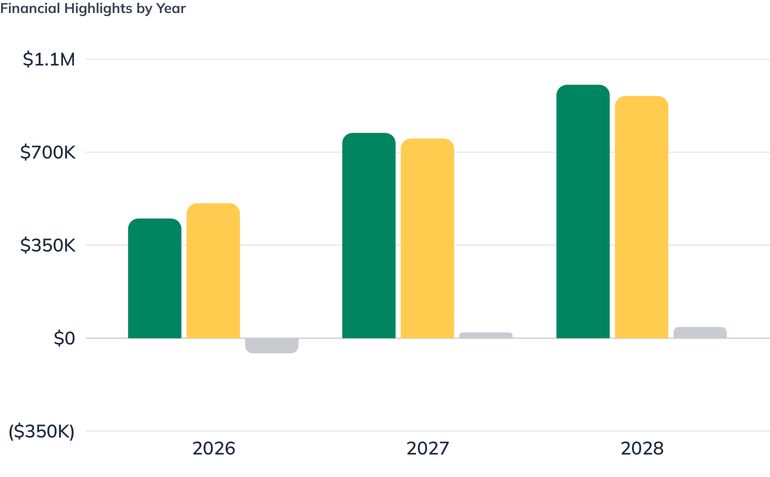
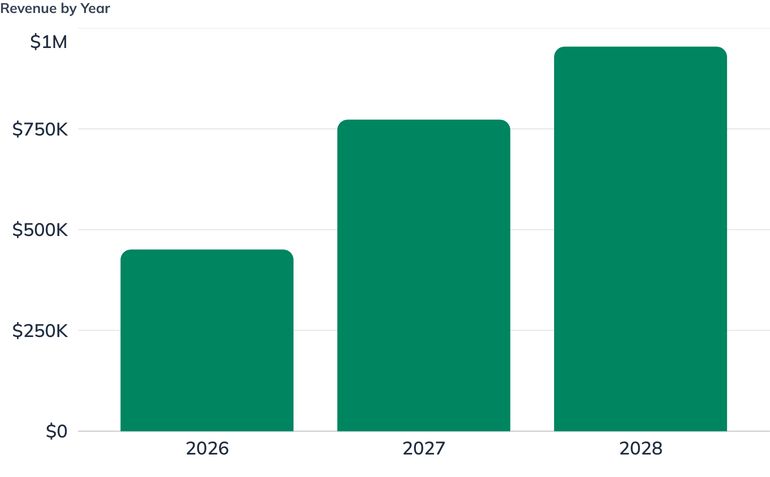
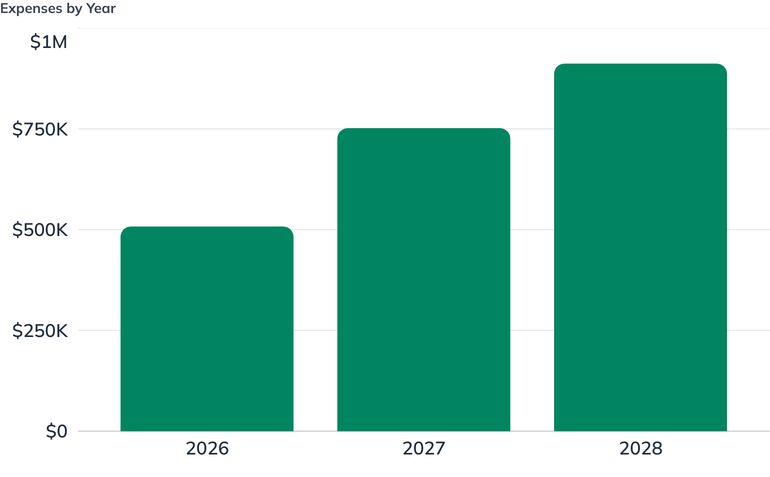
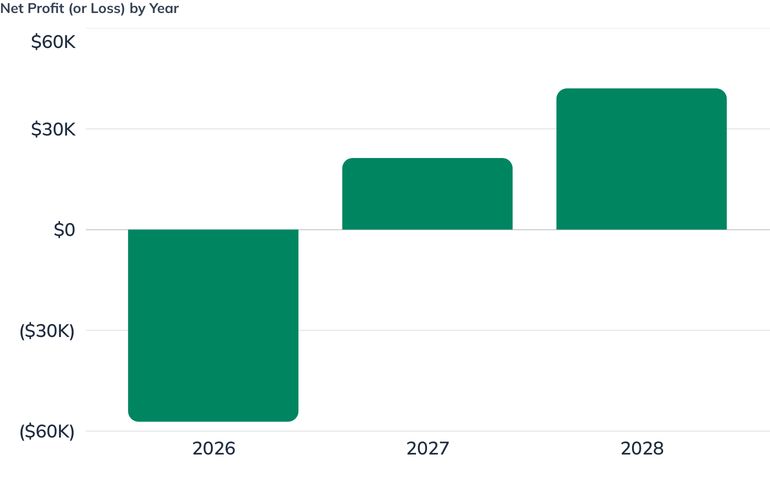
Startup capital of $245,000 combines a $60,000 owner equity contribution with a $130,000 SBA-backed term loan and $55,000 in equipment financing on the trucks. Revenue grows from roughly $451,000 in our first nine months of operation to $773,000 in year two and $954,000 in year three. The business posts a loss of about $57,000 in the ramp year, turns profitable in year two at roughly $21,000, and reaches about $42,000 in year three, while cash on hand climbs from a low of roughly $55,000 in our first spring to approximately $130,000 by the end of year three.
Need real milestones? We recommend using LivePlan as the easiest way to create milestones for your own business plan.Create your own business plan

Opportunity
Problem Worth Solving
Moving is one of the most stressful events in a household's life, and in central Maine the experience of hiring a mover routinely makes it worse rather than better.
The quote is not the price. The dominant pricing model in this industry is open-ended hourly billing: a crew rate, a truck rate, travel time, and a non-binding estimate of how many hours the job will take. The customer signs off on a number they are told is approximate and discovers on moving day that it was optimistic. Stairs get billed. Long carries get billed. A crew working at an unhurried pace gets billed. The customer has no leverage at the moment the bill arrives, because their possessions are on the truck. This is the single most common source of anger in mover reviews across Maine, and it is a structural feature of how the industry prices, not an occasional lapse.
The crew may not come. Small movers in this region operate on thin, seasonally volatile labor. When a crew member does not show up on a Saturday in July, the operator's options are to run short-handed, run late, or cancel. Customers report crews arriving three and four hours outside the promised window, and cancellations delivered by voicemail on the morning of a move that had been booked for six weeks — after the closing has happened, after the truck rental window has passed, after the help has taken the day off work. There is no practical recourse and, in most contracts, no penalty to the mover.
Damage gets absorbed by the customer. Household goods get broken in transit; that is unavoidable in any volume of moves. What is avoidable is what happens next. Reviews in this market describe claims submitted and never acknowledged, phone calls that go to voicemail, and settlement offers that arrive months later at released-value rates the customer never understood they had accepted. The default liability standard in household goods moving is 60 cents per pound per article — a broken 30-pound flat-screen television settles for $18. Most customers do not learn this until they file.
Older customers are the least well served. A crew paid by the hour has an economic incentive to move quickly, and quickly is precisely wrong for a downsizing move. An 80-year-old leaving a home of forty years needs to make decisions during the move, needs the pace to accommodate that, and often has adult children coordinating remotely from out of state. Standard residential crews are neither trained nor incentivized for this work, and the retirement communities and elder-care professionals who field the resulting complaints have no confident local referral to make. In the fastest-growing demographic segment in Maine, that is a conspicuous gap.
None of these problems requires new technology or significant capital to solve. They persist because solving them costs the incumbent operator something — a binding price cap transfers estimation risk from the customer to the mover, an on-time guarantee costs real money when it is missed, and a ten-day claims commitment requires staffing the follow-through. Those costs are precisely what makes the commitments credible, and precisely why our competitors have not made them.

The Transitioning Senior
Martha Higgins
Martha is a widow moving from her 40-year family home in Gardiner to a managed retirement community in Augusta. She is overwhelmed by the emotional and physical task of sorting through a lifetime of belongings and is deeply concerned about her antique furniture being handled with care.
Age
74
Location
Gardiner, ME
Family Status
Widowed, 3 adult children living out of state
Education
Master's in Education
Profession
Retired Public School Teacher
Opportunities
- Leverage the Certified Senior Move Manager credential to offer a high-touch, slower-paced service that includes floor planning for the new smaller residence.
- Offer a full-service unpacking and 'home-setup' package so Martha can sleep in a fully arranged bedroom on her first night.
- Provide a single, predictable $3,000 project fee to remove the stress of watching an hourly clock during an emotionally difficult day.
Pain Points
- High anxiety regarding the safety of sentimental heirlooms
- Physical inability to pack heavy or high-shelf items
- Aggressive 'hustle' culture of standard moving crews that feels disrespectful to her pace
Needs
- Patience and clear communication throughout the moving day
- A mover who coordinates directly with the retirement community's intake rules
- Trustworthy professionals who won't surprise her with extra fees on a fixed income
“I'm not just moving boxes; I'm moving my entire life. I need someone who understands that my mother's china isn't just 'cargo.'”

The New Mainer
Sarah Jenkins
Sarah is part of the recent wave of in-migration to Maine, relocating from Boston for a leadership role at MaineGeneral Health. She is unfamiliar with local service providers and is looking for a reputable, 'no-drama' company to handle her intrastate transition from a temporary rental to her permanent home.
Age
36
Location
Waterville, ME
Family Status
Single
Education
Master's in Healthcare Administration
Profession
Administrator at MaineGeneral Health
Opportunities
- Partner with major local employers like MaineGeneral to become the 'preferred' mover for incoming executive talent.
- Provide a seamless bridge for her belongings while she waits for her new home's closing date through partner facilities.
- Offer online booking and video estimates to accommodate her tech-savvy preferences and busy professional schedule.
Pain Points
- Difficulty vetting local companies from a distance
- Fear of the 'Maine flake'—service providers who stop communicating once the job is booked
- Stress of coordinating a move while starting a high-pressure new job
Needs
- A professional digital presence that builds immediate trust
- Clear, prompt email and text communication
- Reliable intrastate service that doesn't require her to hire a national van line
“I'm moving here for a fresh start and a big promotion. The last thing I need is to start my first week at the hospital dealing with a moving company that won't call me back.”

The Public Sector Professional
David Miller
David works for the State of Maine and is moving his family from a starter home in Augusta to a larger property in Winthrop. His schedule is rigid, and he cannot afford for a mover to show up late or for the final bill to exceed his carefully planned budget.
Age
44
Location
Augusta, ME
Family Status
Married, 2 children (ages 12 & 14)
Education
Bachelor's in Public Administration
Profession
Department Manager, State of Maine
Opportunities
- Market the contractual arrival window to appeal to his need for scheduling precision around his work hours.
- Utilize the video walkthrough to provide a Not-to-Exceed quote that fits perfectly into his household's financial planning.
- Highlight the 10-day resolution offer to mitigate his fear of the 'unanswered claim' loop common in the local market.
Pain Points
- Taking time off work only to have a service provider arrive hours late
- Final invoices that land 20% higher than the initial over-the-phone estimate
- Lack of accountability when items are scratched or broken during the move
Needs
- A binding price ceiling to ensure budget compliance
- A professional, disciplined crew that respects his time
- A written contract that guarantees service levels rather than just promising them
“I'm taking a Friday off for this move. If the crew doesn't show up until noon, my whole weekend is ruined and I've wasted a vacation day.”
Our Solution
True North Moving Co. delivers full-service residential moving in Kennebec County and throughout Maine, structured around four commitments that our competitors do not make in writing.
The True North Promise
Not-to-Exceed pricing. Every move begins with a video survey — a scheduled 20-minute walkthrough of the home conducted over video call, or an in-person survey for larger jobs. From that survey we issue a written estimate with a guaranteed ceiling. We bill at our hourly crew rate for the actual hours worked, and if the job runs long, the customer pays the ceiling, not the overage. The customer's downside is capped and our estimating discipline is the thing at risk. If we estimate badly, we absorb it, which is the correct allocation of that risk.
The two-hour arrival window, guaranteed. We commit to a two-hour arrival window rather than the "sometime in the morning" that is standard in this market. If our crew is not on site within that window, the customer receives a $100 credit against the invoice, applied automatically without being asked for. If we cancel a confirmed move for any reason within 72 hours of the date, we credit $250 and place the customer with a vetted partner mover at our expense for any difference in rate.
Claims answered in ten days. Damage claims are acknowledged in writing within one business day and carry a resolution offer within ten business days. We carry Full Value Protection on every move as the default, not as an upsell — meaning damaged items are repaired, replaced, or settled at replacement value rather than at the industry-standard 60 cents per pound. Customers may elect down to released value for a discount, but they have to actively choose it, and the difference is explained on the estimate in plain language.
Photographed before it moves. Crews photograph every high-value item and every pre-existing damage point before it is loaded, timestamped to the job file in our dispatch system. This resolves the most common claims dispute — was it already broken — before it becomes a dispute, and it takes a crew about eight minutes per job.
Services
Local and intrastate residential moving is our core. A typical job is a two- or three-bedroom home moving within Kennebec County, staffed by a crew of two to three with one 26-foot truck. We serve the full state for intrastate moves, with Portland, Bangor, Lewiston, and the midcoast reachable as day trips from Augusta.
Senior downsizing and transition moves are our specialty practice. These are priced and staffed differently: a dedicated crew, a slower schedule, sorting and disposition support for what is not coming along, room-by-room setup at the destination including making beds and hanging pictures, and a single point of contact who can brief adult children by phone. We coordinate directly with retirement communities on move-in day logistics — elevator reservations, loading dock windows, and the community's own furniture restrictions.
Packing and unpacking is offered as full-service, partial (kitchen and fragile items only, which is what most customers actually want), or materials-only. We sell boxes, paper, and dish-pack kits directly and buy back unused materials at full price after the move, which removes the overbuying anxiety and costs us nothing but restocking.
Storage-in-transit is handled through a contracted arrangement with a local climate-controlled facility rather than our own warehouse. Closing dates slip constantly in this market; a customer whose sale closes eleven days before their purchase should not have to solve that alone. Carrying the service without carrying the building keeps our fixed costs down in the early years.
Single-item and specialty moves — pianos, gun safes, antique furniture, appliance disconnect and reconnect — are offered as standalone jobs. They are small revenue individually but they fill weekday and shoulder-season capacity, and they are a low-risk way for a customer to try us before booking a full move.
Target Market
The market
Our service area is Kennebec County and the surrounding central Maine communities, with Augusta at the center. The county holds approximately 129,000 residents across roughly 54,000 households. The Augusta-Waterville micro area, which is coterminous with the county, recorded a one-year residential mobility rate of 13.4% — meaningfully above the 11.8% national figure and well above Maine's statewide 10.3%. Roughly 17,000 people in our immediate service area moved in the past year.
Transaction volume is growing. Kennebec County recorded 1,343 residential property sales in calendar 2025, up 5.33% over 2024, outpacing statewide growth of 4.78%. The county median sale price of $325,000 was flat year over year against a statewide median of $405,000 — a useful combination for us, because rising transaction counts without an affordability squeeze means more households moving and fewer of them forced into a DIY rental truck by cost.
Maine's population growth is now driven entirely by in-migration; the state gained more than 10,000 net migrants in 2024 against a natural population decline of over 5,000. Kennebec County is projected to grow 5.1% by 2032, ahead of the statewide 3.5%. Augusta's employment base is unusually stable — the State of Maine employs over 5,000 people here, MaineGeneral Health over 2,000, VA Maine at Togus roughly 1,500, and government accounts for close to four in ten regional jobs. Stable public-sector employment produces steady, non-cyclical household formation and relocation, which insulates us somewhat from the housing-market volatility that hits movers in more speculative markets.
Nationally, the moving services industry is roughly $23.4 billion with about 9,100 establishments. Critically for our positioning, only about 19% of American moves cross state lines — roughly half stay within the same county and another quarter move within-state. The overwhelming majority of the market is addressable without interstate operating authority.
Who we serve
Relocating homeowners and renters — roughly 53% of job volume, 41% of revenue. Households in the $60,000–$140,000 income range moving within or into Kennebec County, typically two- and three-bedroom homes. They are moving because of a home purchase, a job change, or a rental transition. They find us through Google search, a real estate agent's recommendation, or a neighbor. They care most about the crew showing up, the price holding, and their furniture arriving intact. They will pay a modest premium for confidence but they are not indifferent to price — our binding-cap model has to be priced within roughly 10% of the market's hourly rates to convert.
Seniors downsizing and transitioning — roughly 22% of job volume but 33% of revenue. Adults 70 and older leaving a long-tenured family home for a smaller residence, an assisted living community, or family. Maine's 65-plus cohort is projected to grow 35.6% by 2032 while the working-age population declines 4.6% — this segment is expanding structurally, not cyclically. The decision-maker is frequently an adult child, often out of state, who is buying reassurance as much as labor. These jobs run longer, involve packing and disposition services, and are quoted as flat-rate projects averaging close to $3,000 — roughly double a standard residential move. They arrive through referral channels rather than search: retirement communities, elder-law attorneys, estate liquidators, senior real estate specialists, and hospital discharge planners. They are also markedly less seasonal than home-sale-driven work, which is why they matter disproportionately to our winter cash position.
Labor-only and specialty jobs — roughly 16% of job volume, 5% of revenue. Customers renting their own truck or container who need loading help, plus single-item piano, safe, gun-safe, and antique moves. Low revenue per job, but these are efficient fillers for weekday gaps and shoulder seasons, and they function as a low-commitment trial that converts to full-service bookings later.
Small commercial and office relocations — roughly 9% of job volume, 11% of revenue. Professional offices, state contractors, and small retail in the Augusta–Waterville corridor, typically under 5,000 square feet. This work is scheduled evenings and weekends and is valuable primarily because it is booked weeks in advance and lands in our shoulder seasons rather than competing with the summer residential peak.
Packing services attach to roughly a third of our moves across all segments and are counted separately, contributing about 9% of revenue.
Seasonality
More than 60% of American moves happen between May and September, and Maine's winters make the trough deeper here than the national pattern. June, July, and August are our peak; December through March is thin. This shapes nearly every operating decision we make — how we staff, how we price, how much cash we hold entering the fourth quarter, and why we actively pursue commercial, senior, and specialty work that is less seasonally concentrated than the residential home-sale cycle.
It is also why our labor model rests on a small full-time core plus a seasonal crew pool rather than a full year-round payroll. Carrying peak-season headcount through a Maine February is the most common way a small moving company fails, and it is a failure mode entirely within our control.
Competition
The competitive set
Central Maine is served by a mix of national franchise operations, van line agents, established regional full-service movers, and a long tail of small local outfits.
Two Men and a Truck is the quality benchmark in this market and our most direct competitive threat. The franchise carries roughly a 4.5-star average, a BBB A+ rating, and approximately 96% positive reviews. They bring brand recognition, a national marketing budget, standardized training, and real operational discipline. They are also priced at the top of the market and are a Westbrook-based operation serving Augusta at a distance rather than from it.
Parker K. Bailey & Sons operates a Waterville location as a United Van Lines agent — the most direct van-line-backed competitor physically inside our service area. Their strength is long-distance and corporate relocation through the van line network. Local residential moving is not their focus, and van line agents typically prioritize the higher-margin interstate work when capacity is tight, which is exactly the summer window when local customers most need service.
Liberty Bell Moving & Storage of Maine offers full service with storage and holds a BBB A rating, but only about 68% positive reviews — a gap between institutional rating and customer experience that is instructive. Allen & Coles Moving Systems (BBB B-), Bisson Moving & Storage (BBB A+), and Midwest Moving Company (BBB C) round out the established regional operators, all Portland-area based and serving central Maine as an extension of their home market.
Locally based operators include D & J Movers and Vallee Moving & Storage in Augusta, Red's Moving in Waterville, and Gordons Moving Service. These are small, generally owner-operated, and they compete primarily on price and availability. Several have limited or no web presence, do not quote online, and are effectively invisible to a customer whose first move is a Google search.
Tiny Tim's Moving occupies the budget and labor-only end, and U-Haul and PODS represent the DIY substitute — the real floor on our pricing for the most cost-sensitive segment.
What we are competing on
The honest assessment of this market is that barriers to entry are low. Maine requires no state license for intrastate household goods movers, a properly spec'd truck avoids federal registration, and forming the entity costs $175. Anyone can enter. That cuts both ways: it explains why the market is crowded, and it means our defensibility cannot come from regulatory position or capital intensity. It has to come from execution and reputation, which compound and cannot be bought quickly.
Against the franchise and the regional full-service movers, we compete on price and locality. They are Portland-based and running Augusta jobs at a distance, which means travel time on the invoice and less flexibility on scheduling. We are ten minutes from most of our jobs. We can also make guarantees a franchise system cannot easily make, because a binding not-to-exceed cap requires local estimating judgment that does not standardize well across a franchise network.
Against the small local operators, we compete on professionalism and visibility. We will be the operator in this market with real-time online booking, video surveys, a written guarantee, uniformed crews, and current insurance certificates available on request. Several of our small local competitors do not answer the phone reliably in July. That is the opening.
Against the DIY substitute, we compete by making the total cost legible. A customer comparing a $200 truck rental against a $1,300 mover is not comparing like for like — they are omitting fuel, their own two days, the friends they have to feed, and the risk of injury and damage. Our marketing addresses this comparison directly rather than pretending it does not exist.
The differentiation that matters
The review data across Maine movers points at one consistent conclusion: complaints cluster on reliability and claims handling, not on price or speed. Customers are not asking for a cheaper mover. They are asking for one that arrives when it said it would and answers the phone when something breaks.
Every one of our four core commitments — the not-to-exceed cap, the two-hour window with an automatic credit, the ten-day claims SLA, and default Full Value Protection — is aimed at that finding. None of them requires capital. All of them require an incumbent to accept real cost and real risk in order to match, which is why an incumbent with an established book of business is slow to copy them. And every one of them is verifiable by the customer before they book, which converts a claim about quality into evidence about it.
Our vulnerability is the reverse of our advantage. Guarantees only differentiate as long as we honor them, and a single well-publicized failure to honor one is worse than never having offered it. Our operational discipline — dispatch, crew retention, estimating accuracy — is not a back-office concern in this business model. It is the product.
Execution
Marketing Plan
Moving is a zero-loyalty, high-intent purchase. A household hires a mover roughly once every seven years, and when they do, they typically decide within 72 hours of starting to look. There is no relationship to nurture and no repeat purchase cycle to optimize. Marketing a moving company means being findable and credible at the exact moment someone starts searching, and being the name a trusted third party says out loud when asked.
Our marketing therefore runs on two tracks: capture demand that already exists and is searching, and build referral sources that generate demand we never had to compete for.
Track one: capturing search demand
Local SEO and Google Business Profile. The overwhelming majority of moving customers begin with a Google search — "movers near me," "movers Augusta Maine," "moving company Waterville." Winning the local map pack is the single highest-return marketing activity available to us. That means a fully built Google Business Profile with weekly posts and current photos, consistent name-address-phone citations across directories, location pages for each community we serve (Augusta, Waterville, Gardiner, Winthrop, Hallowell, Belgrade, Oakland), and a systematic review request sent by text within two hours of every completed job while the relief is still fresh. Review velocity and recency are what move local rankings, and they are also what a customer actually reads. Our target is 50 Google reviews at a 4.8 average by the end of year one.
Website and instant quoting. Our site is built for one job: convert a searching stranger into a booked video survey. It leads with the four guarantees, shows real crew photos rather than stock imagery, publishes our hourly rates openly, and offers both an instant ballpark estimate tool and one-click scheduling for a video survey. Publishing rates is unusual in this market and deliberate — customers are conditioned to expect movers to hide pricing, and transparency is consistent with everything else we are promising.
Paid search. A tightly controlled Google Ads budget on high-intent local terms, geo-fenced to our service area and weighted heavily toward the March-through-August booking season. Moving keywords are expensive per click, so we run narrow rather than broad, bid on our competitors' brand terms, and measure on cost per booked job rather than cost per click. Paid search is a bridge while organic rankings mature, not a permanent channel.
Review platforms and aggregators. Claimed and actively managed profiles on Yelp, Thumbtack, Angi, and moveBuddha. We respond to every review, positive and negative, within 24 hours. A well-handled negative review is more persuasive to a reading customer than an unbroken wall of five stars, and given that our entire positioning is about how we behave when something goes wrong, the response is the marketing.
Track two: building referral sources
Referral relationships generate our highest-value and least price-sensitive work, and they compound. Our target is that referred jobs grow from roughly 20% of bookings in year one to 40% by year three.
Senior living and senior care. Direct relationships with the retirement and assisted living communities in the Augusta-Waterville corridor, built by making their move-in days easy — arriving on their schedule, respecting their loading dock and elevator rules, and never creating a problem their staff has to solve. We supplement this with quarterly downsizing workshops hosted at community centers and libraries, and a printed downsizing guide that costs us little and gets handed to families at exactly the right moment. Sarah Cormier is pursuing Certified Senior Move Manager credentialing through the National Association of Senior Move Managers in our first year, which is both a genuine training investment and a credential these referral sources look for when vetting a preferred mover.
Real estate agents. Kennebec County closes over 1,300 residential transactions a year, and every one involves at least one household that has to move. We build agent relationships the way agents actually respond to — by being reliably available and making them look good to their client, not by dropping off branded notepads. Our agent program provides a dedicated booking line, priority scheduling on closing dates, and a co-branded moving checklist agents can send to clients under their own name.
Professional and estate channels. Elder-law attorneys, estate liquidators, probate professionals, and property managers. These are low-volume, high-trust relationships that produce senior and estate work directly.
Community presence. Sponsorship of local youth sports and community events, participation in the Kennebec Valley Chamber of Commerce, and visible trucks. In a market this size, two clean, well-branded trucks parked at a Little League field on a Saturday are meaningful advertising, and the trucks are a cost we are paying regardless.
Sales Plan
How we price
We bill an hourly crew-and-truck rate with a guaranteed not-to-exceed ceiling established from a video survey. Rates are published openly on our website.
Crew | Rate |
|---|---|
Two movers plus a 26-foot truck | $165 / hour |
Three movers plus a 26-foot truck | $220 / hour |
Four movers plus a 26-foot truck | $275 / hour |
Each additional mover | $55 / hour |
Labor only, no truck, two movers | $120 / hour |
A three-hour minimum applies. Travel time is billed portal-to-portal at the crew rate and is included in the not-to-exceed ceiling — there is no separate fuel surcharge, mileage charge, or trip fee, which is where a great deal of the surprise in a typical moving invoice originates. Weekends and the June-through-August peak carry a published seasonal premium of roughly 15%, and we discount weekday and off-season moves by a comparable amount to pull demand into the capacity we are otherwise paying for.
These rates sit in the middle of the Maine market rather than at either end. Published rates from operating Maine movers start around $140 per hour for a two-mover crew, while Portland-area and aggregator-quoted pricing runs substantially higher. We are priced above the discount operators because a binding price ceiling and a paid on-time guarantee cost real money to honor, and below the Portland-based full-service movers because we are not billing our customers for a drive up from Cumberland County.
Packing labor bills at $72 per packer-hour. Materials are sold at published per-unit prices with unused, unopened materials bought back at full price after the move. Senior transition moves are quoted as a flat project price rather than hourly, because an hourly clock is the wrong instrument for a job where the customer needs to make decisions at their own pace — and because the adult child approving the invoice wants a number, not a range.
Full Value Protection is included at no additional charge on every move. Customers may elect down to released-value liability for a 5% discount, but they must actively choose it and initial the explanation.
What a typical job bills
Home size | Crew | Typical total |
|---|---|---|
Studio or one-bedroom apartment | Two movers | $800 – $1,000 |
Two-bedroom home | Two to three movers | $1,250 – $1,600 |
Three-bedroom home | Three to four movers | $2,150 – $2,900 |
Four-bedroom home | Four movers | $3,150 – $3,800 |
Senior transition project | Dedicated crew, flat rate | ~$3,000 average |
Our standard residential book skews toward the smaller end of this table. Apartments, condominiums, and two-bedroom homes are the bulk of the volume in a market where the county median sale price is $325,000, and our modeled average standard residential job runs between $1,500 and $1,650 across the plan period. The larger three- and four-bedroom jobs are less frequent but carry proportionally more packing revenue with them. Senior transitions are quoted separately as flat-rate projects and average close to $3,000, roughly double a standard residential move.
The sales process
Inquiry to survey, within one business day. Inquiries arrive by phone, web form, or online scheduler. Every one gets a human response the same business day — during peak season, within two hours. This alone distinguishes us in a market where competitors routinely do not return calls in July. The goal of the first contact is not to quote; it is to book the video survey.
The video survey. A scheduled 20-minute video walkthrough conducted over the customer's phone, or an in-person survey for homes over roughly 2,500 square feet and for all senior transition jobs. The survey is where the sale is actually made. We are inventorying the home to build an accurate estimate, but we are also demonstrating competence, spotting the problems the customer has not thought about — the third-floor walkup, the piano, the closing date that has not been confirmed — and establishing that we have done this before. Video surveys cost us 20 minutes instead of an hour of drive time, which is what makes accurate estimating economically viable on jobs of this size.
The written estimate, within 24 hours. The estimate specifies crew size, the arrival window, the hourly rate, the estimated hours, and the not-to-exceed ceiling. It states the four guarantees in plain language on the first page. It includes a materials list and separately priced optional services. Nothing in it is contingent or asterisked.
Booking and deposit. A $150 deposit confirms the date and applies to the final invoice. It is fully refundable up to 72 hours before the move. Customers book electronically; nothing requires them to print, sign, and scan.
Pre-move confirmation. An automated text at seven days and again at 48 hours confirming the date, the arrival window, and the crew lead's name. A phone call from the crew lead the evening before. This sequence costs almost nothing and directly addresses the single most common anxiety in the purchase — that the mover has forgotten.
Post-move follow-up. A review request by text within two hours of completion, and a call from the owner within 48 hours on every senior transition move and any job that had a complication. Referral sources are notified when their referred job completes, which is what keeps a referral channel alive.
Sales capacity
The owner personally handles all senior transition sales and all referral-source relationships through year two. An office coordinator, part-time at launch and moving to full-time by year three, manages inbound inquiry response, scheduling, and standard residential video surveys. A part-time sales and marketing coordinator is added in year three as volume outgrows what the owner can carry alongside operations.
Locations & Facilities
Facility
True North Moving Co. operates from a leased light-industrial flex space in Augusta, sized at approximately 3,000 square feet. The building provides secure overnight parking for our trucks, a small office for dispatch and administration, and enough interior space to store moving equipment, materials inventory, and the occasional overnight load.
The Augusta industrial market is thin — at the time of writing there are only a handful of active listings countywide, ranging from roughly $5.75 to $18.00 per square foot annually depending on condition and finish. Availability, not affordability, is the constraint. We are targeting the lower-cost end of that range for basic warehouse space with adequate yard access and a paved apron for truck maneuvering, and we have identified the Maple Street and Anthony Avenue corridors as the most viable areas. Because inventory is limited, securing the lease is an early milestone rather than a later one.
Location within Augusta matters less than access. Our jobs come to us across the county, so proximity to Interstate 95 and Route 27 governs how quickly crews reach a job and how much travel time lands on a customer's invoice. Augusta's position at the intersection of I-95 and Route 3 puts Waterville, Gardiner, Winthrop, and Belgrade within a 25-minute drive, and Lewiston, Bangor, Portland, and the midcoast all within reach as day trips.
What we are deliberately not building
We are not operating our own storage warehouse in the first three years. Storage is a real customer need in this market — closing dates slip constantly, and a family whose sale closes two weeks before their purchase has to put their belongings somewhere. But a climate-controlled warehouse means significantly more square footage, higher lease cost, racking and vault investment, additional insurance, and inventory management labor, all carried year-round against demand that is intermittent.
Instead we contract storage-in-transit through an established local climate-controlled facility and mark up the service modestly. The customer gets the solution, we get the revenue and keep the customer relationship, and we do not carry the fixed cost through a Maine February. If storage demand proves consistent enough to justify it — which we will know from booking data by the end of year two — bringing it in-house becomes a year-four decision made with evidence rather than a launch assumption made with hope.
Service territory
Our primary territory is Kennebec County: Augusta, Waterville, Gardiner, Hallowell, Winthrop, Oakland, Belgrade, Winslow, Farmingdale, and the surrounding towns. Jobs here are typically within 25 minutes of our yard, which keeps billable travel time low and makes our pricing competitive against Portland-based operators who have to bill their drive up.
Our secondary territory is the rest of Maine for intrastate moves — a household leaving Augusta for Portland, Bangor, Camden, or Kittery. These are day trips, priced hourly with travel included in the ceiling, and they carry higher revenue per job at similar crew cost.
We do not take interstate moves. Crossing state lines for hire requires federal MC operating authority, $750,000 in public liability filings, and a compliance burden that does not pay for itself at our volume. When a customer needs an interstate move — and living two hours from New Hampshire, they regularly will — we refer them to a vetted van line agent partner and collect a referral fee. This keeps the relationship, serves the customer honestly, and avoids a regulatory footprint we do not need.
Vehicle and regulatory considerations
Our trucks are spec'd at 26,000 lbs GVWR or below, which is a deliberate operating decision rather than an incidental one. Maine exempts intrastate-only carriers operating vehicles under 26,001 lbs GVWR from federal USDOT number requirements, and staying under that threshold also keeps our drivers outside CDL requirements — which materially widens the pool of people we can hire in a tight rural labor market. We verify GVWR on the door sticker of every vehicle before purchase. Maine imposes no separate state operating license on intrastate household goods movers, and purely intrastate carriers are exempt from Unified Carrier Registration.
Technology
Our guarantees are only deliverable if our operations are tight, and in a business of this size operational tightness comes from software rather than headcount. A three-truck mover that runs on a paper calendar and a cell phone cannot credibly promise a two-hour arrival window. Our technology stack is modest in cost and non-negotiable in function.
Core operating system
SmartMoving is our moving-specific CRM and operations platform, handling lead capture, estimating, dispatch, crew scheduling, digital bills of lading, and customer communication in one system. Purpose-built moving software costs meaningfully more than a generic CRM and is worth it — it understands crew-hours, travel time, materials, and valuation coverage natively, and it produces the tariff-compliant documentation a general tool cannot. Alternatives we evaluated include Supermove and MoveitPro; SmartMoving fits our size and price point best.
The platform carries the operational load behind each guarantee. Estimates are built from a video-survey inventory and stored with the job file, so estimating accuracy is measurable rather than anecdotal. Arrival windows are dispatched with GPS-verified crew departure. The automated seven-day and 48-hour customer confirmations run from it. Photo documentation from each job attaches to the job record, timestamped, which is what makes a ten-day claims resolution realistic instead of aspirational.
Google Workspace handles email, documents, and calendar. QuickBooks Online handles accounting, integrated with SmartMoving so completed jobs flow to invoicing without re-entry. Gusto handles payroll, benefits administration, and Maine tax filings, including the state's Paid Family and Medical Leave contributions.
Field technology
Crews run the mobile app on company tablets. Crew leads capture the pre-load photo inventory, record actual start and stop times, note any pre-existing damage, collect the customer's signature on the bill of lading, and process payment on site. Nothing goes home on paper, which means the office is never chasing a crew lead for a signed document three days later.
Motive telematics units in each truck provide GPS tracking, route history, and driver behavior monitoring. This serves three purposes: dispatch knows where crews actually are rather than where they said they are, we can prove arrival times when a guarantee credit is disputed, and telematics typically earns a 5–15% commercial auto insurance discount that substantially offsets the subscription cost.
Customer-facing technology
Our website runs on WordPress with a booking integration that lets a customer schedule a video survey without speaking to anyone — important because a meaningful share of moving research happens at ten o'clock at night. An instant ballpark estimator gives a home-size-based range before the survey, which sets expectations early and screens out customers who were never going to be in our price range.
Customer communication runs on SMS by default rather than email or voicemail. Confirmations, crew-en-route notifications, and review requests all go by text, because text is what actually gets read on moving day.
AI in operations
We use AI tooling where it saves administrative hours, not as a differentiator we market. Call transcription and summarization on inbound inquiries so nothing is lost between the phone and the CRM; drafting for marketing copy, location pages, and review responses; and route sequencing for multi-stop days. Estimating remains a human judgment — the not-to-exceed model puts our margin at risk on every estimate, and that is not judgment we are prepared to delegate to a model that has not seen the third-floor walkup.
Data we watch
Every job produces the operating data that runs the business: estimated versus actual hours, on-time arrival percentage, claims filed per hundred moves, revenue per crew-hour, and lead-to-booking conversion by source. These are reviewed weekly, not quarterly. In a business where the product is reliability, the metrics are the early warning system.
Equipment & Tools
Trucks
We launch with two 26-foot box trucks and add a third in year two as volume supports it.
Both launch vehicles are used, four to six model years old, purchased in the $25,000–$40,000 range and financed over 60 months with equipment loans. Buying used is the right call at our stage: a box truck in this class holds value well, the depreciation curve on a new unit is steepest in years one through three, and the capital difference — a comparable new truck runs $50,000 to $90,000 — is better deployed into working capital through our first winter.
Each truck is spec'd deliberately:
- 26,000 lbs GVWR or below, verified on the door sticker before purchase. This keeps us outside federal USDOT registration for intrastate work and outside CDL driver requirements, which materially widens our hiring pool in a tight rural labor market.
- Liftgate, adding roughly $3,000–$7,000 to a used purchase. A liftgate costs 700 to 1,000 pounds of payload capacity and pays for it in appliance moves, heavy safes, senior transition jobs, and crew injury avoidance. It is not optional equipment for the work we do.
- E-track tie-down rails and translucent roof panels for load security and interior visibility.
- Full vehicle wrap in company branding. In a market of 129,000 people, a wrapped truck sitting in a driveway all day is the most efficient advertising we buy.
We evaluated diesel against gasoline carefully. Maine diesel is running above $5.50 per gallon against roughly $4.00 for regular gasoline. For long-haul operation the better fuel economy of a diesel wins; for local moving with 40 to 70 miles a day and heavy idle time, the fuel-price gap outweighs the mileage advantage, and gasoline units are cheaper to acquire and maintain. We are buying gasoline-powered units.
Per-truck equipment
Each truck is outfitted at roughly $1,200:
- Three four-wheel furniture dollies and two heavy-duty appliance hand trucks with stair climbers
- Thirty-six moving blankets, laundered on a rotation
- Ratchet straps, rope, and load bars
- Shrink wrap, tape guns, and mattress bags
- Door jamb protectors, floor runners, and banister padding
- Basic tool kit for furniture disassembly and appliance disconnect
- Fire extinguisher, first aid kit, spill kit, and DOT-compliant triangles
- Wardrobe boxes carried on the truck for day-of hanging clothes
Protecting the customer's home — runners, jamb guards, banister padding — is a small line item that prevents the most common and most avoidable damage claim, which is scuffed walls and floors rather than broken furniture.
Shop and yard equipment
Piano dollies and a piano board, an appliance dolly with a powered stair climber for the heaviest specialty work, furniture sliders, a pallet jack, shelving for materials inventory, and a workbench with tools for basic equipment repair.
Materials inventory
We hold a working inventory of boxes in small, medium, large, and dish-pack sizes, wardrobe boxes, packing paper, bubble wrap, tape, and mattress bags. Materials are sold to customers at published per-unit prices, with unused unopened materials bought back at full price after the move. The buyback removes the customer's fear of overbuying, costs us only restocking, and reliably makes it into reviews.
Maintenance
Preventive maintenance is scheduled by mileage through a local commercial fleet service, with oil changes, brake inspections, and tire rotations tracked in our operations software rather than remembered. Annual Maine state inspections are calendared. Budgeted maintenance runs roughly $4,000 to $6,000 per truck annually for local-duty operation — below the $7,000 figure typical of over-the-road use, since our trucks accumulate far fewer miles.
A truck down in July is not an inconvenience, it is a cancelled move and a guarantee credit. We maintain a standing rental relationship with a local commercial truck rental provider so a mechanical failure becomes a two-hour delay rather than a broken promise.
Milestones
Form Maine LLC and secure financing File Certificate of Formation with the Maine Secretary of State ($175), obtain EIN, open business banking, and close the SBA-backed term loan and equipment financing. Maine corporate filings take 25-30 business days to process, so the filing goes in during the first week of January and this milestone allows for that turnaround plus SBA underwriting. | Sarah Cormier Feb 20, 2026 |
Sign Augusta facility lease and acquire first two trucks Secure ~3,000 sq ft flex space with yard access (Maple St / Anthony Ave corridors). Purchase two used 26' gas box trucks with liftgates, GVWR verified at or below 26,000 lbs. Augusta industrial inventory is thin — this is the highest-risk early milestone. | Sarah Cormier Feb 28, 2026 |
Bind insurance and complete truck outfitting Bind commercial auto, general liability, cargo, and workers' compensation through a Maine trucking-experienced broker. Wrap both trucks, install E-track and Motive telematics, and outfit each truck with dollies, blankets, straps, and home-protection gear. | Sarah Cormier Mar 20, 2026 |
Hire and train founding crew; launch website and booking Hire the operations lead and two full-time movers in March and complete paid training on lifting, wrapping, home protection, and photo documentation. The part-time office coordinator starts in April. Launch website with published rates, video-survey scheduler, and instant estimator. Configure SmartMoving, QuickBooks, and Gusto. | Sarah Cormier Mar 31, 2026 |
First revenue move completed Open for business ahead of the spring ramp, giving the crew eight weeks of live reps before the June peak. All four guarantees in force from job one. | Operations Lead Apr 6, 2026 |
Sign first three senior living referral partners Establish preferred-mover relationships with retirement and assisted living communities in the Augusta-Waterville corridor, plus initial elder-law attorney and estate liquidator contacts. This channel is the foundation of the senior transition practice. | Sarah Cormier June 30, 2026 |
Reach 50 Google reviews at 4.8+ average Systematic review requests sent by text within two hours of every completed job, with 100% response rate within 24 hours. Review volume, velocity, and recency are the primary driver of local map pack ranking. | Office Coordinator Dec 31, 2026 |
Complete Certified Senior Move Manager credential NASMM credentialing for the senior transition practice — both a genuine training investment and the credential referral partners look for when vetting a preferred mover. | Sarah Cormier Mar 31, 2027 |
Add third truck and second crew lead Bring the third 26-foot truck online ahead of the year-two peak season, promoting a second crew lead from within at $26.00/hr and expanding the seasonal part-time pool rather than adding year-round full-time movers. Triggered only if year-one peak truck utilization exceeded 80%. | Sarah Cormier Apr 30, 2027 |
Referrals reach 30% of bookings Milestone on the path from ~20% in year one to 40% by year three. Referred work converts at roughly double the rate of paid search and is materially less price-sensitive. | Sarah Cormier Dec 31, 2027 |
Hire part-time sales and marketing coordinator Add a part-time (roughly 20 hours/week) sales and marketing coordinator at $25.00/hr to take referral relationship management and marketing execution off the owner. Required to sustain a referral network carrying 40% of bookings. | Sarah Cormier Mar 31, 2028 |
Key Metrics
Our business model makes reliability the product, so our metrics measure reliability before they measure volume. These are reviewed weekly by the owner and operations lead, not quarterly.
Promise-keeping metrics
On-time arrival rate. The percentage of jobs where the crew is on site within the committed two-hour window, measured from GPS-verified arrival rather than crew self-report. Target: 97% or better. Below 95% we are paying out guarantee credits faster than the model absorbs, and the fix is dispatch discipline, not apology.
Estimate accuracy. Actual billable hours as a percentage of estimated hours, tracked by estimator. Under a not-to-exceed model, every hour of underestimation comes directly out of margin. Target: actual hours within 10% of estimate on 85% of jobs, with a deliberate slight bias toward overestimating.
Not-to-exceed breach rate. The percentage of jobs where actual billable hours exceeded the ceiling and we absorbed the difference, and the average dollar value absorbed. Target: under 12% of jobs, averaging under $150. This is the direct cost of our headline promise and it needs a number on it.
Claims rate and claims cycle time. Claims filed per 100 moves, and average days from claim to resolution offer. Targets: fewer than 4 claims per 100 moves, and 100% of claims resolved within our ten-business-day commitment. Cycle time matters more than claim count — damage happens in this industry, and what customers remember is what we did next.
Commercial metrics
Revenue per crew-hour. Total revenue divided by total paid crew hours, including travel and shop time. This is the single best measure of operational efficiency in a moving business, because it captures pricing, crew productivity, and unbilled time in one number.
Truck utilization. Billable job hours as a percentage of available truck hours, tracked separately for peak and off-season. The off-season figure is the one that determines whether we survive a Maine winter.
Lead-to-booked conversion, by source. Percentage of inquiries that become booked jobs, segmented by organic search, paid search, referral, and repeat/word-of-mouth. Referral leads should convert at roughly double the rate of paid search; if they do not, our referral relationships are producing name recognition rather than qualified customers.
Cost per booked job by channel. Marketing spend divided by jobs booked, by channel. Paid search is a bridge channel and we need to see its cost per booked job fall as organic rankings mature, or we are renting demand permanently.
Average job value. Tracked separately for standard residential, senior transition, commercial, and labor-only work. Senior transition jobs should carry a materially higher average ticket, and if they do not, our specialty pricing is wrong.
Referral share of bookings. Percentage of jobs originating from a referral source rather than paid or organic search. Target: 20% in year one growing to 40% by year three. This is our clearest measure of whether reputation is compounding.
Reputation metrics
Review volume and velocity. New Google reviews per month and running average rating. Target: 50 reviews at 4.8 average by end of year one, with steady monthly velocity rather than clustered bursts. Recency drives local search ranking as much as volume does.
Review response rate and time. 100% of reviews responded to within 24 hours. Non-negotiable — the response is more persuasive to a reading customer than the review itself.
Net Promoter Score, collected by text after every job.
People metrics
Crew retention. Percentage of crew members still employed at 90 days and at one year. Turnover in this industry is high, and every departure costs us training, productivity, and — because experienced crews are faster and break less — margin and claims.
Crew hours per job versus standard. Productivity by crew lead. Wide variance between crews is a training problem surfacing as an estimating problem.
Safety: injuries and preventable incidents per 100 jobs. Moving is physically hazardous and workers' compensation in Maine's trucking classification is among our largest labor costs. Safety performance is a direct financial metric here, not only a moral one.
Company
Ownership & Structure
True North Moving Co. is organized as a Maine limited liability company, formed through the Secretary of State's Bureau of Corporations with a Certificate of Formation filing fee of $175 and an $85 annual report due each June 1. Maine corporate filings currently take 25 to 30 business days to process, so entity formation is sequenced early in our launch timeline rather than treated as a formality.
The LLC structure fits this business for three reasons. It provides liability separation between the company and the owner's personal assets — meaningful in an industry where crews drive heavy vehicles and handle irreplaceable property. It passes profits through to the owner's personal return without entity-level taxation. And it keeps administrative overhead low, which matters when there is no in-house finance function.
Ownership
The company is wholly owned by its founder, Sarah Cormier, who holds 100% of membership interests. Ms. Cormier's capital contribution funds a portion of startup requirements, with the balance raised through an SBA-backed term loan and equipment financing secured against the trucks. There are no outside equity investors and none are contemplated. This is a business that should be able to fund its own growth from operations after the initial capitalization, and adding equity partners to a company of this size and margin structure would create governance complexity out of proportion to the capital it raises.
The operating agreement provides for the future admission of a member and includes a buy-sell provision, which anticipates the most likely path to a second owner: promoting the operations lead into an equity position after three to five years. In an industry where the owner's personal reliability is the product, retaining a strong operations partner through equity is a realistic succession and retention tool.
Structure and governance
The company is member-managed. Ms. Cormier serves as Managing Member with day-to-day authority over operations, hiring, pricing, and capital decisions. The scale of the business does not warrant a formal board, but we have assembled an advisory group that meets quarterly and is described in the Advisors section.
Employees are classified as W-2 employees rather than independent contractors. This is a deliberate and costly choice. Classifying movers as contractors is common in this industry and it is usually wrong — the degree of control we exercise over schedule, method, equipment, and training does not survive scrutiny under Maine or federal tests, and misclassification exposure in a business with physical injury risk is severe. W-2 classification also makes our training investment and our guarantees possible; we cannot promise a customer a two-hour arrival window while relying on labor we do not direct.
Maine requires workers' compensation coverage for essentially any business with one or more employees, which we carry from our first hire.
Professional relationships
Our registered agent is the owner, at the company's Augusta business address. Legal work is handled by a Kennebec County business attorney on an as-needed basis, with the operating agreement, customer contract terms, employment documents, and lease reviewed at formation. Bookkeeping runs on QuickBooks Online with a local bookkeeper engaged monthly and a Maine CPA firm handling tax preparation and quarterly planning. Insurance is placed through a Maine commercial broker with experience in trucking and household goods classifications — a specialist relationship rather than a general small business agent, because commercial auto, cargo, and general liability for a mover are not commodity products and the coverage details are what our claims commitments rest on.
Banking is with a Maine-based community bank, which is also our lending relationship for the SBA-backed term loan.
Management Team
Sarah Cormier — Founder and Managing Member
Sarah Cormier spent eleven years in the moving industry before founding True North, the last six as general manager of a three-location moving operation in southern Maine where she carried responsibility for dispatch, estimating, crew hiring, and claims resolution across a nine-truck fleet. She started as a crew member, which is the relevant credential in this business — she has loaded trucks in July and in February, and she estimates jobs from having done them rather than from a software default.
Her operating conviction comes directly from that experience. She spent six years watching the same three complaints arrive — the crew was late, the bill was higher than quoted, and nobody returned the call about the broken dresser — and watching ownership decline to fix any of them because fixing them cost money. True North exists to test the proposition that those fixes pay for themselves in referral volume and pricing power.
Ms. Cormier holds Maine real estate salesperson licensure, maintained not to practice but because it keeps her inside the referral network that generates our highest-value work, and she is pursuing Certified Senior Move Manager credentialing through the National Association of Senior Move Managers in our first year. She grew up in Winslow and lives in Augusta, which in a market this size is a business asset rather than a biographical note.
Through the first two years she personally handles all estimating on jobs over $2,000, all senior transition sales, all referral-source relationships, and all claims resolution — and she works crews herself during the peak weeks, which is both economically necessary at our starting scale and the fastest way to hold a training standard. Under a not-to-exceed pricing model, estimating is the margin, and it is not delegated until there is a second person trained to her standard.
Her compensation starts deliberately low and grows as the business stabilizes: roughly $42,000 in year one, $62,000 in year two, and $78,000 in year three. That final figure sits well above the Southwest Maine benchmark for a first-line transportation and material-moving supervisor ($58,300) and approaches, without yet reaching, the regional general and operations manager median of $92,300. Taking less than market in the early years is what funds the crew wages below, and closing that gap is what year four is for.
Operations Lead / Senior Crew Chief — hired at launch
The operations lead runs daily dispatch, crew scheduling, and quality control, and serves as the senior crew chief on complex jobs. We are hiring for an experienced crew chief with at least five years in household goods moving and a demonstrated record of crew retention — not for a manager who has never loaded a truck. Crews in this business follow people who can do the work.
This role owns the on-time arrival metric and the photo documentation standard. It is the position most likely to be offered equity in years three to five. We budget $29.00 per hour rising to $32.00 by year three, above the Southwest Maine median of $28.04 for transportation and material-moving supervisors and at the upper end of what crew chief postings in the region advertise.
Office Coordinator — hired at launch
The office coordinator is the first human voice a customer reaches and, in a market where competitors routinely fail to return calls in July, that is a commercial function rather than an administrative one. The role manages inbound inquiries, books and conducts standard residential video surveys, produces written estimates from survey inventories, handles scheduling and customer confirmations, and manages materials inventory and accounts receivable.
The position starts part-time — roughly three days a week from April of our first year — and grows to four days in year two and full-time in year three as call volume justifies it. We budget $23.50 per hour rising to $25.50, at or above the regional medians for both customer service representatives ($23.48) and dispatchers ($23.73). We are hiring for customer service capability over moving industry experience; the estimating methodology is trainable and the temperament is not.
Crew
We launch with two full-time movers and a seasonal part-time pool that expands sharply from April through October, reaching the equivalent of four to six additional people at the summer peak. This structure is a direct response to how concentrated demand is in this market: more than 60% of moves happen between May and September, and a Maine mover who carries a full peak-season crew on payroll through February will not survive its first winter. The full-time core handles the year-round base of senior transitions, commercial relocations, and specialty jobs; the seasonal pool absorbs the summer surge.
We budget $21.00 per hour for full-time movers, rising to $23.00 by year three — above the Southwest Maine median of $19.41 for material movers and within the $21–$26 band that experienced-mover postings in the region advertise. Seasonal crew are paid $19.75 per hour, above that same regional median and above the $17–$21 entry-level helper rates posted locally, and well clear of Maine's $15.10 minimum wage. We do not run a discount tier for summer help; the guarantees do not have a seasonal exception, so neither does the pay.
Every crew member completes paid training before their first customer-facing job, covering safe lifting technique, furniture protection and wrapping standards, appliance and furniture disassembly, home protection setup, the photo documentation protocol, and customer interaction — including the specific pacing and communication expectations for senior transition work. Seasonal crew complete the same training.
Paying at or above the local market median across every crew role is not generosity — it is the cheapest available insurance on a business model that collapses if crews do not show up. Turnover costs us training investment, productivity, damage claims, and guarantee credits, and it costs all of them at once during the exact weeks when we make our money.
Advisory and outsourced functions
Bookkeeping, payroll processing, tax preparation, and legal work are outsourced from the outset. Adding a finance or HR employee to a business of this size would consume margin that belongs in crew wages, and the outsourced providers are better at these functions than we would be.
Planned additions
Year two: a second crew lead, promoted from within at $26.00 per hour, as the third truck comes online in April. Rather than adding more year-round full-time movers, we expand the seasonal pool substantially — this keeps our fixed labor cost aligned with a demand curve that collapses every winter, and it gives us a proven internal bench to promote from.
Year three: the office coordinator moves to full-time, and a part-time sales and marketing coordinator is added at roughly 20 hours per week and $25.00 per hour to take referral relationship management and marketing execution off the owner. By year three the referral network is intended to carry 40% of bookings, and that is more relationship management than an owner-operator can sustain alongside running the floor.
Advisors
A company of our size cannot afford a formal board, and does not need one. What it does need is access to judgment the owner does not have, on the specific questions where being wrong is expensive. We have assembled a small advisory group that meets quarterly and is available between meetings.
Moving industry advisor. A retired owner of a multi-truck moving company in northern New England, engaged informally for perspective on the questions that only come from having run this business through a full cycle: fleet timing, seasonal cash management, claims exposure, and when adding a truck is growth versus overreach. This relationship costs us dinner four times a year and is the most valuable input we receive.
Maine SBDC. The Maine Small Business Development Center provides no-cost advising through the University of Southern Maine network, with an office serving central Maine. We use SBDC advising for financial model review, SBA loan application preparation, and access to their market research resources. Their loan packaging support materially improves the odds and the terms on our SBA-backed financing.
SCORE Maine. Volunteer mentorship from retired executives, used for marketing strategy and general management questions. Free, and worth more than free in a market where the alternative is paying a consultant for advice a retired operator will give for a cup of coffee.
Commercial insurance broker. Our broker functions as an advisor rather than a vendor. Insurance is among our largest fixed costs — roughly $21,000 in year one and rising above $32,000 as the fleet reaches three trucks, which puts it in the same range as our facility lease and marketing budget — and coverage structure is directly load-bearing on our claims commitments. A Full Value Protection promise is only as good as the cargo policy behind it. We review coverage annually against actual claims experience and fleet changes, and consult the broker before any operational change that affects risk profile, including adding storage services or taking on commercial work.
We also lean on the broker for the question no published source could answer for us: what commercial auto and cargo coverage actually costs for a moving startup in Maine specifically. National ranges for a small operation span $12,000 to $25,000 a year, which is a wide enough gap to change whether a first year is viable. This is quoted, not estimated.
CPA. A Maine CPA firm handles tax preparation and quarterly planning, with specific attention to depreciation strategy on the trucks and Section 179 treatment, entity tax elections as profitability develops, and the quarterly estimated payment discipline that owner-operated businesses routinely get wrong in their first two years. Because we are a pass-through LLC, business income is taxed on the owner's personal return rather than at the entity level, and planning for that liability is a real cash-management question rather than a filing formality.
Attorney. A Kennebec County business attorney for the operating agreement, customer contract terms and liability language, employment documentation, and the facility lease. The customer contract deserves particular attention: our not-to-exceed pricing, on-time guarantee, and Full Value Protection commitments are contractual promises with real financial exposure, and they need to be drafted to mean exactly what our marketing says they mean — no more and no less.
Kennebec Valley Chamber of Commerce. Membership provides referral network access, local business visibility, and a practical channel into the commercial relocation work that fills our shoulder seasons.
Local banking relationship. Our Maine community bank lender is a genuine advisor rather than only a source of capital. Community bank commercial lenders see the financial performance of dozens of local small businesses and have a well-calibrated sense of what healthy looks like in this market. We share financials quarterly rather than only at renewal, which builds the relationship we will need when we want to finance a fourth truck.
Open questions we are resolving before committing capital
Three assumptions in this plan carry enough weight that we are verifying them directly rather than relying on published sources:
- Confirmation that Maine requires no intrastate household goods mover license. Our research indicates the former state operating authority requirement was repealed, and the Maine BMV's operating authority materials address only for-hire passenger carriers. Barrier to entry is a core assumption of this business case, so we are confirming it directly with the BMV Operating Authority Unit before launch.
- A real Maine insurance quote, as described above.
- Achievable hourly rates, verified by obtaining quotes from three Augusta-area competitors as a prospective customer. Published Maine rates and lead-generation aggregator estimates differ by nearly a factor of two, and our entire revenue model rests on which is closer to true.
Financial Plan
Revenue
Need real milestones? We recommend using LivePlan as the easiest way to create milestones for your own business plan.Create your own business plan
Expenses & Costs
Need real financials? Explore a spreadsheet-free path to generating financial data for your business.Create your own business plan
Profitability
Need impressive charts? Discover the simplest way to create detailed graphs for your business plan.Create your own business plan
Use of Funds
True North Moving Co. requires $245,000 to launch and to carry the business through its ramp-up and first Maine winter. The allocation is weighted deliberately toward working capital rather than equipment, for reasons the seasonality of this market makes unavoidable.
Capital equipment and startup assets — $109,500
Use | Amount |
|---|---|
Two used 26-foot gas box trucks with liftgates | $68,000 |
Truck outfitting, shop equipment and vehicle wraps | $16,000 |
Leasehold improvements and office setup | $12,000 |
Website build and online booking system | $9,000 |
Facility lease security deposit | $4,500 |
We buy used rather than new trucks. Comparable new units run $50,000 to $90,000 each before a liftgate, against the $34,000 we are paying for a four- to six-year-old truck — a saving of roughly $32,000 to $110,000 across the pair depending on spec. The depreciation curve on a box truck is steepest in its first three years, and that difference is worth far more to us as working capital than as a newer odometer reading.
Pre-launch operating costs — $18,000
Entity formation and legal work on the operating agreement and customer contract terms, insurance binders and initial premium deposits, licensing and vehicle registration, the first two months of rent before revenue begins, pre-launch marketing to build search presence ahead of the spring season, initial packing materials inventory, and paid crew training in March before the first customer-facing job.
Working capital reserve — $117,500
This is the largest single use of funds and it is the one most often underfunded in this industry.
Two features of the business make a deep reserve necessary rather than merely prudent. The first is the ramp: we hire and train the crew in March, but revenue does not begin until April and does not reach meaningful volume until June. We carry roughly three months of full payroll, rent, and insurance before the business generates enough to cover them.
The second is the season. More than 60% of American moves happen between May and September, and Maine's winters make our trough deeper than the national pattern. December through March produces a fraction of our annual revenue while payroll for the core crew, the lease, the insurance, and the loan payments all continue at full rate. A moving company in this climate that funds only its startup costs will be solvent in August and insolvent in February. We are funding for February.
The reserve is sized so that our projected cash position never falls below approximately $55,000 — reached in May 2026, before the first peak season generates cash — and so that the winter trough between our first and second seasons is absorbed without drawing on additional financing.
Year two capital — $44,500
Our third truck at $38,000, plus $6,500 to outfit, wrap, and fit telematics to it, is funded in April 2027 through equipment financing and operating cash rather than from the initial raise. This purchase is explicitly conditional: we add the truck only if year-one peak-season truck utilization exceeded 80%. If the volume is not there, the truck is not bought, and the growth plan slows rather than the balance sheet stretching.
Sources of Funds
The $245,000 launch requirement is funded from three sources, blending owner equity with secured and government-backed debt.
Source | Amount | Terms |
|---|---|---|
Owner equity contribution — Sarah Cormier | $60,000 | Member capital; no repayment obligation |
SBA 7(a) term loan, working capital and startup | $130,000 | 10-year term, 9.5% APR, 3-month interest-only period |
Equipment financing, Trucks 1 and 2 | $55,000 | 5-year term, 9.0% APR, secured by the vehicles |
Total at launch | $245,000 | |
Equipment financing, Truck 3 (April 2027) | $38,000 | 5-year term, 9.0% APR, secured by the vehicle |
Owner equity — $60,000
Ms. Cormier contributes $60,000 of personal capital, representing roughly 24% of the launch requirement. This is deliberately sized to exceed what a lender would require. An SBA 7(a) borrower is typically expected to contribute 10% to 20% of project cost, and equipment lenders look for 20% to 35% down from a startup borrower with no operating history. Coming in above those thresholds improves both the probability of approval and the rate, and it signals to the lender what it is meant to signal: that the owner's own money is at risk alongside theirs.
There are no outside equity investors and none are contemplated. A business of this size and margin structure does not generate returns that justify the governance complexity of outside equity, and the capital requirement is modest enough to be met with debt on reasonable terms.
SBA 7(a) term loan — $130,000
The working capital facility is placed through a Maine community bank under the SBA 7(a) program, at a 10-year term and 9.5% APR — realistic terms for a startup borrower in the current lending environment rather than optimistic ones. We have structured a three-month interest-only period at the front, which is not a concession we expect to have to argue for: it aligns repayment with the reality that this business generates no revenue in January, February, or March, and lenders familiar with seasonal Maine businesses understand that.
The Maine SBDC's loan packaging support is used to prepare the application. Their assistance is free and materially improves both approval odds and terms.
Equipment financing — $55,000 at launch, $38,000 in year two
The trucks are financed separately from the working capital, secured against the vehicles themselves at a 5-year term and 9.0% APR. Separating equipment debt from working capital debt is deliberate: the collateral is real and specific, which earns a better rate than unsecured working capital, and matching a 5-year term to a vehicle we expect to hold for seven years avoids paying interest past the asset's productive life.
Combined with the $60,000 equity contribution, the $55,000 in equipment financing covers the $68,000 truck purchase with a 19% effective down payment from equity.
What this structure means
Total debt service across both launch facilities runs approximately $2,850 per month once the three-month interest-only period ends, rising to roughly $3,640 after the third truck is financed in April 2027. Interest expense runs about $15,000 in year one, $17,500 in year two, and $16,300 in year three.
The model absorbs this and still reaches positive net profit in year two — a loss of roughly $57,000 in the ramp year, followed by profits of about $21,000 and $42,000. Cash on hand climbs from a low of approximately $55,000 in May 2026, before the first peak season generates cash, to roughly $130,000 by the end of 2028.
The seasonal sawtooth is visible in the monthly cash position and is expected: cash builds from June through October and draws down through the winter. What matters is that the floor rises each year rather than falling — from roughly $55,000 in the spring of 2026 to roughly $67,000 by February 2027. The one interruption is April 2027, when cash dips to approximately $59,000 as the third truck comes online: its $6,500 outfitting is paid from operating cash and the second crew lead joins payroll ahead of the season. The peak that follows rebuilds cash to roughly $104,000 by November 2027.
We are not planning a second capital raise. Growth beyond the third truck is intended to be funded from operations, which is both realistic for a business with our margin structure and consistent with an ownership philosophy that does not want a fourth truck badly enough to over-leverage the first three.
Projected Statements
Frequently Asked Questions
A moving company business plan should define the service area and customer segments, the pricing model, how the business is staffed against seasonal demand, the licensing position, and how the launch is capitalized. True North Moving Co.'s plan, for example, sets a Kennebec County service area centered on Augusta, builds the offer around four written service guarantees, staffs a five-person year-round core supported by a seasonal crew pool, and raises $245,000 weighted toward working capital rather than equipment.
True North Moving Co. budgets $245,000 to launch and carry the business through its first Maine winter: $109,500 in capital equipment and startup assets, $18,000 in pre-launch operating costs, and a $117,500 working capital reserve. The plan buys two used 26-foot box trucks at roughly $34,000 each rather than comparable new units at $50,000 to $90,000, on the reasoning that the steepest part of a box truck's depreciation curve is worth more to a startup as working capital than as a newer odometer. Notably, the working capital reserve is the single largest line, which the plan argues is the item most often underfunded in this industry.
It depends heavily on whether you cross state lines. True North operates intrastate only, and its plan notes that Maine imposes no state license on intrastate household goods movers, while a truck spec'd at or below 26,000 lbs GVWR keeps purely intrastate work outside federal USDOT registration. What the business does carry is a Maine LLC ($175 Certificate of Formation, $85 annual report), workers' compensation from the first hire, and commercial auto, cargo, and general liability placed through a trucking-specialist broker. Interstate household goods carriers face a materially heavier FMCSA requirement, and state rules vary widely, so confirm yours before launch.
True North bills an hourly crew-and-truck rate capped by a not-to-exceed ceiling: $165 per hour for two movers with a 26-foot truck, $220 for three, $275 for four, and $120 for labor-only crews, with a three-hour minimum and travel time billed portal-to-portal inside the ceiling rather than as a separate fuel or trip fee. A typical two-bedroom move runs $1,250 to $1,600 and a four-bedroom $3,150 to $3,800, while senior transitions are quoted as flat-rate projects averaging close to $3,000. Packing labor bills separately at $72 per packer-hour and contributes about 9% of revenue, and weekend and June-through-August moves carry a published premium of roughly 15%.
True North's model shows a loss of about $57,000 in the ramp year, followed by roughly $21,000 of profit in year two and about $42,000 in year three, on revenue growing from approximately $451,000 across the first nine months of operation to $773,000 and then $954,000. Cash bottoms out around $55,000 in May 2026, before the first peak season generates any, and climbs to roughly $130,000 by the end of year three. The plan expects a visible seasonal sawtooth in monthly cash and treats the relevant test as whether the annual floor rises rather than whether the line is smooth.
The plan is candid that barriers are low, since Maine requires no state license, a properly spec'd truck avoids federal registration, and forming the entity costs $175, so defensibility cannot come from regulatory position or capital intensity. Instead it comes from execution against what customer reviews in central Maine actually complain about, which clusters on reliability and claims handling rather than price: a binding not-to-exceed cap, a two-hour window with an automatic credit, a ten-day claims standard, and default Full Value Protection. Against Portland-based operators like Two Men and a Truck it competes on locality, since those competitors bill travel time down from Cumberland County, and against small local outfits it competes on visibility through online booking, video surveys, and uniformed crews.
True North's plan splits demand into four segments with deliberately different economics. Relocating homeowners and renters earning $60,000 to $140,000 are about 53% of job volume and 41% of revenue; seniors downsizing or moving into retirement communities are only 22% of volume but 33% of revenue, arriving through referrals from retirement communities, elder-law attorneys, estate liquidators, and hospital discharge planners rather than through search. Labor-only and specialty jobs such as pianos and safes fill weekday gaps at 16% of volume and 5% of revenue, while small commercial and office relocations add 9% of volume and 11% of revenue and usefully land in the shoulder seasons.
More than 60% of American moves happen between May and September, and True North's plan treats Maine's deeper winter trough as the constraint shaping nearly every operating decision. Rather than carry peak headcount year-round, which the plan calls the most common way a small mover fails, it runs a five-person core team supplemented by a seasonal part-time pool expanding to the equivalent of four to six additional people from April through October. It also deliberately pursues senior, commercial, and specialty work that is less tied to the home-sale cycle, and sizes its $117,500 working capital reserve so the business is funded for February rather than merely solvent in August.

Business Plan Outline
Start your plan