





Building Construction Business Plan




Business Plan Summary
This building construction business plan example features Concrete Installation LLC, a specialized concrete formwork engineering firm in Sulphur, Oklahoma, led by owner Barry Newman. It covers Concrete Installation's custom, digitally modeled form systems for complex structures, its strategy of pursuing government and commercial contracts, and a $280,000 all-equity launch. Use it as inspiration for your own plan, and read our guide on how to start a construction company for step-by-step advice. See also our construction business plan example for another perspective. Download a free business plan template to get started, or browse more business plan examples.
Concrete Installation
Executive Summary
Introduction Concrete Installation LLC plans to become the leading provider of concrete formwork services in the area. This means always having the best and most efficient facilities, processes, and people. To achieve this, Concrete Installation is investing in many ways that will pay off in competitive advantages for its customers.
The company's overall strategy will be based on a continuing improvement process of setting objectives, measuring results, and providing feedback to facilitate further growth and progress.
Concrete Installation is an Oklahoma Limited Liability company, with principal offices located in Sulphur, Oklahoma. Concrete Installation's management is highly experienced and qualified. Mr. Barry Newman leads the management team with over ten years of experience in the construction industry.
Products/Services Concrete Installation has developed sophisticated formwork solutions for some of the most complex construction projects being done today. The company's standard form systems are versatile and completely adaptable to a variety of configurations such as Y-walls, shafts, and circular walls.
The Concrete Installation system can be adapted to almost any construction requirement that calls for forming. The company's expert staff has the capability to design and manufacture any custom component or accessory item that may be required to complete the formwork package, using digital modeling to plan assemblies before they ever reach a job site.
Owners, developers, construction managers, general contractors, and concrete subcontractors have realized substantial savings in labor and material costs by using structural contours construction methods, systems and equipment. Applications include commercial and residential structures, bridges, educational projects, recreational projects, civil projects, tunnels, utility projects, environmental projects, and virtually every other type of concrete construction.
The Market Commercial and heavy construction activity remains strong heading into 2026, driven by continued infrastructure investment, data center and warehouse construction, and a steady pipeline of public-sector projects funded through federal and state infrastructure programs. The concrete work industry remains highly fragmented — dominated by small, regional operators — which creates an opening for a well-capitalized firm with genuine engineering and custom-manufacturing capability to win larger, more complex projects. This makes for an excellent opportunity to expand Concrete Installation operations and gain significant market share in its primary target market segment. The company also plans to focus to a lesser extent on the residential construction industry, which remains resilient in its regional market.
The company plans to rapidly develop marketing alliances with industry leaders and pursue new sales of its services to residential and commercial builders. The market strategy is to capitalize on Concrete Installation's alliances by securing city, county, state, and federal government contracts.
Concrete Installation plans to use a direct sales force, relationship selling, and subcontractors to reach its markets. These channels are most appropriate because of time to market, reduced capital requirements, and fast access to established distribution channels.
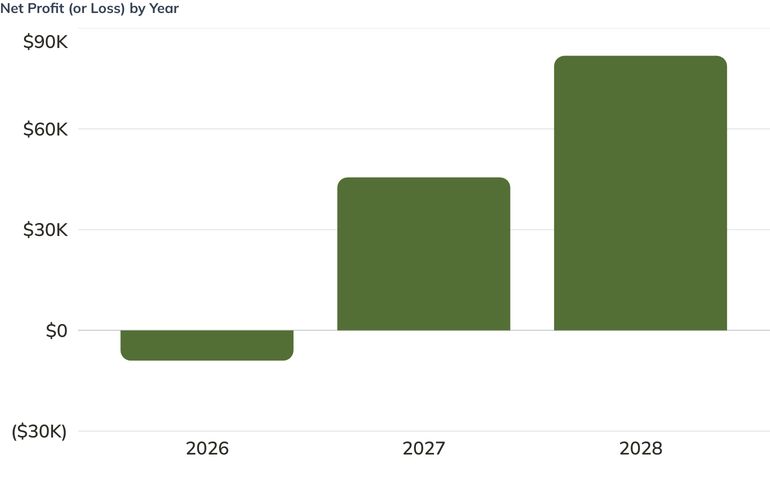
Financial Considerations Concrete Installation expects a modest operating loss in its first year as it invests in equipment, staffing, and its government and commercial contract pipeline, followed by a return to profitability in Year 2 and strong margin growth by Year 3. Despite initial outlays in cash to fund equipment purchases and promote sales, the founders have structured start-up funding to cover the launch period. Revenue is expected to grow steadily as the company builds its government and commercial contract pipeline, with the detailed forecast set out in the Financial Plan.
Mission
The mission of Concrete Installation is to provide quality service at competitive pricing.
Opportunity

Problem Worth Solving
Complex construction projects increasingly require sophisticated formwork systems that can adapt to non-standard configurations — Y-walls, shafts, circular walls, and other specialized forming requirements. General contractors and concrete subcontractors often struggle to find local providers who can design, manufacture, and deliver complete custom formwork packages on tight schedules.
The concrete work industry is fragmented, with over 30,000 U.S. establishments averaging less than $1 million in annual sales. Many competitors lack the engineering expertise and equipment inventory to handle the most demanding commercial and heavy construction projects. Project owners need formwork partners who can eliminate guesswork through detailed drawings, ensure OSHA-compliant safety standards, and deliver substantial labor and material savings through efficient structural forming methods.
Concrete Installation addresses this gap by combining versatile standard form systems with in-house design and manufacturing capability, allowing the company to serve commercial construction clients across foundations, parking structures, tilt-up, high-rise, and civil projects throughout its served market.
Our Solution
The Concrete Installation system can be adapted to almost any construction requirement that calls for forming. The company's expert staff has the capability to design and manufacture any custom component or accessory item that may be required to complete the formwork package.
Owners, developers, construction managers, general contractors, and concrete subcontractors have realized substantial savings in labor and material costs by using structural contours construction methods, systems and equipment. Applications include commercial and residential structures, bridges, educational projects, recreational projects, civil projects, tunnels, utility projects, environmental projects, and virtually every other type of concrete construction.
Concrete Installation's formworks will offer major advances, complete adaptability, and high strength-to-weight ratio, and all at cost effective prices. Assembly will be quick and easy. During form use, maintenance will be minimal. Concrete Installation will recommend, as a safety precaution, occasional inspection for bolts and nuts that may have loosened from handling.
The required formwork drawings that Concrete Installation will furnish to the contractor eliminate all guesswork. The company will specify the order of assembly and erection including the location of the strongbacks and joists, the location and actual loading of the form ties, location of all accessories and advise clients of the maximum allowable rate of concrete placement.
Concrete Installation will sell its services to clients in the area of commercial construction.
Applications
The following applications are uses for Concrete Installation's services:
- Foundations
- Parking Lots
- Parking Garages
- Low Rise/Tilt-Up
- High Rise
- Flowable Fill/Soil Displacement
- Retaining Walls
Market Overview
Industry Statistics – Concrete Work
Special trade contractors primarily engaged in concrete work, including foundation, structural, and formwork installation for commercial, residential, and civil projects.
- Estimated number of U.S. establishments: 33,500
- Number of people employed in this industry: 265,000
- Total annual sales in this industry: $52 billion
- Average employees per establishment: 8
- Average sales per establishment: $1.6 million
Establishments primarily engaged in manufacturing ready-mix concrete delivered to a purchaser in a plastic and unhardened state:
- Estimated number of U.S. establishments: 6,100
- Number of people employed: 95,000
- Total annual sales: $38 billion
- Average employees per establishment: 16
- Average sales per establishment: $6.2 million
Market Growth and Segmentation
Commercial and heavy construction activity remains strong heading into 2026, supported by continued public infrastructure funding, warehouse and data center development, and steady demand for institutional and municipal projects. Residential construction has cooled from its post-pandemic peak but remains a stable secondary market for regional formwork providers.
Total market potential of the three targeted market segments (commercial construction, residential construction, and heavy/civil construction) is estimated at a combined Year 1 potential of $210,000, growing to roughly $275,000 by Year 5 at an approximate 7% CAGR, driven primarily by continued growth in commercial and civil project volume.
Competitors
The concrete formwork and special trade contracting market includes thousands of small regional operators, many focused on residential or basic commercial work rather than complex engineered form systems. Concrete Installation competes against:
- Regional concrete subcontractors — local firms handling foundations and basic forming, typically without custom design and manufacturing capability.
- National formwork equipment suppliers — larger companies offering rental systems and engineering support, often at higher price points and with less local responsiveness.
- General contractors with in-house forming crews — some large builders self-perform basic formwork, though they still outsource specialized or complex packages.
Concrete Installation's competitive edge lies in combining sophisticated formwork solutions with local service, OSHA-approved safety practices, and the ability to design and manufacture custom components. The company's strategy of securing city, county, state, and federal government contracts, along with alliances among industry leaders, helps differentiate it from smaller operators who lack the capacity or credentials for larger commercial projects.
Execution
Market Plan Overview
The company plans to rapidly develop marketing alliances with industry leaders and pursue new sales of its services to residential and commercial builders. The market strategy is to capitalize on Concrete Installation's alliances by securing city, county, state, and federal government contracts.
Concrete Installation will develop sophisticated formwork solutions for some of the most complex construction projects being done today. The company will adopt a corporate strategy dedicated to improving the performance of activities on the critical path of its customers' projects, building on innovative equipment, design engineering expertise, and project and site management within an environment of safety excellence.
Marketing Strategy
Concrete Installation plans to reach its markets primarily through direct sales, relationship selling, and subcontractor partnerships, supported by a digital-first marketing presence. The company will maintain a project portfolio website with case studies and photos of completed formwork packages, an active company profile on LinkedIn to reach general contractors and project owners, and listings on construction bid platforms such as ConstructConnect and BuildingConnected to surface new commercial and government bid opportunities.
For the first six months of operation, marketing is budgeted at approximately $11,000, covering website development, targeted digital advertising to general contractors and developers, and trade association memberships. On an ongoing basis, the company plans to budget marketing expenses at less than 10% of revenues.
Marketing activities include direct outreach to general contractors and construction managers, participation in regional trade association events and bid conferences, digital advertising targeted at commercial and public-sector project owners, and a referral program that rewards repeat business from contractors and subcontractors.

The Strategic Growth Leader
VP of Operations
Responsible for the bottom-line profitability of multi-million dollar infrastructure and commercial projects across Oklahoma. He seeks partners who can provide a competitive advantage through labor savings and sophisticated engineering to win high-stakes bids like data centers and bridges.
Priorities
- Maximizing ROI on labor and material spend
- Meeting aggressive 2026 infrastructure deadlines
- Securing large-scale government and federal contracts
Evaluation Criteria
- Documented labor and material cost savings
- Firm's ability to handle complex geometries like Y-walls and shafts
- Financial stability and capacity to scale for large projects
Pain Points
- Rising labor costs for skilled concrete finishers in the region
- Project delays caused by unreliable, low-tech subcontractors
- High material waste from inefficient, non-standard formwork methods
Common Objections
- Is the initial cost of custom formwork offset by field labor savings?
- Can a local firm in Sulphur handle the volume of a 500MW data center project?
“I don't just buy formwork; I buy a guarantee that we will hit our milestones without blowing the labor budget.”

The Field Efficiency Advocate
Senior Site Superintendent
Manages day-to-day execution on-site and is directly responsible for safety and schedule. He advocates for solutions that are easy for his crews to assemble and meet strict OSHA standards to avoid rework and injuries.
Priorities
- Maintaining high safety standards and OSHA compliance
- Minimizing on-site modifications and manual rework
- Keeping the project on a tight daily schedule
Evaluation Criteria
- Ease of assembly and disassembly for field crews
- Built-in safety features of the formwork system
- Availability of local expert support for on-site troubleshooting
Pain Points
- Shortage of skilled labor capable of handling complex manual forming
- Safety hazards created by makeshift or low-quality formwork
- Downtime caused by missing accessories or poorly designed components
Common Objections
- Will my guys need specialized training to use these sophisticated systems?
- How does the equipment hold up under heavy-duty civil construction use?
“I want a system that goes up fast, keeps my guys safe, and doesn't require us to field-engineer a solution every time we hit a circular wall.”

The Precision Estimator
Chief Estimator
Evaluates the technical viability and cost-effectiveness of specialized construction methods during the bidding phase. He relies on digital modeling to ensure that complex project requirements are feasible and within budget before making a recommendation.
Priorities
- Ensuring bid accuracy for complex concrete structures
- Reducing technical risk through digital modeling and planning
- Identifying vendors with in-house custom manufacturing capabilities
Evaluation Criteria
- Quality and detail of digital modeling and assembly drawings
- Versatility and adaptability of the standard form systems
- Technical expertise of the vendor's engineering staff
Pain Points
- Inaccurate quotes from fragmented regional operators lacking engineering depth
- Difficulty finding formwork that adapts to non-standard configurations
- Manual planning processes that lead to on-site assembly errors
Common Objections
- How quickly can you turn around custom components if site specs change?
- Does your digital modeling integrate with our existing BIM software?
“If the formwork isn't planned perfectly in the digital phase, we are just burning money once the concrete starts pouring.”
Sales Plan
Concrete Installation plans to use a direct sales force, relationship selling, and subcontractors to reach its markets. These channels are most appropriate because of time to market, reduced capital requirements, and fast access to established distribution channels.
The company will capitalize on marketing alliances by securing city, county, state, and federal government contracts, as well as residential and commercial builder relationships.
Customer service is a pro-active partnership. On the job site, with the help of a newly integrated technology system and a well-trained staff, Concrete Installation will maintain excellent control over inventory, shipments/deliveries, damage loss, and invoicing. The company will provide a highly qualified and well-prepared labor force, ensuring that schedules and deadlines are met and worker safety remains a top consideration.
Locations and Facilities
Concrete Installation is an Oklahoma Limited Liability company with principal offices located in Sulphur, Oklahoma. The company operates from this central location to serve commercial and heavy construction clients throughout its regional market.
Facilities support formwork design, equipment storage, and project coordination. Start-up requirements include $500 in initial rent plus ongoing monthly rent budgeted at $500/month in Year 1, rising modestly in subsequent years as operations expand. Equipment and form systems — including access scaffolding, concrete shoring frames, and forming equipment — are maintained on-site and deployed to customer job sites as projects require.
The company invests in long-term assets to support growing project volume, with equipment purchases of $105,000 in Year 1, $100,000 in Year 2, and $100,000 in Year 3 to maintain competitive capacity and safety standards across its served markets.
Technology
Concrete Installation runs its job-site and back-office operations on a small stack of purpose-built construction tools rather than general-purpose software, so the team spends its time on projects instead of administration:
- Project management and field coordination — Procore to track active projects, punch lists, and daily field reports across every job site.
- Formwork design and drawings — Autodesk Construction Cloud to produce and revise the formwork drawings that specify assembly order, strongback and joist placement, form tie loading, and maximum concrete placement rates, eliminating guesswork for field crews and contractors.
- Inventory and equipment tracking — a barcode-based equipment tracking system to monitor formwork components, scaffolding, and shoring equipment across multiple active projects, flagging damage and loss before it becomes a costly surprise.
- Scheduling and dispatch — route and crew scheduling software to coordinate equipment shipments and deliveries to job sites on time.
- Invoicing and accounting — QuickBooks Online for billing, receivables, and payroll tax tracking.
Field supervisors use mobile devices on-site for real-time updates and troubleshooting, so issues get resolved the same day rather than at the next in-person check-in. AI-assisted takeoff and estimating tools are used during bidding to speed up quantity calculations on complex forming packages, letting the team turn around competitive bids faster than smaller regional competitors.
Equipment and Tools
Concrete Installation's standard form systems are versatile and completely adaptable to a variety of configurations such as Y-walls, shafts, and circular walls. The company's expert staff has the capability to design and manufacture any custom component or accessory item that may be required to complete the formwork package.
Equipment includes access scaffolding, concrete shoring frames, and forming equipment — all maintained to OSHA standards. Start-up equipment investment includes $14,000 in expensed equipment plus $20,000 in long-term assets at launch, with ongoing equipment purchases planned throughout the forecast period to support growing project volume.
Milestones
Complete start-up funding and launch Complete $365,000 funding round ($15,000 owner + $350,000 investor) and launch operations from Sulphur, Oklahoma offices. | Barry Newman Jan 31, 2026 |
Launch promotional campaign Launch digital-first marketing presence including project portfolio website, LinkedIn company profile, and construction bid platform listings, backed by the initial $11,000 marketing budget. | Sales Team June 30, 2026 |
Secure first government contract Secure first city, county, or state government formwork contract through direct sales and industry alliances. | Barry Newman Sept 30, 2026 |
Complete Year 1 equipment purchases Complete $105,000 in long-term asset purchases including formwork systems, scaffolding, and shoring equipment to support growing project volume. | Operations Dec 31, 2026 |
Key Metrics for Success
Concrete Installation tracks the following key metrics to measure performance against its growth and profitability goals:
Metric | Year 1 (2026) | Year 2 (2027) | Year 3 (2028) |
|---|---|---|---|
Net profit margin | -2% | 6% | 9% |
Gross margin | 36% | 38% | 39% |
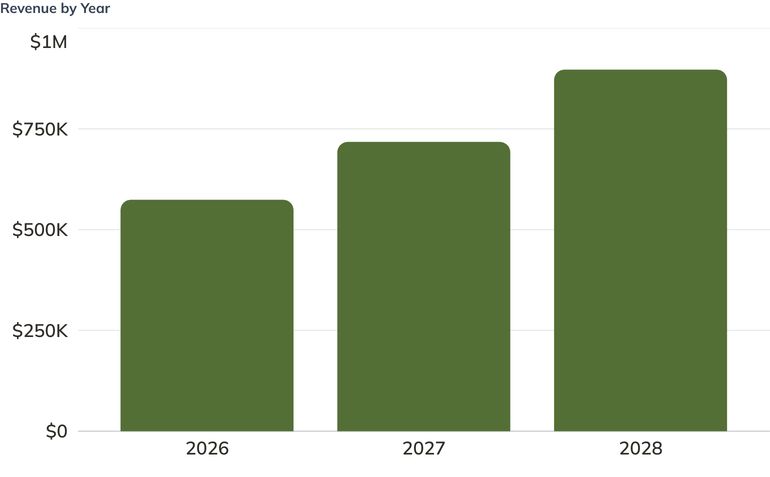
Revenue | $574,000 | $717,500 | $896,876 |
Net profit | -$8,995 | $45,549 | $81,723 |
Break-even target: Monthly revenue break-even of approximately $49,900 in Year 1, based on roughly 64% average variable cost and estimated monthly fixed costs (including a fully staffed administrative team) of approximately $18,100.
Operational targets:
- Maintain OSHA-compliant safety standards across all job sites.
- Control advertising and promotion expenses at less than 10% of revenues after the initial six-month launch campaign.
- Grow government and commercial contract pipeline through direct sales, relationship selling, and industry alliances.
- Achieve year-over-year revenue growth of roughly 25% in Years 2 and 3 through expanded formwork capacity and market share gains.
- Reach sustained net profitability by Year 2, as administrative overhead is fully absorbed by a growing contract pipeline.
Regulatory Requirements
Concrete Installation will be committed to conducting business in a manner that protects the health and safety of all employees, customers, and persons living in the community where it operates. The company will comply with current Health Administration and Occupational Health and Safety laws.
Each employee will fully comply with established safety rules. Concrete Installation will ensure that products used on job sites — from access scaffolding to concrete shoring frames and forming equipment — are safe and OSHA approved. Accident prevention is the cornerstone of the company's safety commitment.
Company
Ownership and Structure
Concrete Installation is an Oklahoma Limited Liability company, with principal offices located in Sulphur, Oklahoma.
The company requires $365,000 in total funding to launch and sustain operations through its Year 1 ramp-up, covering start-up expenses and assets plus a working capital buffer to carry the business through its slower early-2028 cash point before the contract pipeline fully matures. Planned investment includes $15,000 from Barry Newman and $350,000 from an investor, for total planned investment of $365,000.
Management Team
The company's management philosophy will be based on responsibility and mutual respect. Concrete Installation will maintain an environment and structure that will encourage productivity and respect for customers and fellow employees.
Concrete Installation will be responsible to its employees throughout the state. Everyone will be considered as an individual and the company will respect their dignity and recognize their merit. Employees will be encouraged to have a sense of security and pride in their jobs.
Concrete Installation's management is highly experienced and qualified. Mr. Barry Newman leads the management team with over ten years of experience in the construction industry. Besides direct labor costs, other labor costs include Mr. Newman's assistant and a part-time accountant (three total personnel in Year 1).
Employees will be committed to providing a safe work environment, supplying safe products for customers, continuously improving the safety program, and monitoring workplaces to enforce safe work practices.
Advisors
Concrete Installation does not maintain a formal advisory board at launch. The company relies on experienced internal leadership led by Barry Newman, supplemented by outside consultants engaged during start-up ($1,000 budgeted) and a part-time accountant supporting financial operations.
As the company grows and pursues government contracts, Concrete Installation may add advisors with expertise in commercial construction bidding, OSHA compliance, and regional contracting regulations to strengthen its competitive position.
Financial Plan
Revenue
Need impressive charts? Discover the simplest way to create detailed graphs for your business plan.Create your own business plan
Expenses & Costs
Need real financials? We recommend using LivePlan as the easiest way to create financials for your own business plan.Create your own business plan
Profitability
Need real financials? We recommend using LivePlan as the easiest way to create financials for your own business plan.Create your own business plan
Use of Funds
Start-up funding will be used as follows:
Start-up Expenses ($33,000): Legal ($500), stationery ($100), brochures ($500), consultants ($1,000), insurance ($15,000), rent ($500), expensed equipment ($14,000), and other ($1,400).
Start-up Assets ($182,000): Cash required ($132,000), other current assets ($30,000), and long-term assets ($20,000).
Working Capital Buffer ($150,000): Additional cash reserve held to cover payroll and overhead during the ramp-up period before commercial and government contract revenue reaches a steady run rate.
Ongoing capital expenditures include purchase of long-term assets ($105,000 in Year 1, $100,000 in Year 2, and $100,000 in Year 3) to support equipment and formwork capacity as project volume grows.
Sources of Funds
Total funding required at launch is $365,000, comprised of:
- Barry Newman (owner): $15,000 planned investment
- Investor: $350,000 planned investment
These equity investments fund $33,000 in start-up expenses, $182,000 in start-up assets (including $132,000 cash, $30,000 other current assets, and $20,000 long-term assets), and a $150,000 working capital buffer to keep cash comfortably positive through the Year 1–2 payroll and overhead ramp-up.
Debt and interest: The forecast assumes no long-term borrowing. Interest expense is $0 across all three years. There are no principal or interest payments to report. All growth is funded through retained earnings and the initial equity investment.
Projected Statements
Key Assumptions
The following assumptions underpin Concrete Installation's financial forecast:
Assumption | Value |
|---|---|
Plan period | January 2026 – December 2028 (3 years) |
Average percent variable cost | 64% of revenue (direct costs) |
Corporate income tax | Not modeled — Oklahoma LLC (pass-through entity) |
Interest rates | No borrowing planned |
Collection days | Approximately 51–57 days |
Payment days | Approximately 26–27 days |
Dividends | None planned during forecast period |
Personnel | 3 roles: Owner/General Manager (Barry Newman), Office Manager/Executive Assistant, and a part-time bookkeeper/accountant, with wages benchmarked to Oklahoma regional averages and owner compensation growing from $65,000 (Year 1) to $95,000 (Year 3) as the business reaches sustained profitability |
Equipment purchases | $105,000 (Year 1), $100,000 (Year 2), $100,000 (Year 3) |
Marketing budget | Approximately $40,000 (Year 1, including initial launch campaign); ongoing at less than 10% of revenue |
Funding assumptions: Total launch funding of $365,000 from Barry Newman ($15,000) and an investor ($350,000), with no long-term debt. Starting cash balance of $132,000 on launch date, plus a working capital buffer sized to keep cash positive through the Year 3 equipment-purchase cash dip.
Revenue growth: Approximately 25% year-over-year growth in All construction work revenue, driven by expanded government and commercial contract pipeline.
Frequently Asked Questions
A building construction business plan should cover your niche and specialization, target market segments, competitive positioning, and funding plan. Concrete Installation's plan, for example, covers its specialized formwork engineering and custom-manufacturing capability, its strategy of pursuing government and commercial contract pipelines, its positioning against regional subcontractors and national equipment suppliers, and a $280,000 all-equity funding plan.
Concrete Installation raised $280,000 in total start-up funding entirely through equity: $15,000 from owner Barry Newman plus $265,000 from an outside investor, with no debt. That covers $33,000 in start-up expenses, $182,000 in start-up assets including formwork equipment, and a $65,000 working capital buffer to keep cash comfortably positive through the year one and two payroll and overhead ramp-up.
Yes — construction and formwork contractors typically need state contractor licensing, OSHA-approved safety certification, and general liability and equipment insurance. This matters even more for Concrete Installation given its focus on winning city, county, state, and federal government contracts, which typically require additional bonding and certification beyond what a purely residential or small commercial contractor needs.
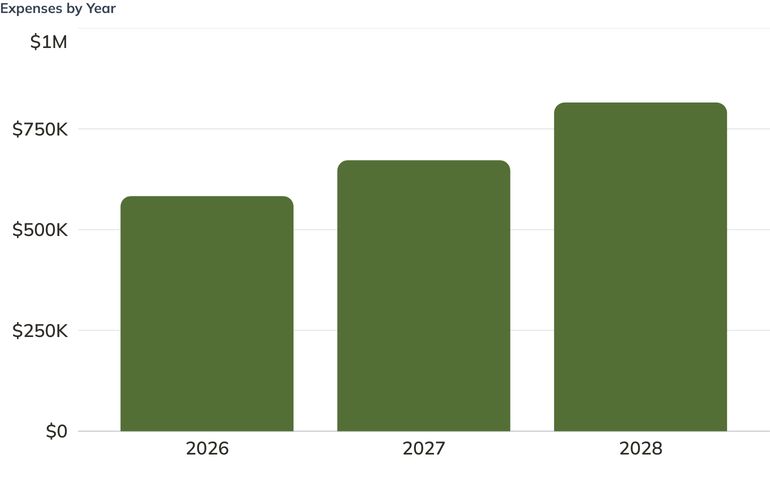
Concrete Installation earns revenue from its full range of specialized concrete formwork and construction work across commercial and residential structures, bridges, tunnels, utility projects, and civil infrastructure. Its five-year forecast projects about $2.19 million in total revenue against roughly $2.07 million in expenses.
Concrete Installation's plan expects a modest operating loss in year one while it invests in equipment, staffing, and its government and commercial contract pipeline, returning to profitability in year two and building strong margin growth by year three. Its five-year forecast shows about $118,277 in cumulative net profit on roughly $2.19 million in revenue.
Regional concrete subcontractors typically handle basic foundations and forming without custom design capability, while national formwork equipment suppliers offer engineering support at higher price points with less local responsiveness. Concrete Installation combines sophisticated, digitally modeled custom formwork engineering — adaptable to Y-walls, shafts, and circular walls — with local service and a strategy of pursuing government contracts and industry alliances that smaller regional operators typically lack the capacity or credentials to win.
Concrete Installation serves owners, developers, construction managers, general contractors, and concrete subcontractors across commercial and residential structures, bridges, educational and recreational projects, tunnels, utility projects, and civil infrastructure. City, county, state, and federal government agencies are a key target segment given the company's strategy of securing public-sector contracts.
Concrete Installation's standard form systems are versatile and fully adaptable to configurations like Y-walls, shafts, and circular walls, well beyond basic straight-wall forming. The company's engineering staff also designs and manufactures custom components and accessory items using digital modeling to plan assemblies before they ever reach a job site — a capability most regional concrete subcontractors don't have in-house.

Business Plan Outline
Start your plan