





Construction Business Plan


Business Plan Summary
This construction business plan example features Fosse Commercial Contractors LLC, a Houston, Texas general contractor transitioning from residential to commercial construction. It covers Fosse's office-building-first segment strategy, its material cost and tech-enabled bidding advantages against three named Houston competitors, and a $131,000 funding plan supporting the commercial transition. Use it as inspiration for your own plan, and read our guide on how to start a construction company for step-by-step advice. See also our building construction business plan example for another perspective. Download a free business plan template to get started, or browse more business plan examples.
Fosse Commercial Contractors LLC
Executive Summary
Problem
Houston's commercial market is expanding faster than the area's licensed, bonded general contractors can keep up with, leaving businesses waiting months for the office buildouts, warehouses, restaurants, and public-works facilities they need to open on schedule.
Solution
Fosse Commercial Contractors (FCC) delivers design coordination, site preparation, accurate cost estimating, and construction, repair, and alteration services for large-scale commercial projects — from office buildings and warehouses to restaurants and special-use facilities — backed by a decade of Houston construction experience and a licensed, bonded, and insured team.
Market
Houston's commercial construction market has grown steadily for several years and is expected to keep expanding through at least 2030, driven by continued corporate relocations and population growth across the metro. We're prioritizing office-building construction, the fastest-growing and highest-margin segment of commercial work, while also serving the restaurant segment, the special-facilities segment (gas stations, theaters, and similar), and general commercial clients.
Competition
We compete against three established Houston general contractors — TNT General Contractors, Texas Specialty Construction, and Polanski Construction — each with a solid reputation for customer satisfaction. Houston's construction demand currently outpaces the supply of qualified commercial GCs, giving us room to win market share without a price war.
Why Us?
Winning commercial work comes down to the bid: design quality, material sourcing, project timeline, and cost. We compete on all four. Our General Projects Manager's supplier relationship with McHoughton's Lumber gives us a material-cost edge few competitors can match, and we pair it with tech-enabled estimating and bid tracking (PlanSwift for takeoffs, BuildingConnected for bid sourcing), a clean safety record, and full bonding and licensing — the baseline commercial clients now expect before they'll even consider a bid.
Expectations
We expect a transition year as we shift our client base from residential to commercial work, a Year 2 that turns profitable as we bring the team up to real Houston-market wages and step up our marketing and insurance coverage, and continued margin improvement in Year 3 as we build a commercial project backlog, add a second job superintendent, and gain purchasing leverage at scale.
Forecast
Fosse has only a small amount of debt and intends to stay that way. We expect to see increased profits from our market shift efforts by the end of Year 2. Over the next three years we expect lower profits as we make inroads into this tough market. We estimate that we will be able to reduce marginal costs and increase overall profitability by Year 3 or Year 4 as we grow and take advantage of economies of scale.
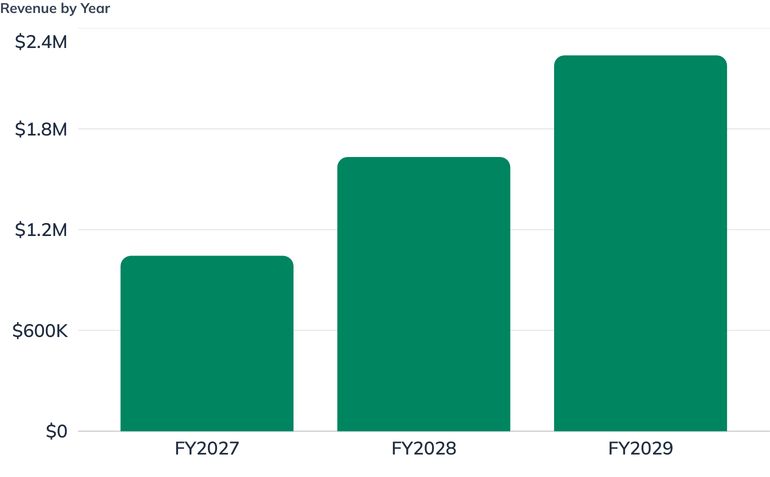
We also think we can grow. For this next year we intend to significantly increase overall revenues to just over $1.0M, from $572K this past year. We have the market, the people, and the capabilities. It's time to grow.
However, growth is expensive. We are prepared to inject new capital to support losses for most of this first year. We can turn a profit for years 2 and 3.
Financial Highlights by Year
Year 1 | Year 2 | Year 3 | |
|---|---|---|---|
Revenue | $1,044,061 | $1,632,394 | $2,237,388 |
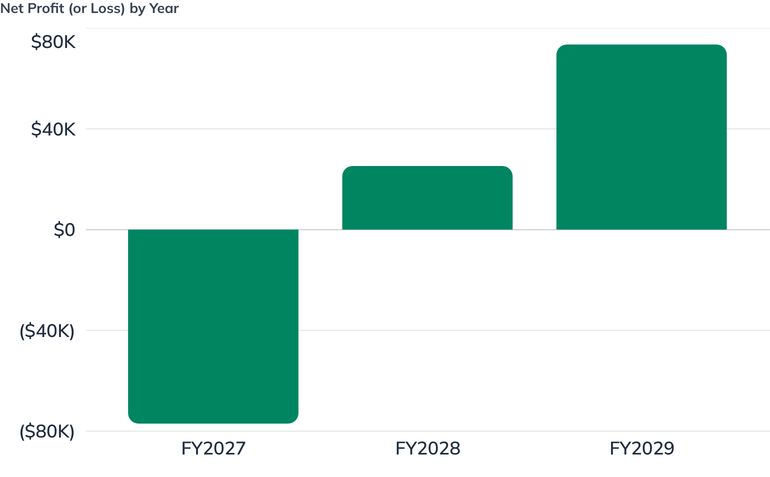
Net Profit | ($76,981) | $25,257 | $73,447 |
Net Margin | -7% | 2% | 3% |
Opportunity

Problem Worth Solving
Houston's commercial real estate market is expanding faster than the supply of qualified, bonded general contractors who can deliver office buildings, warehouses, restaurants, and public-works facilities on schedule. Businesses that need commercial space built or renovated routinely wait months longer than they'd like because there aren't enough contractors positioned to handle large-scale, multi-trade projects.
Two structural problems compound the shortage. First, the bidding and permitting process for commercial work is more demanding than residential — clients expect a bonded, insured, and licensed contractor who can produce accurate estimates, a compliant safety program, and a realistic schedule before they'll even shortlist a bid. Many smaller, residential-focused contractors aren't set up to clear that bar. Second, commercial construction carries pronounced seasonality: contract volume and production drop off sharply during the winter months, creating real cash-flow risk for contractors without a diversified project backlog.
Fosse is built to solve both problems. We already hold the licensing, bonding, and insurance commercial clients require, and we're structuring our project mix — office buildings, restaurants, and special facilities — to smooth out the seasonal dips that hurt less diversified competitors.
Our Solution
Fosse Commercial Contractors LLC is a Houston-area construction company formed from the merger of Fosse Painting & General Construction and West General Contractors. We've operated in the Houston market for the past ten years, building our reputation on small and large-scale construction, repair, and alteration projects that began in residential contracting.
With Houston's commercial market booming and residential margins compressing, we're shifting our focus toward larger commercial clients: office buildings, warehouses, large apartment complexes, restaurants, special-use facilities, and public works. This plan lays out how we make that transition and build a defensible position in a highly competitive market.
We compete by offering design coordination, site preparation, accurate cost estimating, and construction, repair, and alteration services built around three things commercial clients now treat as table stakes: a licensed, bonded, and insured contractor of record; a documented safety program; and technology-enabled estimating and project tracking — we use PlanSwift for digital takeoffs, Procore for project management, and BuildingConnected to source and manage bid invitations — that lets us turn around accurate bids faster than smaller competitors still working from spreadsheets.
Market Overview
Market Size & Segments
Houston's commercial construction market has grown for several consecutive years and is expected to keep expanding through at least 2030, driven by continued corporate relocations, population growth, and infrastructure investment across the metro. Industry directories put the number of active general contracting and specialty trade firms across the Houston metro at more than 6,500 — our addressable universe of potential competitors and subcontractor partners.
We're concentrating on the clients that provide the greatest margin — those needing office building construction, the fastest-growing segment of all the commercial clients requiring our services. The other categories we serve include:
- Restaurant segment
- Special facilities segment (gas stations, theaters, and similar)
- General segment — all other potential commercial clients
Target Market
Since office building construction carries the highest average profit margin, we focus most of our marketing and servicing capacity toward these clients. These projects tend to be the largest in scope, land use, and cost, and the clients tend to be the most sensitive to completion timelines.
We're built to serve them through a well-established, expedited permitting process; disciplined cost accounting and supply management (tracked in QuickBooks Online); and hands-on, comprehensive project management that draws on Fosse's decade of experience in the Houston market.
Competitors
Current Alternatives
We compete against three established general contractors in the Houston commercial market:
- TNT General Contractors
- Texas Specialty Construction
- Polanski Construction
Each has a solid reputation for customer satisfaction and targets the same client base we do. Houston's construction demand currently outpaces the supply of qualified commercial GCs, which gives us room to win contracts without competing purely on price.
Our Advantages
In commercial construction, contracts are won through the bid: cost, project management capability, timeline, and reputation. Fosse competes on several fronts:
- Material cost advantage — our General Projects Manager, David West, has a long-standing supplier relationship with McHoughton's Lumber, giving us preferred pricing most competitors can't access.
- Faster, more accurate bids — we use PlanSwift for takeoffs and BuildingConnected to source and track bid invitations, letting us turn around detailed estimates faster than competitors still bidding from spreadsheets.
- Bonded, licensed, and insured — we carry the surety bonding and general liability coverage commercial clients require before they'll shortlist a contractor.
- Safety record — a clean safety history and OSHA-compliant jobsite practices, increasingly a deciding factor for commercial and public-works clients screening bidders.
With demand outstripping supply in this market, our edge isn't just winning bids — it's being able to say yes to more of them than our competitors can staff for.
Execution
Market Plan Overview
Fosse markets itself through a mix of relationship-driven and digital channels:
- Referral system with local businesses and past clients
- Digital bid-sourcing platforms (BuildingConnected and regional plan rooms) to find and track new commercial opportunities
- Trade association membership (Associated General Contractors of Texas) for early visibility into projects going out to bid
- Pre-existing relationships with local real estate developers and brokers
Keys to Success
The Houston commercial construction market is booming. To build a defensible position in this environment, Fosse is concentrating on:
- Securing at least five large-scale commercial contracts over the next three years
- Expanding into adjacent Houston-area submarkets to sustain profitability as we scale
- Committing $14,400/year to marketing — a significant step-up from our residential-era budget — to build visibility in the office-building segment as we rebrand toward commercial clients

The Risk-Averse Visionary
VP of Real Estate Development
Responsible for high-stakes corporate relocations and large-scale office expansions in the Houston metro. They focus on long-term ROI and protecting the organization from the legal and financial risks associated with non-compliant contractors.
Priorities
- Ensuring 100% compliance with bonding and insurance requirements
- Meeting strict move-in deadlines for corporate headquarters
- Mitigating financial risk through accurate, transparent cost accounting
Evaluation Criteria
- Proven track record with Fortune 500 relocations
- Total bonding capacity and insurance aggregate limits
- Demonstrated ability to deliver shell construction within $40-$50 per square foot
Pain Points
- Massive operational costs incurred by construction delays
- Difficulty finding contractors with the financial capacity for $100M+ projects
- Rising labor costs impacting the total project budget
Common Objections
- Concerned about the contractor's ability to scale labor during peak demand
- Worried that seasonal dips in the contractor's other projects might impact their specific timeline
“We are moving thousands of employees to Houston; a three-month delay isn't just a nuisance, it's a multi-million dollar failure.”
The Timeline Driver
Senior Operations Manager, Industrial Logistics
Manages the rapid expansion of warehouse and distribution space to keep up with Houston's 16.7 million square foot industrial pipeline. They need a reliable partner who can handle the day-to-day headaches of construction so they can focus on logistics strategy.
Priorities
- Minimizing construction downtime to get facilities operational faster
- Coordinating complex multi-trade schedules for specialized cold storage or PEMB installations
- Maintaining consistent project momentum regardless of seasonal industry trends
Evaluation Criteria
- Hands-on project management and frequency of site updates
- Specific experience with PEMB and industrial warehouse construction costs
- Strength of the contractor's local subcontractor network in Houston
Pain Points
- Managing too many fragmented subcontractors instead of one reliable GC
- Seasonal contractor slowdowns that disrupt the supply chain rollout
- Lack of real-time communication regarding site progress and trade coordination
Common Objections
- How do you ensure your subcontractors stay on schedule during the winter months?
- We've been burned by contractors who over-promise on their ability to manage multiple trades simultaneously.
“I need a partner who owns the whole site, from the first permit to the final inspection, so I can focus on our logistics strategy.”

The Process Guardian
Director of Pre-Construction & Compliance
Acts as the primary filter for all general contractor bids, ensuring every partner meets the rigorous technical and safety standards required for commercial work. They have a deep understanding of the Houston permitting landscape and reject any firm that lacks professional documentation.
Priorities
- Streamlining the expedited permitting process with the City of Houston
- Verifying the robustness of the contractor's safety program
- Standardizing bid packages for easier comparison across multi-trade projects
Evaluation Criteria
- Quality and detail of the initial bid and safety documentation
- Experience with Houston-specific building codes and permit offices
- Use of professional project management and accounting software like QuickBooks Online
Pain Points
- Wasting time on bids from residential-focused contractors who lack commercial licensing
- Inaccurate estimates that lead to change-order friction later in the project
- Permitting bottlenecks that stall project starts for months
Common Objections
- The estimate seems too low to be realistic given current material price forecasts
- Doubtful that the contractor can manage the complexity of a multi-trade public-works facility
“If a contractor can't produce a compliant safety program and a realistic schedule during the bid, they won't survive the actual build.”
Sales Plan
The most critical part of sales isn't marketing — it's the bidding process, in which contractors compete on design, service, material quality, project timeline, and cost. The contractor offering the best combination of these variables is the most likely to win the contract.
Detailed project planning — supply agreements, labor needs, subcontractor commitments, and presentation — is what wins bids. We're standardizing this process across every contract: a consistent bid package built with PlanSwift and tracked through BuildingConnected, with an emphasis on quality, timeliness, and cost discipline to outbid our competitors on the merits, not just price.
Locations and Facilities
Fosse Commercial Contractors operates from its principal office in the Houston, Texas metropolitan area, serving clients throughout Houston and its suburbs.
We hold a General Contractor's license in the state of Texas and coordinate active job sites across the region from our Houston office. As commercial project volume grows, we'll add job superintendents and project managers to supervise multiple concurrent sites, and will evaluate a satellite office if we expand into adjacent submarkets.
Technology
Fosse relies on purpose-built construction software to support the cost accounting, supply management, and project management our office-building clients expect on tight timelines:
- PlanSwift for digital takeoffs and estimating
- Procore for project management, daily logs, and subcontractor coordination across active job sites
- BuildingConnected for sourcing and tracking bid invitations
- QuickBooks Online for job costing, invoicing, and general bookkeeping, managed by our office manager
Standardizing on these platforms lets every contract package include consistent supply agreements, labor plans, subcontractor schedules, and presentation materials — and gives management real-time visibility into job costs across every active site.
Equipment and Tools
Fosse maintains the equipment required for commercial construction, repair, and alteration work, from site preparation through finish work — including excavation and grading equipment, scaffolding, power tools, and jobsite safety equipment.
Capital from our expansion plan will go toward additional equipment needed to serve larger commercial contracts efficiently. Existing long-term assets (vehicles, tools, and jobsite equipment) are depreciated over their useful lives and support both our remaining residential work and new commercial projects.
Milestones
Plan vs. Actual Review — Q1 Complete Q1 plan vs. actual review of commercial market shift progress. | Management Jan 20, 2027 |
Ramp Up Marketing Budget Commit the full $14,400/year marketing budget to reach the commercial office-building segment. | Management Feb 24, 2027 |
Standardize Bidding Process Finalize standardized bidding and project planning process for all commercial contracts. | Management Mar 15, 2027 |
Secure First Office-Building Contract Secure first large-scale contract in the office-building segment — our fastest-growing, highest-margin priority target market — building on the general commercial work already underway since launch. | Management Mar 24, 2027 |
Plan vs. Actual Review — Mid-Year Mid-year plan vs. actual review of revenue growth and commercial market penetration. | Management June 23, 2027 |
Hire Job Superintendents Hire the additional job superintendent (0.5 FTE) as commercial project volume supports it in Year 3. | Management Apr 28, 2028 |
Key Metrics for Success
We're tracking the following as we shift into commercial construction:
- Large-scale contracts won per year — target at least five over three years
- Bid-to-win ratio — the share of commercial bids we submit that convert to signed contracts
- New construction mix — target over 50% of revenue from new construction versus repair/alteration work
- On-time, on-budget completion rate — the percentage of projects delivered within the client's approved schedule and budget
- Experience Modification Rate (EMR) — our OSHA safety benchmark; keeping our EMR at or below 1.0 keeps us competitive on bonding costs and bid eligibility
- Gross margin — maintain approximately 25% gross margin on commercial work
Regulatory Requirements
Commercial construction in Texas carries more regulatory overhead than residential work, and clients screen for it before they'll consider a bid. Fosse maintains:
- General Contractor's license issued by the State of Texas, covering the scope of commercial work we bid
- Surety bonding sized to our active project volume — required by most commercial and all public-works clients before award
- General liability and workers' compensation insurance meeting Texas requirements and typical commercial client minimums
- OSHA compliance program, including jobsite safety plans and an Experience Modification Rate (EMR) we track as a key metric (see Key Metrics for Success)
- Local building code and permitting compliance, coordinated through our established relationships with Houston-area permitting offices
Maintaining current bonding capacity and a clean safety record is as much a growth constraint as capital — larger contracts require larger bonds, and our safety record directly affects our bonding costs and bid eligibility.
Company
Ownership and Structure
Fosse is a Limited Liability Company registered in the state of Texas. Fosse Commercial Contractors, LLC is exclusively owned by Mr. Robert Fosse (50%) and his partner, David West (50%).
The company is expecting to alter to a Class C corporation chartered in Texas. This will create greater investment opportunities through the acquisition of investment capital from a limited number of shareholders.
Company History
Fosse Commercial Contractors, LLC began in the Houston area when Mr. Robert Fosse, who had worked in the residential construction business for ten years, began his own company, Fosse Painting and General Construction. For the next eight years the company grew slowly, working mostly on small scale residential projects while gaining a reputation for quality services and reliability.
The original company was merged with another small-scale local company, West General Contractors, and the company began to bid successfully for larger projects. The company's management concluded that the firm had grown sufficiently to alter its primary target market from the residential construction segment to the higher margin office and commercial construction segment.
Management Team
Fosse's management team consists of:
- Mr. Robert Fosse (CEO) — client relationships, bidding, and overall company management
- Mr. David West (General Project Manager) — project management, cost controls, supplier relationships, day-to-day project supervision, and labor relations
- Mrs. Janet Fosse (Office Manager) — client communication, invoicing, permitting, and bookkeeping
Salaries for these roles are benchmarked to the Houston market: a general/commercial construction project manager in Houston typically earns $85,000–$135,000, and we're targeting the lower-middle of that band as a smaller firm making the commercial transition. Office administration for a construction company runs roughly $45,000–$50,000 in Houston, and we're paying accordingly.
We're bringing on OSHA-certified job superintendents in step with commercial project volume: a part-time supervisor from day one (0.33 FTE, priced at a Houston superintendent's market rate), plus a second superintendent added in Year 3 once the business can support it (see Hire Job Superintendents milestone). Superintendents handle direct jobsite supervision, quality control, subcontractor scheduling, material delivery coordination, plan verification, and safety compliance. We also keep a small in-house crew of temporary/contract laborers — growing from roughly 1.5 to 2.5 FTE as volume increases — paid at the Houston market rate for construction labor, supplementing (not replacing) subcontracted trade labor already priced into our direct construction costs. Most of this flexible labor comes through Contractor-Temps, a nationwide temporary labor company, while supervisory and core roles stay in-house.
Personnel Plan
Role | Year 1 | Year 2 | Year 3 |
|---|---|---|---|
CEO | $42,000 | $55,000 | $70,000 |
Project Manager | $85,000 | $89,000 | $93,000 |
Office Manager | $48,000 | $49,500 | $51,000 |
Temporary Contractors (~1.5–2.5 FTE, Houston market rate) | $63,000 | $86,000 | $110,000 |
Job Supervisor (0.33 FTE) | $28,050 | $28,050 | $28,050 |
Additional Job Superintendent (0.5 FTE, added Year 3) | — | — | $46,000 |
Totals | $266,050 | $307,550 | $398,050 |
Advisors
Fosse doesn't yet have a formal board of advisors, but draws on a working network of outside expertise:
- A construction-focused CPA for job costing, tax planning, and cash-flow guidance through the seasonal swings common to commercial construction
- A surety/bonding agent who helps us size and secure the bonding capacity larger commercial contracts require
- A construction attorney for contract review, lien matters, and compliance with Texas licensing requirements
- Associated General Contractors of Texas membership, which connects us to peer contractors and early visibility into upcoming projects
As Fosse grows, we plan to formalize this network into a standing advisory board, with Charles Nunn of McHoughton's Lumber as a likely first member given his existing relationship with the company.
Financial Plan
Revenue
Need real financials? Explore a spreadsheet-free path to generating financial data for your business.Create your own business plan
Expenses & Costs
Need real milestones? Establish a clear path for your business with real-world examples.Create your own business plan
Profitability
Need actual charts? We recommend using LivePlan as the easiest way to create graphs for your own business plan.Create your own business plan
Use of Funds
We will use the influx of capital to expand into the commercial construction market and to carry us through the slower first year of the transition. There is a lot of opportunity to grow and be successful.
Specific uses include:
- Buy equipment needed for larger commercial projects
- Hire experts and job superintendents as contract volume grows
- Develop the company website to refocus our brand toward commercial clients
- Fund a $14,400/year marketing budget to reach office-building and commercial segments
- Maintain a working capital cushion to cover payroll and material costs during Year 1, before the commercial backlog is fully established
Sources of Funds
We will be using sales and cash from our already established business to expand, supplemented by:
- $112,000 owner investment (one-time equity contribution in Year 1)
- $49,000 business loan at 8% over 60 months for working capital
Together, this $161,000 in funding covers our equipment and hiring needs for the commercial transition — including staffing at real Houston-market wages for our project manager, office manager, and field crew, plus the second job superintendent we add in Year 3 — and gives us a real cash cushion through the slower first year and the seasonal winter dips common to this industry, rather than leaving us running on fumes while we build a commercial backlog.
Debt Service
Annual interest expense on the business loan: Year 1 is $3,344, Year 2 is $2,990, and Year 3 is $2,248, declining each year as the loan amortizes.
Fosse has only a small amount of existing debt and intends to stay manageable while funding the commercial market shift.
Projected Statements
Key Assumptions
We do not anticipate significant net profits until our 2nd year as we need time to penetrate the new commercial market. We plan on basing dividend payouts on overall performance and health of the company and may decide to retain earnings for future growth. As the business stabilizes, we're building in CEO compensation growth (from $42,000 in Year 1 to $70,000 by Year 3) to reflect improving profitability, rather than holding owner pay flat while margins improve.
Forecast Assumptions
Assumption | Value |
|---|---|
Gross margin on commercial work | 25% |
Direct costs | 75% of revenue |
Corporate income tax | 0% (pass-through LLC; loss in Year 1) |
Business loan | $49,000 at 8% over 60 months |
Owner investment | $112,000 one-time in Year 1 |
Equipment depreciation | $2,042/year on existing assets |
Interest expense | $3,344 (Y1), $2,990 (Y2), $2,248 (Y3) |
CEO compensation | $42,000 (Y1) → $55,000 (Y2) → $70,000 (Y3) |
Project Manager wage | $85,000–$93,000, benchmarked to the Houston commercial PM market ($85K–$135K) |
Office Manager wage | $48,000–$51,000, benchmarked to Houston construction admin pay (~$45K–$50K) |
Field labor wage | Benchmarked to the Houston construction-laborer market (~$42K/FTE/year) |
Job superintendent staffing | 0.33 FTE from Year 1 at ~$85K FTE-equivalent; +0.5 FTE added in Year 3 at ~$92K FTE-equivalent |
Revenue seasonality | Winter months (Dec–Feb) run below the yearly average; summer months (Jun–Jul) run above it |
Insurance | $14,400/year (general liability + workers' comp, sized for our bonding and commercial client requirements) |
Utilities | $2,760/year |
Sales and Marketing | $14,400/year — a deliberate step-up to build brand visibility for the commercial pivot |
Frequently Asked Questions
A construction business plan should cover local market demand, your competitive bid positioning, target project segments, and a funding plan. Fosse Commercial Contractors' plan, for example, documents Houston's commercial construction demand outpacing the supply of qualified general contractors, its bid advantages against three named local competitors, an office-building-first segment strategy, and a $161,000 funding plan supporting its shift from residential to commercial work.
Fosse Commercial Contractors is funding its residential-to-commercial expansion with $161,000 in new capital — an $122,000 owner investment plus a $49,000 business loan at 8% over 60 months — layered on top of sales and cash from its already-established residential business. That covers equipment, staffing at real Houston-market wages, and a cash cushion through its slower transition year and the seasonal winter dips common to the industry.
Yes — commercial general contractors typically need state contractor licensing, surety bonding, and general liability insurance, plus OSHA-compliant safety practices. Fosse Commercial Contractors' plan is explicit that full bonding, licensing, and insurance, along with a clean safety record, are baseline requirements commercial clients expect before they'll even consider a bid.
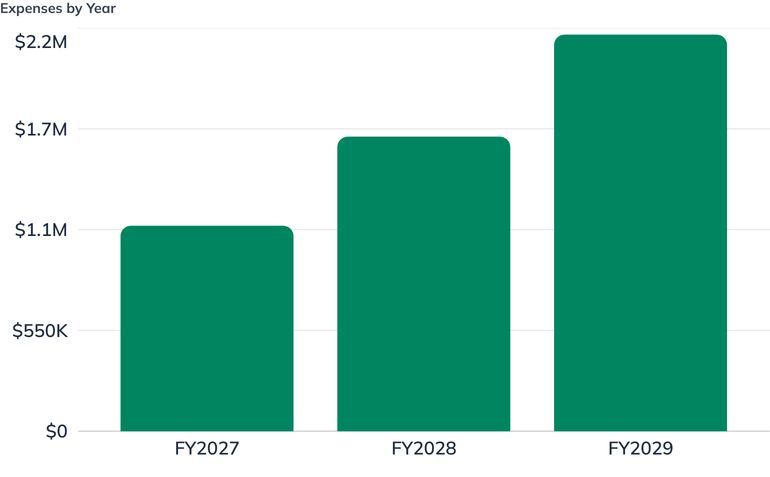
Fosse Commercial Contractors earns revenue entirely from commercial construction projects — office buildings, warehouses, restaurants, and special-use facilities like gas stations and theaters. Its five-year forecast projects about $4.91 million in total revenue against roughly $4.89 million in expenses.
Fosse Commercial Contractors projects a year-one transition-year net loss of about $76,981 (a -7% margin) as it shifts its client base from residential to commercial work and raises wages to real Houston-market levels, turning profitable in year two with about $25,257 in net profit (2% margin) and improving further to $73,447 by year three (3% margin) as it builds a commercial project backlog.
Fosse competes against three established Houston general contractors — TNT General Contractors, Texas Specialty Construction, and Polanski Construction — through a material cost advantage from General Projects Manager David West's long-standing supplier relationship with McHoughton's Lumber, plus tech-enabled bidding using PlanSwift for takeoffs and BuildingConnected for bid sourcing, letting it turn around estimates faster than competitors still bidding from spreadsheets. Full bonding, licensing, insurance, and a clean OSHA-compliant safety record round out its edge in a market where demand for qualified commercial GCs outpaces supply.
Fosse Commercial Contractors targets commercial clients needing office buildings — the fastest-growing, highest-margin segment it prioritizes — along with warehouses, restaurants, special-use facilities like gas stations and theaters, and public-works projects across the Houston metro area.
Houston's commercial construction market is growing faster than the supply of qualified, licensed, and bonded general contractors can keep up with, and commercial work offers materially better margins and backlog stability than residential projects. The plan grew last year's residential revenue of $572,000 into a year-one commercial transition target of just over $1 million, accepting a planned first-year loss as the price of making that shift.

Business Plan Outline
Start your plan