





Bakery Business Plan


Business Plan Summary
This bakery business plan example features Jolly's Java and Bakery (JJB), a from-scratch bakery in Vancouver, Washington selling artisan bread, pastry, and cake through a retail storefront with a full espresso bar and a wholesale program supplying independent cafes, restaurants, and grocers across the Vancouver–Portland metro. It covers market positioning across both channels, a $240,000 funding plan combining founder investment and an SBA loan, and three-year financial projections showing revenue growing from roughly $610,000 to over $920,000 as the business moves from a first-year loss to profitability. Use it as inspiration for your own plan, and read our guide on how to start a bakery for step-by-step advice. Download a free business plan template to get started, or browse more business plan examples.
Jolly's Java and Bakery
Executive Summary
Jolly's Java and Bakery
Opportunity
Vancouver, Washington's higher-income neighborhoods along the SR-500/I-5 corridor lack a scratch bakery that produces genuinely artisan bread, pastry, and cake — most local options are grocery-store bakery counters or coffee chains with reheated, centrally-baked goods. At the same time, the independent cafes, restaurants, and grocers scattered across the Vancouver–Portland metro have no local wholesale bakery they can rely on for consistent, high-quality bread and pastry, and instead patch together large-format distributors or bake in-house without the equipment to do it well.
Solution: Jolly's Java and Bakery (JJB) is a from-scratch bakery: breads, viennoiserie, cakes, cookies, and pastries baked fresh daily in our own production kitchen. We sell through two channels — a retail storefront with a full espresso bar for the walk-in customer, and a wholesale program that supplies daily-baked bread and pastry to independent cafes, restaurants, and grocers throughout the region. Coffee and espresso are a natural complement to the bakery case, not the center of the business.
Market: JJB serves three overlapping segments: local residents building daily and weekly bakery habits, wholesale accounts (cafes, restaurants, and independent grocers) that need a reliable local baked-goods supplier, and tourist and highway traffic drawn by storefront visibility. Washington's cool, wet climate keeps hot beverage and baked-goods demand strong most of the year, with steady foot traffic concentrated in the morning hours before 10 a.m.
Competition: Local alternatives are grocery-store bakery counters and national coffee chains, none of which offer scratch-baked quality at the volume or consistency JJB targets. On the wholesale side, most independent cafes and restaurants currently either bake in-house at small scale or buy from large regional distributors with limited flexibility and long lead times — leaving room for a responsive, quality-focused local wholesale bakery.
Why Us: JJB is owned and managed by two partners covering sales/marketing and finance/administration, supported by a dedicated head baker who runs day-to-day production. The partners are funding the business from personal savings, covering startup costs and providing a cash cushion through the first months of operation.
Expectations
JJB expects steady growth in both retail and wholesale revenue across the plan period, with wholesale accounts ramping more gradually as we build relationships with local cafes, restaurants, and grocers. We expect to reach break-even within the first year of operation as retail traffic and wholesale accounts both scale. The founders are investing from personal savings, supplemented by SBA financing, to cover startup costs and early operating cash needs.
Startup requirements:
Startup costs cover leasehold improvements to the production kitchen and retail storefront, commercial baking equipment (deck ovens, mixers, proofers, and refrigeration), a smaller espresso setup for the retail counter, a delivery vehicle for wholesale routes, initial inventory, and working capital to fund operations through ramp-up. Full detail is in the Financial Plan.
Funding:
The business is funded through a combination of founder investment and an SBA loan, detailed in the Sources of Funds section of the Financial Plan.
Need real milestones? We recommend using LivePlan as the easiest way to create milestones for your own business plan.Create your own business plan

Opportunity
Problem Worth Solving
Vancouver, Washington's higher-income neighborhoods lack a genuine scratch bakery. Local options are limited to grocery-store bakery counters and national coffee chains selling centrally-baked, reheated pastries — nobody in the immediate area is baking artisan bread, cakes, and viennoiserie fresh, in-house, every day.
The gap extends beyond retail. Independent cafes, restaurants, and small grocers throughout the Vancouver–Portland metro have no dependable local wholesale bakery. Most either bake in small batches themselves without the right equipment or staff to do it consistently, or they buy from large regional distributors that offer little flexibility, long lead times, and inconsistent freshness. Both groups — quality-focused local customers and local food businesses that need a wholesale baking partner — are underserved by the current market.
Our Solution
Jolly's Java and Bakery is a from-scratch bakery producing artisan breads, viennoiserie, cakes, cookies, and pastries baked fresh daily in our own production kitchen. We sell through two complementary channels:
- Retail storefront: A bakery case and full-service espresso bar where walk-in customers can get fresh-baked goods and high-quality coffee made to order. The storefront is the public face of the brand and our highest-margin channel per transaction.
- Wholesale bakery program: Daily-baked bread, rolls, and pastry supplied to independent cafes, restaurants, and grocers across the Vancouver–Portland metro who want a reliable local source of scratch-baked product without building their own bakery operation.
Coffee and espresso round out the retail experience and pair naturally with our bakery case, but they are not the core of the business — baked goods, across both retail and wholesale channels, drive the majority of revenue and define who we are.
Market Overview
JJB serves three customer segments across our retail and wholesale channels.
Local Residents
Our core retail customer base: middle- and upper-income households in Vancouver's SR-500/I-5 corridor neighborhoods who want scratch-baked bread, pastry, and cake on a regular basis, along with quality coffee. Building a loyal base of repeat local customers is what gives the business a stable, predictable revenue floor.
Wholesale Accounts
Independent cafes, restaurants, and small grocers throughout the Vancouver–Portland metro that need a dependable local supplier of daily-baked bread and pastry. This segment doesn't walk through our door — it's built through direct outreach, samples, and standing delivery routes, and it diversifies our revenue beyond retail foot traffic while making fuller use of our production capacity, especially overnight and early-morning baking windows.
Tourists and Highway Traffic
Storefront visibility from two highway corridors brings in seasonal and pass-through traffic. This segment is a meaningful revenue contributor but is secondary to our local resident and wholesale base, which anchor the business.
Washington's cool, marine-influenced climate supports strong hot beverage and baked-goods demand most of the year, with a shift toward iced coffee and lighter pastry items in the warmer summer months. The broader bakery and specialty coffee categories have both seen sustained consumer demand for scratch-made, locally-produced food, a trend that favors an independent bakery over mass-produced alternatives.
Target Customer Personas
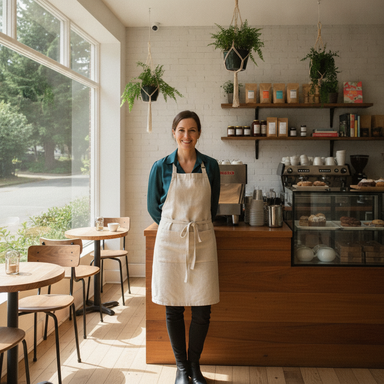
The Strategic Proprietor
Owner and General Manager
The owner of a high-end independent cafe or boutique grocer in Vancouver who is focused on differentiation and healthy margins. They are looking to replace mediocre, mass-produced goods with premium local offerings that justify a higher price point and build customer loyalty.
Priorities
- Increasing average transaction value through premium upsells
- Building a reputation for local, high-quality sourcing
- Ensuring 100% delivery reliability to avoid empty shelves
Evaluation Criteria
- Wholesale margin potential and suggested retail pricing
- Reliability of the delivery schedule and morning drop-off times
- Brand alignment with the 'artisan' and 'from-scratch' narrative
Pain Points
- Losing customers to national chains with better-looking (though lower quality) displays
- High waste costs from inconsistent product quality from current distributors
- Difficulty finding skilled in-house bakers to handle production
Common Objections
- Concerned that the premium price point might alienate budget-conscious regulars
- Worried about the transition period from their current large-scale distributor
“I need a bakery partner who understands that if the croissants aren't here by 6:30 AM, I am losing the morning rush revenue.”
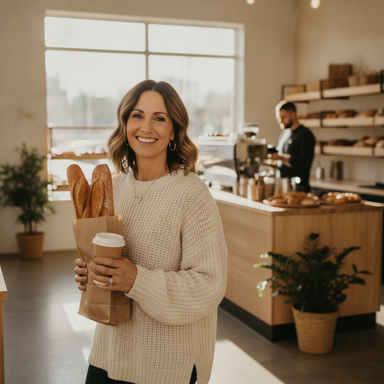
The Artisan Enthusiast
Sarah Miller
A high-income suburban resident who prioritizes food quality and local sourcing for her family. She is frustrated by the lack of authentic boulangerie-style products in her immediate neighborhood and currently travels into Portland to find acceptable sourdough and viennoiserie.
Age
42
Location
Salmon Creek, Vancouver, WA
Family Status
Married, 2 children (ages 9 & 12)
Education
Master's in Education
Profession
High School Administrator
Opportunities
- Curate pre-ordered 'Saturday Morning' boxes featuring a mix of croissants, seasonal danishes, and a fresh loaf of sourdough to capture the family weekend market.
- Implement a weekly 'loaf-of-the-month' subscription that allows locals to pick up fresh, scratch-made bread on a set schedule, ensuring recurring retail revenue.
Pain Points
- Settling for 'par-baked' or frozen-thawed bread from grocery store counters
- Driving 20+ minutes across the bridge to Portland for high-quality artisan cakes
- Lack of sophisticated 'third-space' environments in the Vancouver suburbs for morning socializing
Needs
- Genuine scratch-baked goods with no preservatives or artificial additives
- A reliable local source for high-end cakes for family celebrations
- Convenient parking and quick service during the 7:00 AM to 9:00 AM school-run window
“I'm tired of paying premium prices at grocery stores for bread that was clearly frozen and reheated. I want to smell the flour and see the bakers working.”
Competitors
Current Alternatives
Retail: National coffee chains and grocery-store bakery counters dominate local options. Chains typically sell centrally-baked, reheated pastries alongside their beverage program — food is secondary to coffee for them, which is the inverse of JJB's model. Grocery bakery counters offer convenience and low prices but limited quality and no personal service.
Wholesale: Independent cafes and restaurants in the region currently either bake small batches in-house without dedicated bakery equipment or staff, or source from large regional wholesale distributors. Distributor relationships typically mean long lead times, high minimum orders, and product that's been frozen or shipped rather than baked fresh nearby.
Our Advantages
JJB is built as a bakery first, which no local competitor is doing well. Our from-scratch production, run by a dedicated head baker, delivers a level of quality and freshness that neither national chains nor grocery counters can match. On the wholesale side, our local production and delivery routes let us offer independent cafes, restaurants, and grocers a level of responsiveness and freshness that large distributors can't — smaller minimums, next-day fulfillment, and a direct relationship with the bakery producing their product. We concentrate our marketing on building a loyal local resident base and a growing wholesale account list, with highway and tourist traffic as a secondary revenue contributor.
Execution
Market Plan Overview
Our marketing splits along our two channels: retail and wholesale.
Retail marketing is rooted in the quality of the in-store experience, generating word of mouth and repeat visits that translate into strong reviews on Google Maps, Yelp, and Instagram. We maintain an active Instagram and TikTok presence with photos and short-form video of the daily bake, seasonal items, and behind-the-scenes production content — the visual nature of bread and pastry makes social content a natural fit. We're deliberate about promotions on social media, favoring useful, genuine content over hard selling, including highlighting community events and local partnerships.
Wholesale marketing is direct and relationship-driven: our founders and head baker approach independent cafes, restaurants, and grocers directly with product samples, a simple wholesale price sheet, and a standing delivery schedule. Referrals between wholesale accounts and word of mouth in the local food service community are the primary growth channel once the first several accounts are established.
Keys to Success
Keys to success for JJB include:
- Consistent, high-quality scratch-baked product across both retail and wholesale channels.
- Reliable wholesale fulfillment — on-time delivery and consistent quality are what keep wholesale accounts.
- Personal customer service at the retail counter.
- Competitive, transparent pricing in both channels.
Sales Plan
JJB succeeds by offering scratch-baked bread, pastry, and cake — plus quality coffee — with personal service at a competitive price, sold through two channels that reinforce each other.
Retail is our storefront business: espresso drinks, pastries, breads, and cakes sold to walk-in customers, with visibility from two highway corridors driving both local and tourist traffic. Our sales approach focuses on building a loyal base of local residents who visit regularly, with tourist and highway traffic as a secondary contributor.
Wholesale is our direct-to-business channel: daily-baked bread and pastry supplied to independent cafes, restaurants, and grocers across the Vancouver–Portland metro under standing delivery agreements. Wholesale accounts are developed through direct outreach and product sampling, and once established tend to generate recurring, predictable order volume — a valuable complement to retail's more variable foot traffic.
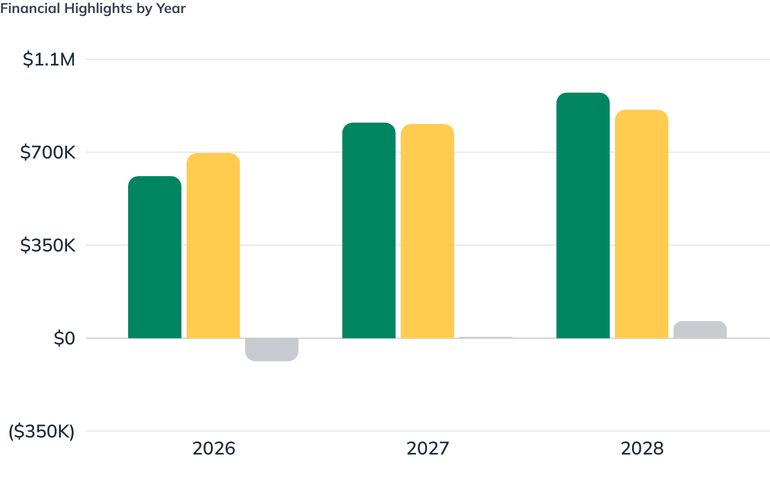
Total revenue is forecast to grow from roughly $610,000 in Year 1 to about $770,000 in Year 2, reaching a run rate near $884,000 by Year 3. Retail and wholesale baked goods together consistently account for roughly three-quarters of total revenue, with coffee and espresso as a meaningful but secondary contributor — reflecting our identity as a bakery first. Wholesale is our fastest-growing stream as we add accounts and delivery capacity, while retail baked goods remain the largest single revenue source throughout the plan. Full revenue detail by stream is in the Financial Plan's Revenue section.
Locations and Facilities
JJB operates from a single facility in Vancouver, Washington that combines a production kitchen with a retail storefront, easily accessible from two highway corridors (I-5 and SR-500) for strong visibility and pass-through traffic.
The production kitchen is sized for both retail and wholesale volume: commercial ovens, mixers, and proofing equipment run through the overnight and early-morning hours to supply the retail bakery case by opening and to fill wholesale orders for same-day delivery. Retail customers see a working bakery through the storefront's open kitchen design, reinforcing the from-scratch positioning.
Wholesale delivery is handled via a dedicated delivery route covering the Vancouver–Portland metro, with a schedule built around each account's opening hours. As wholesale volume grows, we'll evaluate whether production capacity requires additional equipment or a second daily bake to keep both channels fully supplied. We concentrate marketing and community presence on local residents and wholesale accounts as our dominant target markets, with tourist and highway traffic as a secondary contributor to storefront revenue.
Technology
JJB uses standard bakery-retail and back-office technology to support daily production, retail sales, wholesale operations, and customer engagement:
- Point of sale: A modern POS system integrated with inventory tracking for flour, coffee beans, and other ingredients across both retail and wholesale production.
- Wholesale ordering: A simple online ordering form/portal wholesale accounts use to place standing and one-off orders, with order data feeding directly into next-day production planning.
- Accounting and planning: QuickBooks (or similar) for bookkeeping, payroll, and invoicing wholesale accounts, with LivePlan for ongoing financial forecasting and reporting.
- Customer engagement: Active Instagram and TikTok presence built around the daily bake, plus monitoring of Google Maps and Yelp reviews.
- Back-of-house: Digital recipe and batch management for consistent bread and pastry production at both retail and wholesale volume, temperature monitoring for ovens and refrigeration, and employee scheduling software.
Larger competitors offer mail-order and e-commerce; JJB will evaluate direct-to-consumer online ordering once the retail storefront and wholesale delivery routes are established and running smoothly.
Equipment and Tools
Startup equipment investment is concentrated in bakery production, with a smaller allocation for the retail espresso bar and wholesale delivery. Key equipment and tools include:
- Commercial deck oven(s), mixers, proofing cabinets, and pastry preparation equipment sized for both retail and wholesale volume
- Refrigeration and freezer units, and bakery display cases for the retail storefront
- Commercial espresso machine, coffee grinders, and iced-beverage equipment for the retail counter
- Delivery vehicle for wholesale routes
- POS hardware, security systems, and small wares
- Storage containers, shelving, and initial ingredient inventory
Bakery production runs overnight and through the early morning in multiple batches to supply the retail case by opening and to fill wholesale orders for same-day delivery. Equipment maintenance and replacement are budgeted in the forecast as part of ongoing operating expenses.
Milestones
Social Media Setup Create and launch Instagram and TikTok accounts with daily-bake content before opening. | Team Jan 5, 2026 |
Grand Opening Promotion Grand opening promotion for the retail storefront with local advertising, sampling, and community outreach to build initial customer base. | Austin Patterson Jan 15, 2026 |
Wholesale Account Launch Begin direct outreach and product sampling to independent cafes, restaurants, and grocers to sign the first wholesale accounts and establish the delivery route. | Austin Patterson Feb 1, 2026 |
Fall Bakery and Coffee Specials Launch seasonal fall bakery items and coffee pairings to drive retail traffic during cooler months. | Austin Patterson Oct 15, 2026 |
Key Metrics for Success
We track our financial performance primarily through total revenue, gross margin, and net profit, viewed by channel (retail vs. wholesale) as well as in aggregate. Total revenue grows from roughly $610,000 in Year 1 to about $770,000 in Year 2 and a run rate near $884,000 by Year 3, with baked goods (retail and wholesale combined) consistently making up roughly three-quarters of revenue. We expect sustained monthly profitability by the second half of Year 2, with owner distributions beginning once profitability is established — see the Financial Plan for the full forecast.
Beyond the core financials, we track operational metrics that tell us whether the business is healthy day to day:
- Daily retail customer counts and average ticket size
- Units sold by category — baked goods vs. coffee — to confirm baked goods remain the majority of revenue
- Number of active wholesale accounts and average order size per account
- Wholesale order fulfillment rate and on-time delivery percentage
- Break-even timing against plan
- Social media engagement (Instagram/TikTok followers and engagement, Google Maps/Yelp review ratings)
Company
Ownership and Structure
JJB is incorporated in the state of Washington. It is equally owned and managed by its two founding partners.
The company intends to hire a head baker to run production, two full-time managers to oversee retail and wholesale operations, part-time baristas to handle retail customer service, and a part-time delivery driver to run the wholesale route from launch.
Management Team
Mr. Austin Patterson has extensive experience in sales, marketing, and management, and was vice president of marketing with both Jansonne & Jansonne and Burper Foods, a regional bakery and food products company. He leads sales, marketing, and wholesale account development for JJB.
Mr. David Fields brings experience in finance and administration, including a stint as chief financial officer with both Flaxfield Roasters and a regional bakery chain. He leads finance, administration, and operations for JJB.
The company will hire an experienced head baker to lead production and maintain consistent quality across both the retail bakery case and wholesale orders.
Advisors
JJB does not have a formal advisory board at launch. The founding partners — Austin Patterson (sales, marketing, and wholesale account development) and David Fields (finance and administration) — bring combined industry experience from bakery, roasting, and food retail companies that substitutes for outside advisors in the early stages.
The company may add an accountant, legal counsel, and a food-service industry advisor with wholesale distribution experience as informal advisors for tax, compliance, lease negotiations, and scaling the wholesale program.
Financial Plan
Revenue
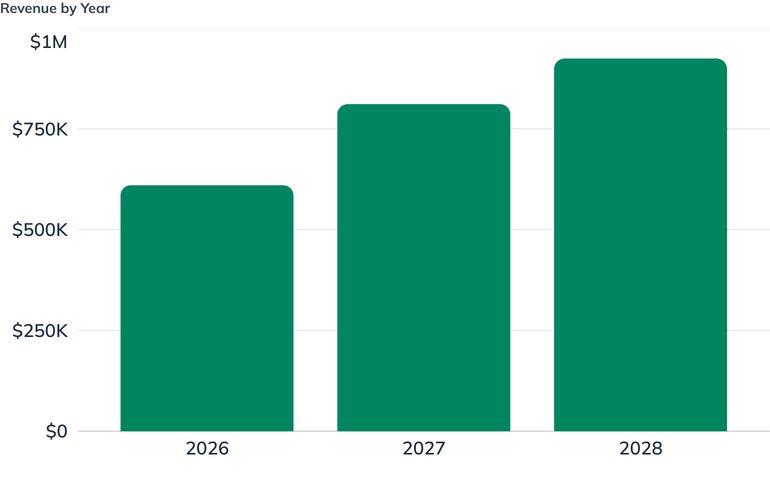
Need impressive charts? Discover the simplest way to create detailed graphs for your business plan.Create your own business plan
Expenses & Costs
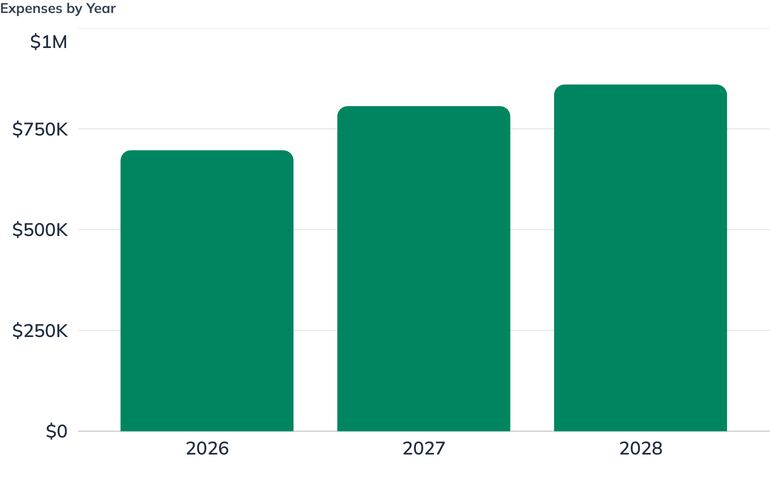
Need actual charts? We recommend using LivePlan as the easiest way to create graphs for your own business plan.Create your own business plan
Profitability
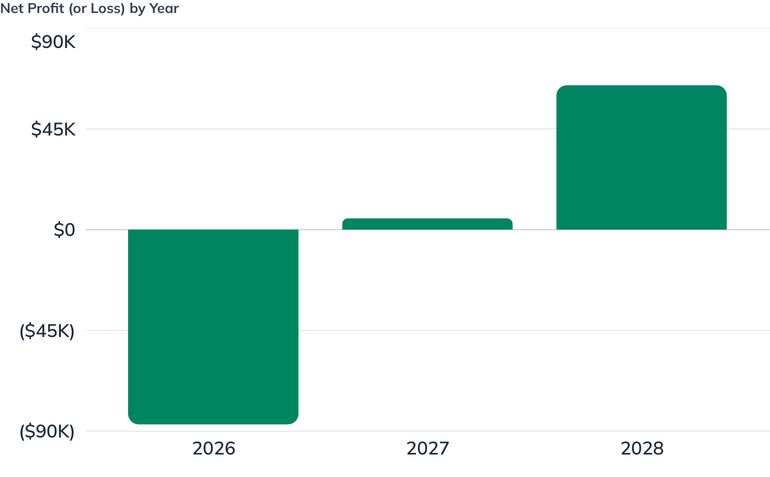
Need actual charts? We recommend using LivePlan as the easiest way to create graphs for your own business plan.Create your own business plan
Use of Funds
We will be financing initial assets of $65,000 long-term assets (equipment, etc.) and $12,000 current assets plus initial inventory and the early months before break-even occurs.
Sources of Funds
Owner investment: Two founders each investing $70,000 — total startup investment of $140,000 in paid-in capital.
SBA loan: $100,000 ten-year loan. Forecast loan payments:
Startup uses: $64,000 in startup expenses (legal, location renovation, expensed equipment, other), $70,000 starting cash, $12,000 in other current assets, and $65,000 in long-term assets.
Projected Statements
Frequently Asked Questions
A bakery business plan should cover your product concept and channels, target customers, competitive positioning, marketing approach, equipment and staffing needs, and financial projections including startup costs, funding sources, and a realistic timeline to profitability. Jolly's Java and Bakery's plan, for example, pairs a from-scratch retail-and-wholesale concept with a $240,000 funding plan and three-year projections showing revenue climbing from about $610,000 to over $920,000.
Startup costs for a bakery commonly range from $100,000 to $300,000 or more, depending on the scope of the production kitchen build-out, commercial baking equipment, and whether the concept includes a retail storefront, wholesale delivery, or both. In this plan, Jolly's Java and Bakery budgets roughly $211,000 in startup uses — covering leasehold improvements, deck ovens, mixers and proofing equipment, a delivery vehicle, and working capital — funded through $140,000 in founder investment and a $100,000 SBA loan.
Yes. A bakery typically needs a food service or retail food establishment license, a health department permit for its production kitchen, and a business license from the state where it incorporates, plus additional wholesale food-handling registration if it supplies other businesses. Jolly's Java and Bakery is incorporated in Washington and budgets ongoing licensing and permit costs as part of its operating expenses, alongside the health and safety approvals needed to run both its retail kitchen and wholesale production.
Bakeries typically earn revenue from retail counter sales, and many add wholesale or subscription channels to diversify beyond walk-in traffic. Jolly's Java and Bakery sells through two channels — a retail storefront with a full espresso bar, and a wholesale program supplying daily-baked bread and pastry to independent cafes, restaurants, and grocers — with baked goods across both channels consistently making up roughly three-quarters of total revenue and coffee as a secondary contributor.
Profitability timelines vary with how quickly a bakery builds repeat retail traffic and, if applicable, wholesale accounts. Jolly's Java and Bakery's plan projects a net loss of about $87,000 in its first year, turning to a modest profit of roughly $5,000 in year two and about $64,000 by year three, with sustained monthly profitability expected by the second half of year two as both retail traffic and wholesale accounts scale.
A wholesale program sells daily-baked product directly to other businesses under standing delivery agreements, rather than relying solely on walk-in counter traffic. Jolly's Java and Bakery pairs its retail storefront with a wholesale bakery program that supplies independent cafes, restaurants, and grocers across the Vancouver–Portland metro, using direct outreach and product sampling to build accounts that generate recurring, predictable order volume and make fuller use of overnight production capacity.
Jolly's Java and Bakery serves three overlapping segments: local residents in Vancouver's higher-income SR-500/I-5 corridor neighborhoods building daily and weekly bakery habits, wholesale accounts such as independent cafes, restaurants, and small grocers that need a dependable local supplier of scratch-baked bread and pastry, and tourist and highway traffic drawn by storefront visibility from two highway corridors.
Independent bakeries typically compete on freshness, from-scratch quality, and personal service that centrally-baked, reheated products from grocery counters and national coffee chains can't match. Jolly's Java and Bakery positions itself as a bakery first — producing artisan bread, viennoiserie, cakes, and pastry fresh daily in its own kitchen — and extends that same responsiveness to its wholesale accounts, offering smaller minimums and next-day fulfillment that large regional distributors don't provide.

Business Plan Outline
Start your plan