





Catering Company Business Plan


Business Plan Summary
This catering business plan example features Fressen Catering, a kosher caterer in Philadelphia built around a nouveau-cuisine menu and a two-tier pricing system serving both budget-conscious families and premium clients. It covers Fressen's positioning against traditional local kosher caterers and out-of-town competitors, a $180,000 funding plan, and a path to profitability by Year 3. Use it as inspiration for your own plan, and read our guide on how to start a catering business for step-by-step advice. Download a free business plan template to get started, or browse more business plan examples.
Fressen Catering
Executive Summary
Opportunity
Problem
Philadelphia's kosher catering market is an interesting one. Recently, consumers have discovered they really like and need kosher food — it's healthy, organic, and a "clean" way to eat. There's real demand for genuinely good, creative kosher food, not just food that technically qualifies.
Solution
Fressen will occupy a niche in the kosher catering market that offers new, creative menu items, broadening people's conception of kosher food. This market consists of two target segments that are differentiated by household income.
Market
The kosher catering business in Philadelphia is fairly unique. At the low- to mid-price point of the cost spectrum, there are four other kosher caterers. These caterers tend to serve the part of the market that must have kosher food served at an occasion due to religious beliefs, but struggle to afford the cost variance between standard and kosher catering. All four of these caterers have fairly standard menu offerings. There is a fifth caterer that also serves the lower end of the market (defined as middle class) but serves the high end of the market as well. Although there is a large wealthy population in Philadelphia that follows the laws of kashrut, they have been underserved.
Competition
Fressen Catering's competitive edge is its attention to servicing customers and inventive approach to kosher cuisine. Fressen's customer attention differentiates them in the world of kosher catering, which is dominated by several companies that have plenty of demand. The consequence of market demand is a decreased pressure to accommodate customers. Fressen is approaching the market as if there was significant competition between the different service providers. By making customer satisfaction a priority, over time, local customers will come to appreciate the attention that their needs are given and form a long-lasting relationship with Fressen Catering.
Why Us?
Fressen Catering's mission is to provide the customer with the finest kosher catering. We exist to attract and maintain customers. When we adhere to this maxim, everything else will fall into place. Our services will exceed the expectations of our customers.
Expectations
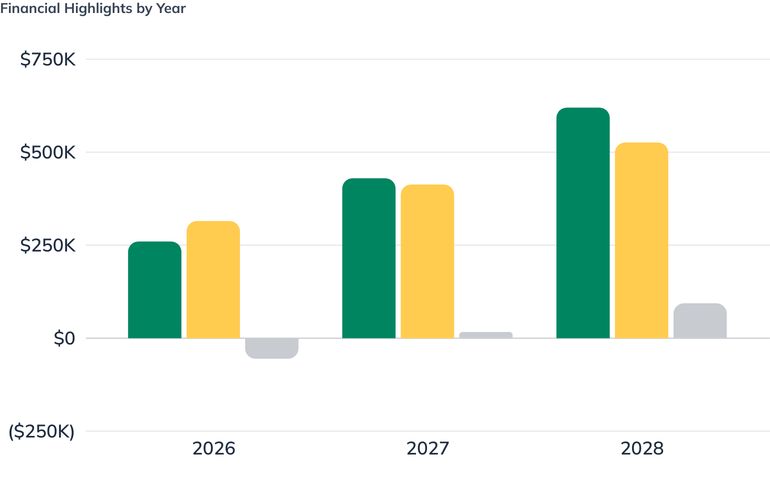
Year 1 is a launch-year investment: startup costs, equipment, and a new team eat into revenue and the business runs at a loss. Year 2 brings the business to roughly breakeven as bookings grow and the premium tier gains traction. By Year 3, Fressen is solidly profitable, and profitability continues to strengthen through Year 5 as the business matures and Susan's own compensation grows with it.
This business needs $180,000 in startup capital: $50,000 from Susan and a $130,000 loan from friends and family, structured with a 12-month interest-only period followed by amortizing payments, fully repaid by the end of Year 4.
Need actual charts? We recommend using LivePlan as the easiest way to create graphs for your own business plan.Create your own business plan

Opportunity
Problem Worth Solving
Philadelphia's kosher catering scene is dominated by a handful of caterers whose menus and pricing look nearly identical to one another — traditional dishes, standard presentation, minimal differentiation beyond which synagogue's newsletter they advertise in. For years, that sameness went unquestioned: many families assumed keeping kosher simply meant accepting a narrower, less adventurous menu than a non-kosher event would get.
That assumption is now out of step with what clients want. Younger families planning b'nei mitzvah and weddings have grown up with food media, Instagram-worthy plating, and global cuisine as the default expectation for any catered event — kosher or not. They're not willing to trade flavor and presentation for kashrut, and they shouldn't have to. Meanwhile, the city's most affluent kosher households, who could support a premium local caterer, instead pay a steep premium to fly in catering from New York because no Philadelphia kosher caterer currently offers a genuinely high-end, creative menu. Both gaps point to the same underlying problem: local kosher catering has stopped innovating, and the market hasn't had a reason to change until now.
Our Solution
Fressen Catering delivers a nouveau-cuisine kosher menu — built around technique, seasonal ingredients, and global flavor combinations rather than the traditional standards clients can get anywhere — served with the kind of individual attention a boutique caterer can give and a large operation can't.
Concretely, that means:
- A dual-tier menu system. A value program built on shared, efficiently-prepared dishes that still feel distinctive, and a premium program with fully customized, chef-designed menus for clients planning a high-end simcha.
- Full-service event support. From the first phone call, Susan personally walks every prospective client through menu options, dietary accommodations, and event logistics rather than handing them off to a sales team.
- A certified, mashgiach-supervised kitchen that guarantees strict kashrut compliance without limiting what we're willing to put on the plate.
- Direct delivery and setup using our own insulated transport system, so food arrives at the right temperature and presentation is consistent with what left the kitchen.
The result is a caterer that treats kosher observance as a constraint to design around creatively, not an excuse to serve the same six dishes every other kosher caterer in the city offers.
Market Overview
Market Segmentation
Fressen Catering serves two distinct segments within Philadelphia's kosher-observant community, roughly 250,000 people across the metro area, differentiated primarily by household income rather than religious practice:
- Value-conscious kosher clients. Families who need or want kosher catering for a religious occasion but are budget-sensitive — they'll pay the premium that kosher catering commands over non-kosher catering, but they're comparing caterers on price as much as menu creativity.
- Premium kosher clients. Households with substantial discretionary income for whom a bar mitzvah, wedding, or holiday event is a showcase occasion. This segment is largely driven by single-income, dual-parent households where event planning — and getting it right — matters enormously.
Target Market
Both segments overlap heavily by community: they attend the same synagogues, know the same families, and hear about caterers through the same word-of-mouth networks. That means Fressen doesn't need two separate go-to-market strategies — it needs one brand with two menu tiers. The differentiation happens at the point of quote and menu design, not in how we reach each group.
The premium segment is currently the more urgent opportunity: these households routinely bypass every Philadelphia kosher caterer and fly in catering from New York for events where cost isn't the deciding factor, because none of the four to five local kosher caterers currently offer a menu built for that occasion.
Competitors
Current Alternatives
Four established kosher caterers serve the low-to-middle end of Philadelphia's market. They compete on price to some degree, given the budget constraints many clients face, but mainly on service quality — the food and menus themselves are largely interchangeable between them.
One caterer serves the higher end of the market but hasn't matched its pricing with service quality, and its client base has been shrinking. The most consistent competitor for premium events isn't local at all — it's kosher caterers from New York City, who Philadelphia's wealthiest kosher families routinely fly in for weddings and milestone events when cost isn't the deciding factor. None of our local competitors have an online ordering or quote-request presence beyond a contact form, and none show up meaningfully in Google reviews or on catering marketplaces like ezCater — an easy opening for a caterer that invests in both.
Buying behavior differs sharply by segment. Value-tier clients are price-sensitive and will switch caterers over cost, though some local options are priced out of reach entirely for this group. Premium clients are largely price-insensitive; they choose based on menu creativity, reputation, and how well a caterer manages the details of the event.
Our Advantages
Fressen's primary edge is direct, high-touch customer service in a market where steady demand has let the incumbents get away with treating clients as interchangeable bookings rather than relationships worth building.
Our second edge is a genuinely modern approach to kosher cuisine. Kosher food has a reputation — not entirely undeserved — for playing it safe. Fressen's menu proves that the rules governing what can be used and how it's prepared don't preclude real culinary creativity. We bring nouveau-cuisine technique to every menu tier, which is exactly the gap that's currently sending Philadelphia's premium clients to New York.
Execution
Market Plan Overview
Fressen's marketing strategy is built around visibility within Philadelphia's kosher community, using a mix of digital-first channels and the trust-based networking that this community runs on.
Social media and search. Instagram is our primary channel — food photography and event coverage are exactly the kind of content that turns heads in a market where clients want proof a caterer can deliver something visually distinctive. We maintain a Google Business Profile so prospective clients searching "kosher caterer Philadelphia" find us, and we actively encourage satisfied clients to leave Google reviews, since reviews are now the first thing prospective clients check before ever calling.
Community and synagogue partnerships. Digital ads in Jewish community newsletters and synagogue bulletins still reach the specific audience that books kosher catering, so we maintain a modest presence there alongside our digital channels — but we treat it as a supplement to search and social, not the primary driver.
Networking. Susan has been an active member of Philadelphia's Jewish community for five years. It's a close-knit community of roughly a quarter million people, and referrals and word of mouth within it carry more weight than any ad. Susan leverages her existing relationships to generate warm introductions, which convert at a far higher rate than cold inquiries and cost nothing beyond the time invested in the relationships themselves.

The Luxury Host
Miriam Goldstein
A prominent member of the Main Line community who hosts large-scale religious celebrations and philanthropic galas. She has historically bypassed Philadelphia caterers, paying a premium to fly in New York-based teams because she refuses to compromise on culinary innovation and sophisticated presentation for her high-profile events.
Age
54
Location
Bryn Mawr, PA
Family Status
Married, 3 adult children
Education
Master of Fine Arts
Profession
Philanthropic Consultant and Board Member
Opportunities
- Provide a level of concierge-style event planning that rivals Manhattan firms, removing the logistical headache of out-of-state coordination.
- Develop high-end menus featuring molecular gastronomy or international cuisines (like Kosher Japanese or French Fine Dining) that local competitors lack.
Pain Points
- High costs and logistical stress of hiring New York caterers for local events
- Lack of sophisticated, modern plating among established Philadelphia kosher providers
- Feeling that local caterers have become 'lazy' due to high demand and low competition
Needs
- A caterer that understands luxury aesthetics and high-society expectations
- Innovative menu items that serve as a conversation piece for guests
- Reliable, high-touch communication throughout the planning process
“I shouldn't have to hire a crew from Brooklyn just to get a menu that doesn't feel like it's stuck in 1985.”

The Wellness Enthusiast
Sarah Miller
A health-conscious professional who views the 'Kosher' label as a proxy for 'clean,' organic, and ethical eating. While she is part of the growing Jewish population in Center City, her primary motivation for choosing Fressen is the focus on healthy, inventive, and high-quality ingredients rather than just religious obligation.
Age
34
Location
Center City, Philadelphia
Family Status
Single, urban professional
Education
Bachelor of Science in Public Health
Profession
Healthcare Administrator
Opportunities
- Market the 'organic and healthy' aspects of the menu to appeal to the wellness-focused urban demographic.
- Offer specialized packages for smaller, high-end boutique gatherings, gallery openings, or corporate wellness retreats.
Pain Points
- Kosher food is often associated with high-sodium, processed traditional dishes
- Lack of 'farm-to-table' options within the Philadelphia kosher market
- Limited options for creative, vegetable-forward kosher catering
Needs
- Transparency regarding ingredient sourcing and organic certifications
- Lighter, modern menu options like grain bowls, fresh seafood, and seasonal salads
- A caterer that aligns with her values of sustainability and health
“I choose kosher because I want to know exactly what's in my food, but I still want it to taste like it came from a five-star restaurant.”

The Instagram-Savvy Parent
David Levin
A modern parent planning a B'nei Mitzvah who is deeply influenced by food media and social trends. He values the laws of kashrut but is frustrated that keeping kosher in Philadelphia usually means settling for 'standard' buffet options that don't look good in photos or appeal to a younger, food-literate crowd.
Age
42
Location
Central Montgomery County, PA
Family Status
Married, 2 children (ages 11 & 13)
Education
MBA from Wharton
Profession
Marketing Director at a FinTech firm
Opportunities
- Focus on highly visual, 'shareable' food stations and plating that appeals to younger generations and social media users.
- Offer a tiered pricing structure that provides 'luxury' feel and creativity at a price point accessible to upper-middle-class families.
Pain Points
- Traditional kosher menus feel 'heavy' and uninspired for a modern celebration
- Difficulty finding a caterer that balances religious requirements with 'foodie' culture
- Generic service from 'big-box' kosher caterers who treat every event the same
Needs
- Creative, interactive food stations (e.g., street food, custom sliders)
- A partner who understands the importance of event branding and aesthetics
- High-quality ingredients that justify the 'kosher premium' price
“My son's Bar Mitzvah should feel like a celebration of his personality, not just another repetitive synagogue luncheon.”
Sales Plan
Fressen's sales process is built to convert an inquiry into a booked event through direct attention and a menu that gives prospective clients a reason to choose us over a familiar competitor.
The inquiry call. Most clients first reach us through our website's quote-request form or a direct phone call. Susan treats every one of these as the critical moment to convert a prospect into a client — she walks each caller through menu options, dietary needs, and event logistics personally rather than routing them to a script or a junior staffer.
Tasting and menu design. For premium-tier clients, we offer an in-person tasting before booking — a low-pressure way to demonstrate that kosher catering can be genuinely creative, and the single most effective tool we have for winning clients who'd otherwise default to a New York caterer.
The menu as the pitch. Beyond traditional kosher staples, Susan offers an extensive roster of nouveau-cuisine dishes developed over her years in the culinary industry. There's no reason kosher-observant clients are less interested in adventurous food than anyone else — they've simply never been offered it locally, and that novelty itself is a strong sales asset.
Follow-up and repeat business. After every event, we follow up directly to ask about the experience and stay top-of-mind for the client's next simcha. Given how tightly connected Philadelphia's Jewish community is, a single well-executed event reliably generates referrals well beyond the original client.
Menu & Pricing
Fressen offers two menu tiers, both fully kosher and mashgiach-supervised, differentiated by ingredient sourcing, plating complexity, and level of customization rather than by a separate kitchen or standard.
Value Tier — Simcha Essentials
Designed for cost-conscious families who still want food that feels distinctive. Built around a rotating seasonal menu of shared preparations that keep kitchen labor efficient without feeling generic — think reimagined classics (short rib instead of standard brisket, a modern grain salad instead of plain kugel) alongside a few traditional staples guests expect to see.
- Per-person pricing generally runs in the mid-to-high double digits, depending on guest count and course selection
- Standard three-course plated or buffet service
- A set menu with a handful of substitution options, not a fully custom build
Premium Tier — Nouveau Kosher
Designed for clients hosting a milestone event who want a menu built specifically for them — the tier meant to compete directly with New York caterers rather than lose that business by default.
- Per-person pricing scales well above the value tier, reflecting fully custom menu design, premium ingredients, and plated multi-course service
- Includes a complimentary in-person tasting before booking
- Menu built in direct collaboration with the client, drawing on global cuisine and modern technique
Booking terms. All events require a signed contract and deposit to hold the date, with a minimum guest count for premium-tier bookings to ensure the event supports the level of customization involved. Final guest counts and menu selections are locked in two weeks before the event to allow for sourcing and prep scheduling.
Locations and Facilities
Fressen operates out of a leased commercial kitchen and office space in an industrial section of Philadelphia. The industrial location keeps occupancy costs manageable — since all business is off-site catering and delivery, there's no need for a client-facing storefront or a location in a high-visibility retail corridor.
The kitchen is certified kosher and operates under regular mashgiach (kosher supervision) oversight, which is non-negotiable for a business built entirely on kashrut compliance — every client booking depends on that certification being current and visibly maintained. The space includes dedicated dry storage, walk-in refrigeration, and a loading area sized for our delivery van, so food can move from stove to vehicle with minimal handling.
Because all events are catered off-site, our effective service area is the greater Philadelphia metro area — the same footprint as the Jewish community Fressen serves — with delivery radius the main constraint on how many same-day events we can realistically staff and deliver to at full quality.
Technology
Fressen Catering relies on a lean, mostly off-the-shelf technology stack to manage operations, finances, and customer communication without adding overhead the business doesn't need yet:
- QuickBooks Online for accounting, invoicing, and payroll
- Catering/event management software (e.g., a tool like CaterZen or HoneyBook) to manage quotes, contracts, deposits, and event timelines in one place as booking volume grows beyond what a spreadsheet can handle
- Website with an online quote-request form, so prospective clients can start the conversation without waiting for a phone call — Susan still personally follows up on every inquiry
- Google Business Profile for local search visibility and client reviews
- Instagram for food photography and event coverage, our primary social channel
- Phone and email remain core channels for the detailed back-and-forth of menu planning and event logistics, since that part of the sales process benefits from Susan's direct, personal attention
This stack is intentionally standard rather than custom-built — the priority in year one is keeping software costs low while Susan's personal attention, not the tech stack, does the differentiating.
Equipment and Tools
Fressen Catering's kitchen and delivery equipment includes:
- Two commercial stoves with ovens
- Dishwasher
- Two sets of cookware and two sets of dishware
- One van with built-in rolling racks (insulated wheeled cart system for hot and cold food transport)
- Assorted serving trays, utensils, knives, and cutting boards (two each)
- Desk and chair for the office area
These items represent the core production and delivery infrastructure needed to serve kosher events across the Philadelphia area. Long-term assets (kitchen equipment and van, totaling $65,040) will be depreciated using G.A.A.P. approved straight-line depreciation over 10 years ($6,504 per year).
Milestones
Kitchen and Office Setup Set up kitchen and office space in industrial Philadelphia location. | Feb 15, 2026 |
First Catering Job Complete first paid catering job. | Mar 15, 2026 |
Key Metrics for Success
The key to success is consistently meeting and exceeding client expectations on food quality and event service — in a referral-driven market, every event either earns future business or costs us a reputation.
Key Metrics
- Repeat and referral bookings as a share of total events — the clearest signal that clients are becoming advocates, not one-time customers
- Google review volume and average rating
- Instagram engagement and follower growth, tracked against inquiry volume from social channels
- Website quote-request submissions and their conversion rate to booked events
- Premium-tier bookings won directly from clients who previously used an out-of-town (New York) caterer
Net Profit Margin Targets
- Net Profit Margin — a loss of roughly (24%) in Year 1 while the business absorbs startup and launch costs, improving to roughly breakeven in Year 2, and reaching approximately 12% in Year 3
- Profitability continues to strengthen in Years 4 and 5 as the business matures and volume grows
Business Objectives
- Build a service-first company whose primary goal is to exceed every client's expectations
- Grow the number of clients served by roughly 20% per year through referrals and superior service
- Build a durable, sustainably profitable business rather than chase short-term growth
- Generate enough cash flow to support the team's salaries while reinvesting in growth
SWOT Analysis
Strengths
- Chef-owner with formal culinary training (Pennsylvania Culinary Institute) and five years as head chef at a nouveau-cuisine restaurant, bringing real technique to a menu category that rarely sees it
- Five years of established, trusted relationships within Philadelphia's Jewish community, giving Fressen a referral network competitors would need years to build
- A menu differentiated from every local competitor, aimed directly at premium clients currently taking their business to New York
Weaknesses
- New business with no operating track record or client reviews yet
- Single-chef dependency — the entire premium-tier value proposition currently rests on Susan personally, with limited redundancy if she's unavailable
- Limited working capital ($130,000) relative to the equipment, staffing, and marketing investment a catering business typically needs to scale
Opportunities
- A clear, currently unaddressed gap in premium kosher catering — the clients and the spend already exist locally, they're just going to New York for it
- Growing appetite among younger kosher-observant clients for modern, Instagram-worthy event food
- Potential to expand into adjacent services (holiday meal delivery, corporate kosher catering) once the core event business is established
Threats
- Established competitors could respond to Fressen's differentiation by upgrading their own menus or service model
- Kosher certification lapses or supply chain disruptions for kosher ingredients would directly threaten the ability to deliver on every booking
- Economic downturns tend to hit discretionary event spending — especially the premium tier — disproportionately hard
Company
Ownership and Structure
Fressen Catering is organized as a single-member LLC, wholly owned and operated by founder and executive chef Susan Cheflily. As sole owner, Susan retains full decision-making authority over menu direction, hiring, and business strategy while the company is in its early growth phase. The LLC structure limits Susan's personal liability while keeping formation and compliance costs low — appropriate for a business of this size at launch.
Management Team
Susan Cheflily, founder and owner, earned her Bachelor of Arts from the University of Pittsburgh. After college, she entered the restaurant industry as a server — initially just a reliable paycheck — at an upscale Pittsburgh restaurant, where she befriended one of the chefs, who began teaching her cooking technique. What started as informal tutoring became a genuine passion, and after six months, Susan decided to pursue chef training formally at the Pennsylvania Culinary Institute, a well-regarded program she completed in one year, graduating near the top of her class.
With that training, Susan took a position as chef at one of Philadelphia's nicer nouveau-cuisine restaurants, spending five years as head chef. She valued the experience but wanted to build something of her own and set her own hours. The idea for Fressen came to her at temple: Philadelphia's kosher catering market had a real gap at the upper end, one the existing players weren't addressing. She spent months validating the idea — conversations with community members and three focus groups — before writing this business plan.
Advisors
Susan Cheflily is not engaging formal, paid advisors at launch. She consults informally with contacts in Philadelphia's Jewish community, synagogue leadership, and culinary industry peers as needed for guidance on kosher certification, event planning, and day-to-day business operations. As the business grows, Susan plans to formalize a relationship with an accountant familiar with restaurant/catering tax treatment and, eventually, a mashgiach on retainer for ongoing kosher supervision.
Financial Plan
Revenue
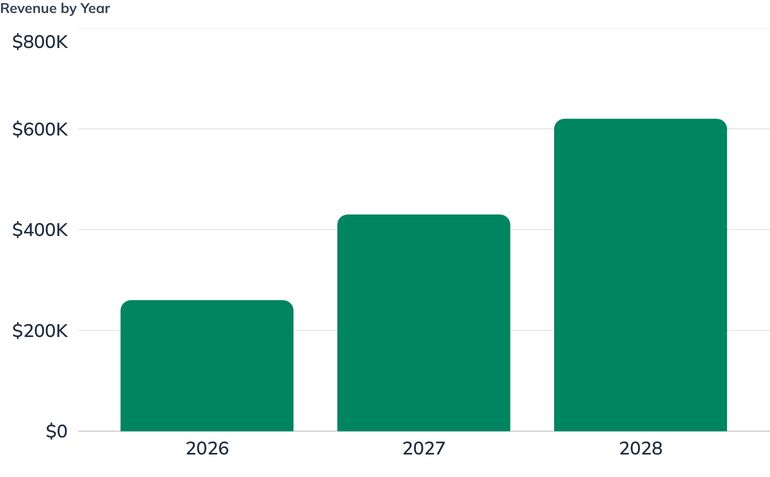
Need actual charts? We recommend using LivePlan as the easiest way to create graphs for your own business plan.Create your own business plan
Expenses & Costs
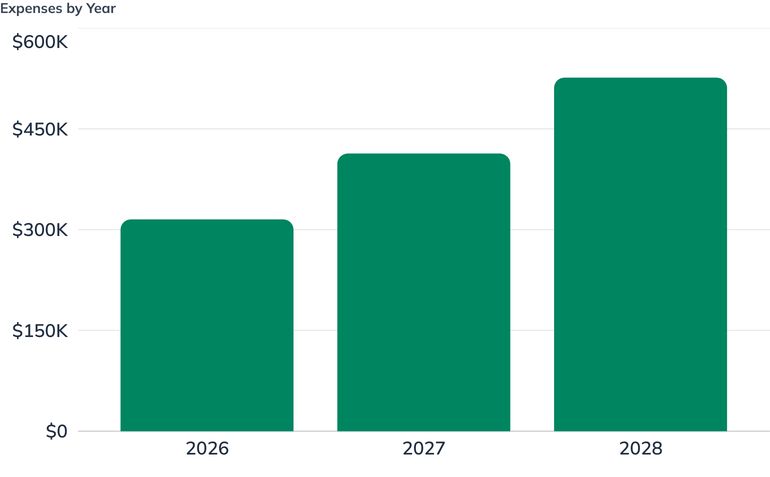
Need real financials? We recommend using LivePlan as the easiest way to create financials for your own business plan.Create your own business plan
Profitability
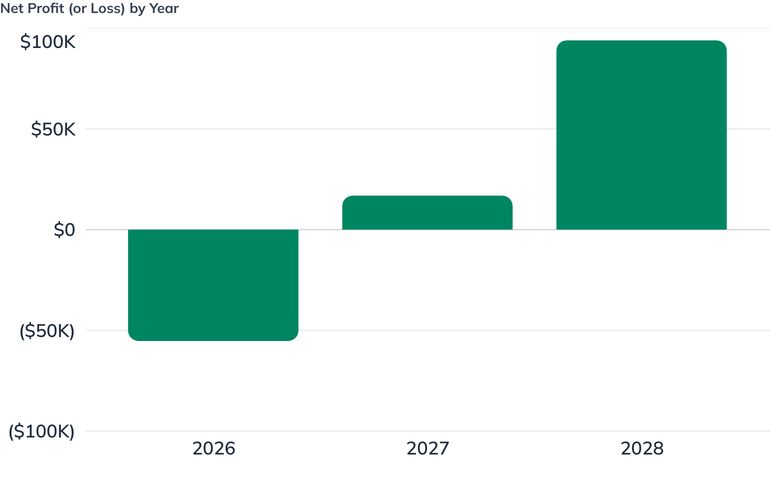
Need actual charts? We recommend using LivePlan as the easiest way to create graphs for your own business plan.Create your own business plan
Use of Funds
Fressen Catering's $180,000 in startup funding covers:
- Kitchen equipment and delivery van — two commercial stoves with ovens, a dishwasher, two sets of cookware and dishware, a delivery van with a built-in insulated rolling-rack system, and assorted serving trays, utensils, knives, and cutting boards ($65,040, treated as a long-term depreciable asset)
- Licensing and kosher certification setup — health department permits and the initial mashgiach/kosher-certification setup needed before Fressen can legally operate
- Office and administrative setup — a computer, printer, and standard office furniture, running QuickBooks Online and a catering management platform for quotes, contracts, and scheduling
- Working capital — enough cash on hand to cover the first two years of ramp-up, during which the business runs at a loss before reaching breakeven in Year 2 and full profitability in Year 3
This mix reflects a lean, service-first launch: the largest single cost is the kitchen and delivery equipment Fressen needs on day one, with the remaining funds sized to keep the business solvent through its slower early bookings rather than covering unnecessary upfront overhead.
Sources of Funds
Fressen Catering requires $180,000 in startup funding, structured as:
- Susan Owner Investment — $50,000 in owner equity
- Friends and Family Loan — $130,000, structured at 6% interest with a 12-month interest-only period followed by amortizing monthly payments, fully repaid by the end of Year 4
Unlike a pure equity contribution, the friends and family funding is structured as an interest-bearing loan from the outset, so repayment isn't contingent on discretionary timing — it's built into the forecast as a fixed obligation Fressen services alongside its other monthly costs.
Projected Statements
Key Assumptions
With experience and after doing research, we assume the following is true:
- There is a need for high-quality kosher food in Philadelphia
- We will be serving both middle-income and upper-income kosher-observant households
- We have the knowledge and equipment to give our customers clean, kosher, and genuinely creative food
Financial Assumptions
- Direct costs (food, plus card and online payment processing) run approximately 35% of revenue, for a gross margin near 65% — in line with typical catering industry benchmarks
- Fressen is a pass-through LLC, so no corporate income tax applies; income tax is paid at the personal level
- The $130,000 friends and family loan carries a 6% interest rate, with a 12-month interest-only period followed by amortizing payments, fully repaid by the end of Year 4
- Long-term assets (kitchen equipment and van, $65,040 total) depreciate on a straight-line basis over 10 years, or $6,504 per year
- Revenue grows from $260,000 in Year 1 to $430,000 in Year 2 to $620,000 in Year 3, continuing to $700,000 in Year 4 and $770,000 in Year 5
- Year 1 runs at a loss while the business absorbs startup costs; Year 2 is roughly breakeven; Fressen turns solidly profitable starting in Year 3, with margins continuing to improve through Year 5
Frequently Asked Questions
A catering business plan should cover the specific menu and pricing tiers you'll sell, the market segments you're targeting, and how you'll operate day to day. Fressen Catering's plan, for example, includes a dedicated Menu & Pricing section laying out its value and premium tiers, a Locations and Facilities section covering its mashgiach-supervised kitchen, and a full financial plan showing startup costs and the path to profitability.
Startup costs vary widely depending on kitchen access, equipment, and licensing. Fressen Catering's plan budgets $180,000 in startup capital, covering commercial kitchen equipment and a delivery van (about $65,000), kosher certification and health department permits, basic office and software setup, and working capital to cover the first two years while the business ramps up toward profitability.
Yes — most caterers need a health department permit for food handling, and a kosher caterer like Fressen also needs ongoing kosher certification maintained through regular mashgiach (kosher supervision) oversight. That supervision isn't a one-time check but a continuous requirement, since every booking depends on the kitchen's kosher status staying current and verifiable.
Catering businesses typically earn revenue per event, priced per guest. Fressen Catering uses a two-tier system: a value tier with set menus and per-person pricing for cost-conscious families, and a premium tier with fully custom menus, a complimentary tasting, and pricing that reflects higher-end ingredients and full customization — both requiring a signed contract and deposit to book.
In Fressen Catering's plan, Year 1 runs at a loss while the business absorbs startup and launch costs, Year 2 is roughly breakeven as bookings grow, and Year 3 is the first year of solid profitability, with margins continuing to strengthen through Years 4 and 5 as the business matures.
Fressen differentiates on menu creativity rather than price alone — its founder brings formal culinary training and nouveau-cuisine restaurant experience to a market where most kosher caterers serve familiar, traditional dishes. That's specifically aimed at Philadelphia's wealthiest kosher households, who currently fly in caterers from New York for milestone events because no local kosher caterer offers a genuinely high-end, design-forward menu.
Fressen's customers are kosher-observant households across Philadelphia's Jewish community, roughly 250,000 people in the metro area, split into two groups: value-conscious families booking a bar or bat mitzvah or holiday event on a budget, and affluent households planning a wedding or milestone celebration who want a menu that matches the scale of the occasion.
Fressen starts lean: a founder/chef, a cook, a server, a kitchen helper, and a mashgiach retained for kosher supervision. Staffing scales gradually as bookings grow rather than hiring ahead of demand, which keeps payroll manageable during the first two years before the business turns consistently profitable.

Business Plan Outline
Start your plan