





Convenience Store Business Plan


Business Plan Summary
This convenience store business plan example features MillenniumMart, a cashierless flagship store opening in downtown Manhattan that uses computer-vision cameras and smart-shelf sensors to eliminate checkout entirely. It covers MillenniumMart's joint venture with major food distributor Martin-Bower, its single-flagship-first expansion strategy, and a $600,000 all-equity launch. Use it as inspiration for your own plan. See also our convenience store soda fountain business plan example and our convenience store cafe business plan example for other perspectives. Download a free business plan template to get started, or browse more business plan examples.
MillenniumMart
Executive Summary
MillenniumMart is a cashierless convenience store built around one idea: walk in, grab what you want, walk out. Computer-vision cameras and smart-shelf weight sensors track every item a customer picks up, and checkout happens automatically through the card on file in our app when they leave, no line, no scanning, no register.
We're launching our flagship store in downtown Manhattan, in a joint venture with Martin-Bower, one of the country's largest food distributors, who bring supply-chain scale and category expertise most single-location convenience stores can't access on their own.
Keys to Success
MillenniumMart's keys to success are:
- A genuinely faster shopping experience than any staffed convenience store can offer, since there's no line and no checkout step at all.
- Meaningfully lower labor costs than a traditional 24-hour convenience store, since one remote operations team can monitor multiple unstaffed locations.
- A distribution and category-management partnership with Martin-Bower that a standalone startup couldn't negotiate on its own.
- First-mover positioning in cashierless convenience retail in our launch market, ahead of the major chains' own pilots.
Objectives
To prove the model and set up expansion, MillenniumMart will:
- Open and stabilize its flagship Manhattan location, validating unit economics before committing to additional sites.
- Operate profitably on a per-store basis by demonstrating that computer-vision checkout meaningfully lowers labor cost versus a staffed store.
- Build the operating playbook, technology stack, and distributor relationship needed to expand to additional locations starting in year 2.
Mission
MillenniumMart exists to make the everyday convenience-store run actually convenient: no waiting, no register, no friction between wanting something and walking out with it.
Opportunity

Problem Worth Solving
Convenience-store shopping is supposed to be fast, but staffed stores rarely deliver on that promise at the moments customers need it most: a line forms behind the one open register during a lunch rush, a late-shift worker waits behind someone paying in cash at 2am, a commuter grabbing a coffee and a snack before a train has thirty seconds to spare and a two-minute wait ahead of them.
The friction isn't the shopping, it's the checkout. Scanning items, waiting for a card to process, digging for exact change: none of it adds value for the customer, and all of it adds labor cost for the store. Traditional convenience chains have tried self-checkout kiosks, but those just move the friction from the cashier to the customer, who now scans their own items and still waits in line for the kiosk.
Urban commuters, late-shift workers, and anyone making a quick stop between other obligations need a convenience store that is actually convenient: one where the time from walking in to walking out with what they came for is measured in seconds, not minutes.
Our Solution
MillenniumMart removes checkout entirely. Customers open our app, tap in with a QR code or NFC tap at the entry gate, pick up whatever they want, and walk out. Ceiling-mounted computer-vision cameras combined with weight-sensing smart shelves track exactly what each customer picks up (and what they put back), and the app charges their card on file automatically after they leave, with a digital receipt arriving within seconds.
The store itself stocks the same core convenience categories customers already expect: coffee and fountain drinks, snacks, cold beverages, grab-and-go food, basic grocery and personal-care items, and age-restricted products like beer and wine sold through an age-verification step at the entry gate rather than a staffed counter.
Because the store runs without cashiers, labor cost per location drops dramatically compared to a traditional 24-hour convenience store, savings we pass through as lower prices rather than banking entirely as margin, which is core to how we compete against 7-Eleven, Wawa, and other established chains on price as well as speed.
Market Overview
The U.S. convenience store industry remains one of the largest retail categories in the country, with total industry sales well into the hundreds of billions annually, and cashierless and automated formats are one of its fastest-growing segments as major players (Amazon's Just Walk Out technology, Circle K and 7-Eleven's own cashierless pilots) and dedicated vendors (Zippin, AiFi, Grabango) prove out the model at scale.
Our flagship location targets dense, high-foot-traffic urban blocks where speed matters more than browsing: commuters near transit hubs, office workers on tight lunch breaks, and late-shift and overnight workers who are underserved by staffed stores that reduce hours or close entirely overnight. Downtown Manhattan gives us all three in a single, walkable radius, plus year-round foot traffic that isn't dependent on a single commuter pattern or season.
Within our target radius, the addressable population skews toward exactly the segments most responsive to a faster, cashierless format: office workers and residents with limited time for a shopping trip, and a meaningful share of shift workers whose schedules fall outside a typical staffed store's most reliably staffed hours. As cashierless technology becomes more familiar to shoppers through Amazon and other chains' pilots, customer comfort with a fully unstaffed store continues to rise year over year.
The Seamless Resident
Jordan Taylor
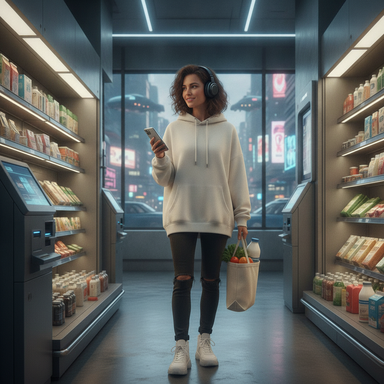
Jordan lives within two blocks of the flagship store and views MillenniumMart as an extension of their own kitchen. They prefer the 'invisible' nature of the technology, allowing for quick 'pantry runs' in casual attire without the social interaction of a traditional register.
Age
27
Location
Maiden Lane, Financial District
Family Status
Living with partner and a dog
Education
Bachelor's in Digital Media
Profession
Freelance Graphic Designer
Opportunities
- Stock smaller, high-frequency household staples like single-roll paper towels or pints of milk to encourage daily visits.
- Use geofencing to send 'flash sale' notifications to residents within a 500-meter radius.
Pain Points
- The '15-item limit' at self-checkouts being clogged by people with full carts
- Having to carry a wallet for a 2-minute trip to get one missing ingredient
- Crowded store aisles that make quick navigation impossible
Needs
- Smartphone-only shopping experience that doesn't require a physical wallet
- Real-time inventory tracking in the app so they know an item is in stock before leaving home
- A 'no-social-friction' experience for quick errands in casual loungewear
“I love that I can run out in my sweatpants, grab a carton of eggs, and be back at my desk before my coffee even gets cold.”
The After-Hours Essentialist
Elena Rodriguez
Elena represents the significant portion of the Manhattan workforce active between 1 AM and 5 AM. As a night-shift supervisor, she often finds staffed stores either closed or feeling unsafe due to limited staffing and loitering during late hours.
Age
46
Location
Lower Manhattan (Commutes from Brooklyn)
Family Status
Married, two teenage children
Education
Associate Degree in Healthcare Administration
Profession
Night-Shift Security Supervisor
Opportunities
- Market the store as a brightly lit, camera-monitored safe haven for late-night workers.
- Offer discounts or 'early bird' coffee specials specifically for users active between midnight and 5 AM.
Pain Points
- Limited food options during overnight shifts when most kitchens are closed
- Feeling unsafe in poorly lit or unmonitored late-night convenience stores
- Waiting behind customers paying in exact change or lottery tickets during her limited break
Needs
- 24/7 access to fresh, healthy food instead of just vending machine snacks
- A brightly lit, clean, and modern environment that feels secure
- Speedy access to caffeine and protein to power through an 8-hour shift
“When I'm on my 3 AM break, I have exactly 15 minutes. I need a place that's open, safe, and doesn't make me wait.”

The Frictionless High-Flyer
Marcus Sterling
Marcus is a high-earning investment analyst in the Financial District who views time as his most valuable currency. He frequently skips meals or settles for poor quality because he cannot justify standing in a 10-person line at a traditional bodega during the mid-day rush.
Age
32
Location
Financial District, Manhattan
Family Status
Single, living in a luxury high-rise
Education
Master of Business Administration
Profession
Senior Investment Analyst at a Tier-1 Bank
Opportunities
- Leverage the Martin-Bower partnership to stock high-end, fresh lunch options that outperform standard deli fare.
- Allow users to link corporate expense cards to the app for seamless business lunch tracking.
Pain Points
- Losing 15-20 minutes of a lunch hour just standing in checkout lines
- Inconsistent food quality at local independent mini-marts
- The friction of manual scanning at traditional self-checkout kiosks
Needs
- A shopping trip that takes under 60 seconds from entry to exit
- High-quality, fresh grab-and-go options that justify a $60+ daily spend
- A reliable digital receipt system for easy expense reporting
“I don't mind paying a premium for a sandwich, but I refuse to pay with my time. If there's a line, I'm walking out.”
Competitors
MillenniumMart competes on two fronts: traditional convenience chains and the emerging cashierless-retail category itself.
Traditional convenience chains — 7-Eleven, Circle K, Wawa, and independent bodegas dominate the category by sheer location count and brand familiarity. They're fast to visit but still bottlenecked by staffed checkout during peak hours, and their labor costs limit how far they can push prices down.
Cashierless technology providers — Amazon licenses its Just Walk Out technology to third-party retailers; Zippin, AiFi, and Grabango offer similar computer-vision checkout systems to convenience and grocery chains. Some of the chains above are already piloting these systems in select locations. Our advantage isn't the underlying technology category, it's operating our own flagship location end-to-end (store design, inventory, and the Martin-Bower distribution relationship) rather than licensing checkout technology into someone else's existing format.
Our edge: the combination of genuinely lower prices (passed through from lower labor costs, not just a marketing claim), a Martin-Bower distribution relationship most single-location operators can't access, and being an early, dedicated cashierless format in our launch market rather than a bolted-on pilot inside an existing staffed store.
To defend this position as competitors add their own cashierless pilots, MillenniumMart needs to maintain visibility through app-based and local digital marketing, keep tight cost control on inventory shrink and technology upkeep, and continue improving the computer-vision and inventory systems that are core to the format.
Execution
Market Plan Overview
MillenniumMart's marketing has to do two jobs at once: explain a shopping format most customers haven't tried yet, and drive enough initial foot traffic near our flagship location to build a habit of stopping in.
Our primary channel is hyperlocal digital marketing: geo-targeted social ads and search ads aimed at commuters and office workers within a few blocks of the store, timed around commute hours and lunch. In-store and storefront signage does double duty as both a landmark and a quick visual explainer for passersby unfamiliar with cashierless shopping.
Once the novelty of the format itself draws initial traffic, we lean on the app's own retention tools, order history, favorites, and simple push notifications, to convert first-time visitors into habitual, several-times-a-week customers rather than one-time novelty shoppers. Because the format itself is the differentiator, we expect word of mouth and local press coverage of the launch to meaningfully extend our paid marketing budget in year 1.
Sales Plan
There's no traditional sales interaction at MillenniumMart, the entire "sale" is the shopping experience itself. A customer opens the app, taps in at the entry gate, shops, and walks out; the checkout happens invisibly in the background. That means our sales plan is really a conversion and retention plan: get a customer to try the format once, and make the second and third visits effortless enough that it becomes their default stop.
First-time conversion depends on the entry experience being frictionless: clear signage explaining the tap-in process, a fast app download and account setup, and staff-free but not help-free service, an on-call remote support line customers can reach through the app if the gate or an item scan doesn't register correctly.
Repeat visits depend on inventory reliability. Because there's no cashier to notice and flag an empty shelf, we rely on smart-shelf weight sensors to trigger automatic reorder alerts well before a category actually runs out, and we cross-reference this against industry inventory-turnover benchmarks for convenience retail to size our restocking cadence and safety stock by category.
Locations and Facilities
MillenniumMart's flagship location opens in downtown Manhattan, chosen for dense, round-the-clock foot traffic from commuters, office workers, and residents within a short walk of the store, exactly the mix of customers most likely to value a faster, cashierless format over a traditional staffed convenience store.
The space is built around the requirements of computer-vision checkout rather than a conventional convenience-store layout: unobstructed sightlines from ceiling-mounted cameras to every shelf, a single controlled entry/exit gate for tap-in and automatic checkout, and shelving spaced to keep weight-sensor readings accurate and camera angles unblocked. This means a somewhat more open floor plan than a typical bodega, with fewer tall, tightly packed aisles.
We deliberately start with a single flagship store rather than opening several locations at once. Proving unit economics, checkout accuracy, and operational reliability at one site gives us a real playbook, not a guess, for site selection, build-out cost, and staffing (in this case, remote monitoring staffing) before committing capital to additional locations starting in year 2.
Technology
Technology is the core of MillenniumMart's business model, not a supporting feature. The store runs on a computer-vision checkout system in the spirit of Amazon's Just Walk Out technology and vendors like Zippin and AiFi: ceiling-mounted cameras combined with weight-sensing smart shelves track which items each customer picks up or returns, in real time, without any barcode scanning step.
Entry and identity are handled through our mobile app: customers tap in with a QR code or NFC tap at a single entry gate, which links their in-store activity to their account and card on file. When they walk out, the system finalizes their cart, charges their card, and sends a digital receipt within seconds, no register, no line, no manual scan.
Behind the scenes, the same camera and sensor network feeds our inventory system: shelf-level weight sensors flag low stock in real time and trigger reorder alerts well before a category actually runs out, replacing manual shelf checks with continuous automated monitoring. Age-restricted products (beer, wine) are sold through an in-app age-verification step tied to ID checks at account setup, rather than a staffed counter check at time of purchase.
Because there's no on-site staff, a remote operations team monitors multiple stores' camera feeds and system health from a central location, and customers can reach live support through the app if a gate or item scan doesn't register correctly. This is the piece of the model that makes multi-location expansion realistic: the marginal labor cost of an additional store is a fraction of what a traditionally staffed 24-hour location requires.
Equipment and Tools
MillenniumMart's flagship store requires specialized equipment to deliver a fully cashierless, self-service shopping experience:
- Ceiling-mounted computer-vision camera array — Tracks item pickups and returns across every shelf in the store, the core sensor layer behind automatic checkout
- Weight-sensing smart shelving — Confirms exactly which item and quantity a customer removed, and feeds real-time inventory levels for reorder alerts
- Entry/exit gate with QR/NFC tap-in — Links each shopper's in-store activity to their app account and card on file, and finalizes checkout automatically on exit
- In-app age-verification system — Handles ID checks for beer, wine, and other age-restricted items without a staffed counter
- Remote monitoring and support infrastructure — Central dashboard and live camera feeds letting a small operations team monitor the store (and future additional stores) and field customer support requests through the app
- Security and surveillance systems — Standard loss-prevention coverage layered on top of the checkout camera network
Start-up equipment is budgeted at $50,000 in expensed equipment plus $96,000 in leased equipment in year 1, covering the camera array, smart shelving, and entry gate hardware for the flagship location. Because the computer-vision and sensor systems are the store's core differentiator rather than a convenience add-on, we budget for ongoing software and hardware maintenance contracts rather than one-time installation only.
Milestones
Open first store in downtown Manhattan Open the flagship, fully cashierless MillenniumMart convenience store in downtown Manhattan, with computer-vision checkout and smart-shelf inventory systems live. | Mr. James Bean Mar 31, 2026 |
Key Metrics for Success
Our key metrics for success include:
- Inventory turnover — Maintain efficient stock rotation across all product categories
- Sales per square foot — Track overall store productivity and compare against industry benchmarks
- Sales per square foot by major category — Identify top-performing product lines (grocery, beverages, prepared food, beer & wine)
- Cost of operations — Monitor automated-store operating costs, especially technology lease and maintenance costs, relative to revenue
- Customer reorders/favorites — Measure repeat purchase behavior through personal account data
- New vs. returning customers — Track customer acquisition and retention rates
- Checkout accuracy rate — Monitor how often computer-vision checkout correctly charges the right items, since accuracy directly affects customer trust in the format
- Customer requests — Capture feedback via the in-app support channel
Financial targets (from forecast):
Metric | Year 1 | Year 2 | Year 3 |
|---|---|---|---|
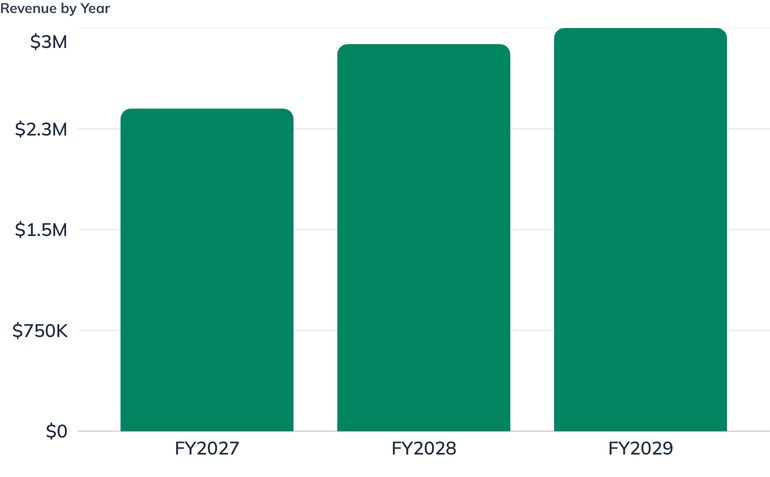
Revenue | $2,400,000 | $2,880,000 | $3,000,000 |
Blended gross margin | ~48% | ~48% | ~48% |
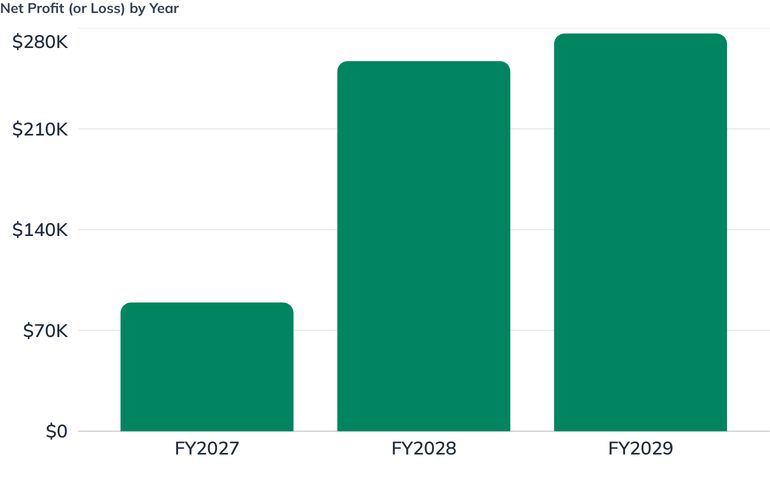
Net profit margin | ~3.7% | ~8.9% | ~9.2% |
Net profit | $89,352 | $257,018 | $276,159 |
Margins start thin in year 1 while the flagship store absorbs full Manhattan rent, technology lease, and maintenance costs against a still-ramping customer base; profitability strengthens meaningfully in year 2 as revenue grows faster than the largely fixed technology and facility cost base.
Company
Ownership and Structure
MillenniumMart is a joint venture between the founding principals and the management of Martin-Bower, one of the country's largest and most successful food distributors. The company is incorporated as a Delaware C-corporation, with shares held by private investors.
Martin-Bower holds a 29% equity stake in MillenniumMart's initial private shares, with an option to acquire an additional 11% based on the company's growth and profitability after the first five years.
The company operates under a board of directors. Mr. James Bean, a former senior manager at Martin-Bower, serves as CEO. Mrs. Linda Tuck serves as CFO.
Management Team
MillenniumMart's leadership pairs deep grocery/convenience-retail operating experience with hands-on automated-retail expertise, plus a strategic tie to Martin-Bower for distribution.
Mr. James Bean, CEO, is a graduate of the University of Texas at Austin's business school and brings more than twelve years in food distribution and grocery retail, including roles as vice president of marketing for Fry's Food and Drug, director of special projects for Giant Foods, and most recently senior vice president at Martin-Bower. His background in traditional grocery and convenience retail informs how MillenniumMart adapts merchandising and category management to a cashierless format.
Mrs. Linda Tuck, CFO, holds a graduate degree in finance from Kansas State University and brings eight years of experience across financial roles, most recently as a financial analyst at Circle K, giving her direct visibility into convenience-store unit economics from the competitor side of the table.
Mr. Minoru Takeda, Operations Manager, holds an MBA from the University of Osaka and spent six years as operations manager for Kiyama Inc., which operates roughly 600 automated convenience stores across Japan, direct, relevant experience running the kind of unstaffed retail format MillenniumMart is bringing to the U.S. market.
The team is rounded out by an office manager handling day-to-day administration and a small technician staff responsible for maintaining the camera, sensor, and entry-gate systems that keep the store running without on-site cashiers. As MillenniumMart proves out its flagship location and moves toward additional stores, the technician team is expected to grow fastest, since it scales most directly with store count.
Advisors
MillenniumMart benefits from the strategic partnership and industry expertise of Martin-Bower, one of the country's largest and most successful food distributors.
Martin-Bower management holds a 29% equity stake in MillenniumMart, with an option to acquire an additional 11% based on growth and profitability after the first five years. Their deep knowledge of food distribution, supply-chain logistics, and convenience retail provides guidance on inventory sourcing, vendor relationships, and category management that a standalone single-location operator couldn't access on its own.
Mr. James Bean, a former senior manager at Martin-Bower, serves as CEO and maintains close advisory ties with Martin-Bower's leadership team throughout the launch and expansion phases, giving MillenniumMart an ongoing channel back into distributor-side expertise beyond the initial investment relationship.
Financial Plan
Revenue
Need real milestones? We recommend using LivePlan as the easiest way to create milestones for your own business plan.Create your own business plan
Expenses & Costs
Need real milestones? We recommend using LivePlan as the easiest way to create milestones for your own business plan.Create your own business plan
Profitability
Need real milestones? Establish a clear path for your business with real-world examples.Create your own business plan
Use of Funds
Start-up funding of $600,000 will be deployed as follows:
Use | Amount |
|---|---|
Checkout & sensor equipment (cameras, smart shelves, entry gates) | $50,000 |
Leasehold improvements & store build-out (Manhattan flagship) | $200,000 |
Pre-opening expenses (legal, permits, pre-sale marketing, insurance, initial rent) | $100,000 |
Initial inventory (4-6 weeks of stock across all categories) | $100,000 |
Working capital reserve | $150,000 |
Total | $600,000 |
This is a meaningfully larger raise than a typical single-location convenience store would need, reflecting the up-front cost of the computer-vision and smart-shelf technology that makes the cashierless format possible, plus premium Manhattan build-out costs. Ongoing technology costs (equipment leasing, software, maintenance) are funded from operating cash flow rather than the initial raise; see Expenses & Costs.
Sources of Funds
MillenniumMart raises $600,000 in initial funding from two sources, all equity, no debt:
Source | Amount | Ownership |
|---|---|---|
Family and Friends | $350,000 | Private investor shares |
Martin-Bower management | $250,000 | 29% initial equity stake (option for additional 11%) |
Total Funding | $600,000 |
This capital covers the checkout technology, Manhattan leasehold build-out, pre-opening costs, initial inventory, and a working capital reserve sized to carry the store through its post-launch ramp-up months. Martin-Bower's investment includes both financial backing and strategic partnership in food distribution and supply chain operations.
There are no loans in the current forecast; all funding is equity investment, so there is no principal or interest expense in the model.
Projected Statements
Key Assumptions
Assumption | Value |
|---|---|
Blended gross margin | ~48% |
Corporate income tax rate | 27% (Delaware C-corp, blended federal/NY effective rate) |
Interest expense | $0 (no debt financing; funded entirely by equity) |
Plan start date | March 2026 |
Forecast period | 3 years shown (2026-2028), 5-year horizon overall |
Revenue growth | ~20% year 1 to year 2, ~4% year 2 to year 3 as the flagship store matures |
Revenue mix and cost of goods by category:
Revenue is modeled across four category streams rather than one blended total, since cost of goods varies significantly by category in convenience retail:
- Grocery, Snacks & General Merchandise (~45% of revenue): 67% cost of goods, typical for packaged retail resale
- Beverages & Coffee (~25% of revenue): 22% cost of goods, the highest-margin category
- Prepared & Grab-and-Go Food (~15% of revenue): 38% cost of goods
- Beer & Wine (~15% of revenue): 72% cost of goods, thin margins typical of regulated alcohol sales
Other assumptions:
- No fuel sales; this is a pure convenience-retail format, which supports a higher blended margin than the fuel-diluted industry average
- Revenue benchmarked against NACS industry data showing average U.S. convenience store in-store sales of roughly $2.2M/year; our dense Manhattan flagship location is modeled at or above that average given foot traffic
- Labor cost is structurally lower than a staffed 24-hour convenience store, since technicians (not cashiers) are the primary variable headcount, and headcount scales with store count rather than staffing shifts
- Significant up-front investment in computer-vision, smart-shelf, and entry-gate technology, funded through the initial equity raise rather than operating cash flow
Frequently Asked Questions
A convenience store business plan should cover your format and differentiation, location strategy, funding structure, and competitive positioning against established chains. MillenniumMart's plan, for example, centers on its cashierless computer-vision format, a joint venture with major food distributor Martin-Bower, a deliberate single-flagship-first expansion strategy, and a $600,000 all-equity funding plan.
MillenniumMart raised $600,000 in all-equity funding: $350,000 from family and friends plus $250,000 from Martin-Bower management in exchange for a 29% initial equity stake (with an option for an additional 11%). That covers checkout technology, its Manhattan leasehold build-out, pre-opening costs, initial inventory, and a working capital reserve — a notably tech-heavy budget, since a traditional staffed convenience store skips computer-vision cameras and smart-shelf sensors entirely and typically costs much less to open.
Yes — a convenience store selling beer, wine, and prepared food typically needs a retail food license, alcohol sales permit, and health department approval, on top of standard business registration and insurance. MillenniumMart handles age verification for beer and wine digitally at its entry gate rather than through a staffed counter, a genuinely novel approach whose regulatory acceptance can vary by jurisdiction and is worth confirming with local alcohol licensing authorities.
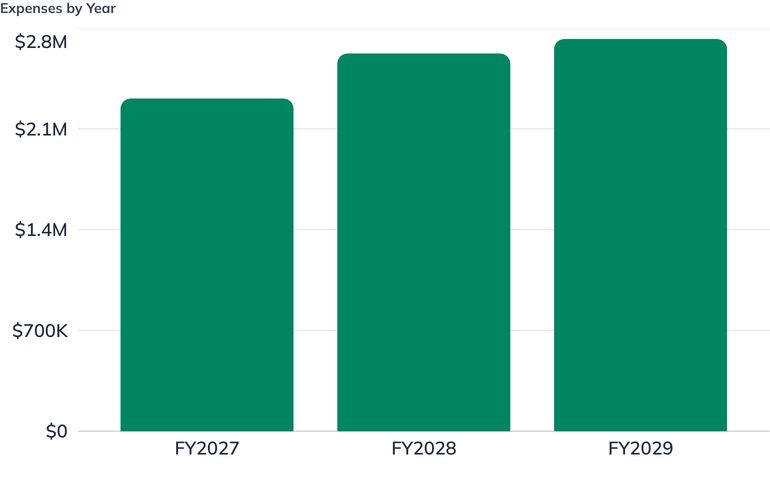
MillenniumMart earns revenue across four categories — grocery, snacks, and general merchandise; beverages and coffee; prepared and grab-and-go food; and beer and wine. Its five-year forecast projects about $8.28 million in total revenue against roughly $7.66 million in expenses, reflecting a model where much lower per-location labor costs get passed through partly as lower prices to compete directly with 7-Eleven, Wawa, and Circle K.
MillenniumMart's stated objective is to open and stabilize its flagship Manhattan location first, validating unit economics on a per-store basis before committing capital to additional sites starting in year two. Its five-year forecast shows healthy cumulative net profit of about $622,500 on $8.28 million in revenue, but the plan is explicit that proving the model at one location comes before any expansion decision.
Traditional chains like 7-Eleven, Circle K, and Wawa are fast to visit but still bottlenecked by staffed checkout during peak hours, while cashierless technology providers like Amazon's Just Walk Out, Zippin, AiFi, and Grabango mostly license their systems into existing retailers' formats. MillenniumMart's edge is operating its own flagship location end-to-end — store design, inventory, and a Martin-Bower distribution relationship most single-location operators can't access — plus passing through genuinely lower prices from lower labor costs rather than just claiming them as a marketing point.
MillenniumMart targets urban commuters, late-shift workers, and anyone making a quick stop between other obligations in downtown Manhattan, drawing on dense, round-the-clock foot traffic from commuters, office workers, and nearby residents. These are shoppers who value speed above all — the plan is built around cutting the time from walking in to walking out with what they came for down to seconds rather than minutes.
Customers open the MillenniumMart app, tap in with a QR code or NFC tap at the entry gate, pick up whatever they want, and walk out — no scanning, no register, no line. Ceiling-mounted computer-vision cameras combined with weight-sensing smart shelves track exactly what each customer picks up or puts back, and the app automatically charges the card on file after they leave, with a digital receipt arriving within seconds; beer and wine purchases go through an age-verification step at the entry gate instead of a staffed counter.

Business Plan Outline
Start your plan