




What Is Scenario Planning? Why Your Business Needs It

Jump to
Scenario planning is the practice of building more than one version of your financial forecast — typically a baseline, a best case, and a worst case — so you’re prepared for multiple outcomes instead of just one. A single forecast is a starting point, not a plan. From that baseline, scenario planning lets you test “what if sales fall by half?” or “what if costs spike?” before it happens, so you already know which decisions to make instead of scrambling in the moment.
Did you know the average business faces 12 major disruptions each year? Whether it’s an employee unexpectedly leaving, competition popping up, changes in consumer behavior, or economic disruption, small business owners face constant pressure to pivot and get ahead of change. Many small businesses that fail do so because they can’t handle that kind of uncertainty.
Scenario planning is a formal way of saying a business owner maps out multiple financial outlooks for their business — considering the possible impacts of “what if” situations like:
- What happens to sales if tariffs raise inventory costs by 10%?
- How long will it take for a new product or service to become profitable?
- How will increasing (or decreasing) headcount affect expenses?
Think of it as building contingency plans in advance. The upfront work means you feel prepared instead of panicked when circumstances actually change, because you’ve already mapped out a smart response.
Why isn’t one forecast enough?
A lot of founders build one forecast and treat it as the plan. The problem is there are a lot of different potential obstacles when you’re running a business, and a single forecast only pictures one of them — usually the one where everything goes well.
A more useful approach is to build three versions from the same starting point:
- A baseline forecast — everything going roughly as planned
- A best-case scenario — things go wildly well
- A worst-case scenario — you sell, say, half as much as expected
It’s the same idea as GPS mapping alternative routes before you head out — one route might have less traffic but take longer, another might avoid tolls. You want to know your options before you’re already on the road, not after you hit the detour. Scenario planning works the same way: having a few scenarios ready means you’re prepared to make good decisions no matter which version of the future actually happens, instead of finding out for the first time when it does.
Scenario planning versus financial forecasting
Financial forecasting is crucial for small businesses. Forecasts are financial projections of future revenue, expenses, cash flows, and other metrics, based on past performance or educated guesses. That last point matters — there’s no such thing as a perfect forecast. No one really knows what’s going to happen in their business until it happens. Forecasting is a business owner’s best effort to plan for the most likely outcome, revised as time passes to reflect what actually happened.
Scenario planning builds on financial forecasting. It takes that one forecast and explores multiple outcomes depending on what might happen. Think of a forecast as a driver’s expected route if the road stays straight. Scenario planning is mapping out the roadblocks and detours in advance, so you still reach your destination even when the road doesn’t stay straight.
What happens if sales don’t grow the way you expected?
Here’s a simple example. A service business starts at $10,000 in monthly revenue and expects to grow by $2,000 a month — so $10,000, $12,000, $14,000, $16,000, $18,000, and so on. That’s the expectation baked into the baseline forecast.
Now cut that growth rate in half. What happens?
You’ll most likely end up with less cash in the bank. If expenses were forecasted against the original, faster-growing revenue line, you’ll likely need to cut them in the slower-growth scenario. Direct costs will scale down proportionally with lower sales, but every fixed cost in the original forecast needs to be re-examined: can this business actually afford its fixed costs at 50% less revenue?
Working through that question surfaces real decisions a founder might need to make:
- Maybe the business can’t hire as many people as planned
- Maybe it needs a less expensive location
- Maybe cost of goods sold needs to come down
- Maybe the business doesn’t work at all at this revenue level — and it’s better to know that now than after signing a lease
Scenario planning gives a founder a vision of what the best case and worst case actually look like financially, so decisions and contingency plans are ready before the obstacle or opportunity actually shows up.
Scenario planning in action: a coffee shop example
Here’s a real example using LivePlan: a coffee shop dealing with a sudden increase in the cost of coffee beans.
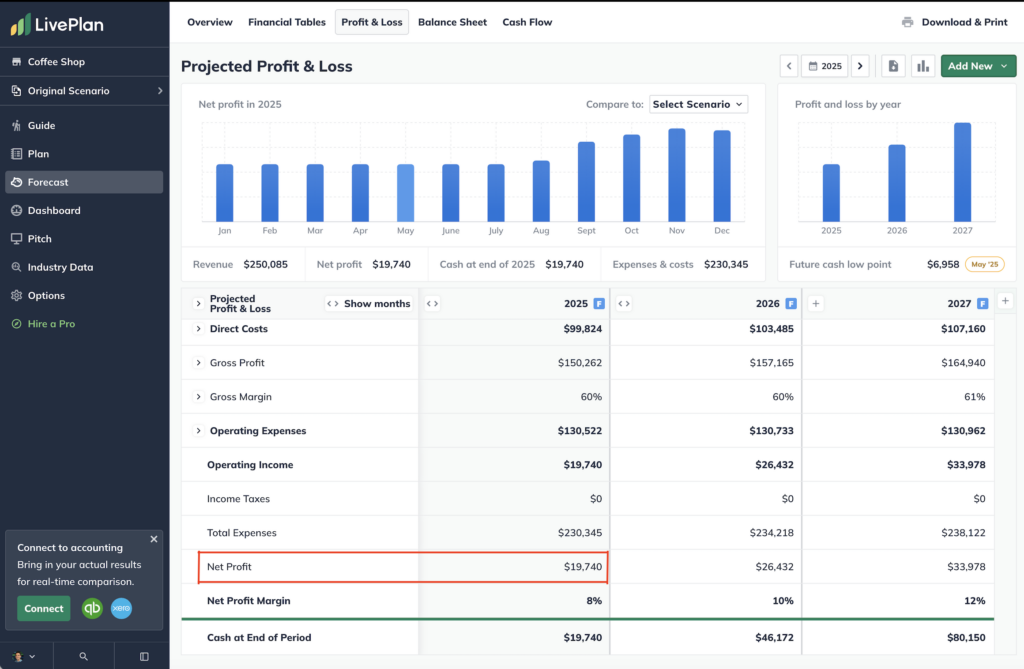
The picture above shows this coffee shop’s profit and loss forecast for three years. As you can see, the owner of this shop is projecting $19,740 in profits in year one, for an 8% profit margin.
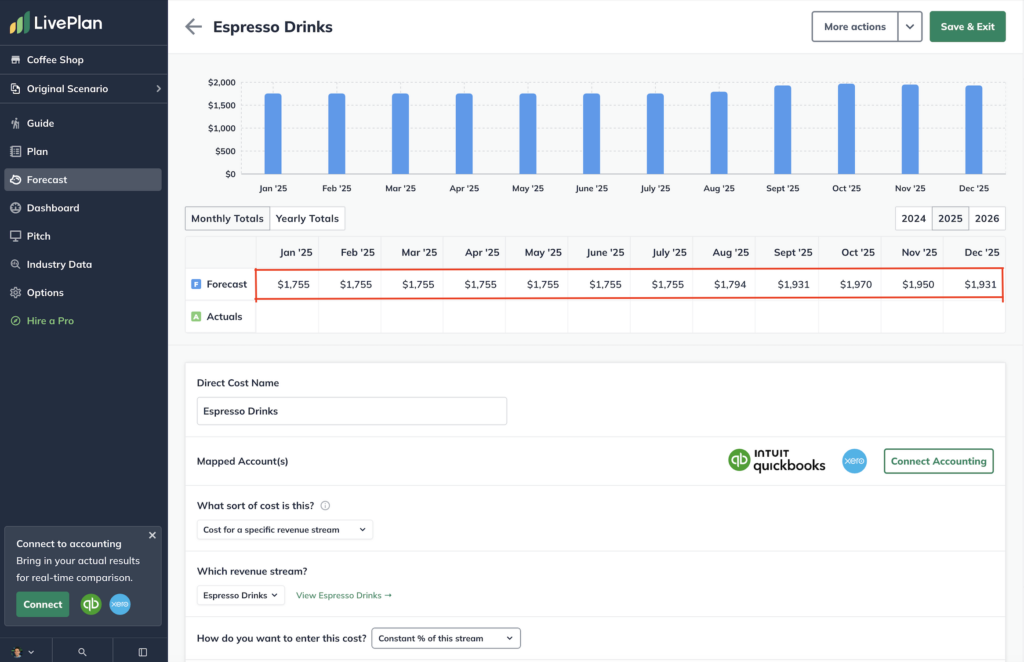
Now let’s zoom in and look at some of this coffee shop’s expenses. The picture below shows the direct costs for making espresso drinks. This forecast indicates that each espresso the shop makes costs it $3.
But what if things change? After all, the economy in 2025 is extremely volatile, with tariffs threatening to drive up the cost of imported goods — like coffee beans.
So, let’s say that those beans suddenly become more expensive. Now, the espresso that used to cost $3 to make costs $5.
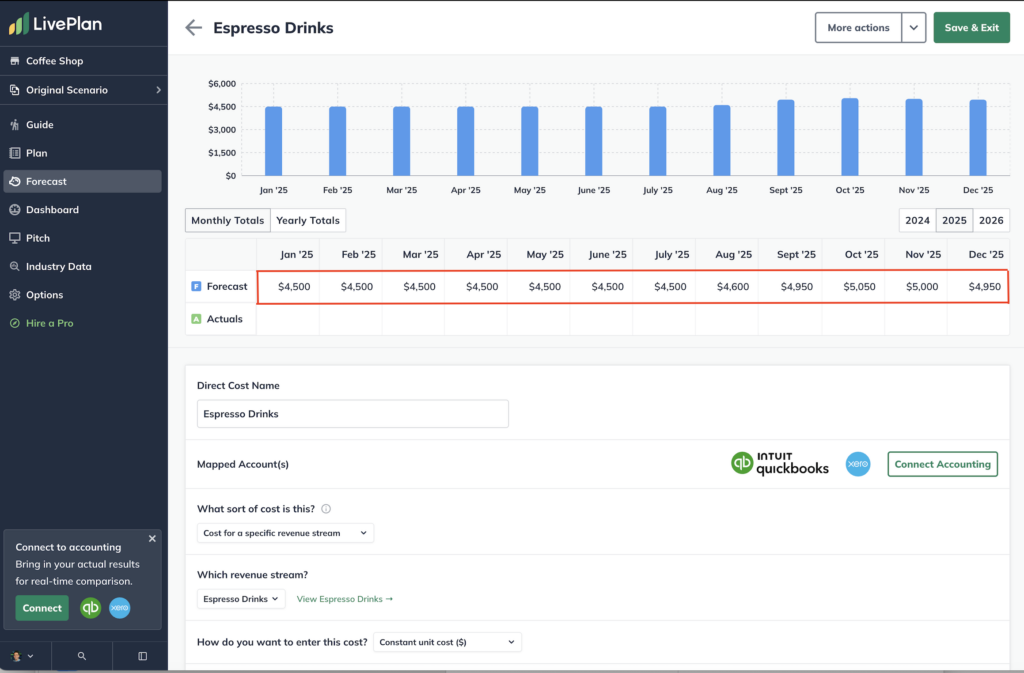
See the difference in the previous two images? The shop’s monthly expenses for espresso drinks more than doubled.
Remember that the shop was forecasting a bit under $20,000 in profit for 2025? Let’s see what impact these higher costs have on its bottom line.
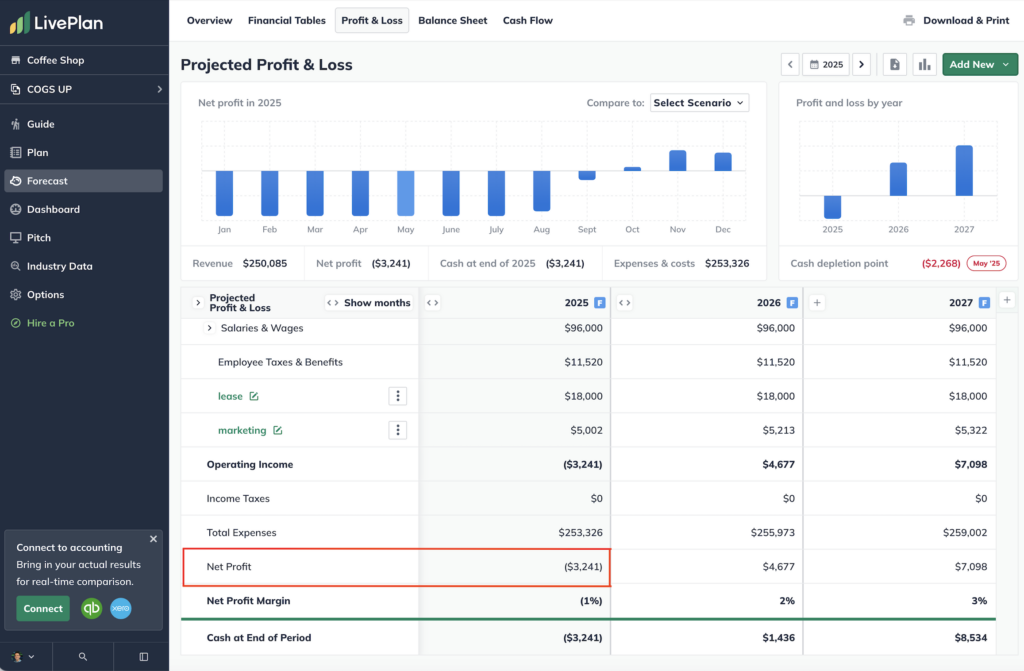
Yikes. That projected profit has been completely erased, and now the coffee shop is projecting a $3,241 loss for the year.
Of course, this is just a scenario plan based on a small business making assumptions about what’s going to happen in the future. But here’s why scenario planning is so powerful. If this were a real business, the owner would have valuable data to help them make decisions. In this case, they could go back into their scenario and raise their espresso prices to a level that brings them back to profitability.
The original forecast put the price of espresso drinks at $6.50. Take a look at what happens when the price increases to $8.
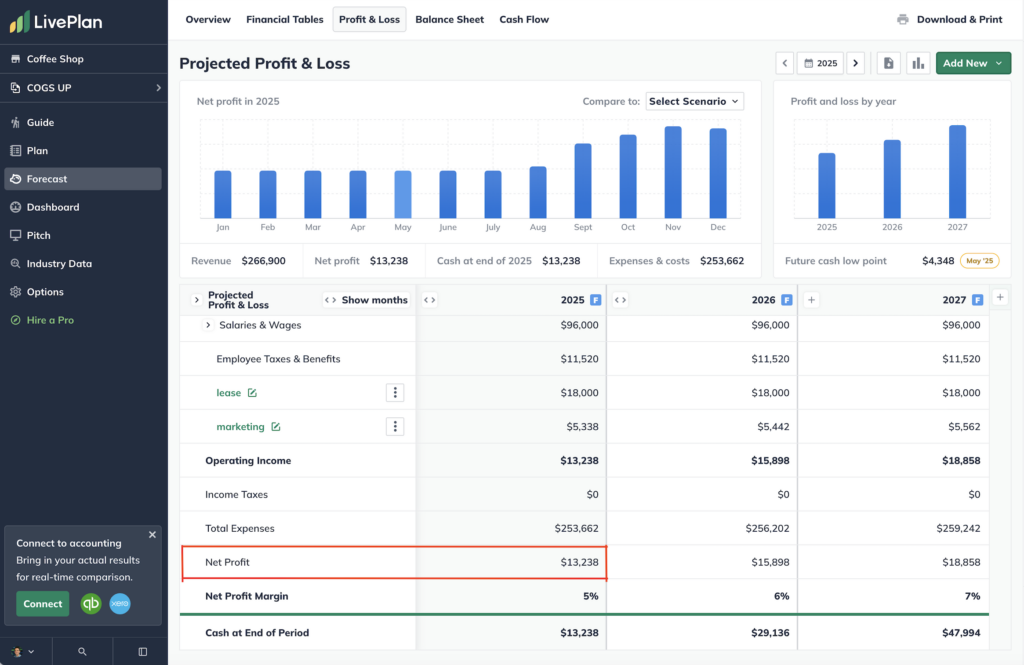

Back to profitability! Not as profitable as before the bean prices went up, but certainly better than when it just absorbed the entire cost increase without passing some of it on through higher espresso prices.
This same approach applies to any small business — coffee, massage therapy, dog grooming, accounting — anywhere a cost or revenue assumption could shift.
Why is scenario planning hard to do in a spreadsheet?
A real scenario doesn’t just change one number — it has to flow through the whole model. You need revenue and expenses flowing into a profit and loss statement, which flows into a cash flow forecast, which flows into a projected balance sheet. Having all three statements linked together is the only way a scenario is actually useful, because that’s what lets you see the two numbers that matter most: profitability and cash in the bank. Building that correctly in a spreadsheet — and keeping it correct across multiple scenario copies — is exactly where spreadsheets get hard to trust.
LivePlan’s scenario planning is built with this linkage in place. You can create a baseline forecast, then copy it to build additional scenarios with a few clicks — all three statements staying linked correctly in every copy. Cut revenue projections by 50% and instantly see the resulting P&L, cash flow, and balance sheet. Copy the baseline again with Help Me Forecast to model a 75% sales drop instead, and watch the same automatic flow-through into direct costs, expenses, and all three statements.
Frequently asked questions
Scenario planning is the process of building multiple versions of a financial forecast — typically a baseline, best case, and worst case — to prepare for different possible outcomes rather than relying on a single prediction.
A financial forecast is one best-effort projection of the future. Scenario planning takes that forecast and builds additional versions around it — testing what happens if a key assumption changes — so you have a plan ready for more than one possible outcome.
You can, but a useful scenario needs the profit and loss statement, cash flow forecast, and balance sheet to stay linked so a change in one flows correctly into the others. Keeping that linkage correct across multiple scenario copies in a spreadsheet is difficult and easy to break.
At minimum, three: a baseline (things go as planned), a best case, and a worst case. From there, you can add specific “what if” scenarios for decisions you’re actually facing, like a price increase, a new hire, or a cost spike.
Yes. The value of a worst-case scenario isn’t predicting doom — it’s knowing in advance whether your business can survive it, and what specific changes (pricing, staffing, location, costs) would keep it viable if it did happen.

Sabrina Parsons
Sabrina has served as CEO of Palo Alto Software since 2007. She and her husband, Noah, founded a UK software distribution company in 2001 that was acquired by Palo Alto Software in 2002. Sabrina is a successful Internet expert, having served as Director of Online Marketing at Commtouch, Senior Producer at Epinions, and founder of her own Web consulting company, Lighting Out.
More in Managing
managing
Control Your Stress, Efficiency, and Intelligence in 10 Minutes a Day
managing
It’s Never Too Early to Think About Your Successor
managing
How to Pivot Your Business During the Pandemic
managing