




How Much Does It Cost to Start a Food Truck?

Jump to
How much does it cost to start a food truck?
What a food truck costs depends first on how you get one. Building or outfitting your own runs from about $16,000 for a bare trailer shell you equip yourself to more than $225,000 for a fully built 24-foot truck, based on published builder pricing. Eastcoast Concessions sells empty trailer shells from $15,990 and says most of its equipped custom trailers land between $55,000 and $95,000 (Eastcoast Concessions). Concession Nation prices step-van builds from $47,000 for a 14-foot kitchen, not counting the van, to over $225,000 for a fully equipped 24-foot truck with the van included (Concession Nation). Buying a running food truck business usually lands in between: the 135 food truck and trailer businesses listed on BizBuySell on Oct. 1, 2026, had a median asking price of $110,000, and half asked between $68,000 and $185,000 (our math from BizBuySell's listings; asking prices, not sale prices). A franchise is the third option: the one truck franchise filing we found, Kona Ice, runs $114,730 to $228,601.
The rest depends on your city, and on fuel. Health and vending permits run from under $100 a year in some smaller cities to about $1,860 in the first year in San Francisco, many cities require a commissary that costs $500 to $1,800 a month, and in New York the hard part is getting a permit at all. Fuel is up sharply: diesel averaged $6.38 a gallon in late September 2026, $2.63 more than a year earlier (U.S. Energy Information Administration).
- For a turnkey benchmark, we found one truck franchise filing. Kona Ice, a shaved-ice truck franchise, puts a complete truck business at $114,730–$228,601, including the truck, equipment, licensing, insurance and opening inventory (Kona Ice FDD, April 2026, Wisconsin DFI file 641104). It doesn't cook, so a full kitchen truck needs more equipment and stricter permits.
- Trailers cost less than trucks for the same kitchen. One Florida builder puts the difference at roughly $8,000 to $10,000 (M&R Specialty Trailers), and you'll need a vehicle that can tow it.
- Your city sets your monthly floor. Commissary rent, parking programs and per-location fees are recurring, and they differ more between cities than any equipment line does.
How we sourced this page: every number links to the builder page, filing or government schedule it came from, with its date and whether it's national or local. Where a figure comes from a trade association rather than an official fee schedule, we say so. Where we couldn't find a citable number, we say that too. In all, we drew on 42 documents, listed at the bottom of the page.

Build, buy or franchise: what does each path cost?
Each path trades money for something else. Building gets you a kitchen designed for your menu, buying gets you a working truck and sometimes a following on day one, and a franchise gets you a proven concept and a brand for a fee.
Path | Typical cost | What you get | What to watch | Source |
|---|---|---|---|---|
Build or outfit your own | About $16,000 (bare trailer shell) to $225,000+ (fully built truck), plus permits, insurance and a commissary | A kitchen built for your menu | Get your health department's plan review before you build; trailers need a tow vehicle | |
Buy a running food truck business | Median asking price $110,000; half asked $68,000–$185,000 | A truck and equipment, and sometimes a name, a route and bookings | Asking prices aren't sale prices. Have the truck inspected by a mechanic and your health department's plan reviewer before you buy | BizBuySell listings, 135 listings on Oct. 1, 2026 (our math) |
Open a franchise | $114,730 to $228,601 (Kona Ice) | A truck and equipment package, a brand and an established menu | Kona Ice sells shaved ice, so it needs less equipment and lighter permits than a truck that cooks |
Whichever path you take, the running costs are the same: permits, a commissary, insurance and fuel. The sections below break those down by city.
What does each part of a food truck cost?
The vehicle and kitchen are most of the money; everything else is small individually but adds up. Figures in this table are national unless a city is named: builders sell across the country, and the franchise filing gives one estimate for everywhere.
Cost line | Range | Source | Geography |
|---|---|---|---|
Trailer, empty shell (8–16 ft) | $15,990–$32,400 | Eastcoast Concessions base prices | Builder list price |
Trailer, equipped (budget lines) | $32,000–$54,000 | Builder list price | |
Trailer, equipped (typical custom) | $55,000–$95,000 | Builder's stated typical range | |
Step-van truck kitchen build, van not included | From $47,000 (14 ft) | Builder list price | |
Fully equipped 24-ft truck, van included | $225,000+ | Builder list price | |
Franchise truck and installed equipment | $87,365–$157,491 | Kona Ice FDD, April 2026, Item 7 | National |
Vehicle tax, title and licensing | $1,000–$8,000 | Kona Ice FDD, Item 7 | National |
Health permit and plan review, first year | $72–$1,856 | City, county and state schedules (see the city tables) | City or state |
Commissary rent | $500–$1,800 a month | San Antonio and DC food truck associations (see the city table) | City, association-reported |
General liability insurance | From $299 a year | National; excludes the vehicle | |
Commercial auto insurance | $209 a month median ($2,509 a year) | Insureon, Sept. 2026 | National; median of Insureon's food truck customers |
Insurance for the first 3 months, all policies | $1,000–$2,100 | Kona Ice FDD, Item 7 | National |
Working capital, first 3 months | $0–$9,600 | Kona Ice FDD, Item 7 | National |
Two cautions on reading this table:
- Kona Ice is a best-case benchmark for permits and working capital. It serves shaved ice, so it needs less equipment, less inspection and less food inventory than a truck that cooks raw meat. Use its licensing and insurance lines as a floor, not an estimate.
- "Van not included" matters. Concession Nation's $47,000 starting price is the kitchen build only. Their fully equipped truck figure includes the van, which is why the jump to $225,000 is so large.
What national data shows
Government data shows a fast-growing industry of small businesses, and one cost a fixed restaurant doesn't carry: fuel, which rose sharply over the past year. The number of mobile food businesses with employees grew about a third from 2022 to 2025. All figures are national.
Measure | Figure | Source |
|---|---|---|
Mobile food service businesses with employees, 2025 | 12,663 establishments (up 5.4% from 2024 and 33% from 9,546 in 2022) employing 47,111 people | BLS Quarterly Census of Employment and Wages, NAICS 722330 (2022) |
Industry revenue, taxable employer firms, 2022 | $3.52 billion, up 26% from 2021 | |
Revenue per establishment, 2022 (our math) | About $368,000 | Census revenue ÷ 9,546 establishments in BLS QCEW, 2022 |
Average annual pay in the industry, 2025 | $27,072 | |
Prices at limited-service restaurants | Up 3.2% from August 2025 to August 2026 | |
On-highway diesel | $6.38 a gallon, U.S. average for the week of Sept. 28, 2026; up $2.63 from a year earlier | |
Regular gasoline | $4.47 a gallon, same week; up $1.35 from a year earlier |
These counts cover only businesses with employees, so owner-operated trucks without payroll aren't included. Fuel is worth its own line in your forecast: a price move this size changes the cost of every service day, and generators that run on gasoline add to it.
How much do food truck permits cost in my city?
Permit fees themselves are modest almost everywhere, from $72 a year in Coeur d'Alene to about $1,860 in the first year for a class 4 or 5 truck in San Francisco. The bigger local differences are commissary rent, where you're allowed to park, and whether you can get a permit at all. In Texas, the state has issued food truck licenses since July 1, 2026, so Austin, Houston and San Antonio no longer issue their own health permits for trucks.
We've grouped the examples by metro size using the USDA's definitions: major metros of 1 million or more people, medium metros of 250,000 to 1 million, and small metros under 250,000 (USDA Economic Research Service, 2023 Rural-Urban Continuum Codes).
Everything in these tables is local to the city or county named.
Major metros (1 million or more people)
City | Health or vending permit | Commissary | Rules that change your costs | Restaurant cook median wage (May 2025) |
|---|---|---|---|---|
Austin | Texas state license since July 1, 2026: $876 application plus a $500 pre-licensing inspection for a truck that prepares or cooks food, renewed yearly (Texas DSHS) | Required unless the truck meets the state's exemption checklist (DSHS Mobile Food Vendor Guide) | State law limits local regulation of food trucks | $17.70/hr |
Chicago | $1,000 per 2 years to cook on the truck; $700 to sell food prepared or packaged elsewhere; plus a $100 fire safety permit and a $150 fire suppression system review (City of Chicago) | Required; trucks must report to a commissary at least once a day for servicing (Chicago Department of Public Health rules) | No parking within 200 ft of a street-level restaurant entrance except 12–2 a.m.; up to 4 hours per block; GPS required; insurance of at least $350,000 (City of Chicago) | $18.72/hr |
Houston | Texas state license since July 1, 2026: $876 plus a $500 inspection for a truck that cooks, renewed yearly (Texas DSHS) | Required unless exempt under the state checklist (DSHS guide) | — | $16.85/hr |
Los Angeles County | $761 a year for a high-risk truck (raw meat) plus $741 plan check (LA County Public Health fee schedule, FY 2026–27) | Required; the county won't issue a permit until the commissary is verified, and it checks commissary use at random (LA County plan check guidelines) | — | $21.38/hr (LA metro) |
New York City | Permits run up to 2 years; new citywide and outer-borough permits require a supervisory license (NYC Health) | Required; trucks must return at least once a day | 2,200 supervisory license applications offered each year for 5 years starting July 1, 2026, to people on waiting lists created in 2022 (Local Law 54 of 2026) | $21.03/hr (NY metro) |
Portland (Multnomah County) | $760 a year (classes 1–3) or $920 (class 4); plan review $790, or $2,380 rush (Multnomah County 2026 fee schedule) | Most carts need one unless they have a 3-compartment sink (Multnomah County) | — | $21.73/hr |
San Antonio | Texas state license since July 1, 2026: $876 plus a $500 inspection for a truck that cooks, renewed yearly (Texas DSHS; San Antonio Metro Health) | $500–$1,200 a month (association-reported) (FTASA) | Fire permit $100–$300 a year (association-reported) | $16.76/hr |
San Francisco | Health permit: $244 a year for class 1–3 trucks or $977 for class 4–5, plus a $376–$879 plan check (SF Environmental Health fee schedule, FY 2025–26). Public Works permit: $199 filing, $318 notification and $608 inspection for the first location; each added location adds $318 notification plus $608 (second) or $304 (third and up) inspection; $199 renewal with no violations (SF Public Works) | — | Fees are per approved location | $22.13/hr |
Washington, DC | DC Health: $100 health inspection certificate every 6 months, plus $75 to review a mobile HACCP plan (DC Health vending application). DLCP: $99 vending business license and $300 mobile site permit, each for 2 years (DLCP) | Required; $1,000–$1,800 a month plus $200–$400 utilities (association-reported) (DCFTA) | Vending-zone lottery $65 a day or $450 a month cap (association-reported) | $20.64/hr |
Texas moved food truck licensing to the state. Since July 1, 2026, food trucks in Texas need a license from the Texas Department of State Health Services instead of a city health permit. A truck that prepares or cooks food (Type III) pays an $876 application fee and a $500 pre-licensing inspection, and the license runs one year from that inspection. Trucks must also operate from a licensed commissary unless they meet the state's exemption checklist (Texas DSHS; DSHS Mobile Food Vendor Guide).
Medium-size cities (metros of 250,000 to 1 million people)
City | Health or vending permit | Commissary | Rules that change your costs | Restaurant cook median wage (May 2025) |
|---|---|---|---|---|
Boise, ID | Central District Health: $80 a year with a licensed commissary or none, $100 with an unlicensed one; $100 plan review (CDH) | Not required; the license costs $20 more if your commissary isn't licensed | No separate city food truck license since March 2024; health rules unchanged (Boise State Public Radio) | $17.90/hr |
Des Moines, IA | State license $250 a year (Iowa DIAL), plus a city permit of $570 a year, a $100 fire inspection and a $200 cash bond (City of Des Moines) | Iowa defines a mobile unit as one that returns to a home base each day or stays up to three days in one spot (Iowa Food Protection Task Force) | Downtown sales only in four vendor zones, in metered spaces ($1,180 per meter hood); no sales within 100 ft of an open street-level restaurant entrance, or from 1:30 to 5:30 a.m. | $17.34/hr |
Small cities (metros under 250,000 people)
City | Health or vending permit | Commissary | Rules that change your costs | Restaurant cook median wage (May 2025) |
|---|---|---|---|---|
Coeur d'Alene, ID | Panhandle Health District: $72 a year if self-contained or using a licensed commissary; $100 plan review (PHD fee schedule, 2021, the latest posted) | Limited-service trucks must report to the commissary daily; full-service trucks regularly (PHD guidelines) | No homemade food may be sold, so all prep has to happen in approved facilities | $18.37/hr |
Rapid City, SD | State license $88 a year (SD Department of Health) | Required unless the truck has approved dishwashing and storage on board (SD Department of Health, July 2026) | Allowed on commercial or industrial lots, or in city parks with a parks vending permit; no vending within 300 ft of a downtown event without the sponsor's permission (Rapid City code 17.50.212) | $17.26/hr |
What the size comparison shows:
- Health permits cost far less outside big cities. Coeur d'Alene ($72), Rapid City ($88) and Boise ($80–$100) charge a fraction of Los Angeles County's $761 plus $741 plan check for a high-risk truck.
- City rules still apply in medium cities. Des Moines adds a $570 city permit, a bond and a fire inspection, and limits downtown sales to four zones, restrictions that look a lot like Chicago's.
- Cook wages don't track city size. Coeur d'Alene's median cook wage, $18.37, is higher than Houston's ($16.85) or San Antonio's ($16.76).
- Smaller cities rarely post complete fee schedules online. We only list cities where every column could be sourced. For others, many county health departments share fees only by phone or on application forms, so call before you budget.
Where these numbers come from:
- Permits: each city or county's published fee schedule, or the Texas state license for Austin, Houston and San Antonio. San Antonio's commissary and fire figures, and DC's commissary and lottery figures, come from the local food truck associations' 2026 permit guides, which give ranges rather than official line items. We've labeled those "association-reported."
- — means we haven't found a citable figure yet, not that there's no requirement. Ask the health department.
- Wages: median hourly wage for "cooks, restaurant" by metro area (BLS Occupational Employment and Wage Statistics, May 2025).
How much cash do you need to keep a food truck running?
Plan on covering a fixed monthly floor before you sell anything. In Washington, DC, commissary rent, commissary utilities and the vending-lottery cap alone come to about $1,650–$2,650 a month, based on the local association's figures (DCFTA). Add a vehicle payment if you finance: Concession Nation quotes lease-to-own from about $1,050 a month (Concession Nation). Insurance adds at least $26 a month for general liability (FLIP), plus commercial auto, where Insureon's food truck customers pay a median $209 a month (Insureon).
That floor is before food, fuel, propane, labor and card fees, which all rise and fall with sales.
The one franchise filing sets aside $0 to $9,600 for the first three months (Kona Ice FDD, April 2026). Treat that as a low bound: a shaved-ice truck carries far less inventory and fewer fixed costs than a full kitchen. We didn't find a current, citable source for how long a new food truck takes to break even.
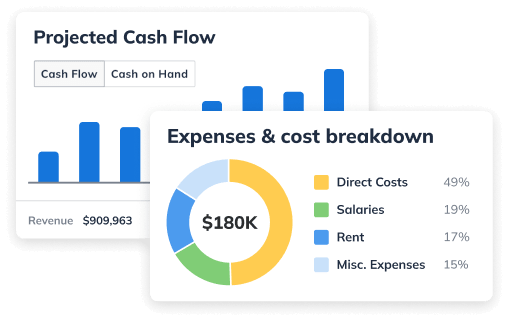
Food trucks are also seasonal, and bad-weather months can bring your sales down while the commissary bill stays the same. A month-by-month cash flow forecast is how you see this coming. In LivePlan you can set a seasonal sales pattern, add your fixed monthly costs, and check whether your cash covers the slowest stretch of the year, not just the first month.
What food truck costs catch first-time owners off guard?
The surprises are mostly recurring local costs and rules, not equipment.
- In New York, the permit may be the bottleneck, not the money. New full-term citywide and outer-borough permits require a supervisory license, and starting July 1, 2026, the city is offering at least 2,200 license applications a year for five years to people on waiting lists created in 2022 (NYC Health; Local Law 54 of 2026). Budget time, not just fees.
- The commissary is a monthly bill that never stops. Associations in San Antonio and DC put commissary rent at $500–$1,200 and $1,000–$1,800 a month (FTASA, DCFTA). New York and Chicago require trucks to return to one at least once a day (NYC Health, Chicago Department of Public Health).
- Cheap liability insurance doesn't cover the truck. FLIP's $299-a-year policy covers general and product liability, but FLIP says it "is not designed to cover your vehicle" (FLIP). Commercial auto is a separate policy, and Insureon's food truck customers pay a median $209 a month for it (Insureon).
- Plan review comes before your first permit. Los Angeles County charges $741 to review a high-risk truck's plans, and Multnomah County charges $790, or $2,380 for a rush (LA County, Multnomah County). San Francisco's plan check runs $376–$879 (SF Environmental Health). Revisions cost extra too: DC's association lists $100–$200 per plan revision (DCFTA).
- Location rules can cut your best spots. Chicago bans parking within 200 feet of a street-level restaurant entrance except 12–2 a.m., limits stops to 4 hours per block and requires GPS on every truck (City of Chicago). San Francisco charges a new notification fee and inspection fee for every location you add (SF Public Works).
What licenses and permits does a food truck need?
Expect four layers: a health permit for the truck, a city vending or business license, vehicle registration, and your business's state and tax registrations. The city table above shows what the first two cost in nine places.
- Health permit and plan review: issued by the city or county health department after it reviews your truck's layout and equipment. High-risk menus, such as raw meat, usually cost more; Los Angeles County's high-risk permit is $761 a year (LA County). In Texas, the state issues this license instead: $876 plus a $500 inspection for a truck that cooks (Texas DSHS).
- Vending or business license: issued by the city. Some cities limit how many exist (New York) or where you can park (Chicago). DC charges $99 for a 2-year vending license plus $300 for a 2-year mobile site permit (DLCP).
- Commissary agreement: many health departments want proof of an approved commissary before they inspect. New York asks for the agreement at the pre-permit inspection (NYC Health), and Los Angeles County won't issue a permit until it has verified the commissary (LA County).
- Fire inspection: trucks with cooking equipment and propane usually need one. San Antonio's association puts it at $100–$300 a year (FTASA).
- Vehicle tax, title and registration: Kona Ice budgets $1,000–$8,000 (Kona Ice FDD, April 2026).
- Food safety certification: at least one certified food manager, plus food handler cards where required. Texas requires a certified food manager when a truck prepares food that needs time and temperature control (DSHS guide).
If you plan to work events in neighboring cities, each may require its own permit. Ask each health department before you book.
What couldn't we pin down?
There's no national dataset for food truck permits or commissaries, so every city is its own research job. These are the gaps.
- Used truck prices. Listings vary with age, mileage and what's already installed, and we didn't find a public dataset of sale prices. Have a used truck inspected by a mechanic and your health department's plan reviewer before you buy.
- Commissary rent outside DC and San Antonio. Commissaries set their own prices, and only those two associations published ranges. Call three in your city.
- Your own commercial auto premium. Insureon's $209-a-month median is a useful benchmark, but your quote depends on your driving record, the vehicle and where it's parked.
- A few cells in the city table. Commissary rules for San Francisco, and local location rules for Houston and Los Angeles County, aren't in the table yet. Dashes mean "not verified," not "not required."
- Time to break even. We didn't find a current, citable source. Your own forecast, built on your city's costs, is the honest answer.
How do I find these numbers for my own city?
Start with the health department, because its rules decide your equipment, your commissary and your timeline.
- Health department: search your city or county name plus "mobile food facility" or "mobile food vendor" for the fee schedule, plan review checklist and commissary rules.
- City business licensing: find out whether the city caps permits, limits where trucks can park, or charges per location.
- Where the lunch crowd is: the Census Bureau's OnTheMap shows where people work, block by block, so you can see daytime population, not just who lives nearby.
- Competition: Census Business Builder counts mobile food services businesses (industry code 722330) in your county.
- Wages: look up "cooks, restaurant" for your metro in BLS wage data.
- Commissary and insurance: get three quotes each. These are the lines most likely to differ from any published number.
How do you start a food truck, step by step?
- Read your health department's rules first. Menu risk level, commissary requirements and plan review decide what kitchen you can build. Doing this before you buy a truck avoids paying to rebuild one.
- Pick your menu and service model. A limited menu means less equipment, a smaller build and possibly a lower-risk permit. Decide whether to build your own, buy a running truck or open a franchise (see the comparison above), and between a trailer and a truck; trailers cost less for the same kitchen but need a tow vehicle.
- Find where you'll sell. Map lunch crowds with OnTheMap, check parking rules and permit caps, and line up events or private lots.
- Price the build. Get quotes from at least two builders, and ask what's included: generator, fire suppression, hood and water tanks change the price most.
- Build your forecast. Estimate covers per service, average ticket and service days per month, then add your fixed costs: commissary, insurance, permits and any vehicle payment. The free food truck sample business plan gives you a starting structure, and LivePlan's forecast turns your numbers into monthly cash flow, including slow seasons.
- Form your company and apply for permits. Submit plans for review, sign a commissary agreement, and schedule health and fire inspections.
- Insure the business and the vehicle. General liability and commercial auto are separate policies.
- Launch, then track every service. Compare actual sales and food costs with your forecast each month, and adjust your menu and locations based on what the numbers show.
Ready to put real numbers behind step 5? Start your food truck plan in LivePlan.
Frequently asked questions
Possibly, with a trailer and a simple menu. Equipped budget trailers start around $32,000 from one builder (Concession Nation), and bare trailer shells start at $15,990 before equipment (Eastcoast Concessions). You'd still need a tow vehicle, permits, insurance, a commissary and opening inventory.
Yes, for the same kitchen. One builder puts trucks at roughly $8,000 to $10,000 more than comparable trailers (M&R Specialty Trailers). The tradeoff is setup time and the need for a tow vehicle.
In many cities, yes. New York requires trucks to be stored and serviced at an approved facility and to return at least once a day (NYC Health). Multnomah County (Portland) says most carts need one unless they have a three-compartment sink (Multnomah County).
It depends on the waiting list. Starting July 1, 2026, the city is offering at least 2,200 supervisory license applications a year for five years to people on waiting lists created in 2022 (NYC Health; Local Law 54 of 2026).
Partly. Federal law lets you deduct up to $5,000 of start-up expenditures in your first year, reduced dollar for dollar once they pass $50,000, and spread the rest over 180 months (26 U.S.C. §195). The truck itself is generally depreciated separately; ask a tax professional.
Sources
All accessed September 2026. Dates in parentheses are the date of the data.
Franchise disclosure document (public on the Wisconsin DFI franchise registry; search by brand)
- Kona Ice, Inc., Franchise Disclosure Document (April 2026), file 641104. Item 7.
Industry data, fuel prices and listings
- U.S. Bureau of Labor Statistics, Quarterly Census of Employment and Wages, NAICS 722330 (2025 annual averages; 2022)
- U.S. Census Bureau, Service Annual Survey: revenue for mobile food services, via FRED (2022)
- BLS Consumer Price Index, limited service meals and snacks (August 2026)
- U.S. Energy Information Administration, gasoline and diesel fuel update (week of Sept. 28, 2026)
- BizBuySell, food trucks for sale (135 food truck and trailer listings with asking prices, Oct. 1, 2026)
Builders and insurers (published pricing)
- Eastcoast Concessions, food truck trailers
- Concession Nation, food truck build FAQ
- M&R Specialty Trailers and Trucks, concession packages
- Food Liability Insurance Program (FLIP), food truck insurance cost
City and county permit schedules
- City of Chicago, food truck licensing
- Chicago Department of Public Health, mobile food vendor and shared kitchen rules
- Los Angeles County Public Health, FY 2026–27 fee schedule
- Los Angeles County Public Health, mobile food facility plan check guidelines
- NYC Health, mobile food vendors
- New York City Local Law 54 of 2026, supervisory licenses
- Multnomah County: food cart license and 2026 base fee schedule
- San Antonio Metro Health, mobile food vending
- San Francisco Environmental Health fee schedule (FY 2025–26)
- San Francisco Public Works, mobile food fee schedule
- DC: DLCP, vending in the District and DC Health vending application
State licensing and insurance
- Texas Department of State Health Services: mobile food vendors and Mobile Food Vendor Guide (July 2026)
- Insureon, food truck insurance costs (Sept. 2026)
Medium and small cities
- USDA ERS, Rural-Urban Continuum Codes documentation (2023 codes)
- Central District Health (Boise), food establishment licenses
- Boise State Public Radio, Boise drops duplicative food truck licensing (March 2024)
- Iowa Department of Inspections, Appeals and Licensing, mobile food units
- Iowa Food Protection Task Force, food trucks, trailers and carts
- City of Des Moines, mobile food vendor application
- Panhandle Health District: fee schedule (2021) and mobile food establishment guidelines
- South Dakota Department of Health: food license application (2025) and mobile food service requirements (July 2026)
- Rapid City Municipal Code 17.50.212, mobile food vendors
Local associations (ranges, not official fee schedules)
- Food Truck Association of San Antonio, permits and licenses (2026 edition)
- DC Food Truck Association, permits and licenses (2026 edition)
Wages and tax
- BLS Occupational Employment and Wage Statistics, metro areas (May 2025)
- 26 U.S.C. §195, start-up expenditures
Tools for your own research

Noah Parsons
Before joining Palo Alto Software, Noah Parsons was an early Internet marketing and product expert in the Silicon Valley. He joined Yahoo! in 1996 as one of its first 101 employees and become Producer of the Yahoo! Employment property as part of the Yahoo! Classifieds team before leaving to serve as Director of Production at Epinions.com. He is a graduate of Princeton University.Noah devotes most of his free time to his three young sons. In the winter you'll find him giving them lessons on the ski slopes, and in summer they're usually involved in a variety of outdoor pursuits.Noah is currently the COO at Palo Alto Software, makers of the online business plan app LivePlan.