



Cash Flow Statement Example: How to Read One Line by Line


Jump to

Quick answer: Cash is the lifeblood of every business. Run out of cash and you can't pay your bills or make payroll. The cash flow statement shows how much cash you have in the bank and how it's moving in and out over time — and the fastest way to understand yours is to walk through a cash flow example line by line. That's what this guide does.
What is a cash flow statement?
A cash flow statement tracks cash moving into and out of your business over a period of time, such as a month or a quarter. It shows where cash comes from, where you spend it, and whether you’re accumulating cash or burning through it.
Cash Flow Statement: A financial statement that tracks the inflow and outflow of cash for your business over a given period.
Every example of a cash flow statement is divided into the same three sections:
- Cash flow from operations: Cash generated or used by day-to-day business activities.
- Cash flow from investing: Buying or selling assets.
- Cash flow from financing: The impact of debt or equity financing.
It’s one of three key financial statements, alongside the income statement (P&L) and balance sheet. Analyzed together, they give a full picture of your business’s finances.
Cash flow formula with example
The basic formula is simple:
Cash Flow = Cash Received – Cash Paid Out
A quick cash flow example: last month you received $15,000 in cash from customers and paid $10,000 in bills. Your cash flow was $5,000.
Real-world calculations are trickier, which is why I recommend a forecasting tool like LivePlan’s cash flow forecast or the free cash flow statement template above — both come pre-built with the correct formulas and formatting.
Cash flow statement example, explained line by line
The example below uses the indirect method — the approach most accounting systems use. An indirect method cash flow statement example starts with net income and adjusts for non-cash items and working capital changes. (The direct method lists cash inflows and outflows directly without adjusting net income; both methods are valid.)
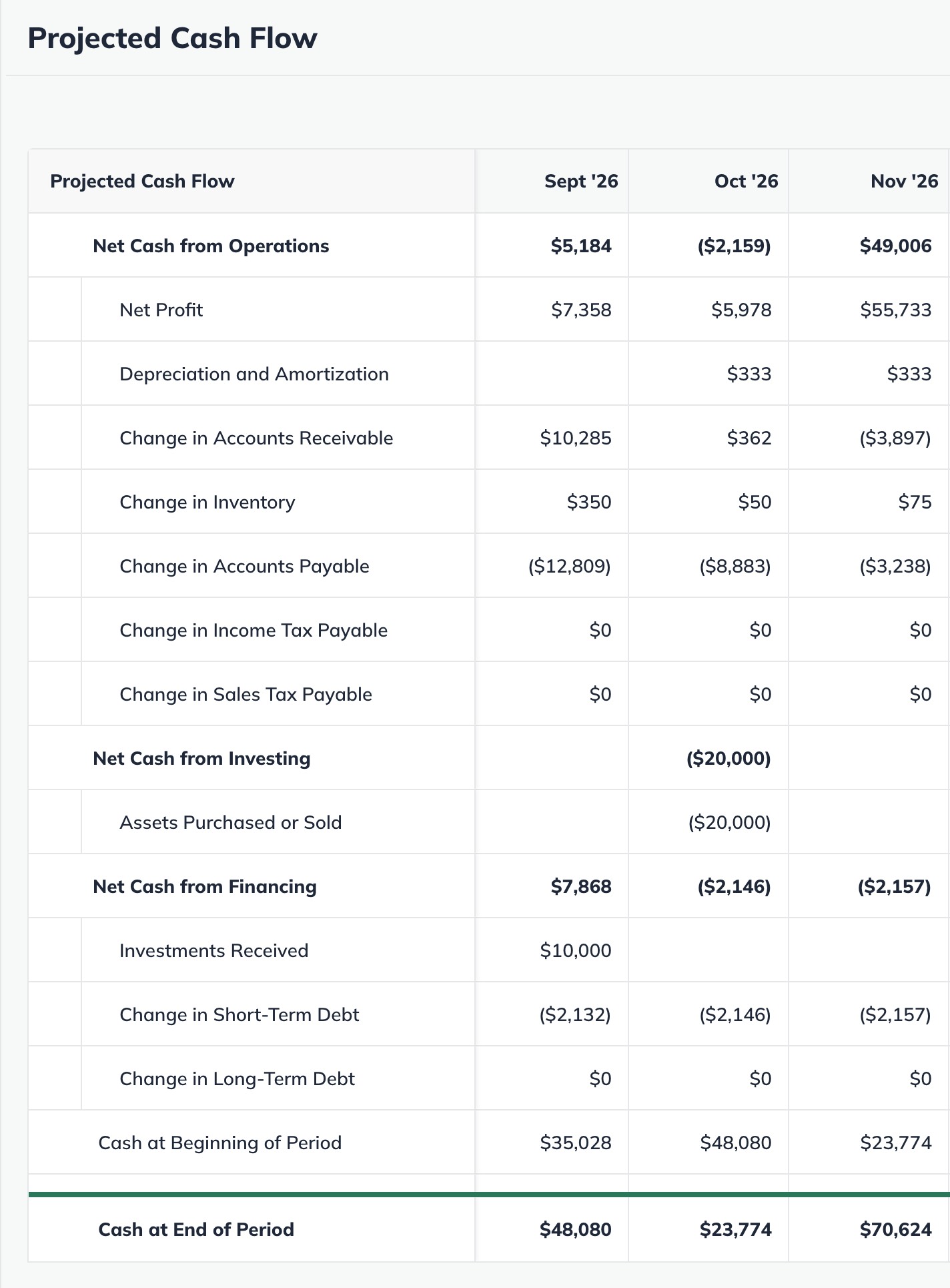
Here's what each line means and where the numbers come from
Cash from operating activities
This section measures your regular cash inflows and outflows and your ability to cover short-term obligations.
Net profit — Comes straight from your P&L or income statement. Cash flow starts here, then adjusts up and down to find how much cash is actually left at the end of a given period. A strong profit doesn’t guarantee cash in the bank — the lines below tell you if and when profit actually converts to cash.
Depreciation and amortization — When you buy an asset (like a vehicle or large piece of equipment), its cost is spread over time on your P&L even if you paid cash up front. Since depreciation was subtracted as an expense on the P&L but isn’t a cash outflow, you add it back here.
Change in accounts receivable — The change in what customers owe you, not the total. Positive means customers paid down what they owed; negative means they owe you more than last month. A negative number isn’t automatically bad — it can mean sales grew faster than invoices got paid — but it can also mean you need to chase delinquent accounts. Compare it to your sales trend to tell the difference.
Change in inventory — Inventory purchases show up here, not on your P&L (they hit the P&L as cost of goods sold when items sell). Negative here means you bought more than you sold; positive means the reverse. Example: a bike shop that restocks two or three times a year shows a big negative number in buying months, then positive numbers as inventory sells down. Judge this line against your normal restocking rhythm, not against zero.
Change in accounts payable — The change in what you owe vendors. Positive means you received bills you haven’t paid yet; negative means you paid down more than you received. Paying down more than planned is a common, easy-to-miss reason cash comes in lower than expected even when profit looks good. Watch this line over several months rather than reacting to one.
Income taxes and sales tax payable — For sales tax (or VAT, GST, HST), positive means you collected tax from customers but haven’t remitted it yet; negative means you paid the government more than you collected — common because of the lag between collecting and remitting. Income tax payments are recorded on their own row when made.
Cash from investing activities
Cash spent on or generated from longer-term assets like property, equipment, securities. When you buy an asset with cash, subtract the purchase here; when you sell one, the proceeds show up here. (If you borrowed to buy it, the loan itself belongs in the financing section.)
Cash from financing activities
Transactions involving debt, equity, and distributions:
Investments received — If funds come in from an investor in the period, that investment amount shows up here.
Dividends and distributions — Any non-salary cash paid out to owners.
Change in short-term and long-term debt — Positive means you borrowed more than you repaid that month; negative means the reverse. Example: a $25,000 three-year loan received in September appears as +$25,000 (split between September’s short and long-term debt rows), then negative numbers each month once repayment starts in October.
Totaling it up
Cash at beginning of period — Cash in the bank at the start of the period.
Net change in cash — The sum of every line above: your net cash flow for the period.
Cash at end of period — Beginning cash plus the net change. This is what’s actually in the bank at the end of the period.
Keep a month-to-month statement for at least the current year. You’ll use it to track performance, update your cash flow forecast, and run a monthly analysis.
How to read it: a cash flow analysis example
Analyzing your statement starts with one question — is net change in cash positive or negative? Reviewing it regularly this way is called a cash flow analysis.
Positive cash flow means your net change in cash is adding to your bank balance. If it’s more than expected, that may be a sign you can reinvest, pay off debt, or fund growth. But remember: cash and profits are not the same. A business can be profitable and lose cash at the same time — or be cash flow positive while unprofitable.
Negative cash flow means you’re burning cash and shrinking your runway. If it’s unexpected, check whether cash flow has been trending down, receivables have grown, payables have shrunk, or profit came in low. (Negative cash flow from deliberate reinvestment in growth is expected and usually fine.)
Profits are up — so why isn’t there more cash in the bank?
This is the most common question in cash flow analysis, and the answer is almost always in one of three lines:
- Accounts receivable is negative — customers haven’t paid for sales you’ve booked.
- Accounts payable is more negative than planned — you paid down more bills than expected.
- Inventory is more negative than planned — cash went into stock to support higher sales.
Worked example: A service business (no inventory) sees a positive net change in cash, but lower than planned. Net profit was actually higher than expected, and receivables were roughly on plan. The culprit: accounts payable showed a large amount paid out — more outstanding bills were paid off than the plan called for. The shortfall came from paying bills faster, not weak sales or slow-paying customers. The fix: review payment terms and account for bills coming due in advance.
Whenever net change in cash misses plan, work through receivables, payables, and inventory in that order before questioning sales or expenses. Most surprises trace to one of those three lines.
Cash flow statement vs. cash flow forecast
A cash flow forecast uses the same format but predicts the future instead of recording the past. You should have both: look back at your statement to spot trends, then use them to plan ahead for cash stockpiles or crunches.
Update your forecast with actuals every month. If you skip this, the forecast drifts too far from reality. It’s much easier to open a line of credit when your business is healthy than mid-crunch. Comparing plan to actuals also points to concrete next moves: negotiating vendor payment terms, collecting from customers faster, or rethinking inventory reorders.
Frequently asked questions
Any movement of cash in or out of your business: a customer paying an invoice, you paying rent, receiving a loan, or buying equipment. On the statement, these are grouped into operating, investing, and financing activities.
Yes — download the free template linked at the top of this article. It works for any small business and comes pre-built with the correct formulas and formatting.
Yes. A cash flow statement shows all inflows and outflows; free cash flow focuses on cash available after operating expenses and capital expenditures.
Under operating activities.
Under financing activities.

Noah Parsons
Before joining Palo Alto Software, Noah Parsons was an early Internet marketing and product expert in the Silicon Valley. He joined Yahoo! in 1996 as one of its first 101 employees and become Producer of the Yahoo! Employment property as part of the Yahoo! Classifieds team before leaving to serve as Director of Production at Epinions.com. He is a graduate of Princeton University.Noah devotes most of his free time to his three young sons. In the winter you'll find him giving them lessons on the ski slopes, and in summer they're usually involved in a variety of outdoor pursuits.Noah is currently the COO at Palo Alto Software, makers of the online business plan app LivePlan.