





Hair And Beauty Salon Business Plan



Business Plan Summary
This hair and beauty salon business plan example features Trend Setters Hair Studio, a full-service salon in Round Rock, Texas offering hair, nail, and basic skin services from one licensed team at prices between chain haircut shops and Austin's luxury day spas. It covers the market gap the founder identified, a three-stream revenue model, a $150K financing plan, and a path to profitability by Year 3. Use it as inspiration for your own plan, and read our guide on how to start a hair salon for step-by-step advice, or our guide on how to write a hair and beauty salon business plan. If your concept leans toward a different niche, see our men's salon and barber shop business plan or our budget hair salon business plan example. Download a free business plan template to get started, or browse more business plan examples.
Trend Setters Hair Studio
Executive Summary
Problem
Round Rock and the surrounding northern Austin suburbs are underserved by mid-market beauty salons. Residents choose between $15–$20 chain haircut shops (Great Clips, Sport Clips, SmartStyle) that offer speed but little relationship or skill for color and styling, or $150–$250 luxury day spas clustered around Austin's Domain and Westlake that most working families can't justify for routine hair, nail, and skin care. There's no well-run, professional option in between — and clients are often forced to split their beauty routine across multiple businesses just to get hair, nails, and basic skin care done.
Solution
Trend Setters Hair Studio is a full-service beauty salon offering skilled hair cuts, color, and styling alongside nail care and basic skin services, all from the same licensed cosmetologists, at prices that respect a working family's budget without cutting corners on training, products, or atmosphere.
Market
Our clients are fashion-conscious women and men across Round Rock, Pflugerville, and Cedar Park with disposable income for regular salon visits but no interest in day-spa prices — working moms, dual-income professionals commuting to nearby employers like Dell and the broader Austin tech corridor, and their families. Roughly 70% of our client base is women booking color, styling, and nail services; the remainder is men and children.
Competition
We compete against low-cost chains on one side and high-end Austin day spas on the other. We win by offering chain-beating skill (every stylist is a licensed, experienced professional, not an entry-level hire) at a fraction of luxury-spa prices, with hair, nails, and basic skin services all in one convenient visit.
Why Us?
Trend Setters is built around owner Carla Mendez's twelve years of experience and loyal client following from a top Austin salon. Clients follow a stylist they trust — Carla is bringing that trust, plus a team of equally committed stylists, into a shop designed around convenience, consistency, and fair pricing for the full range of beauty services our clients actually use.
Expectations
Forecast
Our forecast reflects a realistic opening timeline: we sign our lease and begin build-out around September 2026, hire and train through October, and hold our grand opening in November 2026 — meaning our first partial year carries real pre-launch and ramp-up costs (lease, setup, licensing, early payroll) against only a couple of months of actual revenue. We forecast hair services, retail product sales, and nail/skin services as three distinct revenue streams, each with its own ramp and cost structure, rather than blending them into one line.
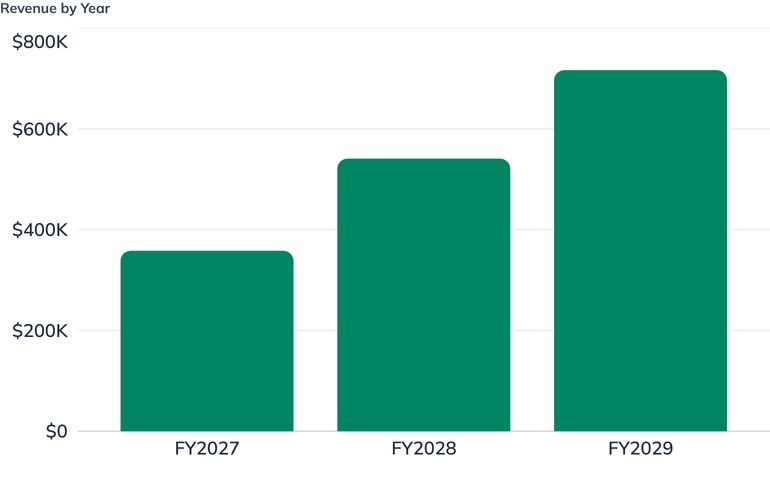
We expect a loss in our opening partial year as pre-launch costs and ramp-up outpace revenue, a roughly breakeven Year 2 as our newly added third stylist chair ramps toward a full client book, and a solidly profitable Year 3 — revenue growing from roughly $358K to $632K over that span, with Year 3 net profit around $57K, a 9% net margin that approaches the hair salon industry average (commonly cited around 9% net / 15% operating margin for established, well-run salons). We get there through the same levers real salons use to mature past a thin opening-year margin: full utilization across five chairs including our third stylist, better wholesale pricing on retail product as we qualify for volume terms with our distributor (see Equipment and Tools), and disciplined cost control on supplies and payment processing as our systems mature. This is a more conservative, and we believe more honest, trajectory than assuming industry-average margins from day one — we're approaching that benchmark by Year 3, not claiming it at launch. We review actuals against forecast monthly and adjust staffing and marketing spend accordingly (see Milestones).
Need real milestones? We recommend using LivePlan as the easiest way to create milestones for your own business plan.Create your own business plan

Financing Needed
We plan to raise $100K in owner investment — sized to cover our full-service buildout (including the nail and skin service area and the part-time nail technician role), a realistic market-rate lease with build-out costs factored in, pre-launch setup costs, and a genuine cash cushion through our opening-year loss — supplemented by $50K in vendor equipment financing to furnish the salon (styling stations, wash basins, dryers, nail and skin service equipment, and reception furniture) without tying up all our cash reserves. Starting costs include roughly $9K in pre-launch expenses (security deposit, signage, initial licensing and permitting fees, opening inventory) on top of $53K in tangible assets at launch.
Opportunity
Problem Worth Solving
Fashion-conscious residents of Round Rock and the northern Austin suburbs face a gap in the local beauty salon market. Chain haircut shops are inexpensive but inconsistent, offer little to no nail or skin care, and have high stylist turnover with little relationship-building. At the other extreme, Austin's upscale day spas deliver a polished, full-service experience but charge premium prices for hair, nail, and skin services combined — out of reach for most working families as a regular routine rather than an occasional splurge.
The result: many clients either settle for a cut they're not thrilled with, bounce between separate hair and nail businesses to cover their full beauty routine, or drive 30+ minutes into Austin and pay more than they can sustain regularly. There's clear demand for a salon that delivers trained, professional results — sharp cuts, well-executed color, reliable styling, and basic nail and skin care — all from one trusted team, at a price point that supports an ongoing relationship rather than an occasional treat.
Our Solution
Trend Setters Hair Studio is a full-service beauty salon built around skilled, licensed cosmetologists and a straightforward, published price menu — no upsell pressure, no guessing what a visit will cost. We offer the full range of services a client needs in one relationship: hair cuts and color (single-process through balayage), blowouts and styling, corrective/smoothing treatments, manicures and pedicures, and basic skin services like brow shaping and waxing — all performed by the same cross-licensed team a client already trusts for their hair.
We maintain a warm, unhurried atmosphere — comfortable seating, complimentary beverages, and a genuinely friendly team — without the markup that comes with a day-spa's marble countertops and robe service. Our stylists are licensed professionals with real experience, not entry-level trainees, which is what lets us charge less than luxury salons while still delivering work clients are proud to walk out with.
Market Overview
Our primary market is Round Rock, Texas and the immediately surrounding suburbs (Pflugerville, Cedar Park, and north Austin) — a fast-growing, middle-to-upper-middle-income corridor anchored by major employers including Dell's global headquarters, along with a dense mix of retail, healthcare, and tech-adjacent employers that draw dual-income households and young families to the area.
Our core client is a working woman aged 28–55 with disposable income for a recurring salon relationship but no appetite for luxury-spa pricing — working moms, healthcare and tech professionals, and small business owners. Men and children round out our client base, particularly for haircuts and family bundled visits.
Nationally, the hair and beauty services industry has continued steady, resilient growth — services are difficult to substitute with e-commerce or DIY alternatives, and demand tends to hold up even during softer economic periods because a haircut is a recurring necessity, not a discretionary big-ticket purchase. Locally, Round Rock's population growth over the past decade has outpaced the state average, and new residential development near our location continues to add households within a short drive of the salon.
We are not relying on formal market research alone: Carla's twelve years building a client book at a top Austin salon give us direct, current knowledge of what clients in this market expect and are willing to pay.
Competitors
Current Alternatives
Our competitive landscape falls into two camps, and we deliberately don't compete head-on with either:
- Value chains — Great Clips, Sport Clips, SmartStyle, and Fantastic Sams locations throughout Round Rock and Cedar Park. Fast and cheap ($18–$30 cuts), but limited color expertise, no meaningful nail or skin services, and high stylist turnover with little continuity between visits.
- Luxury day spas and boutique salons — concentrated in Austin's Domain, Westlake, and downtown core, charging $150–$250+ for combined hair, nail, and skin services and bundling in spa amenities most clients don't need for a routine visit.
Our Advantages
We occupy the gap between these two: licensed, experienced stylists (not entry-level chain hires) at prices closer to a mid-market chain than a luxury spa. Carla's move from an upscale Austin salon means our color and cutting technique matches what clients pay premium prices for elsewhere — we're simply not charging Domain-district rent and overhead.
We also solve a real, common frustration: clients typically have to get their hair done at one business and their nails done at another. Carla saw this firsthand from years of client conversations at her prior salon — people want one trusted place for hair, nails, and basic skin care, not three separate appointments at three separate businesses. Offering all of it under one roof, from one team, is a genuine convenience advantage most of our direct competitors don't match.
Our other real advantage is relationship continuity. Chain salons rotate stylists constantly; clients rarely see the same person twice. Every Trend Setters client books directly with a specific stylist and keeps that relationship visit after visit, which is what drives repeat business and referrals in this industry.
Our space is comfortable without being precious — comfortable waiting-area seating, complimentary coffee and water, and a TV in the styling area — designed so clients can relax without feeling like they're paying for the furniture.
Market Trends
Hair and beauty services have proven resilient across economic cycles — a haircut is a recurring necessity, not a discretionary big-ticket purchase, and the service can't be replaced by e-commerce or DIY in the way many retail categories have been. That structural resilience is part of what makes this a durable small-business category rather than a trend-dependent one.
A few shifts are relevant to how we've built Trend Setters:
- Booking has moved almost entirely online. Clients expect to see real-time availability and book without a phone call — our investment in Vagaro's online booking isn't a nice-to-have, it's table stakes for capturing younger clients who won't call to book.
- Visual, before/after content drives discovery. Instagram and TikTok have become primary discovery channels for salon services specifically, because hair transformations are inherently visual — a trend we're building our entire marketing plan around rather than treating as a secondary channel.
- Color and treatment complexity is rising. Balayage, hand-painted highlights, and corrective color have grown from specialty services to mainstream demand, driven by social media trends; salons without strong colorists increasingly lose that revenue to specialists.
- Men's grooming has grown into a real category. Men are booking more frequent, more deliberate haircuts and grooming services (beard work, skin fades) rather than treating a haircut as an infrequent errand — part of why we built a dedicated barber role into our founding team rather than treating men's cuts as an afterthought.
- Membership and subscription pricing is emerging in parts of the industry (monthly blowout or maintenance memberships), which we're watching but not adopting at launch — we want to validate our core à la carte pricing model first before adding subscription complexity.
Execution
Market Plan Overview
Our marketing centers on the channel that actually drives salon bookings: visual, before/after content on Instagram and TikTok showing real client transformations from our own stylists, posted several times a week and geo-tagged to Round Rock and the surrounding suburbs. A well-maintained Google Business Profile with a steady stream of client reviews is our second priority — most new local clients search "hair salon near me" before they ever see a social post, and review volume and recency directly affect that ranking.
We run a structured referral program through our booking software: existing clients who refer a friend receive a $10 service credit, and the new client receives $10 off their first visit. We also build local partnerships — cross-promoting with a nearby boutique fitness studio and a bridal shop for wedding-party bookings — rather than relying on discount platforms like Groupon, which tend to attract one-time bargain hunters instead of repeat clients.
We run occasional seasonal promotions (back-to-school kids' cuts, holiday party blowout specials) but keep our core price list stable — clients trust a salon that doesn't constantly discount its regular services.

The Time-Pressed Professional
Sarah Jenkins
A project manager at Dell's Round Rock headquarters who is now required to be in-office five days a week. She values a polished appearance for leadership meetings but struggles to find the time to commute to high-end Austin spas.
Age
42
Location
Forest Creek, Round Rock, TX
Family Status
Married, 2 school-aged children
Education
Bachelor of Business Administration
Profession
Senior Project Manager at Dell Technologies
Opportunities
- Offer 'Executive Lunch' packages where a root touch-up and a express manicure are performed simultaneously to fit her strict 60-minute windows.
- Develop a partnership or discount tier specifically for Dell and major local tech employees to capture the commuter market.
Pain Points
- Losing 60-90 minutes of her day commuting to Westlake or The Domain for hair services
- The high cost of childcare ($13,000+ annually) makes $300 spa visits feel financially irresponsible
- Inconsistency at low-cost chains that requires her to spend more time fixing bad cuts elsewhere
Needs
- Reliable, high-quality color that covers greys and looks professional
- A one-stop-shop for hair, nails, and basic skin care to minimize travel between appointments
- Online booking that integrates with a busy professional calendar
“I need to look the part for my executive team, but I don't have three hours to spend driving into Austin and paying a premium just for the zip code.”

The Quality-Focused Family Manager
Elena Rodriguez
A long-time Round Rock resident who manages the household schedule and budget. She is tired of 'salon hopping'—taking her kids to a chain, herself to a separate colorist, and going elsewhere for nails.
Age
38
Location
Teravista, Round Rock, TX
Family Status
Married, 3 children
Education
Associate Degree in Early Childhood Education
Profession
Small Business Owner (Online Boutique)
Opportunities
- Offer discounted 'Family Days' where mom can get her color done while kids get quality cuts in the adjacent chairs.
- Sell professional-grade hair and skin products at the salon to capture the 19% of personal care spending residents typically spend on products.
Pain Points
- Frustration with the 'assembly line' feel and high turnover of stylists at discount chains
- The logistical nightmare of coordinating three different beauty appointments at three different locations
- Feeling like she has to choose between a 'treat yourself' luxury experience and the family's financial goals
Needs
- A trusted, long-term relationship with a stylist who knows her hair history (like Carla)
- Consistent results for her and her children so she doesn't have to 'fix' cuts at home
- A welcoming, family-friendly atmosphere that still feels like a professional salon
“I'm looking for a stylist who actually remembers my name and my hair, without having to pay Austin prices for the privilege.”

The Budget-Conscious Trend Seeker
Jordan Martinez
A recent UT Austin graduate working in the local healthcare sector who follows beauty trends on social media. They want the 'Instagram look'—like balayage and Gel-X nails—but are living on an entry-level salary and paying off student loans.
Age
26
Location
Pflugerville, TX
Family Status
Single, lives with roommates
Education
Bachelor of Science in Nursing
Profession
Registered Nurse at St. David's Round Rock
Opportunities
- Promote 'Balayage & Glow' packages that offer the high-end aesthetic at the $150 price point rather than the $250+ charged by luxury boutiques.
- Implement a 'Refer-a-Friend' program to tap into the social circles of young professionals moving to the northern suburbs.
Pain Points
- Luxury spas feel intimidating and 'too old' for their demographic
- Budget constraints make high-end services like $180 Volume Lash sets or $200 Balayage prohibitive
- Chain salons lack the technical skill to perform modern, trendy color techniques
Needs
- Access to trendy services (Balayage, Gel-X, facials) at mid-market prices
- A stylist who understands current social media trends and aesthetic goals
- Flexible evening or weekend appointments that accommodate a nursing shift schedule
“I want the hair and nails I see on my feed, but I need to be able to pay my rent in Pflugerville too.”
Sales Plan
Our sales approach is built on Carla's existing client following and referral-driven growth rather than one-off discounting. Roughly 40–60 of Carla's regular clients from her prior Austin salon are expected to follow her in the first months of operation, giving us a running start on revenue before local marketing fully takes hold.
We expect revenue to climb steadily as new local clients discover us through social media, Google search, and referrals, and as our stylists build their own client books. Every stylist is compensated on a commission structure tied to the revenue they generate, which naturally aligns their incentives with client retention and rebooking — a stylist only grows their income by keeping clients coming back.
Year 2 growth reflects the planned addition of Stylist 3, our fifth chair, as client demand outpaces what our founding team can book on its own. We track chair utilization closely (target: each stylist chair booked at 70%+ of available appointment slots) as the signal for when to add capacity rather than guessing. Because we open in November rather than at the start of the fiscal year, our first partial year carries real pre-launch and ramp-up costs against only a couple of months of revenue — we expect a modest loss in that opening year, near-breakeven in Year 2 as Stylist 3 ramps, and solid profitability by Year 3 once our full team is mature.
Locations and Facilities
Trend Setters occupies 1,540 square feet in a retail strip center in Round Rock, Texas, near the La Frontera Village shopping corridor — one of the busier retail stretches in the city, with strong drive-by visibility and shared parking with the surrounding center. The location sits within a 10-minute drive of most of our target neighborhoods and is easily reached from I-35.
The space is laid out with five styling stations along the front windows for natural light, two shampoo/wash basins toward the rear, a dedicated color-mixing station, a small nail bar with two manicure/pedicure setups, and a private area for brow and skin services. A small reception and waiting area near the entrance seats six. A blow-dry and processing area with a wall-mounted TV lets clients relax during color processing time. We lease under a standard retail buildout, with tenant improvements (plumbing for the wash basins and pedicure stations, station electrical) negotiated into our lease terms rather than built entirely at our own cost.
We chose this location specifically for its retail-strip visibility and easy parking — critical for a walk-in-friendly beauty salon — over a stand-alone building that would cost more to build out and be less visible to passing traffic.
Technology
We run on Vagaro for salon management — online booking, client records and color formula history, automated appointment reminders (text and email), point-of-sale, and commission tracking for each stylist. Clients book directly through our website, our Vagaro listing, or Instagram's booking link, which keeps the front desk focused on greeting clients rather than answering the phone all day.
Payment runs through the same platform's integrated card processing, with tap-to-pay at the front desk for speed. We use Square as a backup card reader in case the primary system is down.
Social media (Instagram and TikTok) is our primary marketing channel, supported by a Google Business Profile we actively manage for reviews and local search visibility. We use a simple shared calendar (Google Calendar) for staff scheduling and time-off requests, and QuickBooks Online for bookkeeping, synced directly with our POS system to avoid manual data entry.
Equipment and Tools
Our initial equipment purchase of $50,000 covers everything needed to open five fully functional styling stations plus our nail and skin service area:
- Five styling chairs and stations with mirrors and storage
- Two shampoo bowls/wash basins with reclining chairs
- Two hooded dryers and a processing/color-development area
- A dedicated color bar with mixing supplies, color trays, and storage
- A small nail bar with two manicure/pedicure setups
- A private waxing/brow station for skin services
- Reception desk, point-of-sale terminal and card reader, and waiting-area seating for six
- Autoclave and implement sanitation equipment required for state health compliance
- Rolling color carts, capes, towels, and station-level tool sets (shears, clippers, flat irons, blow dryers) for each stylist
Starting inventory of retail and back-bar product (professional shampoo, conditioner, styling, color, and nail-care lines from our primary distributor) is budgeted at approximately $1,000, with ongoing restocking built into direct costs and timed to our appointment volume rather than bulk-ordered up front. We maintain a relationship with a single primary beauty supply distributor for both retail and back-bar product to consolidate ordering and qualify for volume pricing as we grow.
Milestones
Acquire Financing Secure $190K owner investment and $50K vendor equipment financing. | Carla Mendez Sept 14, 2026 |
Hire Employees Hire stylists, barber, receptionist, and nail technician/esthetician for salon opening. | Carla Mendez Sept 24, 2026 |
Marketing Program Starts Launch Instagram and TikTok content, Google Business Profile, and referral program. | Marcus Mendez Oct 1, 2026 |
Grand Opening Official salon grand opening in Round Rock, Texas. | Carla Mendez Nov 12, 2026 |
Plan vs. Actual Review Review first months of actual results against forecast and adjust as needed. | Marcus Mendez Nov 30, 2026 |
Key Metrics for Success
The metrics we track weekly and monthly to know whether the business is on track:
- Chair utilization rate — the percentage of each stylist's available appointment slots that are actually booked; our target is 70%+ per stylist once ramped, and it's the clearest early signal for when to hire the next chair.
- Average ticket per client — total spend per visit (service plus any retail add-on), tracked to see whether color and treatment upsells are landing, not just base cuts.
- Client rebooking rate — the percentage of clients who book their next appointment before leaving the salon; this is the single best predictor of repeat revenue and is tracked per stylist.
- New clients from referrals — every new client is asked how they heard about us at booking, so we can see which channel (referral program, Instagram, Google search) is actually converting.
- Retail attachment rate — the percentage of service visits that include a retail product purchase, since retail carries higher margin than service revenue alone.
- Net profit margin — tracked monthly against forecast rather than waiting for year-end, so we can adjust staffing or marketing spend early if margin drifts off target.
We review these metrics as part of our monthly Plan vs. Actual review (see Milestones) rather than only at year-end.
Pricing
Our menu is published in full on our website and booking page — no hidden consultation surcharges, and every stylist charges the same base rates regardless of seniority, with commission (not price markup) reflecting experience. Prices below reflect our opening menu and may be adjusted modestly as we validate demand.
Cuts
- Women's Haircut & Style — $45–$65
- Men's Haircut — $28–$35
- Kids' Haircut (12 and under) — $20
- Beard Trim (add-on) — $15
Color
- Single-Process Color — $75–$95
- Root Touch-Up — $65
- Partial Highlights or Balayage — $120–$160
- Full Highlights or Balayage — $160–$220
Styling & Treatments
- Blowout & Style — $35–$45
- Special-Occasion Updo — $75–$110
- Keratin Smoothing Treatment — $200–$275
- Deep Conditioning Treatment (add-on) — $20
Nail Services
- Classic Manicure — $25
- Gel Manicure — $40
- Classic Pedicure — $40
- Gel Pedicure — $55
- Gel Polish Finishing Touch (with a color or style service) — $25
Skin Services
- Brow Shaping (wax or tint) — $15–$20
- Lip or Chin Waxing — $10–$15
We price a notch below the Austin day-spa market and a notch above value chains, matched to the added skill and consultation time our color, nail, and skin services require. Retail product (professional shampoo, conditioner, and styling lines from our distributor) is sold at standard suggested retail pricing, with margin tracked separately from service revenue as part of our Key Metrics for Success.
Regulatory Requirements
As a Texas salon, we operate under the Texas Department of Licensing and Regulation (TDLR), which governs both the business and the individuals who work in it:
- Individual licensing. Every stylist on staff must hold a current, valid TDLR-issued cosmetology operator license — the license class that covers hair, skin, and nail services together — before touching a client, and our barber must hold a valid barber license. Our nail technician and esthetician holds the same TDLR cosmetology operator license (or the equivalent specialty manicurist/esthetician license), consistent with her nail and skin service scope. We verify license status before extending any job offer and keep copies on file, renewed on TDLR's standard schedule.
- Salon establishment license. The salon itself must hold a TDLR establishment license, separate from individual stylist licenses, obtained before we can open for business. We're securing this as part of our pre-launch buildout, alongside our standard City of Round Rock business license and certificate of occupancy.
- Health and sanitation compliance. State rules require proper sanitation and disinfection of all tools and implements between clients — including nail and pedicure equipment, which carries its own state sanitation standards — clean and organized workstations, and posted licenses visible to clients and inspectors.
- Chemical and workplace safety. Because we handle hair color, bleach, nail products, and other chemical processing agents, we maintain a bloodborne pathogen exposure control plan and keep safety data sheets (SDS) on file for every chemical product we use, consistent with OSHA workplace safety requirements.
- Employment and wage compliance. Our stylists are W-2 commission-based employees, not independent contractors or booth renters — we've structured compensation this way deliberately to maintain quality control and consistency, which means we're responsible for standard payroll tax withholding and workers' compensation coverage.
- General liability and professional liability insurance. We carry a business owner's policy that includes general liability and salon-specific professional liability coverage (covering chemical service claims), required by our landlord as a condition of our lease and a baseline protection for the business regardless of that requirement.
We treat license renewal dates and insurance policy terms as standing calendar items for Marcus to track — a lapsed license or coverage gap is one of the more common ways small salons run into trouble, and it's entirely avoidable with basic tracking discipline.
Risks & Mitigation
Key-person risk on Carla. Our early revenue is heavily dependent on Carla's existing client following. If Carla is unable to work for an extended period (illness, injury), a meaningful share of near-term bookings is at risk. Mitigation: we're cross-training our second stylist on Carla's most common color formulas and client preferences, and we carry disability insurance for both owners so the business can cover payroll during a gap.
Stylist turnover. Skilled stylists are portable — they can take their client book with them if they leave, which is a structural risk in this industry. Mitigation: we pay competitive commission rates, invest in ongoing product and technique training, and build our booking and client-history systems (Vagaro) so relationship continuity doesn't depend entirely on any one person's memory.
Lease and location risk. A retail-strip lease means our rent and any center-level issues (parking lot changes, anchor tenant turnover affecting foot traffic) are outside our direct control. Mitigation: we negotiated a multi-year lease with a renewal option to lock in our rate, and chose a center with multiple long-standing anchor tenants rather than a newer, unproven development.
Slower-than-planned client acquisition. If our marketing and referral programs ramp more slowly than forecast, we could face a cash crunch before reaching our Year 1 targets. Mitigation: our $50K cash cushion is sized specifically to cover this scenario, and we review actuals against forecast monthly (see Milestones) so we can pull back discretionary spend early rather than discovering a shortfall late.
Product and chemical liability. Color and chemical services carry a real risk of allergic reaction or scalp/skin damage if performed incorrectly. Mitigation: mandatory patch testing for new color clients, strict adherence to manufacturer processing times, and professional liability insurance that specifically covers chemical service claims.
Economic sensitivity. While haircuts are a recurring necessity, discretionary services like color and treatments are more sensitive to a client's disposable income during a downturn. Mitigation: our core cut-and-blowout services remain affordable relative to competitors even if clients trade down from higher-ticket color services, keeping baseline visit frequency intact.
SWOT Analysis
Strengths
- Carla's twelve years of experience and an existing, loyal client following from a top Austin salon
- Licensed, experienced founding team rather than entry-level chain hires
- Straightforward, published pricing with no hidden upsell pressure
- Low fixed overhead relative to luxury day spas, supporting a defensible price gap
Weaknesses
- Heavy early dependence on Carla's personal client following (see Risks & Mitigation)
- No brand recognition in the Round Rock market at launch — we're building reputation from zero locally, even with Carla's Austin following
- Small team (five chairs) means limited capacity to absorb a sudden demand spike or staff absence
- Limited working capital relative to well-funded chain competitors
Opportunities
- Round Rock's continued population and household growth expands our addressable client base year over year
- No directly comparable mid-market, stylist-relationship salon currently operating in our immediate trade area
- Referral and social-content marketing scale with minimal incremental cost as our client base and content library grow
- Retail product attachment and treatment upsells offer margin growth without adding chairs
Threats
- Low-cost chains could add color services or promotional pricing that narrows our price advantage
- A new upscale salon entering the Round Rock market directly could compete for the same client demographic
- Rising rent or lease non-renewal at our current location would force a costly relocation
- Broader economic softness could push clients toward less frequent visits or lower-ticket services
Partners & Resources
Beauty supply distributor. Our primary product partner supplies both our back-bar (in-salon use) and retail product lines, and provides volume pricing, new-product training for our stylists, and a dedicated sales rep who advises on what's moving in comparable Austin-area salons.
Equipment vendor. The vendor financing our styling stations, dryers, and wash basins ($50K vendor equipment loan) has a direct stake in our success and has been a source of informal guidance on station layout and workflow based on other recent salon buildouts they've financed.
Landlord / retail center management. Our lease relationship with the shopping center's property manager matters beyond rent — center-wide marketing, parking lot maintenance, and anchor tenant mix all affect our foot traffic, and we maintain a direct, cooperative relationship rather than a purely transactional one.
Vagaro (salon software). Beyond booking and POS functionality, Vagaro's marketplace listing exposes us to clients actively searching for salon appointments in our area, functioning as a secondary discovery channel alongside our own marketing.
Local business network. Cross-promotional partners including a nearby boutique fitness studio and a bridal shop refer clients to us for special-occasion styling, and we reciprocate with referrals and co-marketing during relevant seasons (wedding season, back-to-school).
Accountant and insurance broker. Engaged on an as-needed basis rather than in-house, our accountant handles tax planning and quarterly review, and our insurance broker manages our business owner's policy, workers' compensation, and professional liability coverage renewals.
Company
Ownership and Structure
Trend Setters Hair Studio, LLC is a Texas limited liability company co-owned by Carla Mendez and Marcus Mendez, formed to limit personal liability while keeping ownership and decision-making entirely within the founding family. Carla holds primary responsibility for salon operations, stylist management, and service quality as the licensed professional in the business; Marcus holds equal ownership and handles the business side — bookkeeping, vendor and lease negotiations, marketing execution, and financial planning.
Profits and losses are split according to ownership percentage as defined in the company's operating agreement. Both owners draw compensation through the Owner line in our personnel plan; Marcus's business-side work is treated as owner sweat equity rather than a separate payroll position in our current financial model.
Management Team
Carla Mendez, Owner & Senior Stylist. Carla is a Texas-licensed cosmetology operator with twelve years of experience, the last eight spent building a loyal client book at a busy upscale Austin salon specializing in color and precision cutting. She's leaving that salon to open Trend Setters, bringing an estimated 40–60 regular clients with her in the opening months along with the technical reputation that built that following. Carla leads all hiring and training decisions and works a full client chair herself.
Marcus Mendez, Co-Owner & Operations. Carla's husband and equal business partner, Marcus spent seven years in retail store management before joining Trend Setters full-time, with direct experience in staff scheduling, vendor negotiation, and P&L management that translates directly to running a service-based small business. Marcus manages the books, lease and vendor relationships, and our marketing calendar, freeing Carla to focus on clients and staff.
Founding stylist team. Alongside Carla, our opening team includes a second stylist with strong color and blowout skills and a barber trained in modern men's cuts and fades — both hired for technical skill and client-facing warmth, not just availability. A dedicated receptionist/salon coordinator handles the front desk, phones, and day-to-day scheduling so no client waits long to be greeted or checked out.
Nail technician & esthetician. To deliver on our full-service positioning from day one, we're bringing on a part-time (roughly 20 hours/week) nail technician and esthetician who handles our manicure, pedicure, and skin services. Unlike our commission-based stylists, this role is paid a set part-time wage while her client book builds — the same approach we're using for Stylist 2 in her first year.
Stylist 3 (Year 2 addition). As chair utilization across our founding stylists approaches our 70% target, we bring on a third commission stylist to add a fifth chair's worth of capacity — matching the five styling stations we built out at launch. She starts partway through Year 2 while building her own client book, moving to a full, mature commission book by Year 3.
Personnel Plan
- Stylist 1 — commission-based, tied to service revenue she generates; approx. $52,200 in Year 1, growing to $54,000 as her book matures.
- Barber — commission-based; approx. $49,400 in Year 1, growing to $54,000.
- Stylist 2 — commission-based, starting at reduced hours while building her client book; approx. $19,200 in Year 1, moving to full-time at $60,000 from Year 2 onward.
- Stylist 3 — commission-based, hired partway through Year 2; approx. $22,000 in her partial first year, reaching a full, mature $54,000 by Year 3.
- Owner (Carla) — $60,000 in Year 1, growing to $75,000 in Year 2 and $93,750 in Year 3 as the business reaches sustained profitability.
- Receptionist — $30,000 in Year 1, with modest annual increases to $33,075 by Year 3.
- Nail Technician & Esthetician — part-time, fixed wage equivalent to roughly $20,000/year at 0.5 FTE, reflecting her hours and the ramp-up period as her nail and skin client base builds.
Stylist and barber compensation blends a base rate with commission on services performed, which is standard in this industry and directly ties pay to the client retention and rebooking metrics we track (see Key Metrics for Success).
Advisors
We don't have a formal advisory board at launch, but we've built an informal network we rely on for guidance:
- Our beauty supply distributor's sales representative, who works with dozens of salons across the Austin metro and shares pricing, product line, and inventory guidance based on what's working elsewhere.
- Our equipment vendor, who financed our styling stations and dryers and has a direct interest in helping us succeed, offering informal advice on layout and station setup drawn from other new-salon buildouts.
- A small network of independent salon owners Carla has come to know through the local beauty industry, who we can call on for practical questions — staffing, scheduling software, supplier issues — that a textbook business plan doesn't answer.
- Our accountant, engaged on a part-time/as-needed basis for tax planning and quarterly financial review rather than as a full-time hire.
As the business grows, we plan to formalize a small advisory group that includes someone with multi-location salon or franchise experience, since that's a gap in our current network.
Company History
Carla Mendez started cutting hair for friends and family in high school and went on to complete her cosmetology training and licensing in Texas, moving directly into an upscale Austin salon known for its color work. Over twelve years there — the last eight building her own book — she developed a reputation for precise cutting and color technique that kept clients coming back and referring friends, eventually building a waitlist she couldn't fully serve within someone else's schedule and someone else's pricing.
Along the way, Carla kept hearing the same frustration from her own clients: they loved their hair appointments but had to go somewhere else entirely for a manicure or a brow wax, turning one beauty routine into two or three separate errands. Since a Texas cosmetology operator license already covers hair, skin, and nail services, Carla realized she could solve that problem directly by building a salon around the full range of care she and her team were already licensed to provide.
The idea for Trend Setters grew directly out of those conversations, many of them with clients who lived in Round Rock and the northern suburbs and drove 20–30 minutes into Austin for their appointments because nothing comparable existed closer to home. Carla and her husband Marcus — who brought seven years of retail management experience to the partnership — spent roughly a year researching the Round Rock market, scouting retail locations, and building the financial plan before signing a lease in a retail strip center near La Frontera Village.
Trend Setters Hair Studio, LLC was formed to give Carla ownership over the pricing, culture, and client experience she'd been delivering for someone else's business for over a decade — and to bring a genuinely full-service beauty salon to a market that didn't have an accessible option for one.
Key Planned Hires
Our founding team (Carla, Stylist 2, Barber, Receptionist, and our part-time Nail Technician & Esthetician) is sized to open and run the salon at launch, with one planned expansion built into our forecast:
- Third stylist chair (Year 2). As client demand fills our founding stylists' schedules past our 70% chair-utilization target, we plan to hire a third stylist. We'll prioritize someone with strong color skills to expand our capacity for our highest-margin service category, and will recruit through our distributor's industry network and local cosmetology school placement programs rather than general job boards, since referred candidates from within the industry tend to be a better skill and culture fit.
- Part-time front desk support (as needed). If receptionist coverage becomes a bottleneck during peak hours (Friday/Saturday), we'll add part-time weekend front-desk support before adding another full stylist chair, since a booking bottleneck at the front desk affects every stylist's schedule.
We intentionally aren't planning further headcount growth beyond this in our current three-year forecast — we'd rather prove out consistent chair utilization and profitability at this scale before considering a second location or a larger buildout.
Financial Plan
Revenue
Need impressive charts? Discover the simplest way to create detailed graphs for your business plan.Create your own business plan
Expenses & Costs
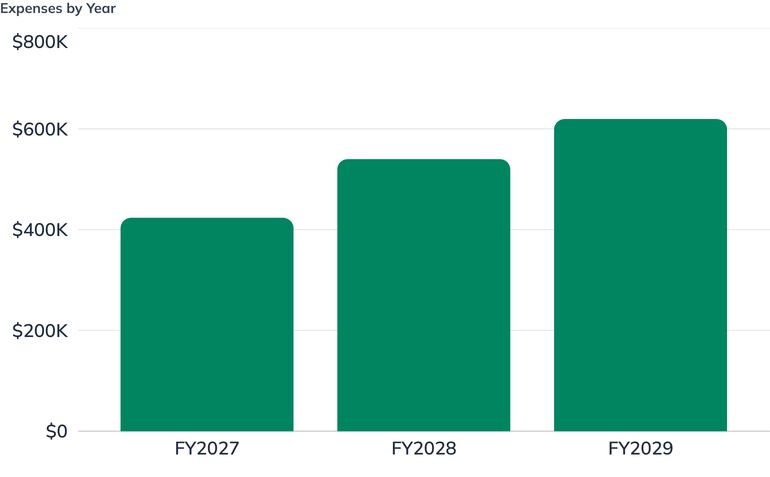
Need real milestones? Establish a clear path for your business with real-world examples.Create your own business plan
Profitability
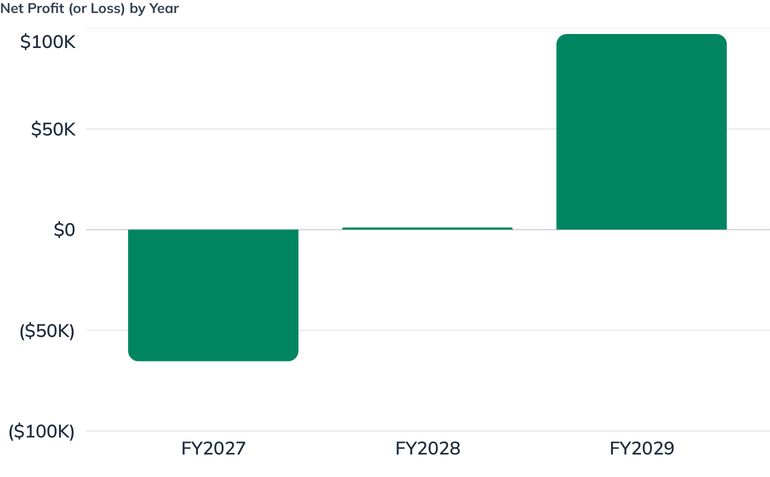
Need impressive charts? Discover the simplest way to create detailed graphs for your business plan.Create your own business plan
Use of Funds
We estimate an initial equipment purchase of $50,000, covering the five styling stations, color bar, nail bar, waxing station, and sanitation equipment described in Equipment and Tools.
Beyond equipment, we budget $1,000 for starting retail and back-bar inventory, $2,000 for other current assets (mostly supplies), and $9,000 in pre-launch expenses — legal formation costs, location fix-up, and initial branding, logo, and social media setup incurred before we open.
Because our commission-heavy staffing model means payroll doesn't ramp down during slower opening months the way a purely hourly model would, and because we're intentionally over-hiring stylists for opening week rather than scaling up gradually, we're carrying a larger cash cushion than a bare-bones buildout would require — roughly $177,000 on top of the equipment and pre-launch costs, for a comfortable runway through the months before the salon reaches steady bookings.
Total starting costs: $9K in pre-launch expenses plus $231,000 in assets and cash, including $53,000 in tangible assets (equipment plus starting inventory and supplies) and the balance held as a working cash cushion — funded by the $240,000 in combined owner investment and vendor equipment financing described in Sources of Funds.
Sources of Funds
Carla and Marcus Mendez will contribute $190,000 in owner equity investment, drawn from personal savings and family capital, to cover the buildout, initial inventory, pre-launch expenses, and a working cash cushion through the salon's ramp-up period.
The additional $50,000 will come from a vendor-financed equipment loan arranged directly with our salon equipment supplier, covering the styling stations, color bar, nail bar, and sanitation equipment described in Equipment and Tools. Financing the equipment through the vendor rather than a separate bank loan lets us move faster on buildout and keeps our equipment relationship and our financing relationship with the same partner.
Total startup funding: $240,000.
Key Assumptions
The financials that are enclosed have a number of assumptions:
- We'll be using a full commission model with stylists and barber getting 60% commission on revenue. Industry average runs 45–65%. We're on the high end because we are not offering a guaranteed base.
- We've looked at the booth rental model but we're used to commission and that creates a more orderly process for payments.
- We project revenues lower than average over the first few months, then stable, with annual increases to account for new clients.
- Our direct costs are mainly stylist and barber commissions plus direct costs of products we sell.
- Product sales estimated at ~$800/month; nail and skin services at ~$1,500/month conservatively.
Projected Statements
Frequently Asked Questions
A hair and beauty salon business plan like Trend Setters Hair Studio's should cover the market gap you're filling (here, mid-market pricing between chain haircut shops and luxury day spas), your service mix and pricing menu, your location and station layout, a marketing plan built around visual social content and referrals, licensing and regulatory compliance, and a financial plan that includes separate revenue streams for services and retail product. It should also spell out staffing, since stylist commission structures and chair utilization drive most of a salon's economics.
Trend Setters Hair Studio's plan calls for $150,000 in startup funding — $100,000 in owner investment and $50,000 in vendor equipment financing — to build out five styling stations, two shampoo bowls, a color bar, a two-station nail bar, and a private skin-services room in a 1,540-square-foot retail space. That $50,000 equipment budget alone covers chairs, dryers, an autoclave for sanitation compliance, and initial retail and back-bar product inventory; salons with a smaller footprint or fewer chairs can open for less.
Yes. As a Texas salon, Trend Setters operates under the Texas Department of Licensing and Regulation (TDLR), which requires every stylist to hold a current cosmetology operator license, the barber to hold a separate barber license, and the nail technician/esthetician to hold a cosmetology operator or equivalent specialty license — all verified before a job offer is extended. The salon itself must also hold a separate TDLR establishment license before opening, on top of any individual stylist credentials.
Trend Setters forecasts three distinct revenue streams rather than one blended salon-services line: hair services (cuts, color, and styling, priced from $20 kids' cuts up to $220 full balayage), nail and basic skin services (manicures, pedicures, brow shaping, and waxing), and retail product sales. Stylists are paid on commission tied to what they generate, which the plan expects to drive both service revenue and retail attachment as stylists build repeat client books.
The plan projects a loss in the opening partial year (lease, build-out, and hiring costs against only a couple months of revenue after a November 2026 grand opening), a roughly breakeven Year 2 as a third stylist chair ramps up, and a profitable Year 3 with revenue growing to about $632,000 and net profit around $57,000 — a 9% net margin the founders deliberately modeled as conservative rather than assuming an immediately mature, fully booked salon.
Trend Setters positions itself in the gap between $15–$30 chain haircut shops and $150–$250 luxury Austin day spas: licensed, experienced stylists — not entry-level chain hires — delivering hair, nail, and basic skin services from one team, at prices closer to a mid-market chain than a boutique spa. That combination lets clients get their full beauty routine done in one relationship instead of splitting it across separate hair and nail businesses, which founder Carla Mendez identified as a recurring frustration from her own clients.
Trend Setters' core client is a working woman aged 28–55 in Round Rock, Pflugerville, or Cedar Park with disposable income for a recurring salon habit but no appetite for luxury-spa pricing — working moms, healthcare and tech professionals near employers like Dell, and small business owners. About 70% of the client base is expected to be women booking color, styling, and nail services, with men and children rounding out the rest through haircuts and family visits.
Marketing centers on Instagram and TikTok before/after transformation content posted several times a week and geo-tagged to Round Rock, since visual content is what actually drives salon discovery, backed by an actively managed Google Business Profile and a $10-for-$10 referral program run through the salon's Vagaro booking software. The plan also leans on founder Carla Mendez's existing client following from her prior Austin salon, with 40–60 regular clients expected to follow her in the opening months.

Business Plan Outline
Start your plan