



Business Plan Outline: The Complete Structure, Formats, and Examples for 2026



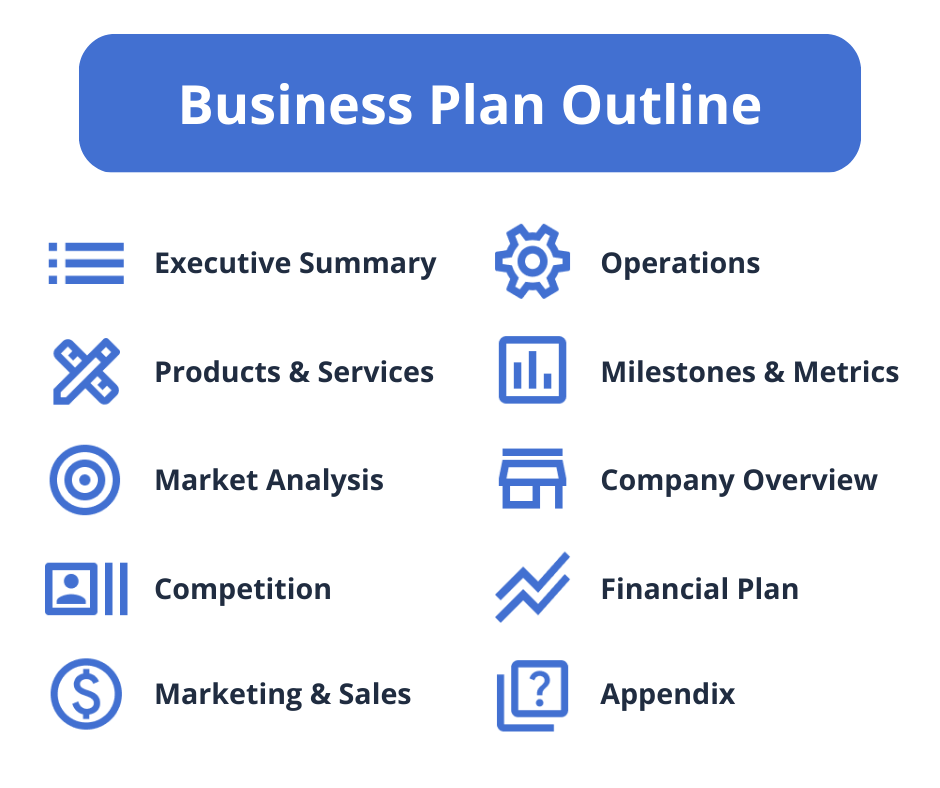
The standard business plan outline has 10 sections: executive summary, products and services, market analysis, competition, marketing and sales, operations, milestones and metrics, company overview and team, financial plan and forecasts, and appendix. Most plans follow this order, though the executive summary is always written last.
When starting a business, having a well-thought-out business plan prepared is necessary for success. It helps guide your strategy and prepares you to overcome the obstacles and risks associated with entrepreneurship.
Below is the full outline, format variations for different purposes, and a step-by-step guide to filling it in.
Jump to
The full business plan outline (copy this)
Copy this outline into a doc as your starting skeleton, then fill in each section — or use LivePlan's guided planner to fill it in with AI assistance and a financial forecast builder that generates the exact financials lenders look for.
Quick download: Download our free business plan template to get started.
1. Executive summary
A brief overview of the problem, your solution, target market, team, and financial highlights. (Length: 0.5–1 page) Read more: How to write an executive summary
2. Products and services
What you sell, the problem it solves, and any traction, IP, or patents worth noting. (Length: 0.5–1 page) Read more: How to create a problem and solution statement
3. Market analysis
The size, trends, and segments of your target market. (Length: 1–2 pages) Read more: Market analysis in 4 steps · Target market examples
4. Competition
Direct and indirect competitors, and the strategic advantages that set you apart. (Length: 0.5–1 page) Read more: How to write a competitive analysis
5. Marketing and sales
How you'll position, price, and sell to your target customers. (Length: 1 page) Read more: 7 steps to market your small business
6. Operations
Facilities, technology, equipment, and supply chain that the business depends on. (Length: 0.5–1 page)
7. Milestones and metrics
The roadmap of goals and key metrics you'll track to gauge progress. (Length: 0.5 page) Read more: Using milestones as a business roadmap
8. Company overview and team
Legal structure, company history, and the people running the business. (Length: 0.5–1 page) Read more: How to write a company overview
9. Financial plan and forecasts
Sales forecast, profit and loss, cash flow, balance sheet, and funding needs. (Length: 2–3 pages) Read more: Forecasting sales and revenue · Profit and loss forecast · Cash flow forecasting · Reading a balance sheet · Exit strategy basics
10. Appendix
Supporting documents: detailed financials, resumes, contracts, licenses, and permits. (Length: As needed) Read more: What to put in a business plan appendix
Need detailed instructions to help you write your plan? Check out our complete guide on how to write a business plan. Or see what a completed plan looks like in our sample business plan library. Want even more guidance with AI support, linked financials and plan review? Try LivePlan.

Format variations: pick the version that matches your purpose
The 10-section outline above is the traditional, full-length format, but most founders don't need all of it on day one. Here's how the outline changes depending on what you're using it for.
Traditional business plan outline (full format)
All 10 sections above, written in full. Use this when you're seeking a bank loan, an SBA loan, or investor funding, and need a complete, standalone document. Typically 15–25 pages.
Lean plan / one-page outline
A single-page format for testing an idea or running a day-to-day strategy — not for funding conversations. Nine sections, each a sentence or two:
- Business identity — what you do and for whom, in one sentence
- Problem — the 1–3 problems you're solving
- Solution — how your product solves each one
- Value proposition — why customers choose you over alternatives
- Market — target customers and competitive landscape
- Marketing strategy — how you'll reach that market
- Revenue model — how the business makes money
- Cost structure — the major costs of running it
- Key metrics — the numbers that show it's working
Best for: testing a new idea, internal alignment, or a plan you'll revisit and update weekly rather than write once and file away.
- See a full walkthrough: How to write a one-page business plan · free one-page business plan template
- Use LivePlan's Idea Canvas to develop a one-page plan and quickly validate your business idea.
SBA loan business plan outline
The Small Business Administration doesn't require a rigid template, but SBA lenders expect to see specific proof points layered into the standard outline:
- Executive summary — include your funding request amount up front
- Company description — legal structure, ownership, and the problem you solve
- Market analysis — target customers and industry conditions
- Organization and management — ownership structure and management team bios
- Products and services — with a focus on revenue-generating potential
- Marketing and sales strategy
- Funding request — the exact amount needed, and the SBA loan program you are applying to
- Financial projections — 3–5 years of forecasts, plus historical financials if the business is established
- Use of funds — a clear breakdown of how loan proceeds will be spent
- Appendix — resumes, credit history, licenses, and contracts
The SBA offers both traditional and lean templates at sba.gov, but lenders reviewing the plan care more about seeing the funding request, use of funds, and 3–5 years of projections than about matching a specific template.
- Full breakdown: How to write an SBA business plan + template
Investor pitch deck outline (and how it compares)
A pitch deck isn't a replacement for a business plan — it's a visual summary of it, built for a 10–20 minute conversation rather than a read-through. The table below maps pitch deck slides to their business plan counterparts.
Pitch deck slide | Corresponding business plan section | Format |
|---|---|---|
Vision / Value Proposition | Executive Summary | 1 slide, text or visual |
Problem / Solution | Products and services | 1-2 slides, visual |
Market size | Market analysis | 1 slide, chart-driven |
Business model | Financial Plan | 1 slide |
Traction | Milestones and metrics | 1 slide, chart-driven |
Marketing and sales strategy | Marketing and sales | 1 slide |
Competition | Market analysis | 1 slide, comparison table |
Team | Company overview and team | 1 slide, headshots + bios |
Ask / Use of funds | Financial plan and forecasts | 1–2 slides, chart-driven |
Most founders build the business plan first, then extract the pitch deck from it — the deck is a shorter, visual layer on top of the same thinking.
- Full slide-by-slide guide: The 11 slides you need in your pitch deck
How to use this outline (write your plan step by step)
Work through the outline in this order — it's not the order you'll present the plan in, but it's the order that makes each section easier to write.
Start with products and services
Write this section first while the problem and solution are freshest. It anchors everything that follows.
Do your market analysis next
You need real numbers here — market size, segments, and trends — before you can credibly write marketing or financials.
Write competition and marketing and sales
With the market defined, describe who you're up against and how you'll reach customers.
Fill in operations, milestones, and company overview
These sections are largely descriptive and move quickly once the strategy sections are done.
Build the financial plan and forecasts
Use the assumptions from your market analysis and marketing plan to build the sales forecast, P&L, cash flow, and balance sheet.
Write the executive summary last
Now that every section exists, summarize the strongest points from each into a half-page overview.
Assemble the appendix
Attach resumes, licenses, and detailed financials that support — but don't clutter — the main plan.
Or skip the blank page entirely: LivePlan's guided planner walks you through each section in this same order, prompts you with AI assistance section by section, and validates your financials automatically so the numbers in your P&L, cash flow, and balance sheet stay consistent.
What good looks like: strong vs. weak examples
Executive summary
Weak: "We are starting a coffee shop that will serve high-quality coffee to the local community and hope to grow into a successful business."
This tells the reader nothing about the problem, the customer, or why this coffee shop specifically will work.
Strong: "Downtown Millbrook has no coffee shop within a 10-minute walk of its 1,200-employee office corridor. Millbrook Coffee Co. will fill that gap with a fast-service, mobile-order shop targeting the morning commute. We project $420,000 in year-one revenue and break-even by month eight, led by a founder with 12 years of café management experience."
This version names the specific problem, the customer, the differentiator, and a financial anchor — in three sentences.
Market analysis
Weak: "The coffee industry is large and growing, and there are many potential customers for our shop."
No numbers, no segments, nothing a lender or investor can verify.
Strong: "The local trade area includes 1,200 office workers and 3,400 residents within a 10-minute walk. Industry data shows the average U.S. coffee drinker spends $2,000 per year on out-of-home coffee. Capturing just 8% of the office segment as regular customers would generate roughly $192,000 in annual sales."
This version ties a market size to a specific, defensible revenue estimate.
What's changed for 2026 (and what hasn't)
AI tools now make it faster to draft each section of this outline — generating a first-pass executive summary, structuring a market analysis, or suggesting milestones based on your industry. That's a real shift from even a couple of years ago, when every section started from a blank page.
What hasn't changed: lenders and investors still expect the same 10 sections, in roughly the same depth, backed by real numbers rather than AI-generated placeholders. A financial forecast that doesn't tie back to your actual assumptions, or an executive summary that reads like generic boilerplate, is a faster way to lose credibility in 2026 than it was before AI writing tools existed. Use AI to get past the blank page — not to skip the work of making the plan specific to your business.
Important notes in the world of AI business plan writing:
- Make sure to verify any research and numbers that AI generates. While the tools are impressive, they make mistakes and fabricate data. Make sure to verify everything by hand or use a tool like LivePlan that verifies the research for you.
- AI forecasts are often not connected to each other and can be incorrect. Make sure you are building a fully linked, accurate forecast so that when you change one number in your sales forecast, your profit and loss, cash flow, and balance sheet all automatically update.
- Your forecast needs to be your forecast, based on how you realistically think your business is going to perform, not numbers an AI tool made up. The numbers can't be invented and you need to be ready to defend them. You will be asked why you think your revenue and expenses are going to be what you have forecasted and you need to really know the numbers so you can defend them.
Frequently asked questions
Executive summary, products and services, market analysis, competition, marketing and sales, operations, milestones and metrics, company overview and team, financial plan and forecasts, and appendix. The one exception: write the executive summary last, even though it appears first, since it summarizes everything else.
Yes, for any plan longer than 8–10 pages, especially one going to a lender or investor. A table of contents lets a busy reader jump straight to the financial plan or team section instead of reading start to finish.
Match the detail to the purpose. A one-page lean plan for internal use needs a sentence or two per section. A plan for an SBA loan or investors needs full paragraphs, real numbers, and supporting documentation in the appendix — typically 15–25 pages total.
The SBA doesn't require one fixed template, and offers both traditional and lean formats. What SBA lenders consistently expect is the standard 10-section outline plus a clear funding request, use-of-funds breakdown, and 3–5 years of financial projections.
An outline is the list of sections and what belongs in each — the structure. A template is a fillable document already built around that structure, often with prompts, sample text, and formatting in place. Every template follows an outline; not every outline comes with a ready-to-use template.
Further Reading

Tim Berry
Tim Berry is the founder of Palo Alto Software , a co-founder of Borland International, and a recognized expert in business planning. Tim is the originator of Lean Business Planning. He has an MBA from Stanford and degrees with honors from the University of Oregon and the University of Notre Dame. Today, Tim dedicates most of his time to blogging, teaching and evangelizing for business planning.
More in Planning

planning
How to Write a Laundromat Business Plan + Example Templates

planning
How to Write a Trucking Business Plan + Example Templates

planning
The 8 Best Business Plan Software Tools in 2026 — Ranked and Compared
planning