



Profit Margin: What It Is, How to Calculate It, and What's Good

Jump to

Quick answer: Profit margin is the percentage of your revenue that's left as profit after costs. You calculate it by dividing profit by revenue and multiplying by 100. There are three common types — gross, operating, and net — depending on which costs you subtract, and each answers a different question about your business. A business with a 10% profit margin keeps 10 cents of profit for every dollar of sales.
What is profit margin?
Profit margin is the percentage of your revenue that's left as profit after costs. You calculate it by dividing profit by revenue and multiplying by 100. There are three common types — gross, operating, and net — depending on which costs you subtract, and each answers a different question about your business.
If your business has a 10% profit margin, you keep 10 cents of profit for every dollar of sales.
That sounds simple, but it's one of the most useful numbers you can know. Revenue tells you how much money came in. Profit margin tells you how much of it you kept — and those are very different things. A business can have strong sales and still barely make money. If most of the revenue goes straight back out to cover materials, payroll, rent, and marketing, the business can look busy and still struggle. Margin is what makes that visible.
The profit margin formula
Profit Margin = (Profit ÷ Revenue) × 100
If you bring in $100,000 and keep $10,000 in profit, your margin is $10,000 ÷ $100,000 × 100 = 10%.
The structure of that formula never changes. What changes is which profit figure you put in the top — and that's what separates the three types.
The three types of profit margin
Type | The question it answers | Formula |
|---|---|---|
Gross profit margin | Is what we sell priced right against what it costs to make? | Gross profit ÷ Revenue × 100 |
Operating profit margin | Does the business model work once overhead is paid? | Operating income ÷ Revenue × 100 |
Net profit margin | What's actually left at the end? | Net profit ÷ Revenue × 100 |
Each subtracts more cost than the one above it, so each is a smaller number. Seeing all three together is what makes them useful — a healthy gross margin next to a weak net margin points you straight at overhead rather than pricing.
We'll use one business throughout: a small bakery with $30,000 in revenue for the month.
Gross profit margin
Gross profit margin is what's left after you subtract the direct costs of making or delivering what you sell — often called cost of goods sold. For the bakery that's flour, butter, sugar, other baking ingredients, packaging, and the wages of the people actually baking. For a product business it's materials and manufacturing. For a service business it's contractor labor tied to a specific job.
Gross profit = Revenue − Direct costs
Gross profit margin = (Gross profit ÷ Revenue) × 100
The bakery's direct costs are $9,000.
- Gross profit: $30,000 − $9,000 = $21,000
- Gross profit margin: $21,000 ÷ $30,000 × 100 = 70%
Seventy cents of every dollar survives the cost of actually making the product. This is your pricing test. If gross margin is thin, you're either charging too little or your cost of goods costs too much, and no amount of trimming overhead will fix it. Industry benchmarks are very helpful here — if your gross margin is significantly different from the industry, that's a red flag worth investigating.
Operating profit margin
Operating profit margin subtracts your operating expenses too — the regular costs of running the place: payroll (front of house, admin, management), rent and utilities, marketing, software and subscriptions, insurance, and professional services. What's left is operating income, also called EBIT — earnings before interest and taxes.
Operating income = Gross profit − Operating expenses
Operating profit margin = (Operating income ÷ Revenue) × 100
The bakery's operating expenses are $16,000.
- Operating income: $21,000 − $16,000 = $5,000
- Operating profit margin: $5,000 ÷ $30,000 × 100 = 16.7%
This is your efficiency test. It's also the best margin for comparing yourself to competitors, because it isn't distorted by how much debt someone carries or what their tax situation looks like. If revenue is rising but operating margin is falling, that's a warning: you're selling more and getting less efficient as you do it.
Net profit margin
Net profit margin subtracts everything that's left — interest, taxes, depreciation, amortization, one-off charges. What remains is net profit.
Net profit margin = (Net profit ÷ Revenue) × 100
The bakery pays $2,000 in interest and taxes.
- Net profit: $5,000 − $2,000 = $3,000
- Net profit margin: $3,000 ÷ $30,000 × 100 = 10%
This is the number most people mean when they ask how profitable a business is, and it's the first one a lender looks at. But on its own it doesn't tell you where a problem is — which is exactly why you run all three.
Reading the three together
Here's the bakery's full month in one view:
Amount | Margin | |
|---|---|---|
Revenue | $30,000 | — |
− Direct costs | $9,000 | |
Gross profit | $21,000 | 70% |
− Operating expenses | $16,000 | |
Operating income | $5,000 | 16.7% |
− Interest and taxes | $2,000 | |
Net profit | $3,000 | 10% |
Now read the gaps. A 70% gross margin is strong — the pricing works and ingredient costs are under control. But 53 percentage points vanish between gross and operating. Overhead is consuming most of the value the pricing creates. So if this owner wants a better bottom line, the answer is in rent, wages, and marketing spend — not in charging more for a croissant. One number alone would have sent them after the wrong problem.
That's the whole point of calculating all three.

How to calculate profit margin, step by step
Step 1: Start with revenue
Total sales for the period. For the bakery: $30,000.
Step 2: Choose which profit figure you want
Gross profit for pricing questions. Operating income for efficiency questions. Net profit for the bottom line. Say you want net margin, and net profit is $3,000.
Step 3: Divide profit by revenue
$3,000 ÷ $30,000 = 0.10
Step 4: Multiply by 100
0.10 × 100 = 10%. That's your net profit margin. Ten cents of every dollar of sales ends up as profit.
What is a good profit margin?
It depends heavily on your industry, and comparing yourself to a general average will mislead you.
Typical ranges by business type:
Business type | Typical gross margin | Typical net margin |
|---|---|---|
Software and SaaS | 70–90% | Varies widely with growth spend |
Professional services and consulting | 50–70% | 10–20% |
Restaurants and bakeries | 60–70% | 3–8% |
Retail | 25–50% | 2–5% |
Grocery | 20–30% | 1–3% |
Construction and trades | 20–35% | 5–10% |
Manufacturing | 25–40% | 5–10% |
Two businesses in the same trade with different rent can both be well run and land several points apart. So the more useful questions aren't "is my margin high or low" but:
Is it improving? Your own trend across quarters beats any national figure.
Is it normal for this kind of business? A 3% net margin means something very different at a grocery store than at a consultancy.
Is it enough to do what I want to do? A good margin covers your expenses, pays you properly, funds reinvestment, and leaves room for a bad quarter.
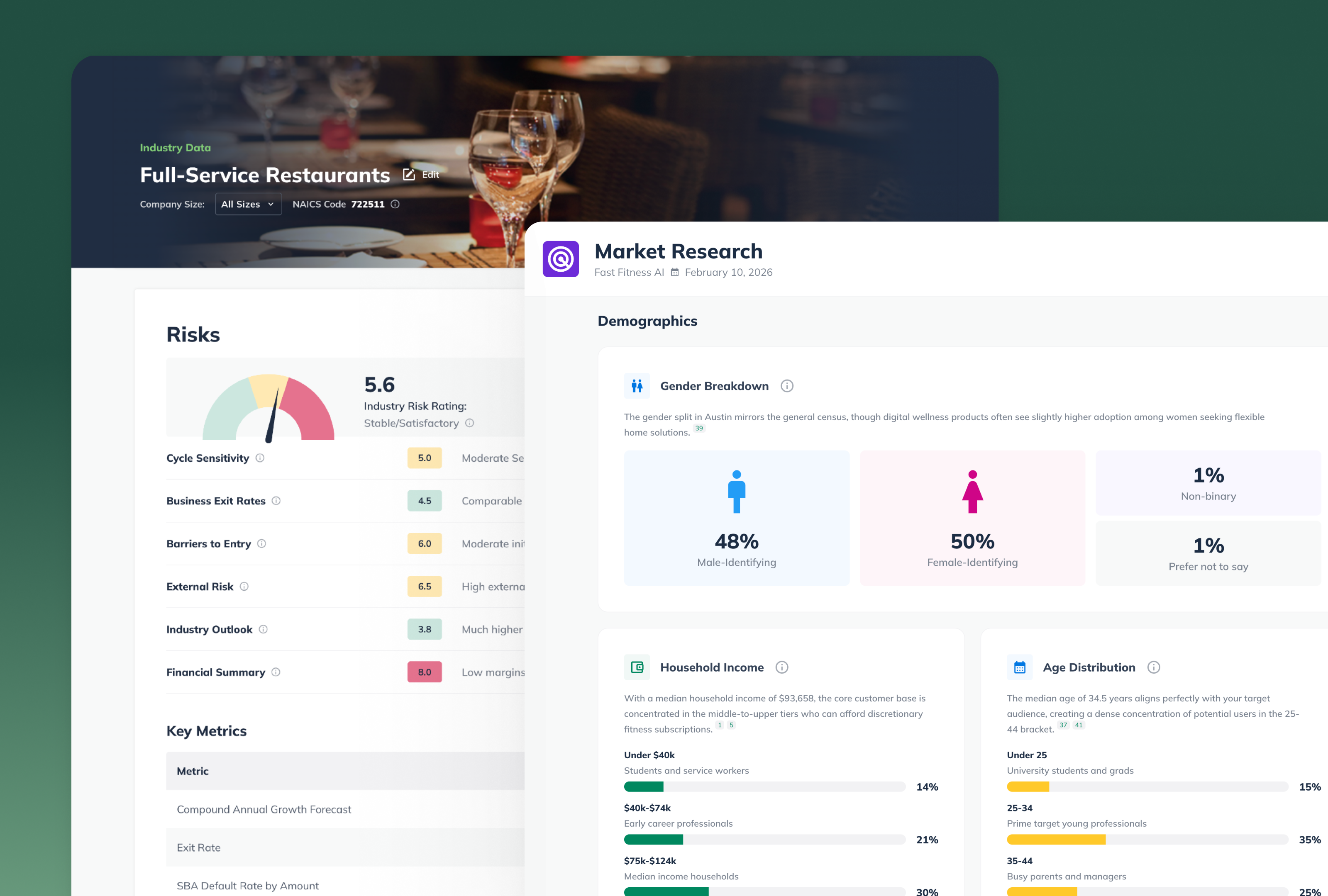
Compare against your actual peers: LivePlan Premium's market research pulls real industry benchmarks for your specific category instead of a generic rule of thumb.
Why margin matters more than profit
Profit is a dollar amount. Margin is a ratio. The ratio tells you things the dollar figure hides.
Whether growth is actually helping. Revenue up 30% with margin down 5 points means you bought that growth with discounting or costs you can't sustain.
Where the problem lives. The gap between gross and operating margin isolates overhead. The gap between operating and net margin isolates debt and tax. A single profit figure gives you nowhere to look.
How you compare to anyone else. You can't usefully compare your $10,000 profit to a competitor's. You can compare your 10% margin to their 16%.
It also turns vague questions into answerable ones — can I afford to hire, should I raise prices, is marketing producing profitable growth, can the business support a loan payment. Margin gives you data you can actually use.
How to improve your profit margin
Only two levers exist: bring in more, or spend less. Which one depends on which margin is weak.
If gross margin is weak — look at pricing and direct costs
- Raise prices. The most direct lever and the most underused. If you haven't raised prices in two years, inflation has cut them for you. Base it on your value, your competitors, and your costs.
- Renegotiate with suppliers. Get quotes from alternatives. Volume commitments often unlock better rates.
- Cut waste in production. Spoilage, rework, and over-portioning come straight out of gross margin.
- Shift the mix. Not every sale is equally profitable. Rank your products and services by margin and put your effort behind the winners.
If operating margin is weak — look at overhead
- Audit the expense budget regularly. Subscriptions and services accumulate quietly. Read the whole list, not just the big lines.
- Fix the bottlenecks. Idle time, long gaps between tasks, and duplicated processes cost payroll without producing anything.
- Consolidate your tools. Three systems doing overlapping jobs is three bills and three sets of friction.
Cutting isn't automatically right. Some expenses drive growth. The question is what each one is actually doing for the business.
If net margin is weak but operating margin is fine — look at debt
Refinancing or consolidating high-interest borrowing moves the bottom line without touching operations at all. Understand your debt, and then make a plan to pay it down.
And run it through your forecast first
Margin shouldn't only be something you calculate after the month closes. Before you hire, raise prices, add a location, or increase marketing spend, create a "what if" scenario and see what it does to your margin in your financial forecast. Revenue growth is only good if the business can afford it. The forecast is where you find that out before committing.
Five mistakes to avoid
Looking only at revenue. Growth feels good, but if expenses are growing faster, the business is getting weaker while the top line says otherwise.
Confusing gross margin with net margin. They're not interchangeable, and comparing your gross margin to a competitor's net margin is meaningless. Compare like to like.
Not paying yourself. Leaving owner compensation out makes the margin look better than it is. If the business only works because you're unpaid, that's critical information — and you need it in the numbers.
Ignoring cash flow. Margin tells you about profitability. Cash flow tells you whether there's money in the bank. A profitable business can still come up short because of timing, inventory, or slow-paying customers.
Reading one month in isolation. Margins move with seasonality and one-off purchases. Look at the quarter and the direction of travel.
Make margin something you manage, not just measure
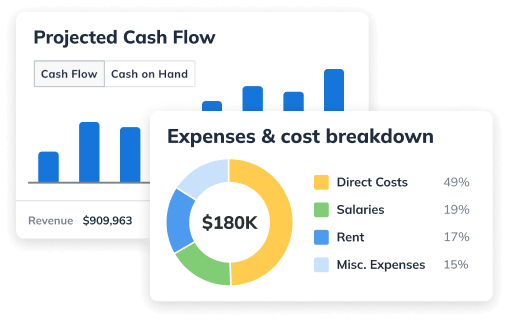
Profit margin gets far more useful when it's connected to the rest of your numbers. In LivePlan, your revenue, direct costs, operating expenses, payroll, cash flow, and balance sheet are built as one connected forecast — so when you change an assumption, you see the effect everywhere. What happens to margin if you raise prices 5%? If ingredient costs jump? If you hire two months earlier than planned? If sales come in under target?
You can also compare actual results against your forecast each month, so you can see not just that a margin moved, but why. That's the difference between calculating profit margin once and actually using it.
Frequently asked questions
Profit margin is how much profit your business keeps from each dollar of revenue. A 10% margin means you keep 10 cents of every dollar in sales.
Divide profit by revenue and multiply by 100. Which profit figure you use depends on whether you want gross margin (after direct costs), operating margin (after overhead), or net margin (after everything).
Gross profit margin looks at profit after direct costs and tests your pricing. Operating profit margin looks at profit after operating expenses and tests efficiency. Net profit margin looks at what's left after all expenses, interest, and taxes.
Profit is a dollar amount; margin is a percentage. A business making $10,000 profit on $100,000 revenue has $10,000 in profit and a 10% margin. The percentage is what lets you compare periods and competitors.
Roughly 10% net is average, 20% is strong, and 5% or below is thin — but it varies enormously by industry. A grocery store at 3% may be healthy while a consultancy at 3% is in trouble. Compare against your own trend and your sector.
Usually, but not always. Businesses deliberately investing in growth often accept lower margins while reinvesting. The problem is a margin falling without a decision behind it.
Margin is profit as a percentage of the selling price. Markup is profit as a percentage of the cost. An item costing $50 and selling for $100 has a 100% markup but a 50% margin — same transaction, very different numbers.
Yes. Margin is based on revenue you've booked, not money collected. If customers pay slowly, a high-margin business can still miss payroll. Review cash flow alongside your margins, not instead of them.
Monthly, when you review your profit and loss statement. Watch the trend across quarters rather than reacting to any single month.

Noah Parsons
Before joining Palo Alto Software, Noah Parsons was an early Internet marketing and product expert in the Silicon Valley. He joined Yahoo! in 1996 as one of its first 101 employees and become Producer of the Yahoo! Employment property as part of the Yahoo! Classifieds team before leaving to serve as Director of Production at Epinions.com. He is a graduate of Princeton University.Noah devotes most of his free time to his three young sons. In the winter you'll find him giving them lessons on the ski slopes, and in summer they're usually involved in a variety of outdoor pursuits.Noah is currently the COO at Palo Alto Software, makers of the online business plan app LivePlan.