


How Much Does It Cost to Open a Coffee Shop?

Jump to
How much does it cost to open a coffee shop?
What a coffee shop costs depends first on how you get one. Buying a running shop is usually the cheapest way in: the median coffee shop sold on BizBuySell from 2021 to 2025 went for $150,000 (BizBuySell). Building your own runs from about $222,000 for a café in an empty storefront to more than $2 million for a new drive-thru, and opening a franchise runs $242,200 to $2,283,500, based on three coffee franchisors' 2026 disclosure filings. The build-your-own range is our math: each filing's total minus its franchise and development fees. BIGGBY Coffee puts a café in a leased "whitebox" space at $242,200–$610,000 and its modular drive-thru at $457,750–$826,000 (BIGGBY FDD, April 2026, Wisconsin DFI file 641503). Scooter's Coffee puts its drive-thru kiosk at $1,163,650–$1,345,750, not including land (Scooter's Coffee FDD, July 2026, file 642104), and 7 Brew puts a drive-thru at $940,500–$2,283,500 (7 Brew FDD, 2026, file 641703).
The spread comes from real estate work, not coffee equipment. Site and building costs run from about $105,000 for an in-line build-out to well over $700,000 for a freestanding drive-thru. The espresso bar itself, meaning machine, grinders and brewer, is roughly $17,000–$35,000 at published list prices.
- Demand isn't the question; your costs are. 66% of Americans had coffee in the past day, and 47% had specialty coffee, according to the Specialty Coffee Association (SCA, 2026 National Coffee Data Trends).
- Franchise filings are an upper bound for an independent shop. They include franchise fees ($20,000 at BIGGBY, $40,000 plus a $20,000 opening support fee at Scooter's) and brand-specified finishes. They're also the most detailed public record of what a coffee build costs, because franchisors must file and update them every year.
- Buying a running shop costs far less. The median coffee shop sold on BizBuySell from 2021 to 2025 went for $150,000, rising to $176,500 in 2025, on median revenue of $375,000 (BizBuySell).
- Rent and labor are where your city shows up. Asking rent for 1,000 sq ft ranges from about $1,110 a month in Twin Falls, Idaho, to $3,500 in New York and San Francisco, and counter-worker wages differ by about $10 an hour across the 46 metros we checked.
How we sourced this page: every number links to the filing, price list or government dataset it came from, with its date and geography. Where we couldn't find a citable figure, we say so. In all, we drew on 50 documents, listed at the bottom of the page.

Buy, build or franchise: what does each path cost?
Each path trades money for something else. Buying gets you customers, equipment and staff on day one, building lets you choose the concept and the space with no franchise fees, and a franchise gets you a brand, training and a supply chain for a fee.
Path | Typical cost | What you get | What to watch | Source |
|---|---|---|---|---|
Buy a running coffee shop | Median sale price $150,000 (2021–2025), $176,500 in 2025 | Customers, equipment, staff and a lease from day one | Owner earnings averaged about 21% of revenue and fell to 18.5% in 2025. Buyers paid a median 2.0 times the owner's annual earnings | |
Build your own café | About $222,000 to $590,000 in an empty storefront (our math) | Your concept, menu and layout, with no franchise fees | The espresso bar is only $17,000–$35,000; the build-out is the big line | BIGGBY filing, minus its franchise fee |
Build your own drive-thru | About $438,000 to $2.2 million (our math) | A freestanding or modular building on a site you choose | Site work and the building drive the cost; land is often extra | BIGGBY, Scooter's and 7 Brew filings, minus franchise and development fees |
Open a franchise | $242,200 to $2,283,500 | A brand, site selection, training and a supply chain | Franchise fees of $20,000 (BIGGBY) to $60,000 (Scooter's, including its opening support fee), and $125,000 for 7 Brew's 10-store development deal, plus the ongoing fees listed in each filing | BIGGBY, Scooter's and 7 Brew filings (Wisconsin DFI) |
- The build-your-own ranges are estimates, not quotes. They remove franchise and development fees from each filing but keep brand-specified finishes, so an independent shop that skips those, or moves into a space that already has plumbing and a coffee bar, can come in lower. We found no public dataset of what independent coffee shops cost to build.
- Whichever path you take, the franchise filings are the most detailed public breakdown of a new build. The next sections use them line by line; skip the franchise-only lines if you're building or buying on your own.
How much does each coffee shop format cost?
In-line cafés in existing storefronts are the cheapest format in every filing; new drive-thru buildings cost two to five times as much. All figures are national: franchisors publish one estimate for the whole country.
Format (brand, filing date) | Total initial investment | Site, building or build-out | Equipment, fixtures and furniture | Working capital, first 3 months |
|---|---|---|---|---|
Café in a leased empty storefront (BIGGBY, April 2026) | $242,200–$610,000 | $105,000–$269,000 | $62,000–$165,000 | $10,000–$40,000 |
Modular drive-thru building (BIGGBY, April 2026) | $457,750–$826,000 | Site work $141,250–$265,000, plus building | $41,500–$111,000 | $10,000–$40,000 |
Site-built café or drive-thru (BIGGBY, April 2026) | $484,200–$973,000 | $331,000–$673,000 | $65,000–$122,000 | $10,000–$40,000 |
End-cap store in a retail strip (Scooter's, July 2026) | $658,898–$1,068,525 | $234,448–$500,000 | $186,500–$194,750 | $29,000–$119,000 |
Drive-thru kiosk, land not included (Scooter's, July 2026) | $1,163,650–$1,345,750 | $725,200–$772,000 | $181,750–$191,300 | $29,000–$119,000 |
Drive-thru (7 Brew, 2026) | $940,500–$2,283,500 | $505,000–$1,450,000 (building plus site development) | $185,000–$250,000 | $25,000–$75,000 |
Sources: Item 7 of the BIGGBY Coffee (file 641503), Scooter's Coffee (file 642104) and 7 Brew (file 641703) franchise disclosure documents, all public on the Wisconsin Department of Financial Institutions registry. The 7 Brew total includes a $125,000 development fee tied to a 10-store commitment, which a single-shop owner wouldn't pay.
How to read the table if you're opening an independent shop:
- Take out the franchise costs. Initial franchise fees are $20,000 (BIGGBY), $40,000 plus a $20,000 opening support fee (Scooter's), and $125,000 for 7 Brew's multi-store development fee.
- Your build-out depends on the space. BIGGBY describes a whitebox as "typically an empty space," such as a strip-center unit. A former café with plumbing and drains already in place may cost less to convert, but only a contractor walk-through tells you how much.
- Drive-thru formats are real estate projects. Most of their cost is site work and the building, not coffee.
What national data shows
Government data, commodity prices and sales of existing shops give a view of the business that doesn't depend on any franchisor. The typical coffee shop that changed hands on BizBuySell from 2021 to 2025 brought in $375,000 a year and sold for $150,000, so buying an existing shop can cost far less than any new build in the filings. All figures are national.
Measure | Figure | Source |
|---|---|---|
Snack and nonalcoholic beverage bars with employees (includes coffee shops), 2025 | 87,158 establishments (up 4.0% from 2024) employing 991,316 people | BLS Quarterly Census of Employment and Wages, NAICS 722515 |
Industry revenue, taxable employer firms, 2022 | $63.96 billion, up 15% from 2021 | |
Revenue per establishment, 2022 (our math) | About $848,000; large chains pull this average up | Census revenue ÷ 75,438 establishments in BLS QCEW, 2022 |
Average annual pay in the industry, 2025 | $25,036 | |
Existing coffee shops and cafés sold, 2021–2025 | 1,013 sales; median sale price $150,000 ($176,500 in 2025); median revenue $375,000; median owner earnings $78,780 | |
Owner earnings as a share of revenue | 21.0% (five-year median), down to 18.5% in 2025 | |
Sale price relative to owner earnings | Median 2.0 times for sold shops | |
Green coffee price | 287.29 U.S. cents per lb, August 2026 average (ICO composite indicator) | |
Retail price of ground coffee | $9.30 per lb, August 2026; up 4.8% in a year and 47% since August 2024 | |
Retail price of whole milk | $4.23 per gallon, August 2026; up 1.4% in a year | |
Commercial electricity | 14.53¢ per kWh U.S. average, July 2026; from 8.47¢ in Texas to 30.56¢ in California | |
48-inch undercounter refrigerator (True TUC-48-HC) | $3,791 list | |
Undercounter ice machine, 300 lb a day (Manitowoc NEO) | $4,187 list | |
How customers buy | 66% of adults had coffee in the past day; 38% of them had it outside the home, the highest since January 2020; 55% of out-of-home buyers used a drive-thru and 40% ordered on an app |
The shrinking earnings share is the number to watch. BizBuySell attributes it to inflation outpacing what coffee shops can charge, and the 47% two-year rise in ground coffee prices points the same way. Build a cost-of-goods line into your forecast that you can update as bean and milk prices move.
How much does coffee shop equipment cost?
The core espresso bar costs about $17,000 to $35,000 at published list prices, depending on the machine you choose. That's a fraction of the equipment lines in the franchise filings, because those also cover refrigeration, ice makers, ovens, sinks, furniture and shelving.
Here are two specific configurations, priced from U.S. distributors' public listings (national prices, September 2026):
Item | Value build | Premium build |
|---|---|---|
2-group espresso machine | Nuova Simonelli Appia Life Compact Volumetric: $7,600 (Prima Coffee) | La Marzocco Linea PB AV: $22,050 (Coffee Machine Depot) |
Espresso grinder | One Mahlkönig E65W GbS: $3,099 (Clive Coffee) | Two E65W GbS: $6,198 |
Bulk and filter grinder | Mahlkönig EK43: $3,899 (Coffee Machine Depot) | Same |
Batch brewer | FETCO CBS-2252 NG twin: $2,699 (Voltage Coffee Supply) | Same |
Core bar total (our math) | $17,297 | $34,846 |
Water filtration, freight and tax are extra, and so is installation unless the seller includes it (Prima lists free installation and water testing with the Appia). Scooter's filing shows what else a full equipment line covers: "merchandising systems, espresso machine, countertops, storage, coffee brewers, coffee grinders, smoothie machines, oven, refrigerators, ice makers, sinks, furniture and shelving" (Scooter's Coffee FDD, July 2026).
The other opening costs for BIGGBY's lowest-cost format give a sense of the smaller lines (national, BIGGBY FDD, April 2026):
Other opening costs, café in a leased storefront | Range |
|---|---|
Rent and deposits before opening | $6,000–$18,500 |
Signage, interior and exterior | $6,500–$19,500 |
Architecture and engineering | $6,100–$19,000 |
Opening inventory | $10,000–$15,000 |
Grand opening advertising | $9,500 |
License, permits and other | $1,000–$5,500 |
Building permits | $2,100–$11,500 |
Insurance | $1,000–$6,000 |
Legal and accounting setup | $2,000–$2,500 |
How much does it cost to run a coffee shop in my city?
Rent and wages are the two costs that change most by city. Asking rent for 1,000 sq ft of retail space runs from about $1,110 a month in Twin Falls, Idaho, to $3,525 in San Francisco, and the median counter worker earns $11.04 an hour in the Montgomery, Ala., area versus $21.09 in the San Francisco area.
We've grouped the examples by metro size using the USDA's definitions: major metros of 1 million or more people, medium metros of 250,000 to 1 million, and small metros under 250,000 (USDA Economic Research Service, 2023 Rural-Urban Continuum Codes).
Every figure in these tables is local to the metro named.
Major metros (1 million or more people)
Metro | Retail asking rent, $/sq ft/yr (Q2 2026) | Rent per 1,000 sq ft, per month (our math) | Counter worker and barista median wage (May 2025) | Food service supervisor median wage (May 2025) |
|---|---|---|---|---|
Atlanta | $24.64 | $2,053 | $13.36/hr | $18.87/hr |
Austin | $31.24 | $2,603 | $14.09/hr | $19.55/hr |
Chicago | $22.10 | $1,842 | $16.65/hr | $20.50/hr |
Dallas–Fort Worth | $24.78 | $2,065 | $13.50/hr | $18.14/hr |
Denver | $26.50 | $2,208 | $17.82/hr | $25.25/hr |
Houston | $24.55 | $2,046 | $13.25/hr | $17.51/hr |
Los Angeles | $35.38 | $2,948 | $20.24/hr | $22.58/hr |
New York | $42.27 | $3,522 | $17.03/hr | $23.41/hr |
Phoenix | $26.74 | $2,228 | $16.61/hr | $20.24/hr |
Portland | $27.28 | $2,273 | $17.13/hr | $23.51/hr |
San Antonio | $23.47 | $1,956 | $13.37/hr | $17.72/hr |
San Francisco | $42.30 | $3,525 | $21.09/hr | $24.77/hr |
Seattle | $31.29 | $2,608 | $18.82/hr | $29.62/hr |
Washington, DC | $35.89 | $2,991 | $16.64/hr | $22.87/hr |
Medium-size cities (metros of 250,000 to 1 million people)
Metro | Retail asking rent, $/sq ft/yr | Rent per 1,000 sq ft, per month (our math) | Counter worker and barista median wage (May 2025) | Food service supervisor median wage (May 2025) |
|---|---|---|---|---|
Akron, OH | $13.72 (Q2 2026) | $1,143 | $13.79/hr | $17.94/hr |
Albany, NY | $18.28 (Q2 2026) | $1,523 | $16.38/hr | $21.79/hr |
Albuquerque, NM | $19.68 (Q2 2026) | $1,640 | $14.01/hr | $18.40/hr |
Bakersfield, CA | $21.86 (Q2 2026) | $1,822 | $18.98/hr | $21.91/hr |
Boise, ID | $19.40 (Q2 2026) | $1,617 | $14.26/hr | $18.68/hr |
Boulder, CO | $27.78 (Q2 2026) | $2,315 | $17.40/hr | $25.01/hr |
Charleston, SC | $24.27 (Q2 2026) | $2,023 | $13.70/hr | $20.97/hr |
Colorado Springs, CO | $21.64 (Q2 2026) | $1,803 | $16.55/hr | $21.82/hr |
Columbia, SC | $19.58 (Q2 2026) | $1,632 | $13.06/hr | $18.21/hr |
Dayton, OH | $15.70 (Q2 2026) | $1,308 | $13.31/hr | $17.64/hr |
Des Moines, IA | $15.37 (Q2 2026) | $1,281 | $14.01/hr | $20.50/hr |
El Paso, TX | $17.61 (Q2 2026) | $1,468 | $11.07/hr | $14.67/hr |
Greensboro, NC | $17.85 (Q2 2026) | $1,488 | $13.56/hr | $21.54/hr |
Greenville, SC | $19.91 (Q2 2026) | $1,659 | $13.39/hr | $18.65/hr |
Knoxville, TN | $18.64 (Q2 2026) | $1,553 | $13.33/hr | $19.89/hr |
Montgomery, AL | $16.48 (Q2 2026) | $1,373 | $11.04/hr | $17.68/hr |
Northwest Arkansas (Fayetteville–Springdale–Rogers) | $20.30 (Q2 2026) | $1,692 | $13.06/hr | $17.35/hr |
Omaha, NE | $18.38 (Q2 2026) | $1,532 | $14.16/hr | $19.59/hr |
Reno, NV | $23.49 (Q2 2026) | $1,958 | $15.16/hr | $20.48/hr |
Sarasota, FL (North Port–Bradenton–Sarasota metro) | $24.80 (Q2 2026) | $2,067 | $14.42/hr | $22.25/hr |
Spokane, WA | $16.79 (ACTIV8 Real Estate, CoStar data, Q2 2026) | $1,399 | $17.20/hr | $24.89/hr |
Syracuse, NY | $14.06 (Q2 2026) | $1,172 | $16.32/hr | $20.59/hr |
Small cities (metros under 250,000 people)
Metro | Retail asking rent, $/sq ft/yr | Rent per 1,000 sq ft, per month (our math) | Counter worker and barista median wage (May 2025) | Food service supervisor median wage (May 2025) |
|---|---|---|---|---|
Bellingham, WA | $21.61 (Pacific Continental Realty report, via PNW Daily, Q2 2026) | $1,801 | $17.81/hr | $28.14/hr |
Bend, OR | $26.40 (average of $2.20/mo, triple-net; Compass Commercial, Q1 2026) | $2,200 | $17.05/hr | $23.10/hr |
Charlottesville, VA | $23.59 (Cushman & Wakefield | Thalhimer, Q2 2026) | $1,966 | $14.50/hr | $22.02/hr |
Coeur d'Alene, ID | $18.48 (ACTIV8 Real Estate, CoStar data, Q2 2026) | $1,540 | $14.46/hr | $18.89/hr |
Idaho Falls, ID | $15.66 (Bonneville County, triple-net; Colliers Eastern & Southern Idaho report, Q1 2026) | $1,305 | $13.79/hr | $17.72/hr |
Missoula, MT | $19.00 (Sterling Commercial Real Estate, as reported by KPAX, year-end 2025) | $1,583 | $14.67/hr | $20.75/hr |
Pocatello, ID | $22.43 (Bannock County, triple-net; Colliers, Q1 2026) | $1,869 | $13.88/hr | $17.73/hr |
Rapid City, SD | $14.80 (CoStar retail report, Q1 2026, posted by a local appraiser) | $1,233 | $14.15/hr | $18.25/hr |
St. George, UT | $27.50 (Washington County, triple-net; NAI Excel, mid-2026) | $2,292 | $13.59/hr | $18.12/hr |
Twin Falls, ID | $13.30 (Twin Falls County, triple-net; Colliers, Q1 2026) | $1,108 | $13.85/hr | $17.53/hr |
What the size comparison shows:
- Twin Falls, Idaho, has the cheapest rent of all 46 metros, about $1,110 a month for 1,000 sq ft, under a third of New York or San Francisco. Akron ($1,140) and Syracuse ($1,170) are the cheapest medium metros. Counter wages are lowest in the Montgomery ($11.04) and El Paso ($11.07) areas; Alabama and Texas use the $7.25 federal minimum.
- A small resort or college town can cost as much as a big metro. St. George, Utah, at about $2,290 for 1,000 sq ft, and Bend, at about $2,200, match or top Denver ($2,208). Bend's median counter wage ($17.05) is slightly above the New York metro's ($17.03).
- Supervisor pay can surprise you. Bellingham's median for food service supervisors, $28.14 an hour, is higher than every major metro we list except Seattle ($29.62).
- Your sewer class can depend on your business type. Boise bills coffee shops $11.25 per unit of sewer, more than twice the $4.59 rate for laundromats, because of wastewater strength (City of Boise, Oct. 2025). Ask your utility which class you'll be in.
Where these numbers come from:
- Rent: shopping-center asking rent by metro, Q2 2026 preliminary (Cushman & Wakefield U.S. Retail MarketBeat, Q2 2026). Asking rent isn't signed rent, and taxes, insurance and common-area charges are often extra. Monthly figures are our math: rate × 1,000 sq ft ÷ 12.
- Wages: metro-area medians for "fast food and counter workers," the federal category that includes baristas, and "first-line supervisors of food preparation and serving workers" (BLS Occupational Employment and Wage Statistics, May 2025).
- Metro medians include the suburbs. A city's own minimum wage can sit above its metro median. Seattle's minimum wage is $21.30 an hour in 2026 (City of Seattle), well above the metro's $18.82 median for counter workers. Check your city's minimum before you budget labor.
City minimum wages in 2026. In Chicago, Denver, Seattle and Washington, DC, the city's minimum wage is above the metro median for counter workers, so budget from the minimum, not the median:
City | 2026 minimum wage | Metro median counter wage (May 2025) | Source |
|---|---|---|---|
Chicago | $17.05 from July 1 (employers with 4 or more workers) | $16.65 | |
Denver | $19.29 from Jan. 1 | $17.82 | |
Los Angeles (city) | $18.42 from July 1 | $20.24 | |
New York City | $17.00 from Jan. 1 | $17.03 | |
Portland metro | $16.80 from July 1 | $17.13 | |
San Francisco | $19.61 from July 1 | $21.09 | |
Seattle | $21.30 from Jan. 1 | $18.82 | |
Washington, DC | $18.40 from July 1 | $16.64 |
Medium and small cities: medium-metro rents come from the same Cushman & Wakefield report. It doesn't cover metros under 250,000, so small-city rents come from local sources: Compass Commercial for Bend, ACTIV8 Real Estate (using CoStar data) for Coeur d'Alene, Pacific Continental Realty for Bellingham as reported by PNW Daily, a CoStar report posted by a local appraiser for Rapid City, Cushman & Wakefield | Thalhimer for Charlottesville, NAI Excel for St. George, Colliers' Eastern & Southern Idaho report for Idaho Falls, Pocatello and Twin Falls (county-level figures), and Sterling Commercial Real Estate's annual Missoula review as reported by KPAX. Spokane isn't in Cushman's report either, so its rent also comes from ACTIV8. Wages come from the same BLS dataset, which covers every U.S. metro.
How much cash do you need to get through the first months?
More than the build. The filings add three months of working capital on top: $10,000–$40,000 at BIGGBY, $25,000–$75,000 at 7 Brew and $29,000–$119,000 at Scooter's. None says how long a new shop takes to cover its costs, and we didn't find a current, citable source that does.
Labor is the monthly cost you control most directly, and local pay rates move it a lot. Here's one position, staffed 12 hours a day for 30 days (360 hours), at local pay rates, before payroll taxes (our math):
Where | Hourly rate used | One position, one month |
|---|---|---|
Houston metro, median counter wage | $13.25 | $4,770 |
New York metro, median counter wage | $17.03 | $6,131 |
City of Seattle, 2026 minimum wage | $21.30 | $7,668 |
Most shops need two or more people on the floor at peak, so multiply accordingly. Rates come from BLS, May 2025 and the City of Seattle.
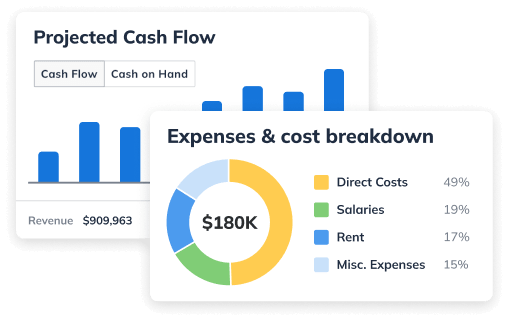
The amount you need to raise is your build cost plus the deepest point your cash reaches before sales cover rent, payroll and supplies. A monthly cash flow forecast shows you that point. In LivePlan you can set your opening hours, staffing and rent, ramp sales up month by month, and see how much cushion you need before you sign a lease.
What coffee shop costs catch first-time owners off guard?
Most surprises come from the building and the city, not the coffee.
- The espresso machine is a small share of the equipment bill. The core bar is $17,000–$35,000 at list price, but equipment lines in the filings run $41,500–$250,000 because refrigeration, ice, ovens, sinks and furniture add up (see the equipment section).
- A drive-thru is a site-development project. 7 Brew budgets $200,000–$800,000 for site development alone, on top of the building (7 Brew FDD, 2026). Scooter's kiosk figures don't include land at all.
- Permit costs vary tenfold. 7 Brew budgets $2,500–$25,000 for business and operating permits; BIGGBY budgets $2,100–$11,500 for building permits in a storefront build-out (7 Brew and BIGGBY FDDs, 2026).
- Your city's minimum wage may be above the metro median. Seattle's 2026 minimum is $21.30 an hour (City of Seattle), about $2.50 above the metro's median counter wage.
- Health permit fees can rise with your sales. Austin charges fixed food establishments $309 to $927 a year depending on risk category and annual sales, plus $312 for new-construction plan review (Austin Public Health, Oct. 2025).
- Opening marketing is a real line. BIGGBY budgets $9,500 for grand opening advertising, and 7 Brew budgets $20,000–$75,000 for start-up marketing.
What licenses and permits does a coffee shop need?
A coffee shop is a food service business, so the core permit comes from your health department, and it usually requires plan review before you build. Annual fees in the cities we checked run from a few hundred dollars to about $1,450, and plan review can cost more than the permit itself (all local figures):
City | Health permit or food license | Plan review | Source |
|---|---|---|---|
Austin | $309–$927 a year, by risk category and annual sales | $312 for new construction | Austin Public Health, Oct. 2025 |
Chicago | Retail food license: $660 per 2 years for up to 1,000 sq ft; $940 for 1,001–2,500 sq ft | — | |
Houston | $224.44–$739.44 a year by risk level, plus a $112.57 or $225.14 inspection fee and a $33.56 admin fee | Required | |
Los Angeles County | $319 (low risk) to $1,206 (high risk) a year for 0–30 seats | $1,044 up to 500 sq ft; $1,530 for 501–1,999 sq ft | LA County Public Health fee schedule, FY 2026–27 |
New York City | $280, plus $25 if you make frozen desserts; a supervisor who has passed the Food Protection Course must be on site at all times | — | |
Portland (Multnomah County) | $970 a year for 0–15 seats, $1,150 for 16–50; $890 for prepackaged items only | $1,265 new construction; $3,780 rush | |
San Francisco | $1,103 a year under 1,000 sq ft; $1,454 for 1,000–2,000 sq ft | $2,008 to review a new or remodeled coffee, deli, tea or ice cream shop | SF Environmental Health fee schedule, FY 2025–26 |
Seattle (King County) | $441 a year for a coffee stand (risk category 1); $693–$945 with more food prep, 0–12 seats | $1,008 base for new construction |
Around the health permit, plan for:
- Building, plumbing and electrical permits for the build-out. BIGGBY budgets $2,100–$11,500 in a storefront (BIGGBY FDD, April 2026).
- Zoning and site approvals, especially for a drive-thru, where stacking lanes and traffic can require separate review.
- Sign permits, a local business license, and your state entity and sales tax registrations.
Requirements vary by city; your health department and permit office can give you the list for your address.
What couldn't we pin down?
These are the numbers we looked for and couldn't cite.
- Build-out per square foot for an independent café. It depends on the space's plumbing, drains and electrical service. The filings give whole-store ranges, not per-foot rates. Get a contractor to walk the actual space.
- How long a new shop takes to break even. No current, citable source. Your forecast, with your rent and staffing, is the honest answer.
- Used equipment prices. Resale listings vary too much to summarize, and warranty and service history matter more than price.
- Health permit fees in 6 of our 14 major metros. We've sourced eight cities' fees in the permits section. Atlanta, Dallas, Denver, Phoenix, San Antonio and Washington, DC, are next on our list.
- Profitability by format. We haven't yet pulled the franchisors' financial performance sections (Item 19) for coffee. For independent shops, BizBuySell's sales data gives one cross-format benchmark: owner earnings of about 21% of revenue (see the national data table).
How do I find these numbers for my own city?
Free public sources cover most of it.
- Morning foot traffic: the Census Bureau's OnTheMap shows how many people work near a given block, which matters more for a commuter coffee shop than who lives there.
- Competition: Census Business Builder counts "snack and nonalcoholic beverage bars" (industry code 722515, the category that includes coffee shops) in your county or ZIP code.
- Rent: start with your metro's retail report on Cushman & Wakefield's MarketBeat page, then compare with listings on the blocks you're considering.
- Wages: look up "fast food and counter workers" for your metro in BLS wage data, then check your city's minimum wage.
- Permits: your health department's food establishment fee schedule and plan review checklist.
- Equipment: price your exact machine and grinders from two distributors, and ask for installed, not list, prices.
How do you open a coffee shop, step by step?
- Choose your path and format first. Decide whether to buy a running shop, build your own or open a franchise (see the comparison above), then whether it's a café in an existing storefront, a drive-thru or a kiosk. Each is a different business with a different budget. The format table above shows the gap is hundreds of thousands of dollars.
- Pick the location with data. Check daytime workers nearby with OnTheMap and existing coffee shops with Census Business Builder. Then visit at 7 a.m. on a weekday.
- Walk the space with a contractor before you sign. Plumbing, drains, electrical capacity and, for a drive-thru, site work decide your build-out cost. Negotiate the lease with those numbers in hand.
- Spec your equipment and get installed quotes. Decide on the machine, grinders, brewer, water filtration, refrigeration and ice before the build-out drawings are final, since they set your plumbing and power needs.
- Build your forecast. Estimate daily transactions and average ticket, then add rent, staffing by hour and cost of goods. The free coffee shop sample business plan is a starting point, and a LivePlan forecast turns your assumptions into monthly cash flow so you can see your low point before you commit.
- Form your company and file for permits. Submit plans to the health department and pull building permits for the build-out.
- Hire and train before opening day. Budget payroll for training time, not just the first shift.
- Open, then compare actuals with your forecast monthly. Ticket counts, average ticket and labor hours tell you early whether the plan is holding.
Ready to put real numbers behind step 5? Start your coffee shop plan in LivePlan.
Frequently asked questions
Possibly, in an existing storefront. BIGGBY's low estimate for a café in a leased empty space is $242,200, including a $20,000 franchise fee an independent owner wouldn't pay (BIGGBY FDD, April 2026). A space that already has plumbing and a coffee bar can bring it lower. Buying a running shop is cheaper still: the median coffee shop sold on BizBuySell from 2021 to 2025 went for $150,000 (BizBuySell).
For a two-group machine, $7,600 for a Nuova Simonelli Appia Life Compact Volumetric to $22,050 for a La Marzocco Linea PB AV at list price (Prima Coffee, Coffee Machine Depot). Installation and water filtration are extra.
Metro medians for counter workers, the federal category that includes baristas, range from $13.25 an hour in the Houston area to $21.09 in the San Francisco area (BLS, May 2025). City minimum wages can be higher, as in Seattle at $21.30 in 2026.
In the places we checked, yes. New York requires a Food Service Establishment permit ($280), and Austin charges $309 to $927 a year based on risk and sales (NYC Business, Austin Public Health).
Partly. Federal law lets you deduct up to $5,000 of start-up expenditures in your first year, reduced dollar for dollar once they pass $50,000, and spread the rest over 180 months (26 U.S.C. §195). Equipment is generally depreciated separately; ask a tax professional.
Sources
All accessed September 2026. Dates in parentheses are the date of the data.
Franchise disclosure documents (public on the Wisconsin DFI franchise registry; search by brand)
- Global Orange Development, LLC (BIGGBY Coffee), Franchise Disclosure Document (April 30, 2026), file 641503. Item 7.
- Scooter's Coffee Franchisor, LLC, Franchise Disclosure Document (July 2026), file 642104. Item 7.
- Brew Culture Franchise, LLC (7 Brew), Franchise Disclosure Document (2026), file 641703. Item 7.
Industry data, prices and demand
- U.S. Bureau of Labor Statistics, Quarterly Census of Employment and Wages, NAICS 722515 (2025 annual averages; 2022)
- U.S. Census Bureau, Service Annual Survey: revenue for snack and nonalcoholic beverage bars, via FRED (2022)
- BizBuySell, coffee shop and café valuation benchmarks (sales 2021–2025)
- International Coffee Organization, Coffee Market Report (August 2026)
- BLS average price data: ground coffee and whole milk (August 2026)
- U.S. Energy Information Administration, average price of electricity by state (July 2026)
- WebstaurantStore: True TUC-48-HC refrigerator and Manitowoc NEO ice machine (September 2026)
- National Coffee Association, National Coffee Data Trends fall 2026 release (Sept. 15, 2026; survey June 8–24, 2026, 1,882 adults)
Equipment list prices
- Prima Coffee, Nuova Simonelli Appia Life Compact Volumetric 2 Group
- Coffee Machine Depot, La Marzocco Linea PB AV 2 Group
- Coffee Machine Depot, Mahlkönig EK43
- Clive Coffee, Mahlkönig E65W GbS
- Voltage Coffee Supply, FETCO CBS-2252 NG
Rent, wages and demand
- Cushman & Wakefield, U.S. Retail MarketBeat (Q2 2026, preliminary)
- BLS Occupational Employment and Wage Statistics, metro areas (May 2025)
- City of Seattle, 2026 minimum wage
- Specialty Coffee Association, 2026 National Coffee Data Trends
Medium and small cities
- USDA ERS, Rural-Urban Continuum Codes documentation (2023 codes)
- Compass Commercial, Central Oregon market report (Q1 2026)
- ACTIV8 Real Estate retail market reports, CoStar data: Coeur d'Alene and Spokane (Q2 2026)
- PNW Daily, reporting Pacific Continental Realty's Bellingham market report (Q2 2026)
- CoStar Rapid City retail report (Q1 2026)
- Cushman & Wakefield | Thalhimer, Charlottesville Retail MarketBeat (Q2 2026)
- Colliers, Eastern & Southern Idaho Market Report (Q1 2026)
- NAI Excel, Southern Utah Midyear Market Report (mid-2026)
- KPAX, reporting Sterling Commercial Real Estate's Missoula Market Watch (March 2026, year-end 2025 data)
- City of Boise, commercial sewer rates (Oct. 2025)
Permits and tax
- NYC Business, Food Service Establishment permit
- Austin Public Health fee schedule (Oct. 2025)
- City of Chicago, retail food establishment license
- Houston Permitting Center, food dealer permit
- Los Angeles County Public Health, FY 2026–27 fee schedule
- Multnomah County, 2026 base fee schedule
- San Francisco Environmental Health fee schedule (FY 2025–26)
- King County, food and facilities program fees (2026)
- 26 U.S.C. §195, start-up expenditures
City minimum wages (2026)
- City of Chicago, minimum wage
- Denver Labor, citywide minimum wage
- City of Los Angeles, minimum wage
- New York State Department of Labor, minimum wage
- Oregon Bureau of Labor and Industries, minimum wage
- City of San Francisco, minimum wage ordinance
- DC Department of Employment Services, 2026 minimum wage notice
Tools for your own research

Noah Parsons
Before joining Palo Alto Software, Noah Parsons was an early Internet marketing and product expert in the Silicon Valley. He joined Yahoo! in 1996 as one of its first 101 employees and become Producer of the Yahoo! Employment property as part of the Yahoo! Classifieds team before leaving to serve as Director of Production at Epinions.com. He is a graduate of Princeton University.Noah devotes most of his free time to his three young sons. In the winter you'll find him giving them lessons on the ski slopes, and in summer they're usually involved in a variety of outdoor pursuits.Noah is currently the COO at Palo Alto Software, makers of the online business plan app LivePlan.

More in Starting
starting
5 Tips for Selecting Business Accounting Software
starting
Should You Sell on Etsy, or Build Your Own eCommerce Site?
starting
The Real Difference Between Business Plan Tools (and How to Pick One)
starting


